Learn how to evaluate pilot-operated safety valve seat tightness near set pressure, interpret API 527, and verify product-specific leakage limits.

A pilot-operated safety valve can, in some designs, maintain tight shutoff while operating pressure is relatively close to set pressure. That does not mean every pilot-operated valve has the same allowable operating margin, nor does an API 527 seat-tightness result by itself define how close an installed system should normally operate to set pressure.
Four quantities must stay separate throughout the review: normal operating pressure, set pressure, the seat-tightness test pressure and acceptance criterion, and leakage observed in actual service. They can be related, but they answer different engineering questions and are not interchangeable.
| Item | What it tells you | What it does not establish by itself |
|---|---|---|
| Normal operating pressure | The actual process pressure during non-relieving service, including whether the process is steady or cycling. | The valve’s API 527 test result, the set pressure, or a universal allowable operating ratio. |
| Set pressure | The specified pressure setting associated with the valve’s defined actuation or opening behavior. | How much leakage is acceptable in a seat-tightness test or in field service. |
| API 527 seat-tightness test pressure and criteria | A controlled bench-test condition and leakage acceptance basis defined by the applicable standard and test method. | The maximum normal operating pressure for every installed pilot-operated valve. |
| Observed field leakage | A real symptom at a known pressure, temperature, medium and operating state. | An API 527 pass/fail result until the leak path and the applicable controlled test basis are established. |
Three questions need to be separated:
- Does the valve meet a defined seat-tightness test?
- Is the specific valve design intended to operate at the actual pressure-to-set-pressure relationship?
- Does observed leakage in service indicate a valve problem, a pilot/control-path issue, another sealing path, or an observation that still needs to be localized?
That distinction matters more than finding a single 95%, 97% or 98% number. Manufacturer percentages are product claims for identified designs; API 527 is a test standard; actual field leakage is an operating observation.
For an engineering review, start with the actual set pressure, normal operating pressure, valve and pilot configuration, observed leakage location, service medium, operating state, and applicable test or acceptance basis.
What Does “Seat Tightness Near Set Pressure” Actually Mean?
“Seat tightness near set pressure” is not one engineering condition.
Set pressure identifies the pressure setting associated with the valve’s specified opening or actuation behavior. Normal operating pressure is the process pressure during service. A seat-tightness test pressure is the controlled inlet pressure used when leakage is evaluated under a specified test procedure. The acceptance criterion is the permitted leakage under that procedure; it is not a synonym for normal process leakage.
Those pressures may be related, but they answer different questions. The current API publications catalog lists API Standard 527, Fifth Edition (2020), as Seat Tightness of Pressure Relief Valves and describes it as covering conventional, bellows and pilot-operated designs. It also states that the test medium is tied to the medium used to determine set pressure. API 2025 refining publications catalog.
A successful bench tightness test does not, by itself, establish the maximum normal operating pressure of the installed system. Likewise, a manufacturer statement that a particular pilot-operated valve can operate close to set pressure does not automatically define the acceptance criteria for an API 527 test.
Seat-tightness testing and installed operation are different questions
A seat-tightness test asks:
Does leakage satisfy the applicable acceptance basis under the defined test pressure, test medium, seat type, valve configuration and measurement method?
An installed-operation review asks:
Is the actual operating condition within the documented application and operating basis of this valve configuration, and is any observed leakage coming from the path being evaluated?
The second question requires more than a leakage test report. The engineer also needs the valve design, normal operating pressure, set pressure, pilot configuration, pressure history, service medium, downstream condition and the manufacturer’s documented operating envelope.
Test-basis boundary: do not convert a familiar API 527 test point into a universal operating-pressure rule. The exact current test pressure and allowable leakage must come from the controlled edition of API 527 or an OEM procedure that explicitly implements the applicable criteria. A field pressure ratio is not a substitute for that test basis.
First identify which leakage path is being discussed
“Valve leakage” is too broad for a useful diagnosis. A pilot-operated valve has more than one possible path that can be mistaken for main-seat leakage.
| Observation | What it may indicate | What it does not prove by itself |
|---|---|---|
| Flow observed at the main outlet | Internal flow through a main-valve sealing path | That the main seat alone is damaged |
| Flow or leakage at a pilot vent/control path | Pilot operation or pilot/control leakage, depending on the design and state | Main-valve seat leakage |
| Leakage at tubing, fittings or external joints | External connection or sealing problem | Internal main-seat failure |
| Leak location cannot be identified | Diagnostic information is incomplete | Any specific valve defect |
This distinction should be made before discussing repair, rejection or operating margin.
Why Can a Pilot-Operated Valve Remain Tight as Pressure Approaches Set Pressure?
The answer lies in the closing-force arrangement of the specific pilot-operated design.
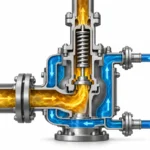
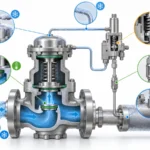
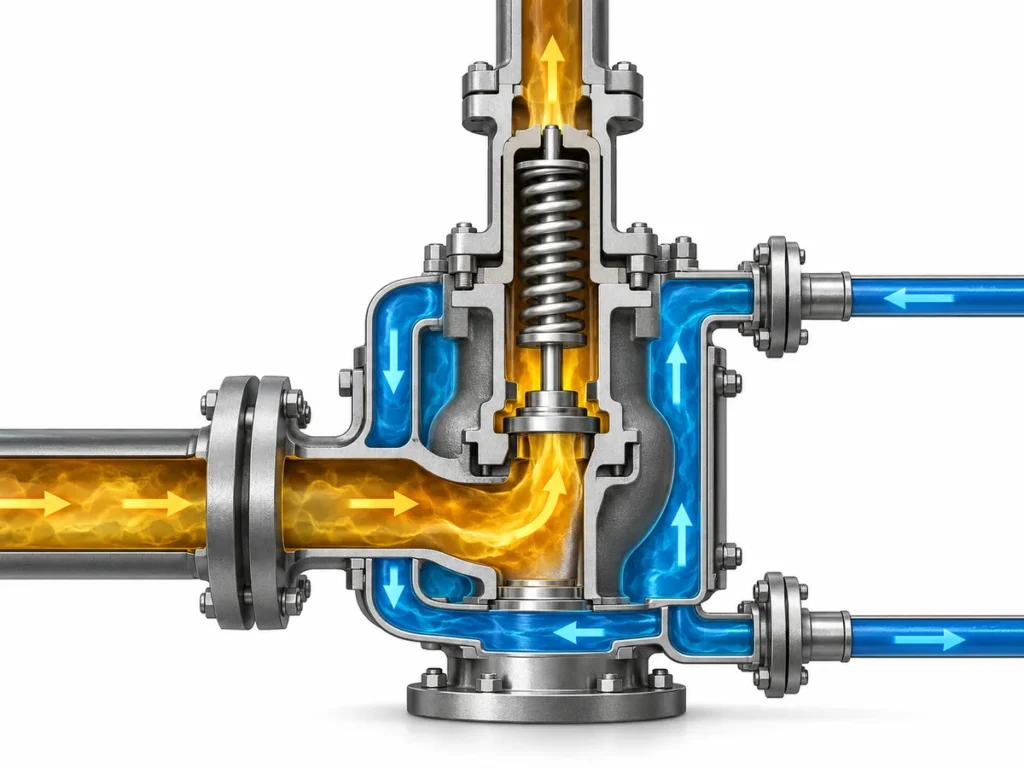
In a common piston-type arrangement, system pressure is routed to a dome or control chamber above the main piston. When pressure acts over a larger effective closing area than the area producing the opening force at the seat, the resulting force balance can hold the main valve closed while the pilot maintains the required dome pressure.
For this type of architecture, increasing inlet pressure can therefore continue to contribute to net seating force rather than reducing seating force in the same way as a conventional direct spring-loaded arrangement. The actual behavior still depends on the pilot architecture, seals, sensing arrangement, main-valve geometry and manufacturer design.
LESER explains its High Efficiency pilot-operated design using this differential-area principle and publishes near-set operating capability for identified products. The mechanism is useful for understanding why near-set tightness can be possible, but its exact pressure limits remain product-specific. LESER High Efficiency POSV technical information.
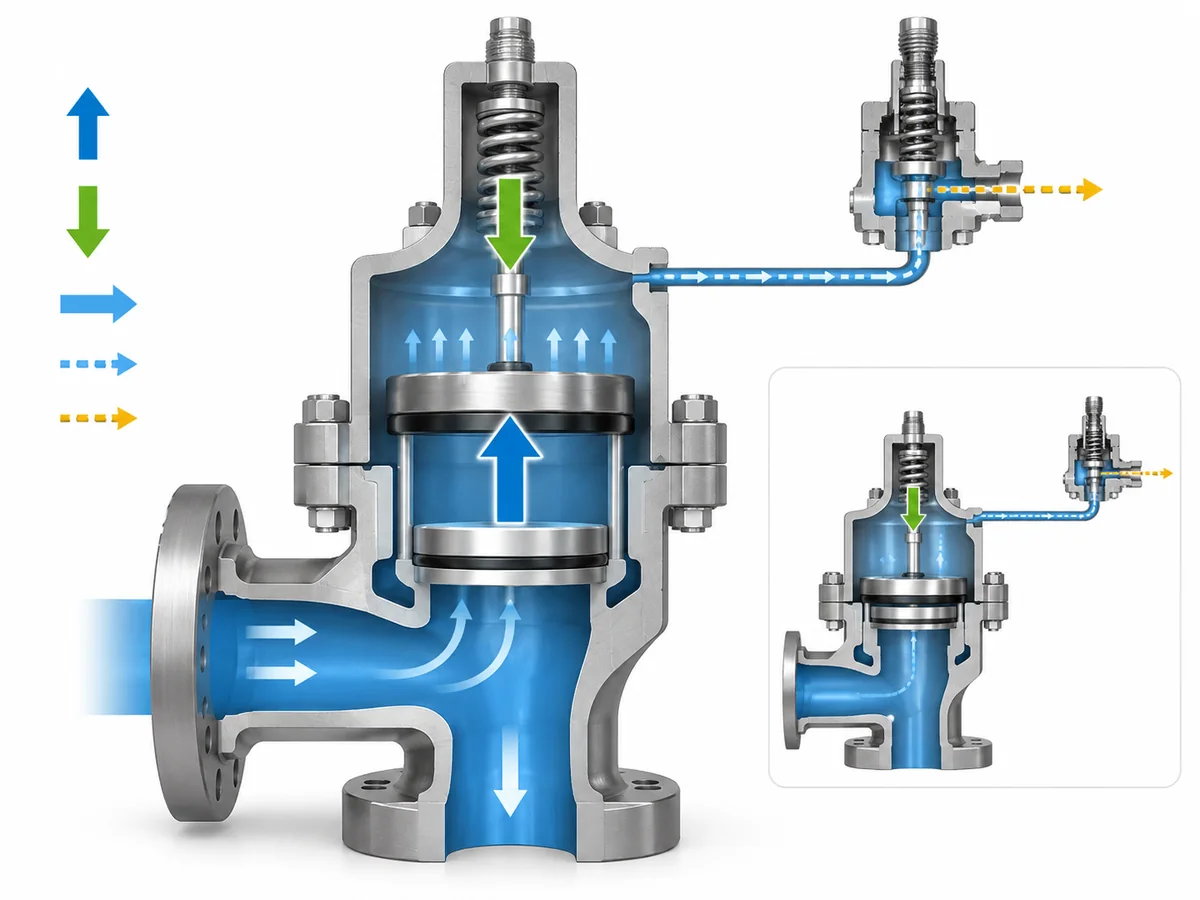
For more detail on the full operating sequence rather than only the seat-tightness mechanism, see how a pilot-operated safety valve works.
Pilot action and main-valve opening are not always the same event
Pilot-operated designs differ in how pressure is controlled as the system approaches set pressure. A pop-action pilot and a modulating pilot do not necessarily change dome pressure in the same sequence, and the presence of pilot vent flow does not by itself prove that the main valve seat is passing.
A modulating pilot may begin changing the control pressure before the main valve reaches a fully relieving state. Other pilot arrangements can follow different sequences. The manufacturer operating description for the exact pilot must therefore be used when interpreting vent flow or pressure changes near set pressure.
For that reason, pilot activity, pilot vent flow and main-valve seat leakage should not be treated as synonyms.
Use the documented operating behavior of the actual pilot and main-valve configuration, not a generic assumption about all pilot-operated valves.
Is 95% or 98% of Set Pressure a Universal Seat-Tightness Rule?
No. A 95%, 97% or 98% figure is not a universal pilot-operated safety-valve rule.
The spread across original manufacturer literature shows why. Emerson’s Anderson Greenwood Series 200 states total valve tightness to at least 95% of set pressure for that series. LESER’s current High Efficiency pilot-operated product group advertises operating pressures up to 97% of set pressure, while individual valve-type pages publish their own limits. Baker Hughes states main-valve and pilot-seat tightness up to 98% of set pressure for its Consolidated pilot-operated valves. These are manufacturer- and product-specific claims, not API 527 test-pressure definitions and not category-wide operating rules.
Sources: Emerson Anderson Greenwood Series 200, LESER High Efficiency POSV, and Baker Hughes Consolidated POSRV.
| Published statement | What it can support | What it cannot support |
|---|---|---|
| Anderson Greenwood Series 200: total valve tightness to at least 95% of set pressure | A product-family performance statement for that identified Series 200 design | A universal 95% POSV rule or the API 527 test pressure |
| LESER High Efficiency POSV group: operating pressures up to 97% of set pressure | A manufacturer operating-envelope statement at the product-group level; exact type still requires confirmation | A promise that every LESER POSV or every POSV from any maker operates at 97% |
| Baker Hughes Consolidated POSRV: main-valve and pilot-seat tightness up to 98% of set pressure | A manufacturer-specific tightness capability for the stated product family | An API 527 acceptance criterion or an industry-wide 98% requirement |
Four questions to ask before using any percentage
- Who owns the number? Is it the exact valve manufacturer and product family, a project specification, a controlled test procedure or another source?
- What does the percentage describe? Normal operating pressure, a manufacturer’s seat-tightness capability, API 527 test pressure, pilot actuation behavior and blowdown are different parameters.
- Which valve configuration does it apply to? Confirm the series, pilot type, main-seat design, sensing method and relevant options.
- Under what condition does it apply? A bench test, a product performance statement and an installed operating recommendation are not automatically equivalent.
This prevents a common sourcing mistake: finding the highest percentage published by one supplier and using it to evaluate a different valve.
Do not turn a product capability into an industry rule
A statement such as “tight to 98% of set pressure” can be meaningful when it belongs to the exact valve family being evaluated and the stated conditions are understood.
It becomes technically unreliable when rewritten as:
All pilot-operated safety valves can operate at 98% of set pressure without leakage.
The evidence does not support that generalization.
For ZOBAI product discussions, do not assign an unverified 95%, 97% or 98% near-set operating claim to a valve simply because another manufacturer publishes that number. Use the exact proposed model documentation and the applicable test basis.
API 527 Seat-Tightness Testing vs Actual Operation Near Set Pressure
API Standard 527 is specifically titled Seat Tightness of Pressure Relief Valves. API’s current standards plan and publications catalog list Standard 527 as the fifth edition issued in 2020. API Standards Plan.
The official API publications catalog describes API 527 as covering seat-tightness methods for metal- and soft-seated pressure-relief valves, including conventional, bellows and pilot-operated designs. It also states that maximum acceptable leakage rates are defined within the standard and that the seat-tightness test medium is tied to the medium used to determine set pressure. API Standard 527 description in the API publications catalog.
The current API 527 scope is also indexed by standards distributors, including the existing reference retained here: API STD 527 current scope listing. For the actual test-pressure table, leakage limits and procedural details, the controlled API document or an approved OEM test procedure is the governing source—not a secondary summary.
That makes API 527 directly relevant to this article—but only for the job it actually performs.
What API 527 evidence can establish
An applicable API 527 test can provide evidence that the valve met the relevant seat-tightness acceptance basis under the prescribed bench-test conditions. The evidence is only meaningful when the test pressure, test medium, seat type, valve configuration, stabilization/observation method and leakage criterion are the ones required by the applicable procedure.
For procurement and QA, that is useful because it gives the buyer and supplier a defined basis for discussing leakage acceptance. It should be recorded as test evidence, not rewritten as a normal operating-pressure recommendation.
For a deeper treatment of the test itself, see ZOBAI’s API 527 seat-tightness test guide.
| Question | Primary evidence to use |
|---|---|
| What is the API 527 test pressure and allowable leakage for this test case? | The controlled current edition of API 527, plus the approved test procedure implementing it |
| How close to set pressure may this valve normally operate? | The exact manufacturer’s operating envelope and project operating basis |
| What behavior is expected from the pilot and main valve near set pressure? | The OEM operating/IOM documentation for the exact pilot-main-valve configuration |
| Does the valve meet the required overpressure-protection code basis? | The applicable project code and device certification/marking evidence; ASME BPVC Section XIII is one current overpressure-protection framework |
| What general product requirements apply to a pilot-operated safety valve under ISO? | ISO 4126-4 for product requirements; ISO states that Part 4 is not an application standard |
ASME BPVC Section XIII covers overpressure-protection rules including pressure-relief-valve design, testing, marking, capacity certification and installation. That broader code role should not be confused with API 527’s seat-tightness acceptance function.
What it does not establish by itself
An API 527 result does not, by itself, establish:
- the maximum normal operating pressure for the installed process;
- a universal 95%, 97% or 98% operating limit;
- guaranteed zero field leakage under every service condition;
- that pilot, sensing, external seals or downstream conditions cannot contribute to a leakage problem;
- that every pilot-operated valve referencing API 527 has the same operating margin.
ISO 4126-4 reinforces the need to separate product requirements from application decisions. ISO describes Part 4 as a product standard for pilot-operated safety valves and states that it is not an application standard; the current 2013 edition was reviewed and confirmed by ISO in 2025. ISO 4126-4.
Avoid turning a test reference into a certification claim
If a catalog or test document states that tightness conforms to, or is tested using, API 527, retain that exact scope.
Do not silently rewrite it as:
The valve is API 527 certified.
A test-standard reference, a completed seat-tightness test, a product capability statement, a code stamp and project approval are different forms of evidence.
If Leakage Appears Near Set Pressure, Identify the Leak Path Before Diagnosing the Valve
Leakage near set pressure is a symptom, not a root-cause diagnosis.
The first useful question is:
Where is leakage actually being observed, and what was the pressure and operating state when it appeared?
Only after that observation is clear should the engineer begin narrowing the possible cause. Manufacturer maintenance procedures reinforce this separation: for example, Emerson’s Anderson Greenwood Series 727 instructions check pilot vent leakage, manual blowdown leakage, field-test connection leakage and the main-valve outlet as distinct points during an internal leak test. Anderson Greenwood Series 727 maintenance instructions.
Start with the observation, not the repair
| What you observe | What to verify next | Why |
|---|---|---|
| Leakage at the main outlet | Actual pressure, set pressure, applicable tightness basis and valve condition | Outlet flow alone does not identify the exact internal sealing path |
| Flow at a pilot vent/control path | Pilot type, operating state and documented pilot behavior | Pilot activity does not automatically prove main-seat leakage |
| Leakage at an external fitting or tubing joint | Connection and external sealing condition | It is a different path from main-seat leakage |
| Leakage appears only close to set pressure | Actual operating/set-pressure relationship and product-specific operating basis | The valve’s documented operating margin may matter |
| Leakage appears after a lift or maintenance event | Event history and applicable OEM inspection/test basis | The relevant checks may change after a relief or service event |
| Leak path remains unknown | Improve the observation or escalate the review | Diagnosis without knowing the path is speculation |
Then separate system conditions from valve conditions
Possible system or operating variables include:
- actual pressure relative to set pressure;
- steady versus transient or cycling pressure;
- downstream or back pressure where relevant;
- internal versus remote sensing arrangement;
- temperature and medium state where they affect the selected valve;
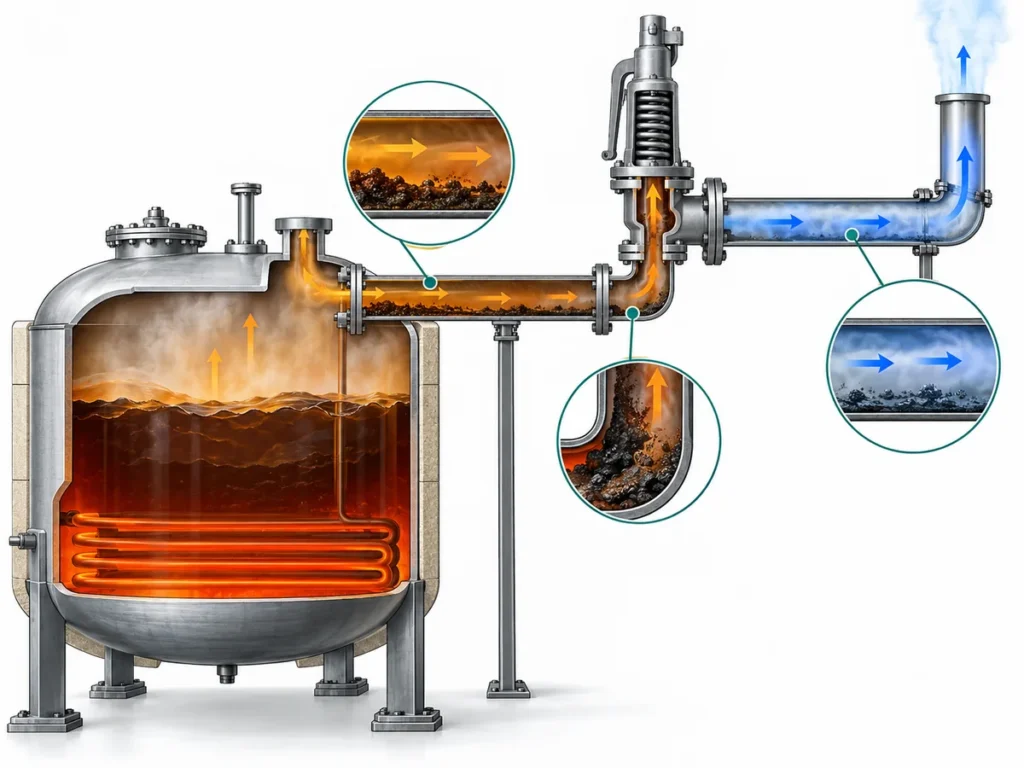
- dirty, wet, contaminated, polymerizing or particulate-laden service where the pilot/control path may be sensitive.
Possible valve/configuration variables include:
- pilot type and action;
- main-seat or seal condition;
- pilot/control-path condition;
- filter, sensing line or small control passage condition where fitted;
- relevant internal seals and soft goods;
- the documented main-valve and pilot leakage test points.
These are investigation categories, not automatic root causes.
A high operating pressure does not prove the valve is defective. Contaminated service does not prove contamination caused the leakage. A pilot vent does not prove the main seat is leaking. Conversely, a previous API 527 pass does not prove that every later in-service leak observation is acceptable.
Stop before generic troubleshooting becomes unsafe adjustment advice
A general article should not instruct a reader to change:
- set pressure;
- pilot adjustment;
- blowdown;
- internal spring or seal settings;
- sensing configuration.
Those actions require the correct valve procedure and qualified review because they can affect the protection function and can invalidate the comparison between observed field behavior and the original test basis.
If the observed behavior conflicts with the applicable OEM or test basis, or the leak path cannot be established safely, move to product-specific engineering or service review rather than continuing by assumption.
What Should Be Verified Before Accepting, Rejecting or Escalating the Valve?
A technically useful supplier inquiry should allow the engineer to reconstruct the condition in which the leakage was observed and compare it with the correct test or operating basis.
Sending only:
Pilot safety valve leaks near set pressure—please advise.
leaves too many variables unresolved.
1. Pressure condition
Provide:
- specified set pressure;
- actual normal operating pressure;
- pressure at which leakage appears;
- whether pressure is steady, rising, falling or cycling;
- outlet/back pressure where relevant.
The pressure ratio only becomes useful when compared against documentation for the actual valve. Do not compare a field operating ratio directly with an API 527 test-pressure ratio unless the governing procedure explicitly makes that comparison.
2. Exact valve and pilot configuration
Identify:
- manufacturer;
- valve series/model;
- pilot type;
- pop-action or modulating arrangement where applicable;
- seat/seal construction if relevant;
- pressure-sensing arrangement;
- relevant options or accessories.
Configuration matters because near-set behavior is not a category-wide property. ZOBAI’s current pilot-operated safety-valve page, for example, distinguishes multiple pilot actions, sensing methods and seat/seal options rather than one universal arrangement. That product-page taxonomy is useful for defining an RFQ, but it is not evidence for an unlisted near-set tightness percentage.
If the task has moved from diagnosis to product selection, see ZOBAI pilot-operated safety valves.
3. Service and test context
Clarify whether the observation occurred during:
- a bench seat-tightness test;
- field verification;
- normal plant operation;
- startup or another transient;
- a condition after the valve lifted.
Include the medium, relevant phase/state, temperature, contamination condition, and whether the test medium and procedure match the required acceptance basis.
4. Describe the leakage itself
Record:
- where it was observed;
- how it was observed or measured;
- whether it is continuous, intermittent or associated with pilot action;
- the pressure at which it begins or stops, if known;
- whether the main outlet, pilot vent and external joints were distinguished.
“Leakage at the main outlet at a known operating pressure” is much more actionable than “the valve leaks.”
5. Identify the acceptance basis
Provide the applicable:
- project tightness requirement;
- controlled API 527 edition and test basis where used;
- OEM test procedure;
- purchaser specification;
- available supplier test report, including test medium, test pressure and acceptance result;
- manufacturer operating-pressure claim for the exact valve, if one is being relied upon.
Without an acceptance basis, an observation cannot be converted reliably into “pass” or “fail” merely from a generic online percentage.
A practical engineering screening decision
Continue the evaluation when the valve identity, pressure state, leakage path and applicable acceptance basis are known.
Hold the judgment when a critical input is still unknown—for example, if “leakage” has not been localized or if the only available percentage belongs to another valve family.
Escalate for product-specific review when the observed behavior conflicts with documented valve or test requirements, when the exact API 527/OEM acceptance basis cannot be reconstructed, or when diagnosis would require OEM-specific inspection or adjustment.
These are article-level engineering screening labels, not API, ASME, ISO or regulatory classifications.
Decision Example: Comparing Two Balanced Architectures
If near-set leakage leads a project to compare a pilot-operated valve with a balanced spring-loaded alternative, keep the comparison tied to the actual leakage problem. The question is not which architecture is “better”; it is which design can document the required operating margin, seat-tightness basis and leak-path behavior for the service.
| Decision factor | Pilot-operated question | Balanced-bellows alternative question |
|---|---|---|
| Near-set operating claim | What operating-pressure-to-set-pressure relationship is documented for the exact pilot and main-valve configuration? | What normal operating margin and seat-tightness behavior are documented for the exact spring-loaded design? |
| Leak-path diagnosis | Can the main outlet, pilot vent, sensing path and external joints be distinguished during the review? | Can main-seat leakage be separated from bonnet/bellows vent or external leakage paths? |
| Contamination sensitivity | Can the service foul the pilot, filter, sensing line or control passages and thereby affect closing pressure or pilot behavior? | Can deposits or corrosion affect the seat, guide, bellows movement or vent condition? |
| Seat-tightness evidence | What API 527 or OEM procedure applies to the assembled pilot/main-valve configuration? | What API 527 or OEM procedure applies to the spring-loaded valve and its seat type? |
| Maintenance after leakage | What OEM procedure governs inspection of the main seat, pilot seats, seals and sensing components? | What OEM procedure governs seat condition, bellows integrity, guide condition and recalibration? |
| Acceptance decision | Can the supplier demonstrate both the required operating envelope and the applicable leakage-test result? | Can the supplier demonstrate the required operating margin and applicable seat-tightness result without relying on a generic architecture claim? |
If a bellows design is being considered because a pilot-operated valve cannot document the required near-set operating behavior or service suitability, also review when a bellows balanced valve is not the right solution. That comparison should be treated as a separate architecture decision, not as a workaround for an unresolved API 527 or leak-path question.
Frequently Asked Questions About Pilot-Operated Safety Valve Seat Tightness Near Set Pressure
Is API 527 test pressure the same as normal operating pressure?
No. API 527 defines controlled seat-tightness testing, while normal operating pressure is the real process pressure during service. A test pressure used for API 527 acceptance should not be reused as a plant operating recommendation unless the applicable valve documentation explicitly supports that operating condition.
Does “tight to 98% of set pressure” mean every pilot-operated safety valve can operate there?
No. Near-set percentages published by manufacturers belong to identified product families and conditions. They do not create a universal POSV operating rule and they are not automatically the API 527 test-pressure criterion.
Can a pilot-operated safety valve pass API 527 and still leak in service?
Yes, because a controlled bench test and installed operation are different conditions. A field leak still has to be localized and reviewed against the actual pressure history, service medium, pilot state, downstream condition, valve condition and OEM operating envelope.
Does flow from the pilot vent prove the main valve seat is leaking?
No. Pilot vent flow can be associated with pilot operation or a pilot/control-path leak depending on the design and operating state. Main-seat leakage should be confirmed at the main outlet or by the applicable controlled test procedure.
What information should be recorded before judging near-set leakage?
Record the valve manufacturer and model, pilot type, set pressure, actual operating pressure, pressure trend, service medium and temperature, back pressure where relevant, leak location, operating state, seat/seal configuration, and the exact API 527, OEM or project acceptance basis being used.
Should set pressure or pilot adjustment be changed to stop leakage?
Not from a general article or a percentage comparison. Adjustment can change the protection function and must follow the correct OEM procedure, applicable project requirements and qualified engineering or service review.