Share your medium, set pressure, temperature, size, standard, or datasheet, and our team will review your requirement and respond with the appropriate next step.
A pilot operated safety valve works by using a small pilot valve to control the pressure above a larger main valve piston. In normal operation, the system pressure is routed to the pilot and to the dome chamber above the main valve. Because the effective dome area is larger than the seat area exposed to …
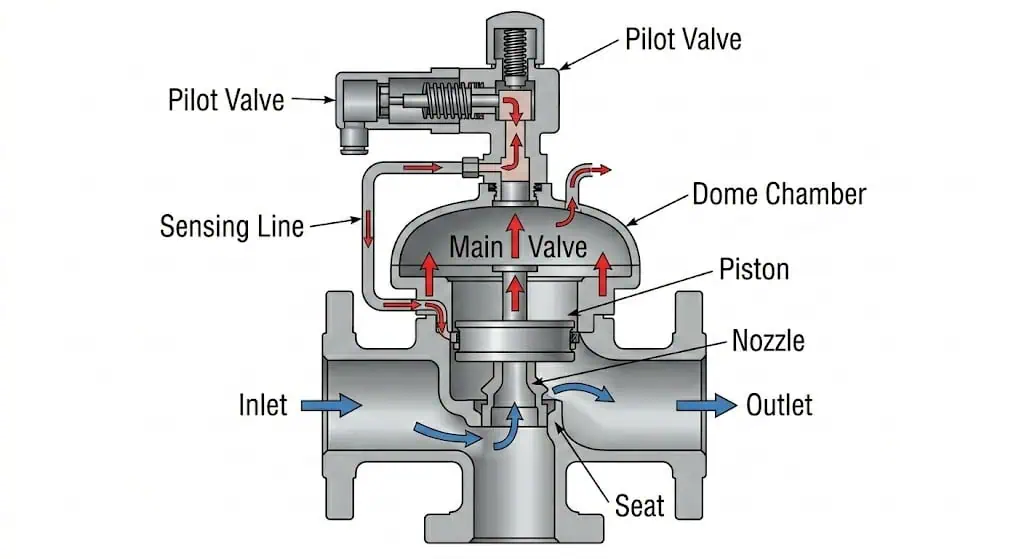
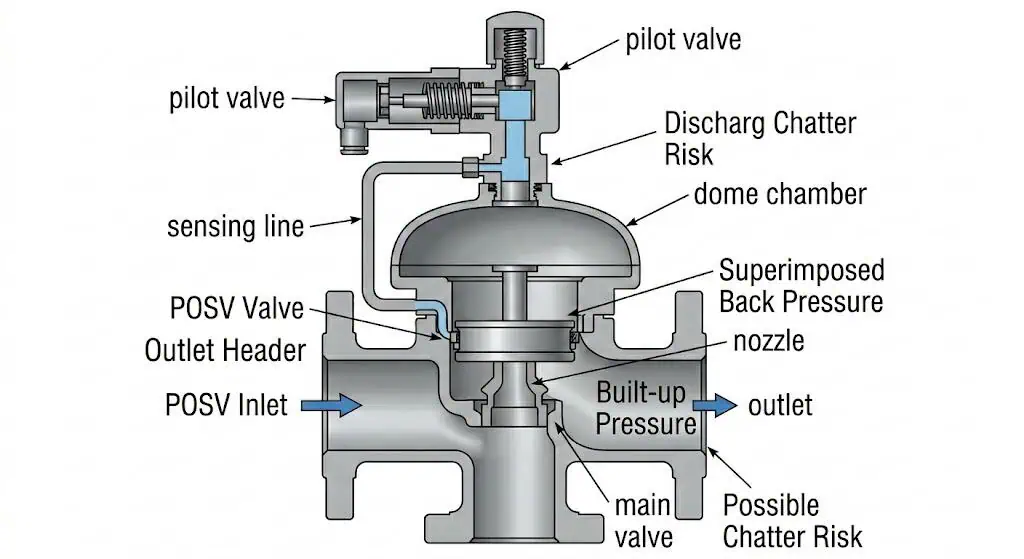
A pilot operated safety valve works by using a small pilot valve to control the pressure above a larger main valve piston. In normal operation, the system pressure is routed to the pilot and to the dome chamber above the main valve. Because the effective dome area is larger than the seat area exposed to inlet pressure, the main valve stays closed and can remain tight even when the operating pressure is close to the set pressure. When inlet pressure reaches the set pressure, the pilot opens or modulates and releases pressure from the dome. The loss of dome pressure removes the main closing force, allowing inlet pressure to lift the main valve and discharge the required relieving flow. When the system pressure falls to the reseating range, the pilot closes, dome pressure is restored, and the main valve reseats.
Engineering summary: the pilot does not normally provide the main relieving capacity. It controls dome pressure. The main valve provides the discharge area. For a real project, the valve still has to be checked for required relieving capacity, set pressure, allowable overpressure, back pressure, inlet pressure loss, material compatibility, seat tightness, and installation conditions.
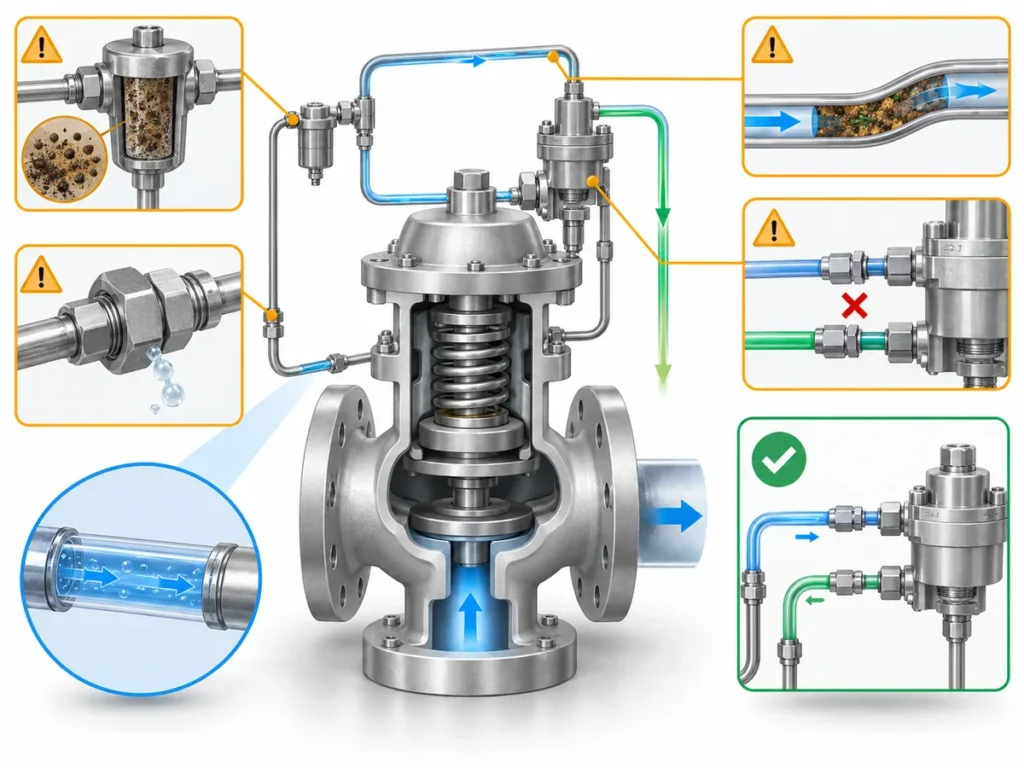
Pilot operated safety valve cutaway structure showing the pilot valve, dome chamber, main valve piston, seat, sensing line, inlet and outlet flow path.
What Is a Pilot Operated Safety Valve?
A Simple Definition for Pressure Protection Systems
A pilot operated safety valve, often called a POSV or POSRV, is an automatic pressure-relieving device used to protect pressure vessels, pipelines, tanks, separators, and process systems from excessive pressure. Unlike a direct spring loaded safety valve, the main valve in a pilot operated design is controlled by a separate pilot valve. The pilot senses inlet pressure and manages the pressure in the dome chamber above the main valve piston.
This design allows the main valve to remain closed during normal operation and open when the protected system reaches the specified set pressure. For engineers, the key point is not simply that the valve “opens automatically.” The important point is how the pilot, dome chamber, piston area, inlet pressure, back pressure, and discharge system interact to create a reliable opening and reclosing sequence.
In procurement review, a POSV should not be selected only because it appears compact or because the inlet and outlet connections match the piping. The valve must be verified against the credible overpressure scenario and the certified relieving capacity basis. A valve with the correct flange size but insufficient orifice area can still fail to protect the equipment.
Main Valve and Pilot Valve: The Two-Part Control Structure
A typical pilot operated safety valve contains two functional assemblies. The pilot valve acts as the pressure-sensing and control element. The main valve acts as the high-capacity relieving element. The pilot receives system pressure through a sensing passage or pressure tapping line. It then directs pressure to, or vents pressure from, the dome chamber above the main valve piston.
When the dome is pressurized, the main valve is held closed. When the dome is vented, the main valve can lift. This two-part structure is why pilot operated valves are often considered for high-pressure, large-capacity, or tight-shutoff applications. However, the same structure also makes them more sensitive to contamination, installation details, sensing line condition, tubing arrangement, seal material, and maintenance quality.
Illustrative engineering case — contaminated pilot circuit: The valve passed its initial bench test but later opened slowly and reseated unpredictably in a polymerizing process stream. The cause was deposit formation in the pilot passages and sensing path, not an incorrect nameplate set pressure. The corrective review included cleaning the pilot circuit, examining the sensing and exhaust paths, checking filtration and maintenance intervals, and reassessing whether a direct spring-loaded or balanced design was more robust for the actual medium.
POSV, POSRV, and Pilot Operated Relief Valve: Are They the Same?
In industry documents, the terms may vary depending on application, manufacturer, and local practice. POSV usually means pilot operated safety valve. POSRV usually means pilot operated safety relief valve. Pilot operated relief valve may be used more broadly for pressure relief applications. The final terminology should match the applicable code, project specification, fluid service, nameplate requirement, and purchasing documentation.
Why this matters: incorrect terminology can create procurement and compliance problems. A valve purchased as a general relief valve may not satisfy the same project expectations as a safety valve or safety relief valve in a pressure vessel application. Before purchase, confirm the required valve type, code basis, certified capacity requirement, nameplate data, set pressure, service medium, and test documentation.
The abbreviation is not a substitute for the approved valve description. The datasheet should identify whether the device is a pilot operated safety valve, pilot operated safety relief valve, or another pressure-relief device, and should state the medium, pilot type, sensing method, main-valve construction, set pressure, required capacity and certification basis. For the broader naming boundary, see PRV vs PSV vs Safety Valve vs Relief Valve.
How a Pilot Operated Safety Valve Works Step by Step
Step 1: System Pressure Is Routed to the Pilot and Dome Chamber
During normal operation, pressure from the protected system is routed to the pilot valve through a sensing line, pressure pickup, or internal passage. This pressure is also used to pressurize the dome chamber above the main valve piston. In many designs, the process medium itself provides the control energy. No external power is required for the basic pressure-relieving function.
The design must ensure that the pilot receives a representative inlet pressure. If the sensing line is blocked, improperly located, isolated, frozen, filled with condensate, or contaminated by process debris, the pilot may not respond correctly to the actual system pressure. This is why installation review is not a secondary issue for POSV service; it is part of the safety function.
Illustrative engineering case — isolated sensing path: A POSV remained closed while equipment pressure increased because a sensing-line isolation valve had been left shut after maintenance. The pilot received no representative inlet pressure even though the main valve was mechanically intact. The corrective action was to restore the sensing path and functionally test the complete assembly; prevention required an approved isolation philosophy, lock-open or car-seal control where applicable, clear tagging and a commissioning checklist.
Step 2: Dome Pressure Keeps the Main Valve Closed
The main valve remains closed because pressure in the dome acts on a larger effective area than the inlet pressure acting upward against the seat area. Even though the pressure may be similar on both sides, the larger dome area produces a greater closing force. As the system pressure rises below set pressure, this closing force can remain strong, which helps reduce leakage close to the set pressure.
Why it matters: this is one of the main reasons engineers consider pilot operated safety valves for systems that operate close to the required set pressure. A conventional spring loaded safety valve may be more likely to simmer or leak if operating pressure is too close to set pressure. A POSV may offer tighter shutoff in the right service, but only if the medium, seals, pilot passages, temperature range, and installation are suitable.
What can go wrong: if the dome cannot hold pressure because of damaged seals, unsuitable elastomers, contaminated seating surfaces, or leakage through pilot internals, the main valve may not remain stable in the closed position. The result can be product loss, environmental emissions, nuisance maintenance, or early seat damage.
Simplified Relationship
Engineering Meaning
Boundary
Closing force ≈ dome pressure × effective dome area
Dome pressure acts over the larger control area and normally holds the main valve closed.
Seal friction, pilot leakage, piston geometry and back pressure also influence the real force balance.
Opening force ≈ inlet pressure × effective inlet area
When dome pressure is sufficiently reduced, inlet pressure can lift the piston or disc assembly.
This is an operating-principle relationship, not a valve-sizing equation.
Net closing margin
The difference between the closing and opening forces affects tight shutoff below set pressure.
Manufacturer data are required for the actual operating-pressure ratio and seat-tightness limits.
Engineering boundary: a POSV does not remain closed merely because the dome area is larger. The pilot circuit must maintain representative pressure, the dome seals must retain that pressure, and the piston or disc must move freely. A leaking dome seal or restricted pilot passage changes the force balance before the nameplate set pressure is reached.
Step 3: The Pilot Opens at Set Pressure
Set pressure is the inlet gauge pressure at which the pilot begins the opening sequence according to the valve design and test condition. When the system pressure reaches this value, the pilot actuates. Depending on whether the pilot is snap-acting or modulating, the pilot may rapidly vent the dome or gradually control the dome pressure.
The pilot action is the trigger. It does not replace the main valve’s relieving area. The main valve must still be sized to pass the required relieving capacity for the credible overpressure scenario. The required capacity should be based on the process hazard case, not on the pipe connection size or a simple replacement of an old valve.
A frequent procurement mistake is to replace a valve by matching only inlet size, outlet size, pressure class, and set pressure. If the protected vessel duty has changed, or if the discharge header has been modified, the original certified capacity basis may no longer be valid. The prevention is to recheck the relieving scenario, required capacity, back pressure, and allowable accumulation before ordering the replacement.
Step 4: Dome Pressure Is Released and the Main Valve Opens
Once the pilot vents the dome, the closing force above the main piston decreases. The inlet pressure acting below the main valve piston or disc can then lift the main valve from the seat. In a snap-acting design, this can produce a rapid opening movement. In a modulating design, the lift may increase in proportion to the pressure rise and required discharge.
What can go wrong: if the dome vent path is restricted, if the pilot does not actuate correctly, or if contamination prevents movement of pilot internals, the main valve may open late, open partially, chatter, or fail to provide the expected response. These risks affect personnel safety, equipment protection, downtime, emissions, and maintenance cost.
For steam or high-temperature vapor service, the review should include condensation, thermal expansion, pilot tubing exposure, seal material, and drainage. A pilot or sensing passage that performs well on clean dry gas may not behave the same way when exposed to wet steam, condensate, or cyclic heating.
Step 5: Excess Pressure Is Discharged Through the Main Valve
After the main valve opens, the excess pressure is discharged through the valve outlet to a safe discharge location, flare header, vent system, or other approved pressure relief path. The discharge system must be reviewed together with the valve because back pressure can affect performance, stability, capacity, and reseating behavior depending on the design and service conditions.
For project selection, the required relieving capacity should be based on the credible overpressure scenario, not on nominal pipe size alone. Fire case, blocked outlet, thermal expansion, control valve failure, utility failure, heat exchanger tube rupture, and other causes may produce different relieving loads.
Illustrative engineering case — discharge-header modification: Several relief devices were connected to an existing common header. The POSV set pressure did not change, but simultaneous relief increased built-up back pressure and affected main-valve stability and reseating. The cause was an outlet-system change that had not triggered a new relief-system analysis. The correction was to recalculate header resistance and simultaneous flow, verify the pilot exhaust and back-pressure limits, and inspect the seat and guide before return to service.
Step 6: The Pilot Reseats and the Main Valve Closes Again
As the protected system pressure falls, the pilot eventually returns to its closed or reset position. Dome pressure is then restored above the main valve piston. The closing force increases, and the main valve reseats. The pressure difference between opening and reseating is related to blowdown behavior and pilot design.
Why it matters: if reseating is unstable, the valve may cycle, leak, or cause repeated pressure disturbances. Poor reseating can damage the seat, increase emissions, and create maintenance work. For systems with frequent pressure fluctuations, the operating pressure margin, pilot type, blowdown behavior, and discharge piping should be reviewed carefully.
Operating Step
System Condition
Pilot Valve Action
Dome Pressure
Main Valve Position
Engineering Result
Normal operation
Pressure below set pressure
Routes pressure to dome
Maintained
Closed
Tight shutoff is maintained if seals, seating surfaces, and pilot internals are suitable
Approaching set pressure
Pressure rises but remains below set pressure
Continues sensing inlet pressure
Maintained
Closed
Valve should not leak or simmer if correctly selected and maintained
At set pressure
Pressure reaches pilot actuation point
Opens or modulates
Reduced or vented
Begins to open
Main closing force is removed; set pressure test basis must match the project requirement
Relieving condition
Overpressure scenario continues
Controls dome pressure
Controlled low pressure
Open
Certified capacity and actual discharge system conditions must support the required relieving load
Reseating
System pressure falls
Closes or resets
Restored
Closed again
Stable reseating reduces leakage, vibration, seat damage, and product loss
Step-by-step working principle of a pilot operated safety valve: dome pressure holds the main valve closed, the pilot actuates at set pressure, dome pressure is released, and the main valve reseats after pressure drops.
Key Components That Control the Opening and Closing Process
Pilot Valve: The Pressure-Sensing Control Element
The pilot valve determines when the main valve should open and when it should reseat. It senses inlet pressure and controls the dome chamber. Because pilot passages and internal parts are smaller than the main flow path, the pilot is more vulnerable to fine particles, sticky media, corrosion products, polymerization, ice, condensate, or incorrect maintenance.
For procurement review, the pilot design should be checked against the medium, cleanliness, operating temperature, corrosion potential, vibration, and maintenance interval. A valve that performs well on clean gas may not be suitable for a dirty, crystallizing, sour, viscous, or polymerizing service without additional engineering review.
Main Valve: The High-Capacity Relieving Element
The main valve provides the primary discharge area. It must be sized according to the required relieving load and allowable overpressure basis. The body size, orifice area, inlet pressure loss, outlet back pressure, and discharge system all influence whether the valve can perform its safety function.
For engineering selection, orifice area and certified relieving capacity are more important than connection size. A larger flange does not automatically mean sufficient capacity, and a smaller-looking valve may be acceptable only if its certified capacity and service conditions have been verified.
Dome Chamber: The Area That Creates Closing Force
The dome chamber is the space above the main valve piston. Under normal operation, pressure in this chamber creates the closing force that keeps the valve seated. When the pilot vents the dome, this force is reduced and the main valve can open. Understanding dome pressure is the fastest way to understand why a POSV can seal tightly before opening and then open rapidly when required.
Sensing Line: The Small Passage That Can Affect Reliability
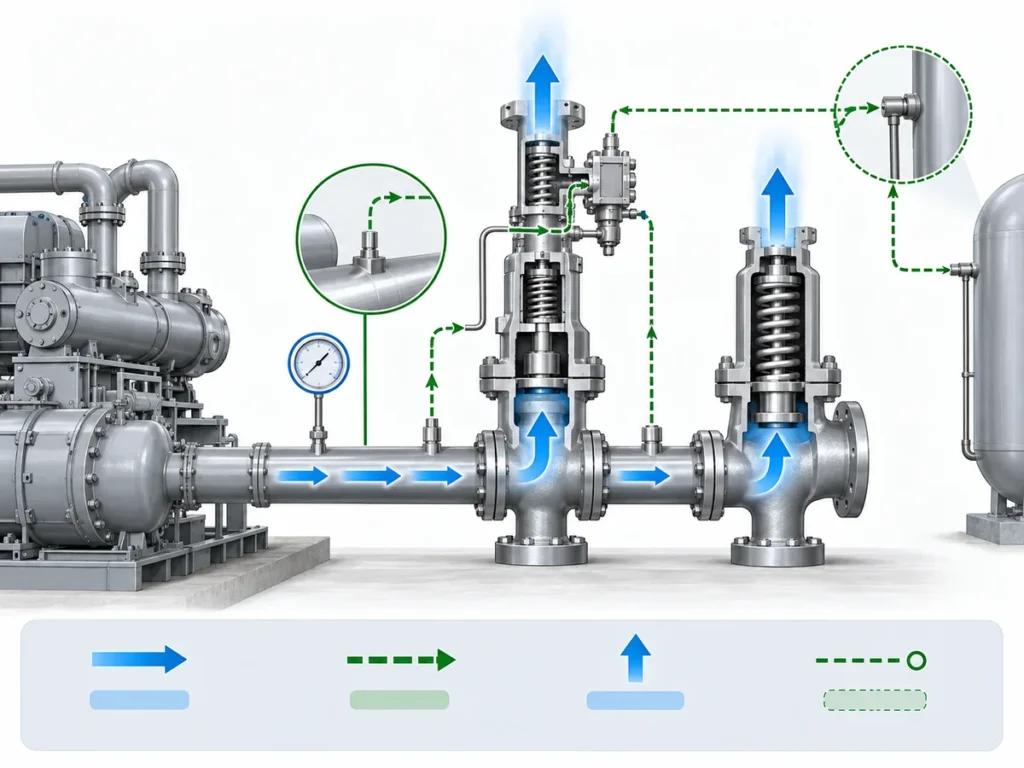
The sensing line or pressure tapping passage connects the protected system pressure to the pilot. If this line is plugged, isolated, frozen, filled with liquid, or placed where pressure does not represent the protected equipment, the pilot may not respond correctly. A small installation problem can therefore become a safety problem.
For remote sensing arrangements, the pressure pickup location should represent the pressure at the equipment being protected. Long tubing runs, liquid pockets, heat loss, vibration, and accidental isolation should be reviewed. Where heat tracing or insulation is needed, it should be specified during design rather than added after a field problem occurs.
Seat, Piston, Seals, and Nozzle: Where Tight Shutoff Depends
Seat tightness depends on the condition of sealing surfaces, seal material compatibility, assembly quality, and the stability of the closing force. Soft seals can improve tightness in suitable service, but they must be reviewed for temperature, chemical compatibility, aging, swelling, compression set, and maintenance conditions. Metal seats may be preferred in severe temperature or certain chemical services, but leakage expectations must be reviewed accordingly.
Corrosive or erosive media can damage the nozzle, disc, guide, piston, or pilot internals. In acid gas, sour service, chloride-containing streams, or wet corrosive service, material selection should not be limited to the valve body. Trim, springs, seals, tubing, fittings, and exposed pilot components may require separate material review.
What Happens at Set Pressure, Overpressure, Blowdown, and Reseating?
Set Pressure: When the Pilot Starts the Opening Sequence
Set pressure is the pressure at which the pilot operated safety valve is adjusted to start opening under specified test or service conditions. In project documentation, set pressure should be consistent with the protected equipment’s maximum allowable working pressure basis and the applicable code requirements. If cold differential test pressure, back pressure correction, or temperature correction applies, the test condition and nameplate information must be reviewed carefully.
Overpressure: How the Main Valve Reaches Required Capacity
Overpressure is the pressure increase above set pressure required for the valve to achieve its rated relieving capacity under defined conditions. For a POSV, the pilot action initiates opening, but the main valve and discharge system determine whether the required capacity is actually achieved.
Accumulation is the pressure increase above the maximum allowable working pressure of the protected equipment during a relieving event, subject to the applicable code and scenario. The distinction matters because a valve can be correctly set but still fail the protection objective if the required capacity, inlet losses, or outlet back pressure are not properly evaluated.
Blowdown: Why the Valve Does Not Close Immediately at Set Pressure
Blowdown is the difference between set pressure and reseating pressure, usually expressed as a pressure difference or percentage depending on the applicable standard and documentation. A valve that closed immediately at set pressure could cycle repeatedly during a relief event. Proper blowdown helps the valve remain open long enough to stabilize system pressure and then reclose after the overpressure condition is relieved.
Reseating Pressure: How the Valve Returns to a Safe Closed Position
Reseating pressure is the inlet pressure at which the valve closes after relieving. Unstable reseating may cause leakage, seat damage, repeated opening, noise, vibration, and operating disturbance. In systems with frequent pressure surges, the distance between normal operating pressure, set pressure, and reseating pressure should be reviewed before selecting the valve type.
Pressure terminology used in safety valve selection, including normal operating pressure, set pressure, overpressure, accumulation, blowdown and reseating pressure.
Term
What It Controls
What It Does Not Prove
Operating pressure
The normal pressure at which the main valve should remain closed and tight.
That operation arbitrarily close to set pressure is acceptable for every pilot and seat design.
Set pressure
The specified pressure at which the pilot begins the defined opening action under stated conditions.
Full main-valve lift or sufficient relieving capacity.
Overpressure
The pressure increase above set pressure available to develop main-valve lift and capacity.
The allowable pressure boundary of the protected equipment by itself.
Accumulation
The pressure increase above MAWP or another code-defined equipment pressure boundary during the event.
That the valve is adequately sized or the discharge system is acceptable.
Blowdown
The difference between set pressure and reseating pressure.
That the valve will reseat cleanly with contamination, unstable back pressure or a damaged seat.
Back pressure
The outlet pressure existing before opening or generated during discharge.
That every POSV is insensitive to outlet-system pressure.
Seat tightness
Closed-valve leakage under the specified test condition.
Capacity, set-pressure accuracy or installed stability.
These values must be tied to the protected equipment and governing scenario. Set pressure is normally reviewed against the equipment MAWP and applicable code; overpressure and accumulation define different reference points; and capacity must be verified at the relevant relieving condition. For a detailed terminology review, see Safety Valve Set Pressure, Overpressure, Accumulation and Blowdown.
Snap-Acting vs Modulating Pilot Operated Safety Valves
How Snap-Acting Pilot Valves Open Rapidly
A snap-acting pilot is designed to create a rapid change in dome pressure at the set pressure. This can cause the main valve to move quickly from closed to open. Snap action is useful where fast pressure relief is required, but it can also create stronger dynamic effects in the discharge piping. Noise, reaction forces, inlet pressure drop, and discharge header behavior should be considered.
How Modulating Pilot Valves Open Proportionally
A modulating pilot controls dome pressure more gradually. The main valve may open only as much as needed for the pressure condition. This can reduce unnecessary product loss in some services and may help with smoother pressure control. However, the correct choice depends on the fluid state, required capacity, stability, allowable overpressure, discharge system, and project specification.
Which Type Fits Gas, Vapor, Steam, or Liquid Service?
Gas, vapor, steam, and liquid services can behave differently during pressure relief. Compressible fluids may require different relieving calculations from liquid service. Steam service introduces temperature, condensate, drainage, and material concerns. Liquid service can create hydraulic forces and stability issues. The pilot type should therefore be selected after confirming the medium, relieving scenario, discharge path, installation arrangement, and applicable code basis.
Pilot Characteristic
How It Controls the Main Valve
Selection Concern
Snap-acting
Produces a rapid change in dome pressure and decisive main-valve opening.
Dynamic reaction, discharge-header response, noise and stable reseating.
Modulating
Controls dome pressure progressively so main-valve lift can follow the relief demand.
Process stability, allowable overpressure, minimum stable lift and pilot cleanliness.
Flowing pilot
Control medium flows through part of the pilot circuit while the valve is relieving.
Pilot discharge destination, consumption, icing, contamination and back-pressure interaction.
Non-flowing pilot
Limits continuous pilot flow after the control state is established, depending on design.
Internal leakage, trapped pressure, sensing response and manufacturer-specific operation.
Internal sensing
Uses pressure taken through the valve or integral passage.
Local inlet pressure loss and whether the sensed pressure represents the equipment.
Remote sensing
Uses an external pickup from the protected equipment or another approved point.
Tubing length, condensate, freezing, isolation, vibration, heat tracing and routing.
Selection boundary: “snap-acting,” “modulating,” “flowing” and “non-flowing” describe different aspects of pilot behavior. They should not be treated as interchangeable catalogue labels. The manufacturer must confirm the exact pilot architecture, sensing method, exhaust arrangement, fluid compatibility and certified configuration.
Why Use a Pilot Operated Safety Valve Instead of a Spring Loaded Safety Valve?
A pilot operated safety valve is not automatically better than a spring loaded safety valve. It is better only when its design advantages match the process conditions and maintenance capability. The selection should be based on shutoff requirement, operating pressure margin, back pressure, required capacity, fluid cleanliness, temperature, corrosion risk, inspection access, and lifecycle maintenance cost.
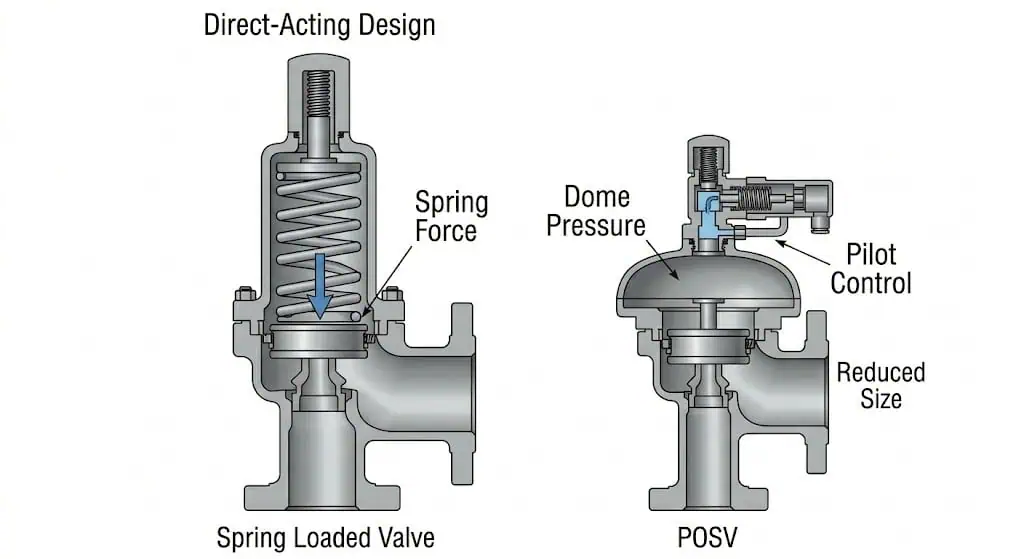
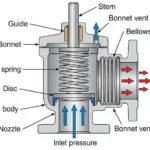
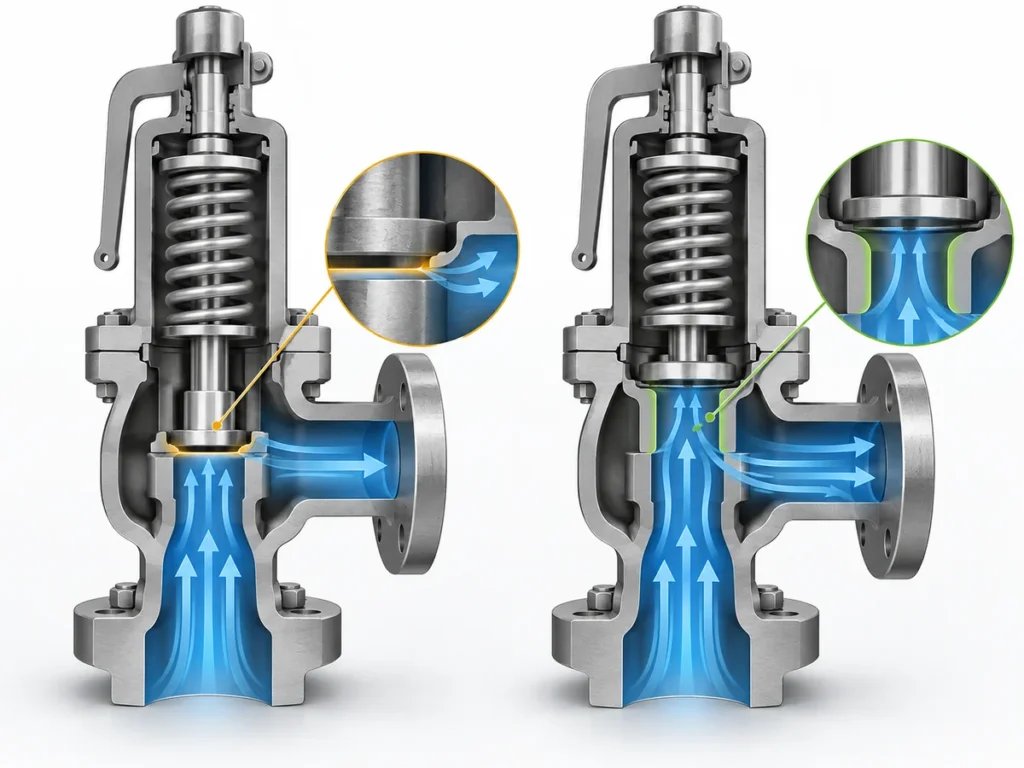
Comparison of pilot operated and spring loaded safety valve operating principles. POSV performance depends on pilot-controlled dome pressure, while spring loaded valves rely on direct spring force.
Selection Factor
Pilot Operated Safety Valve
Spring Loaded Safety Valve
Engineering Note
Operating close to set pressure
Often suitable because dome pressure can increase closing force
May be more prone to simmer or leakage if margin is too small
Confirm allowable operating margin, blowdown behavior, and seat tightness requirement
Large capacity or high pressure
Can be advantageous in selected designs
Large springs and higher mechanical loads may become limiting
Do not select by valve size alone; verify required capacity and certified capacity basis
Dirty or sticky medium
Requires caution because pilot passages are sensitive
May be more tolerant depending on design
Review filtration, material, maintenance access, pilot tubing, and medium behavior
Back pressure
Some designs reduce back pressure influence, but this must be verified
Conventional designs may be affected; balanced bellows may be required
Back pressure must be reviewed with the discharge system and valve construction
Maintenance complexity
Higher; pilot, tubing, seals, and main valve must be inspected
Usually simpler construction
Lifecycle cost may be higher if maintenance capability is limited
Initial cost
Usually higher for small and medium sizes
Usually lower
Total cost should include leakage, downtime, testing, spare parts, and recertification
Cost impact: a lower-cost direct spring loaded safety valve may be the correct choice for clean, moderate-pressure, easy-maintenance services. A pilot operated valve may reduce leakage, improve operating margin, or solve high-capacity problems in selected services. The wrong choice can increase downtime, emissions, seat damage, recertification work, spare parts cost, and lead time for replacement.
Field example: a spring loaded valve installed on a discharge header with higher-than-expected built-up back pressure began to chatter after a header modification. The set pressure was correct, but the outlet system resistance changed the operating behavior. The corrective action was to review the discharge header, confirm back pressure under the relief scenario, and evaluate whether a balanced bellows or pilot operated design was more suitable. The prevention is to include outlet system review whenever relief piping is modified.
Back pressure must be reviewed with the discharge system because outlet resistance can affect safety valve stability, relieving capacity and reseating behavior.
Back-pressure limitation: a pilot operated valve is not automatically immune to back pressure. Outlet pressure can affect the main valve, pilot exhaust, sensing reference and certified capacity in different ways. A pilot vented to atmosphere behaves differently from one exhausting into the valve outlet or a closed system. The supplier should state the allowable superimposed and built-up back pressure, whether the limit is constant or variable, and whether a capacity correction or special pilot arrangement applies.
Engineering Limits and Failure Risks You Should Not Ignore
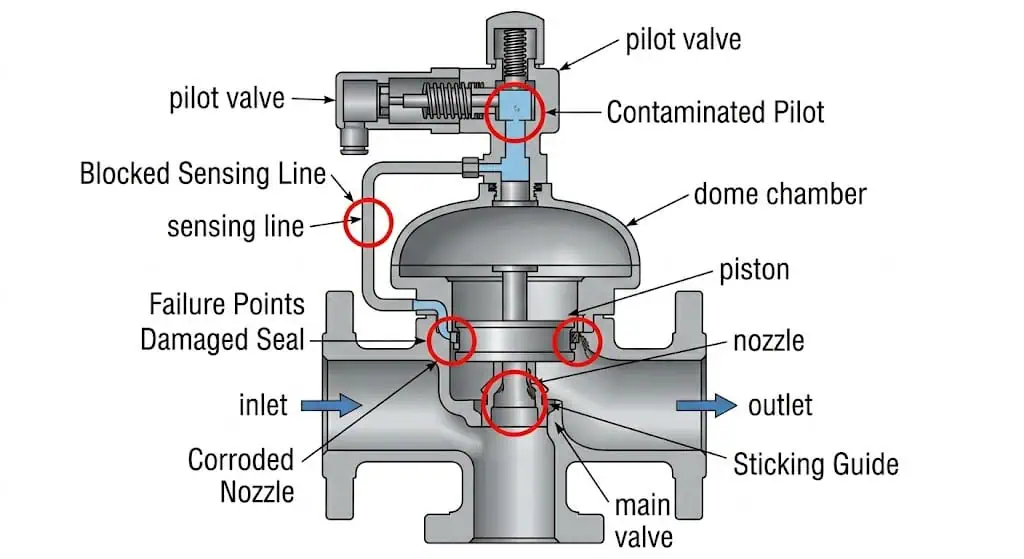
A reliable pilot operated safety valve depends on both the valve design and the system around it. In field service, many problems are not caused by the main valve body itself. They are caused by unsuitable medium, blocked sensing passages, poor drainage, wrong materials, excessive vibration, incorrect back pressure assumptions, inlet pressure loss, outlet resistance, poor maintenance access, or incomplete documentation after repair.
Common POSV failure locations include the sensing line, pilot passages, dome seals, seat area, nozzle, piston and guide surfaces.
Check sizing, inlet pipe loss, outlet back pressure, and dynamic forces
Seal failure
Wrong elastomer, excessive temperature, chemical attack
Leakage, pilot malfunction, failure to hold dome pressure
Reduced reliability and unexpected maintenance shutdown
Review material compatibility and maximum service temperature
Incorrect reseating
Improper blowdown behavior, contaminated pilot, unstable process pressure
Valve remains open too long or recloses too early
Process disturbance, loss of medium, repeated cycling
Confirm pilot type, blowdown requirement, and operating pressure range
Post-maintenance set pressure drift
Improper reassembly, spring/pilot adjustment error, no final calibration
Valve opens above or below intended pressure
Unsafe protection margin or nuisance lifting
Perform documented reset, retest, sealing, and certificate review after repair
After repair or overhaul, the valve should not be returned to service based only on visual inspection. The set pressure, seat tightness, functional response, sealing, and documentation should be checked according to the applicable plant procedure, standard, and local jurisdictional requirement. Where National Board or similar repair authorization is required, the repair scope and documentation should be confirmed before the work is released.
Where Pilot Operated Safety Valves Are Commonly Used
Oil and Gas Pressure Vessels and Pipelines
Pilot operated safety valves are often considered for high-pressure gas systems, separators, process vessels, and pipeline protection where tight shutoff, large capacity, or high operating pressure margin may be required. Discharge header back pressure and remote sensing requirements should be checked during project review.
Chemical and Petrochemical Process Systems
In chemical and petrochemical plants, POSV selection must consider medium behavior. Clean gas or vapor services may be suitable. Sticky, polymerizing, crystallizing, corrosive, or dirty services require careful review because the pilot assembly contains smaller passages and control elements.
For chloride-containing, acidic, sour, or wet corrosive media, the material review should include body, nozzle, disc, guide, piston, pilot tubing, fittings, seals, and springs. If only the body material is specified while the trim and pilot materials are ignored, early corrosion, sticking, seat leakage, and unstable pilot action can occur.
High-Pressure Gas and Vapor Applications
High-pressure gas and vapor services may benefit from the ability of a POSV to remain tight near set pressure. However, the valve must still be selected according to the required relieving load, allowable overpressure, materials, inlet pressure loss, outlet back pressure, and discharge system conditions.
Storage Tanks, Separators, and Process Equipment
For storage tanks, separators, and pressure vessels, the valve must be selected as part of the complete pressure protection system. The protected volume, credible overpressure scenario, inlet losses, outlet losses, and safe discharge location must be reviewed together.
Applications Where Tight Shutoff and High Capacity Are Important
A POSV may be appropriate when leakage control, operating pressure margin, or high capacity is more important than simple construction. It may not be the best choice where the medium is dirty, maintenance is difficult, or the process temperature exceeds the practical limit of pilot seals and soft goods.
How to Select a Pilot Operated Safety Valve for Your System
Selection should start with the overpressure scenario and process data, not with a catalog size. A pilot operated safety valve must be checked for capacity, pressure, temperature, material, fluid state, back pressure, connection standard, installation layout, maintenance access, repair route, documentation requirement, and project code basis.
Required Process Data Before Sizing or Selection
Medium name and composition
Gas, vapor, steam, liquid, or two-phase service
Normal operating pressure
Set pressure requirement
Relieving pressure or allowable overpressure basis
Operating and relieving temperature
Required relieving capacity
Required orifice area or certified capacity basis
Inlet and outlet connection size
Flange standard and rating
Expected built-up and superimposed back pressure
Inlet line length, fittings, and pressure loss estimate
Material requirement or corrosion allowance
Soft seat or metal seat requirement
Installation orientation and discharge destination
Applicable code or project specification
Required test and inspection documents
Repair, recertification, and sealing requirements
Medium, Pressure, Temperature, and Back Pressure Checks
Medium behavior directly affects valve selection. Clean dry gas, saturated steam, corrosive vapor, thermal liquid, dirty process fluid, and two-phase service are not equivalent. Pressure and temperature determine body rating, seal selection, spring or pilot setting considerations, and test requirements. Back pressure affects discharge performance and must be reviewed with the outlet system, not treated as an afterthought.
Back pressure is especially important because it can affect opening stability, effective relieving capacity, and reseating behavior. For conventional spring loaded valves, balanced bellows valves, and pilot operated valves, the allowable back pressure influence is not identical. The correct valve type should be reviewed against both superimposed back pressure and built-up back pressure during relieving.
Material and Seal Selection for Corrosion and Temperature
Body, trim, seat, seal, guide, spring, tubing, fittings, and pilot materials should be selected based on corrosion, temperature, pressure, and medium compatibility. For soft seal designs, elastomer or polymer limits must be confirmed. For high-temperature or aggressive media, metal seating or special materials may be required, but leakage acceptance must be defined clearly in the project specification.
Component
Why Compatibility Matters
Typical Failure if Missed
Body and pressure-retaining parts
Pressure rating, corrosion allowance, low/high-temperature toughness and external environment.
Wall loss, cracking, leakage or pressure-boundary failure.
Nozzle and main seat
Corrosion, erosion and surface condition control leakage and repeatable closure.
Seat leakage, wire drawing and failure to reseat tightly.
Piston, guide and sliding surfaces
Clearance, galling resistance, deposits and differential thermal expansion affect motion.
Sticking, delayed opening or incomplete closure.
Pilot trim and passages
Small passages are sensitive to corrosion products, particles, wax, hydrate, polymer and scale.
Delayed actuation, unstable dome control or failure to reset.
Soft seats and dome seals
Temperature, chemical exposure, decompression, swelling and compression set affect tightness.
Loss of dome pressure, nuisance opening or continuous leakage.
Tubing and fittings
External corrosion, vibration, freezing and sour-service cracking can interrupt the sensing path.
False pressure signal, leakage or loss of the pilot control function.
Where H2S-containing oil and gas production service is within scope, material qualification may require review against ISO 15156 / NACE MR0175 principles. That review addresses specified cracking mechanisms and does not replace general or localized corrosion assessment, the pressure design code or manufacturer qualification.
Capacity, Connection Size, and Flange Standard Confirmation
Nominal connection size does not prove relieving capacity. The required orifice area, certified capacity basis, inlet pressure loss, and outlet back pressure must be reviewed. Flange standard, pressure class, face type, and end connection must match the piping specification. A mismatch can delay procurement, fabrication, inspection, or site installation.
Illustrative engineering case — correct connections, insufficient capacity: A replacement matched the existing flanges and set pressure, but a process expansion had increased the governing relief load. The mechanical interface was correct while the supported relieving capacity was not. The order was stopped, the relief scenario and required capacity were recalculated, and the valve orifice and certified or documented capacity were reselected. Major process changes should trigger a formal PRD capacity review.
When to Ask the Manufacturer for Engineering Review
Engineering review is recommended when the valve is used for high pressure, high temperature, corrosive service, variable back pressure, two-phase flow, near-set-pressure operation, critical equipment protection, unusual installation, shared discharge header, or service requiring special repair documentation. A complete RFQ package reduces technical clarification time and shortens procurement lead time.
Project review CTA: If you are selecting a pilot operated safety valve for a pressure vessel, pipeline, separator, tank, or process system, send ZOBAI your medium, operating pressure, set pressure, relieving temperature, required capacity, back pressure, inlet/outlet connection, material requirement, and applicable standard. Our engineering team can review the working conditions and recommend a suitable safety valve type for further evaluation.
Technical Approval Item
Supplier Must Confirm
Buyer / Engineer Must Verify
Relief duty
Supported capacity for the offered model and configuration.
Governing scenario, required load, units and calculation revision.
Pilot architecture
Snap/modulating, flowing/non-flowing, sensing and exhaust arrangement.
Process stability, cleanliness, condensation, icing and maintenance access.
Pressure basis
Set pressure, test pressure basis, blowdown or reseating range and allowable back pressure.
MAWP, operating margin, overpressure and accumulation limits.
Materials
Body, nozzle, piston, pilot trim, seals, tubing and fittings.
Corrosion, temperature, sour-service and decompression requirements.
Installation
Orientation, sensing-line rules, vent routing and drainage requirements.
Actual inlet loss, outlet resistance, support, reaction force and isolation controls.
Documents
Datasheet, drawing, capacity evidence, material certificates and test records.
Project code, marking, inspection and repair-document requirements.
Testing, Inspection, and Quality Checks Before Delivery
Testing is not only a compliance activity. For pilot operated safety valves, testing confirms whether the pilot and main valve respond correctly as an integrated pressure protection device. The final inspection plan should match the purchase specification, applicable standard, service risk, and required documentation.
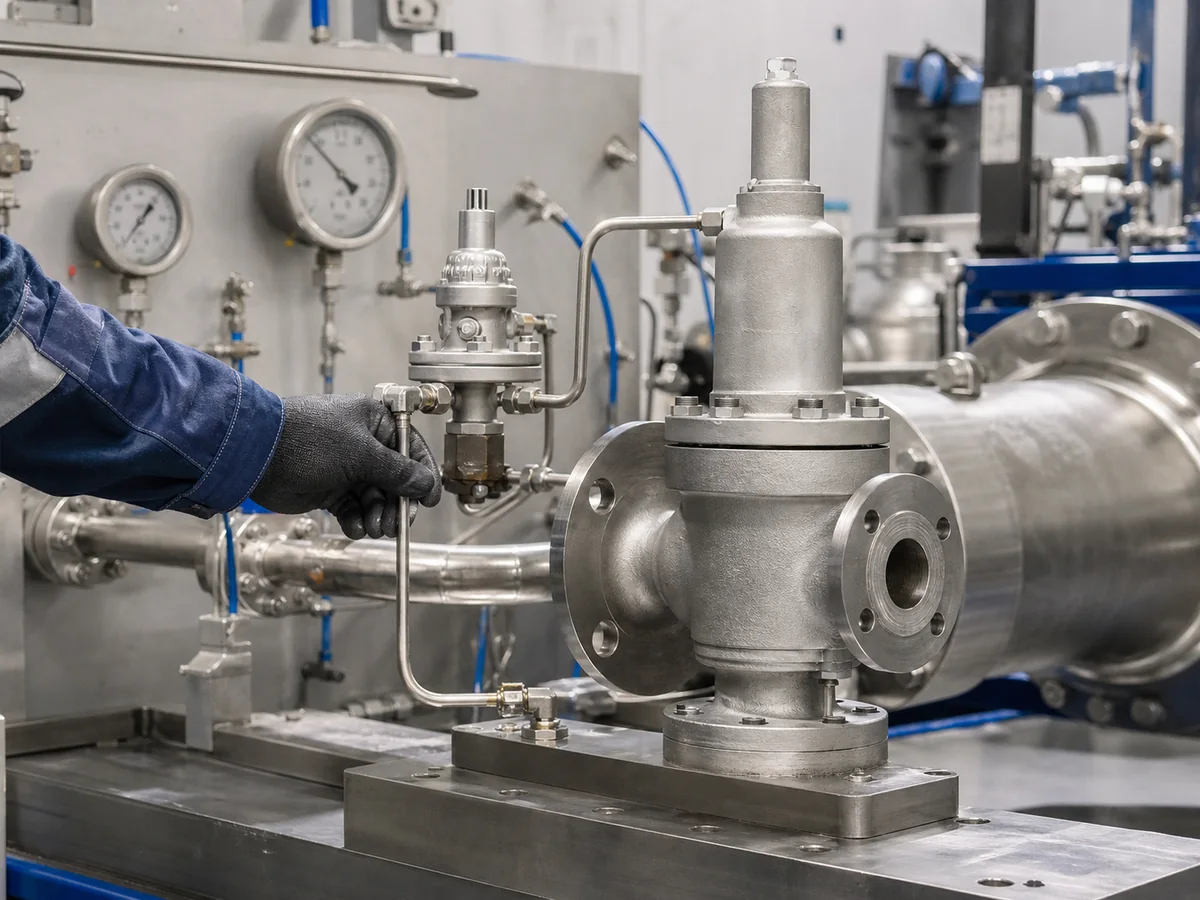
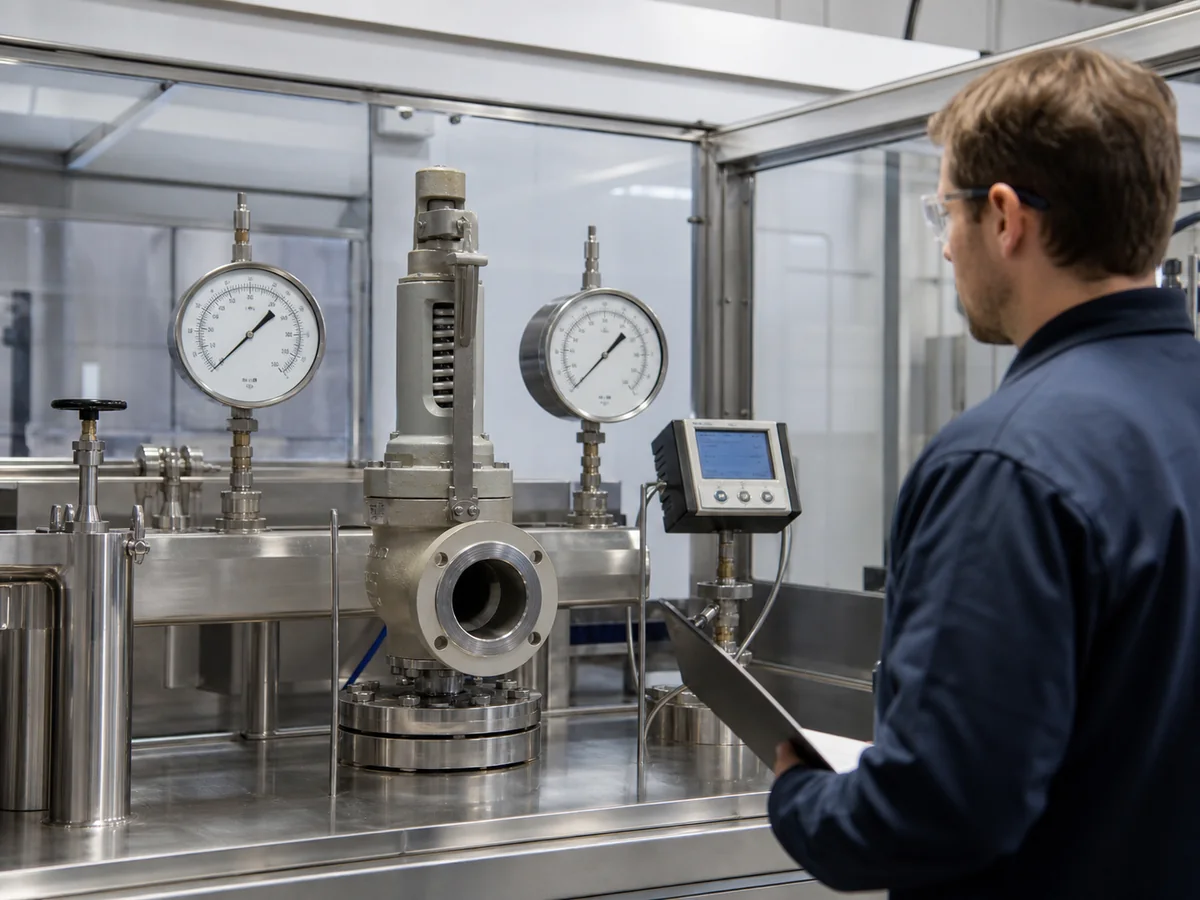
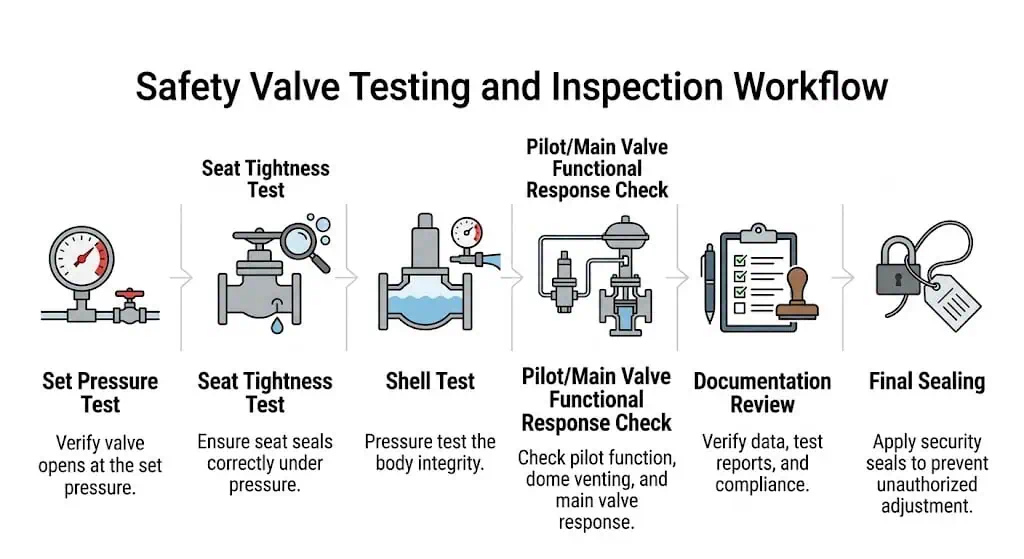
Testing and inspection workflow for safety valves, including set pressure testing, seat tightness testing, shell testing, functional response checks, documentation review and final sealing.
Set Pressure Test
The set pressure test confirms the pressure at which the valve begins the specified opening action under test conditions. If cold differential test pressure, back pressure correction, or temperature correction applies, it should be confirmed before testing and recorded in the documentation. After maintenance or repair, the valve should be reset, retested, and sealed according to the applicable procedure before being returned to service.
Seat Tightness Test
Seat tightness testing checks leakage when the valve is closed. For users operating close to set pressure, seat tightness is a key quality and cost factor because leakage can cause product loss, emissions, unstable operation, or unplanned maintenance. The purchaser should specify if tighter leakage expectations are required beyond the usual project standard.
Shell Pressure Test
The shell test verifies pressure-containing integrity of the valve body and pressure-retaining parts according to the specified inspection requirement. This is especially important for pressure equipment projects where documentation, material traceability, and inspection records are required.
Functional Test of Pilot and Main Valve Response
A pilot operated valve should be reviewed as a complete functional assembly. The pilot must sense pressure, control dome pressure, and allow the main valve to open and reclose as intended. Testing should verify the interaction between the pilot and the main valve, not only individual component condition.
Documentation Required for Industrial Projects
Typical documentation may include test reports, material certificates, inspection records, nameplate information, drawing approval, operating manual, calibration record, repair record, sealing record, and conformity documents where applicable. The required document list should be confirmed before purchase to avoid shipment, customs, inspection, or commissioning delays.
Return-to-Service Controls After Repair or Internal Adjustment
Hold Point
Required Check
Evidence
As-found condition
Record leakage, set-pressure condition, contamination, damaged parts, pilot tubing condition and seal status before cleaning.
Inspection report, photographs and test record.
Parts and configuration
Verify pilot model, main-valve trim, piston, nozzle, seals, springs, tubing and any modified settings.
Parts list, serial traceability and approved drawing.
Cleaning and assembly
Remove deposits without changing critical geometry; assemble using controlled clearances and specified torque.
Repair procedure and technician sign-off.
Pressure-boundary testing
Perform the required shell or pressure-containing-part test when the repair scope calls for it.
Pressure test report.
Functional calibration
Verify pilot actuation, dome-pressure response, main-valve opening sequence and reseating under the approved test procedure.
Set-pressure and functional test report.
Seat tightness
Test the main seat and relevant pilot leakage points under the specified method and medium.
Seat-tightness report.
Final release
Restore seals, tags, nameplate traceability and required repair marking; close all NCRs before shipment or installation.
Release note, calibration certificate and repair record.
API 527 may be specified for seat-tightness testing of applicable conventional, bellows and pilot-operated pressure-relief valves, but it does not prove required capacity or installed stability. See the API 527 Seat Tightness Test Guide. Where the jurisdiction or code-controlled repair route requires it, confirm whether the organization must hold a National Board VR authorization before work begins.
What is the difference between a pilot operated safety valve and a pilot operated relief valve?
The difference depends on application, terminology, and applicable code. A pilot operated safety valve is generally used for pressure safety protection and may be associated with gas, vapor, or steam service. Pilot operated relief valve is often used more broadly. Always match the term to the project specification and required certification basis.
Does a pilot operated safety valve use a spring?
The pilot assembly may include a spring or other control elements, but the main valve is not opened directly by balancing inlet pressure against a large main spring in the same way as a conventional spring loaded safety valve. The pilot controls the dome pressure, and the dome pressure controls the main valve.
Why does a pilot operated safety valve seal tightly near set pressure?
Before the set pressure is reached, system pressure is routed to the dome chamber above the main valve piston. Because the dome area is larger than the seat area exposed to inlet pressure, the net force keeps the main valve closed. This can support tighter shutoff near set pressure when the valve is correctly selected and maintained.
Can a pilot operated safety valve be used for liquid service?
Some pilot operated designs can be used for liquid service, but the selection must be confirmed by design type, manufacturer data, fluid properties, stability, and applicable standard. Liquid service can introduce different dynamic behavior from gas or vapor service.
What is dome pressure in a pilot operated safety valve?
Dome pressure is the pressure in the chamber above the main valve piston. It creates the closing force during normal operation. When the pilot vents the dome, the closing force is reduced and the main valve can open.
What causes a pilot operated safety valve to fail?
Common causes include blocked sensing lines, contaminated pilot passages, damaged seals, incorrect material selection, poor installation, excessive back pressure, vibration, wrong operating pressure margin, excessive inlet pressure loss, and lack of maintenance.
Is a pilot operated safety valve better than a spring loaded safety valve?
Not always. A pilot operated safety valve can be better for selected high-pressure, high-capacity, tight-shutoff, or back-pressure-sensitive services. A spring loaded safety valve may be better for simpler, dirtier, lower-risk, or easier-maintenance services.
How often should a pilot operated safety valve be tested?
Testing frequency depends on local regulations, plant maintenance policy, service severity, valve history, medium risk, repair history, and applicable standard. Critical, dirty, corrosive, or high-temperature services may require more frequent inspection than clean and stable services.
What information is needed to select a pilot operated safety valve?
At minimum, provide medium, fluid state, operating pressure, set pressure, relieving temperature, required capacity, back pressure, inlet and outlet size, connection standard, material requirement, installation orientation, and applicable code or project specification.
Can pilot operated safety valves handle back pressure?
Some pilot operated designs are less affected by back pressure than conventional spring loaded valves, but this should not be assumed for every valve. Back pressure must be confirmed with the valve design, discharge system, and project standard.
What is the difference between set pressure and overpressure in a POSV?
Set pressure is the specified pressure at which the pilot begins the defined opening action. Overpressure is the pressure increase above set pressure available during relief to develop main-valve lift and capacity. Set pressure alone does not prove full relieving capacity.
Why is certified relieving capacity more important than connection size?
Connection size describes the piping interface. Relieving capacity depends on the internal flow area, lift, fluid, relieving pressure, temperature, back pressure and the certified or documented performance of the offered configuration.
Can a pilot operated safety valve be used for dirty or polymerizing media?
Only after a specific engineering review. Fine pilot passages and sensing lines can be restricted by solids, wax, polymer, crystals or corrosion products. Filtration, purging, alternative sensing arrangements, maintenance access or a direct spring-loaded design may be more suitable.
How does back pressure affect a pilot operated safety valve?
Back pressure can affect the main valve, pilot exhaust reference, available lift, capacity and reseating. The effect depends on the pilot and exhaust arrangement, so allowable superimposed and built-up back pressure must be confirmed for the actual model.
Why can a pilot operated safety valve leak after installation?
Possible causes include contaminated seats, damaged dome seals, piping strain, incorrect orientation, unstable outlet pressure, debris in the pilot circuit, unsuitable soft goods or operation outside the manufacturer’s pressure and temperature limits.
What materials should be checked for corrosive or sour service?
Review the body, nozzle, piston, guide, pilot trim, springs, seals, sensing tubing and fittings. A suitable body alloy does not prove that the small pilot components or soft seals are compatible with the actual fluid and cracking environment.
What must be checked after a pilot operated safety valve is repaired?
Record the as-found condition, verify all replaced or adjusted parts, complete required pressure and seat-tightness tests, calibrate the pilot and main-valve response, confirm reseating, restore tags and seals, and issue traceable repair documentation.
Which standards matter when specifying a pilot operated safety valve?
The answer depends on the protected equipment and jurisdiction. ISO 4126-4 addresses general product requirements for pilot-operated safety valves; ASME BPVC and the equipment construction code may govern overpressure protection; API 520 and 521 may apply in covered process-industry services; API 527 addresses seat tightness; and NBIC or National Board VR requirements may govern repair.
Standards and Technical Reference Links
The applicable document set depends on the protected equipment, process industry, jurisdiction, valve certification route and project specification. Product standards, equipment construction codes, sizing practices, installation guidance, seat-tightness methods and repair authorizations perform different functions.
Overpressure-protection rules covering design, materials, inspection, assembly, testing, marking, capacity certification and installation where the ASME framework applies.
It must be used with the applicable construction code, jurisdiction and certification scope; a generic product claim is not evidence for the offered valve.
Material selection principles for specified H2S-containing oil and gas production environments.
Its cracking-resistance scope does not by itself address all general corrosion, downstream-service or pressure-design requirements.
Edition and evidence control: specify the project-adopted edition in the RFQ. Verify the legal manufacturer, exact model, pilot type, size, materials, marking, capacity certificate, repair authorization and order-specific records. Do not convert a standard name in a catalogue into a compliance claim.
Engineering Review
This article supports technical education, preliminary troubleshooting, RFQ preparation and replacement screening. Final selection and return-to-service approval should use the actual relief calculation, protected-equipment code, manufacturer-certified or documented performance, sensing and exhaust arrangement, installed piping analysis, approved calibration procedure and responsible engineer’s review.
Review focus: safety valve working principle, POSV selection logic, dome pressure behavior, set pressure, overpressure, blowdown, certified relieving capacity, back pressure consideration, inspection requirements, and B2B project review points.
Need a Pilot Operated Safety Valve Review for Your Project?
For a practical recommendation, send ZOBAI the process medium, operating pressure, set pressure, relieving temperature, required capacity, back pressure, inlet and outlet connection, material requirement, seat requirement, installation arrangement, discharge system information, and applicable standard. This information allows an engineering review of whether a pilot operated safety valve, spring loaded safety valve, balanced bellows safety valve, or another pressure relief solution is more suitable for your system.
Suggested RFQ attachment: P&ID, protected equipment data sheet, relief scenario, discharge system information, line list, valve specification, material requirement, and inspection documentation requirement. For project review, contact ZOBAI safety valve engineering team.
To provide the best experiences, we use technologies like cookies to store and/or access device information. Consenting to these technologies will allow us to process data such as browsing behavior or unique IDs on this site. Not consenting or withdrawing consent, may adversely affect certain features and functions.
Functional
Always active
The technical storage or access is strictly necessary for the legitimate purpose of enabling the use of a specific service explicitly requested by the subscriber or user, or for the sole purpose of carrying out the transmission of a communication over an electronic communications network.
Preferences
The technical storage or access is necessary for the legitimate purpose of storing preferences that are not requested by the subscriber or user.
Statistics
The technical storage or access that is used exclusively for statistical purposes.The technical storage or access that is used exclusively for anonymous statistical purposes. Without a subpoena, voluntary compliance on the part of your Internet Service Provider, or additional records from a third party, information stored or retrieved for this purpose alone cannot usually be used to identify you.
Marketing
The technical storage or access is required to create user profiles to send advertising, or to track the user on a website or across several websites for similar marketing purposes.