What causes overpressure?
State the governing scenario, required relieving rate, relieving pressure and fluid properties. Fire, blocked outlet, thermal expansion and control failure do not share one sizing basis.

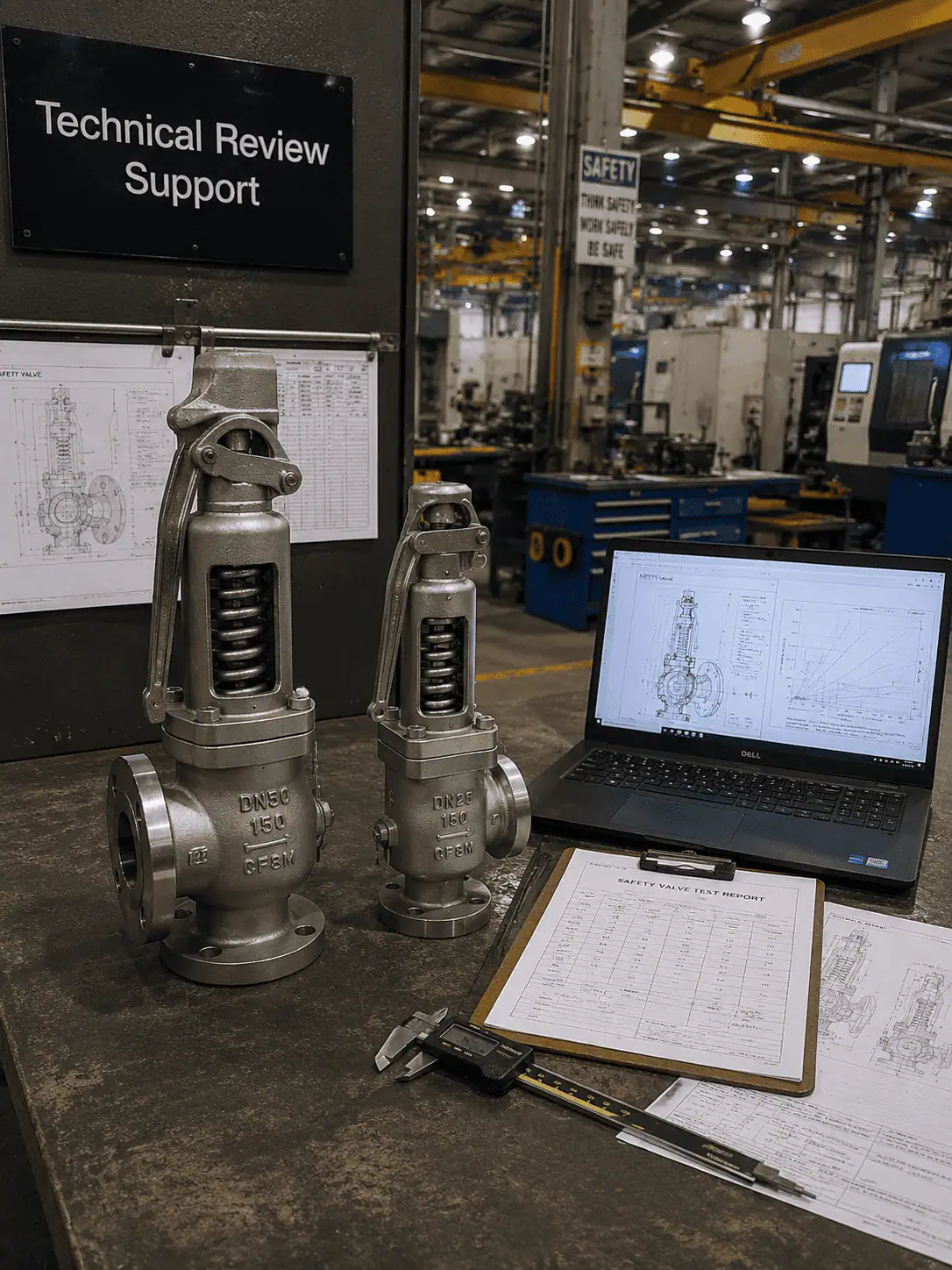
Safety valve engineering support
Turn process conditions, relief cases and project specifications into a reviewable valve enquiry. The engineering task is to confirm the selection basis, expose application risks and define the evidence required before a purchase decision.
Start with the engineering problem
A procurement team may begin with a model name or nominal size, but engineering approval depends on the protected equipment, credible overpressure scenario and complete operating envelope. Missing data can produce an apparently valid quotation that cannot be verified for capacity, stability, materials or code compliance.
State the governing scenario, required relieving rate, relieving pressure and fluid properties. Fire, blocked outlet, thermal expansion and control failure do not share one sizing basis.
Normal operating pressure, set pressure and expected transients define the operating margin. A narrow margin increases simmer and seat-leakage risk.
Inlet pressure loss, built-up back pressure, superimposed back pressure, drainage and reaction loads must be checked as system conditions, not treated as valve-only details.
Engineering insight
Provide enough information for another engineer to reproduce the selection logic. When an input is unknown, mark it as open rather than replacing it with an assumption.
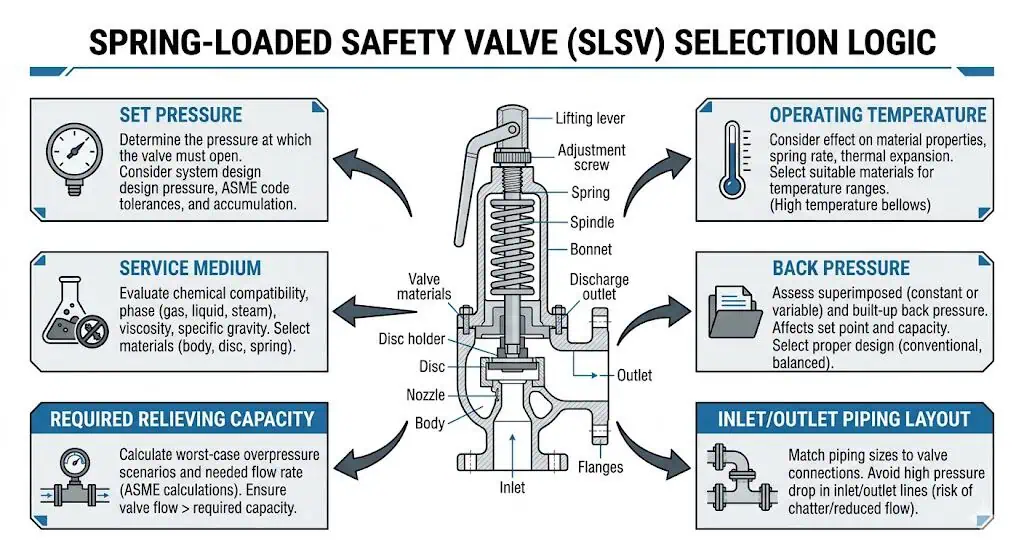
Selection guide
| Decision | Engineering question | Evidence for approval | Do not rely on |
|---|---|---|---|
| Valve type | What operating margin, back pressure, service cleanliness and response behavior apply? | Selection note showing why conventional, balanced or pilot-operated design fits | Product family name alone |
| Capacity | Can the selected orifice pass the required load under the governing relieving case? | Sizing calculation and applicable certified capacity basis | Nominal inlet size |
| Materials | Are pressure parts, trim, seat, spring and bellows suitable for the medium and temperature? | Approved bill of materials and traceability requirements | Generic stainless-steel wording |
| Connections | Do rating, facing, orientation and line loads match the system? | Approved datasheet, drawing and line specification | Photograph or outline size only |
| Compliance | Which code edition, conformity route and client specification govern? | Document matrix linked to the ordered configuration | Unrelated certificate image |
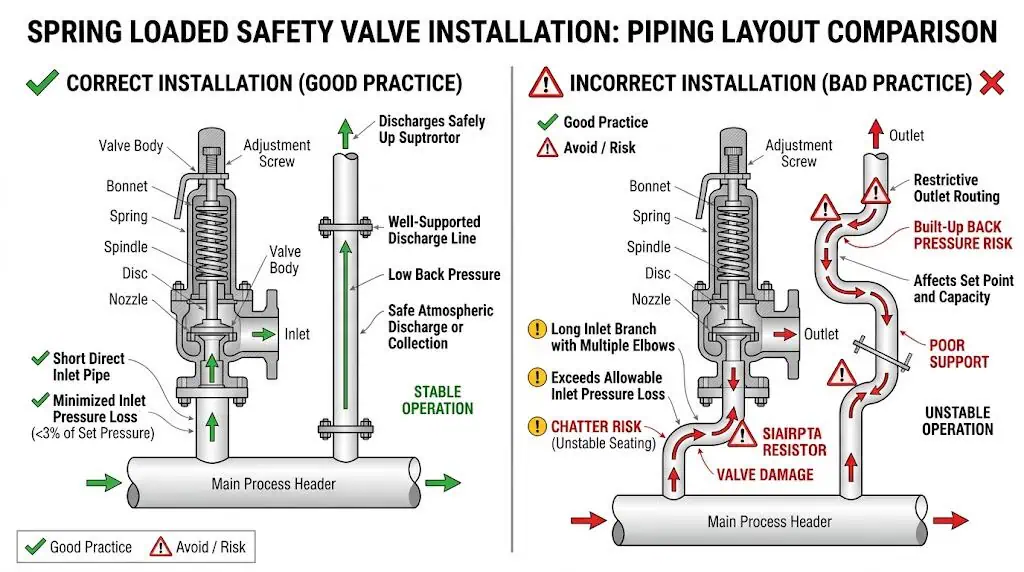
Application guide
Equipment and piping conditions define whether the selected valve can perform as intended. Add the application drawing, line data and operating narrative when any of the following applies:
Failure analysis
The valve was chosen by line size or model familiarity instead of a documented relieving load and certified basis.
High inlet loss, excessive back pressure, oversizing or dynamic interaction causes repeated opening and closing.
Operating pressure is too close to set pressure, the seat is unsuitable, or contamination damages the sealing surfaces.
Body or trim materials were selected from a generic table without checking composition, temperature and corrosion mechanism.
Connection rating, orientation, discharge drainage, line loads or maintenance clearance conflict with the actual system.
The supplied certificate or test report does not match the model, size, pressure range, serial number or required code scope.
Manufacturing capability and quality control
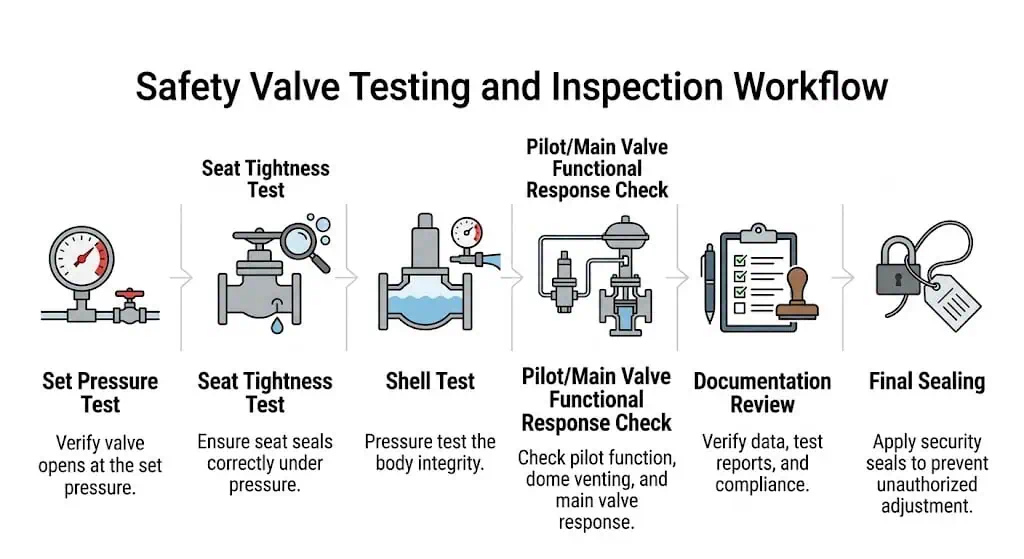
Equipment lists and factory photographs provide context, but purchasing approval should use records connected to the ordered valve. Agree the evidence package before the purchase order.
Approved datasheet, sizing basis, drawing, material list and revision history.
Heat or batch traceability, inspection-document type and supplementary PMI or impact-test requirements.
Machining dimensions, assembly instructions, calibrated equipment and defined inspection points.
Valve identification, set-pressure result, shell and seat-leakage records, witness status and release note.
Review certificate requirements | Review material traceability
Project experience
Who is responsible
FAQ
Provide the protected equipment, governing relief case, required capacity, medium properties, set and relieving pressures, operating and relieving temperatures, back pressure, connections, materials, code route and document requirements.
No. Pipe size does not prove relieving capacity, and set pressure does not address the relief case, fluid properties, temperature, back pressure, materials or installation stability.
Consider alternative designs when back pressure, operating margin, tightness or system behavior makes a conventional spring-loaded valve unsuitable. The final choice depends on verified process and discharge conditions.
Typical records include the approved datasheet and drawing, material traceability, dimensional inspection, calibrated test equipment references, set-pressure and leakage results, witness records and final document index.
No. Check the certified entity, standard edition, tested design, size and pressure scope, material limitations, validity and traceability to the ordered configuration.
Next step
A complete enquiry reduces clarification cycles and makes technical exceptions visible before procurement approval.