A safety valve is the final automatic pressure-protection device between normal operation and an overpressure event. It must open at the required pressure, discharge enough fluid, remain stable under the installed conditions and reseat after system pressure returns to a safe level. Safety valve selection should therefore never be based only on inlet size, outlet …

A safety valve is the final automatic pressure-protection device between normal operation and an overpressure event. It must open at the required pressure, discharge enough fluid, remain stable under the installed conditions and reseat after system pressure returns to a safe level.
Safety valve selection should therefore never be based only on inlet size, outlet size, flange class or price. A DN50 or NPS 2 valve may fit the equipment nozzle but still have insufficient certified relieving capacity. A valve may also have the correct set pressure and still perform poorly if the inlet pressure loss is excessive, the outlet system creates too much back pressure, the medium changes phase during relief or the trim and seat materials are unsuitable.
Engineering takeaway:
Select the safety valve from the protected equipment and credible relief scenario first. Then confirm set pressure, required relieving capacity, manufacturer-certified capacity, fluid state, relieving temperature, back pressure, materials, installation and the applicable code or project specification.
Scope of this guide
This page covers reclosing safety valves and pressure relief valves used for pressure protection. It is not a complete design method for rupture discs, vacuum relief devices, pressure regulators, HIPPS, flare-network design or emergency depressuring systems. Project-specific calculations, official standards, jurisdictional rules and manufacturer-certified data remain controlling.
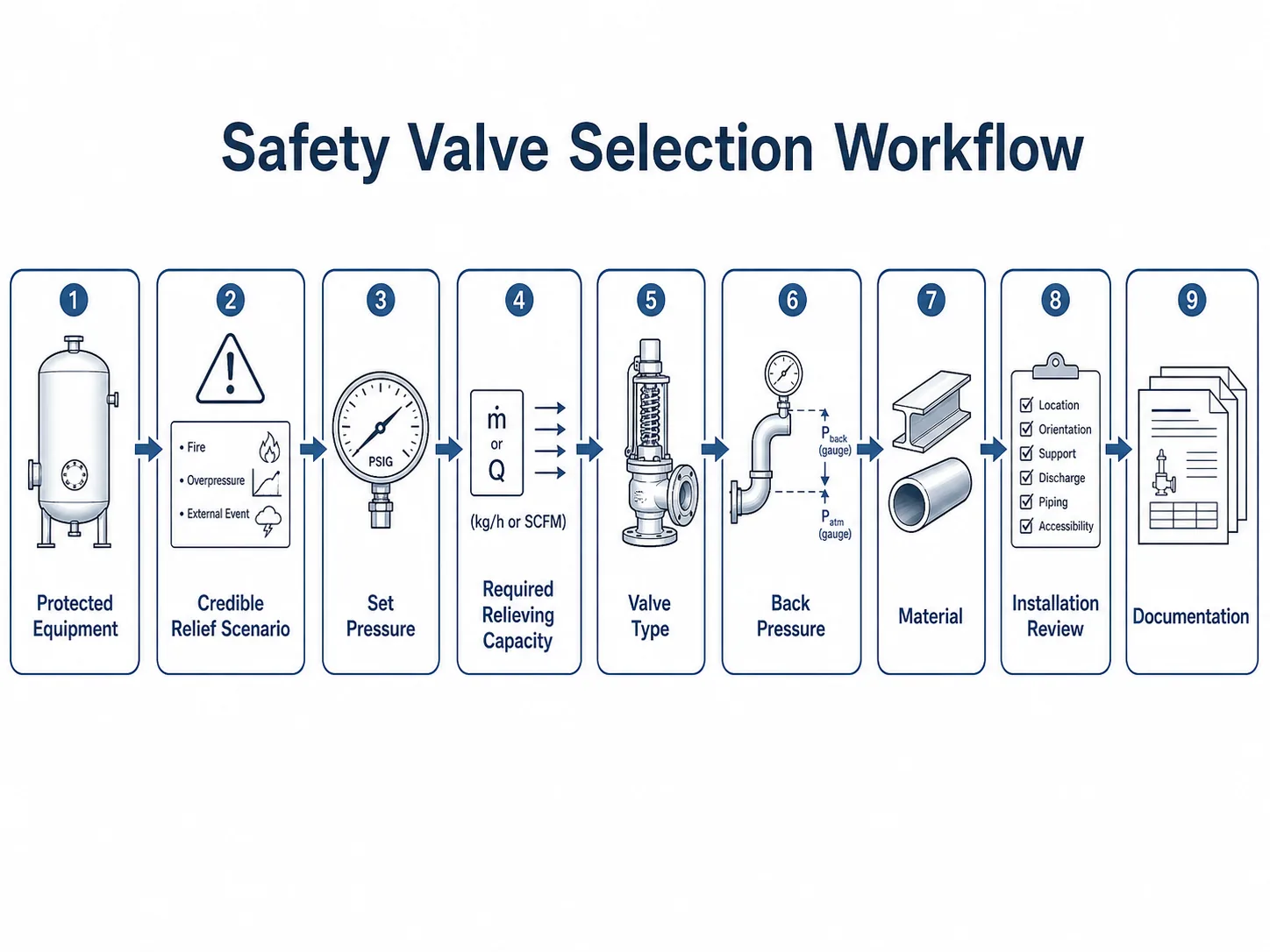
60-Second Safety Valve Selection Checklist
Before selecting a model or asking for a quotation, confirm whether these ten inputs are available. Missing data does not always prevent an initial discussion, but it does prevent a defensible final selection.
Protected equipment
Vessel, boiler, exchanger, line, compressor or skid.
Vessel, boiler, exchanger, line, compressor or skid.
MAWP or allowable limit
The pressure boundary the valve must protect.
The pressure boundary the valve must protect.
Set pressure
The specified opening condition.
The specified opening condition.
Governing relief case
Fire, blocked outlet, tube rupture, thermal expansion or another case.
Fire, blocked outlet, tube rupture, thermal expansion or another case.
Required relieving load
Mass or volumetric flow from an approved calculation basis.
Mass or volumetric flow from an approved calculation basis.
Medium and phase
Steam, gas, liquid, flashing or two-phase flow.
Steam, gas, liquid, flashing or two-phase flow.
Relieving temperature
Not only the normal operating temperature.
Not only the normal operating temperature.
Back pressure
Superimposed and built-up pressure at the outlet.
Superimposed and built-up pressure at the outlet.
Materials and seat
Body, trim, spring, bellows, seals and seat requirements.
Body, trim, spring, bellows, seals and seat requirements.
Code and documents
Required standard, edition, tests, certificates and marking.
Required standard, edition, tests, certificates and marking.
Already have a datasheet or process specification?
Send it with the required relieving capacity and back-pressure data for an initial technical review.
What Is a Safety Valve in Pressure Protection?
A safety valve is a self-actuated pressure-relieving device that opens automatically when its inlet pressure reaches the specified set condition. It discharges fluid to prevent the protected equipment or pressure system from exceeding its permitted pressure boundary.
The terms safety valve , relief valve , safety relief valve , pressure safety valve , pressure relief valve , PSV and PRV are sometimes used differently by industry, region and project specification. The abbreviation alone does not define the correct valve. Selection must still confirm the service medium, opening characteristic, required capacity, back pressure, temperature, materials, installation and certification basis.
Safety valve
Commonly associated with steam, air, gas and other compressible fluids, often with rapid or pop-action opening depending on design.
Relief valve
Often associated with liquid or thermal-relief service and may open more progressively, depending on design and application.
Safety relief valve
A broader term that may cover gas, vapor, steam or liquid service when the design and certification support the specified application.
PSV / PRV
Useful project abbreviations, but they should be defined in the datasheet because PRV can also mean pressure-reducing valve in other contexts.
Steam, gas, liquid and two-phase flow do not behave the same during pressure relief. A valve suitable for clean compressed air may be unsuitable for flashing liquid, wet steam, corrosive gas or a polymerizing medium even when its pressure class and connection size appear acceptable.
The Core Principle of Safety Valve Selection
Do not select a safety valve by connection size alone. Connection size confirms mechanical fit. It does not prove relieving capability or installed stability.
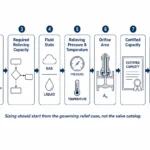
Protected equipment → credible relief scenario → required relieving capacity → valve type → certified capacity → materials → installation review → documentation
The main selection variables are:
- protected equipment and applicable pressure boundary;
- credible overpressure scenario and governing relief case;
- set pressure, relieving pressure, overpressure, accumulation and blowdown;
- required relieving capacity and manufacturer-certified capacity;
- fluid composition, phase, density or molecular properties and relieving temperature;
- superimposed and built-up back pressure;
- inlet pressure loss and outlet-system resistance;
- body, trim, spring, bellows, seat and seal materials;
- connection standard, pressure-temperature rating and installation orientation;
- applicable code, test, certification and documentation requirements.
A replacement valve may bolt directly onto an existing nozzle and still reduce the original protection if its orifice, flow coefficient or certified capacity is lower. The first procurement question should therefore be “What relief case must this valve protect against?” rather than “What flange size is required?”
Step 1: Identify the Protected Equipment and Credible Relief Scenario
Start by defining what the valve protects. A steam boiler, pressure vessel, LPG vessel, compressor package, reactor, heat exchanger, pump discharge line and blocked-in liquid section can have very different relief requirements.
Typical protected equipment includes pressure vessels, boilers, steam headers, air receivers, separators, filters, heat exchangers, reactors, storage vessels, compressor systems, process skids and liquid-filled piping sections.
Then identify the credible overpressure cases. Common examples include:
- blocked outlet or closed downstream valve;
- external fire exposure;
- thermal expansion of trapped liquid;
- control valve or pressure regulator failure;
- heat exchanger tube rupture;
- utility, cooling or power failure;
- gas blow-by from a higher-pressure system;
- chemical reaction, vapor generation or runaway conditions;
- compressor discharge overpressure;
- other project-specific operating or fire contingencies.
Do not size from normal operation.
The governing case may be a fire, tube rupture, blocked outlet or another emergency condition with a much higher relieving load than normal pressure fluctuation.
The relief scenario and required relief rate should be established by qualified personnel using the equipment design basis, process data, applicable code, project specification and current operating conditions. For more detail, see the Safety Valve Sizing and Certified Relieving Capacity Guide and the API 521 Pressure Relief Systems Guide .
Step 2: Confirm Set Pressure, Overpressure, Accumulation and Blowdown
The pressure terms must be reviewed together because they describe different parts of the protection function.
| Term | Practical meaning | Why it matters |
|---|---|---|
| Operating pressure | Normal system pressure during operation. | Must provide an appropriate margin below set pressure for the selected valve and service. |
| Set pressure | The inlet pressure at which the valve demonstrates the specified opening characteristic under defined conditions. | Determines when overpressure protection begins. |
| Overpressure | The pressure increase above set pressure during relief. | Used with the sizing and rated-capacity basis. |
| Accumulation | The pressure rise above the protected equipment’s MAWP or applicable allowable pressure limit during relief. | Relates to the equipment pressure boundary, not merely the valve set point. |
| Blowdown | The difference between set pressure and reseating pressure, normally expressed as a percentage of set pressure. | Affects how far system pressure falls before the valve closes. |
| Reseating pressure | The inlet pressure at which the valve closes after relieving. | Influences cycling, leakage and process recovery. |
Operating pressure that remains too close to set pressure can increase simmer, leakage or cycling. Raising set pressure to stop leakage is not an acceptable shortcut unless the change is supported by engineering approval, code review, recalibration, resealing and updated documentation.
Overpressure and accumulation are related but are not interchangeable. Overpressure is referenced to set pressure and is connected to valve capacity. Accumulation is referenced to the protected equipment’s allowable pressure boundary.
For a detailed pressure-term explanation, read Safety Valve Set Pressure, Overpressure and Blowdown Explained .
Step 3: Calculate the Required Relieving Capacity
Required relieving capacity is the flow that must be discharged during the governing relief case to keep the protected equipment within the applicable pressure limit. This value must be established before selecting a catalog model.
The sizing input normally includes:
- protected equipment and MAWP or design-pressure basis;
- set pressure and allowable overpressure or accumulation;
- governing relief scenario;
- fluid composition and phase at relieving conditions;
- relieving temperature and upstream pressure;
- required mass flow or volumetric flow;
- back pressure and discharge destination;
- applicable sizing method, code and correction factors.
The selected valve should have manufacturer-certified relieving capacity equal to or greater than the required capacity under the specified conditions. Nominal inlet size, outlet size and pressure class do not demonstrate this.
Illustrative screening example — not project data
Why a Matching Flange Size Can Still Fail the Capacity Check
| Protected equipment | Compressed-air receiver |
|---|---|
| MAWP | 10 bar(g) |
| Normal operating pressure | 7.5 bar(g) |
| Set pressure | 10 bar(g) |
| Required relieving capacity | 1,250 kg/h from the approved governing-case calculation |
| Candidate A | Same inlet flange, certified capacity 900 kg/h — reject for insufficient capacity |
| Candidate B | Certified capacity 1,420 kg/h — may proceed to back-pressure, material, connection and installation review |
This example demonstrates the screening logic only. It is not a sizing calculation and the values must not be reused for another installation.
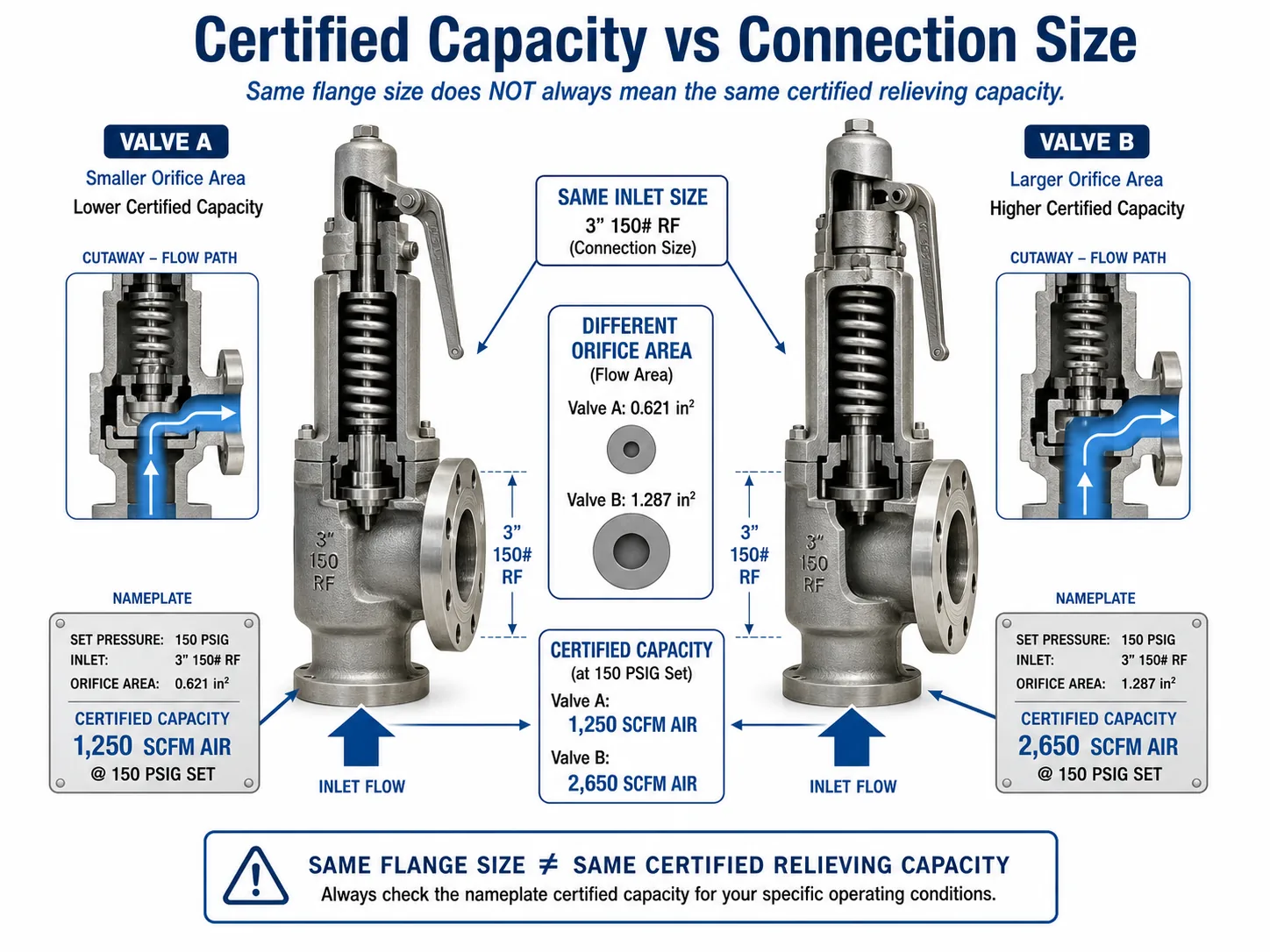
Review the nameplate, datasheet, model identification and capacity documentation together. Confirm the set pressure, orifice designation, rated capacity, capacity basis or test medium, temperature basis, inlet and outlet size, code marking, manufacturer and valve identification.
Special calculation review is required
for two-phase flow, flashing liquid, high-viscosity or non-Newtonian fluids, reactive systems and unusual mixtures. A gas-only or liquid-only catalog assumption should not be used unless the method is technically justified.
For process-industry sizing, review the API 520 Safety Valve Sizing Guide together with project calculations and manufacturer-certified data.
Do you know the required relief load but not the valve model?
Provide the calculation basis, set pressure, medium, temperature and back pressure so the candidate capacity can be screened correctly.
Step 4: Choose the Right Safety Valve Type
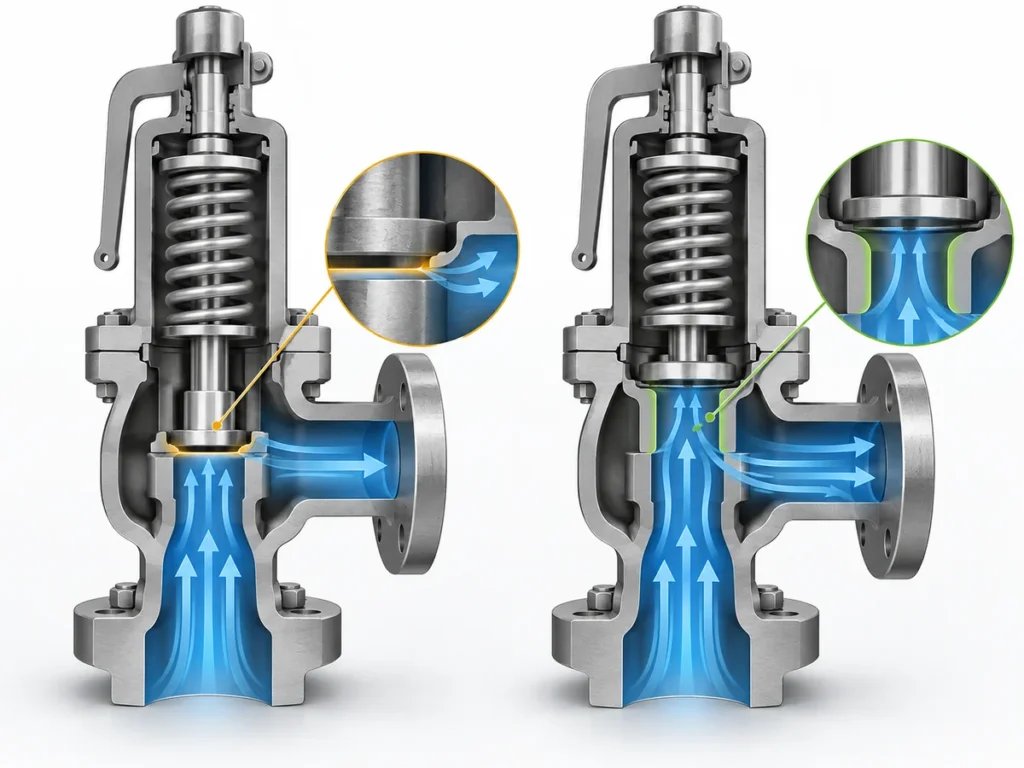
| Valve type | Typical strengths | Main review points |
|---|---|---|
| Conventional spring-loaded | Simple construction, broad availability, familiar maintenance and suitability for many steam, air, gas and liquid duties. | Back pressure, operating margin, inlet loss, outlet resistance, seat tightness and service cleanliness. |
| Balanced bellows | Reduces the effect of back pressure on the spring-loaded valve’s force balance and may isolate upper parts from some process exposure. | Bellows pressure and temperature limits, corrosion, fatigue, bonnet venting, inspection access and manufacturer limits. |
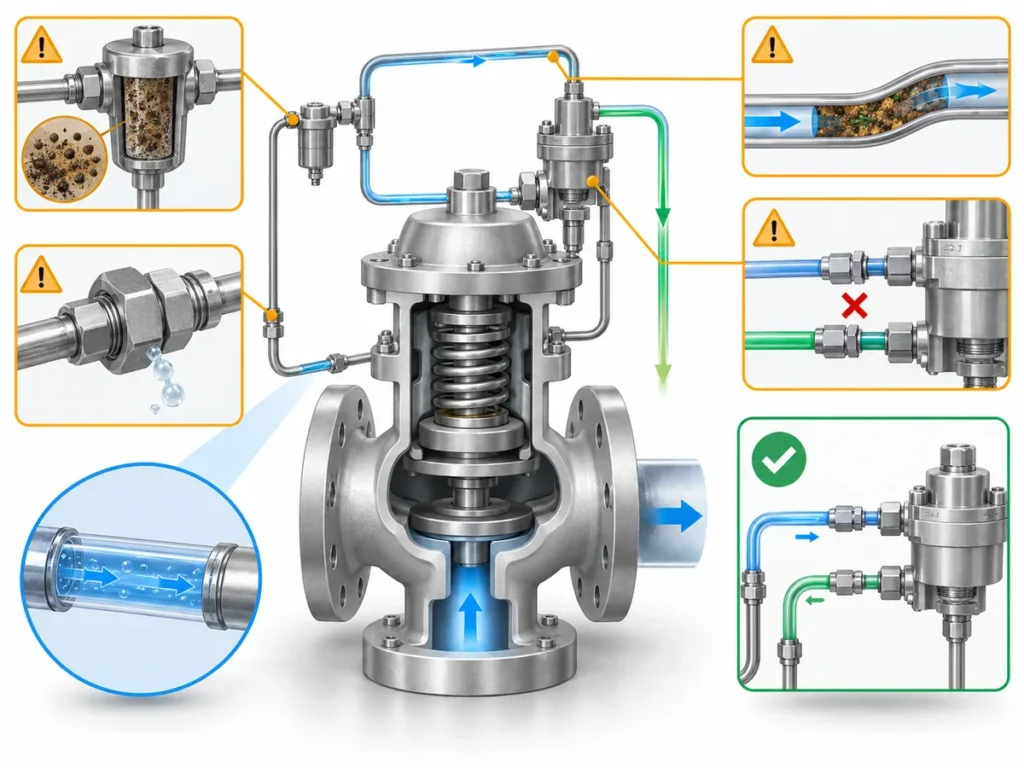
| Pilot-operated | Can provide tight shutoff, high-pressure capability, large capacity and operation closer to set pressure in suitable clean services. | Pilot and sensing-line cleanliness, plugging, liquid carryover, icing, polymerization, variable back pressure and maintenance capability. |
Conventional Spring-Loaded Safety Valve
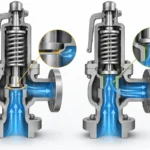
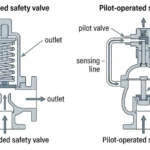
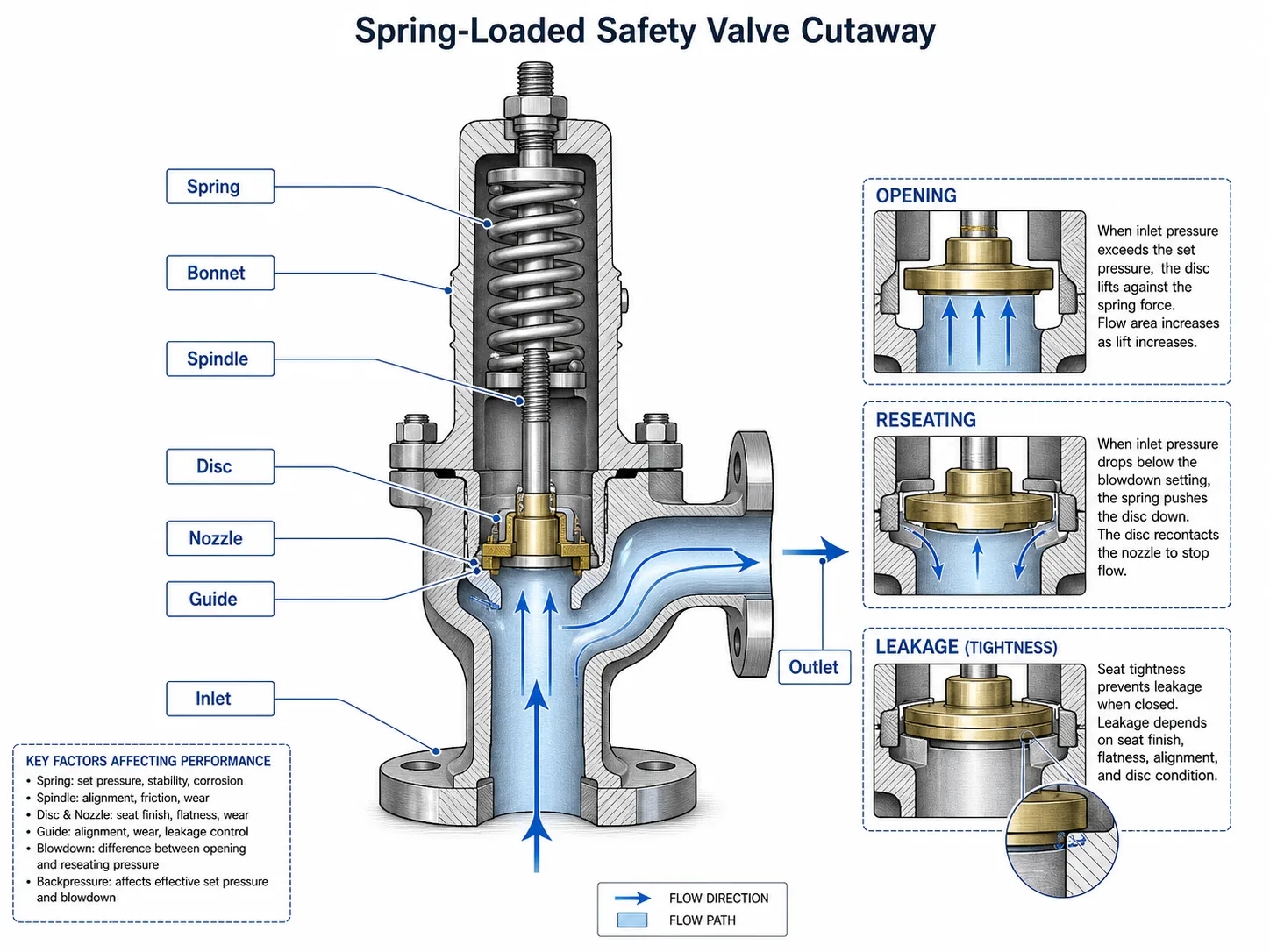
This is the most common design. A spring applies closing force to the disc. It is often suitable where the service is reasonably clean, the operating pressure margin is acceptable and the discharge condition remains within the manufacturer’s limits.
Balanced Bellows Safety Valve
A bellows can reduce back-pressure influence on the valve’s force balance, but it is a critical pressure- and movement-sensitive component. The bellows material, corrosion exposure, cyclic fatigue, vent arrangement and inspection requirements must be reviewed. A blocked bonnet vent can invalidate the intended behavior.
Pilot-Operated Safety Valve
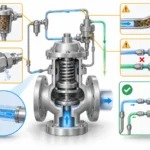
A pilot-operated valve uses system pressure and a pilot mechanism to control the main valve. It may be advantageous in high-pressure, large-capacity or tight-shutoff applications. It requires particular caution with dirty, sticky, crystallizing, waxy, polymerizing or particle-containing media because the sensing path and pilot circuit can become restricted.
For a direct comparison, read Spring-Loaded vs Pilot-Operated Safety Valves . For back-pressure applications, also review Back Pressure and Bellows in Safety Valves .
Spring-Loaded Safety Valves
Direct-acting designs for many steam, gas, vapor and liquid duties where operating margin and back pressure remain suitable.
Bellows Balanced Safety Valves
Spring-loaded designs used where back-pressure effects, bonnet isolation or service exposure require additional review.
Pilot-Operated Safety Valves
Main-valve and pilot configurations for suitable clean-service, high-pressure, large-capacity or tight-shutoff applications.
Step 5: Confirm the Medium and Fluid State at Relieving Conditions
The valve must be selected for the fluid condition during the relief event, not only for normal operation. Pressure reduction through the valve can change phase, temperature and flow behavior.
Steam
Check saturated versus superheated conditions, temperature limits, trim and spring exposure, drainage, reaction force, outlet support and condensate accumulation.
Gas or air
Review compressible-flow capacity, high discharge velocity, noise, reaction force, gas composition, entrained liquid, corrosion and outlet-system resistance.
Liquid
Consider density, viscosity, thermal expansion, pump deadhead, pressure surge, flashing potential, stable opening and the safe discharge destination.
Two-phase or flashing flow
Use a validated engineering method and manufacturer review. Do not assume that a gas-only or liquid-only equation represents the actual relieving condition.
Also identify contamination, solids, corrosion products, crystallization, polymerization, toxicity, sour-gas exposure, oxygen cleanliness, sanitary requirements and other properties that affect valve design, materials, cleaning, maintenance and documentation.
When Engineering or Manufacturer Review Is Mandatory
Do not complete the selection from a general catalog table alone when any of the following conditions apply:
- two-phase or flashing flow;
- high-viscosity, non-Newtonian, crystallizing or polymerizing media;
- toxic, sour, oxygen, cryogenic or otherwise hazardous service;
- variable superimposed back pressure or high built-up back pressure;
- discharge to a common flare, vent or closed header;
- multiple relief devices protecting one pressure system;
- severe pulsation, vibration, liquid carryover or frequent cycling;
- unusual installation orientation or remote sensing arrangement;
- process changes affecting pressure, temperature, composition or relief load;
- uncertain certification, capacity basis, code marking or standard edition.
Required action: document the uncertainty, provide the full process and piping data, and obtain review from the responsible project engineer and the valve manufacturer before purchase or installation.
Step 6: Evaluate Back Pressure Before Final Selection
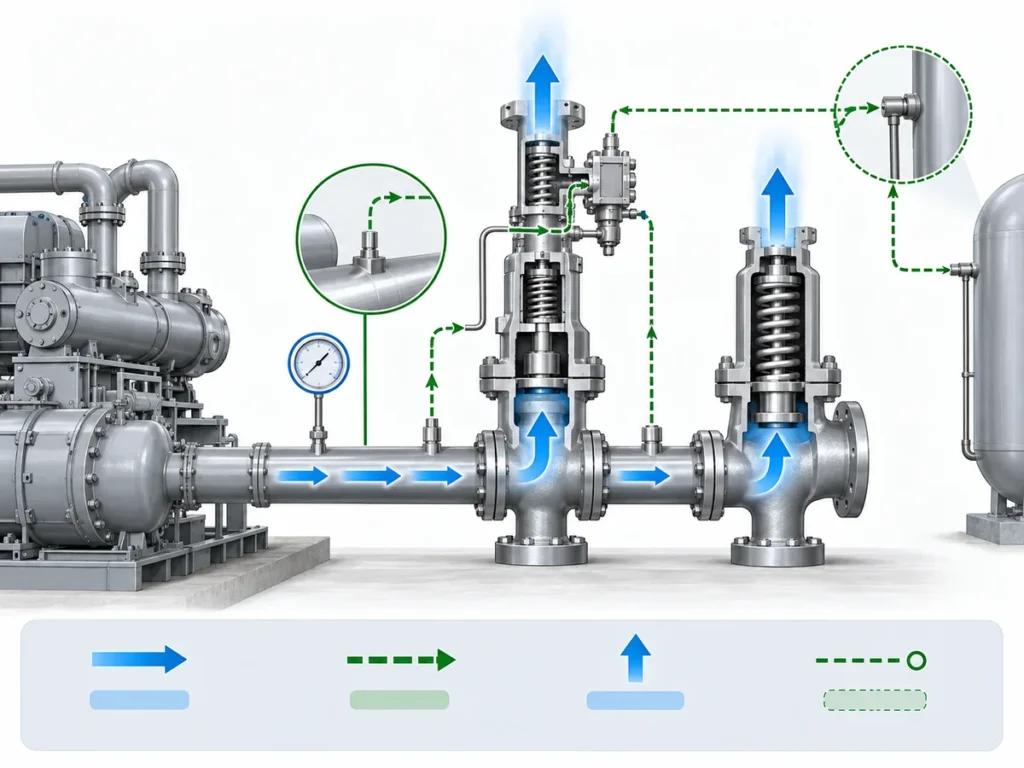
Back pressure is pressure at the outlet of the safety valve. It may exist before the valve opens or be generated by discharge flow after opening.
Superimposed Back Pressure
Superimposed back pressure is present in the discharge system before the valve opens. It may be constant or variable, for example when the valve connects to a pressurized header.
Built-Up Back Pressure
Built-up back pressure is generated after the valve opens as flow passes through outlet piping, elbows, silencers, vent stacks, flare headers or other restrictions.
Back pressure can affect opening behavior, available lift, capacity, flow stability, blowdown and reseating. Its effect is design-dependent; there is no single universal formula that can be applied to conventional, balanced bellows and pilot-operated valves in the same way.
Review:
- maximum and minimum superimposed back pressure;
- whether superimposed back pressure is constant or variable;
- built-up back pressure at the required relieving rate;
- outlet pipe size, length, fittings and elevation;
- silencer, vent stack, flare or common-header resistance;
- simultaneous relief from other devices;
- reaction force, drainage and piping support;
- manufacturer limits for the selected design.
A valve can pass a bench set-pressure test and still chatter or lose stability after installation if the outlet system creates excessive or variable back pressure.
Use the Back Pressure and Bellows Guide for design selection and the Safety Valve Installation Guide for outlet-piping review.
Step 7: Select Suitable Materials and Seat Design
Material selection must be component-specific. The body, bonnet, nozzle, disc, guide, spindle, spring, bellows, seat, gasket, O-ring and fasteners do not necessarily require the same material.
| Component | Main exposure | Potential failure |
|---|---|---|
| Body and bonnet | Pressure, temperature, external atmosphere and process exposure | Corrosion, leakage, loss of pressure-boundary integrity |
| Nozzle and disc | Sealing, erosion, corrosion and thermal distortion | Seat leakage, wire drawing and poor reseating |
| Guide and spindle | Sliding contact, deposits, galling and alignment | Sticking, chatter or restricted lift |
| Spring | Temperature, corrosion and mechanical cycling | Set-pressure drift or loss of required force |
| Bellows | Back pressure, corrosion and cyclic movement | Fatigue, leakage and loss of balancing function |
| Soft seat and seals | Chemical compatibility, temperature and compression | Swelling, hardening, extrusion or leakage |
Metal Seat vs Soft Seat
Metal seats are often preferred for high-temperature steam and severe service because they tolerate heat and erosion better. Soft seats can provide tighter shutoff in suitable clean service, but the material must be compatible with the temperature, pressure, medium and required service life.
Where seat leakage testing is specified, use the current project requirement and the applicable acceptance basis. The API 527 Seat Tightness Test Guide explains the role of API 527 for conventional, bellows and pilot-operated pressure relief valves.
For component-by-component selection, read the Safety Valve Material Selection Guide .
Step 8: Review Installation Conditions
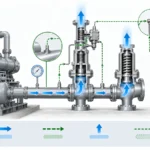
A correctly sized valve can still perform poorly if the inlet or outlet piping is unsuitable. The valve and piping should be reviewed as one pressure-relief installation.
Inlet Piping
Keep the inlet path direct and adequately sized. Restrictions, undersized nozzles, long runs, excessive fittings, poorly selected isolation valves and pressure drop can destabilize the valve. Excessive inlet pressure loss can cause rapid opening and closing, chatter, seat damage and reduced service life.
Outlet Piping
Review back pressure, reaction force, support, drainage, thermal expansion, discharge direction and safe disposal. Outlet piping should not impose damaging loads or misalignment on the valve body. Closed headers require evaluation of header pressure and simultaneous relief cases.
Orientation, Drainage and Temperature Control
Install the valve in the manufacturer-approved orientation. Many spring-loaded valves are intended for upright vertical installation unless another orientation is specifically approved. Steam and wet-gas systems may require drainage. Viscous, crystallizing, freezing or polymerizing services may require insulation, tracing, flushing or other controls, but heating must not exceed the limits of the spring, seat, seals, pilot or other components.
See the complete Safety Valve Installation Guide for inlet, outlet, support and discharge review.
Step 9: Check Applicable Standards and Certification Requirements
The applicable requirements depend on the protected equipment, country, jurisdiction, industry, owner specification and valve design. Standards should be connected to a specific engineering or procurement decision rather than listed as marketing labels.
| Reference | Typical role | Useful links |
|---|---|---|
| ASME BPVC | Boiler and pressure-vessel construction and overpressure-protection framework where ASME Code applies. | ZOBAI ASME guide · ASME official page |
| API 520 Part I | Sizing and selection of pressure-relieving devices in covered process-industry applications. | ZOBAI API 520 guide · API official page |
| API 520 Part II | Installation and engineering analysis for pressure-relieving-device installations. | Installation guide · API official page |
| API 521 | System-level relief scenarios, pressure-relieving and depressuring-system design. | ZOBAI API 521 guide · API official page |
| ISO 4126 | International safety-device requirements, including safety valves and pilot-operated safety valves. | ZOBAI ISO 4126 guide · ISO 4126-1 · ISO 4126-4 |
| API 527 | Seat-tightness test methods and acceptance communication when specified. | Current API 527 guide |
| NBIC / National Board VR | Repair authorization and controlled repair documentation in applicable ASME/NBIC contexts. | National Board official page |
Standards notice:
ZOBAI overview pages do not replace official copyrighted standards, the project specification, manufacturer-certified data, jurisdictional requirements or authorized engineering review. Always confirm the edition required by the project.
Browse the complete Safety Valve Standards Center for API, ASME, ISO, DIN/EN, GB, flange and pressure-temperature references.
Step 10: Prepare a Safety Valve Procurement Checklist
A supplier cannot correctly select a safety valve from connection size and pressure class alone. Provide enough process, equipment and documentation data for a meaningful review.
| RFQ item | Why it is required |
|---|---|
| Protected equipment | Defines the pressure boundary and applicable code context. |
| MAWP / design pressure | Identifies the protected equipment limit. |
| Operating pressure | Supports operating-margin and leakage review. |
| Set pressure | Defines the required opening condition. |
| Relief scenario | Identifies the governing emergency case. |
| Required relieving capacity | Determines the minimum required certified capacity. |
| Medium and composition | Affects sizing, materials, valve type and safety controls. |
| Fluid state at relief | Distinguishes gas, steam, liquid, flashing or two-phase methods. |
| Relieving temperature | Affects capacity and component temperature limits. |
| Back pressure | Affects design selection, capacity and stability. |
| Inlet / outlet connections | Confirms dimensions, pressure class, facing and piping compatibility. |
| Body / trim / seat materials | Controls corrosion, temperature, leakage and service life. |
| Applicable standard and edition | Defines the required compliance and documentation basis. |
| Testing and certificates | Clarifies calibration, pressure test, leakage test and handover records. |
Documents to Request
- approved valve datasheet;
- general arrangement drawing;
- manufacturer-certified capacity data or applicable capacity certificate;
- material test certificates for specified components;
- shell or pressure test report where required;
- seat-tightness test report where required;
- set-pressure calibration certificate;
- nameplate and tagging information;
- installation, operation and maintenance instructions;
- code, conformity or certification documents required by the purchase order;
- repair and recertification records for repaired valves.
Use the detailed Safety Valve Procurement Checklist for Engineers and Buyers when preparing an inquiry.
Common Safety Valve Selection Mistakes
-
Selecting by nominal size instead of capacity.
Equal inlet sizes do not guarantee equal orifice areas, flow coefficients or certified capacities. -
Using normal operation as the sizing case.
The governing relief case may be fire, blocked outlet, tube rupture, reaction or another emergency scenario. -
Ignoring back pressure.
Outlet piping, silencers, flare headers and simultaneous relief can change installed behavior. -
Using the wrong design for dirty service.
Pilot passages, sensing lines, soft seats and close-clearance parts may be affected by particles, deposits or polymerization. -
Specifying only the body material.
The seat, nozzle, disc, guide, spring, bellows, seals and fasteners may control reliability. -
Reusing an old valve after a process change.
Changes in pressure, temperature, composition, relief load or discharge piping require renewed review. -
Repairing without controlled testing.
Cleaning or lapping alone does not confirm set pressure, seat tightness, reseating behavior, tagging or code compliance. -
Treating a code name as proof of suitability.
The exact edition, scope, marking, capacity basis, test documentation and project requirement must be confirmed.
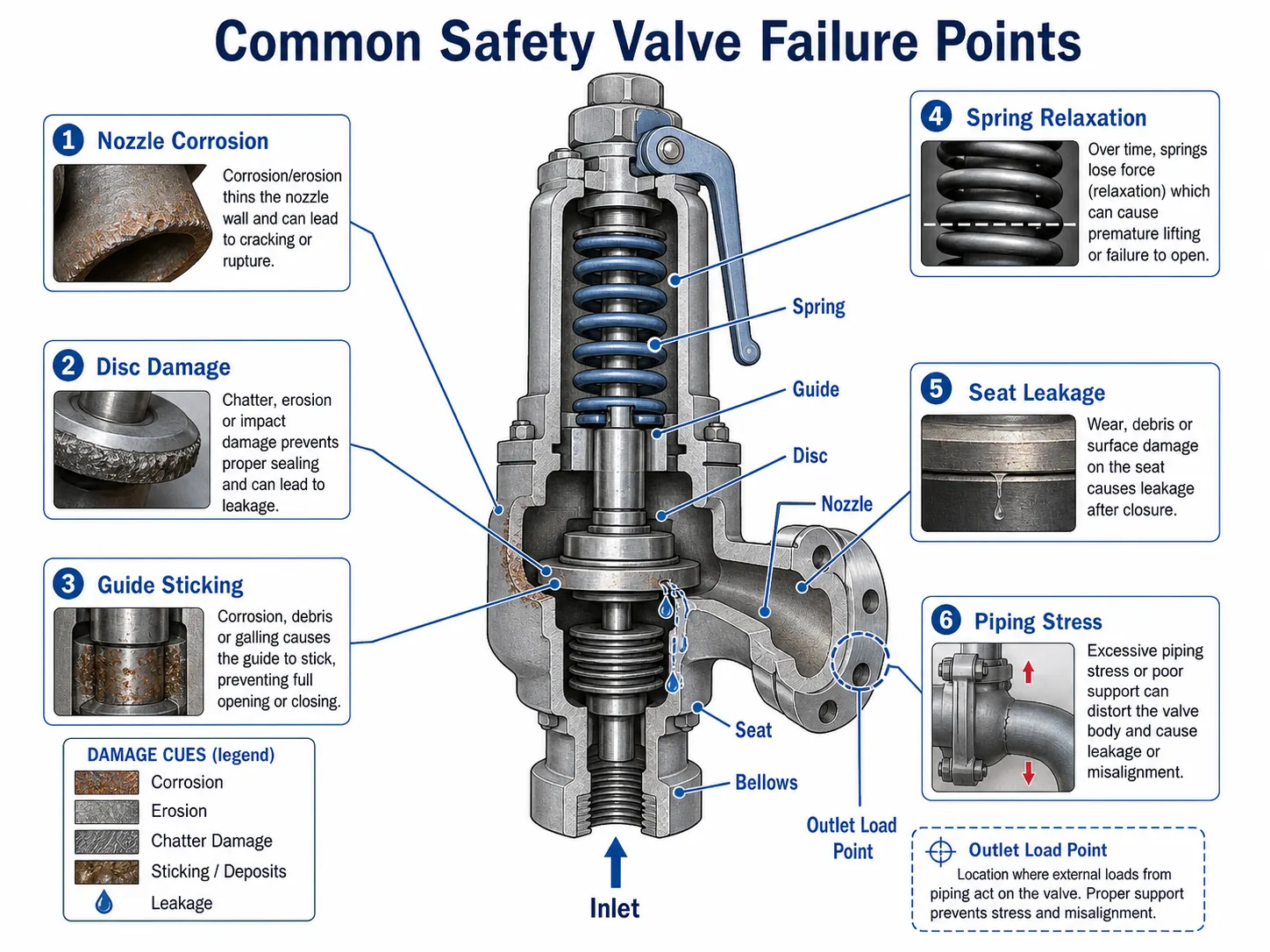
For leakage after opening or maintenance, read Why Safety Valves Leak After Popping .
Expert Selection Summary
A complete safety valve selection should answer four questions:
- When will it open? Confirm set pressure, operating margin and the protected equipment limit.
- How much can it relieve? Confirm the governing load, calculation basis, orifice and manufacturer-certified capacity.
- Will it operate stably after installation? Review inlet loss, outlet resistance, back pressure, piping loads, drainage and valve design.
- Will it survive the service? Review medium, phase, temperature, corrosion, erosion, materials, seat design and maintenance conditions.
The best safety valve is not the valve with the largest connection or highest pressure class. It is the valve whose set pressure, capacity, design, materials, installation and documentation match the actual pressure-protection duty.
FAQ About Safety Valve Selection
How do I choose the right safety valve?
Identify the protected equipment and governing relief scenario, calculate the required relieving capacity, then confirm set pressure, fluid state, relieving temperature, back pressure, valve design, certified capacity, materials, installation and applicable requirements.
What is the difference between a safety valve and a relief valve?
A safety valve is commonly associated with rapid opening in steam, gas or other compressible-fluid service. A relief valve is often associated with liquid or thermal-relief service and may open more progressively. Actual terminology depends on design, code, industry and project specification.
Why is certified relieving capacity more important than connection size?
Connection size confirms mechanical fit. Certified relieving capacity confirms how much flow the valve can discharge under a defined basis. Two valves with the same inlet size can have different orifices and capacities.
How does back pressure affect safety valve selection?
Back pressure can affect the force balance, lift, capacity, stability, blowdown and reseating behavior. The effect depends on whether the valve is conventional, balanced bellows or pilot-operated and whether the back pressure is constant, variable or built up by discharge flow.
When should a pilot-operated safety valve be considered?
It may be considered for suitable clean-service applications requiring high pressure, large capacity, tight shutoff or operation closer to set pressure. Dirty, sticky, crystallizing, polymerizing or particle-containing media require careful review because pilot and sensing passages can become restricted.
What materials should be specified for corrosive service?
Review each component rather than specifying only the body. The body, nozzle, disc, guide, spindle, spring, bellows, seat, gaskets, seals and fasteners may need different materials based on the corrosion mechanism, temperature, pressure and movement.
Why can a safety valve leak after installation?
Possible causes include damaged or contaminated seats, operating pressure too close to set pressure, corrosion, unsuitable seat material, thermal distortion, piping stress, chatter, calibration problems or back-pressure fluctuations.
How often should a safety valve be tested or recalibrated?
There is no universal interval for every installation. The interval depends on jurisdiction, equipment code, service severity, medium, operating history, plant procedure, prior inspection results and manufacturer guidance.
Which standards should be checked before buying a safety valve?
The answer depends on the equipment and project. Common references include ASME BPVC, API 520, API 521, ISO 4126, API 527 and applicable National Board or NBIC requirements. Always confirm the required edition and scope.
What documents should be requested from a supplier?
Typical documents include the datasheet, drawing, certified capacity information, material certificates, pressure and seat-leakage test reports, calibration certificate, nameplate details, installation manual and project-required conformity or repair records.
Need Help Reviewing a Safety Valve Selection?
Send the protected equipment, MAWP, operating pressure, set pressure, relief scenario, required capacity, medium, relieving temperature, back pressure, connection, material and certificate requirements for technical review.
Ask an Engineer Request a Quote