
Vacuum Protection • Tank Inbreathing & Vacuum Relief Valves
Vacuum Safety Valves Manufacturer for Storage Tanks and Process Equipment
Vacuum safety valves are engineered devices used to protect storage tanks, low-pressure vessels, condensate tanks, sanitary tanks and process equipment from excessive vacuum. When internal pressure drops below the selected vacuum set point, the valve opens to admit air, nitrogen or another suitable gas to prevent tank deformation or collapse.
ZOBAI supplies vacuum safety valves, vacuum relief valves, vacuum breaker valves and pressure vacuum relief valves with engineering support for tank design vacuum, vacuum set point, required inbreathing capacity, medium, materials, seat tightness, vent piping and project documentation.
Valve Type: Vacuum Relief / Vacuum Breaker / Pressure Vacuum Valve
Service: Storage Tank / Condensate / Sanitary / Chemical / Solvent
Key Checks: Vacuum Set Point / Inbreathing Capacity / Tank Design Vacuum
Applications: API Tank / Low-Pressure Tank / Process Vessel / Sanitary Tank
Options: Air Inlet / Nitrogen Inlet / Flame Arrester / Weather Hood
Docs: Datasheet / Capacity Data / Test Report / Material Certificate
Vacuum safety valve selection should be confirmed against tank design vacuum, vacuum set point, required inbreathing capacity, vacuum scenario, medium, air or inert gas requirement, material compatibility, seat tightness, accessories and applicable project standards.
Safety Valve Categories
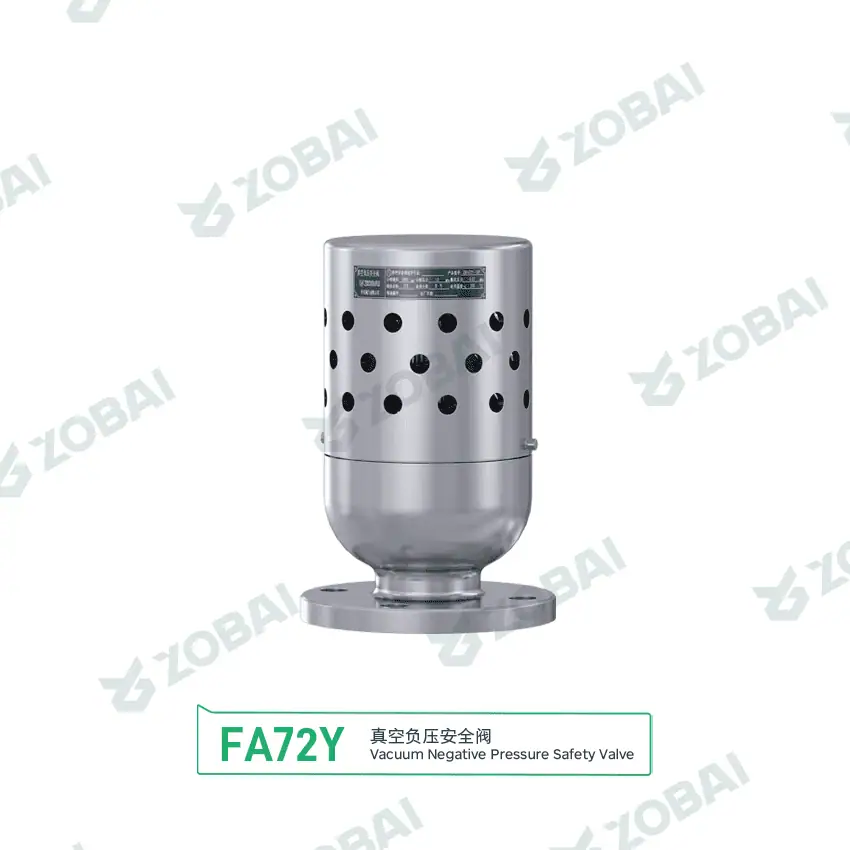
Vacuum Safety Valves for Tank and Equipment Vacuum Protection
Vacuum safety valves, also called vacuum relief valves or vacuum breaker valves in many applications, are used to protect tanks, vessels and process equipment from excessive internal vacuum. When internal pressure drops below the allowable vacuum limit, the valve opens to admit air, nitrogen or another suitable gas so the equipment is not pulled inward by external atmospheric pressure.
Why vacuum protection is different from overpressure relief
A conventional safety valve usually opens outward to release pressure. A vacuum safety valve works in the opposite direction: it opens inward to relieve vacuum by allowing gas into the protected equipment. This is especially important for atmospheric storage tanks, low-pressure tanks, condensate systems, steam-jacketed equipment, cooling vessels and process tanks that may experience pump-out, draining, condensation or cooling.
Vacuum damage can happen quickly because many atmospheric or low-pressure tanks are not designed to resist strong external pressure. A tank may deform or collapse even when there is no overpressure event. Correct selection depends on vacuum set point, required inbreathing capacity, tank design vacuum, medium, blanketing gas, weather exposure, vent pipe loss, seat tightness and maintenance access.
Selection boundary
Vacuum safety valves are commonly used on storage tanks, chemical tanks, low-pressure process vessels, condensate tanks, hot liquid tanks, sanitary tanks, reactor jackets and systems where rapid cooling or liquid withdrawal can create vacuum.
The valve should open before the tank or vessel reaches its maximum allowable vacuum. Capacity must also be enough for the largest credible inbreathing case.
How a Vacuum Safety Valve Works
A vacuum safety valve remains closed during normal operation. When internal pressure drops below the selected vacuum set point, the pallet, disc or spring-loaded element lifts inward and admits air or inert gas into the tank. Once internal pressure recovers, the valve reseats to limit unnecessary air entry, vapor loss or blanketing gas disturbance.
Normal Pressure
The valve stays closed while tank pressure remains within the normal operating range.
Vacuum Develops
Liquid withdrawal, pump-out, condensation or cooling lowers internal pressure.
Inbreathing Opens
The valve admits air or inert gas to relieve vacuum and protect the tank shell.
Reseating
After pressure recovers, the valve closes to reduce air ingress, vapor loss and contamination risk.
Key Design Points in Vacuum Safety Valves
Vacuum valve selection is mainly about protecting weak equipment from external atmospheric load. The correct design depends on tank vacuum rating, inbreathing capacity, set point accuracy, seat tightness, vent line losses, process medium and whether the valve also needs pressure relief capability.
Vacuum Set Point
The vacuum set point determines when the valve opens to admit air or inert gas. It must be lower than normal operating pressure but safely above the tank’s maximum allowable vacuum. A set point that is too low may allow tank deformation before the valve opens.
For thin-wall atmospheric tanks, the allowable vacuum margin is often small, so the valve setting, vent losses and maintenance condition should be reviewed together.
Required Inbreathing Capacity
Inbreathing capacity must cover credible vacuum scenarios such as liquid pump-out, gravity draining, steam condensation, rapid cooling, weather change, nitrogen blanketing failure or emergency emptying.
A valve with a suitable connection size may still be undersized if the actual liquid withdrawal rate or condensation rate is high.
Vacuum Relief Valve vs Pressure Vacuum Valve
A vacuum relief valve mainly protects against vacuum by admitting gas. A pressure vacuum valve can protect against both excessive pressure and excessive vacuum on atmospheric or low-pressure tanks.
If the tank can experience both outbreathing and inbreathing, a pressure vacuum relief valve may be more suitable than a vacuum-only device.
Materials, Seat and Leakage Control
Body, pallet, spring, seat and gasket materials should match the tank vapor, weather exposure, corrosion risk, temperature and cleaning conditions. Stainless steel, aluminum, carbon steel, PTFE, FKM or EPDM may be considered depending on service.
Seat tightness matters where air ingress, vapor loss, odor release, nitrogen consumption or product contamination must be controlled.
Quick Vacuum Safety Valve Fit Check
Use this quick guide to identify what should be reviewed before quotation. It does not replace the applicable tank or vessel design standard, API 2000 or ISO 28300 where in scope, or project engineering verification.
Select your vacuum protection case
Click one condition below to see the engineering checks that matter most.
Parameters That Decide Whether a Vacuum Safety Valve Is Suitable
Vacuum Safety Valve vs Pressure Safety Valve
| Item | Vacuum Safety Valve | Pressure Safety Valve |
|---|---|---|
| Main purpose | Prevents excessive vacuum and inward tank collapse. | Prevents excessive internal pressure and outward rupture. |
| Opening direction | Opens inward to admit air or inert gas. | Opens outward to discharge fluid or gas. |
| Key capacity | Required inbreathing capacity. | Required relieving capacity. |
| Typical cause | Pump-out, draining, cooling, condensation or blocked vent. | Fire, blocked outlet, overfilling, regulator failure or thermal expansion. |
| Typical equipment | Atmospheric tanks, low-pressure tanks, condensate tanks and process tanks. | Pressure vessels, boilers, pipelines, reactors and pressure systems. |
| Main selection risk | Undersizing inbreathing capacity or setting vacuum too low. | Undersizing certified relieving capacity or wrong set pressure. |
Where Vacuum Safety Valves Are Used
Atmospheric and low-pressure storage tanks
Storage tanks can develop vacuum during pump-out, draining, cooling or vapor condensation. Vacuum relief valves admit air or inert gas to prevent tank shell deformation or roof damage.
Pressure vacuum relief valve systems
Tanks that experience both filling outbreathing and emptying inbreathing often require pressure vacuum relief valves. This helps control both overpressure and vacuum within the tank operating envelope.
Steam condensation and hot liquid cooling
When steam condenses or hot liquid cools in a closed vessel, internal vapor volume can shrink rapidly. A vacuum breaker or vacuum safety valve can prevent equipment from being pulled inward.
Sanitary, chemical and solvent tanks
Sanitary and chemical tanks may require vacuum protection with cleanable construction, corrosion-resistant materials, soft seats, sanitary connections, nitrogen inlet or contamination control.
Vacuum Safety Valve Selection Table
| Service Condition | Common Requirement | Recommended Review | Key Engineering Check | Main Risk |
|---|---|---|---|---|
| Storage tank emptying | Admit air or gas during pump-out | Tank vacuum relief valve | Tank design vacuum, liquid withdrawal rate, inbreathing capacity and vent loss | Tank deformation from insufficient inbreathing |
| Pressure and vacuum tank service | Protect against both pressure and vacuum | Pressure vacuum relief valve | Pressure set point, vacuum set point, outbreathing and inbreathing capacity | Using vacuum-only valve where pressure relief is also required |
| Steam condensation | Prevent rapid vacuum during condensation | Vacuum breaker valve | Condensation rate, inlet gas source, temperature and seat material | Delayed opening or undersized air admission |
| Nitrogen blanketed tank | Maintain inert atmosphere while preventing vacuum | Vacuum valve with nitrogen supply review | Blanketing pressure, vacuum set point, gas capacity and seat tightness | Air ingress or excessive nitrogen consumption |
| Sanitary tank | Cleanable and contamination-controlled vacuum protection | Sanitary vacuum relief valve | Material, seal, cleanability, connection type and product compatibility | Contamination, sticking or poor cleaning access |
| Replacement project | Match old valve safely | Nameplate and venting case verification | Set point, capacity, material, connection, seat type and tank design vacuum | Replacing by size or appearance only |
This table is for preliminary engineering screening. Final selection must be confirmed against tank design vacuum, vacuum set point, required inbreathing capacity, medium, temperature, materials, seat tightness, vent piping, blanketing gas and applicable project standards.
Common Engineering Mistakes to Avoid
Selecting by nozzle size only
A vacuum relief valve with the same tank nozzle size may have very different inbreathing capacity. Pump-out rate, vent losses and tank design vacuum must be checked before selection.
Setting vacuum too close to collapse limit
If the valve opens too late, the tank may deform before enough air or gas enters. Vacuum set point should leave practical margin for valve tolerance, fouling and piping pressure drop.
Ignoring pallet sticking or blocked screens
Sticky vapors, dust, insects, ice, product carryover or corrosion can prevent a vacuum valve from opening or reseating. Routine inspection is part of real vacuum protection.
Vacuum Safety Valve Troubleshooting Table
| Symptom | Possible Cause | Engineering Check | Corrective Action |
|---|---|---|---|
| Tank pulls inward during emptying | Undersized valve, blocked vent, wrong set point or excessive pump-out rate | Check inbreathing calculation, pump rate, valve capacity and screen condition | Resize valve, clean vent path, reduce pump-out rate or add additional venting |
| Valve opens too often | Vacuum set point too high, unstable blanketing pressure or normal pressure fluctuation | Review operating pressure range, blanketing setting and valve set point | Adjust operating range, verify set point or select suitable valve type |
| Air ingress contaminates product | Atmospheric air admitted where inert gas is required | Check product sensitivity, oxygen/moisture limit and nitrogen blanketing design | Use inert gas admission, blanketing system or tighter seat design |
| Valve does not reseat tightly | Dirt, sticky vapor, damaged seat, corrosion or misalignment | Inspect pallet, seat, gasket, guide and product residue | Clean, repair, replace seal material or improve maintenance interval |
| Valve freezes or sticks outdoors | Condensation, ice, weather exposure or unsuitable material | Review weather hood, drain path, material, heating or insulation needs | Add protection, heat tracing, drainage or weather-suitable configuration |
Standards and Documents to Confirm Before Purchase
Standards to review
Vacuum safety valve specifications may reference tank venting standards, storage tank design standards, sanitary standards, material standards and project-specific testing requirements. The correct standard depends on whether the valve protects an atmospheric tank, low-pressure tank, sanitary tank or pressure vessel.
- API Standard 2000 for atmospheric and low-pressure tank venting; confirm the current active edition in the API Digital Catalog.
- ISO 28300 where atmospheric and low-pressure storage tank venting requirements apply.
- API Standard 650 or API Standard 620 where the tank design standard and allowable pressure or vacuum are part of the project scope.
- ASME BPVC Section VIII, Division 1 where pressure-vessel design includes external-pressure or vacuum conditions.
- Pressure relief valve and installation requirements for nitrogen blanketing, flame arresters, materials, seat tightness and testing.
- Sanitary safety valve or food-grade requirements where cleanability and contamination control are critical.
Documents buyers often request
Documentation should be confirmed before quotation, especially for storage tanks, chemical tanks, petroleum tanks, sanitary tanks, nitrogen blanketing systems and replacement projects.
- Valve datasheet and model specification.
- Vacuum set point and pressure set point if combined pressure vacuum design is required.
- Inbreathing capacity data and test basis.
- Material certificate when specified.
- Seat tightness or leakage test report when required.
- Connection standard, flange drilling or sanitary connection details.
- Existing drawing, nameplate photo and tank design vacuum for replacement projects.
Related Pages and Standards for Vacuum Protection
Use these links to connect the vacuum safety valve page with related ZOBAI safety valve categories, tank applications, engineering resources and official tank venting standards.
Recommended ZOBAI internal links
- Safety Valves — main product category hub.
- Vacuum Service Applications — tank inbreathing, condensation, pump-out and low-pressure equipment review.
- Pressure Relief Valves — compare pressure relief and vacuum relief applications.
- Sanitary Safety Valves — cleanable tanks and sanitary process applications.
- Spring Loaded Safety Valves — direct acting pressure relief design reference.
- Pilot Operated Safety Valves — high-capacity and stable relief applications.
- Storage Tanks — tank equipment application page.
- Chemical Processing — chemical tank and process plant applications.
- Food & Beverage — sanitary tank and clean process use cases.
- Safety Valve Installation Guide — inlet, outlet, support and commissioning checks.
- Safety Valve Sizing Guide — general capacity terminology; tank inbreathing and outbreathing still require the applicable tank-venting method.
- Safety Valve Catalog PDF — catalogs, datasheets and certificates.
Authoritative external references
- API Standard 2000 — active API tank-venting standard listed in the official digital catalog.
- ISO 28300 — normal and emergency vapor venting for atmospheric and low-pressure tanks.
- API Standard 650 — official notice for the current welded-tank edition and its effective date.
- API Standard 620 — large welded low-pressure storage tank standard listed in the API catalog.
- ASME BPVC Section VIII, Division 1 — pressure-vessel rules covering internal and external pressure design conditions.
- 49 CFR § 195.264 — scope-limited U.S. hazardous-liquid pipeline facility requirements for tank pressure and vacuum protection.
Vacuum Safety Valve FAQs
These answers clarify vacuum protection, pressure-versus-vacuum operation, sizing data and the standards commonly reviewed for storage tanks and vessels.
RFQ Checklist for Vacuum Safety Valves
| Required Data | Why It Matters | Example Input |
|---|---|---|
| Protected equipment | Defines tank or vessel design limit. | API 650 tank, low-pressure tank, sanitary tank, condensate vessel |
| Tank design vacuum | Determines safe vacuum set point. | mmWC, mbar, kPa, inWC |
| Vacuum set point | Defines when the valve opens for inbreathing. | -25 mbar, -50 mmWC, -2 inWC |
| Required inbreathing capacity | Confirms whether the valve can protect the tank. | Nm³/h, SCFH, m³/h air |
| Vacuum cause | Clarifies sizing basis. | Pump-out, draining, cooling, condensation, blanketing failure |
| Medium or vapor | Affects material, seal and corrosion review. | Solvent vapor, petroleum product, water vapor, chemical vapor |
| Air or inert gas | Determines whether atmospheric air is acceptable. | Air admission, nitrogen admission, filtered air |
| Connection type | Ensures installation compatibility. | Flanged, threaded, sanitary clamp, tank nozzle size |
| Material requirement | Prevents corrosion and contamination risk. | Carbon steel, aluminum, 304, 316L, PTFE seat |
| Pressure relief requirement | Determines vacuum-only or pressure vacuum valve design. | Vacuum-only, pressure vacuum combined, emergency vent separate |
| Accessories | Affects real installed capacity and maintenance. | Weather hood, flame arrester, screen, filter, heat tracing |
| Existing drawing or nameplate | Reduces replacement selection risk. | Photo, model, set point, capacity, connection, material |
Need Help Selecting a Vacuum Safety Valve?
Send us your tank design vacuum, vacuum set point, required inbreathing capacity, vacuum scenario, medium, operating temperature, air or nitrogen admission requirement, connection, material, pressure relief requirement and existing drawing. Our engineering team can review whether a vacuum relief valve, vacuum breaker valve or pressure vacuum relief valve is more suitable before quotation.
Prepare these data before RFQ
TECHNICAL INSIGHTS
Related Vacuum Safety Valves Articles
FAQ
Vacuum Safety Valve FAQs for Tank Vacuum Protection and Selection
What is a vacuum safety valve?
A vacuum safety valve is a vacuum relief device used to protect tanks, vessels and process equipment from excessive internal vacuum. It opens when internal pressure drops below the selected vacuum set point and admits air, nitrogen or another suitable gas to prevent deformation or collapse.
What is the difference between a vacuum safety valve and a pressure safety valve?
A vacuum safety valve opens inward to admit gas and relieve vacuum. A pressure safety valve opens outward to discharge fluid or gas and relieve overpressure. Vacuum valves protect against inward collapse, while pressure safety valves protect against rupture from internal pressure.
When should a tank use a vacuum relief valve?
A tank should use a vacuum relief valve when pump-out, draining, cooling, condensation, blocked venting or blanketing failure can create vacuum greater than the tank can safely withstand. The valve should be sized for the required inbreathing capacity.
What is a pressure vacuum relief valve?
A pressure vacuum relief valve is a tank venting device that can relieve both excessive pressure and excessive vacuum. It is commonly used on atmospheric or low-pressure storage tanks that need controlled outbreathing and inbreathing protection.
How do you size a vacuum relief valve?
Sizing should consider the tank design vacuum, vacuum set point, required inbreathing capacity, maximum liquid withdrawal rate, cooling or condensation rate, vent piping pressure loss, accessories and whether air or inert gas is used for vacuum relief.
Can a vacuum safety valve use nitrogen instead of air?
Yes. If the product is oxygen-sensitive, moisture-sensitive, flammable or contamination-sensitive, the valve or system may need nitrogen or another inert gas instead of atmospheric air. Nitrogen supply capacity and blanketing pressure should be reviewed.
Why does a vacuum relief valve fail to open or reseat?
Common causes include sticky vapors, product residue, corrosion, blocked screens, ice, dirt, damaged seats, wrong set point, poor maintenance or incorrect material selection. Regular inspection is important for reliable vacuum protection.
What information is needed before requesting a vacuum safety valve quotation?
Provide the protected equipment type, tank design vacuum, vacuum set point, required inbreathing capacity, vacuum scenario, medium or vapor, air or nitrogen requirement, connection type, material, seat material, accessories, applicable standard, quantity and any existing drawing or nameplate.

Raymon Yu
“When a safety valve fails to pop on site, it’s rarely because someone can’t read a standard. It’s usually because critical operating parameters (like backpressure or relief temperature) were assumed instead of specified. I reviewed the key technical content on this page to keep it practical, API/ASME spec-aligned, and RFQ-ready. (We prefer assumptions for lunch choices.)”
What I work on daily: reviewing drawings and project specs, supporting engineer-to-engineer questions, resolving capacity calculations, material selection, and backpressure impacts so production and quoting stay consistent. (Yes—set pressure and seat tightness test records get plenty of attention.)