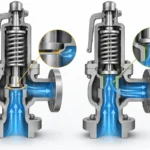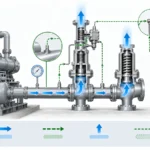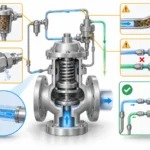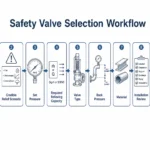
Safety valve sizing is the process of determining how much flow must be relieved during a credible overpressure event and selecting a valve with enough verified capacity to protect the equipment. It is not the same as choosing a valve with the same inlet and outlet connection size. A valve may fit the nozzle, match …

Safety valve sizing is the process of determining how much flow must be relieved during a credible overpressure event and selecting a valve with enough verified capacity to protect the equipment. It is not the same as choosing a valve with the same inlet and outlet connection size.
A valve may fit the nozzle, match the flange class and open at the correct set pressure, yet still be undersized if its certified relieving capacity is below the required relief load. Correct sizing therefore starts with the protected equipment and governing relief scenario—not with a stock valve model.
Engineering takeaway: Set pressure tells you when the valve starts to open. Required relieving capacity tells you how much flow the system must discharge. Certified relieving capacity shows whether the selected valve design can deliver enough verified flow under the stated basis.
Scope of this guide: This page focuses on relief-load inputs, sizing workflow, orifice selection and certified-capacity verification. For the wider decision covering valve type, materials, seat design, installation and procurement, use the Safety Valve Selection Guide. For API 520-specific requirements and RFQ interpretation, use the API 520 Safety Valve Sizing Guide.
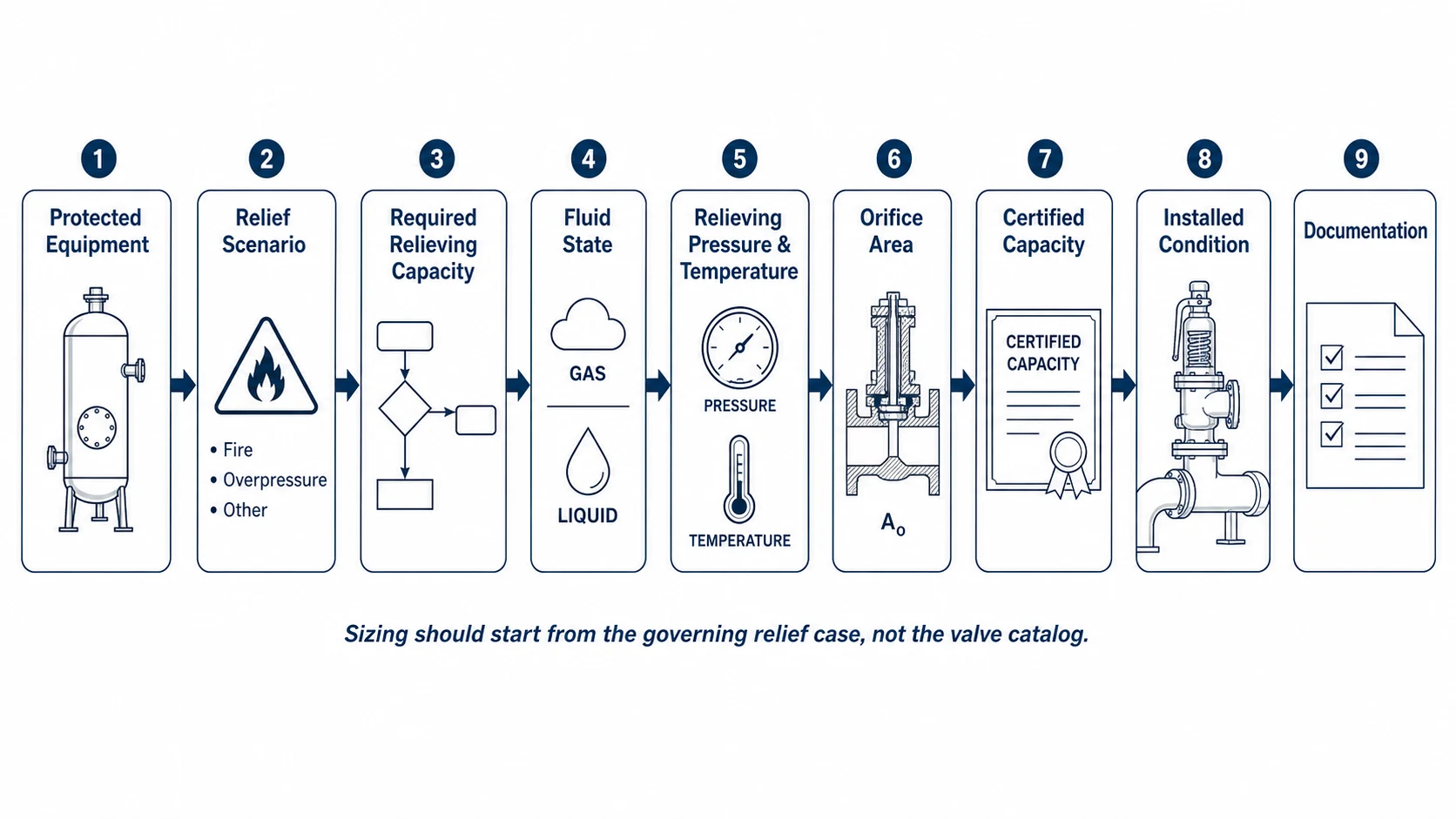
How Do You Size a Safety Valve?
At a practical level, safety valve sizing follows this sequence:
Protected equipment → credible relief scenarios → governing relief load → relieving pressure and temperature → fluid properties → required discharge area → next suitable valve orifice → certified capacity → installed-condition review
- Define the protected equipment. Confirm the equipment tag, MAWP, design pressure, operating pressure and applicable code basis.
- Identify all credible overpressure scenarios. Examples include blocked outlet, external fire, regulator failure, tube rupture, thermal expansion and loss of cooling.
- Determine the governing required relieving capacity. The largest credible case does not always govern; the controlling case depends on the complete sizing basis and allowable conditions.
- Confirm relieving conditions. State the relieving pressure, relieving temperature, medium composition and fluid phase.
- Calculate the required flow area. Use the applicable code method, process data and correction factors.
- Select a manufacturer or standardized orifice. Choose an orifice that meets the required area and service limitations.
- Verify certified capacity. The selected device must provide sufficient certified or documented capacity for the stated service basis.
- Review the installed system. Check inlet loss, back pressure, outlet resistance, discharge routing and simultaneous relief conditions.
Do not use this article as a final calculation sheet. Final sizing must use the project-required code edition, validated process data, current manufacturer-certified coefficients and capacity information, and approval by the responsible engineer.
Why Safety Valve Sizing Is Not the Same as Choosing a Connection Size
Inlet and outlet sizes describe how a valve connects to the equipment and discharge system. They do not define the internal flow area or prove that the valve can discharge the required relief load.
Actual relieving performance is affected by:
- effective or actual discharge area;
- valve lift and internal flow path;
- certified coefficient of discharge;
- set pressure and absolute relieving pressure;
- fluid phase and properties;
- relieving temperature;
- superimposed and built-up back pressure;
- viscosity, compressibility or steam correction factors;
- rupture-disk combination factors where applicable;
- manufacturer-certified capacity and certification basis.
Two valves can both be described as 2 in × 3 in and still have different orifice designations, lifts, discharge coefficients and certified capacities. A same-size replacement is therefore not automatically capacity-equivalent.
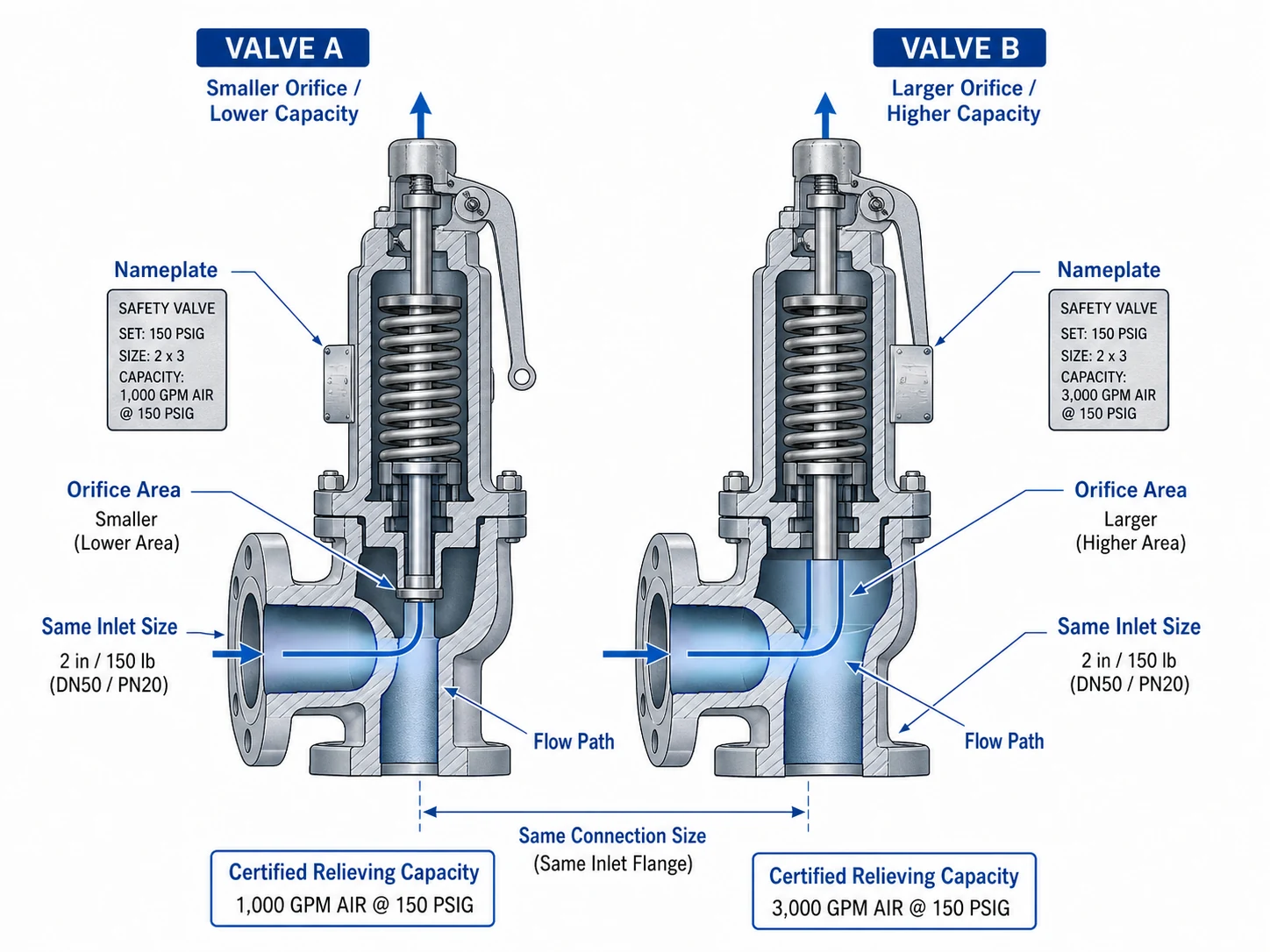
Replacement warning: Do not approve a replacement by model appearance, flange size or pressure class alone. Compare the original sizing basis, orifice designation, capacity basis, certified capacity, set pressure, back pressure condition and nameplate information.
60-Second Safety Valve Sizing Input Checklist
Before a calculation or supplier review begins, confirm that the following information is available. Missing data should be identified explicitly instead of replaced with silent assumptions.
Protected equipment: vessel, boiler, exchanger, compressor, pipeline or skid
Pressure limit: MAWP, design pressure and applicable code limit
Operating data: normal pressure and temperature
Set pressure: including any multiple-device arrangement
Relief scenarios: all credible causes of overpressure
Required flow: mass or volumetric rate with units and basis
Medium: composition, molecular weight, density or steam condition
Fluid phase: gas, vapor, steam, liquid, flashing or two-phase
Relieving conditions: pressure and temperature at the valve inlet
Back pressure: superimposed, built-up and total
Installation: inlet loss, outlet piping, headers, silencers and discharge point
Compliance: code edition, certification, inspection and documentation
When these inputs are incomplete, submit the available datasheet, P&ID, equipment drawing, old valve nameplate and outlet sketch through Ask an Engineer so the missing information can be identified before quotation.
Safety Valve Sizing, Selection and API Standards: Which Page Should You Use?
Clear separation between sizing, selection, standards and application guidance prevents technical confusion. These ZOBAI resources serve different purposes:
| Resource | Primary Question | Main Scope |
|---|---|---|
| Safety Valve Sizing Guide | How much capacity and orifice area are required? | Relief load, required area, certified capacity, sizing inputs and approval checks. |
| Safety Valve Selection Guide | Which valve type and configuration should be selected? | Valve type, medium, back pressure, materials, seat, installation and procurement. |
| API 520 Guide | How is API 520 used in process-industry sizing and RFQs? | API 520 Part I context, input factors, RFQ data and links to installation review. |
| API 521 Guide | Which relief scenarios and disposal-system conditions must be evaluated? | Fire case, relief-system design, flare headers, depressuring and system-level loads. |
| API 526 Guide | How are standardized flanged PSV orifices and dimensions communicated? | Orifice designations, flange sizes, pressure ratings, dimensions and procurement details. |
What Is Required Relieving Capacity?
Required relieving capacity is the flow that must be discharged during the governing credible overpressure event so that the protected equipment remains within the applicable pressure limit.
This value comes from the system and relief scenario—not from the valve catalog. A supplier can help match a device after receiving the calculation basis, but a product model cannot determine the relief load by itself.
Required Capacity Comes from the Relief Scenario
| Relief Scenario | Typical Load Mechanism | Key Data to Review |
|---|---|---|
| Blocked outlet | Incoming flow continues while normal discharge is prevented. | Maximum credible inflow, upstream pressure and control behavior. |
| External fire | Heat input causes vapor generation, gas expansion or pressure rise. | Wetted area, heat input basis, insulation or fireproofing credit and fluid properties. |
| Thermal expansion | Trapped liquid expands as temperature rises. | Blocked-in volume, heat source, liquid expansion and discharge destination. |
| Control valve or regulator failure | Higher upstream pressure or flow reaches lower-rated equipment. | Upstream source, failure position, maximum differential and downstream capacity. |
| Heat exchanger tube rupture | High-pressure fluid enters the lower-pressure side. | Tube size, pressure difference, phase behavior and downstream response. |
| Gas blow-by | Gas passes into a lower-pressure vessel or liquid system. | Restriction geometry, upstream conditions and downstream phase behavior. |
| Loss of cooling or utility | Heat removal stops or process control is lost. | Reaction or vapor-generation rate, heat input and escalation time. |
| Chemical reaction | Reaction heat or gas generation increases pressure. | Kinetics, heat release, gas generation, two-phase behavior and emergency response. |
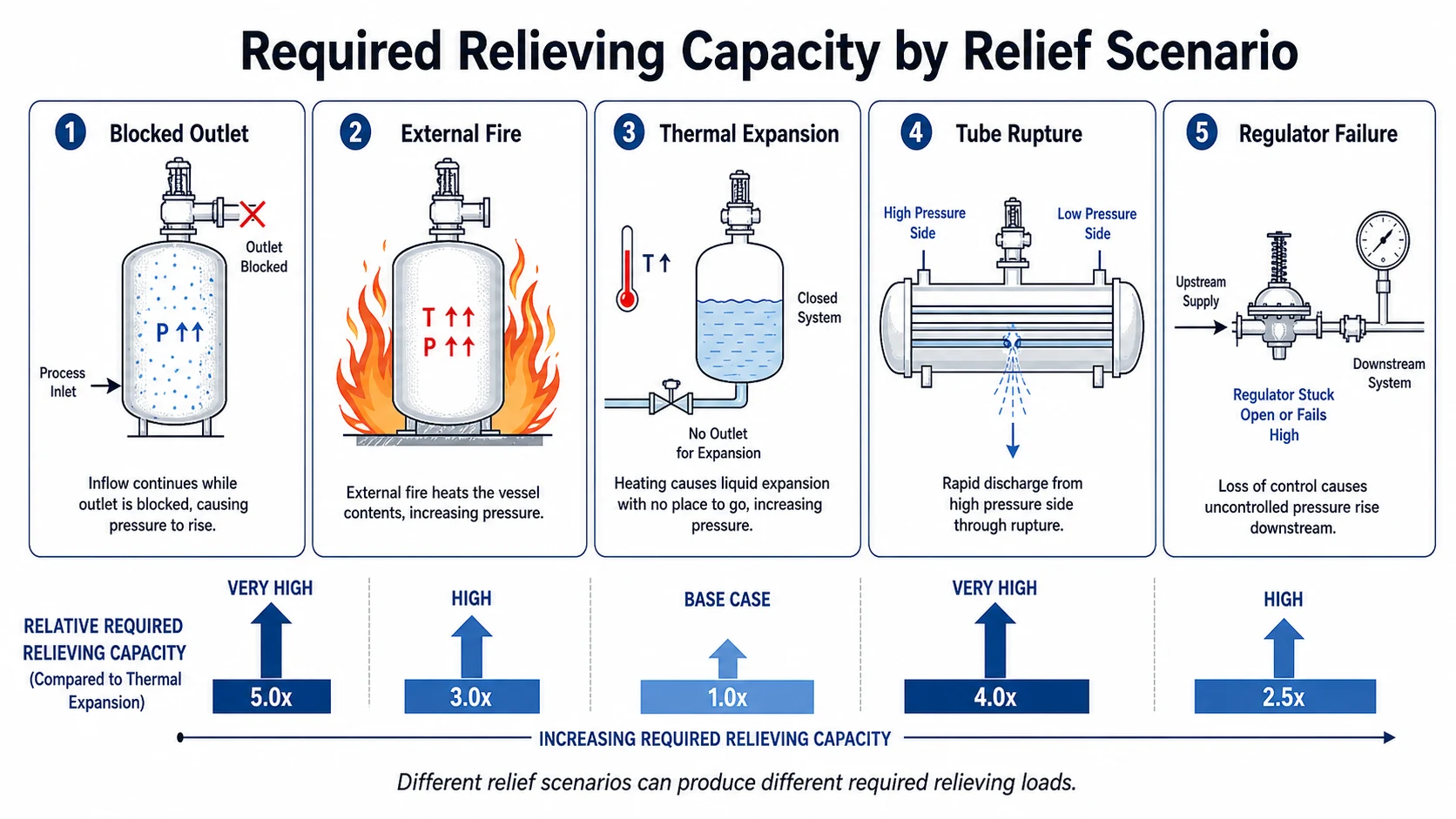
More than one scenario may need to be documented. The case requiring the largest nominal flow is not automatically the only case that matters because fluid phase, back pressure, allowable overpressure, multiple-device rules and discharge-system behavior can change the controlling valve or installation requirement.
What Is Certified Relieving Capacity?
Certified relieving capacity is a verified capacity value associated with a defined pressure-relief-device design and certification basis. It enables engineers, buyers, inspectors and equipment owners to compare the selected device against the required relief load.
In applicable ASME and National Board contexts, certified-device information can be checked through the official National Board NB-18 pressure relief device certification resource. The National Board also operates pressure-relief-device capacity certification programs through its Pressure Relief Laboratory.
Required Capacity, Calculated Capacity, Rated Capacity and Certified Capacity
| Term | Meaning | Approval Question |
|---|---|---|
| Required relieving capacity | The flow the protected system must discharge during the governing case. | What does the process or equipment require? |
| Calculated capacity | A result derived from a sizing equation, conversion or manufacturer tool for specified conditions. | Were the correct inputs, equation and correction factors used? |
| Rated capacity | A capacity stated for a valve under defined rating conditions. | What conditions and factors support the rating? |
| Certified relieving capacity | A capacity verified under the applicable certification framework for the device design. | Is the value traceable to the exact model, orifice, set pressure and capacity basis? |
| Installed performance | The behavior of the valve after inlet loss, back pressure and discharge-system effects are considered. | Will the certified device remain suitable in the real piping system? |
Capacity basis matters: A certified air, saturated-steam or water capacity should not be treated as an interchangeable process capacity without the required conversion, correction or manufacturer confirmation.
Key Terms Used in Safety Valve Sizing
Set Pressure
The inlet pressure at which the valve demonstrates the specified opening characteristic under defined test conditions. Correct set pressure does not prove adequate capacity.
Relieving Pressure
The pressure used for capacity determination while the device is relieving. The calculation basis must state whether pressure values are gauge or absolute.
Overpressure
The pressure increase above set pressure during relief. The allowable value depends on the equipment, scenario, code and device arrangement.
Accumulation
The pressure increase above the protected equipment’s MAWP or applicable allowable limit during relief. It is not the same reference as overpressure.
Discharge Area
The flow area used by the sizing or certification basis. Do not assume it is equal to the nominal inlet area.
Coefficient of Discharge
A performance coefficient relating actual device flow to theoretical flow. Use the code- or manufacturer-certified value required by the calculation basis.
Back Pressure
Outlet pressure acting on the valve before or during relief. It may affect required correction factors, force balance, capacity and stability.
Capacity Margin
The difference between available verified capacity and required capacity. There is no universal extra percentage suitable for every project.
For a fuller explanation of set pressure, overpressure, accumulation and blowdown, read Safety Valve Set Pressure, Overpressure and Blowdown Explained.
Safety Valve Calculation Input Map
The exact equation depends on the code, medium and flow regime. The table below shows the types of inputs that normally control the calculation without reproducing a copyrighted standard equation or replacing approved software.
| Service | Typical Core Inputs | Common Corrections / Checks |
|---|---|---|
| Gas / vapor | Required mass flow, molecular weight, absolute relieving pressure, relieving temperature, compressibility and heat-capacity ratio. | Discharge coefficient, back-pressure correction, rupture-disk combination factor and critical/subcritical flow basis. |
| Saturated steam | Required steam flow, absolute relieving pressure and applicable steam-capacity basis. | Discharge coefficient, back pressure, code factors and certification basis. |
| Superheated steam | Saturated-steam inputs plus actual relieving temperature. | Superheat correction, material temperature limits, back pressure and manufacturer data. |
| Liquid | Required volumetric flow, density or specific gravity, inlet pressure and outlet/back pressure. | Viscosity correction, back-pressure correction, rupture-disk factor, flashing and cavitation review. |
| Two-phase / flashing | Mass flow, composition, upstream state, phase change, thermodynamic path and outlet conditions. | Validated two-phase method, reaction force, discharge-system behavior and manufacturer/process-safety review. |
API states that API 520 Part I, 10th Edition provides sizing procedures for selecting pressure-relieving devices in refinery applications. The applicable standard and edition should be confirmed from the project specification rather than assumed from this article.
Step-by-Step Safety Valve Sizing Process
Step 1: Define the Protected Equipment
Record the equipment tag, equipment type, MAWP, design pressure, operating pressure, design temperature, operating temperature, connected pressure sources and applicable construction code. A boiler, pressure vessel, heat exchanger, compressor package, LPG vessel and blocked-in liquid line do not share the same protection basis.
Step 2: Identify Every Credible Relief Scenario
Build a relief-case list before calculating flow. The list should consider operating failures, utility failures, external fire, upstream pressure sources, control-valve positions, heat input, reaction conditions and discharge-system interactions. API 521 is commonly used at this system level in applicable petroleum and process facilities. See the API 521 Pressure Relief Systems Guide and the official API 521 page.
Step 3: Determine the Required Relieving Load
Calculate or otherwise establish the flow generated by each credible scenario. State the flow units and basis clearly. For example, standard gas volume is not the same as actual volume at relieving temperature and pressure. A mass-flow basis is often easier to trace across changing conditions.
Step 4: Confirm Relieving Pressure and Temperature
Do not copy normal operating conditions into the sizing sheet. Relieving pressure must be established from the set pressure, allowable overpressure and arrangement of the protective devices. Relieving temperature should represent the governing scenario and may differ materially from normal temperature.
Step 5: Confirm the Fluid State and Properties
Identify whether the fluid reaches the valve as gas, vapor, saturated steam, superheated steam, liquid, flashing liquid or two-phase mixture. Confirm composition, molecular weight, compressibility, density, viscosity, vapor pressure and other required properties at the stated conditions.
Step 6: Calculate the Required Discharge Area
Apply the project-required calculation method and current correction factors. Document every assumption, source and software revision. The result should be the minimum required discharge area for the stated case—not a nominal pipe size.
Step 7: Select the Next Suitable Orifice and Valve Design
Select a manufacturer or standardized orifice that meets or exceeds the required area while remaining suitable for the medium, set pressure, temperature and back pressure. The next larger orifice is not automatically the final answer if valve stability, minimum flow, blowdown or mechanical limitations are not acceptable.
Step 8: Verify Certified or Manufacturer-Documented Capacity
Compare the required relief load with the certified or documented capacity for the exact model, orifice, set pressure, medium basis and applicable corrections. The technical bid should show this comparison explicitly.
Step 9: Review Inlet and Outlet Conditions
Check inlet pressure loss, outlet resistance, superimposed and built-up back pressure, common headers, silencers, discharge stacks, reaction forces, supports and drainage. API notes that API 520 Part II, 7th Edition includes engineering-analysis guidance for appropriate installation of pressure-relieving devices.
Step 10: Approve a Traceable Documentation Package
The final file should connect the equipment, relief scenario, calculation, selected orifice, certified capacity, manufacturer model, nameplate and inspection documents. An untraceable catalog statement is not a complete sizing record.
Sizing Considerations for Steam, Gas, Liquid and Two-Phase Flow
Steam
State whether steam is saturated or superheated. Confirm relieving pressure, temperature, required mass flow, applicable superheat correction, certified steam basis, material temperature limits and discharge reaction forces.
Gas and Vapor
Confirm molecular weight, compressibility, heat-capacity ratio, relieving temperature and whether flow is critical or subcritical. Air capacity cannot automatically be treated as process-gas capacity.
Liquid
Confirm density, viscosity, pressure differential, back pressure and flashing potential. A small thermal-relief flow can still protect against rapid pressure rise in a trapped liquid volume.
Two-Phase / Flashing
Use a validated specialist method. Phase change through the valve and outlet system can affect required area, reaction force, back pressure and disposal-system design.
Steam Safety Valve Sizing
A valve certified for saturated steam at one pressure should not be approved for a different superheated condition without applying the required basis and checking manufacturer data. Steam sizing should also be coordinated with valve lift, blowdown, lever requirements, drainage and discharge piping. For related products, see Steam Safety Valves and Full Lift Safety Valves.
Gas Safety Valve Sizing
Gas sizing depends on the actual gas properties and relieving conditions. When the certified value is stated for air, document the conversion to the actual gas or obtain manufacturer confirmation. For high-capacity clean gas systems, a pilot-operated safety valve may be considered after medium cleanliness, back pressure and maintenance requirements are reviewed.
Liquid Relief Valve Sizing
Liquid sizing requires a clear differential-pressure basis and review of viscosity, flashing and outlet pressure. Thermal-relief applications may require limited capacity, but they still need a documented heat source, trapped volume, relieving destination and set-pressure basis.
Two-Phase and Reactive Systems
Two-phase, flashing and reactive relief cases should be treated as specialist calculations. They can require process-safety methods, thermodynamic modeling, reaction data, dynamic analysis and discharge-system review beyond a conventional single-phase equation.
How Back Pressure Affects Sizing and Installed Capacity
Back pressure is not a final number added after the valve has been selected. It can influence the required correction factor, device type, certified capacity, opening behavior, stability and reseating.
- Superimposed back pressure exists at the outlet before the valve opens and may be constant or variable.
- Built-up back pressure develops after opening because flow passes through the outlet piping and disposal system.
- Total back pressure during relief combines the applicable superimposed and built-up components.
The source may be a flare header, closed vent, scrubber, recovery line, silencer, long discharge pipe or simultaneous discharge from other devices. The selected correction and allowable limit must come from the applicable calculation method and certified manufacturer data.
Management-of-change trigger: Recheck sizing and installed suitability whenever outlet piping, a silencer, vent stack, flare header or shared discharge system is modified—even when the valve body and set pressure remain unchanged.
Use the Back Pressure and Balanced Bellows Guide for force-balance and valve-type selection, and the Safety Valve Installation Guide for inlet loss, outlet routing, support and drainage.
Orifice Area, Valve Size and API 526 Designations
The required discharge area is a calculation result. The selected valve orifice is a manufacturer or standardized flow designation. The inlet and outlet connections are mechanical interfaces. These values are related, but they are not interchangeable.
| Item | What It Describes | What It Does Not Prove |
|---|---|---|
| Required discharge area | Minimum area calculated for a defined relief case and method. | Final product suitability or certified capacity. |
| Orifice designation | A standardized or manufacturer identifier linked to a nominal or certified flow area. | Capacity for every pressure, medium and back-pressure condition. |
| Inlet size | Connection between protected equipment and valve. | Internal flow area or required capacity. |
| Outlet size | Connection to the discharge system. | Acceptable back pressure or outlet-system performance. |
| Pressure class | Connection and body pressure-temperature rating basis. | Relieving capacity or set-pressure accuracy. |
API 526 is commonly used as a purchase specification for standardized flanged steel pressure-relief valves. It supports communication of orifice designation, inlet and outlet size, pressure rating, materials, pressure-temperature limits and dimensions. It does not replace the relief-load calculation or certified-capacity verification. See the API 526 Flanged Safety Valve Guide.
For capacity-driven product pathways, review Large Orifice Safety Valves, Full Lift Safety Valves and Flanged Safety Valves.
Illustrative Example: Correct Set Pressure but Insufficient Certified Capacity
Illustrative technical-bid review
This example is fictional and for review logic only. It is not a sizing calculation or manufacturer capacity table.
10 bargSet pressure
3,800 kg/hRequired air relief load
3,250 kg/hOffered certified capacity
4,150 kg/hAlternative certified capacity
A compressed-air receiver is protected against a credible blocked-outlet case. The approved calculation requires 3,800 kg/h of air at the specified relieving basis. A supplier offers a 2 in × 3 in replacement valve with the correct set pressure and flange class, but its certificate shows only 3,250 kg/h under the applicable basis.
The offered valve is short by 550 kg/h, or approximately 14.5% of the required load. It opens at the correct pressure but does not provide enough verified capacity. The technical bid is therefore rejected despite the matching connection size.
An alternative valve with a larger certified orifice provides 4,150 kg/h under the same basis. It can proceed to the next review stage, which must still confirm inlet loss, outlet back pressure, materials, dimensions, stability and project documentation.
Lesson: A positive capacity comparison is necessary, but it is not the only approval criterion. A much larger valve should not be selected blindly because excessive oversizing can create operational or stability problems in some applications.
How Much Capacity Margin Is Required?
The selected certified or documented capacity must meet the required capacity under the approved basis. There is no universal extra percentage that should be applied to every valve. Any design margin should follow the project specification, calculation method, uncertainty review and responsible engineer’s approval. Margin should not be used to hide missing process data, and excessive oversizing should be avoided.
Nameplate and Certificate Data to Check Before Approval
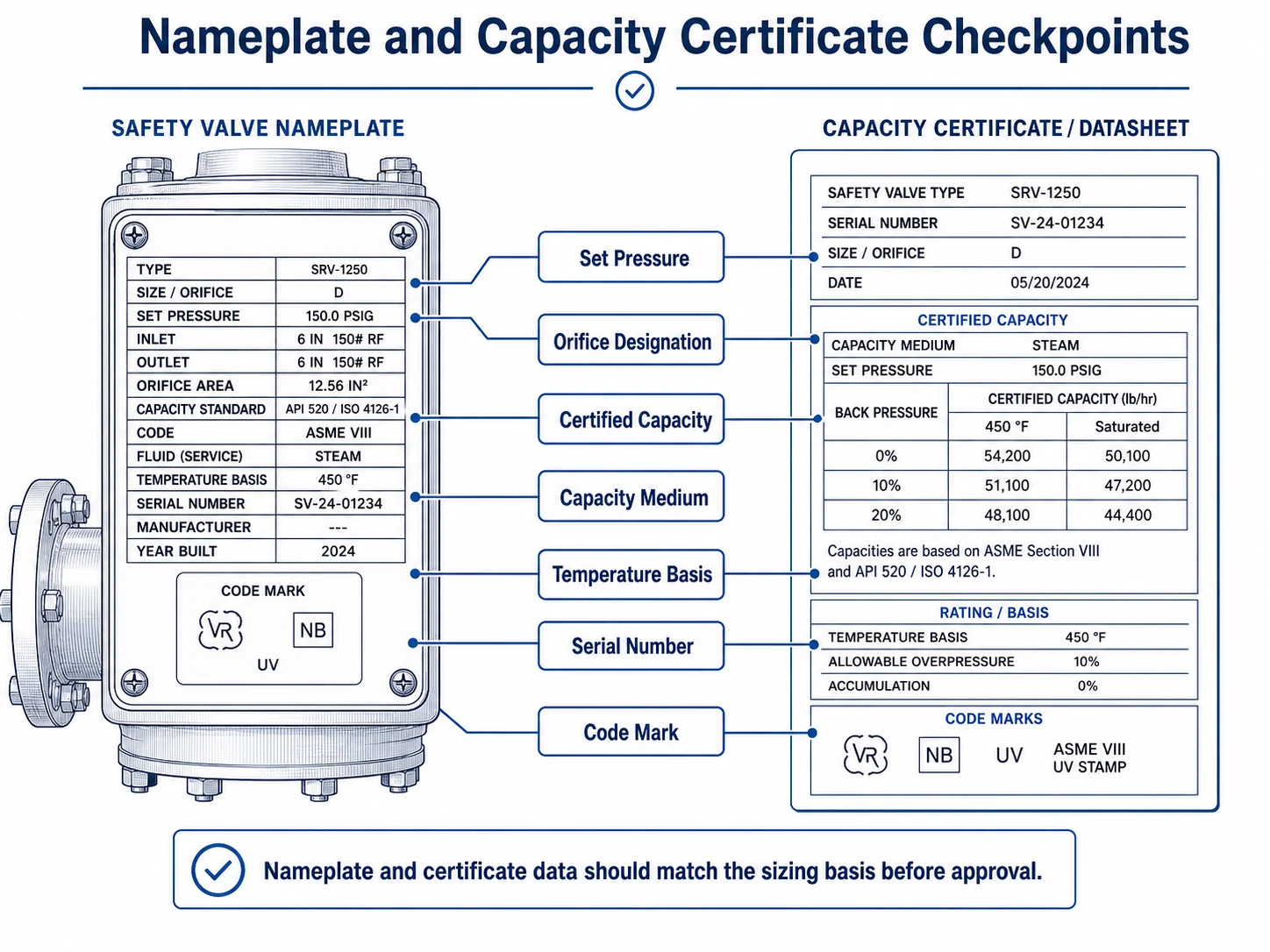
| Data to Check | Approval Purpose | Common Mismatch |
|---|---|---|
| Manufacturer, model and design | Links the physical valve to the certified device family. | Quotation model differs from certificate model. |
| Serial number or traceable identification | Connects the valve, nameplate and test records. | Generic certificate supplied without valve traceability. |
| Set pressure | Confirms the required opening condition. | Certificate or nameplate pressure differs from approved datasheet. |
| Orifice designation and area | Connects the selected geometry to capacity. | Same body size offered with a smaller internal orifice. |
| Certified relieving capacity | Demonstrates capacity against the required load. | Supplier states “suitable” without a traceable capacity value. |
| Capacity medium and basis | Shows whether capacity is for air, steam, water or another condition. | Air value compared directly with process gas without conversion. |
| Pressure and temperature basis | Confirms that the capacity applies to the approved relieving condition. | Normal conditions used instead of relieving conditions. |
| Back-pressure condition | Confirms correction and valve-type suitability. | Certificate assumes atmospheric outlet while project uses a closed header. |
| Code or certification marking | Supports project compliance where required. | Marketing logo shown instead of the required certification basis. |
| Test and calibration reports | Confirms set pressure, pressure test and specified seat test. | Reports do not match the serial number or final set pressure. |
For a complete commercial and document package, use the Safety Valve Procurement Checklist for Engineers and Buyers.
When Sizing Requires Specialist Engineering or Manufacturer Review
The following conditions should not be reduced to a simple catalog comparison:
1
Two-Phase or Flashing Flow
Phase change can alter required area, reaction force and outlet-system behavior.
2
Reactive or Runaway Systems
Relief load can depend on kinetics, heat generation, gas generation and emergency response.
3
High-Viscosity Liquid
Viscosity correction may be iterative and linked to the selected orifice.
4
Variable Back Pressure
Changing outlet pressure can affect capacity, opening and reseating.
5
Common Flare or Relief Header
Simultaneous events and network pressure require system-level analysis.
6
Multiple Relief Devices
Staggered set pressures and combined capacity must follow the governing code basis.
7
Rupture Disk Combination
Combination factors, pressure loss and fragmentation or leakage risks must be reviewed.
8
High Pressure or Extreme Temperature
Real-gas behavior, materials, correction factors and certified limits can control selection.
9
Dirty, Crystallizing or Polymerizing Media
Nominal capacity is irrelevant if the flow path or sensing system cannot remain functional.
Common Safety Valve Sizing Mistakes
- Selecting by inlet and outlet size. Mechanical fit does not prove orifice area or capacity.
- Using normal process flow as the relief load. The governing emergency case may be substantially different.
- Checking set pressure but not capacity. A valve can open correctly and still be unable to control the event.
- Using air capacity directly for another gas. Molecular weight, temperature, compressibility and pressure basis may require conversion.
- Ignoring flashing or two-phase flow. A single-phase equation may understate the required area or misrepresent discharge behavior.
- Ignoring back pressure. Closed headers, silencers and outlet piping can affect both calculated and installed suitability.
- Using an assumed discharge coefficient. The required coefficient must come from the approved calculation and certification basis.
- Adding an arbitrary safety factor. Excessive oversizing is not a substitute for correct relief-load analysis.
- Failing to recalculate after process changes. Increased throughput, changed composition, new heat input or modified discharge piping can invalidate the old basis.
- Accepting a generic certificate. Documents must be traceable to the offered device, orifice, pressure and capacity basis.
Safety Valve Sizing Checklist for Engineers and Buyers
| Step | Review Item | Required Evidence | Status |
|---|---|---|---|
| 1 | Protected equipment identified | Tag, datasheet, drawing or P&ID | ☐ |
| 2 | MAWP and code basis confirmed | Equipment design documentation | ☐ |
| 3 | Set pressure and arrangement confirmed | Approved datasheet or calculation | ☐ |
| 4 | Credible relief scenarios listed | Relief study or engineering review | ☐ |
| 5 | Governing required capacity established | Calculation with units and revision | ☐ |
| 6 | Relieving pressure and temperature stated | Calculation input sheet | ☐ |
| 7 | Fluid properties and phase verified | Process data or property source | ☐ |
| 8 | Required discharge area calculated | Approved method or software output | ☐ |
| 9 | Selected orifice meets area requirement | Manufacturer or API 526 mapping | ☐ |
| 10 | Certified capacity meets required load | Traceable capacity data | ☐ |
| 11 | Back pressure and inlet loss reviewed | Piping calculation or engineering analysis | ☐ |
| 12 | Nameplate and certificates match | Final approved document package | ☐ |
| 13 | Management-of-change check completed | Current process and discharge configuration | ☐ |
Have a Sizing Sheet or Existing Valve Nameplate?
Send the equipment data, relief scenario, required capacity, relieving pressure and temperature, fluid properties, back pressure, existing valve nameplate and project standard for an engineering-oriented RFQ review.
Upload Datasheet for Review Request a Safety Valve QuoteFAQ About Safety Valve Sizing and Certified Capacity
How do you size a safety valve?
Identify the protected equipment and credible relief scenarios, calculate the governing required relieving capacity, confirm relieving pressure, temperature and fluid properties, calculate the required discharge area, select a suitable orifice and verify certified or manufacturer-documented capacity under the approved conditions.
What is certified relieving capacity?
Certified relieving capacity is a verified flow value associated with a defined pressure-relief-device design and certification basis. It is used to determine whether the selected device provides sufficient capacity for the required relief load.
Is safety valve size the same as connection size?
No. Connection size describes the mechanical inlet and outlet. Relieving capability depends on the internal discharge area, valve design, lift, discharge coefficient, relieving conditions, correction factors and certified capacity.
Is orifice size the same as inlet size?
No. The orifice or discharge area is the internal flow area used for capacity. The inlet size is the connection to the protected equipment. Valves with the same inlet size can use different orifices and provide different capacities.
Why can a valve with the correct set pressure still be undersized?
Set pressure defines the opening condition. It does not define how much flow the valve can discharge. A valve can open at the required pressure and still have less certified capacity than the governing relief load.
How much extra safety valve capacity should be selected?
The selected verified capacity must meet the required load under the approved calculation basis. There is no universal extra percentage for every project. Any margin should follow the project specification and responsible engineering review, while excessive oversizing should be avoided.
Can certified air capacity be used for process gas?
Not directly without review. The actual gas molecular weight, temperature, compressibility, pressure basis and applicable calculation method may require conversion or manufacturer confirmation.
When is two-phase safety valve sizing required?
Two-phase review is required when gas and liquid can flow together or when a liquid may flash significantly during pressure reduction. These cases usually require a validated specialist method rather than a simple gas-only or liquid-only equation.
When should a safety valve be resized?
Recheck sizing after changes to throughput, operating pressure, temperature, composition, equipment MAWP, relief scenarios, fire basis, control systems, inlet piping, outlet piping, flare headers or other discharge-system conditions.
Which documents prove safety valve capacity?
Typical evidence includes the approved sizing calculation, manufacturer datasheet, orifice information, certified or documented capacity data, nameplate information, code or National Board certification information, test records and technical approval documents.