Screen a pilot-operated safety valve for LNG service by checking low-temperature exposure, sensing lines, pilot seals, back pressure, standards and RFQ evidence.

A pilot-operated safety valve for LNG service can be a valid candidate, but the main valve’s low-temperature rating alone does not establish suitability. The complete pilot-operated system has to be reviewed: the main valve, pilot, pressure-sensing path, tubing, seals and other soft goods, pilot vent arrangement, and the conditions under which the pilot receives its pressure signal.
The pilot circuit is part of the valve’s pressure-control function. A main valve may appear suitable for cryogenic service while an unresolved pilot component, sensing path or seal limitation still prevents a defensible selection.
The practical question is not simply, “Is this a cryogenic pilot-operated valve?” It is:
Has the complete configured pilot-operated safety valve been shown suitable for the defined LNG relief duty, temperature exposure, fluid state, sensing arrangement and downstream conditions?
This guide uses that question to screen a candidate before model-specific engineering or RFQ review.
Can a Pilot-Operated Safety Valve Be Used for LNG Service?
Yes—as a candidate architecture for defined LNG duties, subject to
project-specific verification.
Pilot-operated safety valves are used in defined LNG applications.
ISO 18154
,
for example, specifically addresses diaphragm-type pilot-operated safety valves for
LNG-carrier cargo tanks. That confirms the architecture can be appropriate within a
defined LNG application while also showing why scope matters: the standard does not
apply automatically to every LNG terminal, liquefaction train, transfer line or other
installation.
A
documented LNG cryogenic POSV application from LESER
likewise shows that pilot-operated relief valves can be engineered for cryogenic duty.
That evidence establishes application feasibility, not universal suitability for every
pilot-operated valve or every LNG service.
For broader LNG pressure-relief scenarios beyond this article’s narrow pilot-circuit scope,
see the
LNG safety valve application guide.
Keep three states separate:
Architecture is used in LNG service
does not mean
this product family is suitable for LNG
and neither automatically means
this exact configuration is suitable for this relief duty.
Before the candidate moves forward, the relief duty, relieving state, temperatures,
back pressure, materials, pilot arrangement and applicable project evidence still need
to be defined.
The word candidate is deliberate. At this stage it means the
architecture deserves further technical review; it does not mean the valve has been
finally sized, certified or approved for the project.
Readers who need the broader product-family context can review
pilot-operated safety valves
separately from this LNG-specific screening guide.
Why Main-Valve Low-Temperature Capability Is Not Enough
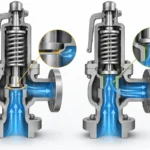
A pilot-operated safety valve is not one temperature-rated object. It is a system of
components that can have different materials, seals, exposure conditions and allowable limits.
The main relieving assembly may include the pressure-retaining body, nozzle, disc or piston
and main-valve sealing components. The control side adds the pilot valve, sensing path,
tubing, pilot seals, filters or restrictions where used, and the dome/control-pressure circuit.
Baker Hughes Consolidated 3900 technical data
illustrate why this distinction matters. The documentation separates pilot/modulator
soft-goods limits from main-valve soft-goods limits and notes that media conditioning
may be needed when applicable limits are exceeded; such arrangements remain
application-specific.
A cryogenic LNG application can go further by deliberately controlling what the pilot
experiences. The
LESER LNG cryogenic POSV example
shows that purpose-built cryogenic configurations may manage the pilot environment rather
than relying on a generic main-valve temperature rating alone.
| Part of the configured system | What must be verified |
|---|---|
| Main relieving assembly | Materials and allowable limits for the exact configuration |
| Pilot | Pilot type, internal materials, seals and applicable limits |
| Pressure-sensing path | What pressure and fluid condition actually reach the pilot |
| Pilot tubing and fittings | Material, routing and expected exposure |
| Seals and other soft goods | Component-specific temperature and compatibility evidence |
| Filters or restrictions, if used | Service suitability and effect on the sensing/control path |
Do not use one temperature number as evidence for the whole pilot-operated valve
unless the supplier documentation actually supports that scope.
The same caution applies to product-family tables. The most extreme low-temperature
value visible anywhere in a catalog should not be assigned to every pilot, seal,
material combination or valve configuration.
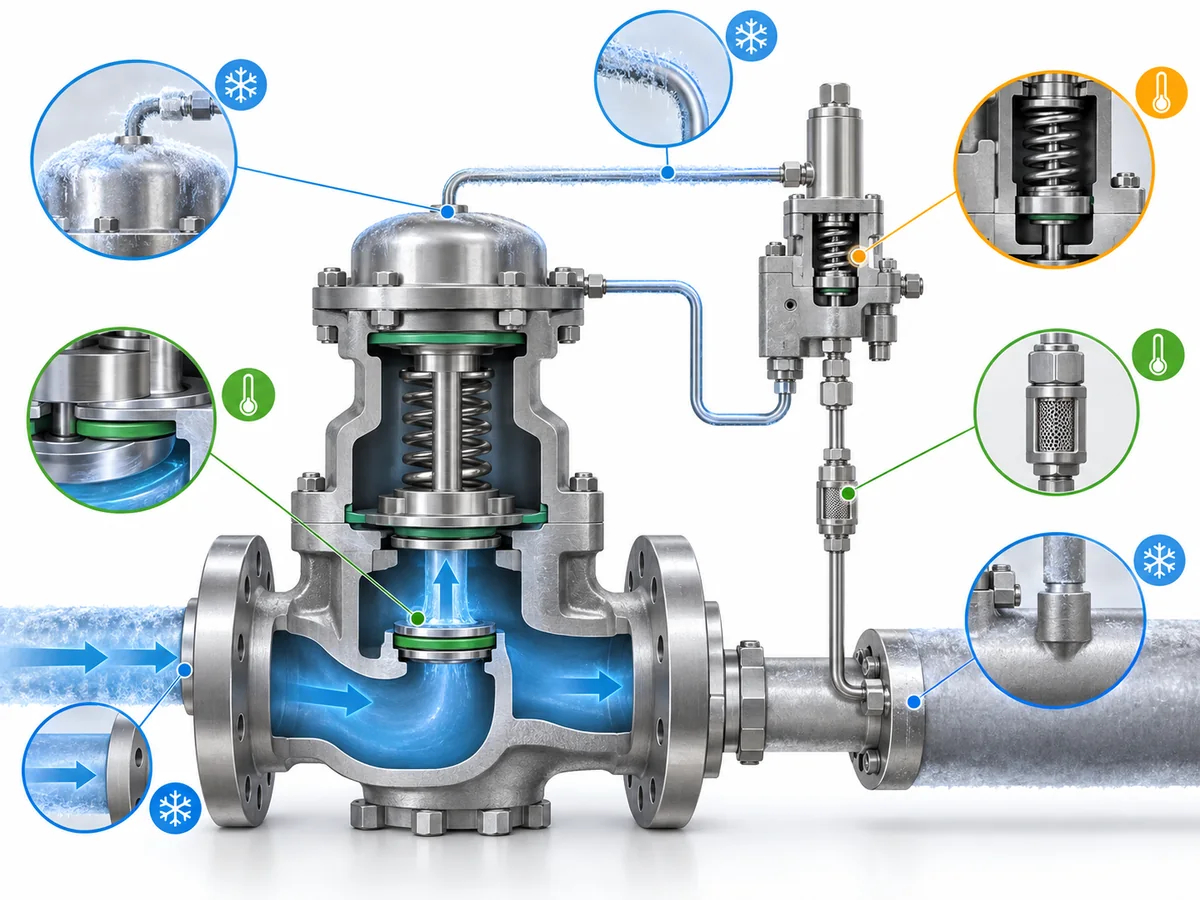
How Low Temperature Can Threaten Pilot Pressure-Signal Integrity
Low temperature becomes a pilot-circuit issue when it interferes with the pressure signal
the pilot needs to perform its control function.
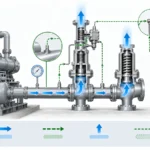
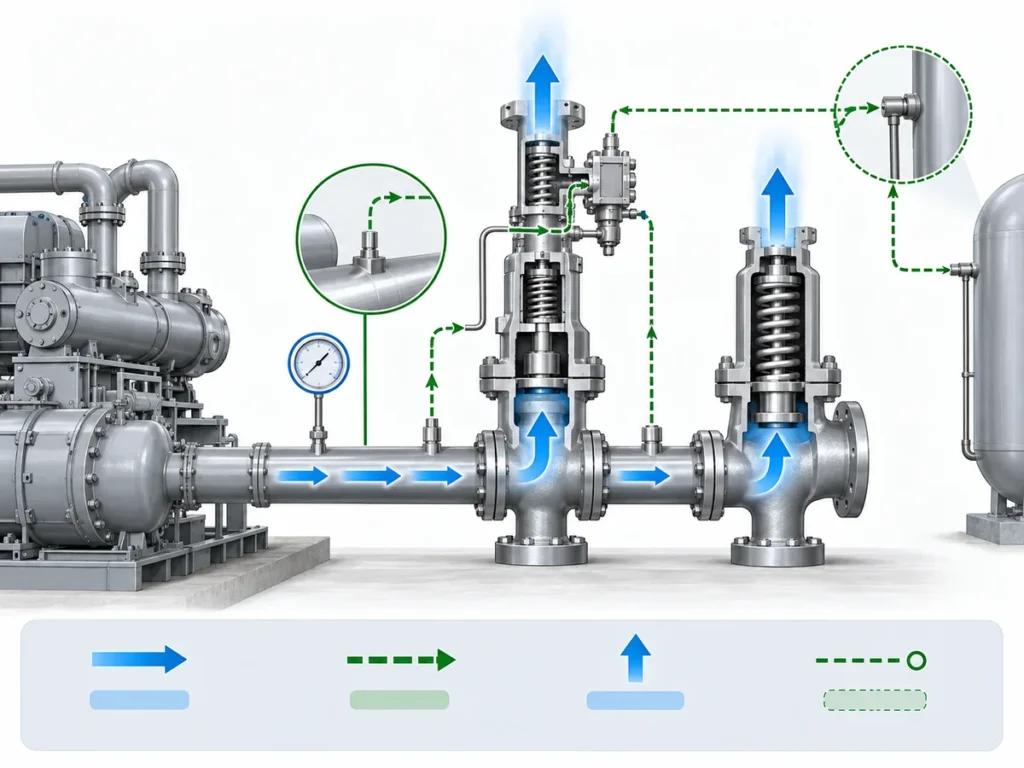
At a simplified level, the functional chain is:
protected system pressure → pressure pickup → sensing path → pilot →
dome/control pressure → main-valve response
That small sensing path can therefore be decision-critical even though it carries far less
flow than the main relief path.
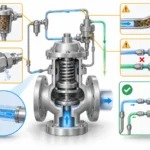
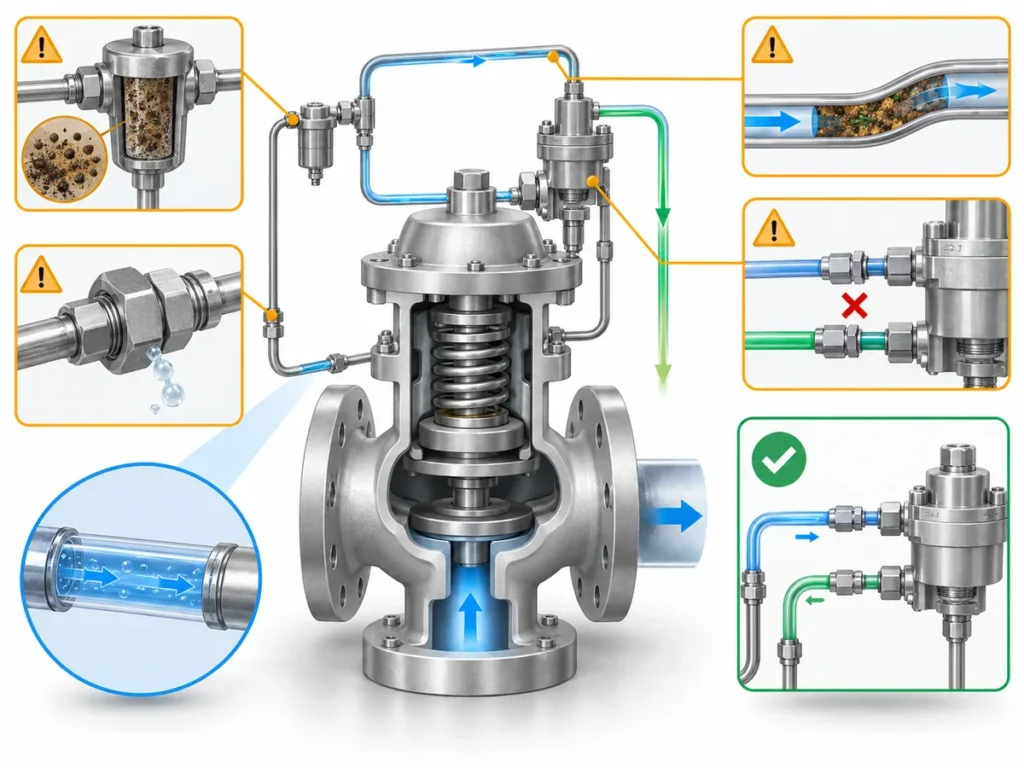
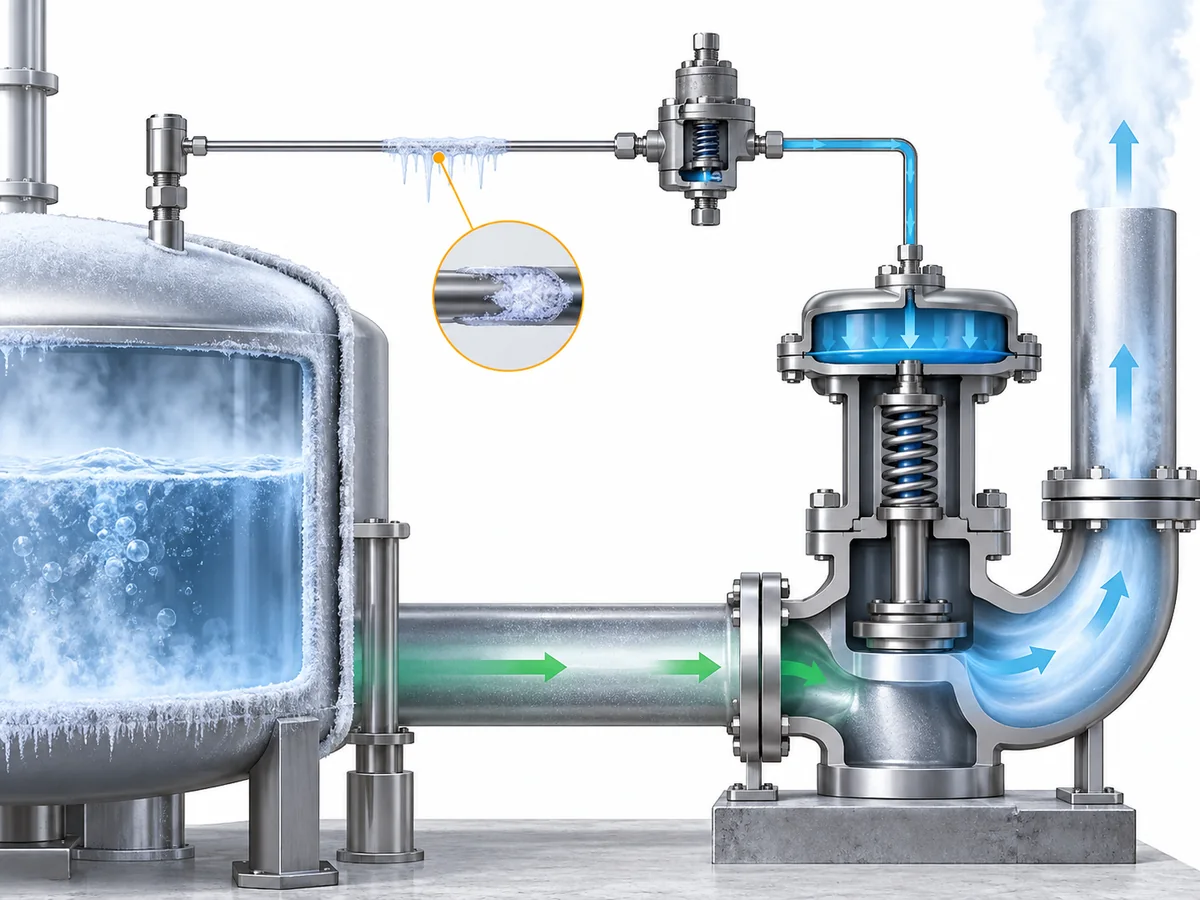
Baker Hughes Consolidated POSRV operating instructions
document the risk directly: if a pilot sensing line becomes clogged or frozen, system
pressure can be isolated from the pilot so that the pilot cannot correctly detect the
protected-system pressure and perform the intended relief response.
Readers who need the complete generic operating sequence can review
how a pilot-operated safety valve works
;
this article only uses the operating principle needed to explain LNG risk.
Do not merge different mechanisms into one risk
Blockage describes a restricted or closed pressure path.
Freezing can be one cause of blockage under applicable conditions.
Other deposits or contamination can produce restriction through different mechanisms.
Manufacturer guidance also discusses hydrate formation in some hydrocarbon applications,
but that does not justify describing hydrates as a routine LNG pilot-circuit failure.
Likewise, steam-condensate freezing examples are useful for the underlying freeze mechanism
but should not be presented as LNG-specific events.
Current evidence also does not support a universal statement that flashing or two-phase
flow in every LNG sensing line will cause a particular pilot failure.
The pressure condition presented to the pilot must remain representative of the
protected system under the defined operating and relieving conditions.
If the proposed design depends on a sensing path whose local temperature, fluid state or
blockage risk is unresolved, that uncertainty should stay visible in the selection review.
What Must Be Checked in the Pilot and Sensing Circuit?
Once the pilot path is treated as part of the pressure-protection function, the review
can move from generic “cryogenic suitability” to specific verification questions.
| Verify | Why it changes the decision | Evidence to obtain |
|---|---|---|
| Pressure pickup location | Determines which system pressure the pilot actually senses | P&ID, connection point or supplier arrangement |
| Integral or remote sensing | Changes the physical pressure-sensing path | Exact valve configuration |
| Remote sensing-line route, where used | Adds tubing length, elevation and routing variables | Routing/configuration data |
| Pilot supply filter, where used | Becomes part of the sensing/control path | Filter configuration and service basis |
| Pilot vent destination | Can interact with downstream/back-pressure conditions | Vent arrangement |
| Backflow-prevention arrangement, where applicable | May matter under particular pressure relationships | Supplier application review |
| Pilot materials and internals | Can have different service limits from the main valve | Material/configuration documents |
| Pilot and main-valve seals | Soft-good limits may differ | Material and allowable-condition evidence |
| Tubing and fittings | The complete control circuit must remain suitable | Material/configuration evidence |
Remote sensing is an engineered arrangement, not an automatic upgrade
Remote pressure sensing is a legitimate configuration, but it should not be recommended
simply because the application is LNG.
Original POSV technical documentation
treats remote sensing as a defined system-pressure connection rather than a generic
feature. The useful project question is therefore:
Where must the pilot sense representative protected-system pressure, and what physical
path connects that point to the pilot?
The answer depends on the installation.
Filters solve a defined problem, not “LNG service” in general
Pilot supply filters appear as options in documented POSV configurations. They can be
relevant when particulate contamination is a concern, but a filter should not become a
mandatory LNG checkbox.
If a filter is proposed, verify what condition it addresses and how it fits into the
selected sensing/control arrangement.
Review pilot venting together with back pressure
Pilot venting and outlet pressure belong in the same configuration review. Manufacturer
technical data show that back-pressure behavior can vary with pilot design and vent
arrangement; the numerical limits are product-specific.
The selected pilot vent arrangement has to be checked against the actual downstream-
pressure conditions.
Backflow prevention is conditional
Backflow-preventer arrangements are documented as optional configurations rather than
universal equipment.
The engineering question is whether the actual system pressure relationships make a
backflow-prevention arrangement necessary for the selected pilot configuration.
The same logic applies to the rest of the circuit: configuration names should trigger
engineering verification, not automatic purchasing decisions.
What Do Standards Prove—and What Do They Not Prove?
Standards are essential evidence, but different standards answer different questions.
standard relevance ≠ certification or conformity evidence ≠ application suitability
≠ project acceptance
ISO 4126-4
is a useful example. ISO describes it as a general product standard for pilot-operated
safety valves and explicitly states that it is not an application standard. ISO also
states that the standard itself places no temperature limitation. Those statements have
to be interpreted together.
Therefore this reasoning is not valid:
“ISO 4126-4 places no temperature limitation, so a valve associated with ISO 4126-4 is
automatically suitable for LNG temperature.”
The standard’s scope does not make that service-specific decision.
LNG-specific standards can be much narrower
ISO 18154
is application-specific, but narrowly so: it covers diaphragm-type pilot-operated safety
valves used on LNG-carrier cargo tanks. It is useful evidence for that defined application,
not a blanket rule for every LNG facility or pilot architecture.
Where API 520 fits
API 520
provides recognized sizing, selection and installation context within its applicable scope.
That makes it relevant to the engineering basis, but citing API 520 is still different from
demonstrating LNG-specific product certification or project acceptance.
For a deeper standards overview without expanding this article beyond its scope, see the
safety valve standards guide
.
For supplier evaluation, separate four questions:
- Which technical standards are relevant to the pressure-relief design or product?
- What conformity or certification evidence exists for the exact proposed configuration?
- Does that configuration satisfy the defined LNG duty?
- Does the project or applicable jurisdiction accept the resulting evidence package?
A long standards list does not substitute for those answers.
When Should an LNG POSV Candidate Proceed, Be Held, or Be Rejected?
The following PROCEED / HOLD / REJECT logic is an engineering screening
framework used in this article. It is not an ISO, API, ASME or regulatory classification.
PROCEED
Use PROCEED when there is enough defined information to continue into
detailed model-specific engineering or supplier review.
Typical decision inputs include:
- relief duty and required capacity;
- fluid and relieving state;
- operating and relieving temperature;
- expected back pressure;
- pilot type and configuration;
- sensing arrangement;
- main-valve and pilot materials;
- seals and other soft goods;
- pilot vent arrangement where relevant;
- applicable standards and required project evidence.
PROCEED does not mean approved. It means the candidate is sufficiently
defined to continue a technically meaningful review.
HOLD
Use HOLD when a missing fact could materially change suitability.
- actual pilot temperature exposure is unknown;
- pilot or main-valve soft-good limits are unresolved;
- the pressure pickup or sensing arrangement is undefined;
- a proposed remote sensing path has not been defined;
- pilot venting and back-pressure interaction remain unresolved;
- a product-family temperature range cannot be tied to the exact proposed configuration;
- required conformity or certification evidence has not been supplied.
Unknown is not the same as unsuitable.
REJECT
Use REJECT only when a known mismatch has been established.
Examples include a component expected to operate outside its documented limit,
a configuration that cannot satisfy a required project condition, or a candidate
that fails the required relieving-duty verification.
| Screening status | Meaning |
|---|---|
| PROCEED | Enough evidence exists to continue detailed engineering/model review |
| HOLD | A decision-critical fact or evidence item remains unresolved |
| REJECT | A known mismatch with the defined service has been established |
This framework helps organize the engineering review without pretending to replace formal
sizing, certification, purchaser acceptance or responsible-engineer approval.
What Should an LNG Pilot-Operated Valve RFQ Include?
An LNG POSV RFQ should define the relief duty, process state and pilot-system
conditions, not only valve size, medium and set pressure.
Original manufacturer ordering data support this approach: meaningful POSV selection
normally requires service inputs such as fluid state, required capacity, operating and
relieving temperatures, set pressure, back pressure and pilot/sensing configuration.
Information the buyer should provide
Relief duty
- protected equipment or service;
- credible relief case;
- required relieving capacity;
- set-pressure basis;
- applicable project overpressure basis where defined.
Process conditions
- LNG composition or defined fluid basis;
- operating pressure;
- operating temperature;
- relieving temperature;
- expected relieving fluid state.
Installed system
- built-up back pressure;
- superimposed back pressure;
- relevant discharge-system conditions.
Pilot and sensing basis
- proposed pressure pickup location;
- integral or remote sensing requirement, if already defined;
- known sensing-path configuration;
- project constraints affecting routing or temperature exposure.
Project evidence
- applicable design standard;
- purchaser specification;
- required conformity, certification or test documentation.
Evidence the supplier should return
The supplier should identify the exact candidate configuration rather than respond only
at product-family level.
- exact model and configuration;
- pilot type or operating action;
- main-valve materials;
- pilot materials and internals;
- seat and seal materials;
- tubing and fitting configuration;
- pressure-sensing arrangement;
- pilot vent arrangement;
- filter or backflow configuration where used;
- applicable temperature limits for the relevant components/configuration;
- sizing or capacity evidence for the defined duty;
- project-required test, conformity or certification documentation.
Buyer inputs define the problem. Supplier evidence shows whether the proposed
configuration can solve that problem.
“Service: LNG” is not enough information to complete either side of that exchange.
Likewise, the word cryogenic is not a substitute for defining which
configuration, which pilot, which soft goods and which actual temperatures the supplier
is confirming.
Readers who need the broader valve-selection workflow can continue with the
safety valve selection guide
.
Preparing an LNG POSV inquiry?
Send the defined relief duty, operating and relieving conditions, expected back pressure,
fluid state and pilot/sensing requirements to ZOBAI
for supplier review and RFQ preparation against the actual service conditions.