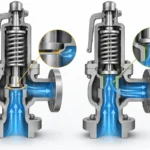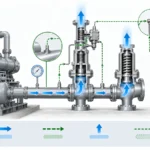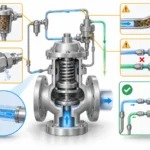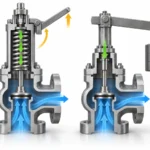
Learn when a packed lever is needed, how it differs from an open lever or closed cap, what the assembly contains, and what to verify before RFQ.

A packed lever safety valve uses a manual lifting mechanism whose shaft or operating penetration is sealed where it passes through the upper valve assembly. The word packed describes that sealing arrangement; it does not mean that the main valve seat, bonnet, or entire valve is “packed.”
The key distinction is between requiring a lifting device and requiring that lifting device to be packed. Those are separate engineering decisions. A code or project specification may require a way to lift the valve manually, while the need for packed construction depends on the applicable requirements, the proposed valve design, the service, and whether leakage through the lifting-mechanism penetration is acceptable.
For specification and RFQ work, use this sequence: governing requirement → lifting-device requirement → need for sealed lever construction → supplier drawing and documentation.
What Is a Packed Lever Safety Valve?
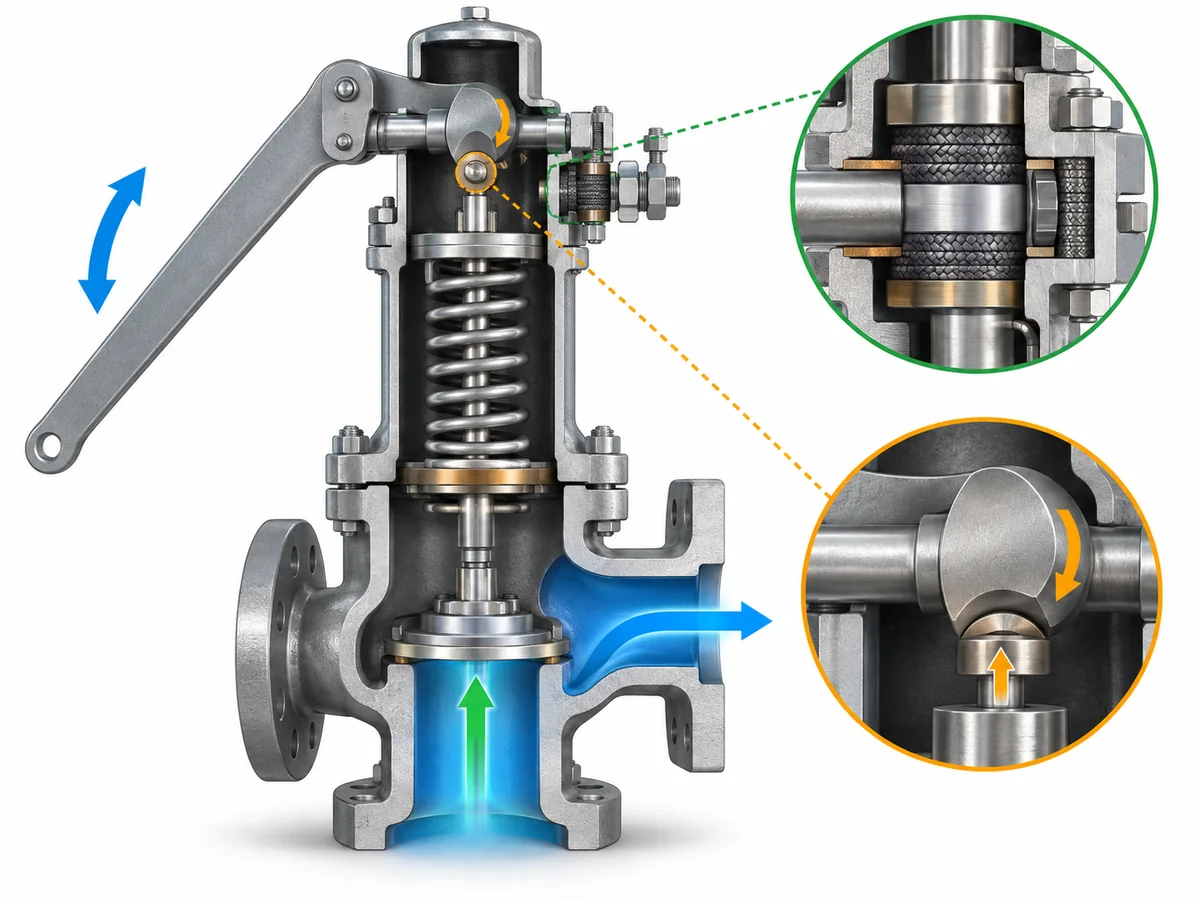
A packed lever is a lifting device with sealing around the shaft or operating mechanism that passes through the valve’s upper cap assembly.
The external lever still performs the manual lifting function. Inside the assembly, a lever shaft, cam shaft, or equivalent mechanism transfers that movement to the valve’s lifting components. Packing, an O-ring, a gland, or another design-specific seal controls leakage around the point where that mechanism penetrates the cap.
Three boundaries matter in practice.
Packed lever does not mean packed main seat. The main nozzle-to-disc seating interface is a separate sealing boundary. Lever packing does not establish main-seat tightness.
Packed lever does not mean closed bonnet. The bonnet houses the spring and related internal components. Manufacturer documentation can describe a valve as having a closed bonnet while separately offering regular lever, packed lever, or cap configurations. Current Crosby J-Series technical data treats these as separate construction choices.
“With lever” does not prove “packed lever.” A valve can have an external lifting lever without having the sealed shaft arrangement implied by packed construction.
That definition gives the buyer something physical to verify on a supplier drawing. For the wider product-family context, see ZOBAI’s lever safety valves page.
When Is a Packed Lever Actually Required?
Short answer: a packed lever is not automatically required whenever a lifting device is required. First establish whether the governing code or project basis requires a lifting device. Then separately determine whether the lever-shaft or operating-mechanism penetration needs to be sealed in the valve construction being specified.
First determine whether a lifting device is required
The answer depends on the governing code, equipment scope, service, and project requirements.
Current manufacturer documentation applying ASME requirements identifies lifting-device requirements for defined steam, air, and water applications. That does not create a universal rule for every relief valve, every medium, or every jurisdiction. ASME BPVC Section XIII is the current ASME section covering overpressure-protection requirements for pressure-relief devices, including design, assembly, testing, marking, and related requirements.
Where a project relies on an omission, exception, or alternative, verify the applicable code edition and jurisdiction rather than carrying a requirement from an older datasheet or another market into the project. ZOBAI’s broader ASME safety valve standards guide owns that wider standards question.
Then determine whether the lifting device needs a packed construction
Not automatically.
Current Crosby and Baker Hughes Consolidated technical documentation separates the lifting-device requirement from the choice between regular/plain and packed lifting-lever constructions. Baker Hughes, for example, describes its plain lever as not pressure-tight and distinguishes packed construction for cases where leakage around the lever assembly must be controlled.
- Confirm the governing basis. Identify the applicable code, project specification, and jurisdiction.
- Determine whether the valve must have a lifting device. Do not infer this from the fluid name alone.
- Check whether an accepted omission or alternative applies. Treat this as a project/code question, not a supplier assumption.
- If a lifting device is required or selected, determine whether leakage through its shaft or upper mechanism is acceptable.
- If that penetration must be sealed, evaluate a packed lifting-lever configuration supported by the actual valve design.
Do not reduce the decision to the fluid name
Rules such as “liquid service always needs a packed lever” are too broad. Manufacturer guidance can differ by valve family and application. Keep the decision tied to the governing requirement, actual service conditions, and the valve construction being offered.
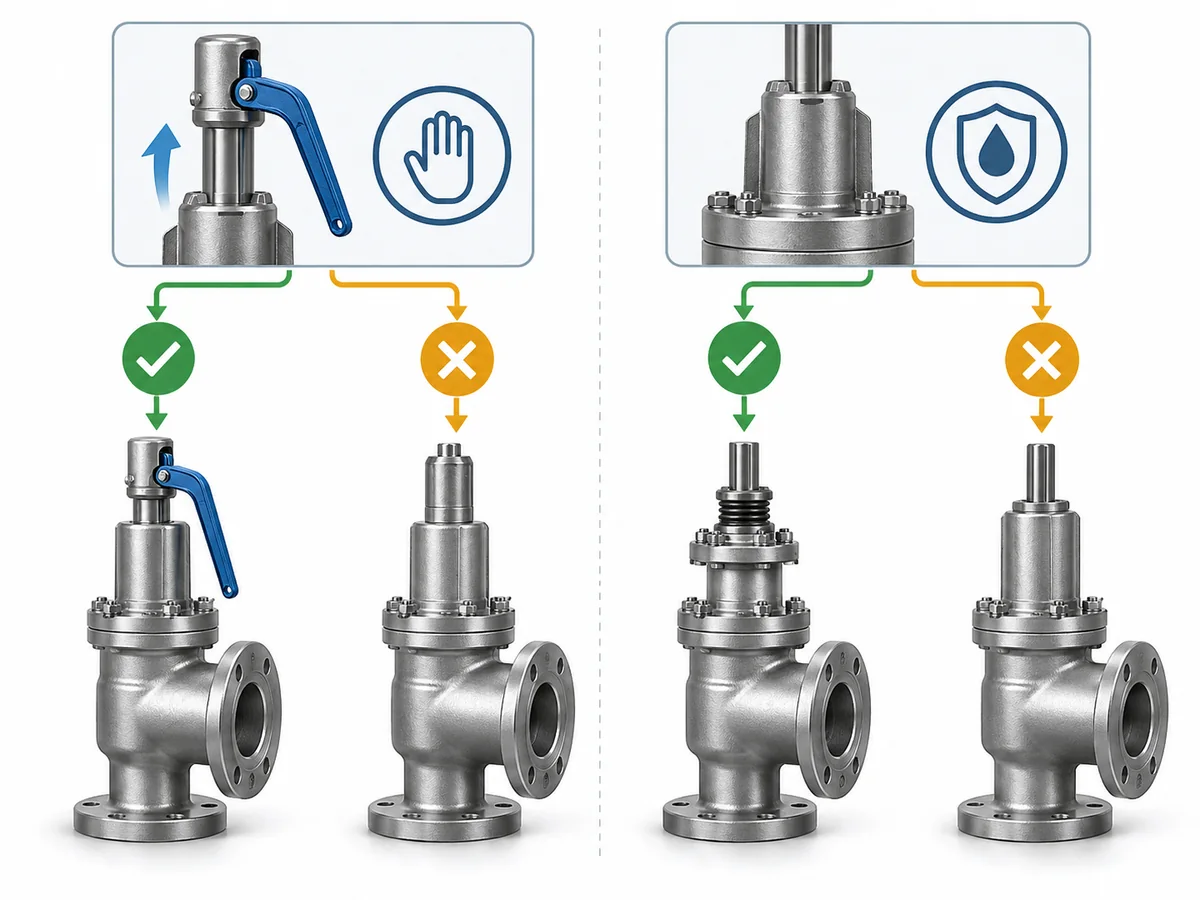
Open Lever, Packed Lever, or Closed Cap: What Changes?
These terms describe different upper configurations, and an RFQ should not use them interchangeably.
| Configuration | Manual lifting | Lever penetration | Packed/sealed lever penetration | Main specification point |
|---|---|---|---|---|
| Open / plain / regular lever | Yes | Present | No, in the cited designs | Manual lifting is available, but the lever mechanism is not pressure-tight. |
| Packed lever | Yes | Present | Yes, design-specific | Manual lifting is retained while the shaft penetration is sealed. |
| Closed-cap configuration | No exposed lifting lever in the cited arrangements | No external lever penetration | Not applicable as a lever penetration | Used where a lever is not part of the selected upper arrangement. |
The decision variables are manual lifting access and sealing of the lifting-mechanism penetration. Bonnet construction is a separate variable: a closed bonnet should not be used as another name for a packed lever or closed cap.
For the broader selection question, see Safety Valve with Lever vs Closed Cap.
What Does a Typical Packed Lever Assembly Contain?
There is no universal packed-lever bill of materials. Manufacturer drawings show different shaft geometry, packing methods, and retaining arrangements. What remains useful across designs is the functional chain.
| Functional group | Representative components | Function |
|---|---|---|
| Manual actuator | Lifting lever, test lever | Provides the external manual input. |
| Motion transfer | Lever shaft, cam shaft, cam, lifting fork | Transfers lever movement toward the valve’s lifting components. |
| Shaft sealing | Packing rings, packing, O-ring | Seals around the moving shaft or penetration. |
| Seal retention | Gland, packing nut, bushing, retaining elements | Holds or compresses the sealing element. |
| Upper housing | Cap / packed-cap assembly | Houses and supports the lifting mechanism. |
| Valve interface | Stem, release nut, test nut, or equivalent | Transfers movement to the internal valve mechanism. |
| Secondary sealing / retention | Gaskets, washers, bushings, nuts | Supports sealing and mechanical retention as required by the design. |
OEM manuals illustrate why these should be treated as functional groups rather than a mandatory universal parts list. Farris 2600 maintenance documentation shows packing rings and a gland associated with the cam shaft, while Consolidated documentation uses other packed-cap and shaft-sealing arrangements. The exact hardware depends on the valve design.
What Should a Packed Lever Not Be Assumed to Do?
The feature solves a specific construction problem. It should not be used as evidence for unrelated valve characteristics.
It does not prove that the entire valve is leak-tight
Lever packing controls a leakage path around the lifting mechanism. It does not prove zero leakage at the main valve seat, body joints, flanges, or other pressure boundaries.
Packed lever ≠ leak-proof valve.
It does not make the valve a balanced design
Back pressure can make an unsealed lever penetration undesirable because process fluid may escape through the upper lifting mechanism. Packing can address that local containment path.
That is different from compensating for the effect of back pressure on valve behavior. A balanced bellows, balanced piston, or another appropriate valve design addresses the relevant performance effects of back pressure. Packed-lever construction and balanced construction therefore solve different engineering problems.
- Packed lever: upper lifting-mechanism sealing.
- Balanced design: management of specified back-pressure effects on valve performance.
A manual lever check does not prove set pressure
A try-lever check can provide evidence that the lifting mechanism is free to move under the applicable test conditions. It does not establish the actual set pressure. 2025 National Board committee material maintains that distinction between freedom of operation and actual set-pressure information.
For boiler-specific lever context, see ZOBAI’s lever safety valve in boiler applications guide.
It does not prove relieving capacity or certification
Formal capacity, testing, marking, and conformity evidence are separate from manual operation. A successful lever movement should not be treated as a substitute for those records.
| Evidence | What it may support | What it does not establish |
|---|---|---|
| Lever operates under the applicable test condition | Freedom of mechanical movement | Set pressure |
| Packed construction shown on drawing | Sealed lifting-mechanism configuration | Whole-valve zero leakage |
| Balanced construction documented | Defined back-pressure design feature | Packed-lever construction |
| Capacity / conformity documentation | Formal evidence within its stated scope | Suitability for every installation |
Manual lifting should also not be turned into a generic operating procedure. The manufacturer instructions, plant procedure, operating condition, and applicable safety controls remain part of any actual test.
What Should Engineers and Buyers Verify Before Specifying a Packed Lever?
An RFQ should not stop at “safety valve with packed lever.” That leaves both the reason for the feature and the proposed construction unclear.
| Buyer / project should define | Supplier should confirm for the offered valve |
|---|---|
| Protected equipment and relief-duty context | Exact valve and upper configuration |
| Governing code and project specification | Whether the mechanism is open, packed, or another approved construction |
| Applicable jurisdiction where relevant | Actual lever / shaft / cam / cap arrangement |
| Service medium | Actual sealing method around the lifting-mechanism penetration |
| Relevant pressure and temperature basis | Packing/sealing material where project compatibility requires confirmation |
| Whether a lifting device is required | Permitted service limits for the offered configuration |
| Why packed construction is requested | Drawing showing the supplied top construction |
| Relevant discharge-side / back-pressure condition affecting containment | Applicable certification, marking, and test documentation |
| Any restrictions on manual lifting | Manufacturer instructions for manual operation or inspection |
| Required document package | Any deviation from the project specification |
The key RFQ sequence is: code / project basis → service → lifting-device requirement → reason for packed construction → exact supplier configuration → sealing evidence → drawing and documentation.
This also protects against a product-name shortcut. ZOBAI’s catalog includes valves described as “with Spanner” and “Enclosed … with Spanner.” Those descriptions alone do not establish that the particular construction is a packed lifting lever. The offered model drawing and technical documentation should confirm that point before the term is used as a product claim.
A packed lever is therefore best treated as a specific lifting-device construction, not as a generic sign that a safety valve is tighter, safer, or suitable for a particular service.
Engineering sequence: establish the requirement → determine whether the lever penetration needs sealing → verify the actual construction → verify the offered valve against the project.