اختر صمام أمان يعمل بالبايلوت لخدمة LNG من خلال التحقق من التعرض لدرجات الحرارة المنخفضة، وخطوط الاستشعار، وأختام البايلوت، والضغط الخلفي، والمعايير، ومتطلبات طلب عرض السعر.

قد يكون صمام أمان يعمل بالبايلوت لخدمة الغاز الطبيعي المسال LNG مرشحًا مناسبًا، لكن تصنيف الصمام الرئيسي لدرجات الحرارة المنخفضة وحده
لا يثبت الملاءمة. يجب مراجعة المنظومة الكاملة بتكوينها المحدد، بما في ذلك:
الصمام الرئيسي والبايلوت، ونقطة أخذ الضغط ومسار استشعار الضغط، وأنابيب التوصيل والوصلات، وموانع التسرب والأجزاء اللينة الأخرى،
وترتيب تنفيس البايلوت، والتعرض للضغط الخلفي، والظروف التي يتلقى فيها البايلوت إشارة الضغط فعليًا.
دائرة البايلوت جزء من وظيفة التحكم في الضغط. لذلك يمكن أن يوجد صمام رئيسي قادر على خدمة التبريد العميق
مع وجود حد غير محسوم لدرجة حرارة البايلوت، أو عنصر إحكام غير مناسب، أو مسار استشعار قد ينسد
أو يتجمد، أو ترتيب تصريف/ضغط خلفي لم يتم التحقق منه لتصميم البايلوت المختار.
السؤال العملي ليس ببساطة: “هل هذا صمام يعمل بالبايلوت للخدمة المبردة؟” بل:
هل ثبتت ملاءمة صمام الأمان الكامل المجهز الذي يعمل بالبايلوت لواجب التنفيس المحدد في خدمة LNG،,
والتعرّض لدرجات الحرارة، وحالة المائع، وترتيب الاستشعار، والضغط الخلفي، وظروف الأنابيب المركّبة؟
يستخدم هذا الدليل ذلك السؤال لفحص المرشح قبل الهندسة الخاصة بالموديل أو مراجعة طلب عرض السعر. وهو لا
يغني عن دراسة حالة التنفيس الحاكمة، أو حساب السعة، أو مراجعة شهادات المنتج، أو موافقة المهندس المسؤول.
هل يمكن استخدام صمام أمان يعمل بالبايلوت لخدمة LNG؟
نعم—كبنية بنية مرشحة لواجب محدد في خدمة LNG، رهناً بالتحقق الخاص بكل تجهيز.
Primary sources show that pilot-operated safety valves are used in defined LNG applications, but the scope of that
evidence matters.
ISO 18154
addresses diaphragm-type pilot-operated safety valves used on LNG-carrier cargo tanks. It confirms that the architecture
is valid in that defined application; it is not a blanket application standard for terminals, liquefaction trains,
transfer lines, storage vessels or every pilot design.
معيار API 521 is relevant at system level because API
explicitly includes LNG terminals in its pressure-relieving and depressuring-system scope. That supports relief-scenario
and downstream-system review, not LNG-specific qualification of a particular POSV.
LESER’s LNG POSV case study
shows why configuration matters: its documented cryogenic POSV solution uses project-specific thermal management of the
pilot, including thermal decoupling and an evaporator in one application. The lesson is not that every LNG POSV needs
those features; it is that pilot temperature and fluid state can be engineered variables rather than assumptions derived
from the main-valve rating.
معامل LESER High Efficiency POSV product family
provides further manufacturer context, but a product-family page does not replace configuration-specific cryogenic qualification.
Keep three statements separate:
يُستخدم التصميم في خدمة LNG
لا يعني
this product family is suitable for every LNG duty
ولا يعني أي منهما تلقائيًا
this exact configured valve is suitable for this relief case.
Before a candidate moves forward, define the relief duty, expected relieving state, relevant temperatures, back pressure,
main-valve and pilot materials, sensing arrangement, pilot vent arrangement and required project evidence.
الكلمة مرشح is deliberate. It means the architecture deserves technical review; it does not mean
the valve has already been sized, certified, accepted or approved for the project.
Readers who need broader product-family context can review
صمامات الأمان التي تعمل بالبايلوت
بشكل منفصل عن دليل الفحص الخاص بالغاز الطبيعي المسال LNG هذا.
For other LNG relief scenarios beyond the pilot-circuit question, see the
دليل تطبيقات صمامات أمان LNG.
لماذا لا تكفي قدرة الصمام الرئيسي على درجات الحرارة المنخفضة
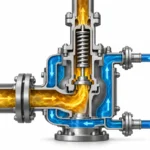
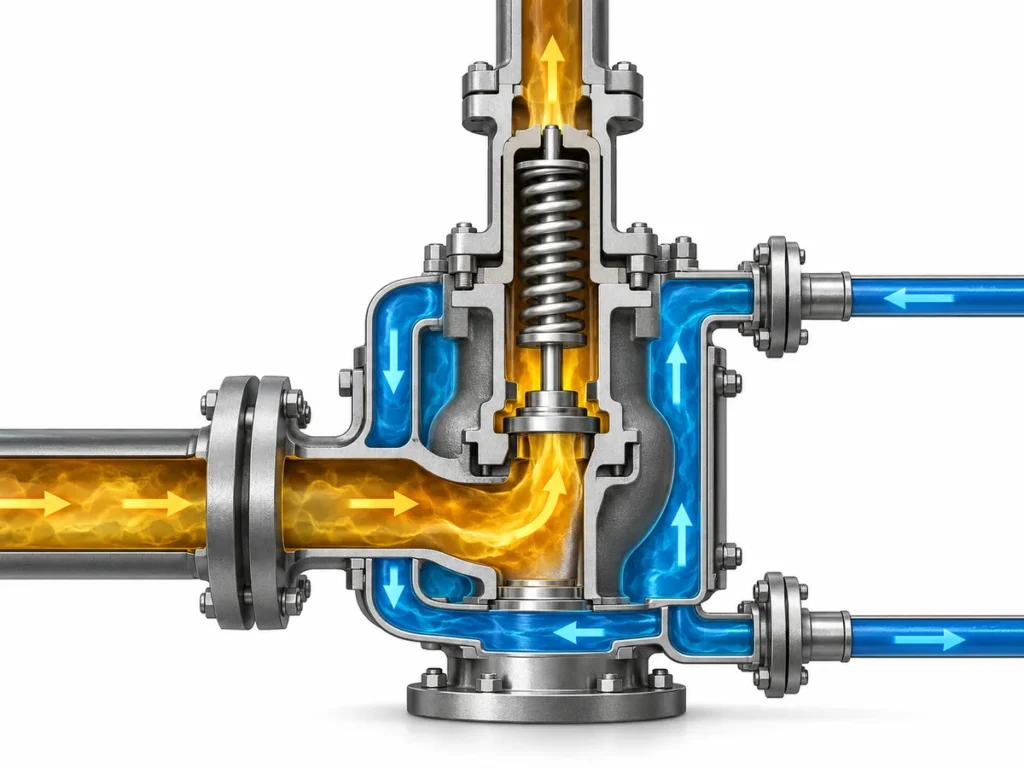
A pilot-operated safety valve is not one temperature-rated object. It is an assembled pressure-relief system whose
components can have different materials, sealing elements, exposure conditions and documented limits.
The main relieving assembly can include the pressure-retaining body, nozzle, disc or piston and main-valve sealing
elements. The control side adds the pilot valve, pressure-sensing path, tubing, pilot seals, filters or restrictions
where used, and the dome/control-pressure circuit. A temperature statement for one element should not be silently
extended to the others.
Baker Hughes Consolidated 3900/3900 TM technical specifications
separate pilot/modulator options, main-valve configuration, remote sensing, pilot venting, back pressure and
component-level selection data. That structure supports the engineering principle here: the exact configured POSV,
not a family-level headline, is what has to be verified.
Material verification should follow the actual temperature map
Cryogenic material review should follow where each component sits and what temperature and fluid state it can experience.
For an LNG POSV, that means checking more than body alloy. Pilot internals, piston or diaphragm elements, soft seats,
O-rings or other elastomers, PTFE-based seals where used, sensing tubing and fitting materials can each have a different
documented service envelope.
LESER’s LNG documentation gives a manufacturer-specific example: its cryogenic POSV arrangement uses a project-configured
approach to keep the pilot in a controlled condition and identifies a specific PTFE compound in the main-valve sealing
arrangement. That proves component-level material and thermal management can matter; it does يحدد establish
a universal LNG material recipe.
| جزء من النظام المهيأ | What must be verified for LNG service |
|---|---|
| مجموعة التنفيس الرئيسية | Exact materials, pressure boundary and allowable-temperature evidence for the selected configuration |
| Main-valve seat / piston or diaphragm elements | Low-temperature compatibility, sealing function and component-specific limits |
| البايلوت | Pilot type, internal materials, seals, operating action and documented service limits |
| مسار استشعار الضغط | What pressure, temperature and fluid state actually reach the pilot |
| أنابيب البايلوت والتجهيزات | Material, routing, joints and expected thermal exposure |
| الفلاتر أو القيود، إن وُجدت | Service suitability and effect on the pressure-sensing/control path |
| Pilot vent path | Vent destination and back-pressure conditions applied to the selected pilot design |
Do not use one temperature number as evidence for the whole pilot-operated valve unless the supplier documentation
explicitly supports that complete configured scope.
The same caution applies to product-family tables. The most extreme low-temperature value visible anywhere in a catalog
should not be assigned to every pilot, seal, material combination or valve configuration.
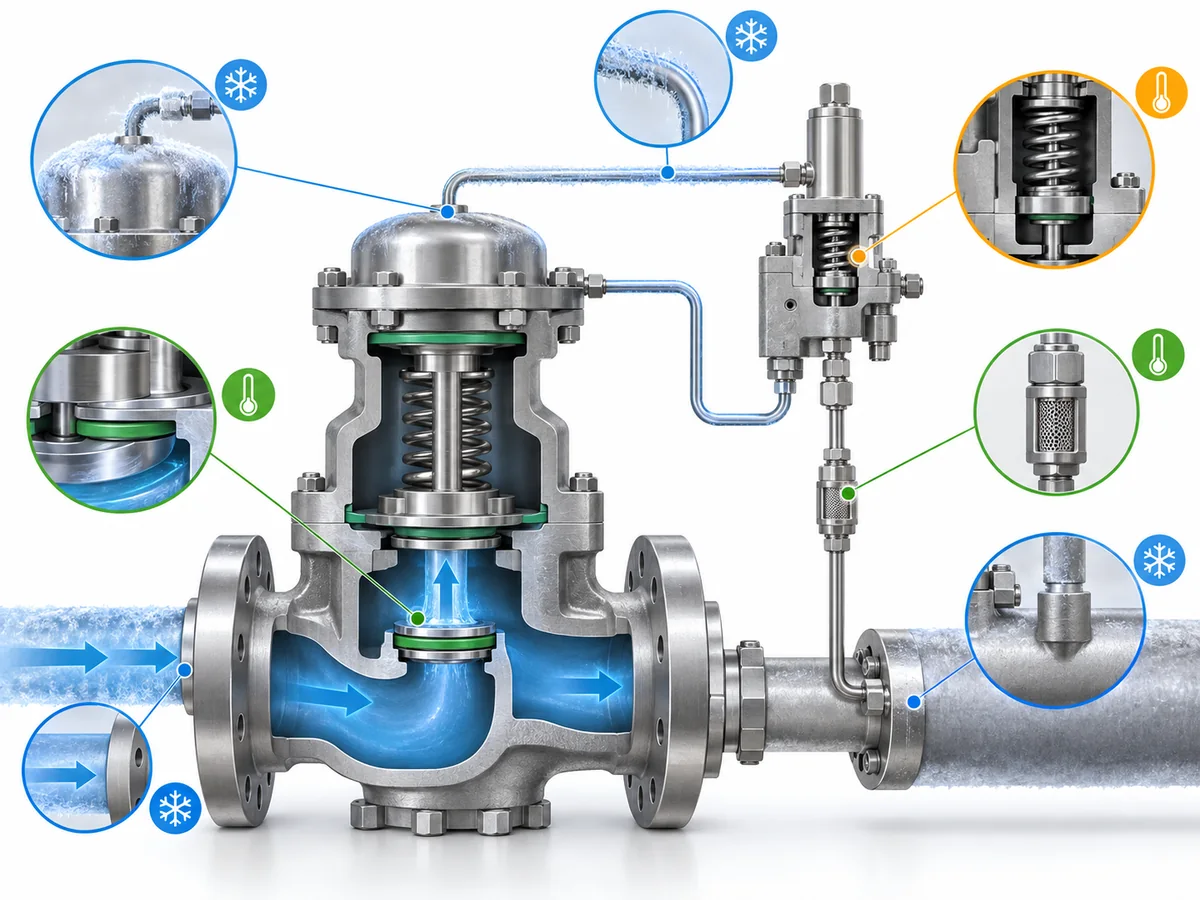
كيف يمكن لدرجات الحرارة المنخفضة أن تهدد سلامة إشارة ضغط البايلوت
Low temperature becomes a pilot-circuit problem when it changes or interrupts the pressure signal the pilot needs for
its control function. That risk belongs to the sensing/control circuit even though the main relief path is much larger.
At a simplified functional level:
protected-system pressure → pressure pickup → sensing path → pilot → dome/control pressure → main-valve response
Every element in that chain has to preserve the pressure information that the pilot is intended to act on.
Baker Hughes Consolidated 2900 POSRV operating instructions
identify the failure mechanism directly: a pilot sensing line that becomes clogged or frozen can isolate system pressure
from the pilot, preventing the pilot from correctly detecting protected-system pressure and carrying out the intended
relief response.
That warning identifies the functional consequence without creating a generic LNG threshold. The design task is to decide
whether the actual installation has a credible sensing-path blockage or freeze condition and, if so, what manufacturer-approved
arrangement controls the risk.
يمكن للقراء الذين يحتاجون إلى تسلسل التشغيل العام الكامل مراجعة
كيف يعمل صمام الأمان الذي يعمل بالبايلوت;
this article uses only the operating principle required to explain the LNG screening risk.
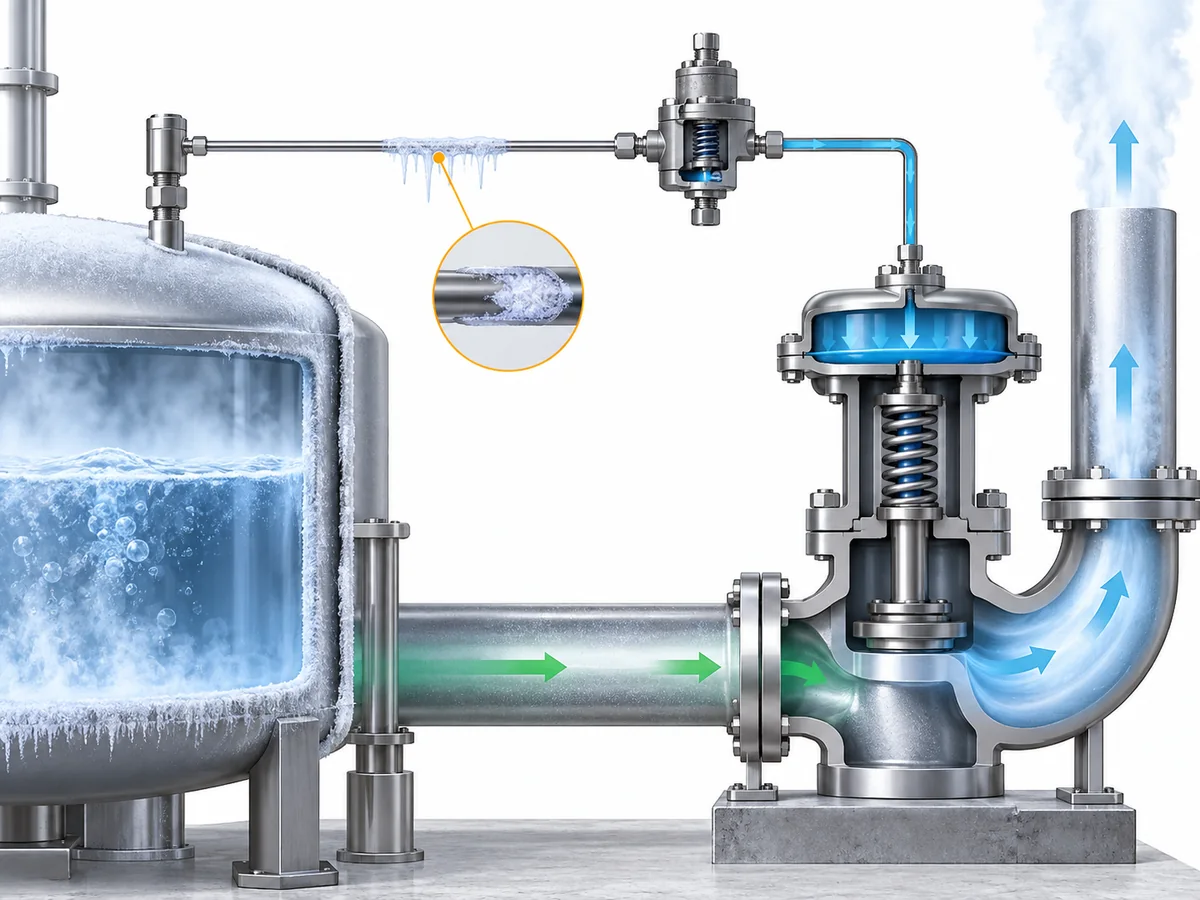
لا تدمج آليات مختلفة في خطر واحد
انسداد يصف مسار ضغط مقيّد أو مغلق.
التجمد can be one cause of blockage when the actual local fluid and thermal conditions allow it.
Particulate contamination, deposits or process contamination can restrict a sensing path through different mechanisms.
Those mechanisms should be identified from the actual service rather than collapsed into the word “freezing.”
Manufacturer guidance in hydrocarbon service can discuss hydrate or contamination risks, but that does not justify
describing hydrates as a routine LNG pilot-circuit failure. Likewise, a freeze-protection instruction written for another
service demonstrates a mechanism; it does not automatically prove that the same mechanism exists in a particular LNG installation.
Current source evidence does not support a universal statement that flashing or two-phase flow in every LNG sensing line
causes one predictable pilot failure mode. The relevant question is whether the pressure and fluid condition delivered
to the pilot remain representative for the selected design.
The pressure condition presented to the pilot must remain representative of the protected system under the defined
operating and relieving conditions.
If a proposed design depends on a sensing path whose local temperature, fluid state, blockage risk or thermal management
remains unresolved, that uncertainty should remain visible in the selection review.
ما الذي يجب فحصه في البايلوت ودائرة الاستشعار؟
Once the pilot path is treated as part of the pressure-protection function, the review can move from generic
“cryogenic suitability” to specific configuration questions.
| تحقق من | لماذا يغير القرار | الأدلة المطلوب الحصول عليها |
|---|---|---|
| موقع التقاط الضغط | يحدد ضغط النظام الذي يستشعره البايلوت فعليًا | P&ID, connection point and exact supplier arrangement |
| الاستشعار المدمج أو عن بُعد | Changes the physical pressure-sensing path and its exposure | Exact valve/pilot configuration |
| مسار خط الاستشعار عن بُعد، حيثما يُستخدم | Adds tubing length, elevation, fittings and thermal-routing variables | Routing, equivalent length, elevation change and manufacturer review where required |
| فلتر تغذية البايلوت، حيثما يُستخدم | Becomes part of the control path and can itself become a restriction point | تكوين الفلتر وأساس الخدمة |
| وجهة تنفيس البايلوت | Determines which downstream pressure acts on the pilot vent arrangement | Vent routing and selected-pilot back-pressure documentation |
| ترتيب منع التدفق العكسي، عند الاقتضاء | قد يكون مهمًا في ظروف ضغط معينة | Supplier application review for the selected pilot design |
| مواد البايلوت والأجزاء الداخلية | May have a different service envelope from the main valve | Component/configuration documents |
| أختام البايلوت والصمام الرئيسي | Low-temperature limits and sealing behavior are component-specific | إثبات المواد وظروف التشغيل المسموح بها |
| الأنابيب والتجهيزات | The complete control circuit must remain suitable at the expected exposure | Material, fitting and configuration evidence |
الاستشعار عن بعد ترتيب هندسي وليس ترقية تلقائية
Remote pressure sensing is legitimate, but it should not be recommended simply because the service is LNG. It adds a
physical path between the protected system and pilot, so routing, length, fittings, elevation and local thermal exposure
become part of the review.
Baker Hughes 2900/2900 TM ordering data
ask for remote-sensing information including sensing-line length, equivalent length and elevation change, while separately
requesting built-up and superimposed back pressure, pilot sense and pilot vent configuration. These are engineering inputs,
not cosmetic options.
Where must the pilot sense representative protected-system pressure, and what physical path connects that point to the pilot?
المرشحات تحل مشكلة محددة، وليس “خدمة LNG” بشكل عام
Pilot supply filters appear as options in documented POSV configurations. They can be relevant when particulate contamination
is a credible concern, but a filter should not become a mandatory LNG checkbox.
If a filter is proposed, verify what condition it addresses, how it affects the sensing/control path, what inspection or
maintenance it requires, and whether it is included in the exact supplier configuration.
راجع تنفيس البايلوت مع الضغط الخلفي
Pilot venting and outlet pressure belong in the same configuration review. Baker Hughes technical data for the Consolidated
3900 series show that back-pressure behavior changes with pilot design and with whether the pilot vent is routed to the
main-valve outlet, to atmosphere or to another documented location. The published numerical limits are product-specific
and are not generalized here.
The system review therefore needs two related answers: what pressure the main valve sees at its outlet, and what pressure
acts on the pilot vent for the selected configuration. If a common discharge header is involved, expected superimposed
and built-up back pressure must be part of the sizing/selection basis.
Back pressure is a property of the installed relief system as well as a valve-selection input; the selected pilot vent
arrangement has to be checked against the actual downstream-pressure conditions.
منع التدفق العكسي مشروط
Backflow-preventer arrangements are documented as optional configurations rather than universal equipment. Whether one
is needed depends on the selected pilot architecture and the actual pressure relationships across the installed system.
The same logic applies to the rest of the pilot circuit: configuration names should trigger engineering verification,
not automatic purchasing decisions.
ماذا تُثبت المعايير — وماذا لا تُثبت؟
Standards are essential evidence, but different standards answer different questions. A defensible LNG POSV review
separates product-standard scope, overpressure-protection rules, relief-system guidance and project-specific conformity evidence.
standard relevance ≠ certification or conformity evidence ≠ LNG application suitability ≠ project acceptance
ISO 4126-4
specifies general requirements for pilot-operated safety valves. ISO describes it as a product standard rather than an
application standard and states that the standard itself places no temperature limitation. Those points must be read
together: absence of a standard-level temperature limit does not prove that every POSV configuration is suitable for LNG.
قد تكون المواصفات الخاصة بـ LNG أضيق نطاقًا بكثير
ISO 18154
is application-specific but narrow: it addresses diaphragm-type pilot-operated safety valves on LNG-carrier cargo tanks.
It is evidence for that defined marine application, not a blanket rule for every LNG facility or pilot architecture.
أين تتوافق API 520
API 520 الجزء الأول provides sizing and selection requirements within
its scope, while API 520 الجزء الثاني addresses installation. API’s current catalog lists
the published editions, while its standards plan also shows later editions under development; edition-specific requirements
should therefore be checked against the project’s adopted basis.
API 521 provides pressure-relieving and depressuring-system guidance
and explicitly includes LNG terminals in its stated scope. It is particularly relevant to relief-scenario and downstream-system
context, including how the back-pressure basis is established.
ASME BPVC القسم XIII is the current ASME overpressure-protection section for
pressurized equipment. Where an ASME construction basis is adopted, it belongs in the code/conformity review; it is not
an LNG-specific pilot-circuit or material qualification.
For in-service inspection and repair planning,
API RP 576 covers inspection and repair practices for pressure-relieving devices,
including pilot-operated pressure-relief valves. It does not justify one universal inspection interval for every LNG project.
For a broader standards overview without expanding this article beyond its LNG POSV scope, see the
دليل معايير صمامات الأمان.
For supplier evaluation, keep four questions separate:
- Which technical standards are relevant to this pressure-relief system and product?
- What certification, conformity or test evidence exists for the exact proposed configuration?
- Does that configuration satisfy the defined LNG duty, temperature exposure, pilot circuit and back pressure?
- Does the purchaser, responsible engineer and applicable jurisdiction accept the evidence package?
قائمة طويلة من المعايير لا تغني عن هذه الإجابات.
When Should an LNG POSV Candidate Proceed, Be Held, or Be Rejected?
The following PROCEED / HOLD / REJECT logic is an engineering screening framework used in this article.
It is not an ISO, API, ASME or regulatory classification.
متابعة
استخدام متابعة when enough defined information exists to continue into detailed model-specific engineering
or supplier review.
- relief duty and required capacity;
- LNG composition or defined fluid basis and expected relieving state;
- operating, relieving and relevant component temperatures;
- الضغط الخلفي المتوقع والمتراكم؛;
- pilot type and operating action;
- pressure pickup and sensing arrangement;
- main-valve, pilot, tubing and fitting materials;
- seals and other soft goods;
- pilot vent arrangement;
- installation constraints affecting sensing or thermal exposure;
- applicable standards and project-required evidence.
PROCEED does not mean approved. It means the candidate is defined well enough for meaningful review.
تعليق
استخدام تعليق when a missing fact could materially change suitability.
- actual pilot or sensing-line temperature exposure is unknown;
- pilot or main-valve soft-good limits are unresolved;
- the pressure pickup or sensing arrangement is undefined;
- a remote sensing path has not been routed or reviewed;
- pilot venting and back-pressure interaction remain unresolved;
- a product-family temperature range cannot be tied to the exact proposed configuration;
- the expected fluid state at the pilot is not established where the configuration depends on it;
- required conformity, certification or test evidence has not been supplied.
Unknown is not the same as unsuitable.
رفض
استخدام رفض only when a documented mismatch has been established.
Examples include a component expected to operate outside its documented limit, a pilot/sensing arrangement that cannot
satisfy a required project condition, a back-pressure condition outside the selected configuration’s documented basis,
or a candidate that fails the required relieving-duty verification.
| حالة الفرز | المعنى |
|---|---|
| متابعة | Enough evidence exists to continue detailed engineering and model review |
| تعليق | A decision-critical fact or evidence item remains unresolved |
| رفض | A documented mismatch with the defined LNG service has been established |
This framework organizes the review without pretending to replace formal sizing, certification, purchaser acceptance
or responsible-engineer approval.
What Should an LNG Pilot-Operated Valve RFQ Include?
An LNG POSV RFQ should define the relief duty, process state, low-temperature exposure, pilot circuit and
downstream conditions, not only nominal valve size, medium and set pressure.
Original manufacturer ordering data support that approach. Baker Hughes POSV ordering information asks for fluid/service
and relief inputs such as required capacity, operating and relieving temperatures, set pressure, built-up and superimposed
back pressure, pilot sense, pilot vent and remote-sensing geometry where applicable. Those inputs can change the configuration.
Information the buyer should provide
واجب التنفيس
- protected equipment or service;
- credible relief case;
- سعة التنفيس المطلوبة؛;
- أساس ضغط الضبط؛;
- applicable project overpressure basis where defined.
Process and cryogenic conditions
- LNG composition or defined fluid basis;
- ضغط التشغيل؛;
- درجة حرارة التشغيل؛;
- درجة حرارة التنفيس;
- expected relieving fluid state;
- ambient or local thermal conditions where they affect pilot/sensing components.
النظام المثبت
- الضغط الخلفي المتجمع؛;
- الضغط الخلفي المفروض من النظام؛
- common-header or discharge-system conditions;
- installation constraints affecting tubing, venting or thermal exposure.
Pilot and sensing basis
- proposed pressure pickup location;
- integral or remote sensing requirement, if already defined;
- known sensing-line length, routing, fittings and elevation change for remote sensing;
- pilot vent destination;
- known contamination, blockage or freeze risks requiring manufacturer review.
Project evidence
- applicable design standard and adopted edition where specified;
- مواصفات المشتري؛;
- required conformity, certification, test and documentation package.
Evidence the supplier should return
The supplier should identify the exact candidate configuration rather than answer only at product-family level.
- الطراز والتكوين بالتحديد؛;
- pilot type and operating action;
- main-valve pressure-boundary and internal materials;
- pilot materials and internals;
- seat, piston/diaphragm and other soft-good materials where applicable;
- tubing and fitting configuration;
- ترتيب استشعار الضغط؛;
- pilot vent arrangement;
- filter, heat exchanger, thermal-management or backflow configuration where used;
- documented allowable conditions for the relevant configured components;
- back-pressure basis and any configuration-specific restrictions or corrections;
- sizing or certified-capacity evidence required by the project;
- project-required test, conformity or certification documentation.
Buyer inputs define the problem. Supplier evidence shows whether the exact configured valve can solve that problem.
“Service: LNG” is not enough information to complete either side of that exchange. Likewise, مبرّد
is not a substitute for defining which configuration, pilot, sensing path, soft goods, back-pressure condition and actual
temperatures the supplier is confirming.
Readers who need the broader valve-selection workflow can continue with the
دليل اختيار صمامات الأمان.
Preparing an LNG POSV inquiry?
Send the defined relief duty, operating and relieving conditions, expected back pressure,
fluid state and pilot/sensing requirements to ZOBAI for supplier review and RFQ preparation against the actual service conditions.
FAQ: LNG Pilot-Operated Safety Valve Selection
Can a pilot-operated safety valve be used for LNG service?
Yes, but only after the exact configuration is verified for the defined LNG duty. ISO 18154 confirms a narrow LNG-carrier
cargo-tank application for diaphragm-type pilot-operated safety valves, while manufacturer documentation shows purpose-built
cryogenic POSV configurations. Neither source means every POSV is automatically suitable for LNG.
Why is the main-valve cryogenic rating not enough?
Because the pilot, sensing path, tubing, fittings and soft goods can have different materials, temperatures and service
limits from the main valve. Suitability has to be demonstrated for the complete configured valve and its actual thermal exposure.
What happens if an LNG POSV sensing line freezes or becomes blocked?
A restricted sensing line can isolate the pilot from representative protected-system pressure. Baker Hughes operating
instructions identify clogged or frozen sensing lines as a condition that can prevent the pilot from correctly detecting
system pressure. Whether that mechanism is credible in a specific LNG installation depends on actual fluid, contamination
and thermal conditions.
How does back pressure affect an LNG pilot-operated safety valve?
Back pressure must be checked against the selected pilot design and vent arrangement. Manufacturer technical data show
that behavior can differ depending on where the pilot vents and whether back pressure is constant or variable. A numerical
limit from one product should not be applied to another configuration.
Does ISO 4126-4 prove that a POSV is suitable for cryogenic LNG temperature?
No. ISO 4126-4 is a general product standard for pilot-operated safety valves and says it is not an application standard.
Its lack of a standard-level temperature limitation does not prove service suitability for a particular LNG configuration.
What should an LNG POSV supplier confirm before the RFQ is closed?
The supplier should identify the exact model and pilot configuration; materials and soft goods; sensing and vent arrangement;
applicable configured-component limits; back-pressure basis; sizing or capacity evidence; and the conformity, certification
or test documents required by the project.