
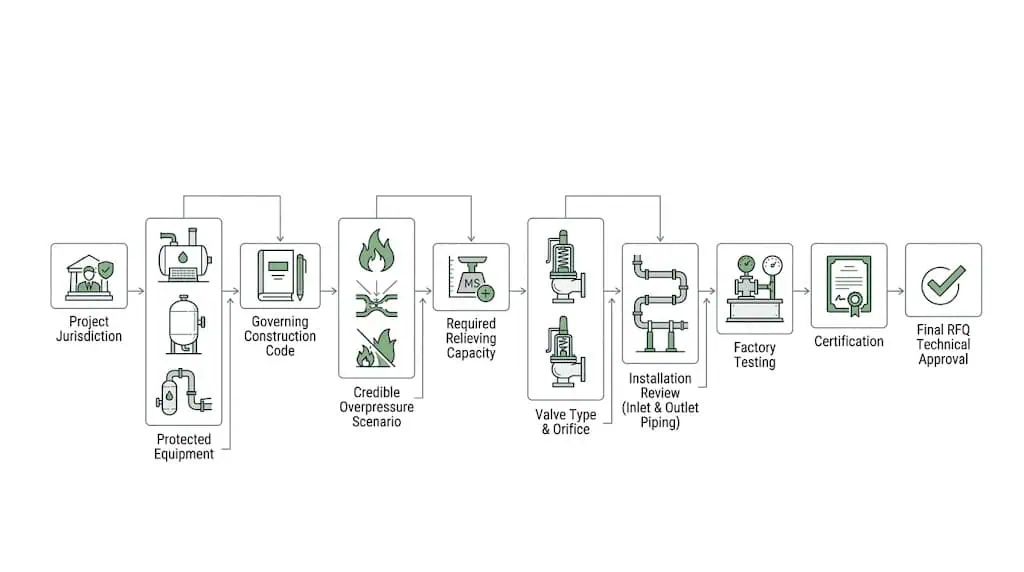
Safety Valve Compliance Usually Requires More Than One Standard A safety valve should not be selected by copying one code number, flange size or valve model into an RFQ. The governing framework normally begins with the protected equipment, project jurisdiction and construction code. Supporting standards may then address the credible overpressure scenario, required relieving capacity, …

Safety Valve Compliance Usually Requires More Than One Standard
A safety valve should not be selected by copying one code number, flange size or valve model into an RFQ. The governing framework normally begins with the protected equipment, project jurisdiction and construction code. Supporting standards may then address the credible overpressure scenario, required relieving capacity, valve configuration, installation, back pressure, seat tightness, inspection and conformity documents. An ASME pressure vessel project may therefore also use API 520 for sizing and selection, API 521 for system-level relief analysis, API 526 for a standardized flanged valve configuration and API 527 for seat-tightness testing. An EU project may require PED conformity together with an EN or ISO product standard. Final acceptance still depends on the actual medium, set pressure, relieving temperature, inlet pressure loss, outlet resistance, certified capacity, materials, installation arrangement and required certification scope.
Engineering boundary
This guide supports preliminary engineering, procurement and supplier-document review. It does not replace the official standard, project specification, approved relief calculation, manufacturer-certified capacity data, local jurisdictional requirements or review by the responsible engineer.
Terminology boundary
“Safety valve,” “relief valve,” “safety relief valve,” “pressure safety valve,” “pressure relief valve,” “PSV” and “PRV” are not used identically in every industry or code system. Safety valve commonly refers to a rapid-opening device used on steam, gas or other compressible-fluid service; relief valve is often associated with liquid or thermal-relief service and more proportional opening; safety relief valve may be suitable for gas, vapor or liquid service depending on its design. These are useful engineering distinctions, but the project standard and manufacturer documentation remain controlling.
Which Safety Valve Standard Applies to Your Project?
The correct starting point is not the valve catalogue. It is the pressure boundary that requires protection. A power boiler, process pressure vessel, compressor package, pipeline section and LNG skid may all use automatic pressure-relief devices, but the governing equipment code, permitted pressure rise, relief scenarios, certification route and inspection requirements can be different.
Start with the Jurisdiction and Protected Equipment
Confirm where the equipment will be installed and which organization has authority over its design, registration, inspection and operation. The destination country alone may not be sufficient. An international EPC project may use an owner specification, a construction code selected by contract and additional local requirements.
The protected equipment must then be identified precisely. “Process skid” is not enough. The RFQ should state whether the valve protects a vessel, boiler, piping section, compressor discharge, heat exchanger, storage vessel or another pressure boundary. This determines which maximum allowable pressure applies and which credible events must be evaluated.
Identify the Governing Construction Code
The construction code establishes the pressure-protection basis of the protected equipment. It may define or influence the relationship between maximum allowable working pressure, set pressure, overpressure, accumulation, capacity certification, marking and inspection. A valve product standard should therefore be coordinated with the equipment code rather than treated as a substitute for it.
Why this matters
Starting with a catalogue model can produce a valve that fits the nozzle but does not satisfy the equipment code, capacity requirement or certification route. The error may not appear until document review or final inspection, when correcting it can require a new spring, different trim, a different orifice, repeat testing or complete replacement.
Separate Mandatory Requirements from Customer Specifications
A project specification may add requirements for sour service, low-temperature impact testing, special alloys, fugitive-emission controls, coating, seat leakage, third-party witnessing, document language or nameplate content. These requirements should be marked as project-specific instead of being presented as universal requirements of ASME, API or ISO.
The distinction affects cost and lead time. A mandatory code requirement cannot normally be removed during commercial negotiation. A preferred documentation format may be negotiable. If both are listed without priority, suppliers may quote different scopes and the apparent lowest price may exclude essential testing or certification.
Build a Standards Hierarchy Before Selecting the Valve
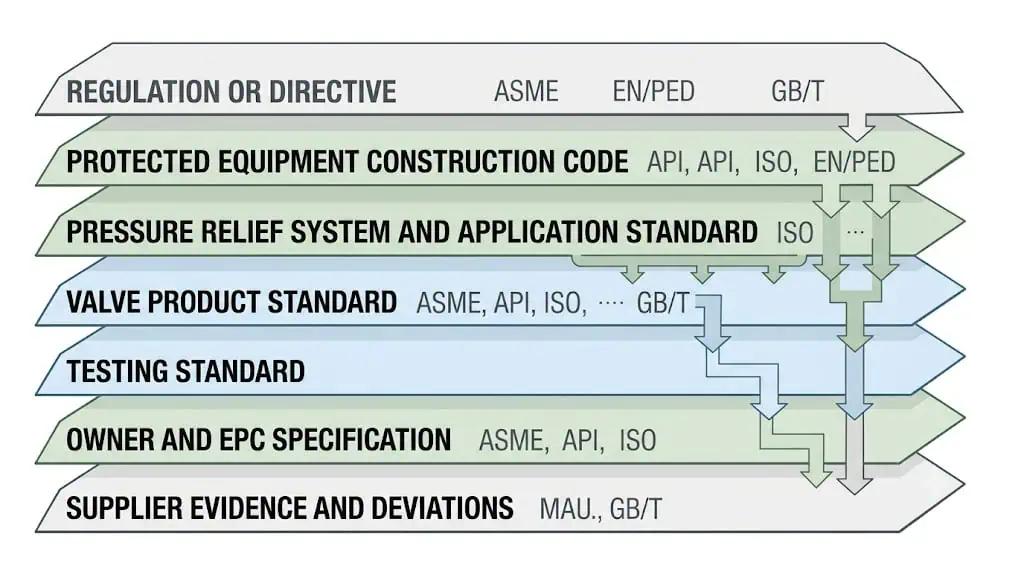
A practical hierarchy normally includes:
- Applicable law, regulation or directive.
- Protected equipment construction code.
- Pressure-relief system and application standard.
- Safety valve product or configuration standard.
- Flange, material and testing references.
- Owner, EPC and package-vendor specifications.
- Approved technical deviations and clarification records.
When requirements conflict, the supplier should not decide silently which document takes priority. The conflict should be entered in a clarification or deviation register and resolved before technical approval.
How Codes, Standards, Directives and Project Specifications Differ
The words code, standard, directive, certification and specification are often used as though they mean the same thing. In a technical bid evaluation, this creates uncertainty about what is legally required, what defines equipment design, what controls valve performance and what evidence the supplier must submit.
Regulations and Directives Define the Legal Compliance Framework
A regulation or directive may control whether pressure equipment can be placed on a market, commissioned or operated. It may establish essential safety requirements and a conformity-assessment route. It should not automatically be treated as a detailed safety valve sizing or installation method.
For stationary pressure equipment supplied to the European market, PED-related requirements may affect equipment classification, safety accessories, technical documentation, conformity assessment and marking. The route must be confirmed for the specific valve, equipment or assembly.
Construction Codes Define the Protected Equipment Basis
Construction codes are connected to the boiler, pressure vessel or piping system that requires protection. They establish the context in which set pressure, acceptable pressure rise, required capacity, certification and installation are reviewed.
Product Standards Define Valve Design and Performance Requirements
A product standard may cover the safety valve itself, including design, materials, operating characteristics, testing or marking. Product compliance does not prove that the selected valve is large enough for the governing relief case, stable with the installed piping or compatible with the process fluid.
Application Standards Guide Sizing, Installation and Relief-System Review
Application standards connect the pressure-relief device to the process system. They may address credible causes of overpressure, relief-load calculation, sizing, inlet pressure loss, outlet piping, built-up back pressure, disposal systems and flare interaction.
Project Specifications Add Service-Specific Requirements
Owner and EPC specifications often control materials, corrosion allowance, seat construction, inspection points, document format and vendor qualification. A supplier must review the complete document set rather than quote against one standard title.
| Document Type | Primary Function | Typical Safety Valve Effect | What Can Go Wrong if Misunderstood |
|---|---|---|---|
| Regulation or directive | Legal or market-access framework | Conformity route, technical file, marking and acceptance | A functional valve may still lack the evidence required for legal acceptance. |
| Construction code | Protected equipment design basis | Set pressure, allowable pressure rise, capacity and certification basis | The valve may not match the boiler, vessel or piping code. |
| Product standard | Valve design and performance framework | Design, testing, marking and product performance | Product compliance may be mistaken for application suitability. |
| Application standard | System-level engineering method | Relief scenario, sizing, inlet and outlet review | Required capacity or back pressure may be evaluated incorrectly. |
| Project specification | Contractual owner or EPC requirements | Materials, tests, documents, inspection and deviations | Late deviations can delay approval, production and shipment. |
| Certificate or test record | Evidence for a defined scope | Confirms a test, quality-system scope or conformity route | A company certificate may be incorrectly assumed to cover the supplied valve. |
What ASME, API, ISO 4126, EN/PED and GB/T Actually Control
No single standards family controls every part of a safety valve project. Their responsibilities may interact, but they are not automatically interchangeable.
| Standard or Framework | Primary Project Role | Typical Use | Does Not Replace | Evidence to Request |
|---|---|---|---|---|
| ASME BPVC framework | Boiler, pressure vessel and overpressure-protection code context | Power boilers, pressure vessels and related pressure-equipment projects | Project-specific relief calculation or local regulatory review | Code basis, applicable marking, capacity evidence and certification documents |
| API 520 Part I | Sizing and selection of pressure-relieving devices | Refinery, petrochemical and related process-industry work | Definition of the governing relief scenario or equipment certification | Sizing sheet, required area, selected area and applicable capacity data |
| API 520 Part II | Installation of pressure-relieving devices | Inlet piping, discharge piping and installation engineering review | Process relief-load calculation | Installation drawing, pressure-loss review and support arrangement |
| API 521 | Pressure-relieving and depressuring system review | Relief cases, flare systems, safe disposal and system interaction | Valve product design or seat-tightness testing | Relief-scenario basis, load summary and disposal-system data |
| API 526 | Standardized flanged steel pressure-relief valve configuration | Orifice designation, connection and dimensional communication | Final capacity verification or service suitability | GA drawing, orifice designation, materials and pressure-temperature review |
| API 527 | Seat-tightness testing | Factory acceptance and leakage-test communication | Sizing, shell integrity, installation or complete certification | Test medium, pressure, acceptance basis and traceable test record |
| API RP 576 | In-service inspection, testing and maintenance practices | Plant inspection programs, turnaround work and failure review | New-valve product certification or repair authorization | Inspection scope, test history, findings and maintenance records |
| ISO 4126 family | International safety-device product requirements | Safety valves, pilot-operated devices and selected combinations | Complete application, process or jurisdictional review | Applicable part, product evidence, capacity and marking information |
| EN/PED framework | European conformity and related standards context | Pressure equipment and safety accessories supplied to European projects | Process sizing or owner-specific requirements | Conformity documents, technical-file requirements and project acceptance records |
| GB/T framework | Chinese safety valve product and testing references | Chinese projects and selected export specifications | Overseas code certification or local acceptance requirements | Applicable GB/T references, test reports and deviation review |
| National Board / NBIC | Certification records, inspection and authorized repair context | Applicable North American jurisdictions and repair programs | The original construction code or process sizing | Device listing, repair authorization, test record and required repair marking |
ASME Requirements for Boilers, Pressure Vessels and Overpressure Protection
ASME references should be selected according to the protected equipment. Boiler protection, pressure vessel protection and general overpressure-protection device rules are related but not identical. A purchase specification should state the protected equipment code and identify the required marking, capacity certification and documentation instead of stating only “ASME valve.”
ASME BPVC Section XIII provides overpressure-protection rules for pressurized equipment and covers matters such as pressure-relief device design, materials, inspection, assembly, testing and marking. The applicable project edition must be verified before publishing or procurement.
For an ASME-specific review, use the ASME safety valve standards guide.
API Requirements for Sizing, Relief Systems, Configuration and Seat Tightness
API standards are frequently used together in refinery, petrochemical, gas-processing and LNG projects. Their titles must be converted into defined RFQ deliverables. A supplier cannot confirm an API 520 sizing basis without the process data and governing relief case, and an API 526-style valve does not prove that its certified capacity meets the required load.
ISO 4126 as an International Product Standard Family
ISO 4126 provides product-related requirements for devices that protect against excessive pressure. ISO 4126-1 addresses safety valves, while ISO 4126-4 addresses pilot-operated safety valves. ISO 4126-1 is explicitly a product standard rather than a complete application standard. Process sizing, back-pressure assessment, installation and local conformity requirements remain separate engineering tasks.
See the ISO 4126 safety valve standards guide for the scope of relevant parts.
EN Standards and PED Conformity for European Pressure Equipment
For European projects, the conformity route should be established before procurement. PED applies to the design, manufacture and conformity assessment of stationary pressure equipment within its scope. The project must separately confirm classification, applicable standards, technical documentation, marking and notified-body involvement where required.
Use the DIN, EN and PED safety valve guide for the European standards path.
GB/T Requirements for Chinese Projects and Export RFQs
GB/T references may control product requirements and test methods for Chinese projects. For export work, the supplier and buyer should identify whether GB/T evidence is accepted, whether an international product or equipment-code requirement also applies and which differences need written approval.
See the GB safety valve standards guide for detailed Chinese references.
Do not treat standards as interchangeable labels
A valve manufactured or tested to one product standard is not automatically certified or accepted under another code system. A mismatch discovered after production can result in document rejection, repeat testing, replacement manufacturing or refusal by the responsible inspector.
How API 520, API 521, API 526 and API 527 Affect One PSV Specification
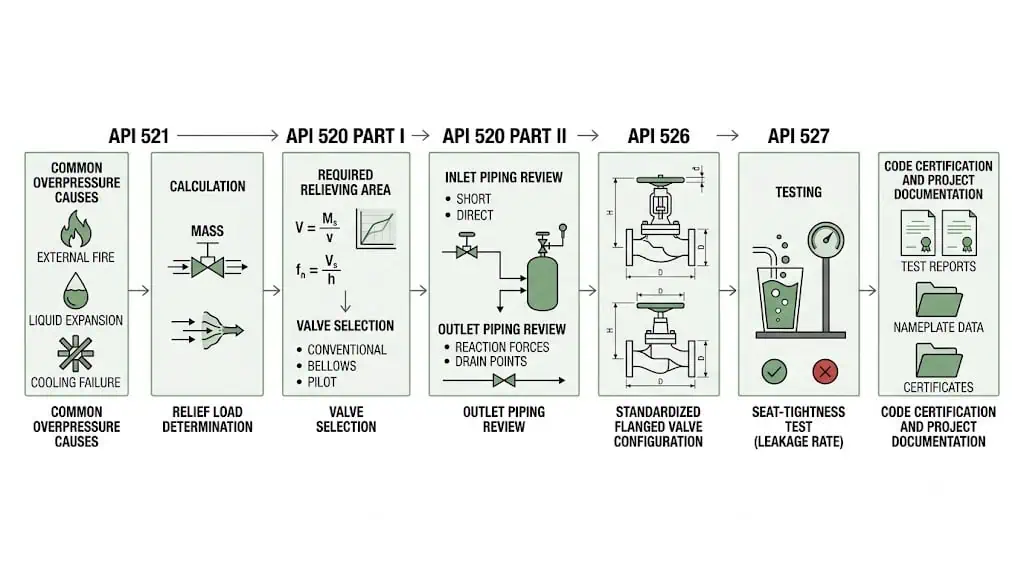
These four API references are often placed together in a datasheet, but each answers a different engineering question.
| API Reference | Main Engineering Question | Required Project Input | Expected Procurement Output | Common Misuse |
|---|---|---|---|---|
| API 520 Part I | What relieving area and valve selection are required? | Fluid, relief load, pressures, temperature and back pressure | Sizing basis, selected area and capacity comparison | Using nominal connection size as proof of capacity |
| API 520 Part II | Is the installed inlet and discharge arrangement acceptable? | Piping sizes, lengths, fittings, supports and discharge destination | Installation review and required engineering analysis | Approving the valve before reviewing connected piping |
| API 521 | What causes overpressure, and where will the discharged fluid go? | Process design, upset scenarios, fire case and disposal-system data | Governing relief case, load summary and disposal basis | Asking the valve supplier to invent the process relief case |
| API 526 | Which standardized flanged steel PRV configuration is specified? | Orifice, flange class, size, materials and temperature | Comparable configuration and dimensional description | Treating the orifice letter as proof of final capacity |
| API 527 | What seat leakage is acceptable under the test condition? | Valve type, set pressure, seat type and test medium | Seat-tightness acceptance and report | Treating a seat test as complete valve approval |
API 520 Defines the Sizing, Selection and Installation Basis
API 520 Part I is relevant when the project uses its methods for sizing and selection. The engineer must know the governing relief case, required relieving load, fluid phase, relieving pressure, relieving temperature and back pressure before comparing the required area with a proposed valve.
API 520 Part II addresses installation. A correctly sized valve can still operate poorly when the inlet line creates excessive pressure loss or when the outlet line produces unstable back pressure. The valve and connected piping must therefore be reviewed as one operating system.
Detailed sizing belongs in the API 520 safety valve sizing guide and the certified relieving capacity guide.
API 521 Defines Relief Scenarios and Disposal-System Requirements
API 521 addresses system-level questions, including principal causes of overpressure, individual relief rates and disposal-system design. Valve sizing cannot be reliable if the underlying relief scenario is incomplete or if the flare and discharge system are ignored.
Review these considerations in the API 521 pressure-relief systems guide.
API 526 Standardizes Flanged Pressure Relief Valve Configurations
API 526 supports consistent communication of flanged steel pressure-relief valve configurations. It assists bid comparison and dimensional coordination, but the selected orifice must still meet the required certified capacity and the valve must remain suitable for the pressure, temperature, medium, materials and back pressure.
See the API 526 flanged safety valve guide.
API 527 Defines Seat-Tightness Test Requirements
API 527 addresses methods for determining the seat tightness of metal- and soft-seated pressure-relief valves, including conventional, bellows and pilot-operated designs. The RFQ should identify the applicable edition, seat type, test medium, test pressure and any purchaser requirement that differs from the base standard.
See the API 527 seat-tightness guide.
What These API Standards Do Not Prove on Their Own
- API 520 does not establish the legal acceptance route for every jurisdiction.
- API 521 does not certify a valve product.
- API 526 does not prove final relieving capacity for the stated service.
- API 527 does not prove shell integrity, correct sizing or acceptable installation.
- Passing a factory test does not establish an appropriate in-service inspection interval.
Which Standards Apply to Boilers, Pressure Vessels, Piping and Process Packages?
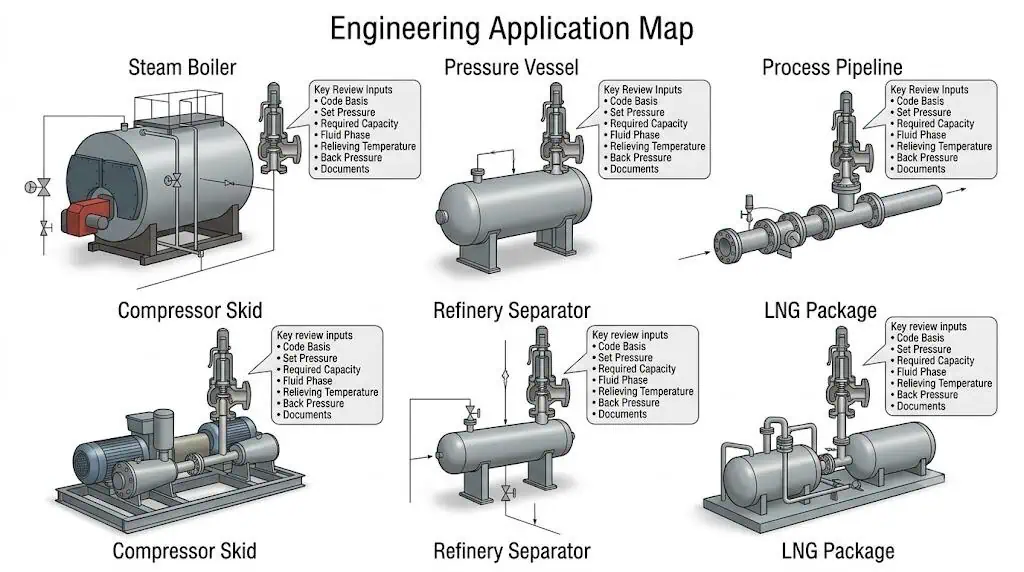
| Protected Equipment | Governing Basis to Confirm | Supporting Review | Critical RFQ Data | Main Project Risk |
|---|---|---|---|---|
| Power boiler or steam drum | Boiler construction and overpressure-protection requirements | Steam capacity, discharge arrangement and applicable piping rules | Steam conditions, set pressure, required capacity, temperature and certification | Incorrect steam capacity, material selection or boiler documentation |
| Pressure vessel | Vessel construction code and MAWP protection basis | Relief scenario, capacity, back pressure and installation | MAWP, set pressure, relief load, fluid and relieving temperature | Valve fits the nozzle but cannot relieve the governing case |
| Process piping section | Piping code and protected pressure boundary | Thermal expansion, blocked outlet or regulator-failure review | Design pressure, trapped volume, heat input and discharge route | Wrong relief basis or unsafe discharge location |
| Compressor package | Package and connected vessel or piping code | Blocked discharge, gas properties, pulsation and back pressure | Maximum flow, discharge temperature, set pressure and header pressure | Undersizing, vibration damage or unstable operation |
| Refinery or chemical process equipment | Equipment code and owner specification | API relief scenario, flare, materials and testing | Governing case, composition, capacity and flare back pressure | Conflicting standards or incomplete bid evaluation |
| LNG, LPG or cryogenic package | Equipment code, local regulation and project specification | Low-temperature materials, phase behavior and vent routing | Minimum design temperature, composition, pressure and capacity | Material failure, icing, leakage or unsafe venting |
| Replacement safety valve | Original design basis and current jurisdiction | Current process conditions, capacity and installation changes | Original datasheet, nameplate, sizing sheet and current process data | False interchangeability based only on flange size |
Boiler and Steam-System Safety Valves
Steam service requires confirmation of the boiler code basis, steam condition, required capacity, relieving temperature, valve opening characteristic, discharge reaction, drainage and outlet arrangement. A valve selected for general gas service should not be assumed suitable for boiler protection.
High-temperature steam also changes material and maintenance decisions. Body and trim materials, spring exposure, guide clearances and seating surfaces must remain suitable at the actual relieving temperature. Condensate retained in the discharge system can increase corrosion, impose additional loads and interfere with operation.
Pressure Vessel and Receiver Protection
The vessel MAWP, set pressure, governing relief case and required capacity must be coordinated. Fire exposure, blocked outlet, tube rupture, utility failure and runaway reaction can produce different loads and relieving conditions. The governing case should come from an approved process or pressure-relief analysis.
Process Piping and Packaged Equipment
Package vendors sometimes identify a safety valve only by connection size and set pressure. This is incomplete when the package interfaces with a customer flare header, utility network or pressure vessel. The connected system must be considered beyond the physical skid boundary.
Refinery, Chemical and Compressor Applications
These applications commonly require equipment-code review, API relief-system analysis, valve configuration, material specification and defined test requirements. Variable header pressure and simultaneous relieving cases can influence whether a conventional spring-loaded, balanced bellows or pilot-operated valve is suitable.
LNG, LPG and Cryogenic Pressure Protection
Low-temperature material properties, phase behavior, boil-off gas, vent routing, icing and seal compatibility may affect the design. General catalogue temperature limits should not replace a review of the exact material grade, minimum design temperature and relieving condition.
Replacement Valves for Existing Installations
A replacement valve must be checked against the original and current operating basis. Plant throughput, process composition, normal operating pressure, flare back pressure and relief scenarios may have changed since the original valve was installed.
Cost and maintenance effect
A dimensionally interchangeable valve may reduce piping modification, but dimensions alone are not an engineering acceptance basis. An incorrect replacement can result in repeat shutdown work, piping alteration, additional testing, production loss or a second purchase order.
Which Process and Valve Data Must Be Confirmed Before Compliance Can Be Claimed?
A supplier cannot confirm application compliance from a valve tag, set pressure and connection size alone. The following parameters determine whether the proposed valve can perform the required protection function.
MAWP, Design Pressure, Set Pressure and Allowable Pressure Rise
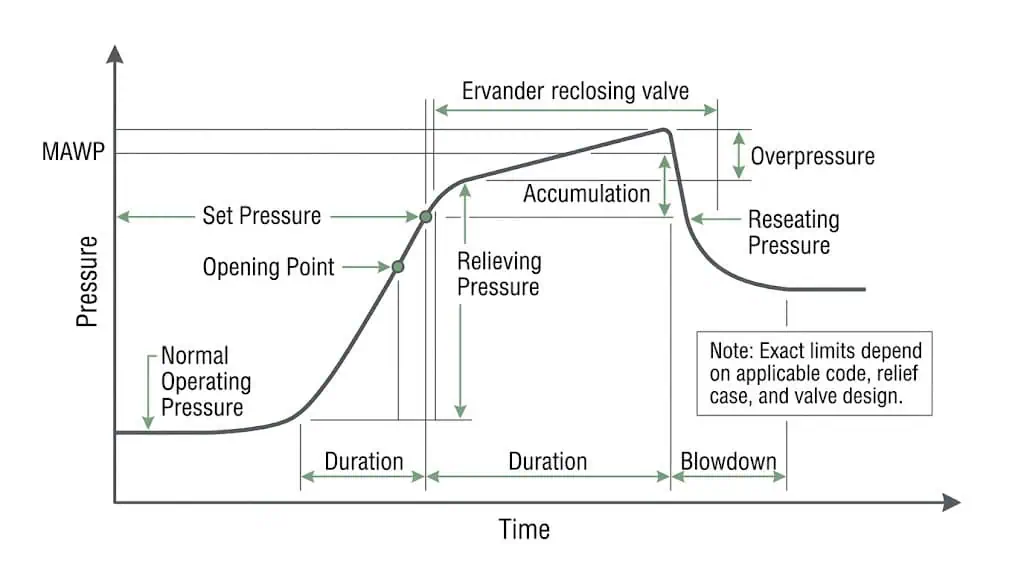
These pressure terms are related but not interchangeable. The set pressure is the specified inlet pressure at which the valve is adjusted to begin its defined opening action under the applicable test or service conditions. It affects when relief begins, but it does not state how much fluid the valve can discharge.
Overpressure is the pressure increase above set pressure during a relieving event. Accumulation describes the pressure increase above the equipment MAWP during overpressure protection. Blowdown is the difference between set pressure and reseating pressure, usually expressed as a pressure difference or percentage according to the applicable standard or manufacturer convention.
| Pressure Term | Engineering Meaning | Why It Matters | Common Error |
|---|---|---|---|
| Operating pressure | Normal or expected process pressure | Influences operating margin and leakage risk | Using operating pressure as the valve set pressure without code review |
| MAWP | Maximum allowable working pressure of the protected equipment | Defines the pressure boundary requiring protection | Using the valve body rating instead of the equipment MAWP |
| Set pressure | Specified opening condition of the valve | Controls when automatic pressure relief begins | Assuming correct set pressure proves adequate capacity |
| Overpressure | Pressure above set pressure during relief | Affects valve lift and available capacity | Using an unapproved overpressure basis in sizing |
| Accumulation | Pressure rise above the protected equipment MAWP | Must remain within the applicable equipment-code boundary | Using overpressure and accumulation as exact synonyms |
| Blowdown | Difference between opening/set pressure and reseating pressure | Affects how long the valve remains open and where it closes | Setting blowdown without considering system pressure recovery |
Required Relieving Capacity and Credible Relief Scenario
Required relieving capacity is determined by the governing overpressure event. It answers how much mass or volume must be discharged to prevent the protected equipment from exceeding its permitted pressure boundary.
The required capacity must be compared with the applicable certified or otherwise approved capacity of the proposed valve at the stated relieving conditions. A valve can have the correct set pressure and still be undersized. Likewise, an NPS 2 or DN50 inlet does not define the effective orifice area or certified flow performance.
Typical relief scenarios may include blocked outlet, external fire, control-valve failure, utility failure, compressor discharge, tube rupture, thermal expansion or runaway reaction. The valve supplier may review the stated basis, but should not invent the process relief case without responsible engineering input.
Steam, Gas, Vapor, Liquid and Two-Phase Service
Fluid phase affects sizing, opening behavior, test interpretation and discharge design. Steam, gas and vapor service commonly require compressible-flow methods. Liquid relief may involve a more proportional opening characteristic. Flashing or two-phase service must be identified explicitly because a single-phase calculation can produce an incorrect required area.
Built-Up and Superimposed Back Pressure
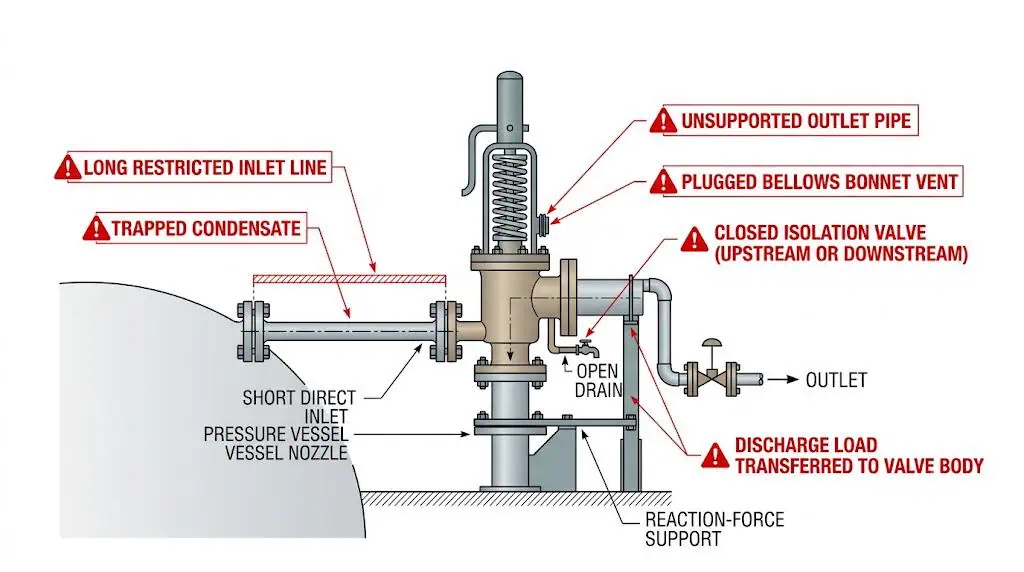
Superimposed back pressure exists at the valve outlet before opening. Built-up back pressure develops because of flow through the discharge pipe, silencer, vent stack or common header after the valve opens. Both can affect opening pressure, available capacity, lift stability and reseating behavior.
A conventional spring-loaded valve may experience an unbalanced force from outlet pressure. A balanced bellows design reduces the effect of back pressure on the disc area but introduces bellows integrity, bonnet vent and material considerations. A pilot-operated valve may tolerate certain back-pressure conditions, but pilot exhaust arrangement, sensing-line design and service cleanliness must be reviewed.
Review the dedicated back pressure and bellows engineering guide.
Conventional, Balanced Bellows and Pilot-Operated Designs
A conventional spring-loaded valve is mechanically direct and often easier to understand and maintain, but its performance can be sensitive to back pressure and installation dynamics. A balanced bellows valve can reduce back-pressure effects and isolate the spring area from some process exposure, but the bellows is a pressure-sensitive component requiring inspection and an unobstructed bonnet vent arrangement where applicable.
A pilot-operated safety valve can support tight operation near set pressure and may provide advantages in selected high-pressure or variable-back-pressure services. It is not automatically the preferred option. Dirty, polymerizing, viscous or solids-containing media can block the pilot circuit or sensing line, causing delayed, unstable or failed operation unless filtration, purging or another engineered arrangement is provided.
For valve-family selection, review pilot-operated safety valves, bellows balanced safety valves and the safety valve selection guide.
Materials, Temperature Limits, Connections and Seat Type
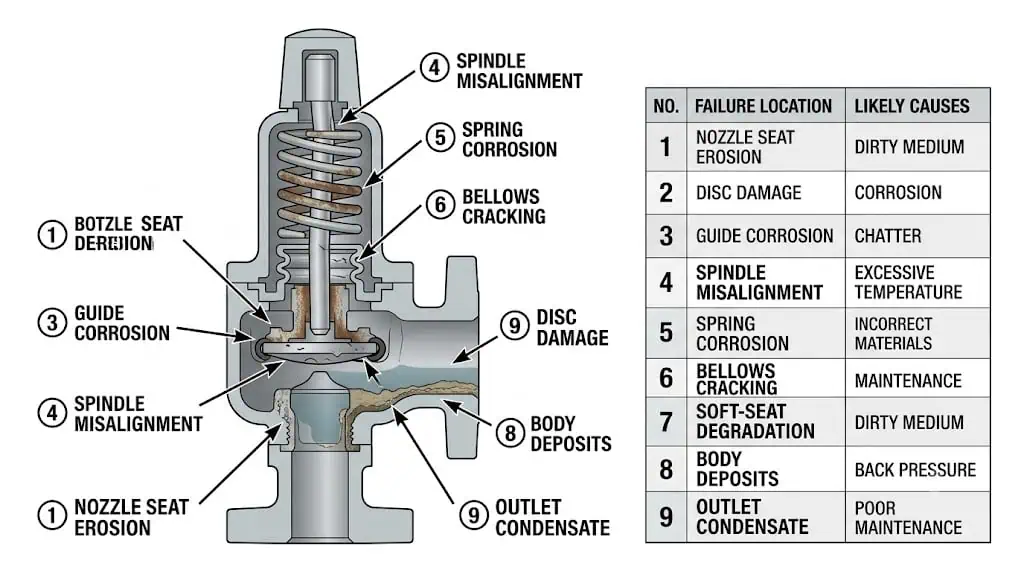
Material review must cover more than the body. The nozzle and disc control seat integrity and are directly exposed to process corrosion or erosion. The guide and spindle affect alignment and can seize if corrosion products, deposits or thermal distortion reduce clearance. The spring may lose performance if exposed outside its intended temperature range. Bellows, O-rings, diaphragms and soft seats may be limited by temperature, swelling, decompression, chemical attack or permeation.
Metal seats generally tolerate higher temperatures and broader chemical exposure but may permit more operational leakage than an appropriate soft-seat design. Soft seats can improve tightness in suitable service but require careful review of temperature, pressure, decompression, fire exposure and chemical compatibility.
For sour service, NACE MR0175 / ISO 15156 may be relevant to material selection, hardness controls and documentation. It should be applied only where the process environment and project specification make it applicable.
Flange class must be verified at the actual material and temperature. A nominal class does not prove that the connection is acceptable at relieving temperature. Review the pressure-temperature rating guide.
Inlet and Outlet Piping, Orientation and Mechanical Loads
The valve should be installed in the orientation required by its design and manufacturer instructions. The inlet path should be direct, adequately sized and free of avoidable restrictions. Excessive inlet pressure loss can cause rapid opening and closing, commonly described as chatter, which damages seating surfaces, guides, springs and connected piping.
The discharge system must be checked for back pressure, drainage, thermal expansion, reaction force and support. The safety valve should not be used as a piping support point. Liquid or condensate trapped in an outlet can increase corrosion, back pressure and mechanical load. Closed-bonnet vents, bellows bonnet vents and pilot exhaust lines must terminate as required and must not be plugged or inadvertently isolated.
Review the full safety valve installation guide.
Protected equipment
Tag, equipment type, code basis and installation location.
Tag, equipment type, code basis and installation location.
Pressure basis
MAWP, design pressure, operating pressure and set pressure.
MAWP, design pressure, operating pressure and set pressure.
Relief case
Governing scenario and approved calculation revision.
Governing scenario and approved calculation revision.
Required capacity
Mass or volumetric flow with basis, phase and units.
Mass or volumetric flow with basis, phase and units.
Fluid data
Composition, phase, density, molecular weight and viscosity as applicable.
Composition, phase, density, molecular weight and viscosity as applicable.
Temperature
Operating, relieving and minimum design temperatures.
Operating, relieving and minimum design temperatures.
Back pressure
Superimposed, built-up, constant and variable conditions.
Superimposed, built-up, constant and variable conditions.
Installation
Inlet line, outlet line, header, vent, support and drainage.
Inlet line, outlet line, header, vent, support and drainage.
Materials
Body, nozzle, disc, guide, spring, bellows, seals and seat.
Body, nozzle, disc, guide, spring, bellows, seals and seat.
Documentation
Tests, certificates, inspection, marking and language requirements.
Tests, certificates, inspection, marking and language requirements.
What Testing, Certification and Documentation Should the RFQ Require?
“Tested” is not a complete acceptance requirement. Each test demonstrates a different property, and the RFQ should state the applicable method, acceptance basis, witness requirement and document format.
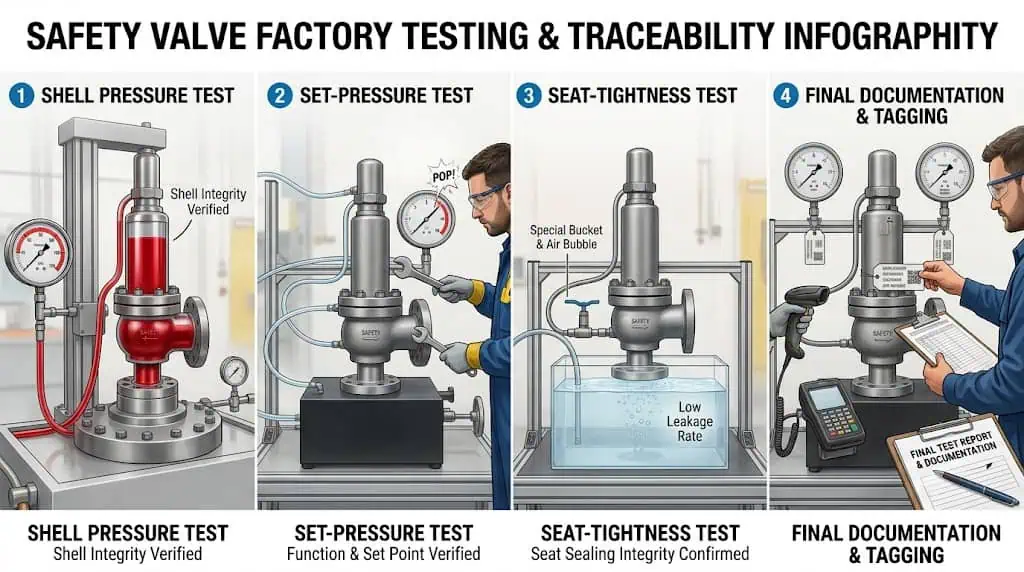
Set Pressure and Functional Performance Testing
Set-pressure testing verifies the adjusted opening condition under the specified test arrangement. The project should identify the test medium and acceptance basis. The record should be traceable to the valve serial number or other controlled identification.
A correct bench set pressure does not prove stable field operation. Inlet pressure loss, outlet back pressure, installation stress, contamination and changed operating conditions can alter the behavior of the installed valve.
Seat Tightness and Leakage Acceptance
Seat leakage depends on valve design, seat material, test medium, test pressure and acceptance criterion. A valve can pass set-pressure testing and still fail the required seat-tightness test. In service, leakage can cause product loss, emissions, icing, corrosion, seat wire-drawing and repeated maintenance.
Shell Pressure and Pressure-Boundary Testing
Shell or pressure-boundary testing addresses structural integrity. It does not demonstrate set pressure, blowdown, certified capacity or acceptable seat leakage. The applicable pressure, medium, duration and acceptance criteria must be confirmed against the specified standard and project requirements.
Capacity Certification and Type-Test Evidence
Capacity evidence should correspond to the valve design, orifice, fluid basis and applicable certification route. A calculated catalogue capacity should not be described as certified capacity unless it is supported by the required testing and certification system.
The procurement comparison should use the required relieving capacity and the proposed valve’s applicable rated or certified capacity under the relevant conditions. Connection size, face-to-face dimension and API orifice designation are not substitutes for this comparison.
Material Traceability, Nameplate Data and Calibration Records
Material certificates should be traceable to the pressure-retaining and critical trim components required by the purchase specification. The nameplate should match the approved datasheet and test documents. Calibration records should confirm that test instruments were suitable for their range and within a valid calibration period.
ASME, PED, Third-Party and Project-Specific Documentation
The buyer should identify whether a code mark, declaration, notified-body document, third-party inspection release or owner-specific certificate is required. A general company certificate is not proof that a specific valve, manufacturing location and order fall within its scope.
Standard Edition and Document Revision Control
The project-required edition should be stated. The latest published edition is not automatically the contractual edition for an existing installation or replacement valve. Manufacturing, inspection and final documentation should use the same approved revision basis.
In-Service Inspection, Recalibration and Repair Control
Inspection and maintenance intervals should be based on jurisdictional requirements, operating history, service severity, leakage history, corrosion, fouling, cycling frequency and plant risk. There is no single universal interval suitable for every safety valve.
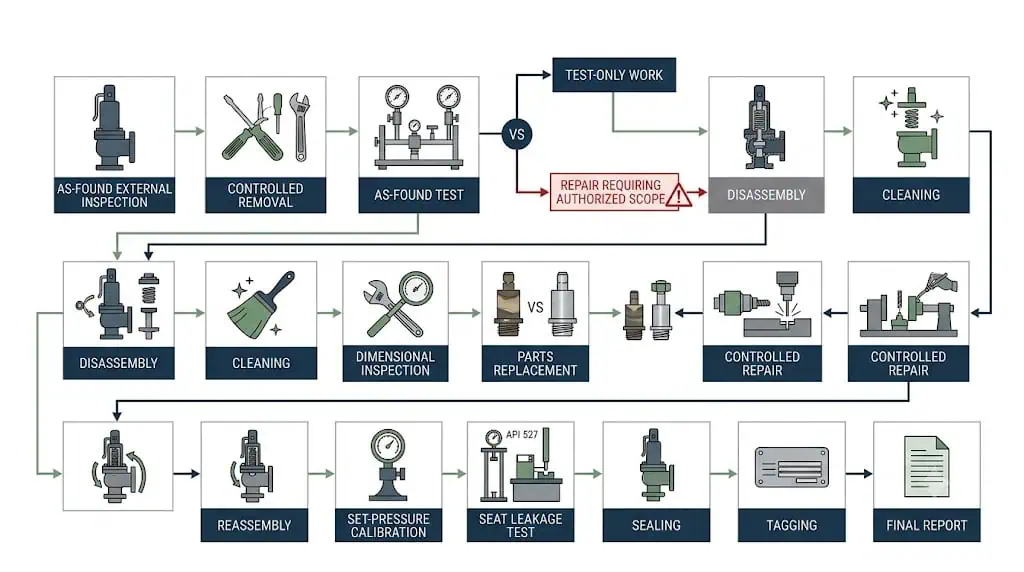
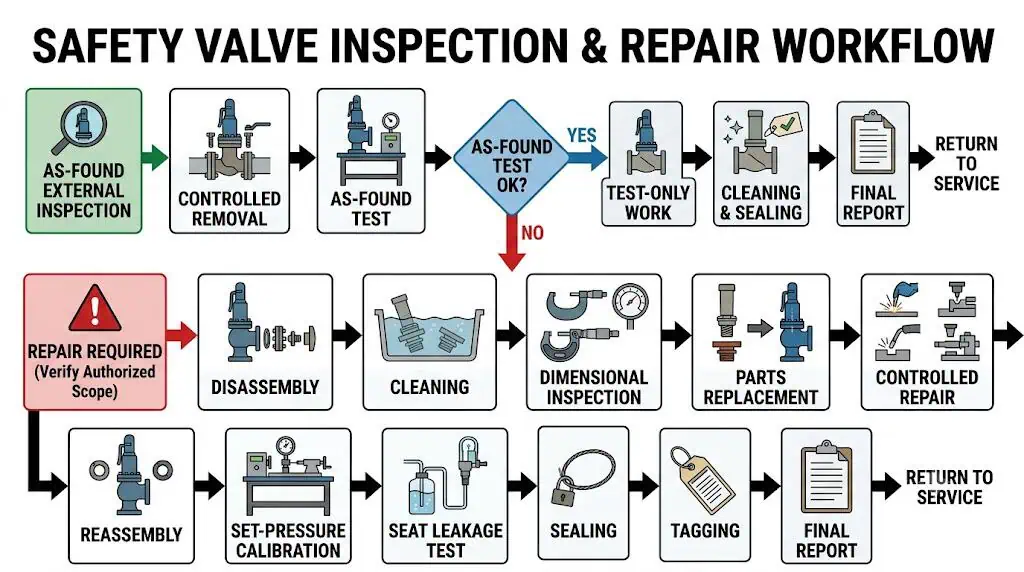
API RP 576 is relevant to inspection, testing and maintenance practices for pressure-relieving devices in applicable process plants. Where National Board or NBIC requirements apply, disassembly and repair may need to be performed by an organization holding the applicable VR authorization. Testing-only and repair activities should not be treated as the same scope.
After repair or adjustment, the valve may require recalibration, controlled sealing, revised tags and traceable documentation. A valve returned to service without confirming its setting, seat condition, parts traceability and applicable repair authorization can create both safety and compliance risk.
Review the API 576 pressure relief valve inspection guide for the in-service inspection context.
| Test or Document | What It Demonstrates | What It Does Not Demonstrate | RFQ Detail to Define |
|---|---|---|---|
| Set-pressure test | Adjusted opening condition | Required capacity, seat tightness or installed stability | Test medium, acceptance, sealing and witnessing |
| Seat-tightness test | Leakage performance at the specified condition | Shell integrity or application suitability | Standard, seat type, medium and acceptance criterion |
| Shell test | Pressure-boundary integrity | Opening behavior, blowdown or capacity | Pressure, duration, medium and report format |
| Capacity certificate or evidence | Flow performance under the applicable rating system | Material compatibility or acceptable piping installation | Valve model, orifice, fluid basis and certification scope |
| Material certificate | Material grade and traceability | Correct material selection for the service | Certificate type, parts covered and heat-number traceability |
| Calibration record | Validity and traceability of test instrumentation | Correct test procedure | Instrument ID, range, accuracy and validity |
| Third-party release | Specified witnessing or inspection was completed | Automatic compliance with every project requirement | Inspection scope, hold points and release document |
| Repair record | Parts replaced, repairs performed and final setting | Valid authorization unless the repair organization’s scope is confirmed | Repair standard, authorization, seal, test result and tag |
Where Safety Valve Standards Are Commonly Misapplied
| Incorrect Statement or Practice | Why It Is Incomplete | Engineering or Project Risk | Better Requirement |
|---|---|---|---|
| “API-compliant safety valve required” | It does not identify API 520, 521, 526, 527 or 576. | Suppliers quote different scopes, making comparison unreliable. | List each applicable reference and required deliverable. |
| “ASME standard valve” | It does not identify the equipment code, required marking or certification. | Wrong documents may be discovered after manufacturing. | State the equipment code and exact certification scope. |
| Selecting by API orifice letter alone | The letter does not replace a service-specific capacity check. | The valve may not relieve the governing load. | Compare required capacity with applicable certified capacity. |
| Replacing a valve by flange size | Connection size does not prove equal internal area or flow capacity. | False interchangeability and inadequate protection. | Review the original calculation and current process conditions. |
| “API 527 approved” | API 527 is a seat-tightness test reference, not complete product approval. | Structural, capacity and certification requirements remain unchecked. | State the exact seat test and all other required evidence. |
| Ignoring outlet back pressure | The valve is treated separately from the discharge system. | Chatter, reduced capacity, unstable opening or poor reseating. | State superimposed and built-up back pressure at all relevant cases. |
| Using a pilot valve on dirty service without review | Pilot passages and sensing lines can foul or block. | Delayed opening, unstable operation or failure to reseat. | Review cleanliness, filtration, purge and maintenance access. |
| “CE valve” without a conformity scope | Marking language alone does not define the applicable route. | Technical-file or declaration evidence may be incomplete. | Define the PED and project conformity requirements. |
| Always using the latest standard edition | The contract or installed equipment may use another adopted edition. | Unapproved changes or owner rejection. | Confirm the contractual and jurisdictional edition. |
| Returning a repaired valve without controlled recalibration | Repair, test-only work and adjustment are treated as identical. | Unknown opening point, leakage, missing seal or invalid repair record. | Define the repair authorization, final test, seal and documentation. |
Lead-time effect
Standards ambiguity is often discovered during document review rather than quotation. By that stage, materials, springs, flanges or test procedures may already have been selected. A clear compliance matrix issued with the RFQ reduces clarification cycles, repeat testing and late production changes.
How to Build a Standards-Based Safety Valve RFQ and Compliance Matrix
Define the Governing Code and Standards Hierarchy
List the governing equipment code first. Then identify the supporting standards for relief-system analysis, sizing, installation, valve configuration, flange connection, seat tightness, in-service inspection and repair. Mark each reference as mandatory, conditional or informational.
Record Process, Capacity, Back Pressure and Installation Data
The RFQ should include enough data for the supplier to assess the proposed valve rather than copy a previous model. When the EPC or owner controls the relief calculation, include the approved required capacity and calculation revision.
Define Required Tests, Certificates and Witness Points
Identify which tests require document review, witness, hold point or third-party attendance. This must be agreed before production because a witness requirement added after a completed test may require the test to be repeated.
Separate Mandatory Requirements from Preferred Requirements
Separating requirements improves technical comparison. A supplier should not be rejected for deviating from a preference, while a mandatory code or safety requirement should not be diluted during commercial negotiation.
Record Supplier Deviations Before Technical Approval
A deviation should state the specified requirement, proposed alternative, technical basis and effect on safety, performance, cost, delivery and documentation. Silence should not be treated as compliance.
Complete the Engineering Review Before Commercial Comparison
Price comparison should begin only after the technically acceptable scope is aligned. A lower quotation may exclude capacity certification, special materials, third-party inspection, soft-seat requirements or final documentation, creating a higher total project cost later.
| RFQ Category | Required Field | Supplier Response | Evidence Required | Status |
|---|---|---|---|---|
| Equipment | Protected equipment and governing code | Confirm or deviate | Datasheet and code basis | Open / accepted / rejected |
| Pressure | MAWP, operating pressure, set pressure and relieving pressure | Confirm operating margin and setting | Approved datasheet | Open / accepted / rejected |
| Process | Medium, phase, composition and temperature | Confirm suitability | Material and performance review | Open / accepted / rejected |
| Capacity | Required relieving capacity | State proposed capacity and basis | Sizing sheet or certified capacity evidence | Open / accepted / rejected |
| Back pressure | Superimposed and built-up values | State limits and selected design | Manufacturer performance data | Open / accepted / rejected |
| Installation | Inlet, outlet, vent, drain and support arrangement | Confirm or identify required changes | GA, piping sketch and pressure-loss review | Open / accepted / rejected |
| Construction | Valve type, materials, seat and connections | Full offered configuration | Datasheet, GA and bill of materials | Open / accepted / rejected |
| Testing | Set pressure, seat leakage and shell test | Method and acceptance | ITP and test reports | Open / accepted / rejected |
| Certification | Code, conformity or third-party requirement | Confirm exact scope | Applicable certificates and release records | Open / accepted / rejected |
| Documentation | Final document list and language | Confirm submission schedule | VDRL or document index | Open / accepted / rejected |
Procurement decision rule
Do not compare valve prices until the suppliers are quoting the same relief basis, certified capacity scope, materials, tests, certification and documentation package.
Engineering Cases: How Safety Valve Standards Affect Real System Performance
The following are composite engineering scenarios based on recurring industry failure patterns. They do not identify a specific customer or claim a specific completed ZOBAI project.
Case 1: Shared Discharge Header Caused a Spring-Loaded Valve to Chatter
What problem occurred
A conventional spring-loaded valve opened during an upset but cycled rapidly instead of maintaining stable lift. Seat and guide damage were found after the event.
Why it happened
The valve had been sized for the required load, but the outlet system was evaluated using an earlier header-pressure condition.
Real system cause
Additional relief devices had been connected to the common discharge header. The resulting built-up and variable back pressure changed the forces acting on the valve and increased outlet-system resistance.
Corrective action
The relief-header model was updated, all simultaneous cases were reviewed, and the valve design and discharge piping were reassessed. A balanced or pilot-operated design was considered only after the revised back-pressure range and service cleanliness were confirmed.
Prevention
Revalidate outlet back pressure after flare, silencer, vent-stack or common-header modifications. Do not rely on the original valve datasheet when the discharge system has changed.
Case 2: Correct Set Pressure but Insufficient Certified Capacity
What problem occurred
A replacement valve passed the set-pressure test and matched the existing flange connections, but the technical review found that its applicable rated capacity was below the required relief load.
Why it happened
The purchase request treated connection size and set pressure as the main selection parameters.
Real system cause
The replacement used a different internal flow area and capacity basis from the original valve. The relief calculation had also been revised after an increase in plant throughput.
Corrective action
The team compared the approved required relieving capacity with the proposed valve’s applicable certified capacity and selected a suitable orifice and body configuration.
Prevention
Require the relief calculation, selected orifice and capacity evidence for every new or replacement valve. Set-pressure testing cannot replace capacity verification.
Case 3: Pilot Circuit Fouling Caused Unstable Operation
What problem occurred
A pilot-operated safety valve developed delayed and inconsistent operation after a period of service.
Why it happened
The valve had been selected mainly for tightness near set pressure and back-pressure capability.
Real system cause
Process solids and deposits entered a small pilot passage and sensing line. The original specification did not define fluid cleanliness, filtration, purge requirements or pilot maintenance access.
Corrective action
The pilot and sensing circuit were cleaned and inspected, and the application was reassessed. The project considered filtration, purge arrangements, sensing-line changes or a spring-loaded alternative based on the actual contamination risk.
Prevention
Include particle content, fouling tendency, viscosity, polymerization risk and maintenance capability when selecting a pilot-operated valve.
Case 4: Repair Work Changed the Actual Opening Point
What problem occurred
A valve returned from maintenance showed an opening point different from the plant record and developed leakage soon after installation.
Why it happened
Internal parts had been disturbed, but the work was treated as cleaning rather than a controlled repair requiring final adjustment and documentation.
Real system cause
The spring adjustment, seating surfaces and blowdown-setting components were not restored under a controlled repair and calibration process. The valve was returned without a complete traceable test record and seal status.
Corrective action
The valve was removed, inspected, repaired under the applicable quality and authorization requirements, recalibrated, seat-tested, sealed and documented before return to service.
Prevention
Define whether the work is inspection, testing, adjustment or repair. Where NBIC or National Board requirements apply, confirm the repair organization’s VR scope before disassembly or alteration.
How to Evaluate a Manufacturer for Standards-Driven Safety Valve Projects
Verify Engineering Review Capability Before Model Selection
The manufacturer should identify missing process data, explain the proposed valve type and show how required capacity, back pressure, materials and installation affect the selection. Merely matching a catalogue model is not sufficient.
Review Test Equipment, Calibration and Traceability
Ask how set-pressure, seat-tightness and shell tests are performed, controlled and recorded. Verify that the test equipment is suitable for the required range and that each report is traceable to the supplied valve.
Confirm the Scope of Certificates and Third-Party Approval
Do not evaluate a certificate by its logo alone. Confirm the issuing organization, certificate holder, manufacturing location, product scope, validity and whether it applies to the proposed valve.
Check Whether Deviations Are Disclosed Before Production
A technically responsible offer identifies exclusions and deviations. Hidden deviations often become document, inspection or commissioning problems after the order has been placed.
Request a Project-Specific Documentation List with the Quotation
The quotation should state which drawings, calculations, certificates, test reports and final records are included. This allows engineering and procurement teams to compare the complete scope rather than unit price alone.
Frequently Asked Questions About Safety Valve Standards
How do you choose the right safety valve?
Start with the protected equipment, governing relief scenario, set pressure and required relieving capacity. Then confirm the medium, phase, relieving temperature, back pressure, valve type, materials, inlet and outlet piping, certification and required tests. Do not select by connection size or price alone.
What is the difference between a safety valve and a relief valve?
A safety valve is commonly associated with rapid opening on steam, gas or vapor service. A relief valve is often associated with liquid or thermal-relief service and more proportional opening. A safety relief valve may be designed for gas, vapor or liquid service. The applicable code and manufacturer definition remain controlling.
What is the difference between set pressure, overpressure, accumulation and blowdown?
Set pressure is the specified opening condition. Overpressure is the pressure above set pressure during relief. Accumulation is the pressure rise above the protected equipment MAWP. Blowdown is the difference between set pressure and reseating pressure.
How does back pressure affect safety valve performance?
Back pressure can affect opening pressure, lift, stability, available capacity and reseating. The effect depends on whether the valve is conventional, balanced bellows or pilot-operated and whether the back pressure is constant, variable, superimposed or built up during flow.
When should a pilot-operated safety valve be used?
A pilot-operated valve may be suitable where tight operation near set pressure, high pressure or selected back-pressure conditions are important. Service cleanliness, pilot exhaust, sensing-line design, fouling risk and maintenance capability must be reviewed before selection.
Why is certified relieving capacity more important than connection size?
Connection size only describes the piping interface. The protection function depends on the effective flow area and the valve’s applicable rated or certified capacity at the stated relieving conditions. Two valves with the same inlet size may have different capacities.
Which standard covers safety valve seat leakage?
API 527 is commonly specified for pressure-relief valve seat-tightness testing in API-based projects. The applicable edition, valve type, seat type, test medium, test pressure and purchaser requirements must still be stated.
Can a GB/T safety valve be used in an ASME or PED project?
Possibly, but only after confirming the equipment code, capacity evidence, certification, materials, testing, connection requirements, documentation and local acceptance. Compliance with one national product standard does not automatically establish acceptance under another framework.
Why does a safety valve leak after installation?
Possible causes include operation too close to set pressure, installation stress, dirt on the seat, damaged seating surfaces, outlet back pressure, corrosion, incorrect adjustment, thermal distortion or transport damage. The system condition and valve should both be inspected.
How often should a safety valve be inspected or recertified?
The interval depends on jurisdiction, service severity, operating history, corrosion, fouling, cycling, leakage history and plant risk. No single interval is correct for every application. The inspection program should follow the applicable code, plant procedure and in-service inspection standard.
Does an API 526 valve automatically meet the required capacity?
No. API 526 supports standardized flanged valve configurations and purchasing communication. The required relieving capacity must still be compared with the applicable capacity data for the selected valve and actual relieving conditions.
What documents prove that a safety valve meets the project requirements?
Typical evidence includes the approved datasheet, sizing or capacity evidence, GA drawing, material certificates, set-pressure report, seat-tightness report, shell-test report, calibration records, nameplate data, conformity documents and third-party inspection release where required.
Standards and Technical References Note
Official standards are copyrighted and may be revised, amended or adopted differently by individual jurisdictions and projects. This article summarizes their engineering roles and does not reproduce official requirements. Before publication and before using this guide for a live project, verify:
- The current official edition and amendments.
- The edition incorporated into the project contract.
- The edition adopted by the local authority.
- The exact scope of the referenced standard.
- The certification and conformity documents required for the specific valve.
- Whether repair, testing and sealing require an authorized organization.
Engineering verification: Confirm the applicable standard edition and numerical acceptance limits from the licensed official document and the responsible engineer before using leakage limits, pressure tolerances, material limits or allowable piping criteria for a project.
Suggested Official Reference Links
- ASME BPVC Section XIII — Rules for Overpressure Protection
- API 520 Part I — Sizing and Selection
- API 520 Part II — Installation
- API 521 — Pressure-Relieving and Depressuring Systems
- API Pressure-Relieving Systems Standards Committee
- ISO 4126-1 — Safety Valves
- ISO 4126-4 — Pilot-Operated Safety Valves
- European Commission — Pressure Equipment Directive
- National Board — Pressure Relief Device Certification
- National Board — VR Certificate of Authorization
Submit Your Safety Valve Project for Standards and Application Review
Send the protected equipment, project location, governing code, process medium, operating pressure, set pressure, relieving temperature, required capacity, back pressure, connection details and required certificates. The review should identify missing data, applicable standards, possible deviations and the information required before a technical quotation can be completed.
Recommended files to submit
- Safety valve datasheet or project specification
- P&ID or protected-equipment drawing
- Relief calculation or approved required capacity
- Existing valve nameplate and GA drawing for replacement work
- Inlet and outlet piping arrangement
- Applicable standards and certificate list
- Inspection and vendor-document requirements



Comments
Kesari Alloys
The emphasis on identifying the specific protected equipment before selecting a safety valve is crucial. It’s interesting to note that just using generic terms like ‘process skid’ can lead to misinterpretation of the pressure requirements. How do you suggest teams ensure clarity in their RFQs to avoid conflicts later on, especially when dealing with multiple jurisdictional codes?