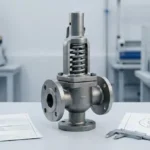
Safety Valve Design Guide What Is an Open Bonnet Safety Valve? An open bonnet safety valve is a spring-loaded safety valve design in which the spring chamber is open to the atmosphere instead of being enclosed by a sealed bonnet. The page helps engineers and buyers understand when this structure is considered, mainly in clean …

Safety Valve Design Guide
What Is an Open Bonnet Safety Valve?
An open bonnet safety valve is a spring-loaded safety valve design in which the spring chamber is open to the atmosphere instead of being enclosed by a sealed bonnet. The page helps engineers and buyers understand when this structure is considered, mainly in clean steam or high-temperature gas/vapor service where spring chamber heat dissipation may matter. The main selection risk is treating “open bonnet” as a complete valve specification. It is not a relieving-capacity proof, pressure rating, material guarantee or code approval. Before RFQ, confirm the protected equipment, relief scenario, medium and phase, operating pressure, MAWP or design pressure, set pressure, required relieving capacity, relieving temperature, back pressure, piping arrangement, materials and applicable documents.

Bonnet type alone does not prove capacity, pressure rating, material suitability, certification or safe replacement interchangeability.
Quick answer: An open bonnet safety valve is a spring-loaded safety valve with an exposed spring chamber. The design can help heat dissipate from the spring area in steam or high-temperature clean service, but it should not be selected by appearance alone. Final selection depends on the protected equipment, relief scenario, medium, pressure definitions, required relieving capacity, relieving temperature, back pressure, installation and applicable code.
What Is an Open Bonnet Safety Valve?
In a safety valve, the bonnet is the upper structure that surrounds or supports the spring, spindle and adjustment components. In an open bonnet design, this spring chamber is exposed to the surrounding atmosphere. The spring is not isolated inside a closed bonnet cavity.
This construction is most commonly discussed in relation to spring-loaded safety valves. The valve still opens because inlet pressure acts against the disc while spring force holds the disc on the seat until the valve reaches its set pressure behavior. For a broader explanation of the mechanism, review how a spring loaded safety valve works.
| Item | Engineering Meaning |
|---|---|
| Valve type | Usually a spring-loaded safety valve construction. |
| Bonnet design | Spring chamber open to the surrounding atmosphere. |
| Main purpose | Heat dissipation around the spring chamber where the service condition supports it. |
| Common discussion area | Steam and high-temperature clean service where the exposed spring chamber does not create unacceptable risk. |
| Not proven by the term | Required capacity, certified capacity, pressure rating, material suitability, certification or code compliance. |
Selection warning: “Open bonnet” describes construction. It is not a capacity rating, not a pressure class and not proof that the valve is suitable for every steam or high-temperature application.
Bonnet, Cap, Lifting Lever, Bellows and Vent Are Different Features
Procurement documents often use these terms as if they describe the same upper-valve arrangement. They do not. An open bonnet describes spring-chamber exposure. It does not confirm whether the adjustment screw is covered by a cap, whether a lifting lever is fitted, whether a balancing bellows is installed, or where a bonnet vent discharges.
| Feature | What It Describes | Why It Must Be Specified Separately |
|---|---|---|
| Open bonnet | The spring chamber is open to the surrounding atmosphere. | It defines environmental exposure, not capacity, lever arrangement or certification. |
| Adjustment cap | A cover over the spring-adjusting components. | A cap can be open, sealed, packed or otherwise configured independently of the bonnet style. |
| Lifting / easing lever | A mechanism that mechanically lifts the spindle or disc under permitted conditions. | It must be confirmed separately for boiler, steam, inspection and operator-safety requirements. |
| Balanced bellows | A pressure-balancing and process-isolation component in a bellows-type valve. | Bellows construction affects back-pressure behavior and maintenance; it is not created by an open bonnet. |
| Bonnet vent | A defined vent path for a closed or bellows bonnet arrangement. | Its function, routing and permitted condition are manufacturer- and design-specific. |
RFQ wording: State bonnet construction, cap arrangement, lifting device, bellows configuration, spring material, exposed-component protection and required seal or lock separately. Avoid the incomplete description “open type valve.”
How an Open Bonnet Design Works
An open bonnet safety valve works according to the same basic spring-loaded safety valve principle as other direct-acting safety valves. Process pressure enters through the inlet and acts under the disc. The spring applies a closing force through the spindle to keep the disc seated. When the required opening conditions are met, the disc lifts and the valve discharges through the outlet.
The open bonnet does not create the relieving capacity. Capacity depends on the valve flow path, nozzle or orifice geometry, lift, fluid properties, relieving pressure, relieving temperature and manufacturer data. For this reason, buyers should not select by connection size or bonnet type only; review safety valve sizing and certified capacity before treating a valve as suitable for a governing relief case.
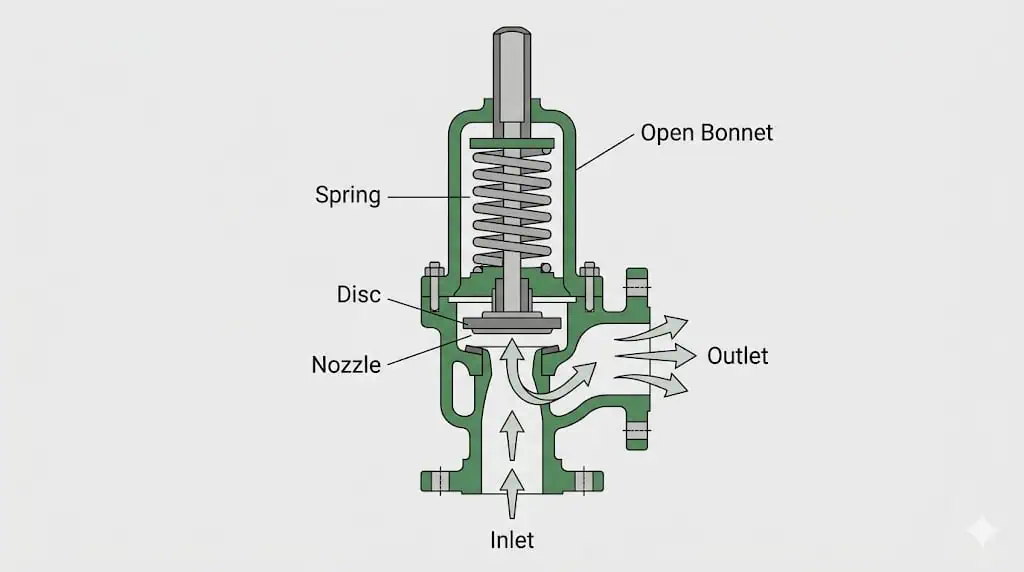
The diagram explains function only; it is not a manufacturing drawing, certified capacity diagram or project approval record.
Spring Force
The spring force keeps the disc seated until the valve reaches its set pressure behavior under specified conditions. Spring selection still depends on valve design, setting range, material, temperature and manufacturer data.
Heat Dissipation
The open spring chamber can allow air circulation around the spring area, which may matter in steam or high-temperature service. This benefit must be balanced against environmental exposure.
Capacity Boundary
Bonnet type does not replace required capacity calculation, certified or documented capacity review, or manufacturer datasheet verification.
Force Balance and Opening Sequence
In a direct spring-loaded valve, the initial opening condition is governed by the balance between inlet-pressure force acting on the effective seat area and the closing force transmitted by the spring. A simplified relationship is:
Opening tendency ≈ inlet pressure × effective seat area
Closing tendency ≈ spring force plus design-specific mechanical effects
This is an explanatory force relationship, not a sizing or set-pressure equation. Disc geometry, guide friction, lift, fluid reaction, adjusting-ring geometry and manufacturing tolerances also affect actual behavior.
What the Open Bonnet Changes—and What It Does Not
| Engineering Item | Possible Open-Bonnet Effect | Still Requires Separate Verification |
|---|---|---|
| Spring-chamber ventilation | Ambient air can circulate around exposed spring and spindle components. | Actual spring temperature, heat transfer from the valve body, insulation arrangement and ambient temperature. |
| Inspection access | External spring corrosion, deposits and mechanical condition may be more visible. | Spring load, cracking, relaxation, internal guide condition and set-pressure accuracy. |
| Environmental exposure | Rain, salt, dust, washdown chemicals and atmospheric contaminants can reach exposed components. | Material, coating, drainage, weather protection and inspection interval. |
| Relieving capacity | No capacity is created merely by exposing the spring chamber. | Required load, orifice, lift, certified/documented capacity and correction factors. |
| Back pressure | Bonnet openness does not automatically balance outlet pressure. | Conventional versus bellows design, total back pressure, vent arrangement and capacity correction. |
Spring Temperature Must Be Verified for the Selected Model
An exposed spring chamber can improve ventilation, but it does not establish a universal spring-temperature reduction. Actual spring temperature depends on valve geometry, body conduction, steam or gas temperature, insulation, discharge frequency, ambient airflow and nearby hot equipment. The spring material, design range and model-specific temperature limits should therefore be confirmed from manufacturer data rather than inferred from bonnet appearance.
Required Capacity vs Bonnet Type
| Selection Item | What It Means | What It Does Not Prove |
|---|---|---|
| Open bonnet | Spring chamber is open to the atmosphere. | It does not prove high capacity, pressure rating, material suitability or code approval. |
| Set pressure | Pressure setting for valve opening behavior under specified conditions. | It does not prove the valve can relieve the required mass or volume flow. |
| Connection size | Mechanical inlet/outlet interface and piping fit. | It does not equal orifice area, selected flow area or certified capacity. |
| Required relieving capacity | Calculated relief load for the governing overpressure scenario. | It must be matched against documented or certified valve capacity; it cannot be assumed from appearance. |
| Manufacturer data | Model-specific capacity, materials, dimensions, ratings and document scope. | It should not be replaced by generic catalogue wording or a photograph. |
Where Open Bonnet Safety Valves Are Commonly Considered
Open bonnet safety valves are commonly considered where spring chamber heat dissipation is important and where exposure of the spring area does not create unacceptable safety, corrosion, contamination or environmental risks.
Typical discussions include steam safety valves, boiler service and certain high temperature safety valves for clean gas or vapor service. These are starting points for engineering review, not automatic rules.
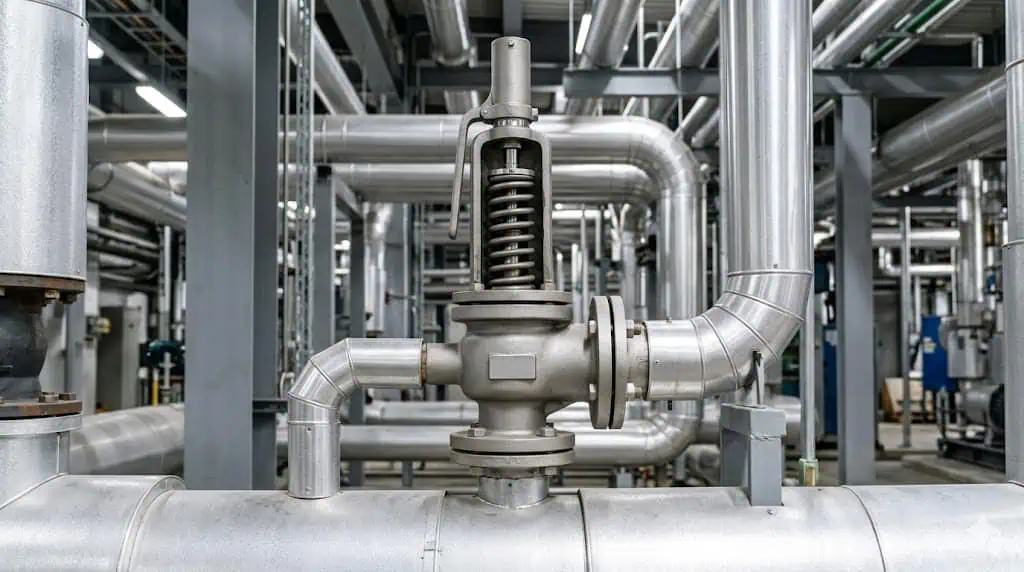
Installation, discharge piping, inlet pressure loss, back pressure, capacity and code requirements must still be reviewed for the actual project.
The discharge route, outlet reaction force, drainage arrangement and personnel exposure area should be checked before installation. Open bonnet construction does not make an unsafe discharge path acceptable.
Steam and Boiler Service
Steam service is one of the most common areas where open bonnet safety valves are discussed. In boiler and steam-header applications, high temperature can make spring chamber heat management important. An open bonnet may help reduce heat concentration around the spring area.
For boiler-related service, selection must still confirm the protected equipment, MAWP, set pressure, required steam relieving capacity, valve arrangement, discharge piping, lifting device requirements, inspection rules and applicable code. A bonnet name alone does not complete a boiler safety valve specification.
Steam and Boiler Engineering Hold Points
| Hold Point | Required Evidence | Why Bonnet Style Is Not Enough |
|---|---|---|
| Boiler or pressure-equipment code basis | Protected equipment category, jurisdiction, adopted code edition and approved datasheet. | Open bonnet does not establish whether Section I, Section VIII, Section XIII or another route applies. |
| Set pressure and pressure boundary | MAWP/design pressure, operating pressure, set-pressure basis and allowable pressure rise. | Bonnet design does not determine the permitted setting. |
| Required steam capacity | Governing load and manufacturer-supported or certified steam capacity. | A valve can open at the correct pressure and still be undersized. |
| Lifting-device arrangement | Lever requirement, cap arrangement, operating restriction and safe access. | Open bonnet does not prove that a lever is fitted or acceptable. |
| Discharge system | Outlet routing, drainage, support, reaction force, silencer and safe discharge area. | Heat dissipation at the spring does not correct unsafe outlet piping. |
Where the valve protects a power boiler, the project should review the adopted edition of ASME BPVC Section I together with the applicable overpressure-protection and jurisdictional requirements. Do not assume that every steam application follows the same boiler rule.
Illustrative Case 1: Open Bonnet but Repeated Set-Pressure Drift
Problem: A high-temperature steam valve used an open bonnet, yet repeated as-found tests showed the opening pressure drifting downward.
Cause: The spring remained exposed to high body-conduction temperature because insulation and nearby hot piping restricted airflow. The spring material and thermal environment had not been reviewed as a system.
Corrective action / prevention: Inspect and replace the spring as required, restore the approved setting, review insulation and local airflow, and retain as-found trends. Treat open bonnet as one thermal-design feature—not proof that spring temperature is acceptable.
High-Temperature Gas or Vapor Service
Open bonnet construction may also be considered for high-temperature gas or vapor service when the process medium and surrounding environment are suitable. The service should normally be clean enough that exposing the spring chamber does not introduce unacceptable contamination or corrosion risk.
Clean, Non-Corrosive Service Conditions
An open bonnet is easier to justify when the service is clean, non-corrosive and not toxic or hazardous to personnel if leakage or discharge-related exposure occurs. Where the surrounding atmosphere is aggressive, dirty, humid, dusty or subject to washdown, the exposed spring chamber can become a maintenance and reliability concern.
When an Open Bonnet Safety Valve May Not Be Suitable
An open bonnet safety valve may not be suitable when the spring chamber needs protection from the environment, process medium or safety-related exposure risks. The main selection risk is treating open bonnet as a “high temperature valve” label instead of reviewing the complete application.
Corrosive or Hazardous Media
If the process medium is corrosive, toxic, flammable, polymerizing, dirty or otherwise hazardous, an open bonnet may create exposure or maintenance risks. The engineer should review whether another configuration is more appropriate.
Outdoor or Contaminated Environments
Rain, dust, salt air, chemical vapors, insulation debris or washdown water can affect exposed spring and spindle components. Environmental exposure can change the bonnet decision.
Failure Modes Created by an Exposed Spring Chamber
| Exposure | Likely Damage Mechanism | Possible Valve Consequence | Control |
|---|---|---|---|
| Rain or washdown | Standing water, coating loss and crevice corrosion around spring seats and threads. | Spring corrosion, adjustment difficulty and set-pressure drift. | Drainage, approved weather protection, suitable materials and inspection. |
| Salt or marine atmosphere | Accelerated atmospheric corrosion and chloride deposits. | Spring-section loss, galling and fastener deterioration. | Material/coating review, washing controls and shortened inspection where justified. |
| Dust, fibers or insulation debris | Deposits on spring, spindle and guide-adjacent external parts. | Restricted movement, hidden corrosion and maintenance contamination. | Housekeeping, protective arrangement compatible with the valve design and regular inspection. |
| Chemical vapor or acid mist | Atmospheric chemical attack independent of the process-fluid material selection. | Spring cracking, corrosion and loss of adjustment integrity. | Ambient chemical review and alternative bonnet/material selection. |
| Freezing environment | Ice around exposed moving components or retained water. | Restricted manual device movement or mechanical interference. | Drainage, shelter, heat-management review and manufacturer approval. |
Illustrative Case 2: Washdown Corrosion on an Otherwise Suitable Steam Valve
Problem: A clean-steam valve passed its initial pressure tests but developed spring corrosion and unstable as-found results after service.
Cause: Repeated alkaline washdown reached the exposed spring chamber. The process medium was compatible with the valve body, but the ambient cleaning environment had not been included in material selection.
Corrective action / prevention: Replace damaged components through the approved repair route, review exposed-part materials and coatings, control washdown direction, and evaluate a protected bonnet arrangement where appropriate.
When the spring chamber should be protected, closed bonnet safety valves may be considered. The correct decision still depends on medium, temperature, back pressure, installation, material, maintenance and applicable code.
Open Bonnet vs Closed Bonnet Safety Valve
Open bonnet and closed bonnet safety valves differ mainly in how the spring chamber is exposed. In an open bonnet design, the spring chamber is open to the atmosphere. In a closed bonnet design, the spring chamber is enclosed.
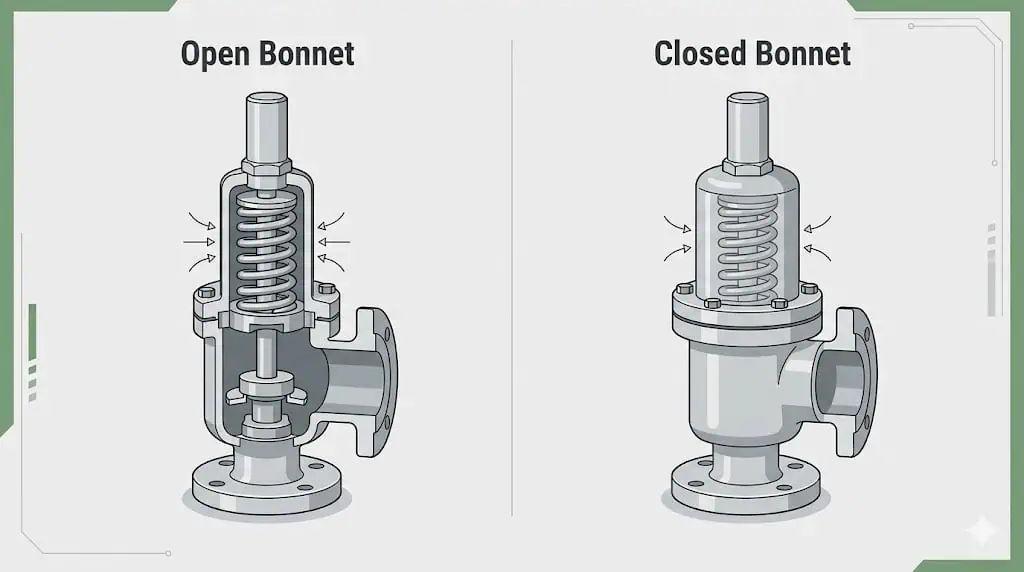
Neither bonnet style alone proves capacity, set pressure suitability, material compatibility, back-pressure suitability or code compliance.
| Factor | Open Bonnet Safety Valve | Closed Bonnet Safety Valve |
|---|---|---|
| Spring chamber | Open to atmosphere. | Enclosed by bonnet. |
| Heat dissipation | Often better around the spring chamber. | Depends on design and service. |
| Environmental protection | Lower. | Higher. |
| Typical discussion | Steam or high-temperature clean service. | Corrosive, hazardous, outdoor or protected spring chamber service. |
| Capacity proof | Not proven by bonnet type. | Not proven by bonnet type. |
| Selection basis | Service condition, manufacturer data, installation and code review. | Service condition, manufacturer data, installation and code review. |
Closed Bonnet Does Not Automatically Mean Hermetically Sealed
A closed bonnet encloses the spring chamber, but the exact relationship between the bonnet, process fluid, bellows, guide clearances and any vent connection is design-specific. Procurement should not use “closed bonnet” as a substitute for requirements such as packed lever, gas-tight cap, bellows isolation, routed bonnet vent or zero external leakage.
Balanced Bellows Is a Separate Configuration Decision
A balanced bellows valve may be selected to reduce specified back-pressure effects and limit process exposure of certain bonnet components. It introduces its own failure modes, including bellows fatigue, cracking, corrosion and bonnet-vent requirements. Open-versus-closed bonnet comparison therefore cannot replace a conventional-versus-bellows selection review.
Preliminary Selection Matrix
The matrix below is not a final selection rule. It helps decide whether an open bonnet safety valve should remain under review or whether another configuration should be considered before quotation.
| Service Condition | Open Bonnet Review Direction | Reason | Data to Confirm |
|---|---|---|---|
| Clean steam or high-temperature vapor | Often reasonable to evaluate | Spring chamber heat dissipation may be useful. | Steam capacity, set pressure, MAWP, relieving temperature, discharge piping and applicable code. |
| Corrosive, toxic or dirty vapor | Use caution or consider other configurations | Exposed spring chamber may create corrosion, safety or maintenance risk. | Medium composition, toxicity, corrosion allowance, material, seat and bonnet exposure requirements. |
| Outdoor, dusty, washdown or marine environment | Review exposure risk carefully | Atmospheric exposure may affect spring, spindle and adjustment components. | Ambient environment, drainage, maintenance access, corrosion protection and inspection interval. |
| Back pressure or discharge header present | Do not decide by bonnet type alone | Outlet back pressure may affect stability and selected valve configuration. | Superimposed back pressure, built-up back pressure, outlet piping and discharge system. |
| Replacement of existing open bonnet valve | Verify before matching | Appearance does not confirm capacity, material, seat, spring or approval basis. | Nameplate, datasheet, photos, service history, capacity basis and connection standard. |
Component-Level Material Review
| Component | Service Exposure | Open-Bonnet Review |
|---|---|---|
| Body / nozzle / disc | Process pressure, temperature, corrosion, erosion and deposits. | Confirm pressure-temperature rating, wetted material and seat geometry independently of bonnet style. |
| Guide / spindle | Sliding contact, thermal expansion, deposits and galling. | Review material pairing, clearances and contamination risk. |
| Spring | Ambient atmosphere plus heat transferred from the valve. | Confirm material, coating, temperature exposure, corrosion mechanism and approved spring range. |
| Adjustment screw / spring seats | Weather, washdown, dust and external chemicals. | Review thread protection, lubrication restrictions, corrosion and tamper control. |
| Lever / pins / cap | Ambient corrosion, mechanical handling and operator access. | Confirm arrangement separately and prohibit use as a lifting point. |
| Bolting / external fasteners | Thermal cycling, corrosion and maintenance disturbance. | Verify materials, condition and replacement traceability. |
Illustrative Case 3: Replacement Matched the Appearance but Not the Spring Range
Problem: A replacement open-bonnet valve had the same inlet/outlet size and similar external appearance, but its setting became unstable during shop adjustment.
Cause: The selected model used a different orifice and spring range. The buyer had supplied photographs and set pressure but no required capacity or original datasheet.
Corrective action / prevention: Re-establish the relief scenario, required capacity, model, orifice, spring range and supported capacity. Treat appearance and connection size only as identification inputs.
Pressure, Capacity and Installation Checks
Open bonnet selection should be reviewed together with pressure definitions, required relieving capacity, inlet pressure loss and outlet back pressure. These items can change the valve configuration even when the bonnet style looks correct.
Pressure Terminology to Keep Separate
| Term | Meaning in Selection | Common RFQ Risk |
|---|---|---|
| Operating pressure | Normal system pressure during operation. | If too close to set pressure, leakage or simmer risk may increase. |
| MAWP / design pressure | Pressure equipment boundary used to define protection requirement. | Confusing MAWP with normal operating pressure can lead to incorrect set pressure discussion. |
| Set pressure | Pressure at which the safety valve is set to start opening under specified conditions. | Set pressure alone does not prove required relieving capacity. |
| Overpressure / accumulation | Allowed pressure rise during relieving, depending on code and scenario. | Missing this value can make sizing and capacity review incomplete. |
| Blowdown / reseating | Pressure difference between opening and reseating behavior. | Poor operating margin or wrong application may cause instability or repeated lifting. |
Certified Capacity, Connection Size and Seat Tightness Are Different Approvals
| Evidence | What It Can Support | What It Cannot Prove Alone |
|---|---|---|
| Connection size / pressure class | Mechanical interface and pressure-temperature connection review. | Orifice area, required capacity, certified capacity or stable operation. |
| Set-pressure certificate | Opening adjustment under the recorded shop-test conditions. | Full lift, certified capacity, spring temperature in service or installed stability. |
| Seat-tightness report | Closed-valve leakage under a specified test method and condition. | Required capacity, code setting basis or outlet-system suitability. |
| Certified / documented capacity | Model-specific flow capability under defined medium and relieving conditions. | That the project relief scenario, piping or back-pressure assumptions are correct. |
| Open-bonnet construction | Spring-chamber exposure and related environmental/thermal review. | Any of the above performance approvals. |
Where seat-tightness testing is specified, API 527 addresses methods for applicable metal- and soft-seated pressure relief valves. It should not be cited as proof of relieving capacity or open-bonnet suitability.
Back Pressure and Inlet Loss Review
For a deeper review of superimposed back pressure, built-up back pressure and bellows-related selection limits, use the back pressure and bellows guide.
| Check | Why It Matters | Open Bonnet Boundary |
|---|---|---|
| Inlet pressure loss | Excessive inlet loss can contribute to unstable operation, chatter or reduced protection reliability. | Open bonnet construction does not correct poor inlet piping. |
| Superimposed back pressure | Existing pressure at the outlet may affect valve opening and discharge behavior. | Bonnet style alone does not define back-pressure suitability. |
| Built-up back pressure | Pressure generated during discharge may affect capacity and stability. | Outlet piping and discharge system must be checked separately. |
| Reaction force, support and exposure | Discharge piping can impose loads on the valve and equipment nozzle, and the outlet path can create personnel exposure risk. | An open bonnet valve still needs supported outlet piping, safe discharge direction and personnel-area review. |
| Drainage and weather exposure | Trapped condensate or exposure may affect operation and maintenance. | Open spring chamber exposure increases the need for environment review. |
Illustrative Case 4: Common Header Modification Caused Chatter
Problem: An open-bonnet steam valve that had previously operated acceptably began chattering after additional relief devices were connected to the same discharge header.
Cause: The modification increased built-up back pressure and changed simultaneous-flow conditions. Maintenance initially focused on the exposed spring, but the primary cause was the outlet system.
Corrective action / prevention: Recalculate header resistance and simultaneous relief cases, inspect the disc, seat and guide for chatter damage, and review whether conventional, bellows or another configuration is appropriate. Every discharge-header modification should trigger a pressure-relief system review.
Selection Data to Confirm Before RFQ
Before requesting a quotation for an open bonnet safety valve, the buyer should prepare enough data for engineering review. Without this information, a supplier may only provide a budgetary or incomplete suggestion.
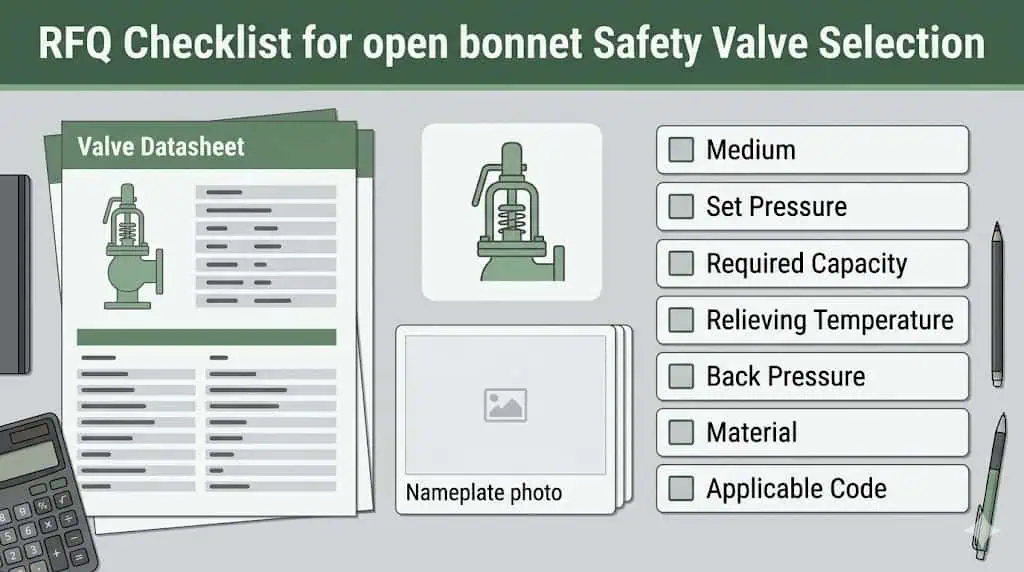
Checklist content supports preliminary RFQ communication and does not replace formal relief calculation, certified capacity verification or manufacturer review.
| RFQ Input | Why It Matters |
|---|---|
| Protected equipment | Identifies what must be protected from overpressure. |
| Relief scenario | Determines the governing overpressure case. |
| Medium and phase | Affects sizing, materials, discharge and safety. |
| Operating pressure / MAWP / set pressure | Prevents pressure-definition confusion. |
| Required relieving capacity | Prevents selection by size, appearance or bonnet name only. |
| Relieving temperature | Explains whether open bonnet construction is relevant. |
| Superimposed and built-up back pressure | May change valve configuration or outlet design. |
| Inlet and outlet piping | Affects inlet pressure loss, reaction force and safe discharge. |
| Material, seat and spring | Confirms service compatibility and spring chamber exposure risk. |
| Applicable code and documents | Controls inspection, approval and documentation path. |
Important: Set pressure is not the same as required relieving capacity. A valve with the correct set pressure can still be unsafe for the governing relief case if required capacity is not verified.
Technical Approval Hold Points Before Purchase Order
| Hold Point | Minimum Release Evidence | Reason to Hold |
|---|---|---|
| Protection basis | Protected equipment, MAWP/design pressure, governing relief scenario and adopted code basis. | The valve function and required load are not established. |
| Capacity | Required load compared with model-specific certified or documented capacity at matching conditions. | Connection size and set pressure do not prove protection. |
| Bonnet and upper arrangement | Approved drawing identifying open bonnet, cap, lever, spring, materials and exposed-component protection. | “Open type” is ambiguous. |
| Installation | Inlet-loss review, outlet back pressure, support, drainage, reaction force and ambient exposure. | Bench suitability may not represent installed behavior. |
| Testing and documentation | Set-pressure, seat-tightness, material, capacity, nameplate and inspection requirements. | Evidence cannot reliably be reconstructed after manufacture. |
Replacement Verification Workflow
Many open bonnet inquiries begin with a photo of an existing valve. A photo is helpful for identifying general construction, but it cannot confirm the selected orifice, spring range, seat design, material, capacity basis or project approval requirement.
| Step | What to Check | Why It Matters |
|---|---|---|
| 1. Nameplate review | Manufacturer, model, set pressure, size, material and any code markings shown on the nameplate. | Confirms the starting point, but may still be incomplete for capacity or document scope. |
| 2. Datasheet comparison | Original datasheet, certified/documented capacity, connection, body/trim/seat material and temperature limits. | Prevents matching by external appearance only. |
| 3. Service condition review | Medium, phase, operating pressure, MAWP, set pressure, relieving temperature and required capacity. | Confirms whether the old selection still matches the current process condition. |
| 4. Installation photo review | Inlet line, outlet line, supports, discharge direction, drainage and surrounding environment. | Identifies piping or exposure problems that may have contributed to leakage, chatter or maintenance issues. |
| 5. Document requirement review | Inspection, material records, test reports, witness scope and applicable project specifications. | Prevents treating a commercial quote as a complete engineering approval package. |
Repair and Return-to-Service After Spring, Seat or Bonnet Work
- Preserve as-found evidence. Record seal condition, corrosion, spring condition, set-pressure result, leakage and visible installation issues before cleaning or adjustment.
- Control the repair scope. Identify spring, seat, disc, nozzle, spindle, guide, lever, fasteners and exposed components that are cleaned, machined or replaced.
- Restore the approved configuration. Do not convert bonnet, cap, lever, spring range or trim by workshop convenience without engineering and manufacturer approval.
- Complete required tests. Perform the applicable set-pressure, functional, pressure-boundary and seat-tightness tests using calibrated equipment and an approved procedure.
- Restore traceability. Reconcile nameplate, serial number, spring identification, final seal and repair report.
- Verify the installation. Check orientation, inlet/outlet alignment, drainage, weather exposure, discharge support and isolation status.
- Close the root cause. Correct high ambient temperature, washdown, corrosion, back pressure, chatter or piping loads before returning the valve to service.
Where the jurisdiction or owner requires an authorized pressure-relief-valve repair route, verify whether a National Board VR Certificate of Authorization or another approved repair system applies. Repair authorization controls repair quality and traceability; it does not replace the relief calculation or installation review.
Common Misunderstandings About Open Bonnet Safety Valves
| Misunderstanding | Correct Engineering View |
|---|---|
| Open bonnet means high capacity. | Capacity must be confirmed by sizing and manufacturer data. |
| Same inlet size means same capacity. | Connection size alone does not prove capacity. |
| Set pressure equals relieving rate. | Set pressure and required capacity are different. |
| High temperature always needs open bonnet. | Temperature is one factor, not the only factor. |
| Visible spring means easy replacement. | Replacement requires nameplate, datasheet and service review. |
| Bonnet design solves installation risk. | Inlet pressure loss, outlet back pressure and discharge safety must be reviewed separately. Use the safety valve installation guide for installation review direction. |
Evidence That Should Agree Before Technical Approval
| Document | Key Data to Match | Mismatch Risk |
|---|---|---|
| Relief calculation | Scenario, required load, fluid, relieving pressure and temperature. | Valve selected for the wrong demand. |
| Approved datasheet | Model, set pressure, capacity, materials, bonnet, lever and connection. | Commercial description does not represent the approved configuration. |
| Manufacturer drawing | Open bonnet details, spring range, cap/lever, dimensions and discharge orientation. | Appearance-based replacement or fit-up error. |
| Capacity evidence | Exact model/orifice, medium, pressure, temperature and correction basis. | Unsupported capacity claim. |
| Nameplate / serial record | Identity, set pressure, size, model and applicable markings. | Wrong valve installed or repaired. |
| Test and repair reports | As-found/as-left result, parts changed, final seal and authorization. | No traceable basis for return to service. |
How ZOBAI Reviews an Open Bonnet Safety Valve Inquiry
ZOBAI should review an open bonnet safety valve inquiry from the service condition first, not from the valve appearance alone. The initial review should confirm why the user is considering an open bonnet design: high temperature, steam service, replacement of an existing valve, project specification or maintenance preference.
- Identify the protected equipment and relief scenario.
- Confirm medium, phase and relieving temperature.
- Separate operating pressure, MAWP or design pressure, set pressure and relieving pressure.
- Confirm required relieving capacity and capacity basis.
- Review back pressure, inlet pressure loss and discharge arrangement.
- Check material, seat, spring, bonnet exposure, applicable standard and documents.
- For replacement inquiries, include existing valve photos, nameplate details, datasheet copies and installation photos where available.
FAQ About Open Bonnet Safety Valves
What is an open bonnet safety valve?
An open bonnet safety valve is a spring-loaded safety valve design where the spring chamber is open to the surrounding atmosphere. This construction is often considered for steam or high-temperature clean service because it can help dissipate heat around the spring area.
Why are open bonnet safety valves used for steam?
Steam service can create high temperature around the valve body and spring chamber. An open bonnet can allow better ventilation around the spring area, but final selection still depends on the protected equipment, steam capacity requirement, set pressure, relieving temperature, discharge arrangement, code and manufacturer data.
Is an open bonnet safety valve better than a closed bonnet valve?
Not universally. An open bonnet may be useful where heat dissipation around the spring is important. A closed bonnet may be more appropriate where the spring chamber needs protection from weather, dirt, corrosion, toxic media or process exposure.
Can an open bonnet safety valve be used outdoors?
It may be possible in some projects, but outdoor use requires careful review. The open spring chamber can be exposed to rain, dust, salt air, chemical vapors or other environmental factors.
Does open bonnet design increase relieving capacity?
No. Open bonnet design does not automatically increase relieving capacity. Capacity depends on the valve flow path, orifice or nozzle, lift, fluid properties, relieving pressure, relieving temperature and manufacturer-certified or documented capacity data.
What data is needed before selecting an open bonnet safety valve?
Confirm protected equipment, relief scenario, medium and phase, operating pressure, MAWP or design pressure, set pressure, required relieving capacity, relieving temperature, back pressure, inlet and outlet connection, piping arrangement, materials, applicable standard and required documents.
Can I replace a closed bonnet valve with an open bonnet valve?
Not without engineering review. The replacement must confirm service medium, temperature, set pressure, required capacity, back pressure, installation environment, material compatibility, connection dimensions and applicable code.
Is an open bonnet the same as an open cap or lifting lever?
No. Open bonnet describes the exposed spring chamber. Cap design and lifting-lever arrangement are separate construction features and must be stated independently in the datasheet and drawing.
Does the process fluid normally contact the exposed spring?
Not necessarily. The process boundary, guide clearances, bellows arrangement and leakage paths are design-specific. Do not infer spring/process isolation or external-leakage behavior from the term open bonnet alone.
How does back pressure affect an open bonnet safety valve?
Back pressure is mainly governed by the valve configuration and outlet system, not by the open bonnet label. Confirm superimposed and built-up back pressure, conventional or bellows construction, capacity corrections and reseating behavior.
What materials should be checked on an open bonnet valve?
Review the body, nozzle, disc, guide, spindle, spring, spring seats, adjustment parts, lever, fasteners, seat and seals. Exposed spring and adjustment components must also be compatible with the ambient environment.
Why can an open bonnet safety valve leak after installation?
Possible causes include seat contamination, piping strain, high operating pressure, incorrect set pressure, guide misalignment, corrosion, outlet back pressure or transport damage. The bonnet style alone does not identify the cause.
Can an open bonnet valve be converted to a closed bonnet valve?
Not by a simple workshop substitution. A conversion may change approved parts, spring temperature, venting, dimensions, lever arrangement and certification scope. Use only a manufacturer-approved configuration with engineering review.
How often should an open bonnet safety valve be inspected?
The interval should follow the applicable code, jurisdiction, owner program, manufacturer instructions, service severity and as-found history. Outdoor, washdown, marine, corrosive or high-temperature exposure may justify additional inspection.
What standards matter for open bonnet safety valve selection?
The applicable standards depend on the protected equipment and jurisdiction. ASME BPVC Sections I, VIII and XIII, API 520/521, API RP 576, API 527 and ISO 4126-1 may be relevant within their respective scopes; none makes open bonnet universally suitable.
Does API 527 prove an open bonnet valve has enough capacity?
No. API 527 addresses seat-tightness testing for applicable pressure relief valves. Capacity must be supported separately by the required relief load and model-specific certified or documented capacity.
What must be verified after spring, seat or bonnet repair?
Verify the approved configuration, replacement-part identity, set pressure, functional behavior, seat tightness, final seal, nameplate traceability, repair authorization and installed piping/environment before return to service.
Is open bonnet always the best choice for high-temperature service?
No. Actual spring temperature, ambient exposure, corrosion, process hazard, insulation, capacity, back pressure and maintenance requirements must all be reviewed. Some high-temperature services require a protected or different valve arrangement.
Standards and Engineering Limits
This page provides engineering communication guidance for understanding open bonnet safety valves. It does not replace formal relief sizing, certified capacity verification, manufacturer datasheet review, project specification review, inspection requirements or approval by qualified engineers and relevant authorities.
Standard names alone do not complete a valve specification. The applicable code, edition, documentation scope and approval route must be confirmed against the actual project.
| Reference | Relevant Role | Boundary for This Article |
|---|---|---|
| ASME BPVC Section I | Power-boiler construction and the related code route where adopted. | Use only for equipment and jurisdictions within its scope; open bonnet does not establish compliance. |
| ASME BPVC Section VIII, Division 1 / Section XIII | Pressure-vessel construction context and overpressure-protection requirements. | Confirm the adopted edition and equipment-specific rules. |
| API 520 Part I | Sizing and selection in its covered refinery and related process-industry scope. | Does not make a bonnet style suitable without actual relief data. |
| API 520 Part II | Installation and engineering analysis of pressure-relieving-device installations in its scope. | Relevant to inlet loss, outlet piping and back-pressure review. |
| API 521 | Pressure-relieving and depressuring-system guidance in its covered petroleum, petrochemical and gas facilities. | System guidance, not a universal product certification. |
| API RP 576 | Inspection practices for pressure-relieving devices in its scope. | Supports inspection planning; it does not define universal intervals for every industry. |
| API 527 | Seat-tightness test methods for applicable pressure relief valves. | Does not prove required capacity or open-bonnet thermal suitability. |
| ISO 4126-1 | General product requirements for safety valves under the ISO route. | ISO identifies it as a product standard, not an application-design standard. |
| National Board / NBIC / VR | Certification records and authorized repair controls where applicable. | Repair authorization does not replace sizing, installation or service review. |
Technical Reference Direction
The following official sources are useful reference directions for overpressure protection, sizing, relieving systems and safety valve requirements. They do not prove that a specific ZOBAI valve automatically has any ASME, API, ISO or local regulatory certification.
- ASME BPVC Section XIII — Rules for Overpressure Protection
- ASME BPVC Section I — Rules for Construction of Power Boilers
- API 520 Part I — Sizing and Selection of Pressure-Relieving Devices
- API 520 Part II — Installation of Pressure-Relieving Devices
- API Standard 521 — Pressure-Relieving and Depressuring Systems
- API 527 — Seat Tightness of Pressure Relief Valves
- ISO 4126-1 — Safety Valves General Requirements
- National Board VR Certificate of Authorization