Share your medium, set pressure, temperature, size, standard, or datasheet, and our team will review your requirement and respond with the appropriate next step.
China Sanitary Safety Valve Manufacturer: What to Check Before Buying
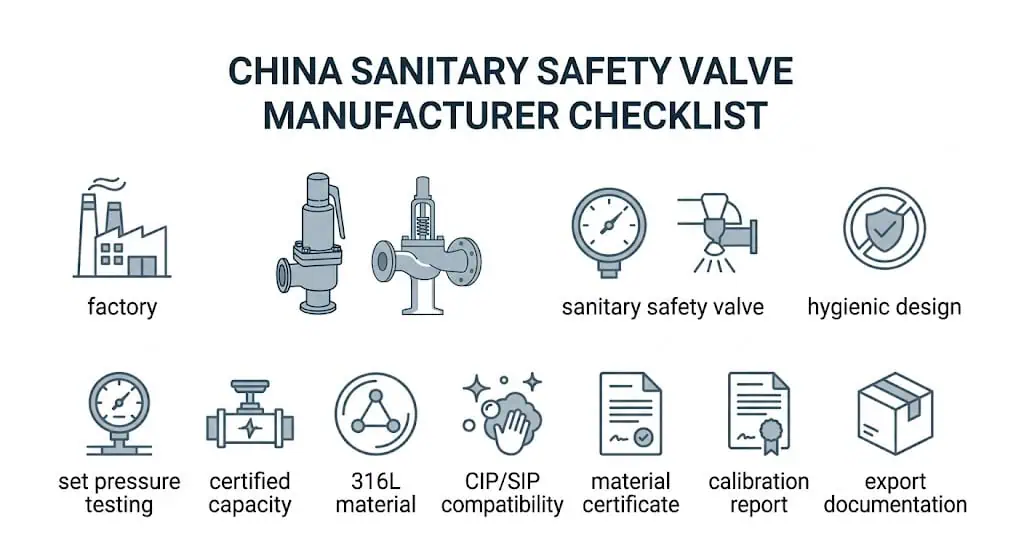
Choosing a China sanitary safety valve manufacturer should not be based on price, a 316L body, tri-clamp size, surface polish or a catalogue photo alone. The buyer must qualify both the manufacturing organization and the exact pressure-relief valve being offered. The manufacturer should be able to connect the protected equipment, MAWP, governing overpressure scenario, set …
Choosing a China sanitary safety valve manufacturer should not be based on price, a 316L body, tri-clamp size, surface polish or a catalogue photo alone. The buyer must qualify both the manufacturing organization and the exact pressure-relief valve being offered. The manufacturer should be able to connect the protected equipment, MAWP, governing overpressure scenario, set pressure, required relieving capacity, supported capacity basis, medium, relieving temperature, inlet pressure loss, outlet back pressure, product-contact materials, CIP/SIP conditions, seal formulation, hygienic geometry, test records and document scope to one traceable quotation.
Quick Answer / Engineering Summary: A credible China sanitary safety valve manufacturer should prove two independent requirements: pressure-protection performance and hygienic suitability. A factory audit, ISO-style management certificate or polished sample supports supplier evaluation, but it does not prove that the ordered valve has the required capacity, correct set pressure, appropriate seals, cleanable geometry or project-specific documentation. Final approval should be based on the actual model, size, orifice, serial or order traceability, materials, tests, certificates, deviations and installed service conditions.
Approval boundary: Country of origin is not evidence of quality or non-quality. Judge the legal manufacturing entity, production site, valve design, supported capacity, calibration system, hygienic scope, order-specific records and change-control process.
A defensible supplier decision verifies the factory, the exact valve configuration and the order-specific evidence package.
Need a project review before quotation?
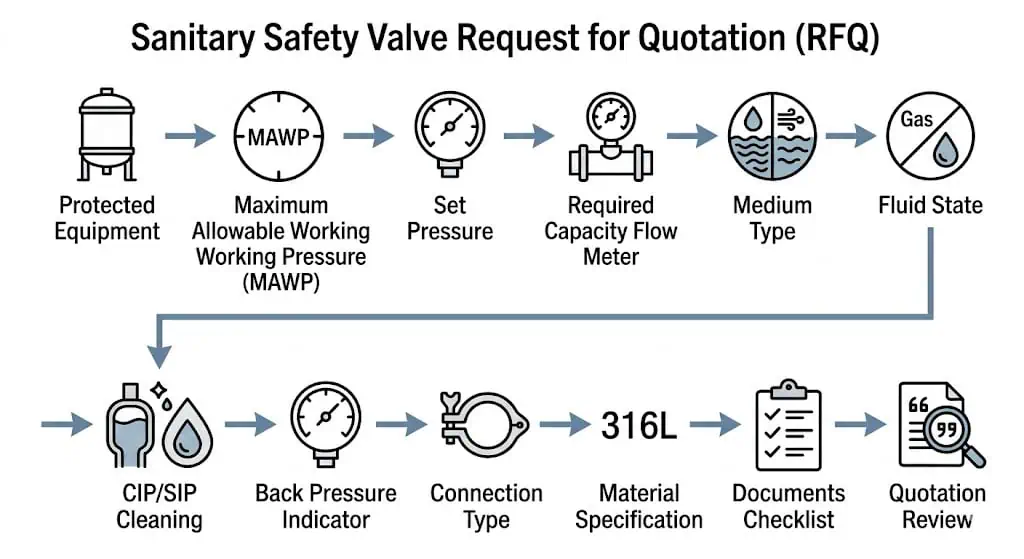
Send us your medium, MAWP, operating pressure, set pressure, required relieving capacity, connection type, CIP/SIP condition, material requirement, seal requirement, back pressure and certificate requirements. A useful sanitary safety valve quotation should start from process data, not valve size alone.
What Makes a China Sanitary Safety Valve Manufacturer Worth Checking?
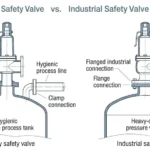
A sanitary safety valve manufacturer should be evaluated differently from a general sanitary valve supplier. A sanitary valve may only need to control process flow, isolation or diversion. A sanitary safety valve must open automatically at a specified set pressure, relieve enough flow to protect equipment and reseat after pressure returns to a safe level. At the same time, it must not introduce hygienic risk into the process.
This matters because a valve can look sanitary but still be wrong for pressure protection. A polished body, hygienic ferrule and generic certificate pack do not establish the governing relief case, effective flow area, supported capacity, calibration status or installed back-pressure limit. Conversely, a valve may satisfy pressure performance but fail hygienic review because the product-contact geometry, gasket interface, drainage, surface documentation or seal compound is unsuitable.
Supplier qualification and product approval should therefore be separated. The factory review asks whether the organization has controlled engineering, machining, welding, cleaning, assembly, calibration, inspection, traceability and nonconformance processes. The product review asks whether the exact quoted valve satisfies this project’s pressure, medium, hygienic, installation and document requirements.
Sanitary Valve Manufacturer Is Not Always a Sanitary Safety Valve Manufacturer
A general sanitary valve manufacturer may produce butterfly valves, check valves, ball valves, diaphragm valves or fittings. These products are not the same as sanitary safety valves. A safety valve requires pressure relief engineering, spring setting, seat performance, capacity review and test documentation.
When reviewing a supplier, ask whether the manufacturer can support safety valve-specific requirements such as set pressure calibration, relieving capacity data, pressure testing, seat leakage control, nameplate marking and technical drawings. If the answer is only about polishing, welding or clamp connections, the review is incomplete.
Terminology control: “Sanitary safety valve,” “sanitary relief valve,” “pressure relief valve,” “PSV” and “PRV” are not interchangeable procurement descriptions in every project. The datasheet should state the complete function, service phase, opening characteristic and valve construction. Use the PRV vs PSV vs Safety Valve vs Relief Valve guide where terminology is unclear.
Why Pressure Protection and Hygienic Design Must Be Verified Together
In a hygienic process system, pressure protection and cleanability are both required. A valve that protects the tank but traps product can become a quality problem. A valve that is hygienic in appearance but undersized for the relief case can become a safety problem.
The manufacturer should be able to discuss both sides of the duty:
set pressure and operating pressure margin
required relieving capacity and capacity basis
medium and fluid state at relieving condition
product-contact material and seal material
CIP/SIP cleaning and sterilization exposure
surface finish, dead space and drainability
back pressure and discharge destination
documents required for engineering and QA approval
Manufacturer Qualification vs Order-Specific Valve Conformity
A qualified factory can still quote the wrong valve, and a technically suitable sample can still be supplied without adequate production control. Review both levels before approval.
Evidence Level
What to Verify
What It Does Not Prove by Itself
Legal entity and manufacturing site
Company name, address, production location, scope and responsibility for the supplied valve
That the quoted valve meets the relief duty
Quality or management-system certificate
Valid issuer, named entity, scope, dates and manufacturing activities
Capacity, hygienic design or order-specific testing
Factory capability audit
Controlled drawings, materials, machining, welding, cleaning, assembly, calibration and traceability
That every production valve automatically conforms
Type or product evidence
Model, size, orifice, pressure, fluid, material and option scope
Coverage of configurations outside the stated scope
Order-specific records
Serial or batch link to materials, calibration, pressure test, seat test and inspection
Suitability of an unreviewed installation
Core Engineering Data to Confirm Before Asking for a Quote
A clear RFQ helps the manufacturer quote the correct valve. If the buyer only sends “316L sanitary safety valve, tri-clamp, 1 inch,” the supplier may quote by size rather than by protection duty. That can lead to the wrong set pressure, wrong capacity, wrong seal or missing documentation.
A technically comparable quotation starts with the protection duty and installed conditions, not with tri-clamp size.
RFQ Data
Why It Matters
What Can Go Wrong If Missing
Protected equipment
Defines what the valve protects and which pressure boundary applies
Wrong valve duty or wrong documentation basis
MAWP / design pressure
Supports set pressure review
Set pressure may not protect the equipment correctly
Operating pressure
Shows margin below set pressure
Leakage, simmering or frequent lifting
Set pressure
Defines when the valve begins to open
Valve may open too early or too late
Required relieving capacity
Defines how much flow must be relieved
Valve may fit the line but fail to protect the equipment
Medium and fluid state
Affects sizing, material, seal and discharge behavior
Wrong material, wrong capacity basis or wrong seat design
CIP / SIP condition
Affects seal, material and hygienic design
Seal damage, leakage or cleaning validation issue
Back pressure
Affects lift, capacity and reseating behavior
Chatter, flutter, poor reseating or reduced installed capacity
Required documents
Supports QA, inspection and import approval
Shipment delay, site rejection or rework
Protected Equipment, MAWP and Set Pressure
The starting point is the protected equipment, not the valve catalogue. Identify whether the valve protects a hygienic tank, fermentation vessel, clean-steam generator or line, process skid, filter housing, heat exchanger or other pressure equipment. Distinguish MAWP, design pressure and normal operating pressure; they are related but should not be treated as interchangeable fields.
The approved set pressure, allowable overpressure or accumulation and any multiple-device arrangement should follow the protected-equipment code, jurisdiction and project basis. Set pressure should never be increased merely to stop leakage. Leakage requires a root-cause review of operating margin, seat condition, contamination, thermal cycling, assembly, back pressure and valve design.
Set pressure should not be selected only because it is commonly available. It should be reviewed against operating pressure, pressure fluctuation, MAWP, process requirement and applicable project specification. If operating pressure is too close to set pressure, the valve may leak, simmer or lift during normal operation.
Checks closing margin and likelihood of simmer or micro-lift
Frequent leakage, seat damage and unstable operation
Set pressure
Defines the specified opening response under the applicable test method
Opening too early, too late or outside the equipment arrangement
Overpressure
Supports lift and capacity evaluation above set pressure
Incorrect capacity comparison
Accumulation
Defines the equipment-side pressure increase for the approved scenario
Protection may not match the equipment limit
Blowdown / reseating
Indicates the closing range after relief
Rapid cycling, delayed reseating or process loss
CDTP, when applicable
Documents shop-test correction for temperature or constant back pressure
Bench setting may not correspond to the intended installed opening condition
Required Relieving Capacity and Certified Capacity
Required relieving capacity is the flow demand established by the approved governing overpressure scenario. Certified or manufacturer-documented capacity is the supported performance of the identified valve, orifice and configuration under stated pressure, fluid, temperature and back-pressure conditions. These values must be compared on a consistent basis before order approval.
The manufacturer should state the effective orifice or flow area, capacity medium, relieving-pressure basis, correction assumptions and any limitation caused by viscosity, flashing, two-phase flow or back pressure. A nominal inlet or clamp size is a connection interface, not a capacity rating.
A frequent procurement problem is the replacement order that says only “same clamp size as the old valve.” The replacement may fit the line, but its internal orifice and capacity basis can be different from the original design. In one review, the valve was rejected before installation because the connection size matched while the documented relieving capacity did not cover the required relief load. The correction was to recheck required capacity, orifice data and capacity documentation before approval. The prevention is straightforward: ask the manufacturer for capacity data or certified capacity basis, not only connection size and pressure rating.
The manufacturer should know whether the valve handles liquid product, clean steam, compressed gas, process water, CIP solution, air, nitrogen or another medium. The fluid state at relieving condition may not be the same as normal operating condition.
Temperature affects density, seal material, stainless steel suitability, cleaning exposure and capacity interpretation. In clean steam or SIP service, the sterilization condition may be more severe than normal production duty. A quotation that does not ask about relieving temperature or SIP exposure is only preliminary.
Back Pressure and Discharge Destination
Back pressure is the pressure at the valve outlet before or during relief. The RFQ should separate superimposed back pressure from built-up back pressure and identify whether each is constant or variable. Closed recovery lines, common clean-steam headers, downstream filters, condensate-filled outlets and long discharge piping can all alter valve behavior.
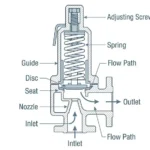
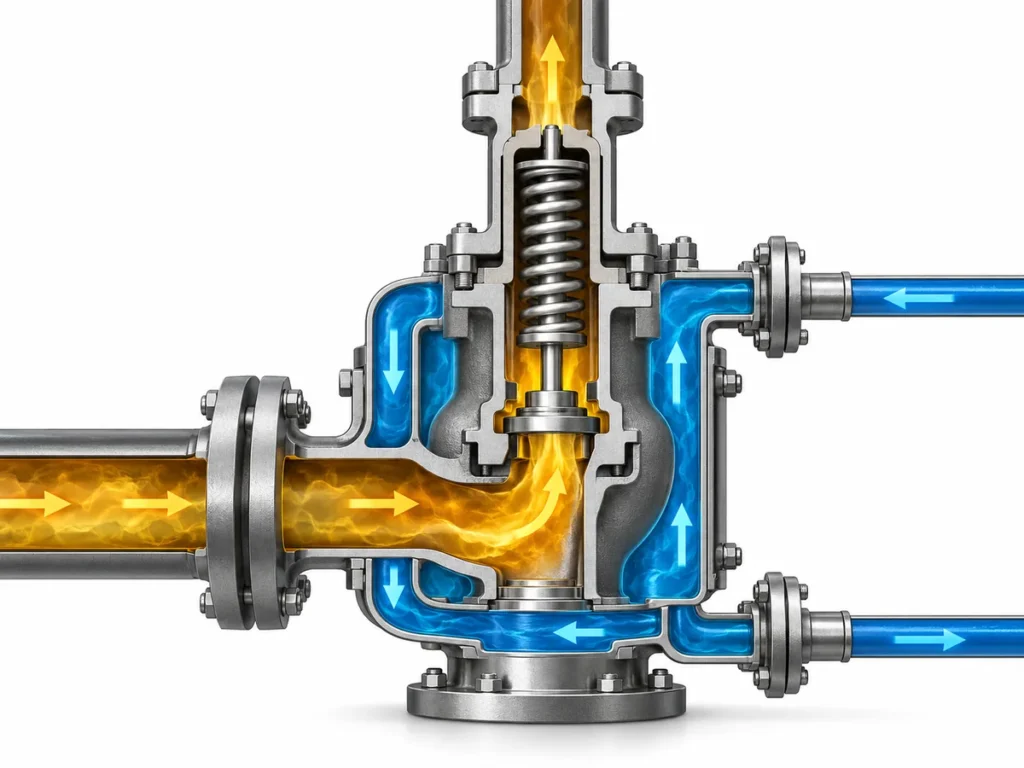
The supplier should not confirm a conventional, balanced-bellows or pilot-operated design without the relevant downstream condition. Balanced construction reduces specific force effects but does not remove capacity, fatigue, drainage or outlet-system limits. Pilot-operated designs also require review of pilot exhaust, sensing paths, seals and medium cleanliness.
Sanitary safety valves are sometimes connected to recovery systems or closed discharge arrangements for product, steam or cleaning fluid management. If the manufacturer assumes atmospheric discharge but the installation creates outlet pressure, the valve may chatter or reseat poorly.
Composite field example: A sanitary steam valve passed shop calibration but chattered after a plant modification. The valve outlet had been connected to a common recovery header, and retained condensate increased variable built-up back pressure. The corrective action was to model the relief case, drain and reroute the outlet, inspect the seat and guide, and reverify the selected valve construction and capacity before return to service.
CIP / SIP and Cleaning Conditions
CIP and SIP conditions should be included in the RFQ. Cleaning chemical concentration, steam exposure, cleaning temperature and exposure frequency can affect seat tightness, seal life and hygienic performance.
If CIP/SIP conditions are ignored, the valve may pass factory testing but leak or degrade after several cleaning cycles. That increases maintenance cost, creates unplanned downtime and may delay quality release.
Inlet Pressure Loss, Outlet Resistance and Installation Data
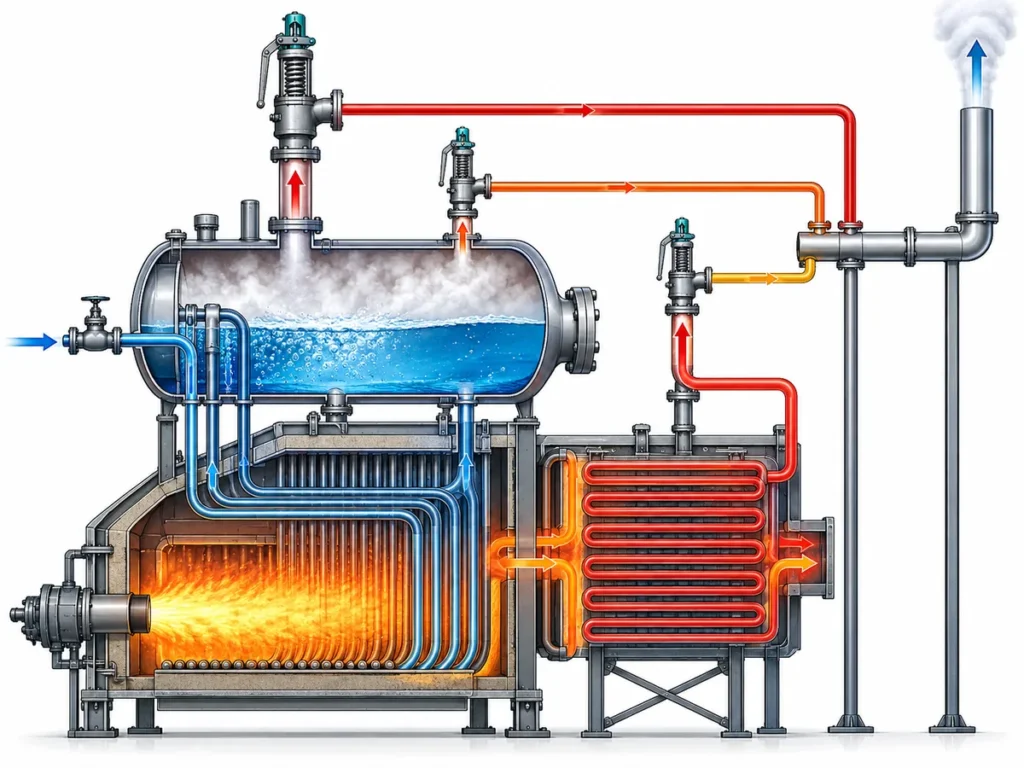
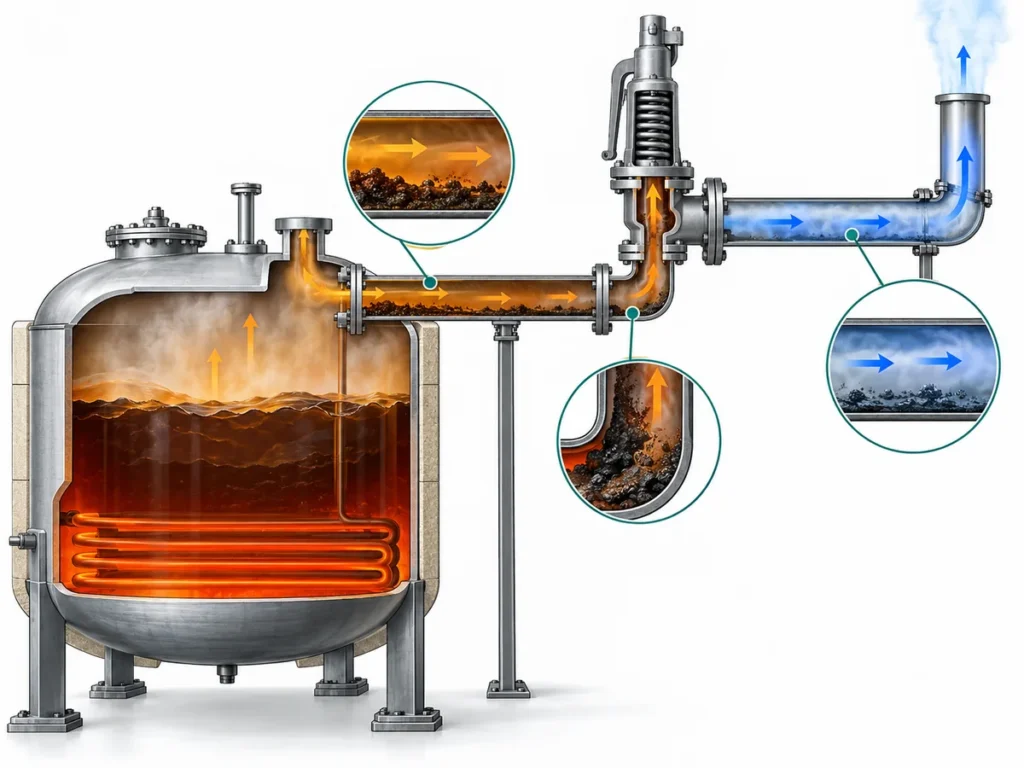
A manufacturer quotation should identify the installation assumptions. Long inlet branches, undersized ferrules, reducers, gasket intrusion, isolation restrictions or poor nozzle geometry can create excessive inlet pressure loss and chatter. Outlet elbows, low points, silencers, filters and common headers can create built-up back pressure, condensate loading and reaction forces.
Provide inlet and outlet size, length, fittings, elevation, orientation, drain points, discharge destination, simultaneous-relief condition and expected support arrangement. A valve that passes a factory test can still perform poorly when the installed piping changes the pressure at its inlet or outlet.
Selected clean, high-pressure or tight-shutoff services
Pilot and main-valve capacity, sensing line, exhaust arrangement, seals, condensate, particles and cleaning residue
Composite service example: A pilot-operated sanitary valve became slow and inconsistent after several batches. Product aerosol and condensate entered the sensing and pilot passages. Cleaning restored short-term operation, but the permanent correction required revised separation and drainage, a maintainable sensing arrangement and a fresh decision on whether a direct spring-loaded design was more robust for the actual medium.
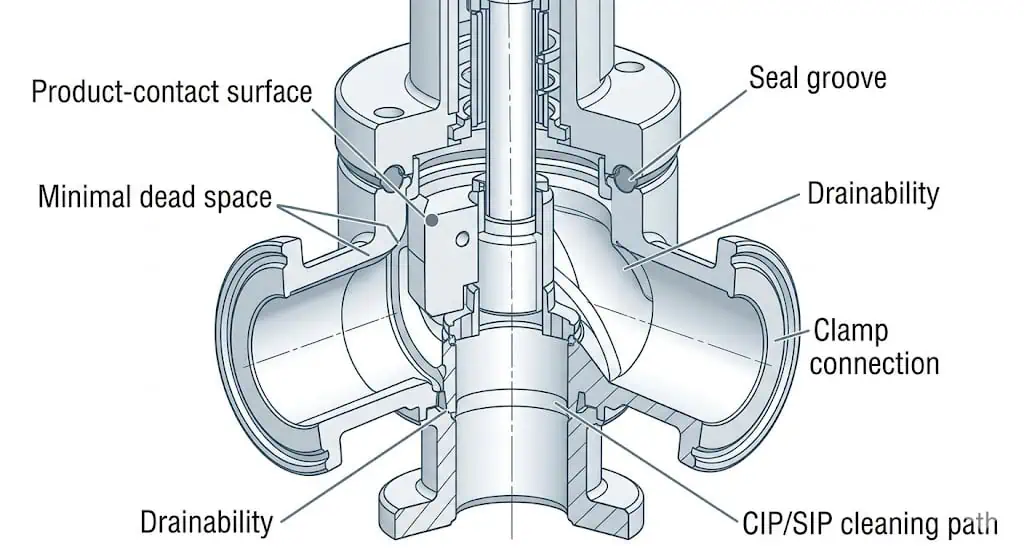
Hygienic Design Points a Manufacturer Should Be Able to Explain
A sanitary safety valve should be reviewed by its product-contact geometry, not only by its external finish. A polished surface is helpful only if the internal design can be cleaned, drained and documented according to the project requirement.
Cleanability must be demonstrated by internal geometry, contact materials, sealing interfaces, orientation and the actual cleaning cycle.
Hygienic Design Point
What to Ask the Manufacturer
Why It Matters
Product-contact material
Which parts contact product or clean steam?
Controls corrosion, contamination and traceability risk
Surface finish
What surface finish is provided and how is it verified?
Affects cleanability and QA acceptance
Dead space
Are there internal pockets or dead legs?
Product retention can create cleaning and microbial risk
Drainability
Can the valve and inlet branch drain correctly?
Residual product or cleaning fluid can remain after CIP
Seal area
Can the seal groove be cleaned and inspected?
Seal pockets can become contamination points
CIP/SIP path
How does cleaning or steam contact the internal surfaces?
Cleaning cycle must reach critical product-contact areas
Connection design
Clamp, welded, aseptic or other connection?
Affects installation, cleaning and maintenance
Product-Contact Material and 316L Stainless Steel
316L stainless steel is common in sanitary process equipment, but the grade name alone is not enough. Confirm the exact product-contact boundary, heat or batch traceability, fabrication route, weld treatment, passivation or electropolishing scope, surface measurement method and corrosion mechanism.
Nozzle, disc, guide, spindle, spring isolation, bellows or diaphragm and elastomer materials should be reviewed separately. Chlorides, acidic cleaning agents, oxidizers, steam cycles and retained condensate can affect these components differently. A 316L body does not prevent a mismatched trim or seal from becoming the life-limiting part.
If the medium contains chlorides, acidic cleaning agents or other corrosive components, material review becomes more important. The wrong assumption can lead to corrosion, roughened surfaces, seat damage and shorter valve life.
Surface Finish, Dead Space and Drainability
A valve can look clean from outside but still have internal retention volume. Review the inlet ferrule, gasket step, nozzle, seat pocket, guide region, lift-device penetration and outlet low points. A generic external roughness statement does not prove the condition of every internal product-contact surface.
Do not apply one universal dead-leg ratio without identifying the governing hygienic standard, measurement convention and installed geometry. Cleanability depends on component design, orientation, cleaning coverage, velocity, chemistry, time, temperature and drainage.
This is where many purchasing mistakes appear. A polished sanitary safety valve may pass visual inspection, but the inlet branch or internal pocket may not be reached effectively by the CIP flow path. The result is not only a cleaning concern; it can become a QA delay, a repeated cleaning issue or a process contamination risk. The practical correction is to review valve orientation, inlet arrangement, product-contact surface information and cleanability before ordering, rather than trying to solve the problem after installation.
Clamp, Welded and Aseptic Connections
Clamp connections are common because they support installation and maintenance. Welded or aseptic connections may be required in some clean systems. The correct connection depends on process layout, cleaning requirement, disassembly plan and project specification.
Do not assume that a clamp connection automatically makes the valve hygienic. Hygienic suitability also depends on internal geometry, seal design, product-contact surface and installation orientation.
Seal Material for Product, CIP and SIP
Seal material should be selected using the supplier’s data for the exact formulation, not only the polymer family name. Review product chemistry, CIP chemicals, SIP temperature and pressure, exposure time, cycle frequency, compression set, swelling, steam resistance, extractables and required food-contact or pharmaceutical evidence.
Ask whether the quoted seat or seal option changes the valve’s temperature range, leakage performance, lift, capacity, hygienic certificate scope or maintenance interval. Substituting one EPDM, FKM or PTFE-based material for another should be controlled as an engineering deviation.
In one typical service review, the valve performed normally during production but started leaking after repeated SIP cycles. The root cause was not only the valve setting. The seal had been selected for the product medium, while sterilization temperature, exposure time and cycle frequency were not included in the RFQ. The corrective action was to review the seal and seat design against product, CIP and SIP conditions together. For future orders, the RFQ was updated to include cleaning chemical, steam temperature and cycle frequency before quotation.
Cleanability Is Not the Same as Polished Appearance
Cleanability depends on geometry, flow path, drainability, surface condition and seal design. A polished exterior does not prove that product-contact surfaces are cleanable. Ask the manufacturer to explain how the valve avoids product retention and how the internal surfaces are inspected or documented.
Testing Capability: What Should Happen Before Shipment?
Testing capability is one of the most important checks when choosing a sanitary safety valve manufacturer. A safety valve should not be shipped only because it looks complete. Set pressure, pressure tightness, seat behavior, material and documentation should be checked before shipment according to the purchase requirement.
Test / Check
Purpose
Document to Request
Set pressure calibration
Confirms the valve opens at the specified pressure
Calibration report / test certificate
Pressure test
Confirms pressure boundary integrity
Pressure test report
Seat tightness check
Confirms leakage behavior under specified condition
Seat leakage test report, if required
Capacity review
Confirms relieving capability against required duty
Capacity data or certified capacity basis
Material verification
Confirms product-contact and pressure-retaining materials
Material certificate
Nameplate and tag review
Links the physical valve to the order and documents
Nameplate data / inspection record
Set Pressure Calibration
Set-pressure calibration confirms the specified opening response under the stated test medium, temperature, back-pressure and test procedure. The report should identify the valve or order, set pressure, units, test medium, date, equipment reference, result, technician or approval and final seal or lock status.
A calibration certificate does not prove required relieving capacity, full lift, installed stability, hygienic cleanability or seat tightness. Those requirements need separate evidence.
Pressure Test and Seat Tightness Test
Pressure-boundary testing confirms the integrity of the tested pressure-retaining parts under the specified method. Seat-tightness testing evaluates leakage while the valve is closed under a stated test pressure, medium and acceptance criterion. These are different tests and should have separate records where required.
Where API 527 is contractually applicable, it provides methods for determining seat tightness of conventional, bellows and pilot-operated pressure relief valves. It does not establish the relief scenario, required capacity, hygienic cleanability or sterility of the process boundary. Use the API 527 Seat Tightness Test Guide for the scope distinction.
If seat leakage performance is critical, define the test requirement before purchase. Do not assume every supplier uses the same leakage acceptance basis unless it is written into the order.
Capacity Data or Certified Capacity Basis
The manufacturer should provide the capacity basis used for selection. In some projects, certified relieving capacity or code-related capacity documentation may be required. In other projects, manufacturer capacity data may be used with project review. The buyer should not leave this point undefined.
A sanitary safety valve protects pressure equipment, so capacity cannot be treated as a secondary detail. If the valve does not relieve enough flow during the governing relief case, hygienic design alone cannot make the selection safe.
Nameplate and Tagging Review
The nameplate should match the datasheet and test records. Check manufacturer, model, size, set pressure, material, serial number, capacity information where applicable and any required markings. A mismatch between nameplate and documents should be clarified before shipment.
When Third-Party Inspection Is Worth Requesting
Third-party inspection may be worth requesting when the order has strict documentation, special materials, project-specific standards, high-value equipment, critical process duty or multiple identical valves. Inspection can help reduce the risk of shipment delay, wrong documentation or site rejection.
Witness Testing, Calibration Traceability and Test-Equipment Control
For critical orders, define whether review points are document review, hold points or witness points. Confirm the calibration status and range of pressure gauges, transmitters, deadweight testers, timers and leakage-measurement equipment used for acceptance testing.
A credible test record should be traceable to the actual valve or production order and should not be a generic sample certificate. Video evidence may support remote inspection, but it should show the valve identification, instrument readings, test sequence and final result clearly enough to connect the test to the supplied item.
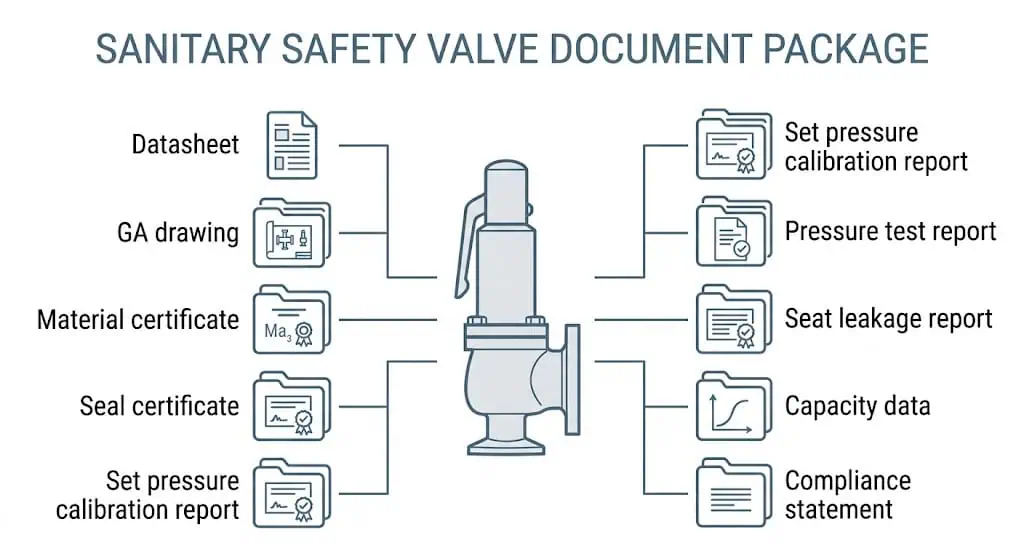
Documents a China Sanitary Safety Valve Manufacturer Should Provide
Documentation is part of the product. For hygienic systems, missing documents can delay QA approval even if the valve itself is mechanically acceptable. The document package should be agreed before order placement.
Document scope should be linked to the quoted model, manufacturing site, order and supplied valve identification.
Document
Why It Is Needed
When to Request It
Valve datasheet
Confirms model, size, set pressure, material, connection and service basis
Before technical approval
General arrangement drawing
Confirms dimensions, connection and installation interface
Before order confirmation
Material certificate
Supports material traceability for pressure and product-contact parts
Before shipment
Seal / elastomer documentation
Supports product, CIP/SIP and compliance review
Before approval for hygienic projects
Set pressure calibration report
Confirms the valve setting
Before shipment
Pressure test report
Confirms pressure boundary test
Before shipment
Seat leakage report
Confirms leakage performance where required
When leakage is specified
Capacity data or certificate
Supports relieving capacity review
Before final approval
Compliance statement
Supports project, QA or import documentation
When required by specification
Valve Datasheet and General Arrangement Drawing
The datasheet and drawing should be reviewed before order confirmation. They should show the valve model, connection, set pressure, material, dimensions, discharge direction and any special hygienic or installation requirement.
Material Certificate and Product-Contact Material Traceability
Material certificates help confirm the material supplied. For sanitary service, buyers should identify which components are product-contact parts and whether the supplied certificate package covers those parts.
Seal / Elastomer Documentation
Seal documentation may be required for food, dairy, pharmaceutical or bioprocessing projects. The manufacturer should identify seal material, service limits and available compliance documents. If the seal contacts product or clean steam, this information should be reviewed before approval.
Test Report, Calibration Certificate and Capacity Data
Test and calibration records should match the valve tag and nameplate. Capacity data should match the required relieving duty or the documented selection basis. If a manufacturer cannot provide a clear capacity basis, the buyer should treat the quotation as incomplete.
Compliance Statement and Project-Specific Certificates
Do not assume every certificate is included by default. If the project requires a specific certificate, compliance statement, material record, inspection report or surface finish document, it should be listed in the RFQ and confirmed in the quotation.
This is a common late-stage procurement issue. A valve may meet the mechanical order description, but the supplied package may only include basic test documents while the buyer requires product-contact material and seal documentation. The result is shipment hold, QA rejection or additional document chasing. The corrective action is usually administrative, but the delay is real. The prevention is to put document requirements into the RFQ before production, not after the valve is ready to ship.
Legal entity, site, activities, issuer and validity
Hygienic certificate or declaration
Defined hygienic design, material or cleanability scope
Exact model, size, seal, option, manufacturing entity and exclusions
Material certificate
Grade, heat or batch and test results
Traceability to the actual body, nozzle, disc or other specified component
Elastomer or food-contact declaration
Exact compound and stated regulatory or compendial basis
Formulation, batch, intended use, temperature and contact condition
Capacity evidence
Supported flow performance of an identified valve configuration
Orifice, medium, pressure, temperature, back pressure and code route
Order-specific test report
Test performed on a serial number, valve or order
Identification, procedure, instruments, results and approval
Public website samples, redacted certificates and brochures can support preliminary supplier screening. They are not substitutes for the controlled order-specific records required by the purchase order.
Standards and Compliance: What Should Be Verified, Not Just Claimed?
Standard names should not be used as decoration. If a supplier claims ASME BPE, 3-A, EHEDG, FDA, National Board or another compliance route, ask what the claim means, which document supports it and whether it applies to the actual valve being quoted.
Standards boundary: Hygienic-design references and pressure-protection references solve different problems. ASME BPE, applicable 3-A Sanitary Standards and EHEDG Guideline 14 may support hygienic design and documentation. ASME BPVC Section XIII, the protected-equipment code, API 520 Part I, API 520 Part II and ISO 4126-1 may support pressure-relief design within their actual scopes. Confirm the required edition, jurisdiction, code marking, product scope and purchase specification before approval.
Reference Direction
Where It May Apply
What to Verify
ASME BPE
Bioprocessing, pharmaceutical and high-hygiene equipment
Whether the supplier’s design, material, fabrication and documentation match the project scope
3-A Sanitary Standards
Food, dairy and sanitary equipment
Whether the specific valve and documentation support the claimed sanitary requirement
EHEDG valve guidance
Hygienic and aseptic valve design review
Whether cleanability, drainability, material and valve design are considered
API 520 Part I
Pressure-relieving device sizing and selection direction
Whether sizing method and capacity basis are suitable for the application
National Board / ASME capacity basis
Code-controlled safety relief device applications
Whether certified capacity or code documentation is required by the project
ASME BPVC Section XIII and protected-equipment section
Code-controlled overpressure protection where the ASME route applies
Required marking, capacity certification, set-pressure arrangement and manufacturer’s scope
API 520 Part II
Installation and engineering analysis in its covered refinery/process scope
Inlet loss, outlet piping, back pressure and installed configuration
Authorized pressure-relief-valve repair where required
Repair organization and scope; it is not a hygienic-design certificate
ASME BPE for Bioprocessing and High-Hygiene Equipment
ASME BPE may be relevant when the sanitary safety valve is used in bioprocessing, pharmaceutical or high-hygiene systems. The buyer should not only ask whether the supplier “knows ASME BPE.” The practical question is whether the valve design, material, surface finish, fabrication, inspection and documentation match the project requirement.
3-A Sanitary Standards for Food and Dairy Equipment
3-A Sanitary Standards may be relevant for food and dairy processing equipment. If a supplier mentions 3-A, request the specific document or basis that supports the claim. A general statement on a website is not the same as project evidence.
EHEDG Guidance for Hygienic and Aseptic Valve Design
EHEDG guidance can be useful when reviewing hygienic and aseptic valve design. In practice, this means checking cleanability, material, drainability, seal design and product-contact geometry. It does not replace safety valve sizing or set pressure review.
ASME / National Board Capacity Certification for Safety Relief Devices
Some applications require certified relieving capacity or code-controlled pressure relief documentation. If this applies to your project, it should be stated clearly in the RFQ. Do not assume every sanitary safety valve manufacturer can supply code-certified capacity documentation for every size and set pressure.
Where National Board VR repair authorization is required, verify the repair organization’s current scope and location rather than accepting a logo or unrelated certificate. New-valve capacity certification and repaired-valve authorization are separate evidence paths.
Do Not Accept Standard Names Without Document Evidence
The safest procurement approach is to ask for evidence. The supplier should state what standard or document applies, which valve or component is covered and what documentation can be supplied with the order. If the claim cannot be connected to the actual valve, treat it as unverified.
Most procurement mistakes come from approving the visible features while missing the engineering basis. The following red flags should be checked before placing an order.
Buying Mistake
Why It Happens
Possible Consequence
Buying by tri-clamp size only
Connection size is easy to see
Wrong capacity or wrong orifice
Confusing sanitary valve with sanitary safety valve
Both may look polished and stainless
No proper set pressure or capacity review
Ignoring certified or documented capacity
Buyer focuses on pressure rating
Valve may fail to relieve required load
Ignoring CIP/SIP seal exposure
Normal product service is reviewed, cleaning cycle is not
Leakage, seal damage and maintenance increase
Accepting standard names without documents
Marketing claims are treated as proof
QA rejection or compliance dispute
Not reviewing back pressure
Outlet is treated as a simple drain
Chatter, flutter or poor reseating
Not confirming documents before production
Documents are requested after shipment is ready
Delivery delay or rework
Buying by Tri-Clamp Size Only
Tri-clamp size confirms the mechanical connection, not the relieving capacity. Always check set pressure, orifice, capacity data and relief duty.
Confusing Sanitary Relief Valve with General Sanitary Valve
A safety valve is not a general flow control valve. It must be tested and documented as a pressure relief device.
Ignoring Certified Relieving Capacity
Capacity should be reviewed before purchase. If the manufacturer cannot provide capacity data or a clear capacity basis, the buyer cannot confirm that the valve protects the equipment properly.
Ignoring CIP / SIP Seal Exposure
CIP/SIP cycles can be more severe than normal operation. Seal material must be checked against both product and cleaning conditions.
Accepting “FDA / 3-A / ASME BPE” Claims Without Documents
Claims should be linked to documents. Ask what certificate, material declaration or compliance statement is available for the actual valve.
Accepting Sample Certificates as Order-Specific Evidence
A certificate displayed on a website may belong to another legal entity, production site, model, size, material or option. Verify the issuer, certificate number, validity, scope, manufacturing location and connection to the quoted valve. Request controlled order documents before shipment release.
Not Reviewing Back Pressure and Installation
Outlet piping can affect valve stability. If the discharge is not atmospheric, provide the discharge destination and back pressure information to the manufacturer.
China Sanitary Safety Valve Manufacturer Evaluation Checklist
The following checklist can be used during supplier screening, technical bid review or final order confirmation.
Review Area
Check Item
Confirmed
Factory capability
Can the supplier manufacture sanitary safety valves, not only general sanitary valves?
☐
Engineering support
Can the supplier review set pressure, medium, capacity and back pressure data?
☐
Hygienic design
Can the supplier explain product-contact surfaces, dead space and drainability?
☐
Material control
Are material certificates available for pressure-retaining and product-contact parts?
☐
Seal compatibility
Is seal material suitable for product, CIP and SIP conditions?
☐
Testing
Can set pressure calibration and pressure test records be supplied?
☐
Capacity basis
Is capacity data or certified capacity basis available?
☐
Documentation
Are datasheet, drawing, certificates and test reports included?
☐
Inspection
Can third-party inspection or project-specific inspection be supported if required?
☐
Export support
Can packing, labeling, shipment documents and after-sales support be handled?
☐
Drawing and revision control
Are approved drawings, bills of material and engineering changes controlled?
☐
Calibration system
Are test instruments suitable, traceable and within calibration?
☐
Nonconformance control
Can the supplier document deviations, rework and corrective action?
☐
Change notification
Will material, seal, sub-supplier, process or manufacturing-site changes require buyer approval?
☐
Factory Capability Checklist
Product range includes sanitary safety valves or sanitary relief valves.
Manufacturing process supports hygienic stainless steel parts.
Valve assembly and setting process is controlled.
Project-specific drawings and documentation can be prepared.
Custom connection, material or seal requirements can be reviewed.
Technical Review Checklist
Set pressure is confirmed against protected equipment.
Operating pressure margin is reviewed.
Required relieving capacity is stated.
Capacity data or capacity basis is confirmed.
Medium, temperature and fluid state are reviewed.
CIP/SIP and cleaning conditions are stated.
Back pressure and discharge destination are reviewed.
Document Review Checklist
Datasheet
General arrangement drawing
Material certificate
Seal documentation, if required
Set pressure calibration report
Pressure test report
Seat leakage test report, if required
Capacity data or certificate, if required
Compliance statement, if required
Shipment and After-Sales Checklist
Nameplate data matches documents.
Valve tag and serial number are traceable.
Spare seals or maintenance parts are available if required.
Packing protects sanitary surfaces.
Documents are sent before shipment release.
Installation and maintenance notes are available.
Factory Audit and Supplier Change-Control Checklist
Confirm the legal manufacturing entity and actual production site.
Review drawing, bill-of-material and revision controls.
Check incoming material identification and heat or batch traceability.
Review machining, welding, polishing, cleaning, assembly and contamination controls.
Check calibration equipment, test procedures and record retention.
Review nonconformance, rework, concession and corrective-action procedures.
Require notification and approval for material, seal, sub-supplier, process or site changes.
Confirm how complaints, replacement parts, repairs and field failures are handled.
What Data Should You Send for an Accurate Quotation?
An accurate quotation depends on engineering data. A low-detail RFQ usually produces a low-confidence quotation. The following information helps the manufacturer select and document the valve correctly.
Data Group
Information to Provide
Process and pressure data
Protected equipment, MAWP, operating pressure, set pressure, required relieving capacity, relieving temperature
Medium data
Product, clean steam, gas, liquid, CIP solution, SIP steam, density or other relevant properties
Provide the protected equipment, MAWP, normal operating pressure, set pressure, required relieving capacity and relieving temperature. Without these values, the manufacturer cannot verify whether the quoted valve is suitable for the protection duty.
Hygienic Design Data
State whether the valve is product-contact, clean steam, CIP, SIP, washdown or non-product-contact service. Include surface finish, drainability, connection and cleaning requirements if they are defined by your project.
Material and Seal Data
Confirm product-contact material, pressure-retaining material, trim material and seal material. If your project requires specific material certificates or elastomer documentation, list them in the RFQ.
Testing and Certificate Requirements
State which tests and documents are required before shipment. If the purchase order does not mention seat leakage test, capacity data, special certificates or third-party inspection, the supplier may not include them.
Drawing, Sample and Lead-Time Requirements
If the valve must fit an existing skid, send drawings, photos or layout information. For OEM or repeated orders, a sample review may reduce installation risk. Lead time should include manufacturing, testing, documentation preparation and packing, not only machining time.
Request a sanitary safety valve quotation with engineering review:
Provide your process data, set pressure, required capacity, medium, CIP/SIP condition, connection, material, seal, discharge condition and certificate requirements. We can review whether a sanitary safety valve configuration is technically suitable before quotation. Review the sanitary safety valve product range only after the protection and documentation basis is defined.
Require a quotation assumptions and deviations list. The supplier should identify any estimated process value, alternate material, substituted seal, unverified capacity basis, excluded test, unavailable certificate or installation assumption. A quotation that appears compliant but silently changes the technical basis cannot be compared fairly.
Final Buying Advice for Engineers and Buyers
When sourcing a sanitary safety valve from China, the lowest price is rarely the safest starting point. The first question should be whether the manufacturer can prove the valve is suitable for both pressure relief duty and hygienic service. That proof should come from engineering data, drawings, material control, seal review, test records and the required document package.
A practical buyer should avoid three shortcuts: buying by clamp size only, accepting standard names without evidence and treating sanitary appearance as proof of cleanability. Instead, ask the manufacturer to confirm set pressure, relieving capacity, product-contact materials, seal compatibility, CIP/SIP exposure, back pressure, testing and documents before approving the order.
Author / Engineering Review Box: This article is written from a safety valve and pressure relief valve engineering review perspective, with attention to sanitary service, set pressure, certified capacity, hygienic design, CIP/SIP exposure, material compatibility, back pressure, testing and procurement documentation. Final valve selection should follow manufacturer-certified data, project specification, applicable standard editions and local regulatory requirements.
Purchase-Order Hold Points and Final Release
Do not release the order or shipment while the governing relief case, required capacity, valve type, capacity evidence, back pressure, product-contact materials, seal compound, hygienic scope, certificate coverage or supplier deviations remain unresolved. Pre-shipment release should confirm that the approved datasheet, drawing, nameplate, serial or order identification and document index all agree.
Repair, Recalibration and After-Sales Evidence
After repair or seal replacement, record the as-found condition, inspected components, replaced parts, material or elastomer batches, cleaning status and assembly controls. Repeat the required set-pressure and seat-tightness tests, restore the tag and seal, and complete hygienic cleaning or quality release before return to service. Where the owner, jurisdiction or code route requires VR-authorized repair, use a qualified organization with the appropriate current scope.
FAQ About Buying Sanitary Safety Valves from China
Are Chinese sanitary safety valves reliable?
They can be reliable when the manufacturer provides proper engineering data, material control, hygienic design review, testing records and required documents. Reliability should be verified by project-specific review, not assumed from country of origin or product appearance.
What should I check before choosing a China sanitary safety valve manufacturer?
Check whether the manufacturer can support sanitary design, set pressure calibration, required relieving capacity review, material certificates, seal documentation, CIP/SIP compatibility, pressure testing, capacity data and export documentation.
Is 316L stainless steel enough for a sanitary safety valve?
No. 316L may be suitable for many product-contact parts, but the valve also needs correct set pressure, capacity, hygienic geometry, seal compatibility, surface finish, drainability, testing and documentation.
Can I buy a sanitary safety valve by tri-clamp size only?
No. Tri-clamp size only confirms the connection. You still need to check set pressure, required relieving capacity, capacity basis, medium, temperature, seal material, CIP/SIP exposure and documentation.
What documents should a sanitary safety valve manufacturer provide?
Common documents include datasheet, general arrangement drawing, material certificate, seal documentation, set pressure calibration report, pressure test report, seat leakage test report if required, capacity data and compliance statement if required.
Do sanitary safety valves need certified relieving capacity?
Capacity must be reviewed. Whether certified relieving capacity is required depends on the project specification, jurisdiction and equipment code. At minimum, the buyer should ask for capacity data or a clear capacity basis.
How do I know if the valve is suitable for CIP or SIP?
Provide the cleaning chemical, steam temperature, exposure time and cycle frequency. The manufacturer should confirm seal material, product-contact material, cleanability and any required documentation against those conditions.
What data should I send for quotation?
Send protected equipment, MAWP, operating pressure, set pressure, required relieving capacity, medium, relieving temperature, connection type, CIP/SIP condition, seal material, back pressure, discharge destination, document requirements and quantity.
How can I verify that the quoted manufacturer is the actual factory?
Confirm the legal entity, manufacturing address, production scope and responsibility for engineering, machining, assembly and testing. Review factory records or an audit, and ensure the quotation, certificates, drawings, nameplate and payment entity do not conflict.
Does ASME BPE, 3-A or EHEDG evidence prove pressure-relief capacity?
No. Hygienic standards and declarations may support materials, cleanability, fabrication or product scope. Set pressure, pressure testing, certified or documented capacity, code marking and installed-system suitability require separate pressure-protection evidence.
How should I compare two sanitary safety valve quotations?
Normalize the protected equipment, relief scenario, required capacity, set pressure, orifice, capacity basis, valve construction, back-pressure assumption, materials, seal compound, surface requirements, tests, certificates, deviations and exclusions before comparing price and lead time.
When should third-party inspection or witness testing be requested?
Consider it for critical equipment, special materials, code-controlled duties, large or repeat orders, strict hygienic documentation, first-time suppliers or projects where site rejection would cause significant delay. Define inspection and witness points in the purchase order.
How does back pressure affect a sanitary safety valve?
Superimposed and built-up back pressure can affect opening stability, lift, effective capacity, blowdown and reseating. Provide recovery-line, common-header, outlet-piping and condensate conditions so the manufacturer can confirm the suitable valve construction and capacity basis.
Can a sample certificate be accepted for the production order?
A sample can support preliminary screening but is not order-specific evidence. Final records should identify the applicable legal entity, factory, model, size, material, seal, serial number or production order, test result and certificate scope required by the purchase order.
What should be reverified after repair or seal replacement?
Record the as-found condition, inspect the nozzle, disc, guide, spring, bellows or pilot components, trace replacement parts and seals, complete the required cleaning and assembly controls, recalibrate set pressure, repeat specified seat testing and restore tags and seals before return to service.
Why is certified or documented capacity more important than tri-clamp size?
Tri-clamp size only defines the connection. The effective orifice, valve lift, pressure basis, fluid, temperature and back-pressure conditions determine relieving performance. The selected valve’s supported capacity must equal or exceed the approved required relieving load.
To provide the best experiences, we use technologies like cookies to store and/or access device information. Consenting to these technologies will allow us to process data such as browsing behavior or unique IDs on this site. Not consenting or withdrawing consent, may adversely affect certain features and functions.
Functional
Always active
The technical storage or access is strictly necessary for the legitimate purpose of enabling the use of a specific service explicitly requested by the subscriber or user, or for the sole purpose of carrying out the transmission of a communication over an electronic communications network.
Preferences
The technical storage or access is necessary for the legitimate purpose of storing preferences that are not requested by the subscriber or user.
Statistics
The technical storage or access that is used exclusively for statistical purposes.The technical storage or access that is used exclusively for anonymous statistical purposes. Without a subpoena, voluntary compliance on the part of your Internet Service Provider, or additional records from a third party, information stored or retrieved for this purpose alone cannot usually be used to identify you.
Marketing
The technical storage or access is required to create user profiles to send advertising, or to track the user on a website or across several websites for similar marketing purposes.