Share your medium, set pressure, temperature, size, standard, or datasheet, and our team will review your requirement and respond with the appropriate next step.
The decisive difference between a sanitary safety valve and an industrial safety valve is the design duty, not the connection or appearance. A sanitary safety valve must satisfy overpressure protection and hygienic product-contact requirements at the same time. An industrial safety valve is selected primarily for pressure, temperature, fluid, mechanical and code service where hygienic …
The decisive difference between a sanitary safety valve and an industrial safety valve is the design duty, not the connection or appearance. A sanitary safety valve must satisfy overpressure protection and hygienic product-contact requirements at the same time. An industrial safety valve is selected primarily for pressure, temperature, fluid, mechanical and code service where hygienic cleanability is not required. Both must be checked for set pressure, required relieving capacity, certified or manufacturer-documented capacity, valve construction, materials, back pressure, inlet pressure loss, installation and testing. The sanitary design adds cleanability, drainability, controlled surface condition, gasket and ferrule geometry, CIP/SIP exposure, elastomer traceability and validation evidence.
Quick Answer / Engineering Summary: Choose a sanitary safety valve when the valve or its inlet branch contacts product, clean steam, purified utility, cleaning solution or an aseptic process boundary. Choose an industrial safety valve for general pressure vessels, boilers, utility steam, compressed air, process gas, chemical service or severe-duty systems where hygienic cleanability is not part of the design basis. A clean-looking valve is not necessarily sanitary, and an industrial valve is not automatically stronger or more reliable. Final approval must compare the protected equipment, relief scenario, pressure terms, capacity, valve design, materials, CIP/SIP or severe-service conditions, discharge system, documents and repair route.
Approval boundary: A tri-clamp connection, polished 316L body or hygienic declaration does not prove relieving capacity, code marking or installed stability. Likewise, a flanged or threaded industrial valve is not automatically unsuitable for every clean utility; the product-contact boundary and project specification decide the required evidence.
The selection must compare the same pressure-protection duty and then add the hygienic requirements that apply to product-contact or clean-utility service.
What Is the Main Difference?
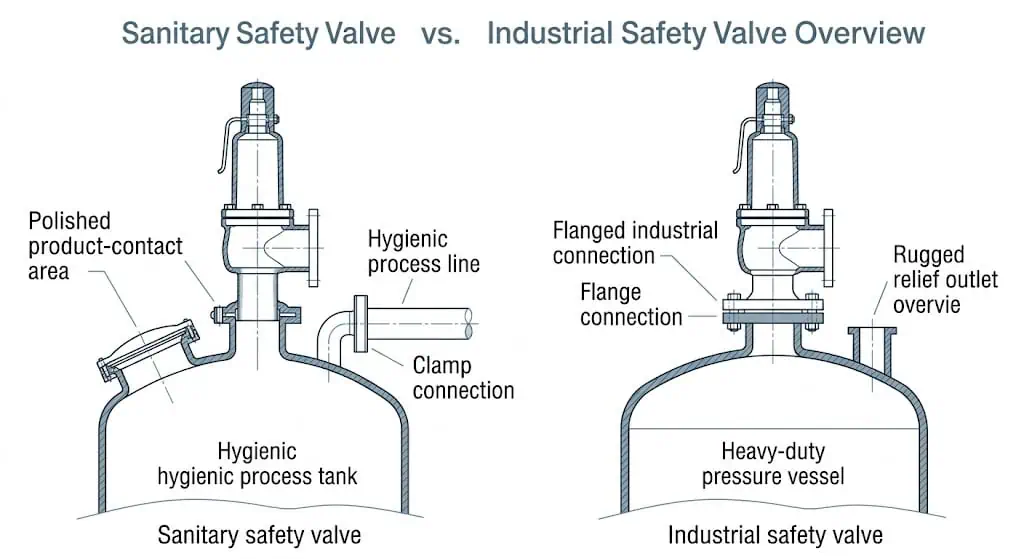
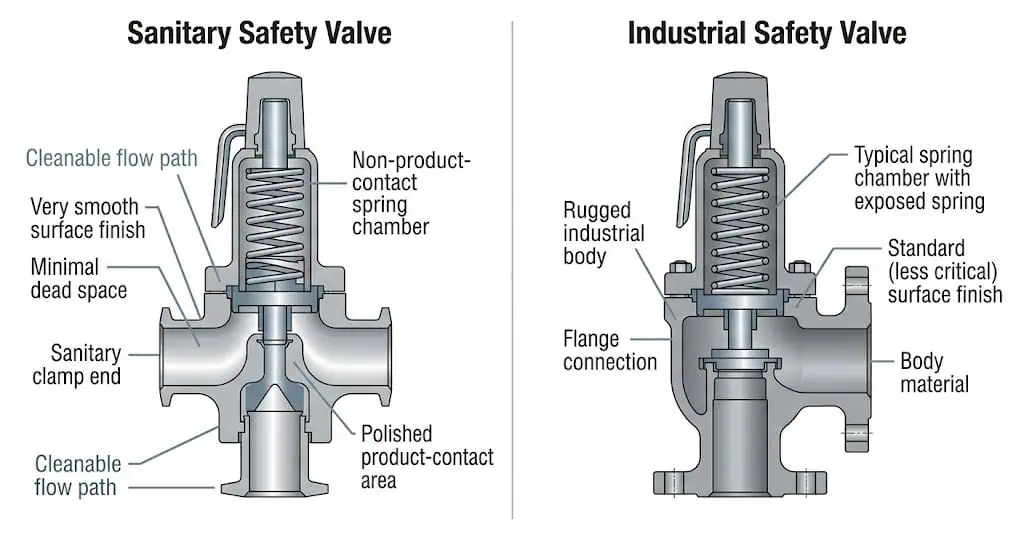
The main difference is the service boundary. A sanitary safety valve protects equipment in a hygienic or aseptic system and must be evaluated as part of the product-contact and cleaning path. An industrial safety valve protects equipment in general process or utility service and is normally optimized around pressure, temperature, phase, corrosion, fouling, vibration, back pressure and code requirements rather than hygienic cleanability.
A sanitary safety valve is not automatically a higher-grade valve, and an industrial safety valve is not automatically a more rugged valve. Each category contains different constructions, materials, seats and performance envelopes. The correct choice is the design that satisfies the governing relief case and the actual service environment without adding unsupported hygienic or severe-duty claims.
Terminology boundary: “Industrial safety valve” is a broad comparison term rather than one code-defined construction. The industrial valve may be conventional spring-loaded, balanced bellows or pilot-operated. “Safety valve,” “relief valve,” “safety relief valve,” PRV and PSV can also be used differently by standards and owners; the approved datasheet must state the medium, opening characteristic, construction and certification basis.
Sanitary Safety Valve Definition in Comparison Context
A sanitary safety valve is an automatic reclosing pressure-relief device intended for hygienic, aseptic or clean-utility systems. It must respond at the approved set pressure, develop sufficient lift and flow during the allowed overpressure, and reseat after pressure falls through the blowdown range. The product-contact geometry, ferrules, gaskets, surfaces and seals must also support the specified cleaning and sterilization conditions.
Typical applications include food, dairy, beverage and fermentation systems, pharmaceutical and bioprocessing equipment, purified-water or clean-gas skids and clean-steam systems. A valve that controls pressure but retains product, condensate or cleaning chemical can still fail the hygienic requirement.
Industrial Safety Valve Definition in Comparison Context
An industrial safety valve is a pressure-relief valve used on boilers, pressure vessels, compressors, storage and process equipment, utility systems and pipelines where hygienic product-contact design is not the primary requirement. Selection may involve steam, gas, vapor, liquid, flashing or two-phase service and can require direct spring-loaded, balanced bellows or pilot-operated construction.
The industrial design review emphasizes the governing relief load, set pressure and allowable accumulation, certified capacity, pressure-temperature rating, body and trim materials, seat design, corrosion or fouling, inlet loss, outlet back pressure, reaction forces and the applicable code. The word industrial alone does not identify the valve type or prove suitability.
Why This Is Not Just a Connection Difference
A sanitary clamp end does not automatically make a valve hygienic, and a flanged valve is not automatically unacceptable for every clean utility. Connection style confirms only one interface. The internal geometry, gasket alignment, contact boundary, capacity, valve construction, installation orientation and document scope remain controlling.
The real comparison should include:
product-contact or non-product-contact service
cleanability and dead space
CIP and SIP exposure
set pressure and operating pressure margin
required relieving capacity and certified capacity
orifice area and capacity basis
material and seal compatibility
surface finish requirement
back pressure and discharge path
inlet arrangement, orientation and drainability
documentation and quality approval
Composite field case — problem: An industrial valve was accepted because its pressure class matched and an adapter connected it to the hygienic line. Cause: the review stopped at mechanical fit; the adapter, inlet cavity and gasket created retained volume outside the effective CIP path. Correction / prevention: the team selected a hygienic valve with a shorter drainable inlet and added internal drawings, installed cleanability and capacity equivalence to the replacement checklist.
The following table gives a practical starting point for engineers and buyers. It should not replace project-specific sizing or compliance review, but it helps identify which valve type is more likely to fit the service.
Boiler, pressure vessel, compressor, chemical plant, utility steam, air and gas systems
Product-contact design
Critical; internal geometry should reduce retention and support cleaning
Usually not designed for hygienic product-contact service
Connection type
Often sanitary clamp, aseptic or hygienic connection
Often flanged, threaded, welded or other industrial connection
Surface finish
Often specified for hygienic or clean process requirements
Specified mainly for corrosion, temperature and mechanical service
Seal review
Must include product, cleaning chemicals, CIP/SIP and steam exposure
Usually focused on medium, temperature, pressure and leakage requirement
Capacity review
Still required; clamp size does not prove certified capacity
Required; connection size does not prove certified capacity
Back pressure review
Important when connected to closed discharge, recovery or clean utility systems
Important for headers, silencers, flare systems, long outlet lines and common discharge piping
Documentation
May require material traceability, elastomer certificates, surface finish and hygienic compliance documents
May require datasheet, test report, material certificate, capacity certificate and code documentation
Common procurement risk
Selecting by sanitary appearance only
Selecting by pressure rating, flange size or body size only
Pressure terms
Set pressure, overpressure, accumulation and blowdown remain code and valve-performance inputs
The same pressure terms apply; industrial service may involve wider code and relief-system arrangements
Valve construction
Often direct spring-loaded; balanced or pilot designs require hygienic review of added cavities and seals
Conventional spring, balanced bellows and pilot-operated options selected to suit back pressure, operating margin and service
Inlet and outlet system
Short cleanable inlet, drainable outlet and no gasket intrusion or retained condensate
Low inlet loss, acceptable back pressure, reaction-force support and safe disposal
Repair and return to service
Pressure recalibration plus controlled cleaning, elastomer traceability and hygienic release
Pressure recalibration, seat testing, code/owner repair records and resealing
Sanitary design prioritizes cleanability and controlled contact surfaces; industrial design may prioritize wider pressure-temperature, material and severe-service requirements.
Design Purpose
Sanitary safety valves are selected where pressure protection and hygienic control are inseparable. Industrial safety valves are selected where the pressure-protection duty and industrial service conditions govern. Neither category changes the need to verify required capacity and installed stability.
Product-Contact Surface
For sanitary service, every wetted cavity, seat interface, ferrule, gasket and adjacent branch can affect cleaning reliability and contamination risk. Industrial internal surfaces are usually reviewed for corrosion, erosion, deposits, galling and temperature rather than validated product-contact cleanability.
Connection Type
Sanitary valves often use hygienic ferrules, unions or weld ends; industrial valves commonly use flanged, threaded or welded pressure connections. Connection geometry must not intrude into the inlet, create a pocket or be used as a substitute for capacity verification.
Material and Surface Finish
Sanitary service may require controlled 316L product-contact materials, heat traceability, defined surface-finish locations, passivation or electropolishing. Industrial service may require carbon, alloy, stainless or nickel-based materials selected for pressure, temperature, corrosion, erosion and mechanical loads.
Seal and Seat Design
Sanitary seats and elastomers must tolerate product, CIP chemicals, SIP or clean-steam cycles and the required documentation scope. Industrial valves may use metal or soft seats based on temperature, pressure, medium, leakage requirement and cycling severity. Seat tightness does not prove capacity.
Documentation and Traceability
Sanitary projects may require heat and elastomer traceability, surface-treatment records and hygienic scope in addition to pressure tests, set-pressure and capacity evidence. Industrial projects may require code marks, certified capacity, materials, calibration, seat-tightness and authorized repair records.
Typical Application
Sanitary valves are used in product-contact, clean-steam, high-purity and validated cleaning systems. Industrial valves are used in boilers, pressure vessels, refineries, chemical plants, compressor packages, utilities and severe process service. Mixed systems may require both pressure-code and hygienic evidence.
When Should You Choose a Sanitary Safety Valve?
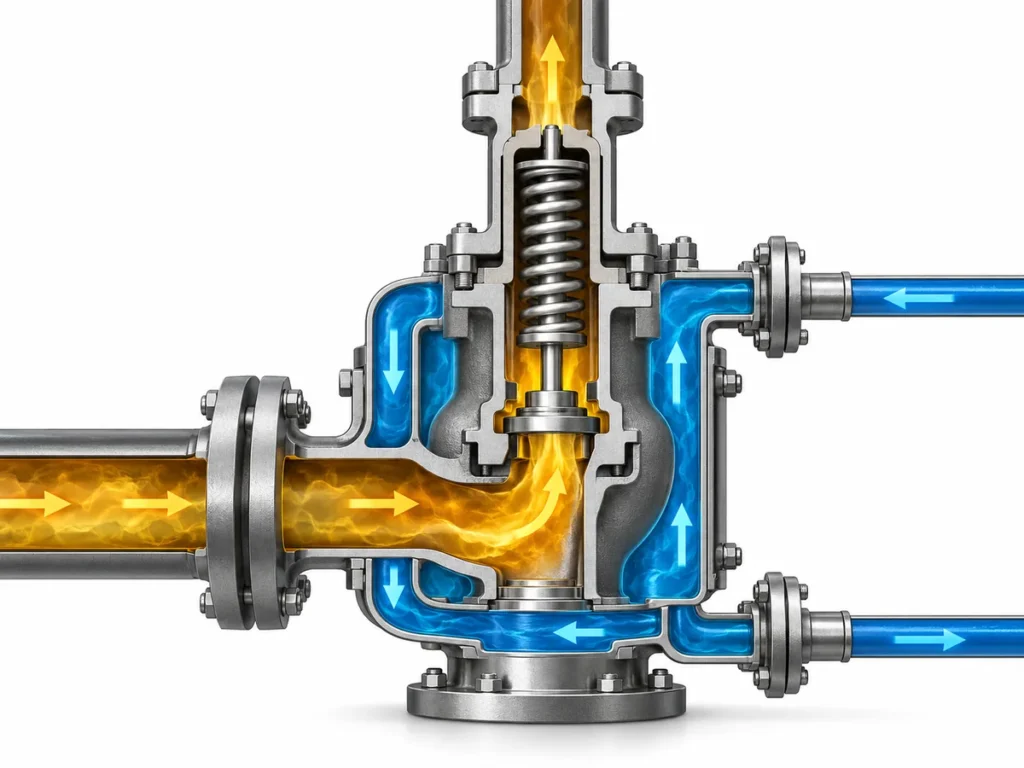
Choose a sanitary safety valve when the valve, inlet branch, discharge recovery path or maintenance procedure can affect a hygienic product or clean-utility boundary. The design should support the approved cleaning method, drainability, material control, inspection and pressure-protection duty.
Sanitary selection trigger: product contact, clean-steam condensate contact, CIP/SIP exposure, aseptic boundary, validated cleaning or required hygienic certificates. The trigger is the process boundary—not the requested connection name.
Food, Beverage and Dairy Processing
Food, beverage and dairy systems often require cleanable process equipment and sanitary materials. A standard industrial valve may protect the system from overpressure, but it may also create product retention, cleaning difficulty or quality approval issues.
Pharmaceutical and Bioprocessing Systems
Pharmaceutical and bioprocessing applications may require stricter control of surface finish, material traceability, elastomer documentation and hygienic design. In this service, the valve should be reviewed against the project specification and relevant hygienic design references.
Clean Steam and Clean Utility Lines
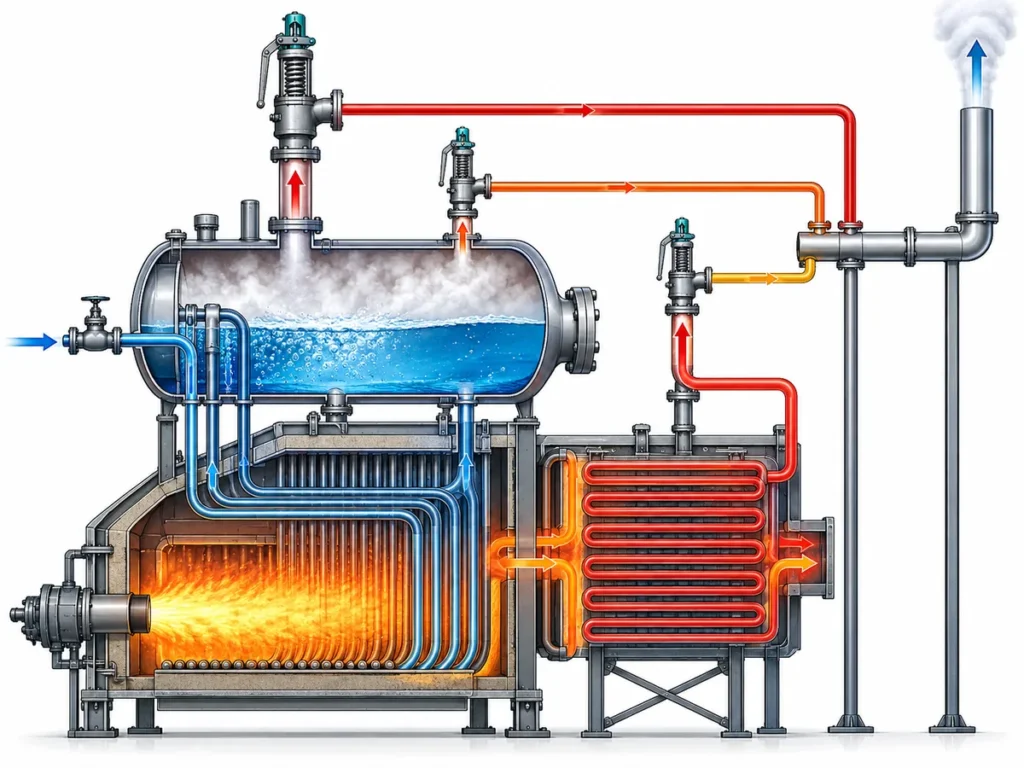
Clean steam and high-purity utilities can require sanitary construction when condensate or wetted surfaces form part of the controlled process boundary. Plant utility steam outside that boundary may use an industrial valve. In either case, verify steam capacity, temperature, condensate drainage, seat construction, discharge reaction and post-lift inspection.
CIP / SIP Systems
If the valve is exposed to CIP or SIP, the cleaning chemicals, steam temperature, exposure time and frequency should be treated as part of the design condition. A seal that works in normal product service may fail during cleaning or sterilization.
Product-Contact or Hygienic Zones
If the valve has product-contact surfaces or is installed in a hygienic zone, sanitary design becomes part of the selection. The inlet arrangement, internal geometry, seal pocket, surface finish and drainability should be reviewed.
Composite field case — problem: A replacement protected the pressure boundary but failed a post-CIP hygiene review. Cause: the industrial valve and adapter created a long branch with weak cleaning coverage and no complete drain path. Correction / prevention: the valve and branch were redesigned together, and future replacements required capacity, internal geometry, cleaning path and installed orientation approval.
When Is an Industrial Safety Valve More Suitable?
An industrial safety valve is more suitable when the protected system requires general or severe-duty pressure protection and no hygienic product-contact requirement applies. This is not a downgrade: industrial designs may offer broader pressure-temperature ranges, larger certified capacities, metal seats, bellows balancing or materials intended for steam, corrosive, dirty or outdoor service.
Boiler, Utility Steam and Air Systems
Boiler, utility steam and compressed air systems often require industrial safety valves designed for pressure, temperature, capacity and code compliance. Hygienic product-contact design is usually not required unless the system is clean steam or process-contact utility service.
General Pressure Vessel Protection
Pressure vessels in chemical, energy, industrial gas and process plants usually require industrial safety valves selected by MAWP, relief scenario, set pressure, certified capacity, material and discharge conditions.
Non-Product-Contact Industrial Service
If the valve is not in a product-contact or hygienic cleanable zone, an industrial safety valve may be more appropriate. Over-specifying a sanitary design can increase cost, lead time and documentation work without improving safety.
High-Temperature, High-Pressure or Severe Industrial Service
Severe industrial services may require materials, trim designs, pressure classes or seat designs that are more typical of industrial safety valves. Corrosive gas, superheated steam, high-pressure liquid and dirty service should be reviewed case by case.
Rugged Applications Where Hygienic Cleanability Is Not Required
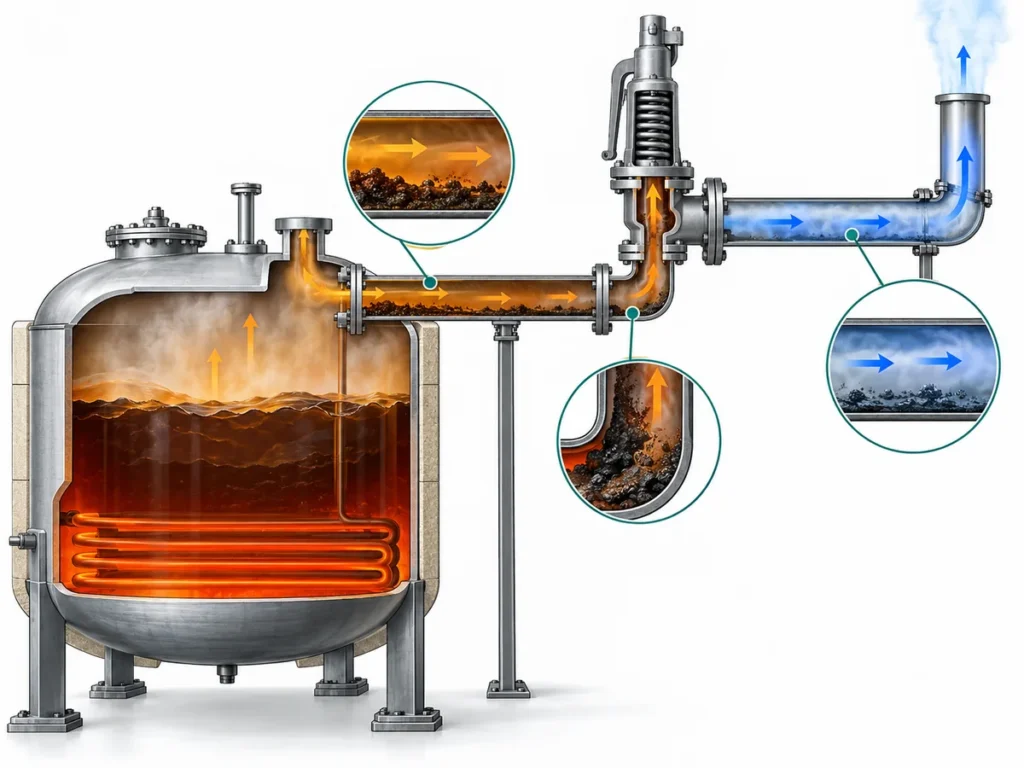
Industrial valves may be preferable for dirty gas, particles, polymerizing deposits, harsh outdoor exposure, vibration or high-temperature metal-seat service. A direct spring-loaded design may be easier to inspect in contaminated service, while a pilot-operated design can be vulnerable to blocked sensing and pilot passages. The actual medium and maintenance capability decide the construction.
Can an Industrial Safety Valve Replace a Sanitary Safety Valve?
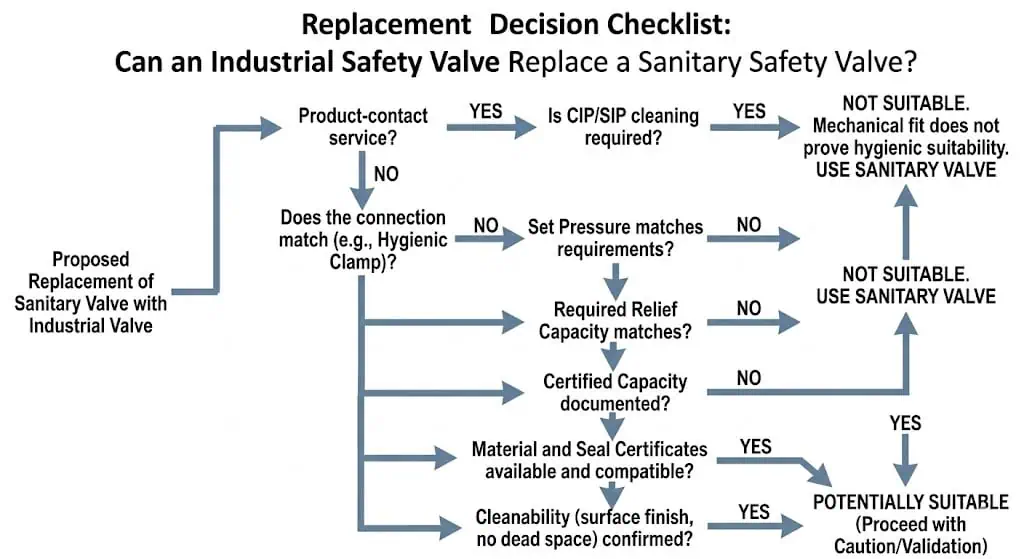
An industrial safety valve should replace a sanitary valve only after a documented equivalence review confirms pressure protection, hygienic suitability, capacity, materials, cleaning, installation and documentation. The decision should be managed as a technical change when the valve construction, inlet branch, outlet system, cleaning route or code basis changes.
Replacement Check
Question to Ask
Risk if Ignored
Product-contact service
Will the valve contact product, clean steam or hygienic process media?
Contamination, cleaning failure, validation issue
Mechanical fit
Does the connection fit the line?
Fit alone may hide cleanability or capacity mismatch
Certified capacity
Does the replacement meet required relieving capacity?
Will the valve see cleaning chemicals or steam sterilization?
Seal damage, leakage, early maintenance
Surface and geometry
Can the valve be cleaned and drained?
Product retention and microbial risk
Back pressure
Does the discharge path create outlet resistance or variable pressure?
Chatter, unstable reseating or reduced effective capacity
Documentation
Can the supplier provide required certificates?
Delayed QA approval or rejected installation
Valve construction
Is the replacement conventional spring-loaded, balanced bellows or pilot-operated, and is it suitable for the medium and back pressure?
Unstable opening, contamination of small passages or incompatible maintenance
Repair and seal history
Was the valve repaired, relapped, recalibrated and resealed under the required program?
Unknown set pressure, leakage, lost traceability or invalid acceptance
Replacement approval requires capacity, valve construction, materials, hygienic suitability, back pressure, installation and document equivalence.
Mechanical Fit Is Not Enough
A replacement valve may fit the pipe, clamp or adapter, but still fail the engineering review. Fit does not prove hygienic design, certified capacity, seat compatibility, back pressure suitability or documentation.
Clamp Size Does Not Prove Certified Capacity
Clamp size is a mechanical interface. Certified capacity depends on internal orifice area, valve design, set pressure, relieving pressure, medium and certification basis. A replacement with the same connection size may have lower capacity.
This issue is common in replacement orders. A buyer may request the same clamp or flange size as the original valve and assume the protection duty is unchanged. During engineering review, however, the replacement valve may show a smaller effective orifice or lower certified relieving capacity than the required relief load. The correction is to compare the required relieving capacity, certified capacity, orifice data and capacity basis before approval, not after installation.
Polished Appearance Does Not Prove Hygienic Design
A polished body can look clean but still have uncleanable pockets, unsuitable seal grooves or poor drainability. Hygienic suitability must be confirmed by design, documentation and installation review.
Missing Certificates Can Delay Quality Approval
In food, dairy, pharmaceutical and bioprocessing projects, missing material certificates, elastomer certificates, surface finish records or hygienic compliance documents may delay approval even if the valve is mechanically acceptable.
This often appears late in procurement. A valve may meet pressure duty, set pressure and connection requirements, but the supplied document package may only match a general industrial valve order. If the project requires product-contact material traceability, elastomer documentation or surface finish records, the valve can be held by QA or site acceptance until the missing documents are resolved.
Replacement Decision Checklist
Confirm whether the valve is in product-contact service.
Confirm whether CIP or SIP cleaning applies.
Check set pressure against protected equipment MAWP.
Check required relieving capacity against certified capacity.
Confirm product-contact materials and seal material.
Review surface finish and drainability.
Confirm discharge path and back pressure.
Request certificates before approval.
Confirm the governing relief scenario and allowable overpressure or accumulation.
Compare valve construction, blowdown and back-pressure limits.
Confirm inlet pressure loss, discharge loads and outlet drainage.
Review previous lift, leakage, repair, calibration and seal records.
Replacement review CTA: Replacing a sanitary safety valve with an industrial safety valve?
Send us the old valve nameplate, medium, MAWP, set pressure, required capacity, connection type, product-contact condition, CIP/SIP cycle, seal material and certificate requirements for review before purchase.
Engineering Factors to Compare Before Selection
Both sanitary and industrial valves remain pressure-relief devices. The common engineering basis is the protected equipment, credible overpressure scenario, pressure terms, required load, valve capacity, fluid condition, back pressure and installation. Hygienic or severe-service requirements are additional selection layers, not substitutes for this basis.
Protected Equipment and MAWP
Identify the protected tank, vessel, boiler, clean-steam generator, line, exchanger, compressor or skid. Distinguish MAWP, design pressure and normal operating pressure. The approved set pressure and allowable accumulation depend on the equipment code, jurisdiction and relief-device arrangement; the valve connection rating is not the protected-equipment MAWP.
Set Pressure and Operating Pressure Margin
Set pressure defines the specified opening response under the applicable test method. Normal and maximum operating pressure must leave enough margin for the selected valve and process stability. Frequent simmer or micro-lift can damage an industrial metal seat and can also transfer product or cleaning residue across a sanitary seat.
Pressure Term
Engineering Meaning
Selection Consequence
Set pressure
Specified opening condition under defined test requirements
Determines when protection begins; it does not prove full lift or capacity
Overpressure
Pressure increase above set pressure while the valve is relieving
Influences lift and rated or certified flow
Accumulation
Pressure increase above the equipment MAWP or allowable reference
Defines the equipment-side pressure boundary for the approved case
Blowdown
Difference between set pressure and reseating pressure
Affects cycling, process recovery and post-lift leakage
Operating margin
Separation between operating pressure and the valve opening region
Insufficient margin can cause simmer, leakage and seat wear
Required Relieving Capacity and Certified Capacity
Required relieving capacity is the flow generated by the approved governing relief scenario. Certified or manufacturer-documented capacity is the supported flow performance of the selected valve, orifice, medium and pressure basis. Approval requires the supported capacity to meet or exceed the required load under the applicable conditions; set pressure and connection size cannot establish this.
A valve can open at the correct set pressure and still allow the protected equipment to exceed its pressure boundary if the effective orifice, coefficient, phase assumption or back-pressure basis is wrong. This risk applies equally to sanitary and industrial replacements.
Medium, Fluid State and Cleaning Cycle
State the medium and its phase at relieving conditions: steam, gas, vapor, liquid, flashing or two-phase flow. Sanitary service also requires foam, solids, product carryover and cleaning media to be considered. Industrial service may require corrosion, polymerization, erosion, sour gas, high temperature or particle loading to be assessed.
Valve Construction
Where It May Fit
Important Boundary
Conventional spring-loaded
General steam, gas or liquid duty; often simpler to inspect
Can be sensitive to superimposed and built-up back pressure; hygienic cavities and spring separation require review
Balanced bellows
Selected back-pressure-sensitive or corrosive outlet service
Selected clean high-pressure gas, close operating margin or large-capacity duty
Small pilot and sensing passages can be affected by product, condensate, particles, icing, crystallization or cleaning residue
Back Pressure and Discharge Path
Superimposed and built-up back pressure can alter opening force balance, lift, effective capacity, blowdown and reseating. Sanitary recovery systems, condensate-filled clean-steam outlets and closed drains require the same hydraulic review as industrial headers, silencers, flare or vent systems. The outlet must also remain safely routed and drainable.
Composite field case — problem: A conventional valve passed shop set-pressure testing but chattered after a discharge-header modification. Cause: the longer outlet and simultaneous header flow increased built-up back pressure; the review had also omitted inlet pressure loss. Correction / prevention: the team recalculated the installed inlet and outlet system, inspected seat and guide damage, and reselected the valve configuration before recalibration and return to service.
Sanitary valves require installed cleanability, ferrule alignment, gasket control and full drainage. Industrial valves require short unrestricted inlets, acceptable outlet resistance, support for reaction forces and thermal expansion, and manufacturer-approved orientation. In both services, poor piping can cause chatter, off-center reseating, body distortion, leakage or loss of effective capacity.
Material, Surface Finish and Seal Differences
Material and seal selection affects corrosion resistance, cleanability, leakage, service life, documentation and maintenance cost. Sanitary and industrial valves often use different priorities when materials are selected.
Item
Sanitary Safety Valve Review
Industrial Safety Valve Review
Body material
Often 316L stainless steel for product-contact parts, depending on specification
Carbon steel, stainless steel, alloy steel or special materials depending on pressure, temperature and corrosion
Surface finish
May require defined finish, polishing or electropolishing
Usually selected for corrosion, temperature and mechanical service
Seal material
Must match product, cleaning chemicals, CIP/SIP and documentation needs
Must match medium, temperature, leakage and pressure requirements
Seat type
Often reviewed for leakage, cleanability and product compatibility
Reviewed for leakage class, temperature, pressure and service severity
Spring and trim
Should be isolated or compatible with the hygienic design and cleaning environment where applicable
Selected for pressure, temperature, corrosion, vibration and mechanical durability
Documentation
May include material certificate, elastomer certificate and surface finish record
May include material certificate, test report, calibration record and capacity certificate
Nozzle and disc
Product-contact grade, finish, crevice control and seat compatibility
Corrosion, erosion, wire drawing, hardness and high-temperature seat integrity
Guide and spindle
Deposits, cleanability, galling and controlled reassembly
Alignment, galling, fouling, vibration and repeated lift damage
Bellows / pilot parts
Cleanability, elastomer traceability and CIP/SIP exposure
Back-pressure balance, fatigue, corrosion, small-passage plugging and exhaust arrangement
Stainless Steel Grade and Product-Contact Parts
Sanitary valves frequently use 316L for wetted parts, but grade alone does not establish suitability. Review the body, nozzle, disc, guide, spindle, ferrules, welds and fastener or spring separation against the product, chlorides, cleaning chemicals, temperature and traceability requirement. Industrial valves may require carbon, Cr-Mo, stainless or nickel-alloy combinations selected for the actual corrosion and pressure-temperature duty.
Surface Finish and Electropolishing Requirements
For sanitary service, state which internal surfaces are product contact, the measurement method and acceptance location, and whether mechanical polishing, electropolishing, passivation and weld finishing are required. Industrial valves may not need a hygienic finish, but seating and guiding surfaces still require controlled machining and repair.
EPDM, PTFE, FKM and Other Seal Materials
Approve the exact seal formulation, not only the polymer family. Sanitary review includes product chemistry, CIP/SIP, steam, extractables and batch evidence. Industrial review includes pressure, temperature, decompression, chemical attack, friction and leakage. Metal seats may be required where soft-seat temperature or chemical limits are exceeded.
CIP / SIP Temperature and Chemical Compatibility
CIP and SIP can impose higher temperature, chemical concentration and cycle severity than production. Repeated exposure can produce swelling, hardening, compression set, creep or loss of seat load. Industrial cleaning, steaming or decontamination cycles should also be treated as service conditions when they contact the valve internals.
Composite field case — problem: A soft-seated sanitary valve remained tight during product operation but leaked after repeated SIP cycles. Cause: the compound was selected from product compatibility only; steam temperature, hold time and cycle frequency caused compression set. Correction / prevention: the exact compound was requalified for production and SIP, the seat and guide were inspected, and the valve was recalibrated and resealed with the new batch recorded.
Material Certificates and Elastomer Documentation
Define the exact order-specific records before manufacture: metallic material certificates, heat and component traceability, elastomer compound and batch declarations, surface-finish measurements, passivation or electropolishing records, and any food-contact or pharmaceutical evidence. A generic brochure or sample certificate does not establish supplied-valve traceability.
Inspection, Recalibration and Resealing After Repair
Seat lapping, spring adjustment, seal replacement, bellows work, pilot cleaning or changes to product-contact parts can affect opening, leakage, traceability or hygienic release. Record the as-found condition, replaced parts and material batches; inspect the nozzle, disc, guide, spring and balance components; repeat the required set-pressure, pressure-boundary and seat-tightness tests; restore controlled cleaning or passivation where specified; then tag, lock or seal the final setting. Use a National Board VR-authorized repair route when required by the jurisdiction, owner or NBIC program. VR authorization addresses pressure-relief-valve repair—it does not replace hygienic cleaning or validation release.
Standards and Compliance Differences
Sanitary and industrial valves may need different but overlapping standards. Hygienic references govern cleanability, product-contact materials and fabrication scope; pressure-relief standards govern sizing, installation, overpressure protection, seat testing and repair. One certificate should never be used as evidence for the other scope.
Edition and scope rule: Use the edition adopted by the project, owner and jurisdiction. Verify the exact product, model, size, materials, options, manufacturing entity and certificate scope rather than accepting a generic compliance statement.
Authorized repair of pressure relief valves where required
Repair authorization is not a hygienic design certification
Hygienic Design References for Sanitary Applications
Sanitary applications may adopt ASME BPE, a specific 3-A Sanitary Standard or Accepted Practice, EHEDG Guideline 14, and project-specific food-contact or pharmaceutical requirements. The RFQ should identify the exact edition, product scope, surface, material, seal and certificate requirements rather than asking for broad “hygienic compliance.”
Pressure Protection Standards for Industrial Safety Valves
Pressure-protection requirements may include ASME BPVC Section XIII together with Section I or Section VIII, API 520 for covered sizing and installation applications, ISO 4126 product requirements, API 527 seat testing, and National Board/NBIC repair rules where adopted. The equipment code, owner and jurisdiction determine the controlling route.
When Both Hygienic and Pressure Certification Requirements Apply
A sanitary safety valve on a code-controlled clean-steam vessel may need both hygienic evidence and pressure-relief evidence. Hygienic documents support materials, cleanability and fabrication scope; capacity certification, set-pressure testing, code marking and installation analysis support the overpressure duty. Neither package replaces the other.
How to Avoid Over-Specifying or Under-Specifying Standards
Build a standards matrix that distinguishes mandatory code, owner specification, hygienic design reference, product certificate, order-specific test and optional preference. Over-specification can add cost without benefit; under-specification can produce an unsafe or unreleasable valve. Require suppliers to list deviations rather than silently changing the basis.
In practice, document requirements should be clarified before purchase. A valve may be acceptable for pressure duty but still be delayed at site because the RFQ did not ask for product-contact material records, elastomer documentation, surface finish records or a specific compliance declaration. This is not only a paperwork issue; missing documents can delay commissioning, force rework or lead to rejection during quality review.
Common Mistakes in Valve Replacement and Procurement
Most failures begin when one visible feature is treated as the complete selection basis. Connection size, body material, set pressure, polished appearance or a certificate logo can each be correct while the valve remains unsuitable for the governing relief case or installed process.
Mistake
Why It Happens
Possible Result
Selecting by connection size only
Buyer assumes same clamp or flange size means same capacity
Undersized valve or failed technical review
Using industrial valves in product-contact zones
Pressure rating looks acceptable
Dead space, cleaning issue, quality rejection
Ignoring cleaning and sterilization
Normal process condition is reviewed, but CIP/SIP is ignored
Seal damage, leakage, downtime
Treating sanitary valves as low-duty utility valves
Sanitary appearance is mistaken for low pressure duty
Wrong capacity, wrong set pressure, unsafe selection
Pilot contamination, conventional-valve back-pressure sensitivity or unsupported bellows selection
Returning a repaired valve without full release
Cleaning or lapping is treated as sufficient
Shifted set pressure, seat leakage, broken traceability or missing reseal
Selecting by Connection Size Only
Connection size confirms only the mechanical interface. Compare the approved relief load with the valve’s supported capacity, effective orifice, fluid basis, set pressure and back-pressure condition.
Using Industrial Valves in Product-Contact Zones
An industrial valve can satisfy pressure duty and still fail the hygienic boundary through cavities, incompatible gaskets, retained product, poor drainage or missing contact-material evidence.
Ignoring Cleaning and Sterilization Conditions
CIP, SIP, steaming, chemical cleaning and cooling cycles are service conditions. They can damage elastomers, change friction, leave residue or alter seat tightness.
Treating Sanitary Valves as Lower-Pressure Utility Valves
Sanitary construction does not imply light duty. The valve still requires an approved set pressure, allowable accumulation, required capacity, supported pressure-temperature range and installed-system review.
Not Requesting Capacity and Material Documents
Specify the document package and certificate scope in the RFQ. Missing capacity, materials, calibration, seat test or hygienic evidence can delay commissioning and can conceal a technical mismatch.
Procurement Checklist: What to Confirm Before Buying
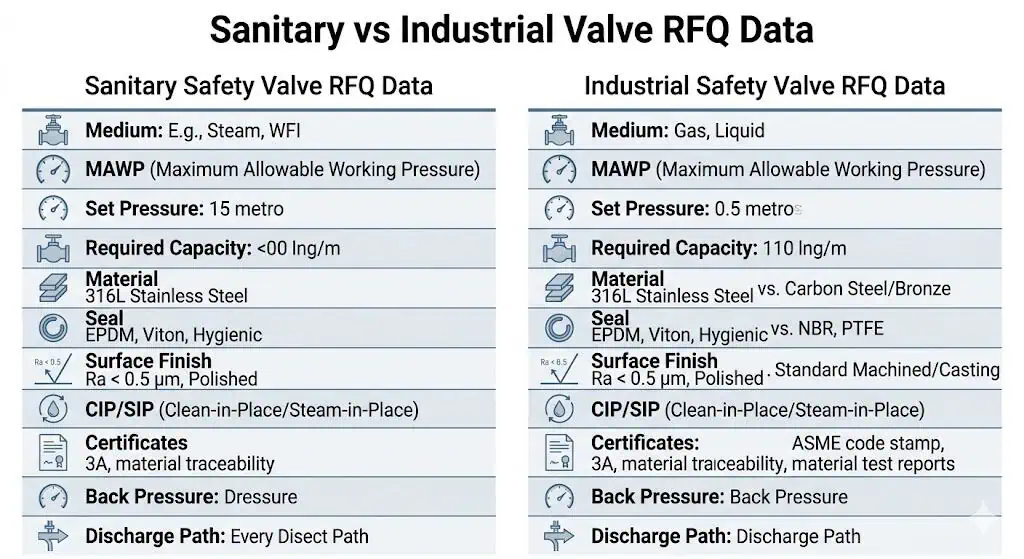
The RFQ must identify the common pressure-protection basis first and then state whether the application is sanitary, industrial or mixed. A quote based only on size, pressure class and material is preliminary and should not be released for purchase.
A complete RFQ identifies the common pressure-protection inputs and the additional hygienic or severe-service requirements.
Process and Pressure Data
protected equipment tag, type and applicable code;
MAWP, design pressure, design temperature and normal operating pressure;
set pressure, multiple-device arrangement and allowable overpressure or accumulation basis;
governing relief scenario and required relieving capacity with units and revision;
medium composition and relieving phase: steam, gas, liquid, flashing or two-phase;
operating and relieving temperature;
inlet piping, restrictions and expected pressure loss;
superimposed and built-up back pressure, outlet destination and simultaneous-relief case;
required valve construction or permission for supplier recommendation;
existing nameplate, lift, leakage and repair history for replacements.
Hygienic Design Data
product-contact, clean-utility or non-product-contact boundary;
CIP chemicals, concentration, temperature, time, flow route and frequency;
SIP or clean-steam pressure, temperature, hold time and cycle frequency;
connection standard, ferrule, gasket geometry and installed orientation;
product-contact material, heat traceability and required surface-finish measurement basis;
passivation or electropolishing scope;
drainability, dead-space and inspection-access requirements;
required ASME BPE, 3-A, EHEDG or owner specification and exact certificate scope.
Material and Seal Data
body, bonnet, nozzle, disc, guide, spindle and spring materials;
bellows, diaphragm, pilot, sensing line and exhaust materials where applicable;
product-contact metal grade and corrosion mechanism;
metal-seat or soft-seat requirement;
exact elastomer or polymer compound and batch evidence;
production medium, cleaning chemical, steam and temperature compatibility;
corrosion, erosion, galling, fouling, sour-service or particle concerns where applicable.
Testing and Certificate Package
approved valve datasheet and general arrangement drawing;
effective orifice, supported capacity and capacity basis;
nameplate and required code or certification marking;
pressure-boundary test report;
set-pressure calibration record and cold differential test basis where applicable;
seat-tightness report under the specified method;
metallic material and component traceability;
elastomer compound, batch and food-contact or pharmaceutical declarations where required;
surface-finish, passivation or electropolishing records where specified;
installation, cleaning, maintenance and spare-parts instructions;
repair, replaced-parts, recalibration and resealing records for repaired valves.
Supplier Questions Before Approval
Which valve construction is quoted and why is it suitable for the medium, operating margin and back pressure?
Does the supported capacity meet the approved required load under the stated pressure, temperature and fluid basis?
Which internal parts are product contact, and can the installed inlet and outlet be cleaned and drained?
What exact body, trim, seat, bellows, pilot and elastomer materials are supplied?
Do the certificates cover the exact model, size, options, materials and manufacturing entity?
What are the inlet-loss, back-pressure, orientation, discharge and maintenance limits?
Which requirements are included, excluded or offered as deviations?
After repair or adjustment, what recalibration, testing, tagging and sealing route will be used?
Procurement Approval Hold Points
Required relieving capacity or governing scenario is unknown.
Fluid phase, relieving temperature or back pressure is unresolved.
The proposed valve construction has no documented service basis.
Supported capacity, orifice or nameplate data conflicts with the quotation.
Hygienic certificate scope does not cover the quoted model, size, seal or manufacturing entity.
Material substitution, surface treatment or elastomer compound is unapproved.
Required tests, repair records or order-specific traceability are missing.
Project review CTA: Not sure whether your application needs a sanitary safety valve or an industrial safety valve?
Send us your medium, MAWP, set pressure, required capacity, product-contact condition, CIP/SIP cycle, connection type, material, seal, back pressure and certificate requirements for engineering review.
Final Selection Guidance
Choose the sanitary design when the pressure-relief device forms part of a controlled product-contact, clean-steam, CIP/SIP or aseptic boundary. Choose the industrial design when general or severe-duty pressure protection governs and hygienic cleanability is not required. For mixed service, specify both the hygienic and pressure-code requirements rather than forcing the application into one label.
Do not substitute one category for the other by visual similarity. Confirm the relief scenario, set pressure, overpressure and accumulation basis, required and supported capacity, valve construction, materials, back pressure, installation, cleaning, repair route and document scope before purchase.
Decision Question
Sanitary Direction
Industrial Direction
Is the valve within a controlled product-contact or clean-utility boundary?
Usually required
Use only after documented hygienic equivalence
Are CIP, SIP or validated cleaning requirements applicable?
Design and materials must support them
Not normally required unless specifically engineered
Is the service severe, dirty, very hot, highly corrosive or vibration-prone?
Use only when the sanitary design has a supported envelope
Often offers more construction and material options
Does the selected valve meet the relief load and installed conditions?
Engineering Review Note: This comparison supports preliminary selection, replacement and procurement review. Final approval should use the protected-equipment documents, approved relief calculation, supported capacity, manufacturer limits, hygienic specification, official standards, local jurisdiction and responsible engineer’s review.
FAQ About Sanitary vs Industrial Safety Valves
What is the difference between a sanitary safety valve and an industrial safety valve?
A sanitary safety valve must satisfy both pressure protection and hygienic product-contact requirements. An industrial safety valve is selected for general or severe-duty pressure service where hygienic cleanability is not required. Both still require set pressure, capacity, materials, back-pressure and installation review.
Can an industrial safety valve be used in sanitary service?
Only after documented pressure and hygienic equivalence is confirmed. Mechanical fit is insufficient; cleanability, drainability, product-contact materials, seals, capacity, back pressure, installation and certificate scope must all be acceptable.
Is a sanitary safety valve always better than an industrial safety valve?
No. A sanitary valve is appropriate for hygienic or clean-utility boundaries. An industrial valve may provide a wider pressure-temperature, material, capacity or severe-service envelope. The better valve is the one supported for the actual duty.
Does tri-clamp connection make a valve sanitary?
No. A tri-clamp or hygienic ferrule is only a connection interface. Internal geometry, gasket alignment, surface condition, drainability, cleaning coverage, materials and documentation determine hygienic suitability.
Can I replace a sanitary safety valve by matching the same connection size?
No. The replacement must also match the approved set pressure, required load, supported capacity, effective orifice, valve construction, medium, back pressure, materials, hygienic design and documents.
What documents should I request for a sanitary safety valve?
Request the approved datasheet and drawing, capacity evidence, nameplate data, pressure and set-pressure tests, seat-tightness report when specified, product-contact material traceability, elastomer evidence, surface-finish or treatment records, hygienic certificate scope, and installation, cleaning and maintenance instructions.
What documents should I request for an industrial safety valve?
Request the valve datasheet and drawing, supported capacity, nameplate and code-mark data, material certificates, pressure test, set-pressure calibration, seat-tightness report when specified, installation limits, and repair or resealing records where applicable.
What data should I provide for quotation?
Provide the equipment and code basis, MAWP, operating and set pressure, allowable overpressure or accumulation, relief scenario, required capacity, medium and phase, temperatures, inlet loss, back pressure, connections, valve construction, materials, cleaning conditions and required documents.
What is the difference between a safety valve and a relief valve in this comparison?
The terminology varies by standard and manufacturer. Safety valve is often associated with rapid opening in compressible service and relief valve with proportional liquid service, but the approved datasheet must define the medium, opening characteristic, construction and capacity basis.
What is the difference between set pressure and overpressure?
Set pressure is the specified opening condition. Overpressure is the pressure increase above set pressure while the valve is relieving and developing flow. Accumulation references the protected equipment pressure boundary, while blowdown describes the difference between opening and reseating.
How does back pressure affect sanitary and industrial safety valves?
Back pressure can affect force balance, lift, effective capacity, blowdown and reseating. Sanitary recovery lines and condensate-filled outlets require the same hydraulic review as industrial headers, silencers, flares and long discharge piping.
When should a pilot-operated valve be considered?
A pilot-operated valve may suit selected clean high-pressure gas, close operating margin or large-capacity service. It requires special caution where product, particles, condensate, crystallization, icing or cleaning residue can block the pilot, sensing or exhaust passages.
Why is certified relieving capacity more important than connection size?
Connection size only establishes the mechanical interface. Certified or supported capacity reflects the valve’s effective flow area and performance under stated pressure, medium and configuration conditions and must be compared with the required relieving load.
How often should these safety valves be inspected or recalibrated?
There is no universal interval. Use the applicable code and owner program, manufacturer instructions, service severity, CIP/SIP or fouling exposure, operating margin, lift history and previous as-found results to establish the interval.
What must be checked after a safety valve is repaired or its seal is replaced?
Record the as-found condition and replaced parts, inspect the seat, guide, spring, bellows or pilot components, verify materials and cleaning, repeat the required set-pressure and seat-tightness tests, then restore tagging and sealing before return to service.
Does a hygienic certificate prove pressure-relief performance?
No. Hygienic evidence may support materials, cleanability or design scope for a stated product. Set pressure, supported capacity, pressure testing, code marking, back-pressure limits and installed stability require separate evidence.
To provide the best experiences, we use technologies like cookies to store and/or access device information. Consenting to these technologies will allow us to process data such as browsing behavior or unique IDs on this site. Not consenting or withdrawing consent, may adversely affect certain features and functions.
Functional
Always active
The technical storage or access is strictly necessary for the legitimate purpose of enabling the use of a specific service explicitly requested by the subscriber or user, or for the sole purpose of carrying out the transmission of a communication over an electronic communications network.
Preferences
The technical storage or access is necessary for the legitimate purpose of storing preferences that are not requested by the subscriber or user.
Statistics
The technical storage or access that is used exclusively for statistical purposes.The technical storage or access that is used exclusively for anonymous statistical purposes. Without a subpoena, voluntary compliance on the part of your Internet Service Provider, or additional records from a third party, information stored or retrieved for this purpose alone cannot usually be used to identify you.
Marketing
The technical storage or access is required to create user profiles to send advertising, or to track the user on a website or across several websites for similar marketing purposes.