
PRV, PSV, safety valve, relief valve and safety relief valve are common pressure-protection terms, but none of them is a complete engineering specification. The same abbreviation can describe a different function in another industry, owner standard, region or document system, so the full device duty must be written out before selection or replacement. In many …

PRV, PSV, safety valve, relief valve and safety relief valve are common pressure-protection terms, but none of them is a complete engineering specification. The same abbreviation can describe a different function in another industry, owner standard, region or document system, so the full device duty must be written out before selection or replacement.
In many process plants, PSV is a tag abbreviation for a pressure safety valve or another approved pressure-relief device. PRV often means pressure relief valve, but in utility, HVAC, water and control documents it can also mean pressure reducing valve. “Safety valve,” “relief valve” and “safety relief valve” can describe different opening characteristics under a particular standard or manufacturer catalogue, yet normal plant language is not always consistent. The nameplate, relief calculation, datasheet, valve drawing and certificate package—not the abbreviation alone—must identify the actual device.
Engineering takeaway: Use the abbreviation only as a document identifier. Select and approve the valve from the protected equipment, governing relief scenario, medium and phase, set pressure, required relieving capacity, certified or manufacturer-supported capacity, valve construction, back pressure, materials, installation and required certification.
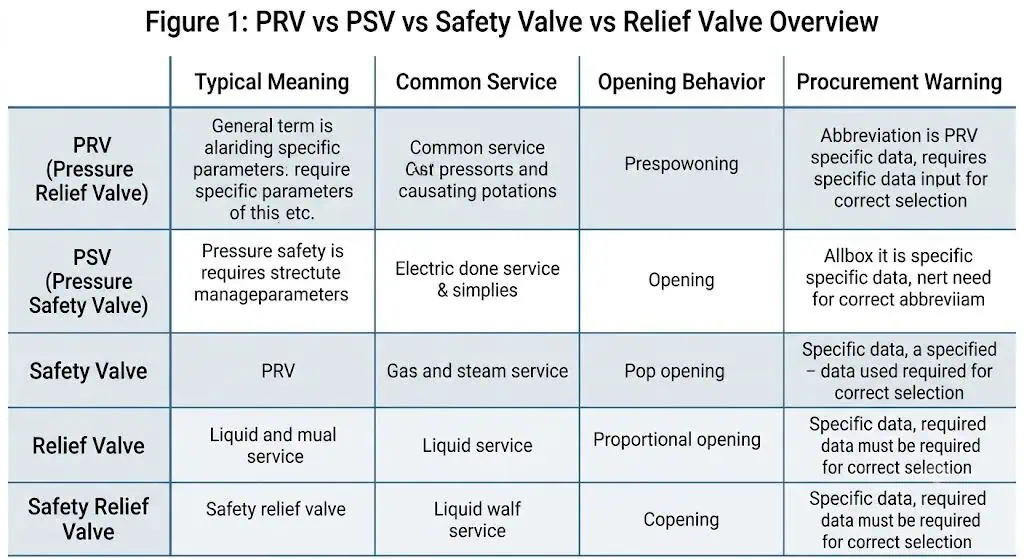
Quick Answer: PRV vs PSV vs Safety Valve vs Relief Valve
| Term | Common Use | What It Does Not Prove |
|---|---|---|
| PRV | Often pressure relief valve; may also mean pressure reducing valve | Relief function, opening behavior, capacity, code or valve design |
| PSV | Common process-plant tag for a pressure safety or pressure-relief device | Spring-loaded, bellows or pilot design; certified capacity; service suitability |
| Safety valve | Often associated with rapid-opening protection for compressible fluids | That the capacity, installation and certificate are correct for the project |
| Relief valve | Often associated with liquid, thermal-relief or proportional-opening duty | That it is unsuitable for all gas service or automatically accepted for vessel protection |
| Safety relief valve | Broad term used for devices suitable for specified gas, liquid or mixed duties | Fluid phase, opening characteristic, sizing method or certification scope |
| Pressure reducing valve | Regulates downstream pressure during normal operation | Independent overpressure protection |
PRV ambiguity: Never place “PRV” alone on an RFQ, replacement order or maintenance instruction when it could mean either a pressure relief valve or a pressure reducing valve. Write the full device function.
What the Abbreviation Does Not Define
| Engineering Item | Why the Term Alone Is Insufficient | Required Evidence |
|---|---|---|
| Set pressure | PRV or PSV does not identify the approved opening setting or code arrangement. | Protected-equipment basis, approved datasheet and calibration record. |
| Overpressure and accumulation | The abbreviation does not define the allowable emergency pressure boundary. | Applicable equipment code, relief scenario and engineering calculation. |
| Required relieving capacity | The tag does not state how much mass or volumetric flow must be discharged. | Approved relief-load calculation with units and revision. |
| Certified or documented capacity | The tag does not identify effective orifice, lift, coefficient or approved flow basis. | Manufacturer or certification data for the exact model and configuration. |
| Back-pressure capability | The same PSV tag can be attached to conventional, balanced or pilot-operated designs. | Outlet-pressure data, manufacturer limits and installed-system analysis. |
| Seat tightness | The term does not establish a leakage-test method or acceptance criterion. | Specified test standard and order-specific test record. |
Why PRV, PSV, Safety Valve and Relief Valve Are Confused
The terminology problem has several causes:
- different industries use different tag conventions;
- owner specifications may define abbreviations differently;
- regional and supplier language varies;
- legacy P&IDs may contain only a short tag description;
- PRV has two widely used meanings;
- commercial catalogues sometimes use broad terms for multiple valve designs;
- the operating characteristic and certification route may not be visible from the tag name.
The safest hierarchy is:
Protected equipment → relief scenario → required capacity → valve function → valve design → standards and documents → final tag description
The abbreviation should be the last communication layer, not the first engineering decision.
Document-control rule: A P&ID tag such as PSV-101 identifies a location and service. It should link to a controlled equipment list, relief calculation, approved datasheet, valve serial number, calibration record and maintenance history. Copying only the tag into a replacement order breaks that evidence chain.
What Does PRV Mean?
PRV as Pressure Relief Valve
In pressure-protection documents, PRV commonly means pressure relief valve. It may be used as a broad category for spring-loaded, balanced bellows, pilot-operated, thermal-relief or other pressure-relieving devices.
This broad use is convenient for discussion but too vague for final procurement. A “PRV” could protect:
- a gas vessel from blocked outlet;
- a liquid line from thermal expansion;
- a compressor receiver;
- a pump discharge line;
- a reactor connected to a flare header;
- a boiler or steam system under a specific code.
Those duties do not use the same sizing method, opening behavior, valve construction or discharge arrangement.
PRV as Pressure Reducing Valve
In water, steam distribution, HVAC, utilities and control applications, PRV may mean pressure reducing valve. This device controls downstream pressure during normal operation. It is fundamentally different from a pressure relief valve, which responds to an abnormal overpressure condition.
Pressure Relief Valve
Opens to discharge fluid when protected-system pressure reaches the specified condition.
Pressure Reducing Valve
Modulates during normal operation to maintain a lower downstream pressure.
Protection-layer warning: A pressure reducing valve can fail open or fail to control. The system may still require an independent pressure-relief device sized for the credible regulator-failure case.
For the basic device definition, see What Is a Pressure Relief Valve?.
Why a Pressure-Reducing Valve Is Not the Final Protection Layer
A pressure-reducing valve normally modulates to control downstream pressure. If it fails open, loses its sensing signal or cannot pass the required turndown, downstream equipment can be exposed to the upstream pressure source. The credible regulator-failure case may therefore require a separate pressure-relief device sized for the resulting inflow.
Do not solve this ambiguity by writing “PRV valve.” Write either pressure reducing valve or pressure relief valve, then state the protected equipment and function.
What Does PSV Mean?
PSV usually means pressure safety valve in oil, gas, refinery, petrochemical and other process-plant documentation. It is commonly used as the tag prefix for an automatic device that protects equipment from overpressure.
PSV is often a plant-language or project-language term. It does not by itself identify:
- conventional spring-loaded, balanced bellows or pilot-operated construction;
- gas, steam, liquid or two-phase service;
- orifice area or certified capacity;
- back-pressure limit;
- seat-tightness requirement;
- code marking or certificate scope;
- discharge to atmosphere, a closed header or a flare system.
A complete PSV schedule should connect every tag to a relief calculation, approved datasheet, valve model, capacity basis and inspection records.
PSV Is Usually a Tag Convention, Not a Construction Type
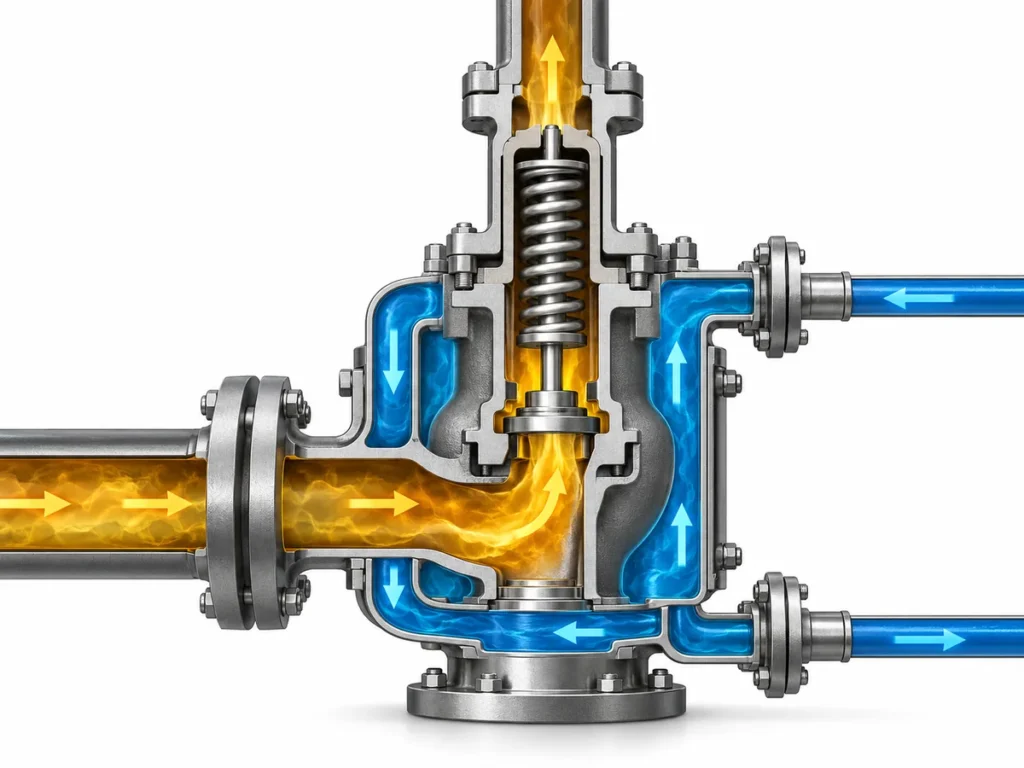
A PSV can be conventional spring-loaded, balanced bellows or pilot-operated. It can discharge to atmosphere, a closed recovery system or a flare header. The tag therefore does not prove the force-balance design, medium, certified capacity, back-pressure limit or seat construction.
During procurement, keep the plant tag but add the full description—for example, “PSV-101, balanced-bellows pressure safety valve for hydrocarbon vapor service”—and attach the approved datasheet.
What Is a Safety Valve?
In many engineering and manufacturer contexts, a safety valve is associated with a rapid-opening or pop-type response, especially for steam, air, gas and other compressible fluids. The exact definition and test characteristic must come from the applicable standard and valve design.
Typical applications include:
- steam boilers and steam equipment;
- compressed-air receivers;
- gas pressure vessels;
- clean steam and utility steam systems;
- process equipment requiring rapid pressure relief.
The term “safety valve” does not prove that the valve has enough relieving capacity. Set pressure, required capacity, certified capacity, fluid state, relieving conditions and installed piping still require verification.
For pressure terms, use Safety Valve Set Pressure, Overpressure, Accumulation and Blowdown.
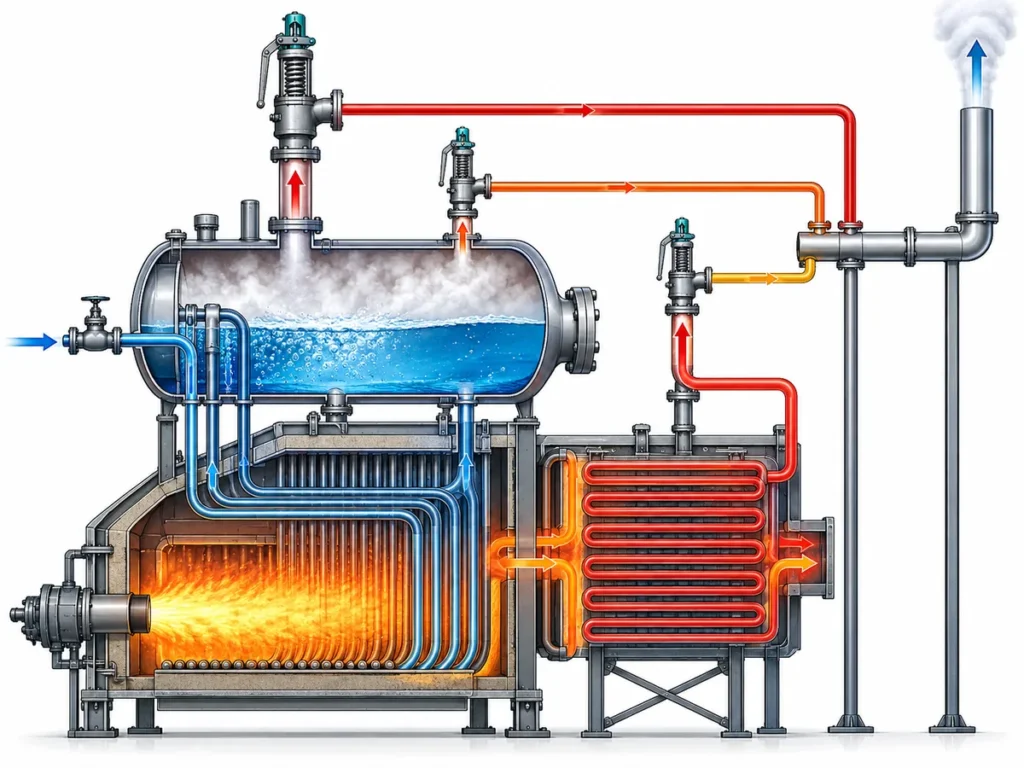
Steam and boiler boundary: When the valve protects a power boiler or other equipment governed by ASME BPVC Section I, use the terminology, capacity, marking and installation requirements of that code arrangement. A general process-plant PSV description is not a substitute for the boiler requirement.
What Is a Relief Valve?
A relief valve is often associated with liquid service, thermal expansion or an opening response that increases with pressure. This is a useful general distinction, but project and regional usage varies.
Typical liquid-related duties include:
- thermal expansion of blocked-in liquid;
- hydraulic systems;
- pump discharge protection;
- liquid vessels and process lines;
- selected bypass or recirculation duties.
Liquid service requires specific attention to density, viscosity, flashing, inlet loss, reaction force, outlet routing and stable operation. A small threaded thermal-relief valve and a high-capacity liquid pressure-relief valve should not be treated as equivalent devices.
Terminology boundary: “Relief valve” does not universally mean liquid-only, and “safety valve” does not universally mean gas-only. Use the applicable standard and manufacturer data for the actual definition.
Illustrative selection error — broad “relief valve” wording used for gas duty: A liquid-service proportional valve was proposed for a gas vessel because the legacy specification and supplier quotation both used the broad term “relief valve.” The problem was not the wording alone: the RFQ omitted the relieving phase, required opening characteristic, gas-capacity basis and applicable product standard. The proposal should be corrected by specifying compressible-fluid service, relieving temperature, required capacity, valve construction and manufacturer-supported gas or vapor performance.
Thermal Relief Is a Specific Liquid Duty
A thermal-relief valve usually protects blocked-in liquid from pressure rise caused by heat input or ambient warming. The required load may be small, but the discharge destination, liquid compatibility and possibility of flashing still require review. A thermal-relief valve should not be assumed suitable for a blocked-outlet pump case or a vapor emergency merely because the connection size matches.
What Is a Safety Relief Valve?
Safety relief valve is a broad combined term used for valves that may serve compressible or incompressible fluid duties when the specific design, certification and sizing basis support the application.
The term is useful when a product family covers multiple fluid services, but it should never replace the following information:
- medium and phase at the relieving condition;
- required relieving capacity;
- set and relieving pressure;
- opening characteristic;
- orifice and certified capacity;
- back pressure and discharge destination;
- materials and seat design;
- applicable code and documentation.
Two-phase warning: A valve called a safety relief valve is not automatically suitable for flashing or two-phase flow. Two-phase sizing and discharge-system behavior require qualified engineering and manufacturer review.
For mixed or uncertain phase behavior, identify the relieving phase from the scenario analysis. A valve selected from normal operating fluid description can be wrong if flashing, entrained liquid, foam or gas generation changes the actual relieving condition.
Terminology and Valve Design Are Different Selection Layers
PRV, PSV, safety valve and relief valve describe terminology or functional categories. Spring-loaded, balanced bellows and pilot-operated describe how the valve is constructed and controlled.
| Design | Operating Principle | Typical Selection Question |
|---|---|---|
| Conventional spring-loaded | Spring force acts directly against inlet-pressure force | Is the operating margin and back pressure acceptable? |
| Balanced bellows | Bellows reduces outlet-pressure influence on force balance | Are back pressure, bellows material, venting and failure mode acceptable? |
| Pilot-operated | Pilot and system pressure control the main valve | Is the medium clean, and are sensing and exhaust conditions suitable? |
| Thermal-relief design | Small valve relieves expansion of trapped liquid | What is the blocked-liquid case and safe discharge destination? |
A device tagged “PSV” may use any of the first three designs. Compare them in Spring-Loaded vs Pilot-Operated Safety Valves.
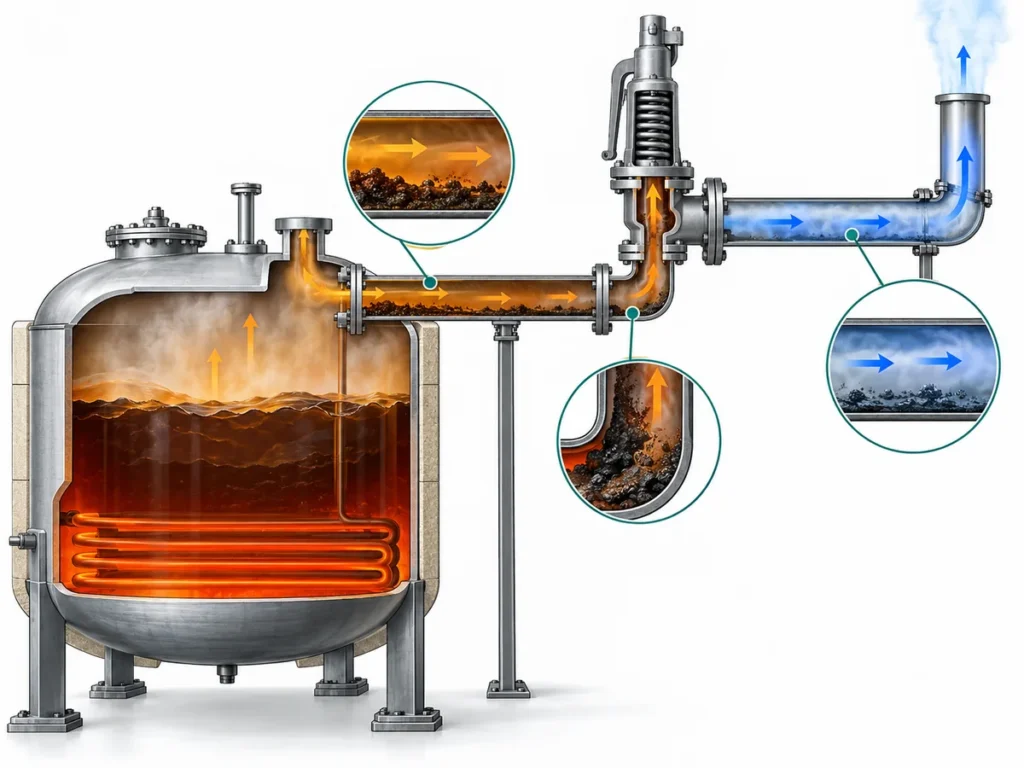
Illustrative design-selection error — pilot-operated PSV chosen from the tag name: A pilot-operated valve developed delayed and unstable action in wet, particle-laden gas service. The project treated “PSV” as proof of general suitability and did not review pilot passages, sensing-line condensate, filtration or exhaust routing. The corrective review should include cleaning and inspection of the pilot circuit, sensing-line drainage and a comparison with a direct spring-loaded design for the actual medium.
Spring-Loaded vs Pilot-Operated Selection Boundary
| Design | Potential Advantage | Important Limitation |
|---|---|---|
| Conventional spring-loaded | Direct mechanical action and relatively simple inspection. | Opening and reseating may be sensitive to superimposed or built-up back pressure. |
| Balanced bellows | Reduces specified outlet-pressure force effects. | Bellows material, fatigue, corrosion, bonnet venting and failure consequence remain critical. |
| Pilot-operated | Can provide tight shutoff and selected high-pressure or close-operating-margin performance. | Small passages, sensing lines, seals and exhaust paths can be affected by particles, condensate, polymerization, crystallization or icing. |
The correct choice depends on the medium, operating margin, required capacity, inlet dynamics, back pressure, environmental conditions and maintenance capability—not on whether the project calls the device a PRV or PSV.
PRV vs PSV vs Safety Valve vs Relief Valve Comparison
| Term | Common Meaning | Common Service Association | Opening Association | Primary Procurement Risk |
|---|---|---|---|---|
| PRV | Pressure relief valve; sometimes pressure reducing valve | Broad, depends on context | Depends on actual device | The abbreviation may identify the wrong function. |
| PSV | Pressure safety valve / plant pressure-relief device tag | Process vessels, gas, vapor, steam and other plant duties | Depends on selected valve design | Tag name is mistaken for a complete specification. |
| Safety valve | Automatic overpressure-protection valve | Often steam, air or compressible fluid | Often rapid or pop action | Capacity and application code are assumed rather than verified. |
| Relief valve | Automatic pressure-relieving valve | Often liquid or thermal expansion | Often proportional/modulating, depending on design | Liquid assumptions are incorrectly applied to gas or steam. |
| Safety relief valve | Combined pressure-relief term | Gas, liquid or specified mixed service | Design- and service-dependent | The broad name hides fluid-phase and certification limits. |
| Pressure reducing valve | Normal-operation pressure regulator | Steam, gas, water and utilities | Modulates to control downstream pressure | It is mistaken for the independent overpressure-protection device. |
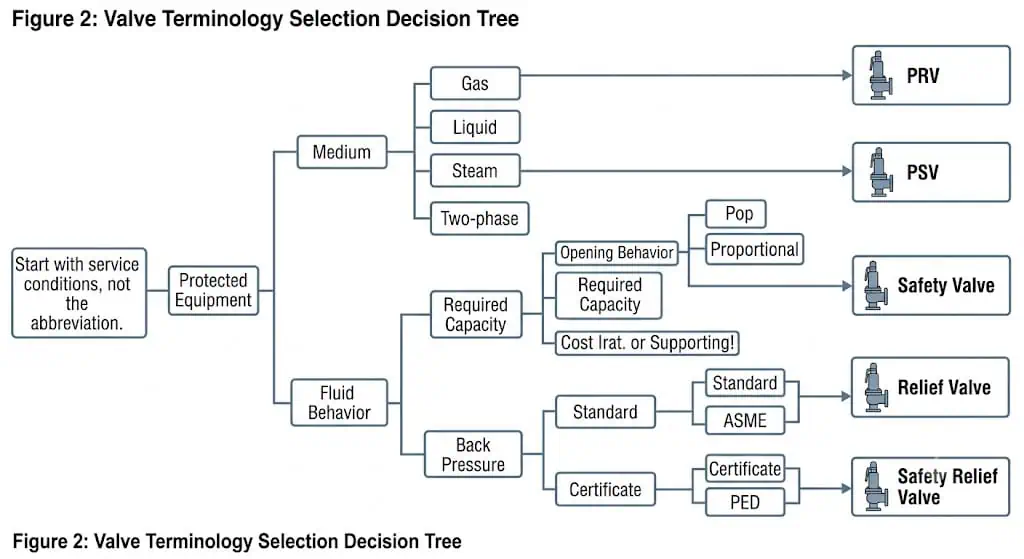
Pressure Terms That PRV and PSV Do Not Define
| Term | Engineering Meaning | Why It Matters |
|---|---|---|
| Operating pressure | Normal system pressure while the device should remain closed. | Insufficient margin can cause simmer, leakage or nuisance lifting. |
| Set pressure | The pressure associated with the specified opening characteristic under defined test conditions. | Determines when protective action begins; it does not prove capacity. |
| Overpressure | Pressure increase above set pressure during relief. | Influences lift and available relieving capacity. |
| Accumulation | Pressure increase above MAWP or another approved equipment pressure boundary. | Defines the protected-equipment pressure limit for the relief case. |
| Blowdown | Difference between set and reseating pressure. | Affects process recovery, cycling and stable closure. |
| Back pressure | Pressure existing or developing at the valve outlet. | Can change opening, lift, capacity and reseating depending on design. |
Materials and Seat Design Are Independent of the Abbreviation
Body material alone does not determine suitability. Review the nozzle, disc, guide, spindle, spring, bellows or pilot parts, seat and elastomers. Corrosion or deposits at the nozzle and disc can cause leakage; galling or contamination at the guide can restrict motion; spring corrosion or temperature exposure can shift the set condition; and incompatible soft seats can swell, harden or lose recovery.
How to Review a PRV or PSV Replacement
A replacement should not be approved only because the new valve has the same tag, inlet size, outlet size and set pressure.
Minimum Replacement Checks
Protected equipment and governing relief scenario
MAWP or approved equipment pressure basis
Required relieving capacity and calculation revision
Fluid phase and relieving temperature
Set pressure and operating margin
Orifice designation or effective flow area
Manufacturer-certified capacity
Conventional, bellows or pilot design
Superimposed and built-up back pressure
Body, trim, spring, bellows, seat and seals
Inlet/outlet connections and installation envelope
Code marking, certificates and test reports
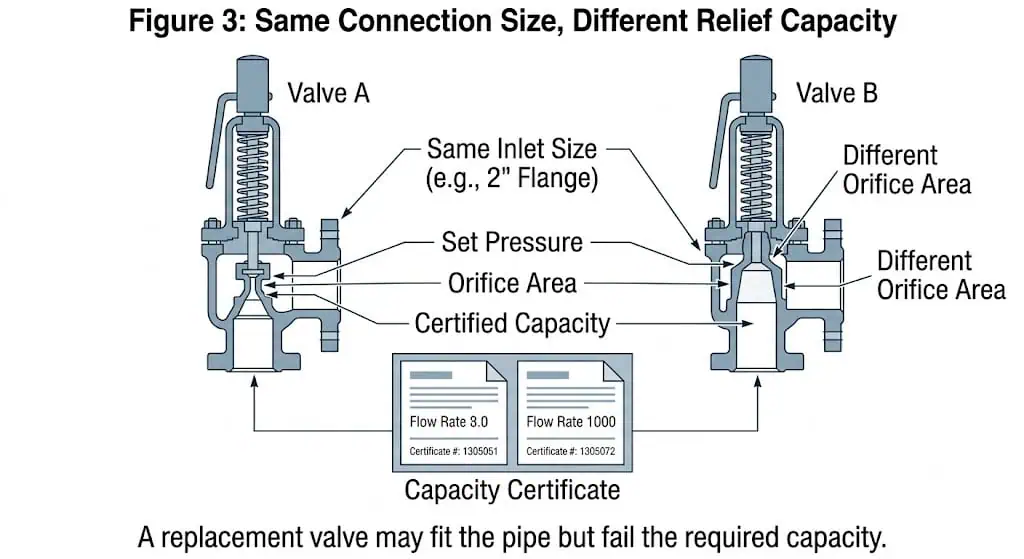
Use the Safety Valve Sizing and Certified Capacity Guide for capacity review and the Safety Valve Procurement Checklist for bid and document review.
Replacement Evidence Hierarchy
| Evidence | What It Supports | What It Cannot Prove Alone |
|---|---|---|
| Old tag or nameplate | Identification and historical setting information. | Current relief load, internal condition or continued suitability. |
| Same connection size | Potential mechanical fit. | Effective orifice, certified capacity or installed stability. |
| Set-pressure certificate | Opening adjustment under stated test conditions. | Required capacity, field back pressure or correct relief scenario. |
| Capacity certificate or manufacturer data | Supported flow performance for a defined configuration. | That the project relief calculation is correct or current. |
| Material certificate | Traceability of listed metallic components. | Seat tightness, calibration or corrosion suitability for every service condition. |
Repair, Recalibration and Resealing
A replacement review should include the repair route for the removed valve. Seat machining, spring replacement, blowdown-ring adjustment, bellows replacement, pilot work or changes to internal parts can affect opening, blowdown, capacity evidence and leakage. Record the as-found condition, identify installed parts, recalibrate under the approved procedure, perform required pressure and seat-tightness tests, restore tags and seals, and link the final records to the serial number.
Where the jurisdiction, owner or code route requires National Board authorization, confirm whether repair must be performed under a valid VR program. VR authorization addresses pressure-relief-valve repair control; it does not replace the engineering review of the relief scenario or installed piping.
How to Choose the Correct Term for a Project
- Write the full device function.
State pressure relief valve, pressure reducing valve, safety valve, thermal relief valve or another precise description. - Identify the protected equipment.
Vessel, boiler, piping, compressor, pump, heat exchanger, reactor or skid. - State the relief scenario.
Blocked outlet, fire, regulator failure, thermal expansion or another approved case. - State the medium and phase.
Steam, gas, vapor, liquid, flashing or two-phase. - State the required capacity.
Include units, relieving pressure, temperature and calculation revision. - Define the valve construction.
Conventional, balanced bellows, pilot-operated, thermal-relief or project-approved alternative. - Define the discharge system.
Atmosphere, safe drain, recovery line, common header or flare. - Define standards and documents.
Code basis, capacity evidence, calibration, leakage, materials and installation records.
Recommended tag description: Keep the plant tag such as PSV-101, but write a complete equipment description and datasheet behind it. The tag supports identification; the datasheet supports engineering.
Approval Hold Points
Full function written without abbreviation ambiguity
Relief calculation and revision approved
Required capacity compared with supported valve capacity
Set pressure checked against MAWP and code arrangement
Fluid phase and relieving temperature confirmed
Back-pressure basis and valve construction accepted
Materials and seat design reviewed
Installation drawing and discharge destination approved
Test and certificate package defined before manufacture
Final nameplate, serial number and documents matched
Illustrative Terminology and Procurement Errors
The two short examples above show how terminology can distort fluid-service and valve-design decisions. The three cases below focus on the errors that are most useful during equipment-list review, replacement approval and discharge-system modification.
How to use these examples: Each case follows the same engineering logic—identify the problem, determine why the terminology or procurement process failed, and define the corrective action required before technical approval. These are fictional training scenarios, not project records or design calculations.
Fictional training example — not project data
Case 1: PRV Meant Two Different Devices
Problem: A utility equipment list used “PRV” without a full description. Purchasing requested a pressure reducing valve, while the vessel engineer intended a pressure relief valve for independent overpressure protection.
Cause: The abbreviation was treated as a complete equipment description. The list did not identify the protected equipment, relief function, set pressure or required relieving capacity.
Correction / prevention: Revise the equipment list, P&ID note and RFQ to state the full device function. Include the protected equipment, tag number, set pressure, governing relief scenario and required capacity so that a regulating valve cannot be confused with a safety device.
Fictional training example — not project data
Case 2: Same PSV Tag, Smaller Capacity
Problem: A replacement valve matched the old PSV tag, flange sizes and set pressure, but its internal flow area and supported relieving capacity were lower than those of the original valve.
Cause: The replacement review focused on mechanical interchangeability and nameplate pressure. The approved relief calculation, orifice designation, certified capacity and back-pressure basis were not compared.
Correction / prevention: Review the replacement against the current governing relief case, required relieving capacity, effective orifice, manufacturer-certified or documented capacity, relieving conditions and back pressure. The tag and connection dimensions should support identification and installation, not determine hydraulic equivalence.
Fictional training example — not project data
Case 3: Same PSV Tag After a Discharge-Header Modification
Problem: The existing PSV passed its bench set-pressure test but chattered after its outlet was connected to a longer common discharge header.
Cause: The modification review retained the same PSV tag and valve model but did not recalculate built-up back pressure, simultaneous relief flow, outlet-line resistance or the effect on valve stability and reseating.
Correction / prevention: Reanalyse the complete outlet system, verify the manufacturer’s allowable back-pressure basis, inspect the disc, seat and guide for chatter damage, and evaluate piping changes, a balanced construction or another valve design before return to service. Any discharge-header modification should trigger a pressure-relief-system review.
Common lesson: A tag or product name identifies the device only at a superficial level. Approval should depend on the full function, protected equipment, relief scenario, medium and phase, set pressure, required and supported capacity, valve construction, back pressure, materials, installation and document scope.
RFQ Checklist When You Are Not Sure Which Term to Use
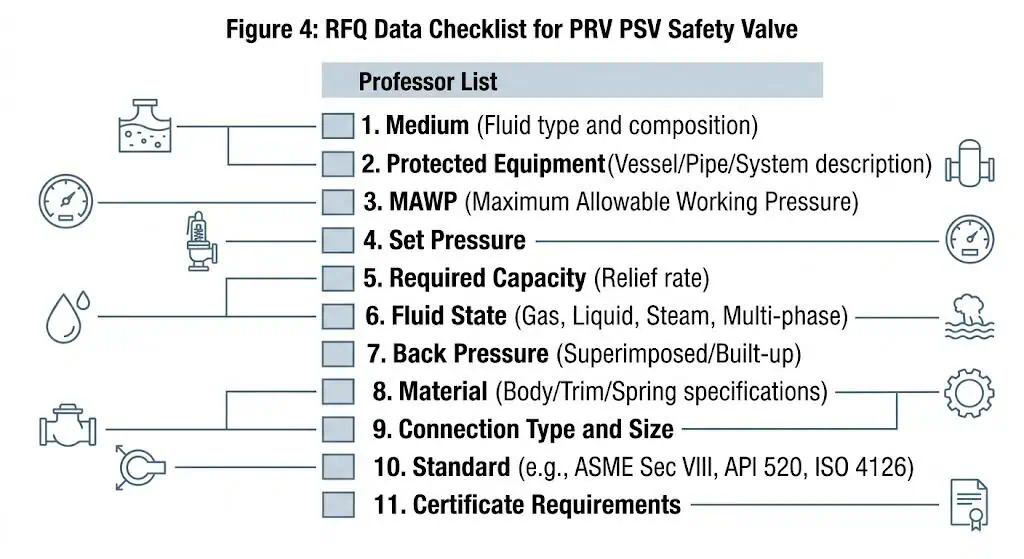
| RFQ Data | Why It Matters |
|---|---|
| Protected equipment and tag | Defines the protected pressure boundary and project identity. |
| Full device function | Eliminates PRV pressure-relief versus pressure-reducing ambiguity. |
| MAWP / design pressure | Supports set-pressure and equipment-code review. |
| Operating and set pressure | Supports operating-margin and calibration review. |
| Relief scenario | Defines why the device must relieve. |
| Medium and phase | Controls sizing, valve behavior and materials. |
| Required relieving capacity | Defines the minimum hydraulic performance. |
| Relieving pressure and temperature | Supports certified-capacity and material verification. |
| Back pressure and discharge destination | Controls valve design, stability and outlet review. |
| Valve construction | Conventional, bellows, pilot or another required design. |
| Materials and seat | Controls corrosion, leakage and temperature suitability. |
| Standards and documents | Defines certification, testing, inspection and project acceptance. |
| Overpressure / accumulation basis | Defines the allowed emergency pressure boundary and capacity condition. |
| Blowdown or reseating requirement | Supports stable closure and process recovery. |
| Inlet pressure loss | Supports chatter and stability review during flow. |
| Seat-tightness requirement | Defines the test method and acceptance criterion. |
| Repair / recertification route | Defines authorized repair, recalibration, sealing and document requirements. |
Unsure Whether the RFQ Should Say PRV or PSV?
Send the equipment, medium, relief scenario, set pressure, required capacity, relieving temperature, back pressure and document requirements. The engineering data matter more than the abbreviation.
Upload Project Data Request a Pressure Relief Valve Quote
Quotation rule: When terminology is unclear, do not ask the supplier to “choose PRV or PSV” from a connection size. Send the engineering data and require the quotation to state all assumptions, deviations, exclusions and the exact capacity basis.
Common Engineering and Procurement Mistakes
Using PRV Without the Full Name
The buyer cannot tell whether the device relieves or reduces pressure.
Treating PSV as a Valve Design
The tag does not identify conventional, bellows or pilot construction.
Replacing by Pipe Size
The valve may fit but have the wrong orifice and capacity.
Assuming Safety Valve Means Gas Capacity Is Verified
The product name does not replace sizing and certification.
Assuming Relief Valve Means Liquid-Only
Terminology varies; the actual service must be stated.
Ignoring Back Pressure
A flare or common header can change lift, capacity and reseating.
Copying a Legacy Tag
The original relief scenario and certificate may no longer be available.
Requesting “API/ASME Valve” Generically
The exact standard, marking, scope and document route remain unclear.
Raising Set Pressure to Stop Leakage
This can hide seat or operating-margin problems while reducing the intended equipment protection.
Assuming a Certificate Covers Every Model
Certification and hygienic or code claims must match the legal manufacturer, model, size, material and configuration.
Ignoring Repair Traceability
Internal work without recalibration, final sealing and serial-linked records breaks the pressure-protection evidence chain.
Using a Pilot Valve in Dirty Service Without Review
Particles, condensate or polymerizing fluid can impair sensing and pilot passages.
Standards and Authoritative References
The references below address different layers of overpressure protection. ASME equipment sections and Section XIII establish code context; API 520 and 521 cover defined refinery and process-industry applications; ISO 4126 provides product requirements; API 527 addresses seat tightness; and NBIC or VR may control repair. Use the edition and route required by the project rather than combining the names into a generic “API/ASME valve” claim.
| Reference | Role | Official / Supporting Link |
|---|---|---|
| ASME BPVC Section XIII | Overpressure-protection rules and pressure-relief-device requirements within the ASME framework | ASME official page |
| ASME BPVC Section I | Construction rules for power boilers and the associated boiler pressure-relief context | ASME official page |
| ASME BPVC Section VIII, Division 1 | Pressure-vessel construction context and applicable overpressure-protection requirements | ASME official page |
| API 520 Part I | Sizing and selection of pressure-relieving devices in covered refinery and process-industry applications | API official page |
| API 520 Part II | Installation and engineering analysis of pressure-relieving-device installations | API official page |
| API 521 | Pressure-relieving and depressuring-system design, including disposal and flare-system context | API official page |
| API 527 | Seat-tightness testing; not sizing, relief-scenario definition or installation validation | ZOBAI API 527 Guide |
| API RP 576 | Inspection and repair practices for pressure-relieving devices in applicable process-industry services | API official page |
| ISO 4126-1 | General product requirements for safety valves irrespective of fluid | ISO official page |
| ISO 4126-4 | General product requirements for pilot-operated safety valves | ISO official page |
| NBIC / National Board VR | Installation, inspection and authorized repair framework where required by the jurisdiction or owner | National Board official page |
| ZOBAI Standards Hub | Procurement-oriented navigation for ASME, API, ISO, NBIC and related pages | Safety Valve Standards |
Standards boundary: The presence of “PRV,” “PSV,” “API,” “ASME” or “ISO” in a description does not prove certification. Verify the legal manufacturer, model, size, material, standard edition, marking and document scope.
FAQ About PRV, PSV, Safety Valves and Relief Valves
Is PRV the same as PSV?
Not necessarily. PRV commonly means pressure relief valve, while PSV commonly means pressure safety valve or a process-plant pressure-relief tag. PRV may also mean pressure reducing valve in some systems.
What does PRV mean?
It often means pressure relief valve, but the drawing, equipment list or specification must confirm whether it instead means pressure reducing valve.
What does PSV mean?
PSV usually means pressure safety valve in process-plant terminology. It does not identify the valve construction, capacity or certification by itself.
What is the difference between a safety valve and a relief valve?
A safety valve is often associated with rapid opening for compressible fluids, while a relief valve is often associated with liquid or proportional-opening service. Exact definitions depend on the applicable standard and design.
What is a safety relief valve?
It is a broad combined term for a pressure-relieving valve that may be approved for specified gas, liquid or mixed duties. The service and capacity basis must be stated.
Is a pressure reducing valve a safety valve?
No. A pressure reducing valve regulates downstream pressure during normal operation. A separate pressure-relief device may be required to protect against regulator failure or another overpressure case.
Can a PSV be replaced with a PRV?
Only after the full functions and engineering data are compared. The replacement must satisfy the relief scenario, capacity, set pressure, medium, design, back pressure, materials, installation and documentation.
Does the connection size determine pressure-relief capacity?
No. Capacity depends on the effective flow area, lift, set and relieving pressure, fluid, temperature, back pressure and manufacturer-certified data.
Which standard applies to a PRV or PSV?
It depends on the protected equipment, industry, jurisdiction and service. ASME BPVC, API 520/521, ISO 4126, NBIC and owner specifications may address different parts of the system.
What should I send a supplier when the terminology is unclear?
Send the protected equipment, relief scenario, MAWP, operating and set pressure, medium and phase, required capacity, relieving temperature, back pressure, valve design, materials, connections and required documents.
What is the difference between set pressure and overpressure?
Set pressure is the pressure associated with the specified opening characteristic under defined test conditions. Overpressure is the pressure increase above set pressure during relief and helps develop lift and capacity.
What is the difference between overpressure and accumulation?
Overpressure is referenced to valve set pressure. Accumulation is referenced to the protected equipment MAWP or another approved pressure boundary. The applicable code and relief case define the permitted values.
How does back pressure affect a PRV or PSV?
Back pressure can affect opening, lift, effective capacity, blowdown and reseating. The effect depends on whether the valve is conventional, balanced bellows or pilot-operated and whether the pressure is superimposed or built up during flow.
Why is certified relieving capacity more important than connection size?
Connection size indicates the mechanical interface. Capacity depends on effective flow area, lift, pressure, fluid, temperature, back pressure and the supported performance of the exact valve configuration.
When should a pilot-operated safety valve be considered?
It may be considered for selected clean-fluid, high-pressure, high-capacity or close-operating-margin duties. Pilot passages, sensing lines, condensate, particles, icing, polymerization and exhaust routing must be reviewed.
What materials should be checked on a PRV or PSV?
Check the body, nozzle, disc, guide, spindle, spring, bellows or pilot components, seat and seals. Material compatibility affects corrosion, galling, sticking, leakage, set-pressure stability and service life.
How often should a PRV or PSV be inspected or recalibrated?
There is no universal interval for every service. Use the applicable code and owner program, service severity, lift history, corrosion or fouling risk, previous as-found results and manufacturer instructions.
What must be verified after a PRV or PSV is repaired?
Record the as-found condition, verify replacement parts, inspect critical internals, recalibrate the set pressure, perform required pressure and seat-tightness tests, restore tags and seals, and link the records to the valve serial number.
Use the Full Function, Not Only the Abbreviation
Send the protected equipment, relief scenario, medium, set pressure, required capacity, relieving temperature, back pressure and certificate requirements. ZOBAI can review the correct valve description and quotation basis.
Upload PRV / PSV Data Request a Pressure Relief Valve Quote

Comments
Kesari Alloys
The point about the ambiguity surrounding the term PRV, especially its dual meaning as both pressure relief and pressure reducing valve in different contexts, is a crucial reminder for engineers. This confusion can lead to significant safety oversights. It would be helpful to elaborate on best practices for distinguishing between these two types in procurement documentation, especially in complex projects where both terms might appear.