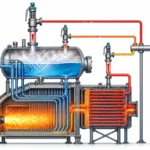
Engineering Comparison Guide A metal seat is generally reviewed where temperature, thermal cycling, severe service, or resilient-material compatibility may limit a soft seal. A soft seat may be considered where lower normal-operation leakage is required and the exact medium, pressure, temperature, cleanliness, cycling frequency, and valve design are compatible. Neither seat type is universally better. …

Engineering Comparison Guide
A metal seat is generally reviewed where temperature, thermal cycling, severe service, or resilient-material compatibility may limit a soft seal. A soft seat may be considered where lower normal-operation leakage is required and the exact medium, pressure, temperature, cleanliness, cycling frequency, and valve design are compatible. Neither seat type is universally better.
Do not select by leakage preference aloneSeat type cannot correct an unsuitable set pressure, unstable process, capacity shortfall, inlet loss, or excessive back pressure.
Confirm the complete service envelopeMedium, phase, operating and relieving temperatures, contamination, pressure conditions, and test requirements all affect the decision.
Verify the exact valve configurationAvailability and limits are model-specific and must be checked against current manufacturer data and project requirements.
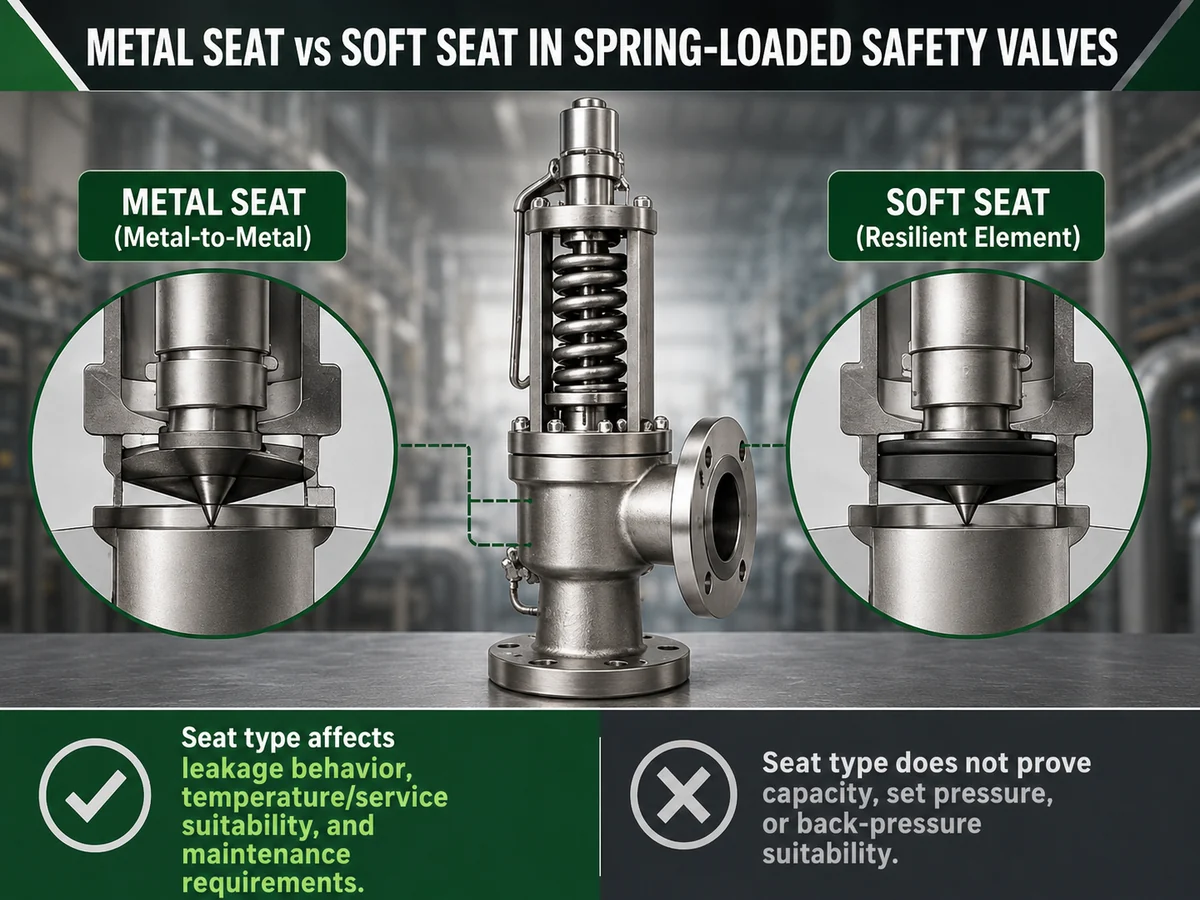
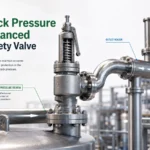
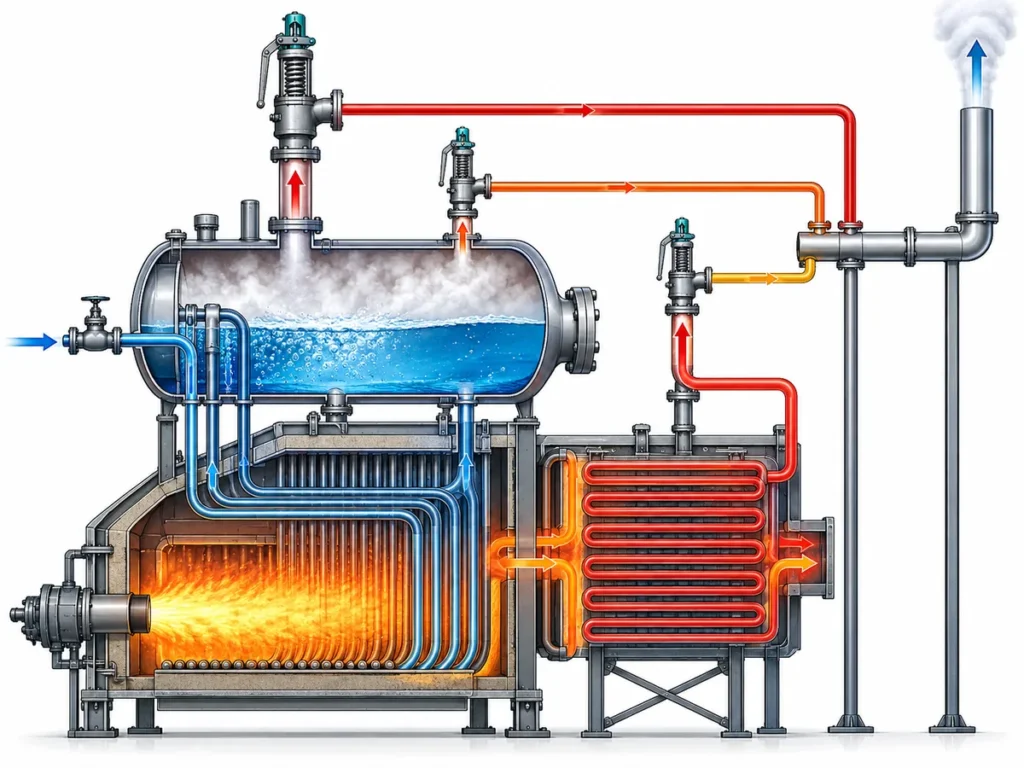
Conceptual visualization for engineering explanation; not a certified product cross-section or model-specific configuration.
Metal Seat or Soft Seat: The Quick Engineering Answer
Review a metal-seat design first when the relieving temperature, thermal cycling, chemical exposure, or project requirements may restrict resilient materials. Review a soft-seat design when lower normal-operation leakage is important and the exact sealing material is compatible with the medium, temperature, pressure, decompression behavior, contamination level, and expected cycling. Particle-containing service is design-specific: small or light particles may affect metal-to-metal seating, while hard or sharp particles may cut, indent, or extrude a soft element. Do not default to either seat type without confirming the particle characteristics and the manufacturer-approved seat construction.
The seat is only one part of the spring loaded safety valve. It does not determine required relieving capacity, correct set pressure, allowable inlet pressure loss, back-pressure suitability, or the acceptability of the complete valve. Final selection depends on actual operating conditions, the governing relief scenario, manufacturer data for the selected configuration, the applicable standard version, project specifications, and local regulatory requirements.
Selection Boundary: What Seat Type Can and Cannot Decide
Seat type is a configuration decision inside the complete pressure-relief device specification. It can materially affect leakage behavior, service compatibility, maintenance method, spare-part control, and the test procedure. It cannot establish whether the valve protects the governing relief case. For the separate capacity and orifice decision, use the safety valve sizing and certified capacity guide.
| Seat Choice Can Influence | Seat Choice Does Not Establish | Separate Evidence Required |
|---|---|---|
| Leakage behavior under a defined seat-tightness test | Required relieving capacity | Relief-load calculation, selected orifice, and manufacturer-certified or documented capacity |
| Response to temperature, chemicals, contamination, decompression, and cycling | Correct set pressure in relation to MAWP or design pressure | Equipment design basis, code review, approved datasheet, and model-specific seat construction |
| Likely damage mechanisms and maintenance approach | Allowable overpressure or accumulation | Applicable code, governing scenario, and system calculation |
| Spare-part, storage, traceability, and repair requirements | Acceptable inlet pressure loss or outlet back pressure | Piping calculation, installation review, and valve configuration data |
| Seat-tightness test method and acceptance documentation | Suitability of the complete valve for steam, gas, liquid, or two-phase service | Exact model data, medium properties, relieving conditions, and project specification |
Stop the preliminary seat decision and request model-specific review when the selected series does not clearly list the proposed seat option, the relieving condition approaches a material limit, the fluid is two-phase, dirty, polymerizing, crystallizing, corrosive, or decompression-sensitive, the process pressure is unstable or close to set pressure, or a replacement changes the internal configuration or documented capacity basis.
What Is the Difference Between a Metal Seat and a Soft Seat?
In a direct spring-loaded safety valve, the spring applies closing force through the spindle and disc assembly. Process pressure acts beneath the disc through the nozzle or seat area. During normal operation, the seating interface remains closed. As the defined opening condition is reached, the pressure force overcomes the effective closing force and the disc begins to lift.
The terms metal seat and soft seat describe the sealing interface between the disc assembly and the nozzle or seat. They do not describe the entire valve body, trim, bonnet, spring, pressure rating, or certified or documented relieving capacity. For a broader explanation of the opening mechanism, see how a spring loaded safety valve works.
Metal-to-Metal Seating Interface
A metal-seat design uses accurately finished metallic sealing surfaces on the disc and nozzle or seat. Tightness depends on geometry, alignment, surface condition, contact loading, material condition, cleanliness, and correct assembly.
Metal seats may be reviewed where resilient materials are restricted by temperature, chemical exposure, thermal cycling, or the selected valve design. They can still leak if particles are trapped across the sealing line, the surfaces are scratched or eroded, deposits prevent full contact, or guiding and alignment deteriorate.
Resilient Soft-Seat Interface
A soft-seat design introduces a resilient sealing element into a manufacturer-specific disc or insert assembly. Depending on the series, the construction may use an O-ring, insert, sealing plate, or another controlled arrangement.
The resilient element may conform to small surface irregularities and support lower leakage under suitable conditions. Its performance still depends on the actual compound, pressure, temperature, fluid exposure, surface design, loading, assembly, and defined test basis.
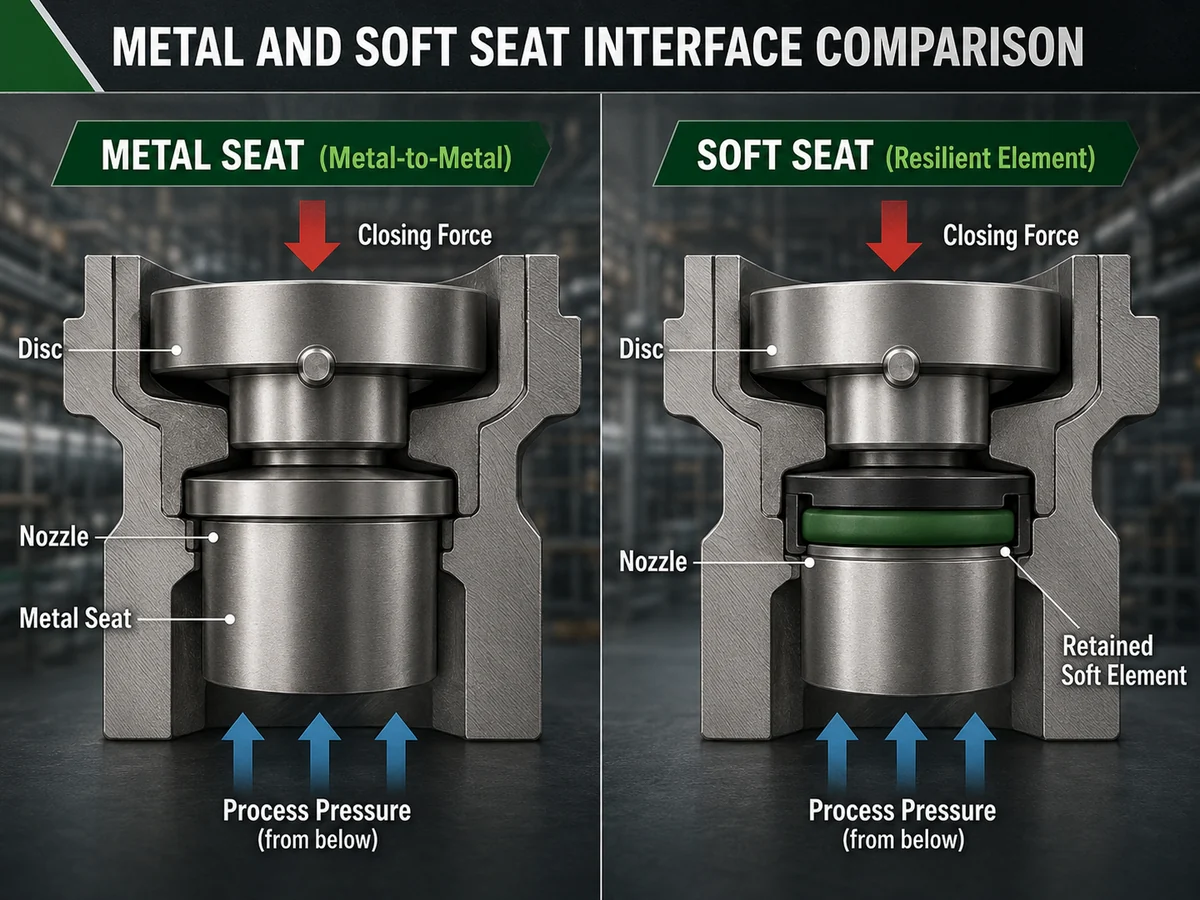
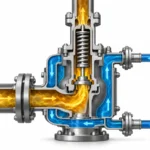
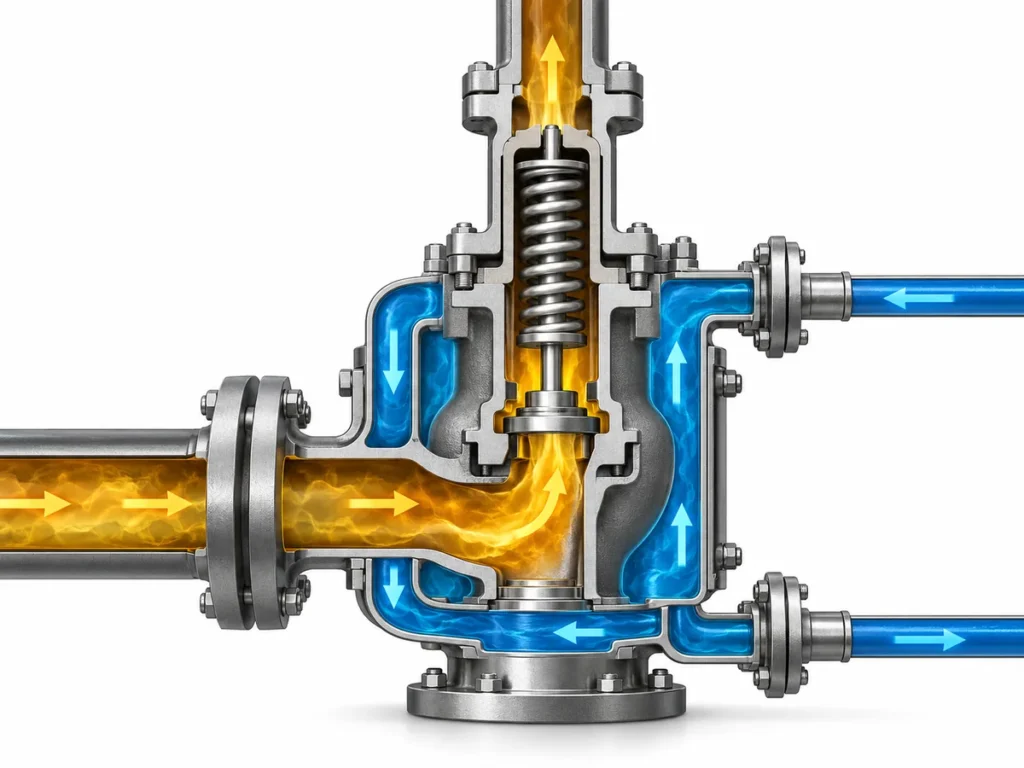
Simplified engineering illustration; the exact disc, nozzle and soft-seat construction varies by valve series.
Do not confuse seat type with overall material selection. A stainless-steel body does not prove that a valve has a metal seat, and a soft-seat valve still includes metallic pressure-retaining, guiding, spring, and flow-control components.
Metal Seat vs Soft Seat: Engineering Comparison
The table below is a preliminary screening tool. It is not an approval for a specific model, medium, pressure, temperature, or jurisdiction.
| Criterion | Metal Seat | Soft Seat | What Must Be Confirmed |
|---|---|---|---|
| Sealing interface | Finished metal-to-metal contact | Resilient element within a manufacturer-specific assembly | Exact disc, nozzle, retention, and sealing construction |
| Normal-operation leakage | May permit a defined measurable leakage rate under the applicable test basis | May support lower leakage in compatible service | Test medium, pressure, acceptance criterion, and actual service conditions |
| Temperature | Often reviewed where resilient materials are restricted | Governed partly by the exact compound and complete assembly | Normal and governing relieving temperatures |
| Chemical compatibility | Depends on alloy, corrosion, deposits, and surface condition | Depends strongly on the exact sealing material and exposure | Full fluid composition, concentration, impurities, and cleaning media |
| Particles and contamination | Particles can scratch the seat or prevent full reseating | Particles can cut, indent, or displace the resilient element | Particle size, hardness, source, and frequency |
| Thermal cycling | May offer a broader review range in an approved design | Repeated exposure can age or distort the seal | Cycle frequency, peak temperature, and dwell time |
| Pressure capability | Model- and construction-specific | The resilient element or retention system may govern limits | Set pressure, back pressure, configuration, and manufacturer rating |
| Maintenance | May require approved inspection, lapping, machining, or replacement | Requires the correct controlled replacement part and procedure | Authorized repair limits, traceable spares, recalibration, and testing |
| Typical damage | Scratching, erosion, corrosion, deposits, distortion, or loss of finish | Cutting, extrusion, swelling, hardening, permanent set, or chemical attack | Inspection evidence and complete service history |
| Main caution | “Metal” does not mean immune to leakage or contamination | “Soft” does not mean unconditional zero leakage | Complete valve and service review |
How Operating Pressure and Set Pressure Affect Seat Leakage
Seat leakage cannot be evaluated without understanding the pressure relationship around the valve. The normal operating pressure should remain sufficiently below set pressure for the selected valve, service, code, and project requirements. As operating pressure approaches the set-pressure region, the effective closing margin becomes smaller, and pressure pulsation, vibration, or process instability can increase the risk of simmer or leakage.
There is no universal operating-margin percentage that applies to every valve. The appropriate margin depends on the design, medium, service behavior, set-pressure tolerance, blowdown, project requirements, and current manufacturer guidance. A soft seat must not be used as a shortcut for operating a system closer to set pressure than the approved configuration allows.
| Term | Meaning Here | What It Does Not Mean |
|---|---|---|
| Operating pressure | Pressure normally present during process operation | The pressure at which the valve is intended to open |
| MAWP or design pressure | The equipment pressure basis defined by the applicable design rules | Automatically the same as set pressure |
| Set pressure | The defined pressure condition at which specified opening action begins | Required or documented relieving capacity |
| Reseating pressure | The pressure at which the valve closes after a relieving event | Normal operating pressure |
| Blowdown | The difference between set pressure and reseating pressure under the applicable convention | Seat-tightness leakage |
| Seat-tightness test pressure | The pressure used during the specified leakage test | A guarantee of all future in-service behavior |
Pressure stability matters. Repeated simmering, flutter, or chatter can damage either seat type. Before changing seat material, review pressure history, pulsation, inlet loss, back pressure, discharge piping, valve orientation, piping strain, contamination, and the condition of the guide, spindle, spring, and previous repairs.
Temperature, Pressure, and Media Compatibility
The seat decision should be based on the most demanding relevant condition, not only ambient temperature or the common name of the process fluid. The normal operating temperature may differ substantially from the relieving temperature under fire exposure, blocked outlet, exchanger tube rupture, compressor upset, steam generation, thermal expansion, or another governing scenario.
Relieving Temperature
For a soft seat, the exact material and its retained mechanical properties at the relieving condition must be reviewed. For a metal seat, alloy, hardness, corrosion behavior, thermal distortion, and surface condition still matter. A generic polymer or alloy property chart is not sufficient to approve the complete valve.
Chemical Compatibility
A resilient material may swell, shrink, harden, soften, crack, or lose elasticity after exposure to an incompatible medium. Compatibility can change with concentration, temperature, pressure, impurities, cleaning chemicals, or intermittent exposure. For broader component-by-component screening, use the safety valve material selection guide.
Particles and Deposits
Rust, pipe scale, catalyst, welding debris, crystallized product, or polymer deposits can scratch a metal surface, prevent full metal contact, cut or indent a soft element, or hold either seat open. The decision is design-specific: particle size, hardness, concentration, shape, velocity, and the approved disc/nozzle or retained-seal construction all matter. Correct the contamination source rather than assuming that changing from metal to soft—or from soft to metal—will solve the problem.
Corrosion and Erosion
Metal seats can lose tightness through corrosion, erosion, wire drawing, galling, deposits, or mechanical damage. A harder or corrosion-resistant seating material may be available for some series, but it must be confirmed for the exact model and project.
Where temperature is the main constraint, review the broader high temperature safety valve configuration rather than treating the seat as the only limiting component.
Preliminary Service Screening Matrix
This matrix identifies the first engineering questions; it does not automatically approve either seat type. The governing relieving condition and the exact valve configuration remain controlling.
| Service Condition | Initial Review Direction | Main Seat-Related Risks | What Must Be Confirmed |
|---|---|---|---|
| High-temperature steam or hot vapor | Metal seat is commonly reviewed first | Thermal distortion, deposits, surface damage, spring exposure, and drainage issues | Relieving temperature, steam capacity, bonnet arrangement, materials, blowdown, discharge, and model rating |
| Clean dry gas with a defined low-leakage requirement | Soft seat may be considered | Compound incompatibility, rapid decompression, extrusion, aging, or excessive cycling | Complete gas composition, pressure envelope, temperature, decompression behavior, test basis, and approved seat option |
| Wet or condensing gas | Either option requires detailed review | Corrosion, deposits, liquid accumulation, contamination, and changing phase behavior | Water content, dew point, drainage, normal and relieving phase, materials, and piping arrangement |
| Liquid or thermal-expansion service | Use a valve configuration approved for the liquid duty | Viscosity, deposits, dynamic response, soft-element damage, or metal-seat contamination | Liquid properties, relieving rate, temperature, required capacity basis, blowdown, and model suitability |
| Corrosive vapor or liquid | Neither metal nor soft seat is automatically preferred | Metal attack, swelling, hardening, permeation, deposit formation, or loss of surface finish | Full composition, concentration, contaminants, temperature, exposure duration, and all wetted materials |
| Dirty, abrasive, or particle-contaminated service | Design-specific review; do not default to metal or soft seat | Metal-seat scratching or hold-open debris; soft-element cutting, indentation, extrusion, or repeat leakage | Particle source, size, hardness, shape, concentration, flow behavior, upstream condition, approved seat construction, cleaning strategy, and maintenance access |
| Polymerizing, crystallizing, or solidifying medium | Specialist valve and system review is required | Sticking, deposits, blocked clearances, loss of reseating, and damaged sealing surfaces | Temperature control, residence time, cleaning method, heating or jacket requirements, discharge arrangement, and exact model design |
| Frequent cycling, pulsation, or operation near set pressure | Correct the dynamic or selection issue before relying on a seat change | Simmer, repeated impact, flutter, chatter, accelerated wear, and unstable reseating | Pressure history, operating margin, sizing, inlet loss, back pressure, process dynamics, and valve condition |
Where the medium can change phase during relief, provide the sizing basis and relieving properties used for the governing case. A seat-material preference does not resolve a two-phase capacity or stability problem.
How Seat Choice Affects Maintenance, Spares, Cost, and Lead Time
Metal-Seat Maintenance
Inspection must evaluate surface finish, flatness or geometry where applicable, corrosion, erosion, deposits, alignment, and the dimensional limits of the disc and nozzle. Lapping, machining, hard-facing repair, or component replacement must follow an approved procedure and must not remove material beyond the allowed design limits.
Soft-Seat Spare-Part Control
The replacement element should be controlled by the approved compound, part number, dimensions, hardness or other manufacturer-defined characteristics. Storage condition, shelf-life controls where applicable, packaging, contamination prevention, and traceability may be part of the maintenance plan.
Project Cost and Lead-Time Drivers
Nonstandard compounds, special alloys, engineered conversion kits, witnessed testing, project-specific documentation, material records, or restricted spare parts may affect cost and lead time. These effects should be confirmed during quotation rather than inferred from the words “metal” or “soft.”
Reliability Planning
Repeated leakage should trigger a review of the process and installation, not only a shorter seal-replacement interval. The maintenance plan should include inspection findings, set-pressure calibration, seat-tightness results, repair history, contamination control, and the conditions that justify removal from service.
No universal replacement interval applies. Inspection and maintenance frequency should be based on service severity, operating history, applicable requirements, manufacturer instructions, and the site reliability program.
When Is Each Seat Type Usually Reviewed?
Metal Seat: Common Preliminary Reasons
- Relieving temperature may exceed the approved limit of available resilient materials.
- Steam, hot process, or significant thermal cycling requires a metal-seat review.
- The medium may cause soft-material swelling, hardening, or chemical degradation.
- The approved metal-seat construction may be reviewed where hard or sharp particles could cut or extrude a resilient element, but particles can also scratch or hold open a metal seat.
- The project or selected valve design requires a metal-seat configuration.
- The maintenance strategy supports controlled inspection or reconditioning of metallic surfaces.
Boundary: Metal seats can still be scratched, corroded, eroded, contaminated, or prevented from reseating.
Soft Seat: Common Preliminary Reasons
- Lower normal-operation leakage is required under a defined test basis.
- The medium is clean and chemically compatible with the exact seal material.
- Normal and relieving temperatures remain within the approved configuration limits.
- Pressure and decompression behavior are acceptable.
- The particle and deposit profile is compatible with the exact retained soft-seat construction, and cutting, indentation, extrusion, or hold-open debris risks are controlled.
- The exact valve series offers an approved soft-seat option.
Boundary: Soft-seat suitability remains material-, model-, pressure-, temperature-, and service-specific.
Common Failure Modes of Metal and Soft Seats
Seat leakage is a symptom, not a complete diagnosis. The valve, process, inlet and outlet piping, maintenance history, and pressure behavior should be reviewed together.
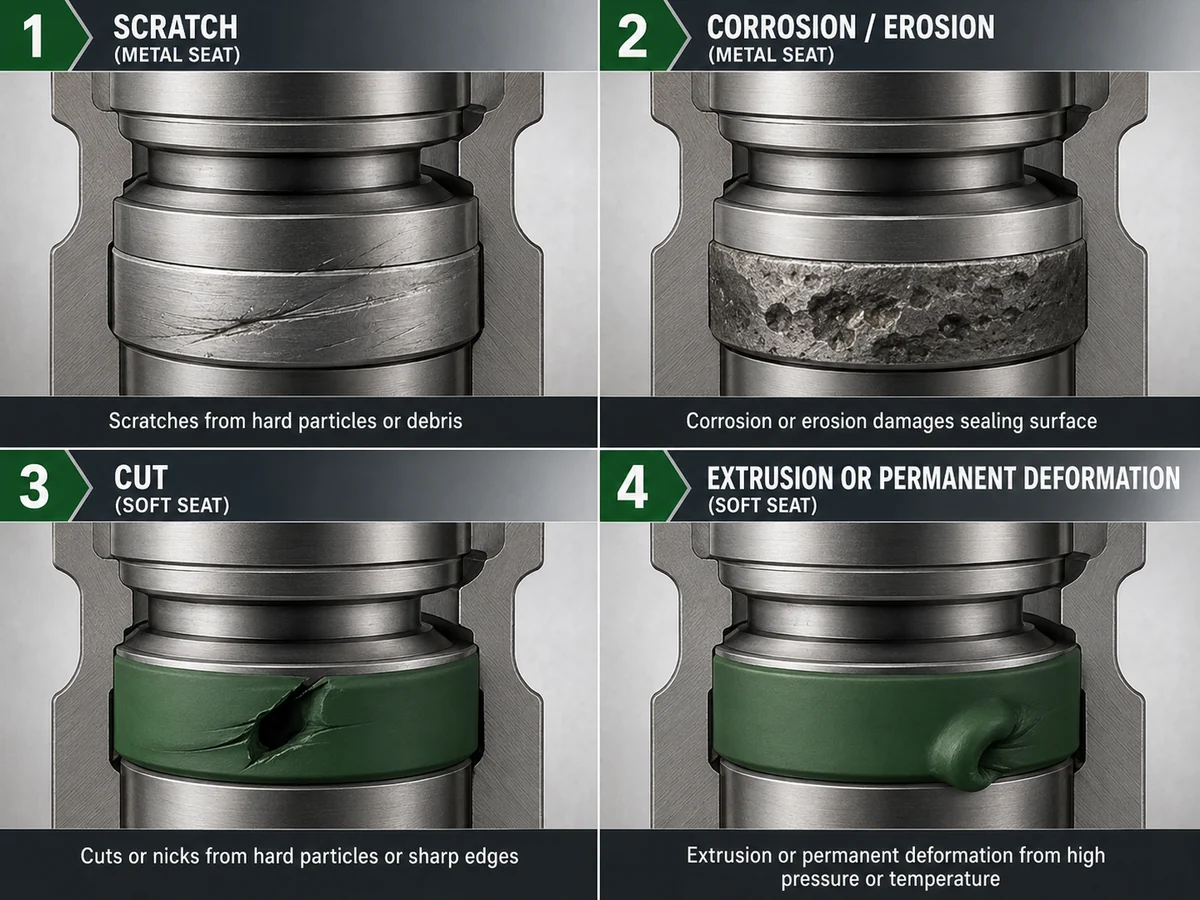
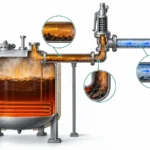
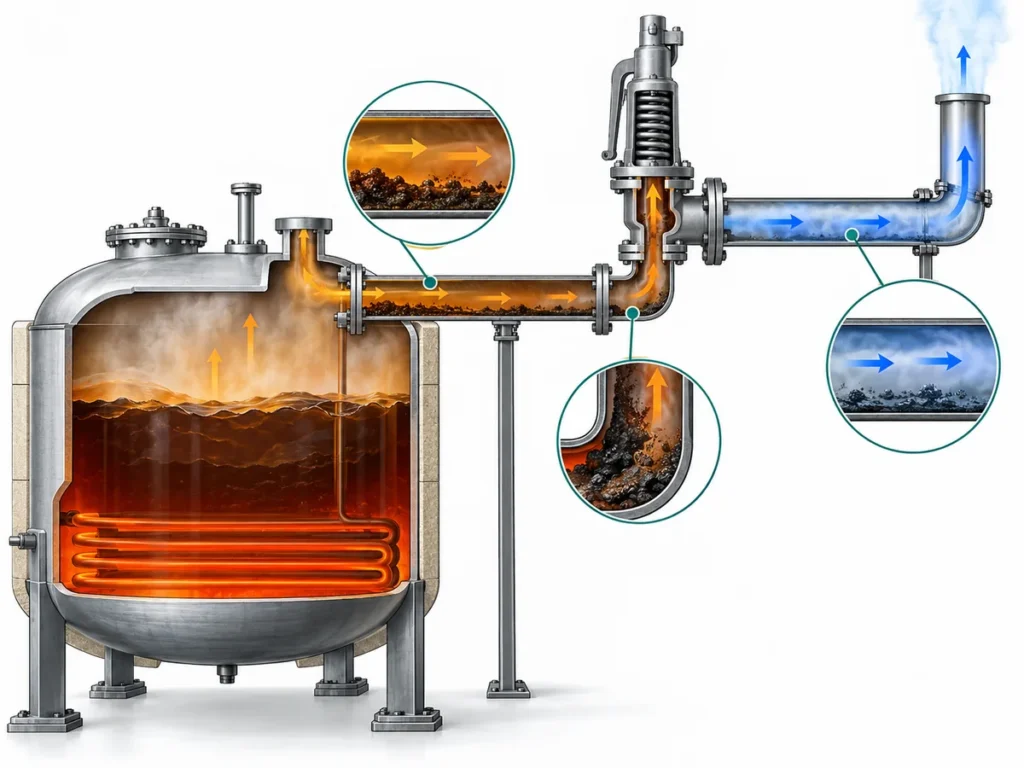
Illustrative failure modes only; diagnosis requires inspection of the valve, process and installation conditions.
| Symptom | Possible Seat Cause | Other Possible Cause | Initial Check | Unsafe Assumption |
|---|---|---|---|---|
| Leakage during normal operation | Damaged metal surface or degraded soft element | Operating pressure too close to set pressure | Review pressure trend and test history | A softer seat will automatically solve it |
| Leakage after a relief event | Debris trapped across the seat | Back pressure or unstable closing | Inspect valve and discharge conditions | The valve only needs readjustment |
| Leakage increasing over time | Corrosion, erosion, wear, or seal aging | Vibration, piping strain, or process contamination | Inspect service history and installation | The set pressure should be increased |
| Leakage after repair | Incorrect lapping, wrong seal, damage, or contamination | Incorrect assembly or calibration | Review repair procedure and final test record | Same-size parts are interchangeable |
| Unstable opening and closing | Seat damage caused by repeated contact | Excessive inlet loss, oversized valve, or back pressure | Review sizing and piping | Seat material is necessarily the root cause |
| Soft element displaced | Extrusion, wrong part, or incorrect assembly | Unapproved configuration | Verify model-specific parts and pressure history | Any seal of the same dimensions is acceptable |
Installation-related leakage and instability should be checked against the safety valve installation guide. Do not adjust the set-pressure mechanism in service to conceal leakage.
Escalate and follow the site removal or isolation procedure when leakage is persistent or increasing, the valve opens or closes unstably, seat or internal damage is visible, an unapproved adjustment or repair is suspected, the installed seat configuration cannot be identified, or the valve no longer has traceable calibration and capacity documentation. Do not increase spring compression or change the set pressure to conceal leakage.
What Does API 527 Tell You About Seat Tightness?
API 527 is used as a seat-tightness testing reference for pressure-relief valves within its scope. It supports defined test conditions and acceptance criteria for metal- and soft-seated designs. It is not a complete valve-sizing, service-compatibility, installation, or maintenance standard.
Edition control: At the time of this technical review, API’s official publications catalog lists API 527, Fifth Edition, July 2020. The purchase specification and test report must still identify the edition required by the actual project, contract, jurisdiction, and current supplier documentation. This article does not reproduce the standard’s acceptance tables.
A controlled test provides evidence against the specified acceptance basis. It does not prove that the valve can never leak in service, where the medium, temperature, pressure pulsation, contamination, vibration, piping loads, back pressure, cycling, corrosion, and aging may differ from the test condition.
What the Test Report Should Identify
- Valve identification and configuration;
- Seat construction;
- Set pressure;
- Test medium and test pressure;
- Applicable procedure or standard edition;
- Observed leakage and acceptance criterion;
- Result, date, and witness status where required.
What the Test Does Not Replace
- Relief-scenario determination;
- Required relieving-load calculation;
- Orifice and capacity selection;
- Pressure-temperature rating review;
- Material compatibility;
- Back-pressure and piping assessment;
- Project and jurisdiction requirements.
For the dedicated testing and report-review topic, use the API 527 seat tightness test guide.
Test and Documentation Matrix
A seat specification is incomplete unless the buyer defines what evidence must be supplied with the final valve. The required scope depends on the applicable code, project specification, jurisdiction, valve type, and procurement stage.
| Evidence Item | Engineering Purpose | Seat-Selection Relevance | Buyer Check |
|---|---|---|---|
| Set-pressure calibration record | Confirms the opening setting after manufacture, assembly, or authorized repair | A seat or internal-configuration change may require recalibration | Match valve identification, set pressure, procedure, result, date, and witness scope where required |
| Seat-tightness test report | Records leakage performance under defined test conditions | Must identify metal or soft seat and the applicable test basis | Check medium, pressure, acceptance criterion, observed result, and standard edition or approved procedure |
| Capacity basis | Demonstrates that the selected orifice and configuration meet the required relief duty | Seat choice must not invalidate the documented or certified configuration | Match model, orifice, medium basis, pressure, temperature, and applicable capacity data |
| Material and component records | Supports compatibility and traceability where required | Soft compound, metal seating materials, trim, bellows, spring, and gaskets may need identification | Confirm scope, heat or batch traceability where applicable, and consistency with the datasheet |
| Repair or conversion record | Documents changed parts, surface repair, assembly, and final configuration | Essential when converting or replacing the seat arrangement | Confirm approved procedure, installed parts, dimensional controls, calibration, tightness test, and final sealing |
| Nameplate, datasheet, and drawing | Identifies the delivered configuration and pressure-protection duty | Prevents confusion between an externally similar valve and the approved seat option | Check model, set pressure, orifice or capacity reference, materials, connections, and revision status |
| Inspection release or witness record | Confirms completion of project-defined inspection points | May include seat-tightness witnessing or document review | Confirm the agreed inspection and test plan rather than assuming a standard default scope |
Required capacity and seat tightness are different evidence streams. A valve can pass a seat-tightness test and still be unsuitable for the governing relief load, or meet capacity requirements but fail the specified leakage acceptance criterion.
Can a Metal Seat Be Replaced with a Soft Seat?
A metal-seat valve must not be converted by simply adding a resilient insert or O-ring. Some product families may have manufacturer-engineered alternatives, but that does not make all seat configurations interchangeable.
A seat change may affect the disc or holder, nozzle geometry, guide clearances, load transmission, effective seating area, pressure and temperature limits, blowdown, lift, set-pressure adjustment, spare parts, test procedure, and the approved capacity or certification basis.
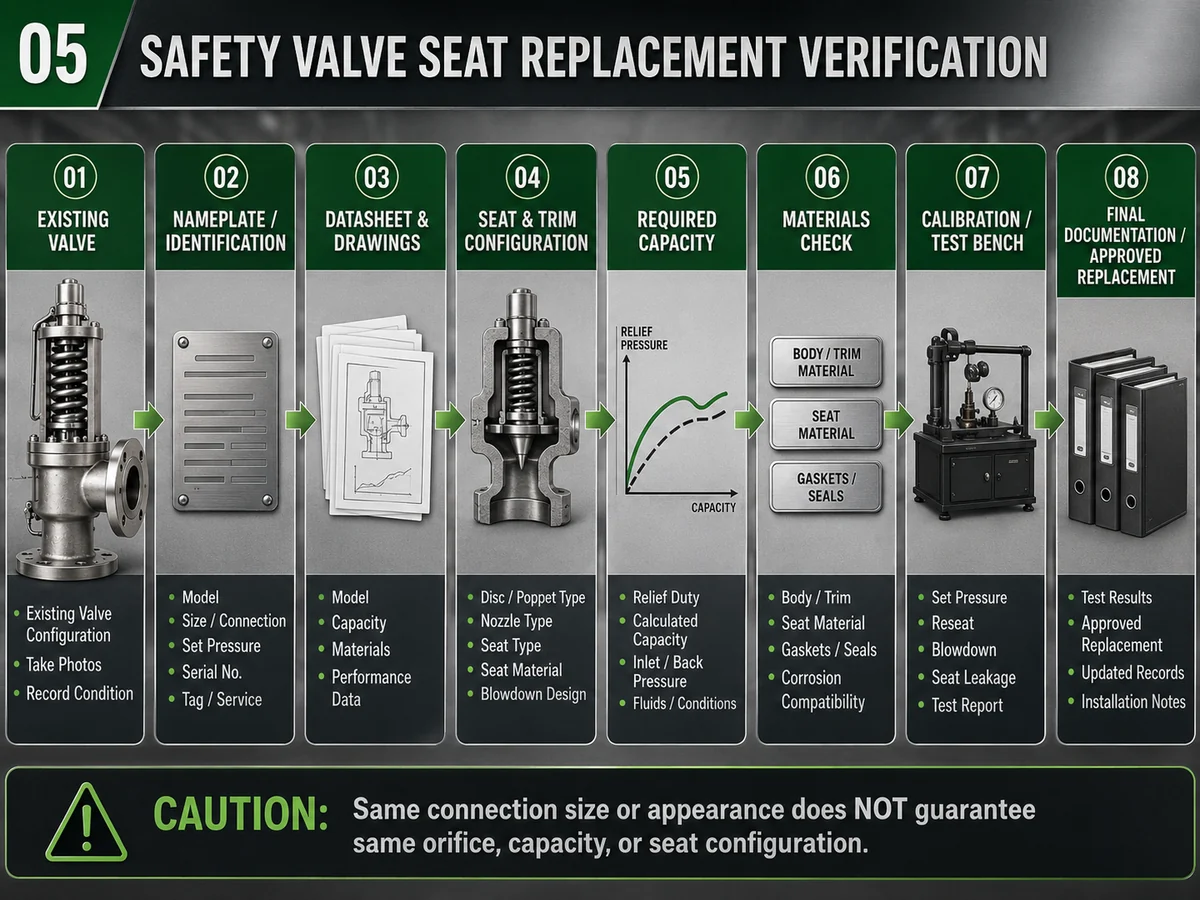
Generic replacement workflow; documents and valve details are illustrative and contain no real certification or customer information.
| Verification Item | Why It Matters | Evidence Required |
|---|---|---|
| Original manufacturer, model, and serial data | Establishes the correct design family and records | Nameplate, datasheet, and available certificates |
| Set pressure and spring range | Confirms the closing-force configuration | Nameplate and current test report |
| Required relieving capacity | Confirms the governing protection duty | Relief calculation and approved basis |
| Selected orifice and documented capacity | Prevents replacement by connection size alone | Capacity sheet or approved manufacturer data |
| Existing and proposed seat construction | Confirms physical and functional compatibility | Drawing, BOM, inspection record, and current model data |
| Materials and service limits | Supports compatibility and pressure-temperature review | Process datasheet and material records |
| Back pressure and installation | May affect configuration, stability, and operation | Relief-system and piping data |
| Authorized repair and final testing | Protects geometry, calibration, and traceability | Approved procedure and final set-pressure and tightness records |
Connection size alone does not prove interchangeability or capacity. Required relieving load, selected orifice, and manufacturer-certified or documented capacity must be verified separately. Review the broader safety valve sizing and certified capacity requirements before approving a replacement.
Preliminary Seat-Selection Decision Workflow
Use the following sequence before selecting or quoting a seat type. Do not begin with connection size, a preferred seal material, or an undefined request for “zero leakage.” For the wider valve-configuration process, see how to select spring loaded safety valves.
Confirm the protected equipment and relief scenarioIdentify the equipment, governing case, required relieving rate, medium, phase, relieving pressure, and relieving temperature.
Define the pressure conditionsConfirm operating pressure, MAWP or design pressure, set pressure, allowable overpressure or accumulation basis, pressure pulsation, superimposed back pressure, and built-up back pressure. For the separate outlet-system and variable-back-pressure review, use the back pressure and bellows guide.
Screen the serviceReview composition, contamination, corrosion, polymerization, crystallization, thermal cycling, relief frequency, cleaning media, and environmental exposure.
Define the tightness requirementState the applicable standard, test medium, test pressure, acceptance basis, documentation, witness requirement, and any project-specific requirement.
Review the exact valve seriesConfirm metal- and soft-seat availability, materials, pressure-temperature range, spring range, capacity, blowdown, back-pressure limits, maintenance parts, and required records.
Verify the complete specificationAlign the relief scenario, required capacity, set pressure, valve configuration, seat type, materials, connections, ratings, installation, testing, and documentation.
Composite Engineering Scenarios
Training note: The following are composite engineering scenarios for explanation. They are not customer cases, accident reports, certified product data, or evidence of a specific ZOBAI model’s performance.
Scenario 1
High-Temperature Steam
Problem: An existing valve leaks during normal service, and the buyer requests a soft seat.
Engineering concern: The governing relieving temperature may restrict resilient materials, while deposits, damaged metal surfaces, insufficient operating margin, piping strain, or unstable operation may be the actual leakage cause.
Required action: Review the steam relief case, required capacity, set pressure, blowdown, bonnet and spring-temperature arrangement, discharge and drainage, installation, seat condition, and the approved model options before deciding whether any seat change is appropriate.
Scenario 2
Clean Compressed Gas
Problem: Product loss during normal operation must be reduced.
Engineering concern: A soft seat may reduce leakage under a defined test basis, but gas composition, temperature, rapid decompression, cycling, contamination, operating margin, and model limits can disqualify the proposed material.
Required action: Confirm the complete gas composition, pressure and temperature envelope, required capacity, back pressure, cycling history, test requirement, approved compound, spare-part controls, and manufacturer data for the exact valve series.
Scenario 3
Gas with Rust or Scale
Problem: Leakage recurs after maintenance on an upstream line.
Engineering concern: The same particles can cut a soft element, scratch a metal seat, or hold either configuration open. Replacing only the seat transfers attention away from the contamination source.
Required action: Inspect the disc and nozzle, identify the particles, review upstream corrosion and cleaning, examine inlet piping, perform approved repair and recalibration, and confirm that the complete valve remains suitable for the actual solids exposure.
What to Specify in the RFQ
A useful RFQ includes more than valve size, set pressure, and quantity. The following information is needed to review both the complete valve and its seat configuration.
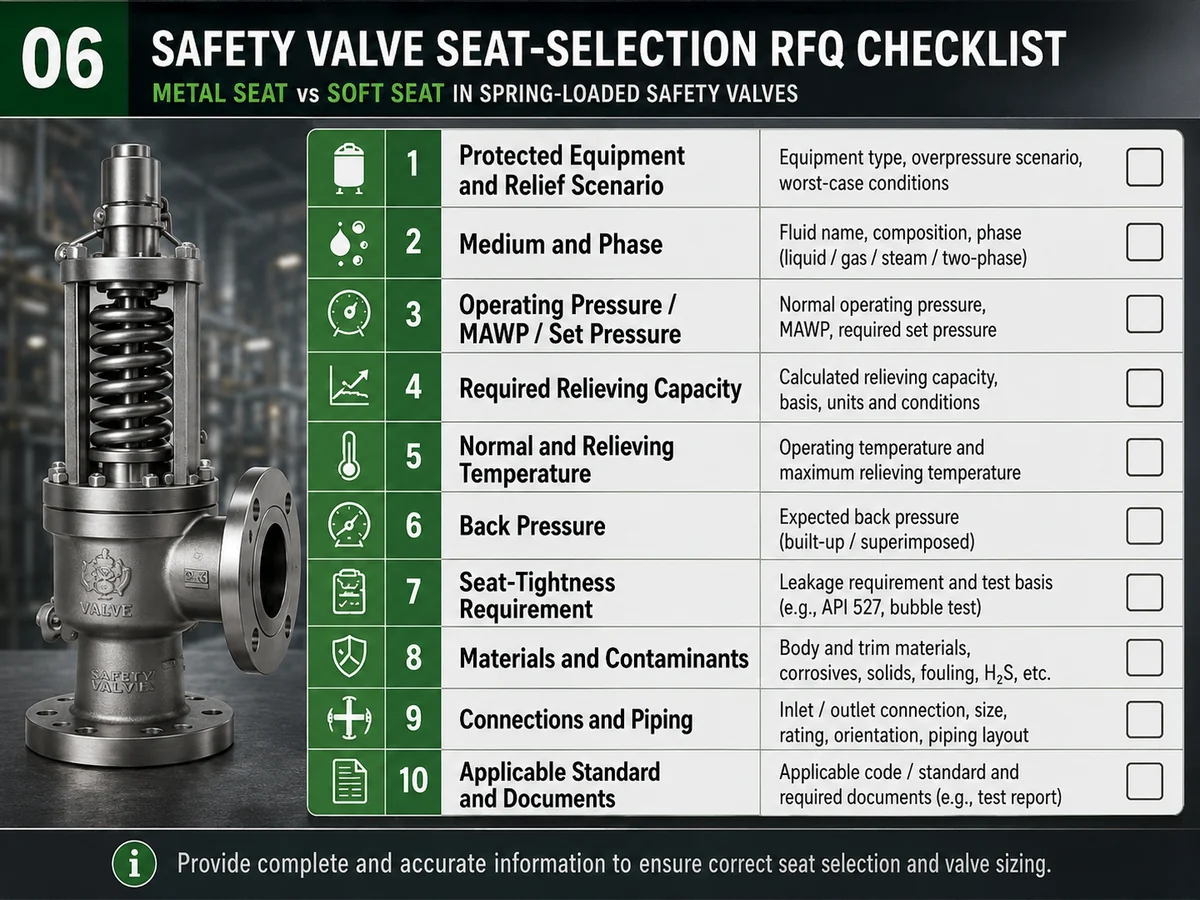
The checklist supports preliminary engineering review and does not replace formal relief calculations or project approval.
| RFQ Field | Buyer Input Required | Why It Is Required |
|---|---|---|
| Protected equipment | Boiler, vessel, pipeline, compressor, exchanger, skid, or other equipment | Defines the protection context |
| Relief scenario | Blocked outlet, fire, thermal expansion, regulator failure, tube rupture, or other case | Establishes the governing duty |
| Medium and phase | Gas, vapor, steam, liquid, or two-phase service | Affects sizing and valve behavior |
| Fluid composition | Components, concentration, water content, contaminants, and cleaning media | Supports material compatibility |
| Operating pressure | Normal and maximum expected operating conditions | Supports operating-margin review |
| MAWP or design pressure | Equipment pressure basis | Supports set-pressure review |
| Set pressure | Required valve set pressure | Determines spring and configuration requirements |
| Required relieving capacity | Mass or volumetric rate with calculation basis | Confirms required valve capacity |
| Relieving temperature | Temperature under the governing case | Screens materials and ratings |
| Back pressure | Superimposed and built-up values | Supports configuration and stability review |
| Connections and piping | Size, rating, facing, standard, layout, support, and discharge destination | Confirms the mechanical interface and installation |
| Seat and tightness requirement | Metal, soft, or open for review; test standard, medium, pressure, and acceptance basis | Prevents ambiguous leakage claims |
| Materials | Body, trim, spring, bellows, seat, seals, and any service restrictions | Supports compatibility review |
| Applicable code and documents | Project standard, datasheet, drawing, test report, material records, capacity data, and inspection scope | Defines design and supply evidence |
| Replacement data | Nameplate, photos, serial number, existing datasheet, and GA drawing | Prevents visual-only replacement |
Technical References and Scope
This article uses standards as engineering references and RFQ translation aids; it does not reproduce protected standard text or imply that every ZOBAI product automatically conforms to every referenced requirement.
- API pressure-relieving systems standards program — official standards-program context, including seat-tightness, sizing, system, and installation topics.
- API refining standards catalog — official catalog reference listing API 527, Fifth Edition, July 2020; confirm the project-required edition before procurement or testing.
- ASME BPVC Section XIII overview — official publisher information for overpressure-protection rules.
- ISO 4126-1 official page — official product-standard information for safety valves within its scope.
Applicable standard editions, project specifications, certification requirements, and local regulatory obligations must be confirmed for the actual project.
Frequently Asked Questions
Does a soft-seat safety valve provide zero leakage?
A soft seat may support lower leakage under suitable, defined conditions. “Zero leakage” should not be used as an unconditional claim. The test medium, pressure, acceptance criterion, valve configuration, and actual service conditions must be specified.
Is a metal seat always required for steam service?
No. Steam temperature, pressure, required capacity, valve construction, materials, applicable code, bonnet arrangement, blowdown, discharge, and manufacturer data must be reviewed. Metal seats are commonly considered because available resilient materials may be temperature-limited.
Can a soft seat be used for high-pressure gas?
Possibly, but pressure alone does not determine suitability. The gas composition, normal and relieving temperatures, set pressure, decompression behavior, cycling, contamination, exact seal material, valve series, and manufacturer limits must be checked.
Does seat type affect relieving capacity?
The capacity must be confirmed for the complete approved valve configuration. Seat type should not be assumed to leave the capacity basis unchanged. Required capacity, selected orifice, and manufacturer-certified or documented capacity remain separate from connection size.
Why does a metal-seat safety valve leak below set pressure?
Possible causes include particles, corrosion, scratches, pressure pulsation, inadequate operating margin, misalignment, piping strain, inlet loss, back pressure, unstable operation, or incorrect repair. Inspection and system review are required.
Can an existing metal-seat valve be converted to a soft seat?
Only when the exact valve design has an approved conversion or soft-seat configuration and a complete technical review confirms compatibility. The final valve must be recalibrated and tested under the applicable procedure. An improvised insert is not an acceptable conversion.
What seat-tightness test should be requested?
Use the test basis required by the project and applicable jurisdiction. API 527 may be relevant for pressure-relief valves within its scope. The RFQ should identify the standard edition, test medium, test pressure, acceptance basis, documentation, and witness requirements.
What information is needed before selecting the seat material?
Provide the protected equipment, relief scenario, medium and phase, composition, operating pressure, MAWP or design pressure, set pressure, required relieving capacity, normal and relieving temperatures, back pressure, contaminants, cycling, tightness-test basis, connections, applicable code, and required documents.
Technical Review and Limitation Note
Send Your Operating Conditions for a Seat-Selection Review
Provide the protected equipment, relief scenario, medium and phase, fluid composition, operating pressure, MAWP or design pressure, set pressure, required relieving capacity, normal and relieving temperatures, back pressure, contamination concerns, preferred seat type, test basis, applicable standard, and any existing datasheet or nameplate.