Learn what API 527 seat-tightness evidence proves for an LPG safety valve, what it does not prove, and what to verify before acceptance.

API 527 proves one narrow but important point: the tested pressure-relief valve met the applicable seat-tightness acceptance criterion under defined test conditions. It does not, by itself, prove zero leakage in LPG service, adequate relieving capacity, complete pressure-performance behavior, material compatibility, or acceptance of the installed relief system.
That boundary is consistent with API’s own standards architecture. API’s refining standards catalog describes Standard 527 as addressing pressure-relief-valve seat tightness, while sizing and selection, installation, and broader valve-specification questions are handled separately.
For an engineer or technical buyer, the useful question is not simply “Does the certificate say API 527?” It is whether that test result supports the conclusion being requested for this valve under the applicable test basis.
For detailed test-method and leakage-limit information, use ZOBAI’s API 527 seat-tightness test guide. This article stays focused on interpreting the evidence for an LPG safety-valve decision.
What an API 527 Seat-Tightness Result Actually Proves
An API 527 PASS should be read as a three-part statement:
this tested valve + this applicable acceptance criterion + this documented test basis.
When those elements line up, the result supports the conclusion that the valve met the applicable seat-tightness requirement for that test.
API’s published scope includes metal- and soft-seated pressure-relief valves and conventional, bellows and pilot-operated designs. The test basis also depends on applicable conditions rather than a generic claim that the valve is simply “leak-free.”
API’s published Standard 527 scope
provides the authority basis for that distinction.
That evidence is useful, but it is deliberately narrower than saying that:
- the valve is suitable for the complete LPG duty;
- the valve has adequate relieving capacity;
- every material and sealing element is compatible; or
- the installed relief system is acceptable.
Those are separate engineering questions.
A defensible summary is: the tested valve met the applicable API 527 seat-tightness acceptance basis under the documented test conditions.
This wording keeps the test result useful without asking it to prove something the test did not examine.
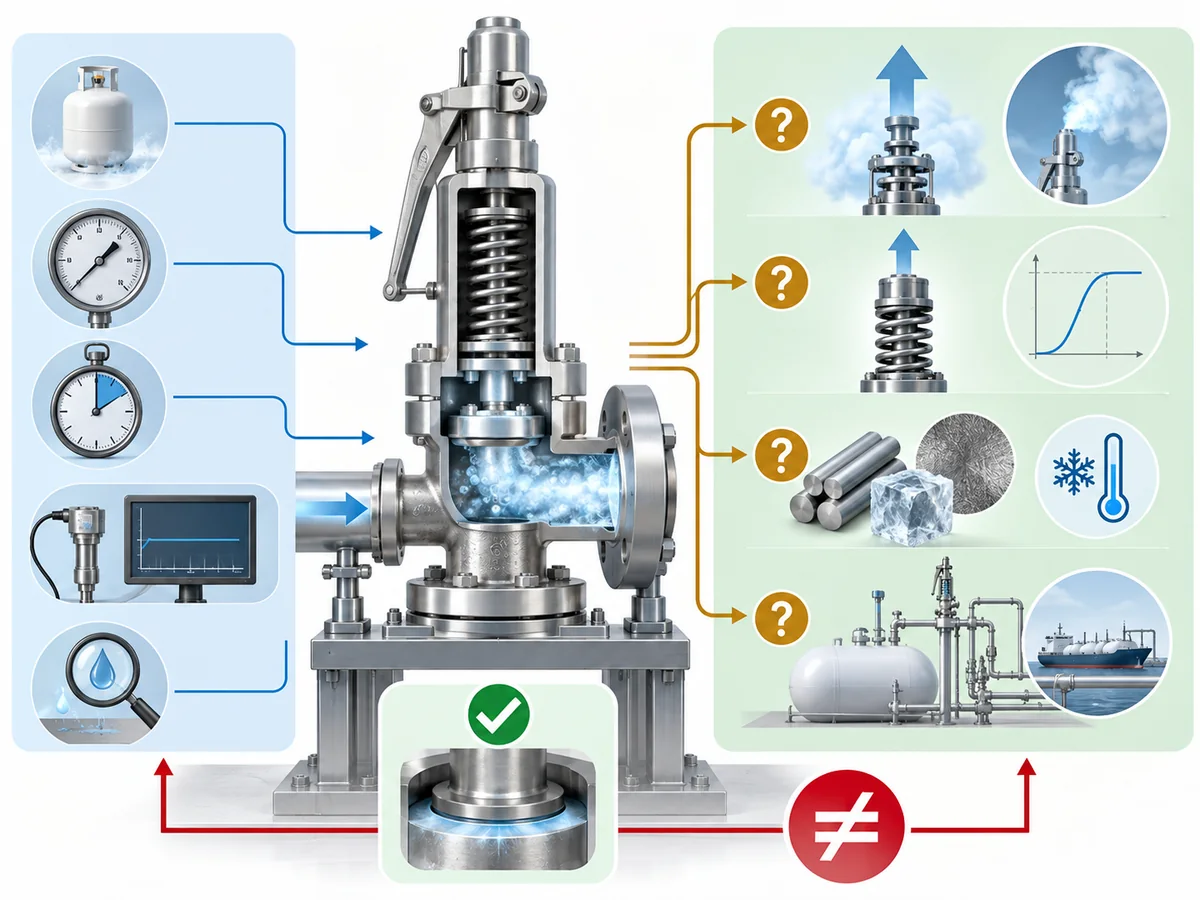
Why “API 527 Passed” Is Incomplete Without the Test Context
A bare API 527 PASS gives less decision value than a result that can be tied to the actual valve, test conditions and acceptance basis.
The following inputs matter because they can change how the seat-tightness evidence should be interpreted.
| Test context | Why it matters | If it is missing |
|---|---|---|
| Valve identity | Establishes that the record belongs to the candidate under review. | The result may not be traceable to the valve. |
| Seat / sealing configuration | Acceptance interpretation can differ with sealing design. | The leakage criterion may be misapplied. |
| Set pressure or applicable pressure basis | Provides the pressure context for the seat test. | The recorded test pressure is difficult to judge. |
| Recorded test pressure | Shows the pressure at which seat tightness was assessed. | The PASS lacks a clear test point. |
| Test medium | The medium is part of the applicable test basis. | The test conditions are incomplete. |
| Observed or measured result | Shows what the test actually found. | A standards reference may be mistaken for evidence. |
| Acceptance basis | Identifies the criterion used to judge the result. | “PASS” cannot be independently interpreted. |
| Purchaser / project requirement | The purchaser may require tighter seat performance than the baseline criterion. | A standard-level PASS may not satisfy the contract. |
This does not mean API 527 universally requires every test certificate to contain the same administrative fields. A serial number, customer tag, witness signature, calibration reference or work-order number may be required by a particular quality plan, but those items should not be described as universal API 527 requirements without the applicable project basis.
The practical review question is whether there is enough valve identity, test-condition and acceptance information to show that the result actually supports the candidate under review.
If that information is missing, the appropriate conclusion is generally that the evidence is incomplete for the requested decision—not automatically that the valve failed.
Does Passing API 527 Mean an LPG Safety Valve Has Zero Leakage?
No. An API 527 PASS should not be translated into a general claim of “zero leakage in LPG service.”
For applicable metal-seated valves, a defined amount of seat leakage can be acceptable under the test basis. Published manufacturer procedures illustrate the distinction: metal-seat testing can use an allowable leakage rate, while some O-ring or soft-seat configurations use a no-leak criterion under defined bench-test conditions.
See, for example,
Baker Hughes’ Consolidated 1900 / 1900 DM technical manual.
Allowable seat leakage is therefore not the same as universal zero leakage. A metal-seated valve may satisfy its applicable acceptance criterion without a literal zero leakage reading.
A no-leak result on a particular soft-seat configuration is also still bounded by the documented bench-test pressure, medium, configuration and setup. It does not become a lifetime guarantee that the complete valve assembly will never show leakage after installation.
The API 527 seat result should also not be used as evidence for every possible leakage path on the assembly. Manufacturer testing frameworks separately distinguish seat tightness from pressure-boundary and outward/back-seat tightness checks; LESER’s published quality documentation is one example of that separation.
LESER quality and testing documentation.
For an LPG application, wording such as “No leakage was observed under the applicable seat-tightness test criterion” may be appropriate when the actual record supports it.
By contrast, “zero-leak LPG valve” implies much more than an API 527 seat-tightness result alone establishes.
What API 527 Does Not Prove About an LPG Safety Valve
A satisfactory seat-tightness result answers one technical question. It does not complete the entire LPG safety-valve review.
Capacity and Required Relieving Duty
API 527 does not show that the selected valve can pass the required relieving flow.
Seat tightness asks whether the closed seat meets the applicable leakage criterion. Capacity review asks whether the valve can relieve the required duty when it opens.
An API 527 PASS therefore cannot substitute for the required sizing and capacity evidence.
For that separate task, see ZOBAI’s
API 520 safety-valve sizing guide.
Set Pressure, Blowdown and Operating Performance
Seat tightness is not complete proof of the valve’s pressure-performance behavior.
Set-pressure verification, reseating or blowdown behavior, and seat leakage are distinct checks. Passing one should not be used to imply that the others have also been demonstrated.
ZOBAI’s
set pressure, overpressure and blowdown guide
owns the detailed pressure-performance terminology.
Materials and LPG-Service Compatibility
A seat-tightness result does not establish that the body, trim, seat or sealing materials are suitable for the actual LPG duty.
Material and seal review remains tied to the real service conditions, including the information needed to assess the proposed materials and sealing arrangement. Passing a leakage test does not replace that compatibility review.
For deeper material-selection context, see ZOBAI’s
safety-valve material selection guide.
Installed-System and Project Acceptance
A factory seat test does not demonstrate that the installed relief system is acceptable.
API treats pressure-relief-device installation as a separate engineering subject under API 520 Part II.
API’s API 520 Part II information
provides that separate installation context.
Depending on the installation, the review may still need to address the inlet and outlet arrangement, back pressure, discharge interface and applicable project requirements. Those questions do not disappear because the valve passed a bench seat-tightness test.
The same applies at project level: an API 527 result may satisfy one required documentation item without establishing that every owner, EPC, jurisdictional or project requirement has been met.
A valid API 527 result that also satisfies the applicable purchaser or project seat-tightness basis can close that seat-tightness question. It does not close every other question attached to the valve.
How to Review a Supplier’s API 527 Test Record
Review the document as evidence for a specific candidate rather than scanning only for the words “API 527.”
-
Match the record to the valve.
Confirm that the identification accepted by the project ties the record to the candidate. A test on another valve or configuration is not evidence for this one merely because both reference API 527.
-
Confirm the seat or sealing configuration.
Make sure the configuration represented by the record matches the valve being supplied.
-
Check the pressure basis.
Compare the stated pressure basis with the recorded seat-test pressure so that the result can be placed in the correct test context.
-
Check the test medium.
Confirm that the documented medium is consistent with the applicable test basis.
-
Check the result and acceptance basis together.
Do not stop at
PASS. Review the relationship between the observed or measured result, the applicable criterion and the final acceptance decision. -
Check the purchase or project requirement.
A project may require tighter seat performance than the baseline standard criterion, so the contractual acceptance basis still needs to be checked.
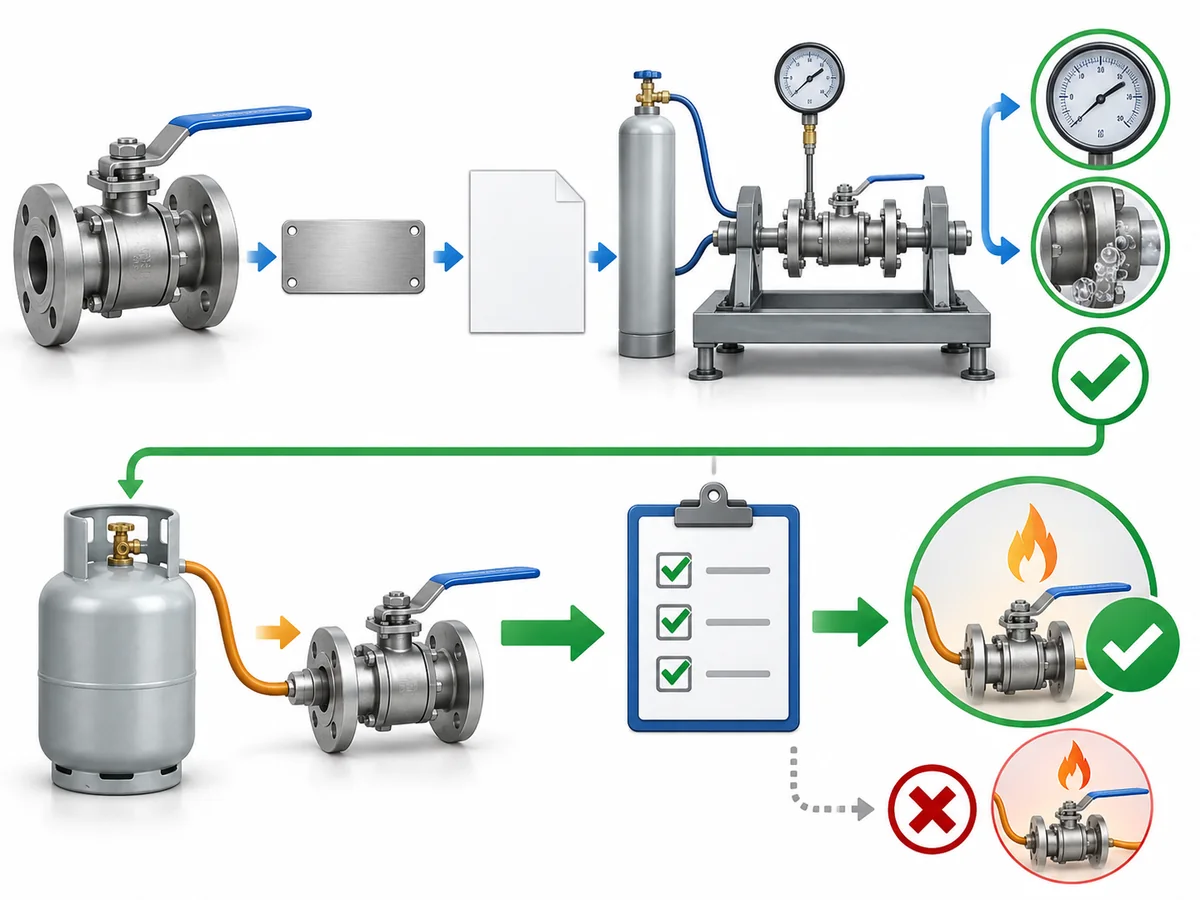
What to Verify Beyond API 527 Before Accepting the Valve for LPG Service
Once the seat-tightness evidence is satisfactory, confirm that the other engineering questions have their own evidence rather than borrowing credibility from API 527.
| Open question | Evidence or input to request | Why it remains separate |
|---|---|---|
| What relieving duty must be handled? | Relief scenario and required capacity basis | Seat tightness does not determine relieving capacity. |
| What pressure performance is required? | Set pressure and other applicable performance requirements | These are separate from seat leakage. |
| What is the actual LPG service? | Medium/state, relevant composition and temperature | Service conditions affect candidate selection. |
| Are the materials and seals suitable? | Body, trim, seat and seal materials plus the compatibility basis | A seat test does not demonstrate compatibility. |
| Which valve configuration is proposed? | Conventional, bellows, pilot-operated or other applicable configuration | Configuration can affect the wider selection review. |
| What does the installed system impose? | Back-pressure and discharge-system inputs where relevant | Installation and system behavior are separate from seat tightness. |
| What project basis applies? | Applicable project specification, code basis and purchaser requirements | Project acceptance covers more than one test. |
| Does the evidence belong to this candidate? | Traceable candidate-specific test documentation | Generic product statements are weaker than candidate evidence. |
The decision path is: verify API 527 seat tightness → identify what remains unproven → request the evidence that answers those remaining questions.
For broader product context, see ZOBAI’s
LPG safety-valve page.