Share your medium, set pressure, temperature, size, standard, or datasheet, and our team will review your requirement and respond with the appropriate next step.
Bellows Balanced vs Conventional Spring Loaded Safety Valve
A conventional spring loaded safety valve is usually the better starting choice for clean service, low or stable back pressure, simple discharge piping, and applications where ease of maintenance and lower initial cost matter. A bellows balanced safety valve should be considered when outlet back pressure is variable, when the valve discharges into a closed …
A conventional spring loaded safety valve is usually the better starting choice for clean service, low or stable back pressure, simple discharge piping, and applications where ease of maintenance and lower initial cost matter. A bellows balanced safety valve should be considered when outlet back pressure is variable, when the valve discharges into a closed header or flare system, or when corrosive, dirty, toxic, or expensive process fluid may affect the spring chamber. The bellows reduces the influence of back pressure on set pressure, lift, and reseating behavior, while also helping isolate internal moving parts. However, a bellows balanced valve is not automatically better. It adds cost, inspection points, bellows failure risk, and bonnet vent requirements. Final selection must still verify required relieving capacity, orifice area, inlet pressure loss, outlet system resistance, material compatibility, testing, and documentation.
Engineering summary: choose the simpler conventional spring loaded safety valve when the system allows it; choose a bellows balanced safety valve when back pressure or process fluid exposure creates a real engineering reason. The correct valve is not the one with the larger connection or higher price; it is the one whose certified relieving capacity, pressure setting, material, installation, and discharge system match the protected equipment.
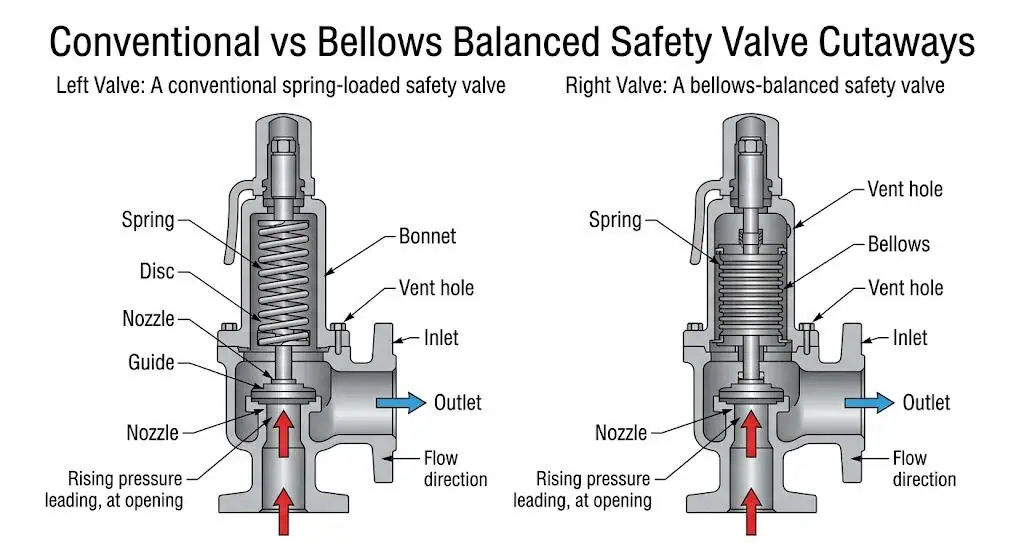
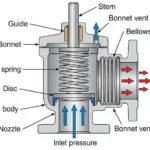
Cutaway comparison of a conventional spring loaded safety valve and a bellows balanced safety valve. The bellows design helps reduce back pressure influence and isolate the spring chamber from process fluid.
Quick Comparison: Bellows Balanced vs Conventional Spring Loaded Safety Valve
When a Conventional Spring Loaded Safety Valve Is Usually Enough
A conventional spring loaded safety valve is often suitable when the process medium is clean, non-corrosive, and the outlet back pressure is low, stable, or already within the acceptable range for the selected valve. It has a simpler structure, fewer flexible sealing components, and is usually easier to inspect and maintain. For many atmospheric discharge, simple vapor, gas, or steam services, a conventional design may be the most practical choice.
Why it matters: using a bellows balanced valve where it is not needed can increase purchase cost, spare parts complexity, inspection requirements, and lead time without improving the protection function. A simpler valve can be the more reliable choice when the process conditions are straightforward and the outlet system does not create a back pressure problem.
When a Bellows Balanced Safety Valve Should Be Considered
A bellows balanced safety valve should be considered when back pressure may affect valve performance, especially in closed discharge systems, common discharge headers, flare systems, or applications with variable outlet pressure. It is also commonly reviewed for corrosive, dirty, toxic, or expensive process fluids because the bellows can help isolate the spring chamber and moving parts from process exposure.
What can go wrong: if a conventional valve is used where variable back pressure is significant, the valve may open late, chatter, lose effective lift, reduce relieving capacity, or reseat unstably. If corrosive fluid reaches the spring chamber, the spring, guide, stem, or adjusting parts may corrode or stick. These failures affect safety margin, leakage, maintenance cost, shutdown duration, and replacement lead time.
The Main Decision: Back Pressure, Medium, Capacity, and Maintenance
The comparison should not be reduced to “bellows is better” or “conventional is cheaper.” The correct decision depends on back pressure type, process medium, required relieving capacity, temperature, discharge piping, material compatibility, inspection access, and maintenance capability. Purchase price is only one part of the decision; leakage, downtime, seat damage, bellows replacement, and retesting can affect lifecycle cost.
Service Condition
Better Starting Choice
Why
Clean gas or vapor, low outlet back pressure
Conventional spring loaded safety valve
Simpler structure, easier maintenance, usually sufficient if capacity and installation are correct
Variable superimposed back pressure
Bellows balanced safety valve
Bellows reduces back pressure influence on opening and reseating behavior
Common discharge header or flare system
Bellows balanced safety valve for review
Built-up back pressure and header pressure can affect conventional valve performance
Corrosive vapor or dirty process fluid
Bellows balanced safety valve for review
Bellows may protect the spring chamber, but bellows material must be checked
Simple service with easy atmospheric discharge
Conventional spring loaded safety valve
Bellows may add cost and inspection burden without a clear benefit
What Is a Conventional Spring Loaded Safety Valve?
Basic Structure and Closing Force
A conventional spring loaded safety valve uses a spring to keep the disc seated against the nozzle until inlet pressure reaches the specified set pressure. The spring force, seat area, nozzle geometry, disc holder, guide, and bonnet arrangement determine how the valve begins to open, relieves flow, and reseats after the overpressure condition is removed.
Set pressure determines when the valve starts to relieve under specified test conditions. Overpressure affects how the valve reaches rated lift and capacity. Accumulation is related to the pressure increase of the protected equipment during a relieving event and must be checked against the applicable design basis. Blowdown affects the pressure range between opening and reseating. These parameters should be reviewed together rather than treated as isolated catalog values.
Terminology should also be controlled in purchasing documents. In many projects, safety valve, relief valve, safety relief valve, PSV, and SRV may be used differently depending on fluid service, code basis, and local practice. The comparison in this article focuses on conventional spring loaded construction versus bellows balanced spring loaded construction, not on every legal or regional naming convention.
How Outlet Back Pressure Can Affect Conventional Valve Performance
In a conventional safety valve, outlet back pressure can act on internal surfaces in a way that changes the net lifting force on the disc. Depending on valve design and service conditions, back pressure can affect opening pressure, lift, capacity, stability, and reseating behavior. This is why conventional valves require careful review when the outlet is connected to a closed header or flare system.
Field scenario: What problem occurred: a conventional spring loaded valve began to chatter after a plant added more relief devices to a common discharge header. Why it happened: the built-up back pressure during simultaneous relief increased. Real system cause: the discharge header modification was not included in the valve selection review. Corrective action: recalculate outlet system resistance, confirm back pressure during relief, and review whether a bellows balanced valve is required. Prevention: include discharge header data, outlet pressure drop, and simultaneous relief assumptions before approving replacement valves.
Typical Applications for Clean and Low-Back-Pressure Service
Conventional spring loaded safety valves are commonly used in services where the discharge arrangement is simple, the medium is clean, and back pressure is low or stable. They can be appropriate for many pressure vessels, gas lines, steam systems, and process equipment, provided the required relieving capacity, inlet pressure loss, outlet conditions, and material requirements are verified.
For procurement, the main point is that conventional does not mean “low grade.” It means the valve has a simpler direct spring loaded structure. In the right service, this can reduce spare parts, simplify inspection, shorten delivery, and lower maintenance burden. For a broader selection workflow, see ZOBAI’s safety valve selection guide.
What Is a Bellows Balanced Safety Valve?
How the Bellows Changes the Valve Structure
A bellows balanced safety valve remains a spring loaded valve, but it adds a flexible metallic bellows between the process side and the bonnet or spring chamber. The bellows moves with the disc assembly and helps isolate the spring chamber from outlet pressure and process fluid. For a more detailed working principle explanation, see how a bellows balanced safety valve works.
This structural change is important because it changes how the valve responds to back pressure. It also adds a component that must be inspected, protected, and selected for material compatibility. The bellows should not be treated as a simple accessory. It is part of the pressure balance and reliability strategy of the valve.
How the Bellows Reduces Back Pressure Influence
The bellows effective area is designed to offset part of the force caused by outlet back pressure acting on the disc assembly. This reduces the effect of back pressure on set pressure, lift, and reseating performance compared with a conventional design. It does not remove the need to calculate back pressure or review the discharge system.
Why it matters: the bellows helps reduce back pressure influence within its design limits. If the outlet system creates excessive or unstable back pressure, the valve may still suffer poor lift, noise, vibration, reduced effective capacity, or unstable reseating. Bellows balanced design is not a substitute for outlet system review.
How the Bellows Protects the Spring Chamber
The bellows can also protect the spring chamber, guide, stem, and related moving parts from corrosive, dirty, toxic, or sticky process fluids. This can reduce corrosion and sticking risk in selected services. However, the bellows itself is a thin-wall flexible component and must be checked for corrosion, fatigue, temperature, and mechanical movement.
Back Pressure: The Main Difference Between the Two Designs
Superimposed Back Pressure vs Built-Up Back Pressure
Superimposed back pressure exists at the outlet before the valve opens. It can be constant or variable. Built-up back pressure develops as flow passes through the valve and discharge piping during a relieving event. Both types can affect valve performance, especially in systems connected to common headers or flare systems.
For early screening, the buyer should never write only “back pressure exists.” The RFQ should identify whether the pressure is superimposed, built-up, constant, variable, or related to simultaneous relief in a common header. This affects valve type, sizing, capacity correction, and discharge system review. For deeper background, refer to ZOBAI’s guide on back pressure and bellows in safety valves or the application page for high back pressure safety valves.
Why Conventional Valves Are More Sensitive to Back Pressure
A conventional safety valve has no bellows barrier to isolate the bonnet and disc holder area from outlet pressure. As outlet pressure changes, the force balance across the disc may change. The result can be a shift in opening behavior, reduced lift, unstable discharge, chatter, or reseating problems.
Why Bellows Balanced Valves Are More Stable Under Variable Back Pressure
A bellows balanced valve reduces this sensitivity by compensating for part of the back pressure force. This makes it a common option when the valve outlet is connected to a closed discharge system, common header, or flare system. Stability still depends on correct sizing, inlet pressure loss, outlet resistance, and system dynamics.
Why Bellows Balanced Does Not Mean Back Pressure Can Be Ignored
Balanced construction reduces back pressure influence within design limits. It does not make the discharge system irrelevant. Excessive or unstable back pressure can still affect lift, capacity, noise, vibration, and reseating. For critical services, back pressure data should be provided during RFQ and reviewed before the valve type is confirmed.
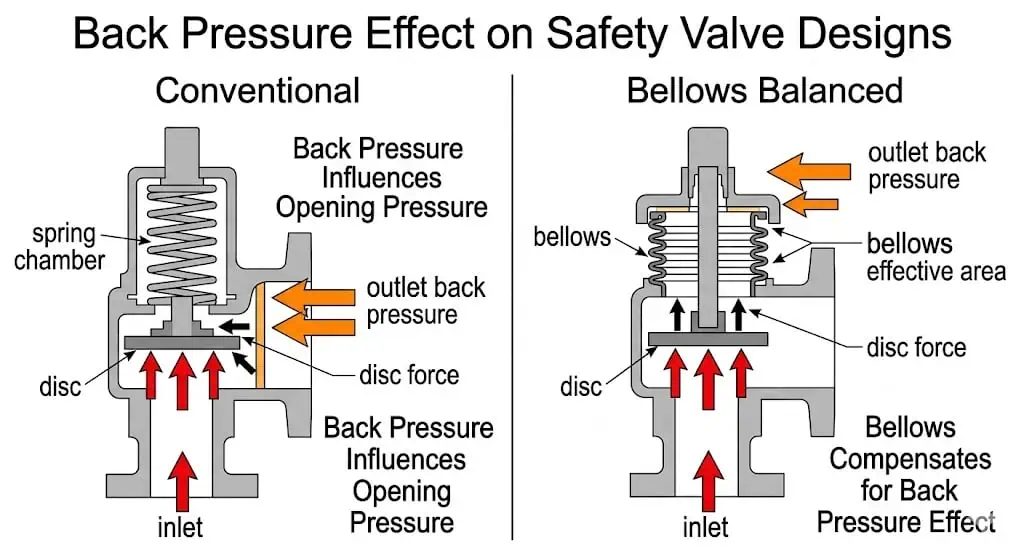
Back pressure affects conventional and bellows balanced safety valves differently. Bellows balanced construction reduces back pressure influence, but outlet system review is still required.
Back Pressure Review Item
Why It Matters
Required Data
Superimposed back pressure
Can affect opening behavior before relief starts
Constant or variable outlet pressure before valve opening
Built-up back pressure
Can affect lift, capacity, and reseating during relief
Calculated outlet pressure during relieving flow
Common discharge header
May create variable pressure during simultaneous relief
Flare header pressure and hydraulic calculation basis
Outlet pressure drop
Affects built-up back pressure and stability
Outlet line size, length, fittings, silencer, header data
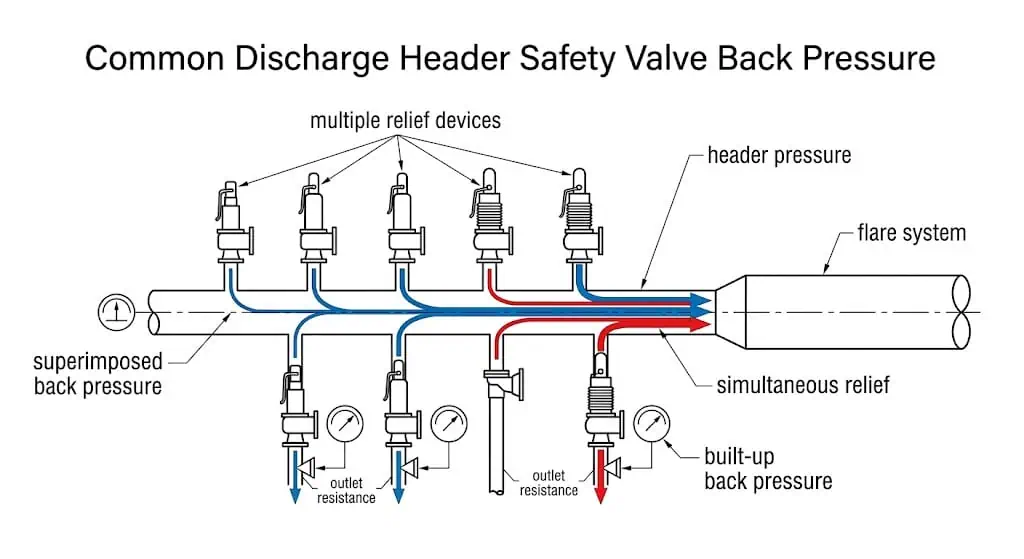
Common discharge headers and flare systems can create built-up or variable back pressure. These conditions should be reviewed before selecting a conventional or bellows balanced safety valve.
Conventional vs Bellows Balanced Safety Valve Selection Table
Selection Factors Engineers Should Compare
The correct selection should be made from service conditions, not from price or appearance. The following table gives an early screening method. It does not replace formal sizing, capacity certification review, or project code confirmation.
Cost, Maintenance, and Reliability Trade-Offs
A conventional valve may reduce initial cost and simplify maintenance, but it can become unreliable if used in a high or variable back pressure service. A bellows balanced valve may increase cost and maintenance requirements, but it can reduce operating problems when back pressure or corrosive service makes conventional construction unsuitable.
How to Use the Table for Early Project Screening
Use this table during early project review or RFQ preparation. If the service falls into the “engineering review required” column, send process data and back pressure information to the manufacturer before ordering. The purpose of the table is not to make a final code decision; it is to prevent an obviously unsuitable valve type from being selected too early.
Selection Factor
Conventional Spring Loaded Valve
Bellows Balanced Valve
Engineering Note
Back pressure
Suitable when back pressure is low or stable within acceptable limits
Preferred for variable or significant back pressure, within design limits
Back pressure calculation is still required
Clean medium
Usually suitable
May be unnecessary unless back pressure requires it
Avoid adding complexity without a technical reason
Corrosive medium
May expose bonnet and spring chamber depending on design
Can isolate spring chamber from process fluid
Bellows material must be reviewed separately
Dirty or fouling medium
Requires review because deposits may affect moving parts
May help isolate the spring chamber, but bellows movement and deposits must be reviewed
Neither design should be selected without medium behavior review
Common discharge header
Requires careful back pressure review
Often a stronger candidate
Simultaneous relief assumptions matter
Maintenance complexity
Lower
Higher because bellows and vent must be inspected
Consider maintenance capability and spare parts
Initial cost
Usually lower
Usually higher
Initial cost should not override safety and reliability
Lifecycle cost
Lower in simple service
May be lower in difficult back pressure or corrosive service
Downtime and repeated leakage can exceed purchase cost
Set pressure and seat tightness records often required
Same records plus bellows and vent review may be needed
Confirm documents before purchase
Which Valve Is Better for Corrosive, Dirty, or Toxic Media?
Spring Chamber Exposure in Conventional Valves
In some conventional valve designs, process fluid or discharge-side fluid can reach internal areas that affect the spring chamber or moving parts. If the medium is corrosive, toxic, sticky, dirty, or crystallizing, this exposure can lead to corrosion, friction, sticking, leakage, or unstable valve movement.
Bellows Isolation for Corrosive or Dirty Service
A bellows balanced valve can isolate the spring chamber from process fluid and reduce exposure of internal moving parts. This can be valuable in acidic vapor, chloride-containing service, wet corrosive gas, dirty vapor, or process fluids that leave deposits. Isolation does not remove the need for material review.
Field scenario: What problem occurred: a valve used in corrosive vapor service developed guide sticking and poor reseating. Why it happened: the body material was reviewed, but internal exposed parts and spring chamber exposure were not. Real system cause: the valve construction did not match the corrosive service and discharge condition. Corrective action: review whether bellows balanced construction and more suitable trim materials are required. Prevention: specify medium composition, temperature, corrosion risk, bellows material, trim material, gasket material, and vent treatment during RFQ.
Bellows Material Compatibility and Failure Risk
The bellows is a thin-wall flexible component. It may be more sensitive to corrosion, fatigue, vibration, and temperature than the valve body. For sour service, chloride-containing service, high-temperature service, or aggressive chemical applications, bellows material should be reviewed as a separate item.
The correct material decision depends on medium, pressure, temperature, back pressure, valve type, discharge system, and local regulatory requirements. Do not assume that the valve body material automatically defines the correct bellows material.
When Special Materials or Additional Review Are Required
Special material review may be required when the medium contains H₂S, chlorides, acid gas, wet corrosive components, polymerizing substances, or abrasive particles. The review should include body, nozzle, disc, guide, spring, bellows, gaskets, soft seats, and vent piping. This affects not only safety but also lead time, spare parts availability, and maintenance planning. For related service conditions, see ZOBAI’s corrosive service safety valve application page.
Installation Differences That Affect Valve Performance
Inlet Pressure Loss and Valve Stability
Inlet pressure loss affects valve stability. Excessive pressure drop between the protected equipment and valve inlet can cause chatter, reduced lift, or unstable opening. This applies to both conventional and bellows balanced designs. A bellows does not correct poor inlet piping.
Why it matters: even a correctly selected valve can perform poorly if inlet piping is too restrictive, too long, poorly supported, or connected through unnecessary fittings. Inlet pressure loss can increase vibration, damage the seat, and create repeat maintenance work after each lifting event.
Outlet Piping, Discharge Header, and Built-Up Back Pressure
Outlet piping affects built-up back pressure. Long outlet lines, small pipe sizes, silencers, elbows, and common headers can increase outlet resistance. For conventional valves, this can strongly affect performance. For bellows balanced valves, the effect is reduced but not eliminated.
Bonnet Vent Requirements for Bellows Balanced Valves
Many bellows balanced valves require correct bonnet venting so the bellows can function as intended. The vent may also help indicate bellows leakage. It should not be plugged without checking the manufacturer’s instructions and project requirements.
Field scenario: What problem occurred: a bellows balanced valve showed unstable operation after installation. Why it happened: the bonnet vent was treated as an unwanted leakage point and plugged. Real system cause: the installation team did not understand that the bonnet vent was part of the balanced design. Corrective action: restore the correct vent arrangement or route it safely according to the project requirement. Prevention: include bonnet vent treatment in installation drawings, inspection checklists, commissioning review, and maintenance instructions.
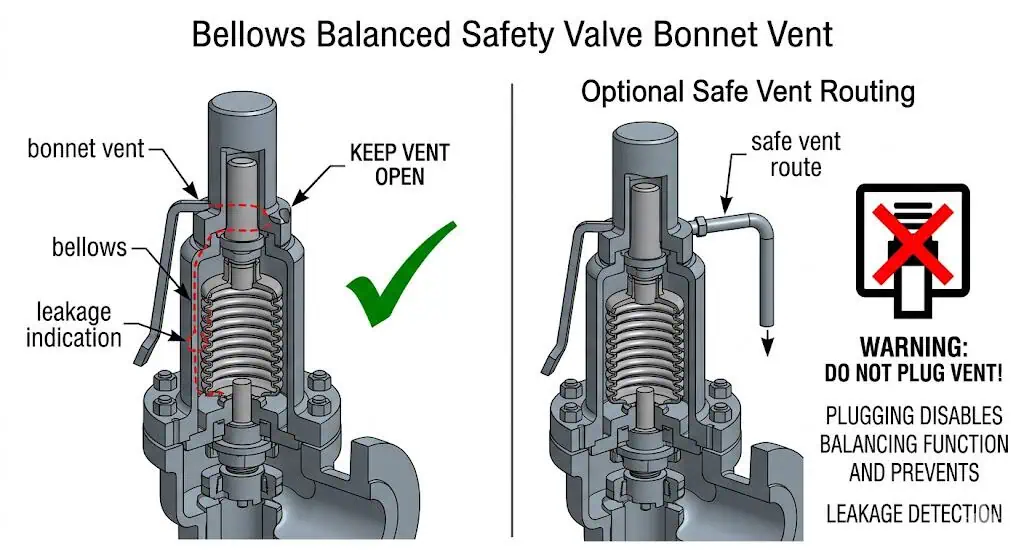
The bonnet vent on a bellows balanced safety valve should be reviewed during installation. Incorrect plugging or restricted vent piping can affect balancing performance and leak detection.
Drainage, Orientation, and Maintenance Access
Drainage, valve orientation, outlet support, thermal expansion, discharge reaction forces, and access for inspection can affect long-term reliability. If the valve cannot be removed or tested without major shutdown work, maintenance cost and lead time may increase.
Review inlet line length, inlet fittings, outlet line resistance, discharge reaction forces, drainage, common header pressure, venting requirements, and access for testing. Incorrect installation can make either valve type unreliable. For more installation details, refer to the safety valve installation guide.
Maintenance and Failure Risks Compared
Common Failure Modes of Conventional Spring Loaded Valves
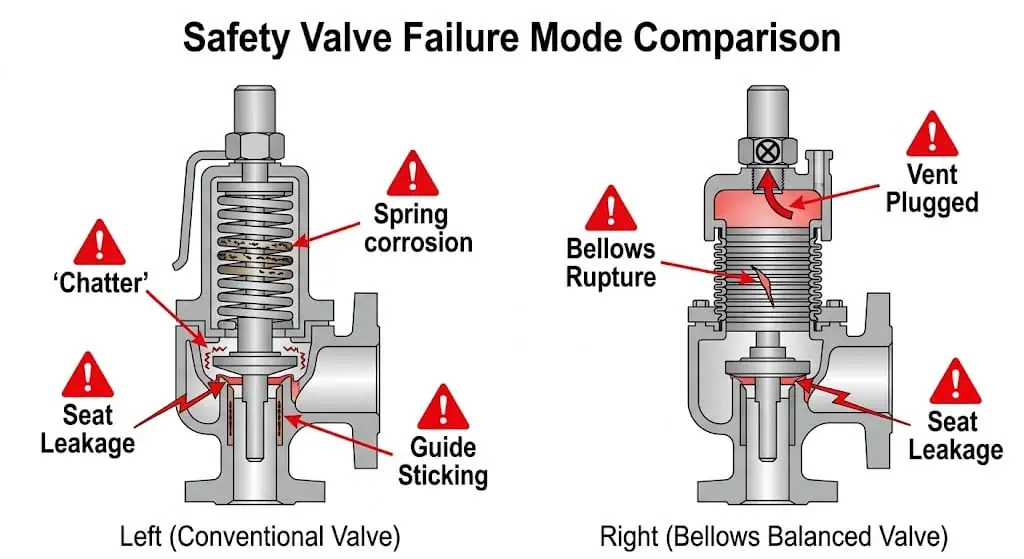
Common conventional valve problems include seat leakage, spring corrosion, guide sticking, chatter, incorrect set pressure after repair, and poor reseating due to discharge piping or inlet pressure loss. These problems are often connected to installation, service medium, or maintenance procedure rather than manufacturing alone.
Common Failure Modes of Bellows Balanced Valves
Bellows balanced valves can also experience seat leakage, chatter, spring problems, and guide sticking. In addition, they introduce bellows-specific risks such as bellows fatigue, rupture, corrosion cracking, vent leakage, and incorrect vent piping.
Bellows Rupture, Vent Leakage, and Corrosion Warning Signs
Fluid, vapor, or residue at the bonnet vent may indicate bellows leakage or rupture. This should not be treated as a minor cosmetic issue. If the bellows fails, the valve may lose back pressure compensation and process fluid may enter the bonnet area.
Common failure modes include chatter, seat leakage, spring chamber corrosion, bellows rupture and vent blockage. The likely failure mode depends on service conditions, installation and maintenance quality.
Testing and Recalibration After Maintenance
After maintenance, the valve should not be returned to service based only on visual inspection. Set pressure, seat tightness, bellows condition, vent condition, sealing, and documentation should be checked according to the applicable plant procedure, project specification, and local jurisdictional requirement.
If the valve has been repaired, disassembled, adjusted, or exposed to a relief event, the review should confirm whether recalibration, retesting, resealing, and updated documentation are required. Where a National Board / NBIC or VR repair route is required by the jurisdiction or owner specification, the repair organization and documentation scope should be confirmed before the valve is released back to service.
Failure Mode
More Common In
Cause
Field Symptom
Prevention
Chatter
Both, but severe in misapplied conventional valves
Oversizing, inlet loss, unstable back pressure
Rapid opening and closing, vibration, seat damage
Check sizing, inlet piping, outlet piping, and back pressure
Specify seat tightness requirement and inspect after relief events
Spring chamber corrosion
Conventional valve in corrosive service
Process fluid exposure or poor material selection
Sticking, set pressure drift, poor repeatability
Review medium, trim, bonnet exposure, and material compatibility
Bellows rupture
Bellows balanced valve
Fatigue, corrosion, vibration, mechanical damage
Fluid at bonnet vent or abnormal valve behavior
Inspect bellows, monitor vent leakage, review material selection
Vent plugged
Bellows balanced valve
Installation error or misunderstanding
Late opening, unstable lift, incorrect reseating
Follow manufacturer and project venting requirements
Set pressure drift after repair
Both
Adjustment error, spring issue, improper reassembly, no final calibration
Valve opens above or below intended pressure
Perform documented set pressure test, sealing, and release inspection
Cost and Procurement Considerations
Initial Cost vs Lifecycle Cost
A conventional spring loaded valve usually has a lower initial purchase cost and simpler spare parts requirements. A bellows balanced valve usually costs more because of the bellows assembly, additional inspection requirements, and more specific material review. However, in variable back pressure or corrosive service, the bellows balanced valve may reduce leakage, repeated maintenance, seat damage, and operating instability.
Lead Time, Spare Parts, and Bellows Replacement
Bellows material, special trim, soft seat requirements, and documentation can affect lead time. If the plant requires spare bellows or special materials, these should be discussed before purchase. Waiting until failure occurs can extend downtime.
Documentation, Test Reports, and Project Compliance
Procurement should confirm set pressure test report, seat tightness test, material certificates, nameplate data, inspection report, drawing approval, and any project-specific documentation. If repair or recalibration must follow a recognized repair program or jurisdictional process, this should be clarified before the valve is ordered.
Why Matching Flange Size Is Not Enough
Matching inlet size, outlet size, pressure class, and set pressure is not enough to confirm a correct replacement. The required relieving capacity, orifice area, fluid state, inlet pressure loss, outlet back pressure, and discharge system must also be reviewed. This is why safety valve replacement should be checked against safety valve sizing and certified relieving capacity, not only connection size.
Field scenario: What problem occurred: a replacement valve was purchased by matching the old flange size and set pressure. Why it happened: the purchasing process did not check whether the protected equipment duty had changed. Real system cause: process expansion increased the required relieving capacity. Corrective action: recheck the relief scenario, certified capacity, orifice area, inlet pressure loss, and outlet back pressure. Prevention: require engineering review before replacing any safety valve in modified service.
How to Choose Between Conventional and Bellows Balanced Safety Valves
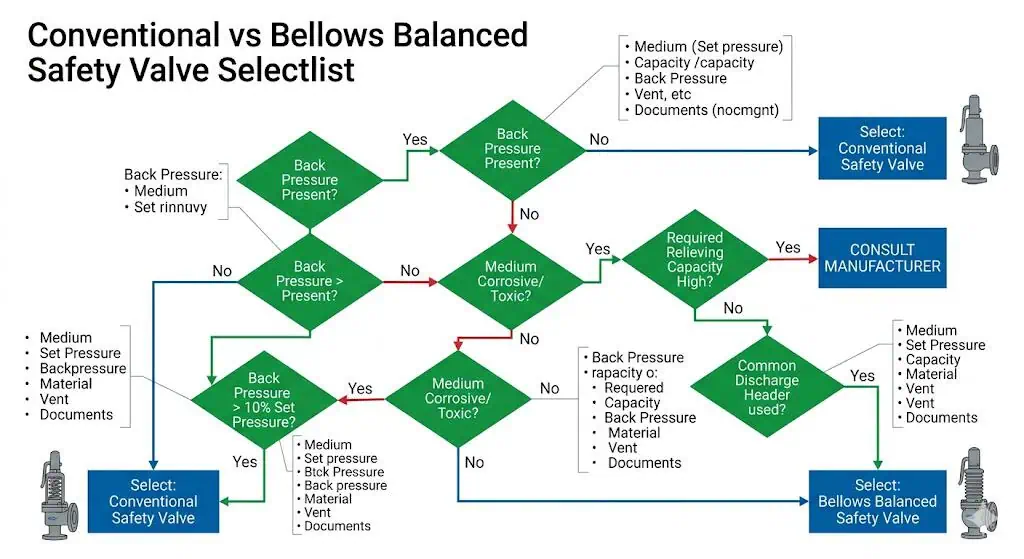
Selection should start with back pressure, medium behavior, relieving capacity, installation conditions, material compatibility and documentation requirements.
Step 1: Confirm Back Pressure Conditions
Identify whether back pressure is low, high, constant, variable, superimposed, or built-up. Confirm whether the valve discharges to atmosphere, a short tail pipe, a closed header, or a flare system. This is the first screening step between conventional and bellows balanced designs.
Step 2: Confirm Medium and Corrosion Risk
Check whether the medium is clean, corrosive, dirty, sticky, toxic, expensive, or likely to polymerize or crystallize. If spring chamber protection is needed, bellows balanced construction may be more appropriate, but bellows material must be reviewed.
Step 3: Confirm Required Relieving Capacity
Required relieving capacity determines whether the valve can actually protect the equipment during the credible overpressure scenario. Orifice area and certified capacity basis are more important than visible connection size. Capacity review should include fluid state, relieving temperature, inlet loss, and outlet back pressure.
Step 4: Review Installation and Discharge System
Review inlet line length, inlet fittings, outlet line resistance, discharge reaction forces, drainage, common header pressure, venting requirements, and access for testing. Incorrect installation can make either valve type unreliable. For more installation details, refer to the safety valve installation guide.
Step 5: Confirm Testing, Maintenance, and Documentation Requirements
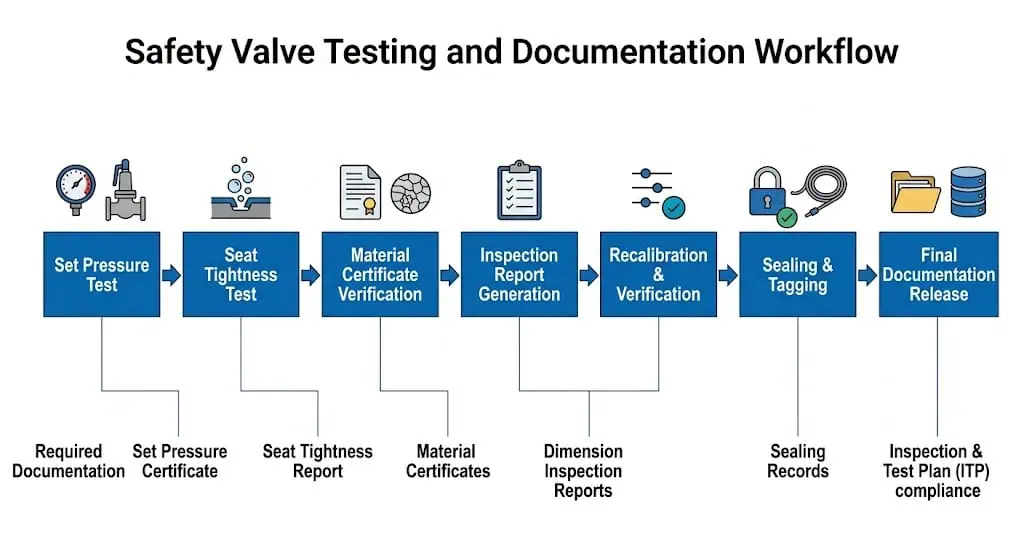
Before purchase, confirm set pressure test, seat tightness test, material certificates, inspection documents, repair route, recalibration procedure, and sealing requirements. The correct valve is not only the one that fits the pipe; it is the one that can be verified, maintained, and documented for the service.
Selection data checklist:
Medium name and composition
Gas, vapor, steam, liquid, or two-phase service
Normal operating pressure
Set pressure requirement
Required relieving capacity
Required orifice area or certified capacity basis
Superimposed back pressure
Built-up back pressure during relief
Inlet pressure loss estimate
Outlet piping and discharge header data
Corrosion or fouling risk
Body and trim material requirement
Bellows material requirement, if applicable
Bonnet vent treatment, if applicable
Seat tightness requirement
Required test and inspection documents
Project review CTA: Not sure whether your service needs a conventional spring loaded safety valve or a bellows balanced safety valve? Send ZOBAI your medium, set pressure, required relieving capacity, back pressure data, discharge system, temperature, material requirement, and documentation requirements. Our engineering team can review the operating conditions and suggest whether a conventional spring loaded valve, bellows balanced valve, pilot operated valve, or another pressure relief solution should be evaluated first.
FAQs About Bellows Balanced vs Conventional Spring Loaded Safety Valves
What is the difference between a bellows balanced and conventional spring loaded safety valve?
A conventional spring loaded safety valve uses spring force to keep the disc closed and is more sensitive to outlet back pressure. A bellows balanced safety valve adds a metallic bellows to reduce back pressure influence and isolate the spring chamber from process fluid.
When should I use a bellows balanced safety valve?
Use a bellows balanced safety valve when back pressure is variable or significant, when the valve discharges to a closed header or flare system, or when corrosive or dirty fluid may affect the spring chamber.
When is a conventional spring loaded safety valve enough?
A conventional valve may be enough for clean service, low or stable back pressure, simple discharge piping, and applications where the medium does not attack the spring chamber or moving parts.
Does a bellows balanced valve eliminate back pressure problems?
No. It reduces back pressure influence within design limits, but outlet piping, discharge header pressure, certified capacity, and valve stability must still be reviewed.
How does back pressure affect a conventional safety valve?
Back pressure can change the net force acting on the disc, which may affect opening pressure, lift, relieving capacity, and reseating behavior.
Is a bellows balanced valve better for corrosive media?
It can be better when spring chamber protection is needed, but the bellows material, trim, seat, gaskets, and vent piping must be compatible with the medium.
What happens if the bellows fails?
If the bellows fails, the valve may lose its intended back pressure compensation and process fluid may enter the bonnet area. Vent leakage or abnormal operation should be investigated.
Should the bonnet vent be plugged?
The bonnet vent should not be plugged unless the manufacturer and project specification allow a defined vent arrangement. Incorrect plugging can affect valve operation and leak detection.
Is a bellows balanced valve more expensive?
Usually yes, because it includes a bellows assembly and requires additional inspection and material review. The lifecycle cost may still be justified in variable back pressure or corrosive service.
What data is needed to choose between conventional and bellows balanced valves?
Key data includes medium, fluid state, set pressure, operating pressure, required relieving capacity, back pressure, discharge system, material requirement, temperature, seat tightness requirement, and documentation needs.
Standards and Technical References Note
Final valve sizing, selection, installation, testing, and documentation should be verified according to the applicable project code, local regulation, owner specification, and manufacturer-certified data. For this comparison, engineers commonly review API 520 Part I for sizing and selection, API 520 Part II for installation and discharge piping, API 521 for pressure-relieving and depressuring systems, API 527 for seat tightness testing, ISO 4126-1 for safety valve general requirements, and ISO 4126-4 when pilot-operated safety valves are considered as an alternative.
Publishing note: Do not state compliance with ASME, API, ISO, CE, PED, National Board, or other certifications unless ZOBAI has confirmed valid certificates, valid scope, product coverage, edition applicability, and market requirements for the specific valve model.
This article is prepared for technical education and preliminary project discussion. Final safety valve selection should be reviewed by qualified engineers based on the protected equipment, process medium, set pressure, required relieving capacity, back pressure, inlet pressure loss, outlet system, material compatibility, installation layout, maintenance route, and applicable code requirements.
Review focus: conventional spring loaded safety valve selection, bellows balanced safety valve selection, back pressure effect, corrosive service, discharge system review, failure risk, testing, procurement checklist, and B2B project review points.
Testing and documentation should confirm set pressure, seat tightness, material certificates, inspection records, recalibration, sealing and release documentation before the valve is returned to service or shipped.
Related Safety Valve Engineering Resources
For project review, these related ZOBAI pages may help confirm the correct valve type and selection data:
For a practical recommendation, send ZOBAI the medium, operating pressure, set pressure, relieving temperature, required relieving capacity, superimposed back pressure, built-up back pressure, inlet and outlet connection, material requirement, discharge system information, and required documentation. This allows an engineering review of whether a conventional spring loaded safety valve, bellows balanced safety valve, pilot operated safety valve, or another pressure relief solution should be evaluated for your system.
Suggested RFQ attachment: P&ID, protected equipment data sheet, relief scenario, discharge system information, valve specification, material requirement, and inspection documentation requirement.
Related Engineering Guides
Continue with these focused guides when the engineering review reaches the corresponding sizing, selection, installation, or maintenance question:
To provide the best experiences, we use technologies like cookies to store and/or access device information. Consenting to these technologies will allow us to process data such as browsing behavior or unique IDs on this site. Not consenting or withdrawing consent, may adversely affect certain features and functions.
Functional
Always active
The technical storage or access is strictly necessary for the legitimate purpose of enabling the use of a specific service explicitly requested by the subscriber or user, or for the sole purpose of carrying out the transmission of a communication over an electronic communications network.
Preferences
The technical storage or access is necessary for the legitimate purpose of storing preferences that are not requested by the subscriber or user.
Statistics
The technical storage or access that is used exclusively for statistical purposes.The technical storage or access that is used exclusively for anonymous statistical purposes. Without a subpoena, voluntary compliance on the part of your Internet Service Provider, or additional records from a third party, information stored or retrieved for this purpose alone cannot usually be used to identify you.
Marketing
The technical storage or access is required to create user profiles to send advertising, or to track the user on a website or across several websites for similar marketing purposes.