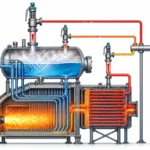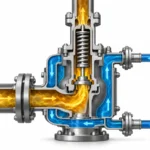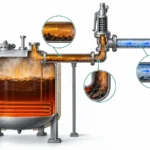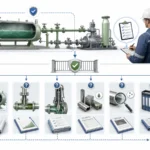
An oxygen service safety valve is not ready for review simply because it has been cleaned or made from a material commonly associated with oxygen duty. Readiness depends on three separate evidence streams: the required pressure-relief duty, component-level material compatibility, and verified cleanliness with contamination control. Those evidence streams cannot substitute for one another. Pressure-relief …

An oxygen service safety valve is not ready for review simply because it has been cleaned or made from a material commonly associated with oxygen duty. Readiness depends on three separate evidence streams: the required pressure-relief duty, component-level material compatibility, and verified cleanliness with contamination control.
Those evidence streams cannot substitute for one another. Pressure-relief evidence does not prove oxygen cleanliness. A cleaning record does not prove relieving performance or material compatibility. A material record does not show that the valve was cleaned, inspected, and protected from recontamination. The practical task is to close each question independently before the candidate proceeds to engineering or RFQ review.
What Must Be Verified Before a Safety Valve Is Considered Ready for Oxygen Service?
Verify three things independently: the pressure-relief duty, the actual component materials, and the cleanliness condition. A candidate should remain unresolved if any one of these evidence streams is missing, even when the other two are well documented.
| Verification area | Question to close | What it does not prove |
|---|---|---|
| Pressure-relief duty | Does the candidate satisfy the required overpressure-protection duty under the applicable engineering basis? | Oxygen cleanliness or component compatibility |
| Material compatibility | Are the relevant metallic and nonmetallic components supported for the defined oxygen service? | Cleanliness, preservation, or relieving performance |
| Cleanliness and contamination control | Was the required clean condition defined, achieved, verified, and preserved? | Pressure-relief duty or complete material suitability |
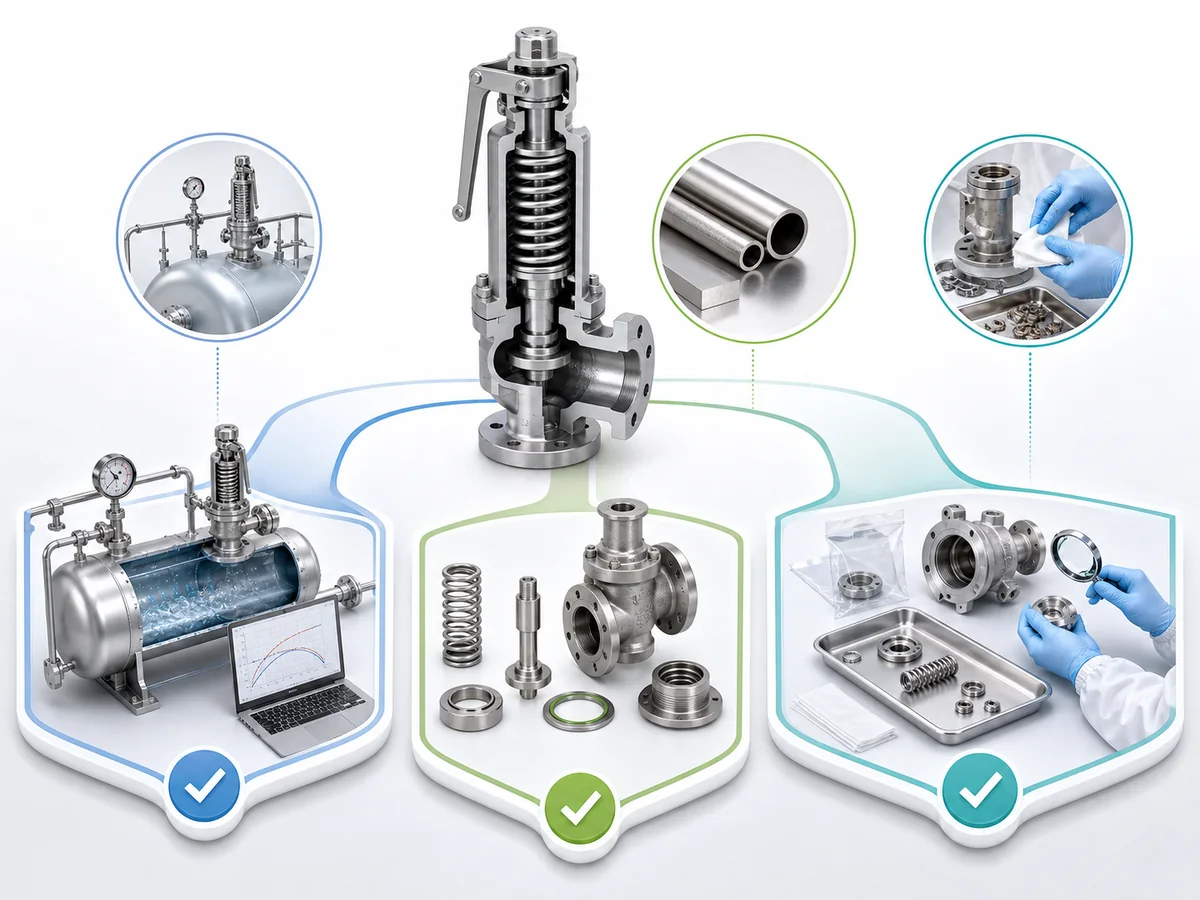
Pressure-relief duty suitability
Oxygen-specific cleaning and material controls do not replace the valve’s pressure-protection function. The protected equipment, required relieving duty, proposed configuration, and applicable engineering basis still belong to the separate pressure-relief review.
A valve can therefore have strong oxygen-cleaning documentation and still remain on HOLD because its relief-duty evidence is incomplete. Strong relieving-performance evidence creates the opposite boundary: it does not close unresolved material or cleanliness questions.
Material compatibility
Material compatibility also has to be demonstrated separately from cleaning status. The relevant question is not whether the valve body carries a familiar material designation, but whether the actual metallic and nonmetallic components are supportable for the defined oxygen service and current configuration.
Cleanliness and contamination-control status
Cleanliness asks whether contamination has been controlled to the applicable basis and whether that verified condition can still be relied on. The useful evidence sequence is:
requirement defined → cleaning performed → condition verified → condition preserved.
MSS oxygen-cleaning practice for valves and fittings treats cleaning as a defined process scope rather than proof of complete valve design or material suitability. The review should therefore follow one rule throughout this article: evidence from one readiness layer can support the overall decision, but it cannot replace evidence belonging to another layer.
What Does Cleanliness Evidence Actually Prove?
Oxygen-service cleanliness evidence should answer three separate questions: what cleaning was performed, whether the required condition was verified, and whether that condition remained protected afterward. A record that answers only one of those questions should not be treated as evidence for all three.
| Evidence stage | Question it answers | Reason to hold the review |
|---|---|---|
| Cleaning process | What was done to remove relevant contamination? | The required cleanliness condition is not defined. |
| Cleanliness verification | Was the resulting condition checked against the applicable acceptance basis? | The inspection basis, method, or result is missing or ambiguous. |
| Preservation | Can the verified condition still be relied on after later handling? | Packaging or subsequent exposure makes the current condition uncertain. |
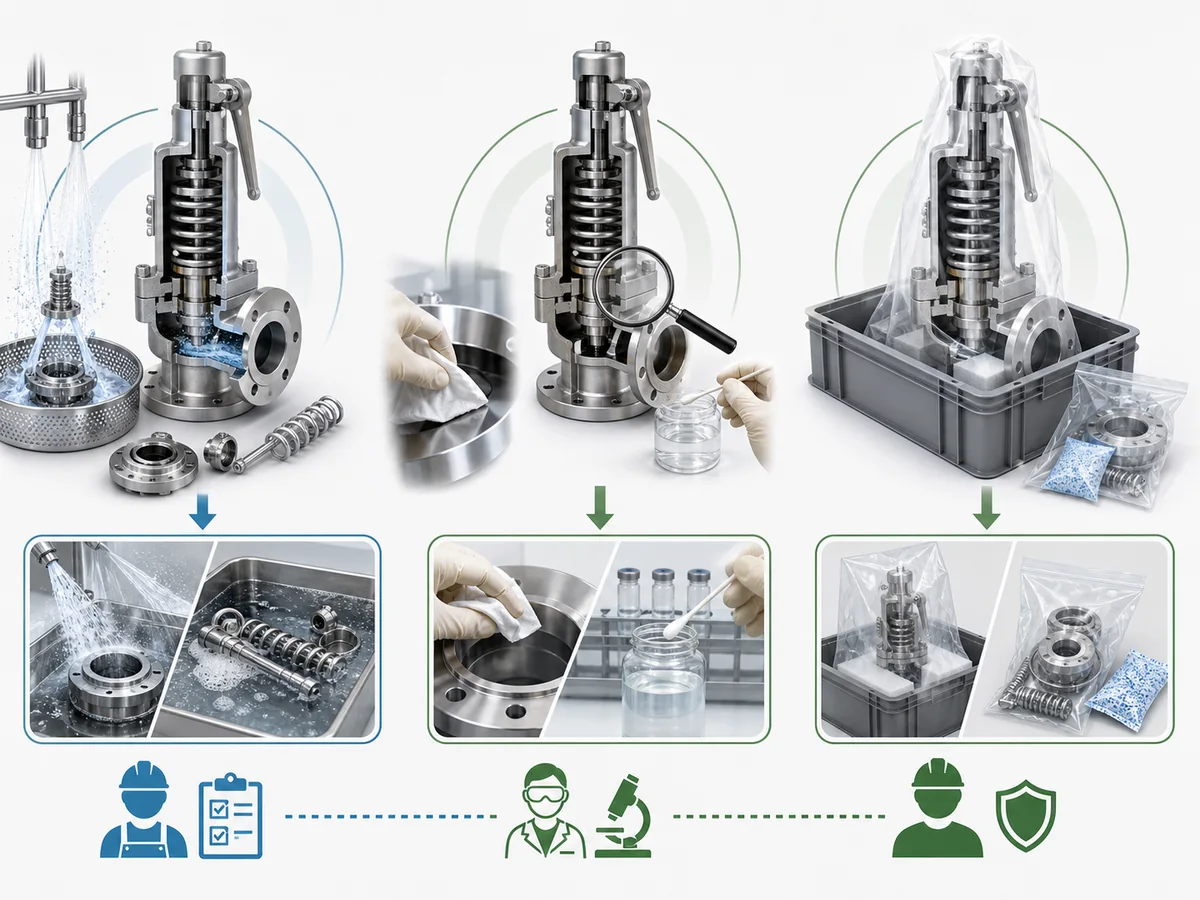
Cleaning-process evidence
ASTM oxygen-service cleaning guidance treats contamination control as part of managing oxygen-service fire risk. The concern is broader than visible oil or grease; particulate and other foreign material can also matter. The cleaning approach therefore has to reflect the actual contamination, the components being cleaned, the cleaning agent, and the required cleanliness condition.
A procedure answers what was done. It does not, by itself, establish that the specified result was achieved.
Cleanliness acceptance and verification
ASTM oxygen-service cleanliness guidance does not establish one universal cleanliness limit for every safety valve or application. The acceptance basis must instead come from the applicable project, specification, or engineering requirement.
Verification should answer three practical questions: what condition was required, how was it checked, and what result was recorded? If one of those elements is unresolved, the cleanliness evidence remains incomplete.
Preservation after cleaning
ASTM and oxygen-industry cleaning guidance also treat preservation as part of the cleanliness lifecycle. A verified clean condition does not remain valid automatically. Assembly, packaging, storage, transport, unpacking, field handling, installation, and later maintenance can all create new contamination exposure.
A practical cleanliness check can follow this sequence:
-
Confirm the acceptance basis.
If the required condition is undefined, place the cleanliness decision on HOLD. -
Confirm the cleaning record.
Check that the documented process applies to the actual valve or components being reviewed. -
Confirm verification.
Look for evidence that the required condition was checked rather than assuming that following a cleaning process guaranteed the result. -
Confirm preservation.
Determine whether later packaging and handling allow the verified condition to remain credible. -
Re-open verification when preservation becomes uncertain.
Do not rely only on historical clean status when later exposure has created a new question.
This sequence prevents a common evidence error: using a detailed cleaning procedure to compensate for an undefined acceptance basis, missing inspection result, or uncertain current condition.
How Should Material Compatibility Be Reviewed at Component Level?
Review the components that actually make up the oxygen-relevant assembly. A body-material designation alone cannot represent the metallic parts, nonmetallic parts, soft goods, and cleaning-agent exposures that may affect the current configuration.
Metallic components
ASTM oxygen-service material guidance treats metallic material assessment as an evaluation problem rather than a blanket approval list. Metallic components should therefore be reviewed within the defined oxygen-service context instead of being treated as universally acceptable because they belong to a familiar alloy family.
The practical question is therefore not “Is this alloy commonly used?” but “Which metallic components in this candidate are relevant to the oxygen-wetted path, and what evidence supports their use in this configuration?”
Nonmetallic components and soft goods
ASTM separately addresses nonmetallic oxygen-service material evaluation. Seats, seals, gaskets, packing, and other nonmetallic or soft components therefore require their own evidence; their suitability should not be inferred from surrounding metallic parts or from a generic material-family name.
NASA oxygen-compatibility engineering guidance also reinforces that material behavior cannot always be separated from component configuration. If a seat, seal, gasket, packing arrangement, or other decision-relevant component changes, an earlier compatibility review should not automatically be assumed to cover the revised assembly.
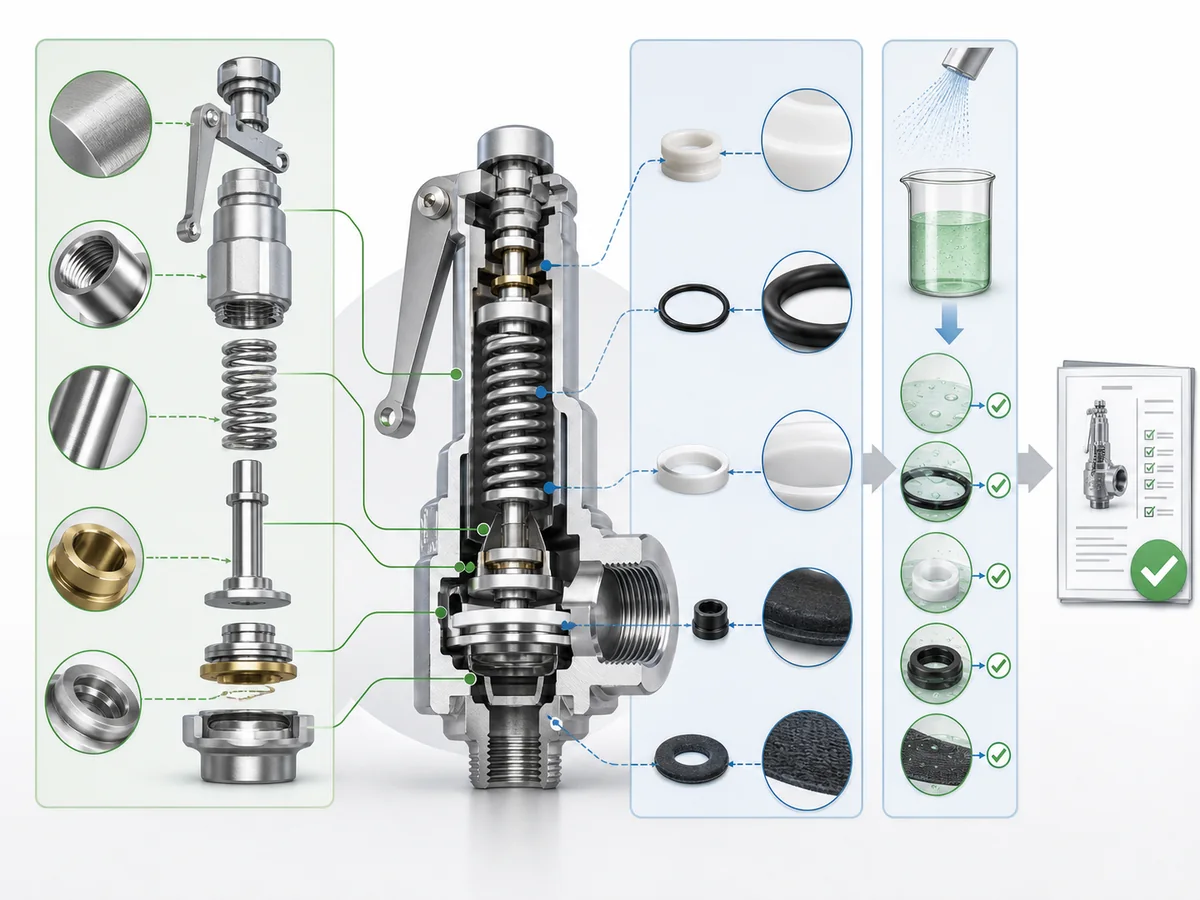
Cleaning-agent compatibility
ASTM cleaning-agent guidance treats cleaning effectiveness and material compatibility as separate considerations. An agent that removes contamination effectively still has to be compatible with the components it contacts, including relevant seats, seals, gaskets, packing, sealants, and other nonmetallic materials.
The review should therefore connect three items:
- the actual component or material identification;
- the cleaning process or agent that contacts that component;
- the evidence supporting that combination for the applicable cleaning and service context.
If one link is missing, HOLD is more defensible than assuming that a familiar cleaner, common material family, or acceptable valve body closes the issue.
| Review question | Evidence needed to continue | Re-open the review when |
|---|---|---|
| Are the relevant metallic components identified? | The current candidate configuration is sufficiently documented. | The record covers only the body or an incomplete component set. |
| Are nonmetallic components identified? | Relevant seats, seals, gaskets, packing, or similar parts are known. | A decision-relevant soft component is missing from the material record. |
| Has the configuration changed? | The evidence corresponds to the current configuration. | Repair or component substitution means earlier evidence may no longer match the assembly. |
| Is cleaning-agent interaction addressed? | The cleaning process is supported for relevant contacted materials. | The cleaner/material relationship is unknown or belongs to a different configuration. |
Where Can Contamination Re-Enter After Cleaning?
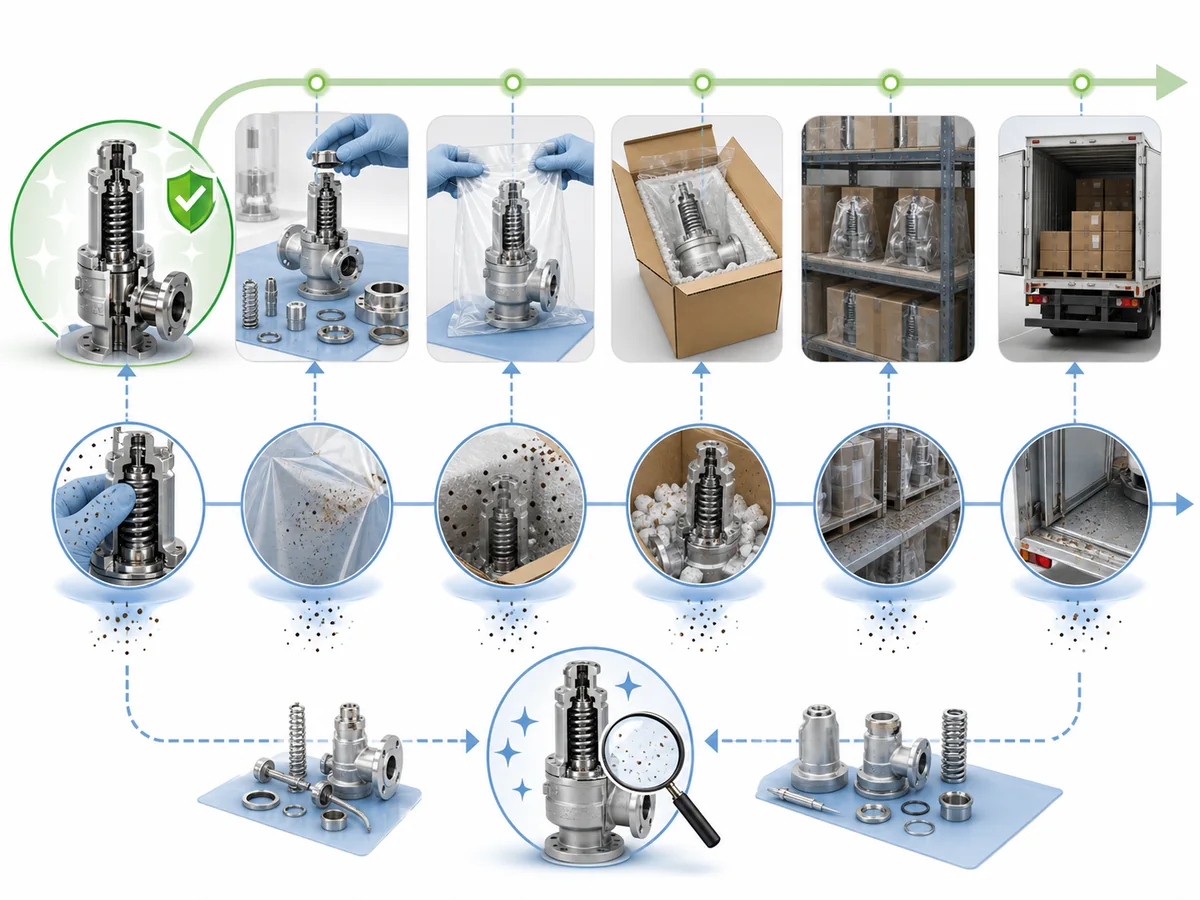
Recontamination can occur after the initial cleanliness check. Assembly, packaging, storage, transport, unpacking, field handling, installation, maintenance, and reassembly are all interfaces where the verified condition can become uncertain.
EIGA oxygen-equipment cleaning guidance treats packaging, storage, transport, handling, and later use as part of preserving a cleaned condition. Its valve guidance also supports renewed cleanliness attention when installation or maintenance introduces uncertainty, while those valve-specific practices must remain within their applicable service scope.
-
Assembly:
cleaned parts can encounter tools, work surfaces, debris, or other foreign material if controlled handling is lost. -
Packaging:
packaging has to preserve the verified condition rather than merely enclose the valve. -
Storage and transport:
the clean condition has to remain credible while the valve is stored or moved before installation. -
Unpacking and field handling:
opening or handling the package creates another exposure interface and may require verification when cleanliness becomes uncertain. -
Installation:
field work can expose the valve to tools, adjacent equipment, debris, or the local work environment. -
Maintenance and reassembly:
removal, repair, component replacement, and reassembly can break the previous cleanliness and material-evidence chain.
Assembly and packaging
Packaging belongs to contamination control because it preserves an already verified condition. A strong cleaning record loses decision value when later assembly or packaging introduces a cleanliness question that is not subsequently resolved.
Storage, transport and handling
Preservation remains relevant until the valve reaches the point of use. If packaging is damaged, unexpectedly opened, or otherwise leaves the condition uncertain, the earlier cleaning record alone may no longer be enough for acceptance.
The appropriate logic is not “package opened = reject.” Oxygen-industry cleaning guidance supports a verification-based response when preservation becomes uncertain rather than treating package opening by itself as proof of final unsuitability.
- identify which preservation control has been lost or questioned;
- determine which surfaces or components may have been exposed;
- review whether inspection or renewed cleanliness verification is required under the applicable basis;
- reclean when the required condition cannot otherwise be demonstrated;
- restore the applicable preservation controls before the valve continues through the supply or installation chain.
Installation and maintenance exposure
Installation or maintenance does not automatically mean that contamination occurred, but both activities can make the previous clean condition uncertain. When that happens, return the affected cleanliness question to verification rather than assuming that the historical cleaning status is still valid.
Maintenance can also change the evidence basis itself. A repaired valve may no longer have the same component configuration, cleanliness condition, or preservation history as the originally supplied assembly. Material and cleanliness records should therefore correspond to the current configuration before earlier acceptance evidence is reused.
What Supplier Documentation Should Support Oxygen-Service Readiness?
Ask for documents that answer defined engineering questions instead of requesting one undefined “oxygen certificate.” Cleaning, material compatibility, cleanliness preservation, traceability, and pressure-relief duty belong to separate evidence streams.
EIGA oxygen-cleaning guidance supports item identification, cleaning records, inspection results, preservation, and traceability as distinct parts of a controlled cleaning record. MSS oxygen-cleaning practice for valves and fittings likewise keeps cleaning evidence separate from broader design and material-suitability questions.
| Evidence group | Question it should answer | Do not assume it proves |
|---|---|---|
| Item identification and traceability | Do these records belong to the valve or components being reviewed? | Technical suitability by itself |
| Cleaning basis and method | What cleaning process was applied, and to what item? | That the required cleanliness condition was achieved |
| Cleanliness verification | Was the defined clean condition checked and recorded? | Material compatibility or relieving performance |
| Material and component records | What metallic and nonmetallic components are actually present? | Oxygen cleanliness or pressure-relief duty |
| Packaging and preservation evidence | Was the verified condition protected after cleaning? | Current cleanliness after an unresolved exposure event |
| Pressure-relief duty evidence | Does the candidate satisfy the defined overpressure-protection requirement? | Oxygen cleanliness or material compatibility |
| Deviations and open exceptions | What requirement remains unresolved? | Approval by omission |
Cleaning scope and acceptance evidence
A useful cleaning record should identify the item, describe the applicable cleaning basis or method, and show how the resulting condition was verified when verification is required. The value of the record comes from its scope and traceability, not from the word “certificate” in its title.
Material and component records
Material records should support the component-level review in S03. They should identify the relevant metallic and nonmetallic parts clearly enough that compatibility is not being inferred from a general body-material entry.
Packaging, preservation and traceability
Preservation evidence connects the post-cleaning result to the condition in which the valve is supplied. If later handling makes that condition uncertain, the evidence should trigger verification rather than an assumption that the original clean state is unchanged.
Open exceptions requiring project review
Missing information should remain visible. An unresolved seat or seal material, undefined cleanliness acceptance basis, unclear traceability, uncertain packaging condition, or incomplete relief-duty requirement should not be converted into a positive assumption simply to keep procurement moving.
The supplier records should also agree with one another. If the material record describes one configuration while the cleaning record or traceability record refers to another, adding more documents does not close the gap. The inconsistent evidence stream should return to HOLD until the records and current valve configuration align.
Testing records require the same discipline. A cleaning-related inspection or test should not be treated as relieving-capacity evidence unless that record specifically belongs to the separate pressure-relief duty.
When Should a Candidate Proceed, Be Held, or Be Rejected From the Current Review?
Use three outcomes. PROCEED means the evidence is adequate for the next engineering or RFQ review. HOLD means a decision-relevant question remains unresolved. REJECT means the available evidence establishes a known mismatch against the defined requirement.
These are review labels used in this article, not certification categories. PROCEED does not mean final project approval.
Check each evidence stream before assigning an outcome
| Review area | Question to close | HOLD when |
|---|---|---|
| Pressure-relief duty | Does the candidate have adequate evidence for the defined protection duty? | The duty or supporting evidence is incomplete. |
| Metallic components | Are the relevant metallic parts identified and supportable? | Component identity or compatibility evidence is incomplete. |
| Nonmetallic components | Are relevant seats, seals, gaskets, packing, and other soft goods addressed? | A decision-relevant component remains unidentified or unevaluated. |
| Cleaning-agent boundary | Is the cleaning process supported for the materials it contacts? | The cleaner/material interaction is uncertain. |
| Cleanliness verification | Is the applicable acceptance basis and verification evidence clear? | The basis, inspection evidence, or result is missing or ambiguous. |
| Preservation and handling | Can the verified clean condition still be relied on? | Packaging, handling, or later exposure creates unresolved uncertainty. |
| Documentation and traceability | Do the records correspond to the supplied candidate and current configuration? | The records are missing, ambiguous, or cannot be matched to the item. |
PROCEED
Proceed only when the required relief duty is defined, relevant component materials are identified and supportable, the cleanliness basis is understood, verification evidence is available, preservation remains credible, and the records correspond to the candidate under review.
A useful final test is to ask whether every positive conclusion can be traced to its correct evidence stream. If relief duty is supported only by a cleaning record, material compatibility only by a body-material label, or current cleanliness only by an old record after uncertain handling, the candidate is not ready to proceed.
HOLD
Use HOLD when additional evidence could change the decision. Examples include an incomplete component list, unresolved soft-good compatibility, an undefined cleanliness acceptance basis, missing inspection evidence, questionable packaging integrity, unclear cleaning-agent compatibility, or weak traceability.
HOLD also applies when earlier evidence no longer clearly matches the current configuration. A component replacement, maintenance intervention, reopened package, or revised document set can reopen the affected evidence stream without automatically invalidating every other part of the review.
REJECT
Reserve REJECT for a known mismatch: a defined relief-duty requirement that is not met, a component that does not satisfy the established compatibility basis, a cleanliness condition known to have failed without corrective closure, or another confirmed requirement that the candidate does not satisfy.
The distinction matters. Missing evidence is not proof of incompatibility, while a known incompatibility should not be softened into a documentation request simply because the candidate is commercially convenient.
| Outcome | Use when | Next step |
|---|---|---|
| PROCEED | The relevant evidence streams are sufficiently closed for the next review. | Continue to project-specific engineering or RFQ review. |
| HOLD | A decision-relevant fact, record, configuration detail, or preservation condition remains unresolved. | Request, verify, or reconcile the missing evidence. |
| REJECT | A known mismatch has been established against the defined requirement. | Do not advance the current candidate unless the mismatch is resolved through an appropriately reviewed change. |
Inputs for engineering or RFQ review
Prepare the information that controls the decision instead of asking a supplier for a generic “oxygen valve.”
- The protected equipment and required pressure-relief duty basis.
- The defined oxygen service and applicable project or engineering requirements.
- The current valve configuration and relevant component-material information.
- Metallic and nonmetallic compatibility evidence where required.
- The applicable cleanliness and acceptance basis.
- Cleaning and verification records tied to the current candidate.
- Cleaning-agent information where material interaction is relevant.
- Packaging, preservation, and handling status.
- Any configuration change, maintenance event, or package-integrity issue that may reopen an evidence stream.
- Any deviation, missing evidence, or unresolved technical question.