Selecting a cryogenic safety valve for LNG service should begin only after the relief basis is defined well enough to support candidate screening. If the governing relief duty or relieving phase is still unresolved, the correct selection decision is HOLD, not an assumed valve type. This guide addresses the next step: screening a valve candidate …

Selecting a cryogenic safety valve for LNG service should begin only after the relief basis is defined well enough to support candidate screening. If the governing relief duty or relieving phase is still unresolved, the correct selection decision is HOLD, not an assumed valve type.
This guide addresses the next step: screening a valve candidate against an already-defined LNG relief duty. It does not calculate the required relief load or valve size. Instead, it checks whether the candidate’s design family, low-temperature construction, seat and leakage basis, thermal arrangement, outlet conditions, and supporting documentation are sufficiently aligned to proceed to engineering and RFQ review.
Are You Ready to Select a Cryogenic Safety Valve for LNG Service?
You are ready to compare valve candidates only when the upstream relief basis is defined well enough to describe the duty presented to the valve. A product described as suitable for LNG or cryogenic service does not create that relief basis. Product suitability and system relief requirements are related engineering questions, but they are not the same question.
What must already be established?
The selection process needs an identified protected duty, a governing relief condition, and a required relieving duty established by the upstream relief analysis. That required duty is carried into this guide as an input; it is not recalculated here. The relieving medium and phase must also be clear enough to determine whether the candidate evidence applies to the intended duty.
The readiness gate therefore asks whether the engineering basis is mature enough to screen a component. It does not certify that sizing, system design, or final project approval is complete.
| Readiness question | Selection response |
|---|---|
| Is the protected duty and governing relief basis defined? | If yes, continue. If not, HOLD and return to the upstream relief basis. |
| Is the required relieving duty already established upstream? | Carry it forward as a selection input. Do not replace it with nominal valve size or catalogue data. |
| Is the relieving medium and phase sufficiently defined? | Continue only with candidate evidence whose service scope matches that duty. |
| Is the request based only on the words “LNG” or “cryogenic”? | HOLD. Those labels are not a complete engineering selection basis. |
What does not count as a complete selection basis?
Nominal connection size, pressure class, a familiar material name, or a general cryogenic product description may all be relevant later, but none substitutes for the defined relieving duty. Starting with those fields can reverse the engineering sequence: the buyer begins with an available valve and tries to make the duty fit it.
The correct sequence is the opposite. Define the duty first, then test whether the candidate evidence matches it.
Define the Relief Duty and Relieving Phase Before Comparing Valve Designs
The relieving phase is a selection variable because candidate evidence can be phase-bounded. Evidence established for one relieving state should not automatically be generalized to another merely because both duties involve LNG.
Carry the relieving condition into the candidate review
The valve screen should remain tied to the defined duty. The reviewer needs enough information to identify the relieving medium and phase, the required duty established upstream, and the service condition against which the candidate’s documented scope will be checked.
| Selection input | Why it matters to the candidate review | If unresolved |
|---|---|---|
| Governing relief duty | Defines the demand against which the candidate must be evaluated. | HOLD rather than infer the requirement from the valve. |
| Relieving medium and phase | Determines whether the candidate evidence covers the actual service state. | HOLD rather than substitute an assumed phase basis. |
| Relevant service condition | Provides the basis for checking low-temperature construction and other service-sensitive evidence. | HOLD if the candidate cannot be matched to the intended duty. |
Phase is an evidence boundary
Different relief-device designs may have evidence for different fluid states. A candidate documented for one phase should not be accepted for a different relieving regime without evidence that the documented scope extends to that condition.
If the project phase basis is unresolved, the correct action is HOLD. If the phase is known but the candidate evidence does not establish coverage, keep the candidate on HOLD pending evidence. If the documented candidate scope conflicts with the defined relieving phase, REJECT that candidate for the current selection path. The article should not replace any of those gaps with a convenient assumption.
Keep selection separate from sizing
This guide does not determine the required flow, calculate an orifice, or reproduce the upstream relief analysis. Those tasks establish the demand placed on the relief device. Candidate selection begins with that established demand and asks whether a particular valve configuration is supported for it.
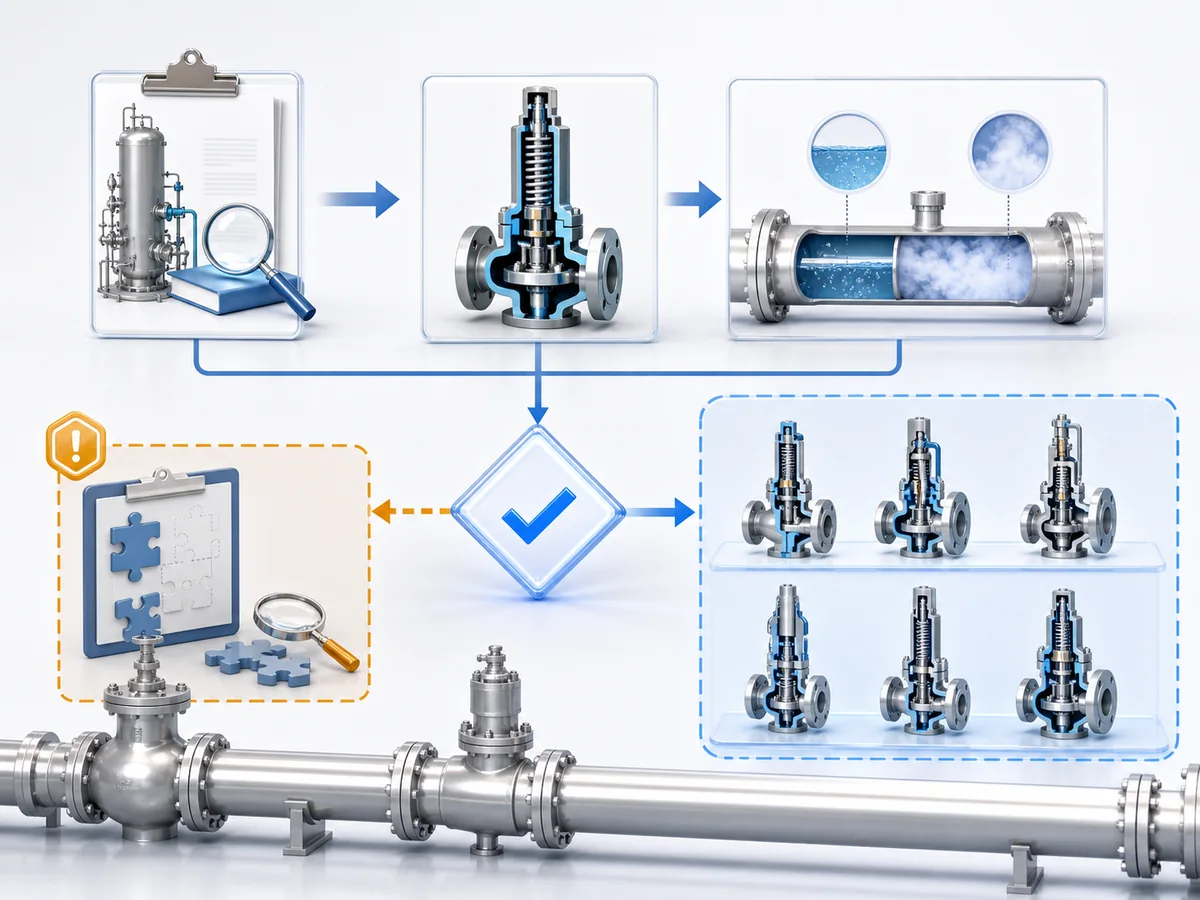
Choose the Valve Design Family From the Duty, Not From an LNG Label
There is no evidence-based rule that one valve architecture is universally best for LNG service. Direct-spring, balanced, and pilot-operated relief devices can all exist in cryogenic applications. The useful question is therefore not “Which type is the LNG type?” but “Which design families remain credible under the defined duty and installed conditions?”
The architectures do not respond identically to every system condition. Back pressure is one example: it can influence conventional spring-loaded valve behavior, while balanced or pilot-operated arrangements may manage that influence differently in specific designs. The exact acceptable behavior and limits remain candidate-specific.
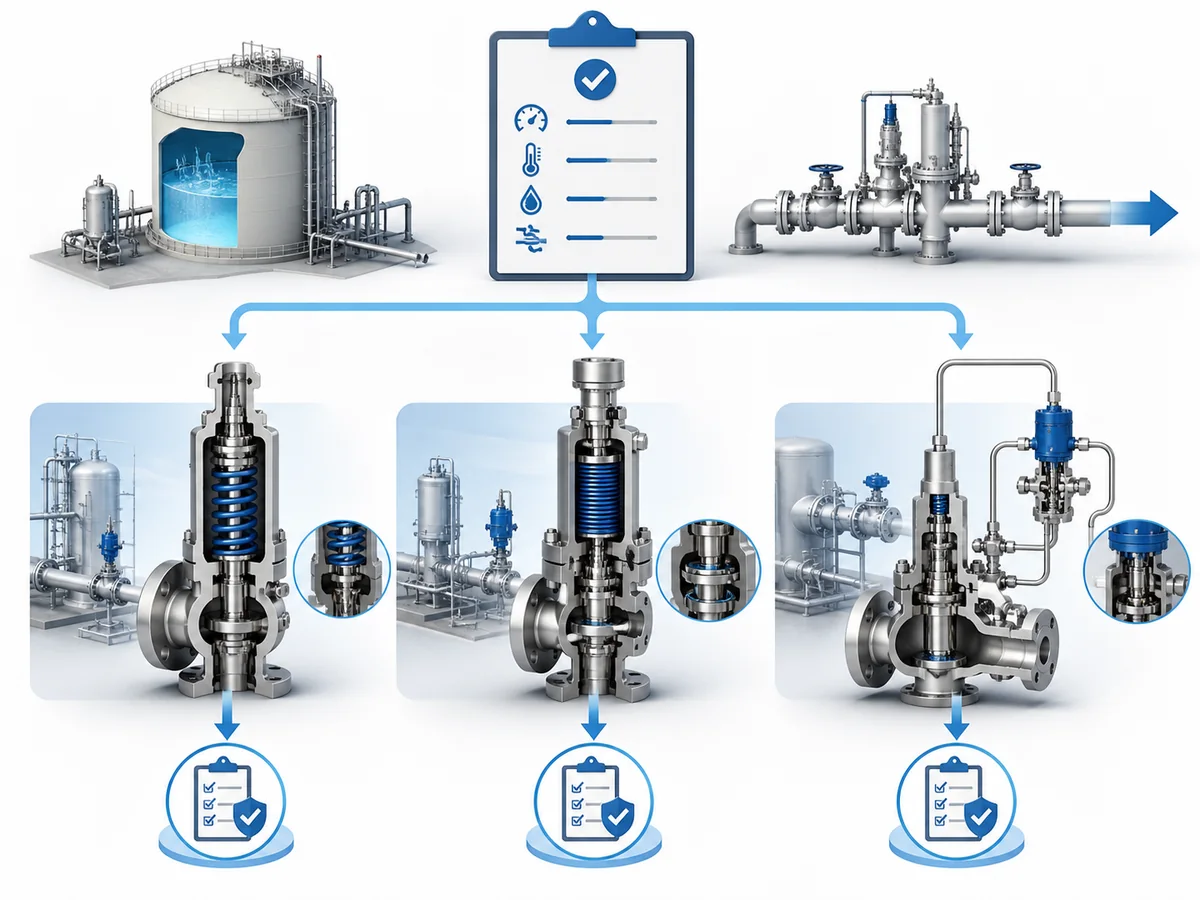
Direct-spring designs remain a conditional option
A conventional direct-spring design can be a legitimate cryogenic candidate when its documented service scope matches the duty. Because changing back pressure can affect conventional spring-loaded valve behavior, the downstream condition cannot be ignored when it is relevant to the installed system.
The existence of direct-spring cryogenic valves also disproves a common shortcut: pilot operation is not a prerequisite simply because the service is LNG.
Balanced designs address a specific system influence
Balanced arrangements may be used to reduce or compensate for the influence of back pressure in specific designs. That makes them relevant when outlet conditions are a meaningful part of the selection problem.
It does not make “balanced” a blanket answer. The actual behavior and limits belong to the specific candidate evidence, and a balanced mechanism does not remove the need to understand the installed discharge condition.
Pilot operation is another legitimate architecture, not a universal upgrade
Pilot-operated pressure-relief devices are also used in cryogenic applications. Their operating characteristics can differ materially from conventional direct-spring designs, including how particular designs respond to back pressure.
Those differences make pilot-operated designs a legitimate branch in the selection process, not a default hierarchy. Before proceeding, the reviewer still has to establish that the particular candidate covers the required relieving state, cryogenic duty, outlet condition, and project documentation requirements.
Verify Low-Temperature Construction, Materials, Seat Requirements, and Thermal Isolation
A candidate should not be accepted as cryogenic-suitable because of one material designation, one seat type, or one visible bonnet feature. Cryogenic pressure-relief suitability is a device-level question involving the complete configuration, its low-temperature service evidence, the seat and leakage requirement, and the way the relevant assembly is documented for the cold condition.
This is why generic rules such as “use stainless steel,” “use a metal seat,” or “use an extended bonnet” are not sufficient selection logic. Real cryogenic relief-valve designs use different material families, seat arrangements, and bonnet configurations. No single feature, by itself, proves suitability for the defined LNG duty.
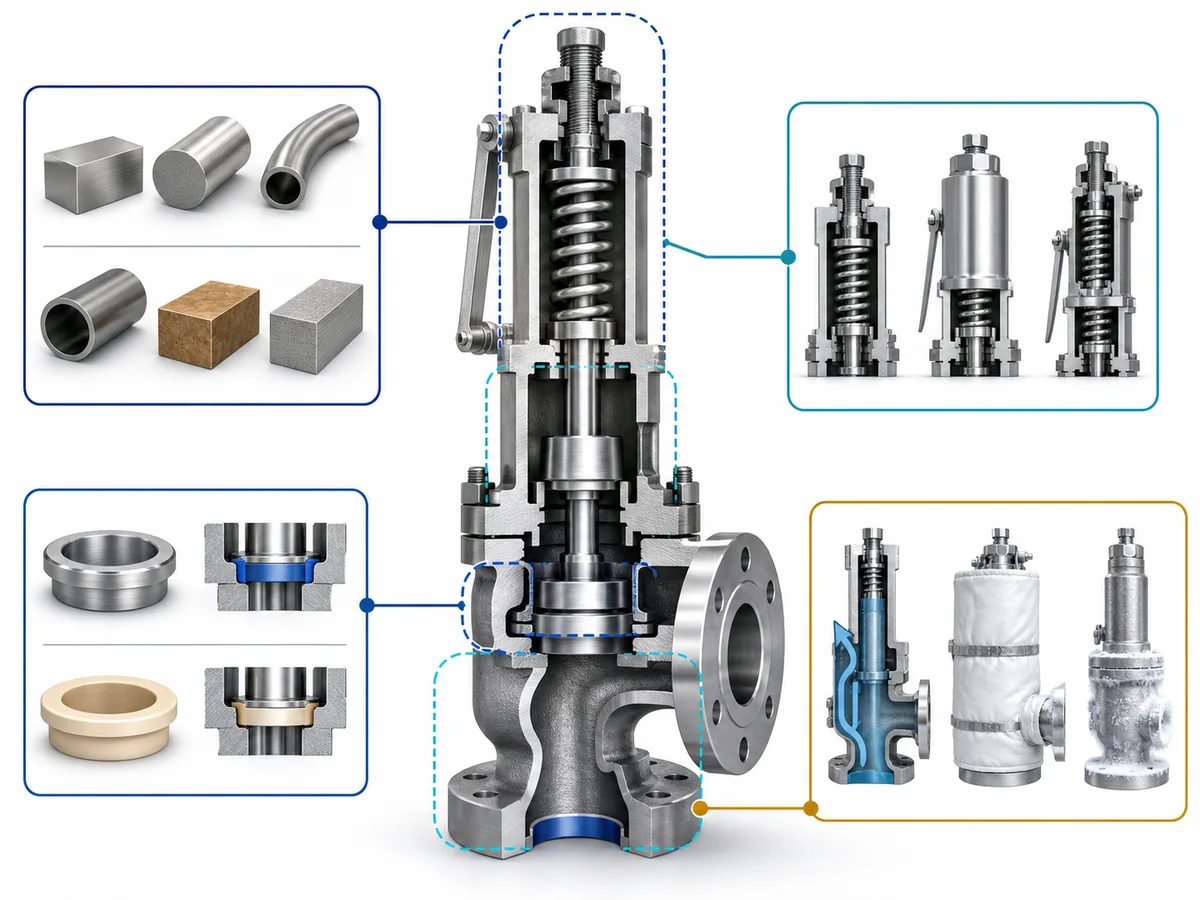
Verify materials against the actual low-temperature duty
The material name is only one part of the check. Low-temperature suitability has to be supported for the relevant service condition and for the pressure-containing or functionally important components to which that evidence applies.
Different metallic material families are used in real cryogenic relief-valve construction, so material screening should focus on documented suitability for the defined duty rather than a universal list copied from another valve or application.
Treat seat construction and leakage acceptance as separate checks
Both metal and nonmetallic seat or sealing arrangements are used in cryogenic relief devices. That evidence does not support a universal claim that one seat category is inherently correct for LNG service.
Seat construction tells the reviewer what is supplied; it does not, by itself, prove that the project’s leakage or tightness requirement is met. The buyer needs a defined acceptance basis and evidence that the proposed candidate satisfies it. If the project requires a tighter leakage condition than the otherwise applicable basis, that requirement must be stated rather than assumed.
A vague claim such as “leak tight” is therefore less useful than a documented test or acceptance basis that can be compared with the project requirement.
Verify bonnet and thermal arrangement without imposing a universal geometry
Cryogenic safety valves exist with different bonnet configurations. Bonnet geometry and thermal isolation are therefore legitimate verification fields, but the evidence does not support a blanket rule that one arrangement is required for every LNG duty.
The candidate review should establish what construction is actually supplied, how the manufacturer documents that configuration for the relevant cold exposure, and whether that documented scope matches the defined duty. The bonnet arrangement should not be used as a stand-alone proxy for cryogenic suitability.
Review the complete cryogenic evidence package
A useful cryogenic review looks across several categories rather than searching for one decisive feature:
- materials of pressure-containing and functionally important components;
- the candidate’s documented low-temperature service scope;
- seat and sealing construction;
- the required leakage or tightness acceptance basis;
- bonnet and thermal configuration;
- the test or documentation basis used to support the claimed service.
If a decision-critical category is missing, the candidate stays on HOLD. Missing evidence should not be converted into a positive claim, but it should not automatically be treated as proof that the valve is technically unsuitable either.
Check the Outlet, Back Pressure, and Discharge Interface Before Accepting the Candidate
A valve that appears suitable from its inlet-side duty can still require further review because of conditions at its outlet. Back pressure belongs to the installed discharge system and can influence relief-valve behavior, so the candidate should not be accepted without establishing the relevant outlet condition when the design depends on it.
Distinguish the source of back pressure
Back pressure can arise because relief flow passes through the downstream discharge path, and pressure may also already exist at the outlet because of the wider system to which the valve discharges. These are different system conditions, but both can matter to candidate selection.
The selection guide does not calculate those conditions. It establishes whether they are known well enough to compare with the candidate’s documented behavior and whether any unresolved system hydraulics must be handled elsewhere.
| Outlet-interface question | Candidate-selection implication |
|---|---|
| Is the relevant outlet condition known? | If not, HOLD when candidate acceptability depends on that condition. |
| Can downstream pressure influence the selected design? | Check the candidate’s documented behavior rather than assume generic limits. |
| Is the outlet condition known, but candidate evidence for it is missing or incomplete? | HOLD. Missing evidence is not the same as a documented mismatch. |
| Does a known installed condition conflict with the candidate’s documented scope? | REJECT that candidate for the current selection path. |
| Does acceptance depend on unresolved interconnected hydraulics? | Route that analysis to the relief/discharge-system owner rather than extending this selection article into hydraulic design. |
Do not turn the component screen into a discharge-system calculation
Detailed outlet-piping and interconnected-system hydraulics belong to system-level relief engineering. This article should identify when that analysis is necessary, not reproduce it.
The escalation point is practical: if the candidate can be screened against an established outlet condition, continue the component review. If the required outlet condition itself depends on unresolved scenario-specific hydraulics, the selection remains on HOLD until that system analysis is completed.
Use HOLD and REJECT differently
An unknown outlet condition, or a known condition for which the candidate evidence is insufficient, is normally a HOLD. A documented conflict between the known installed condition and the candidate’s supported operating scope is a REJECT.
Keeping those states separate prevents an evidence gap from being mistaken for a technical failure.
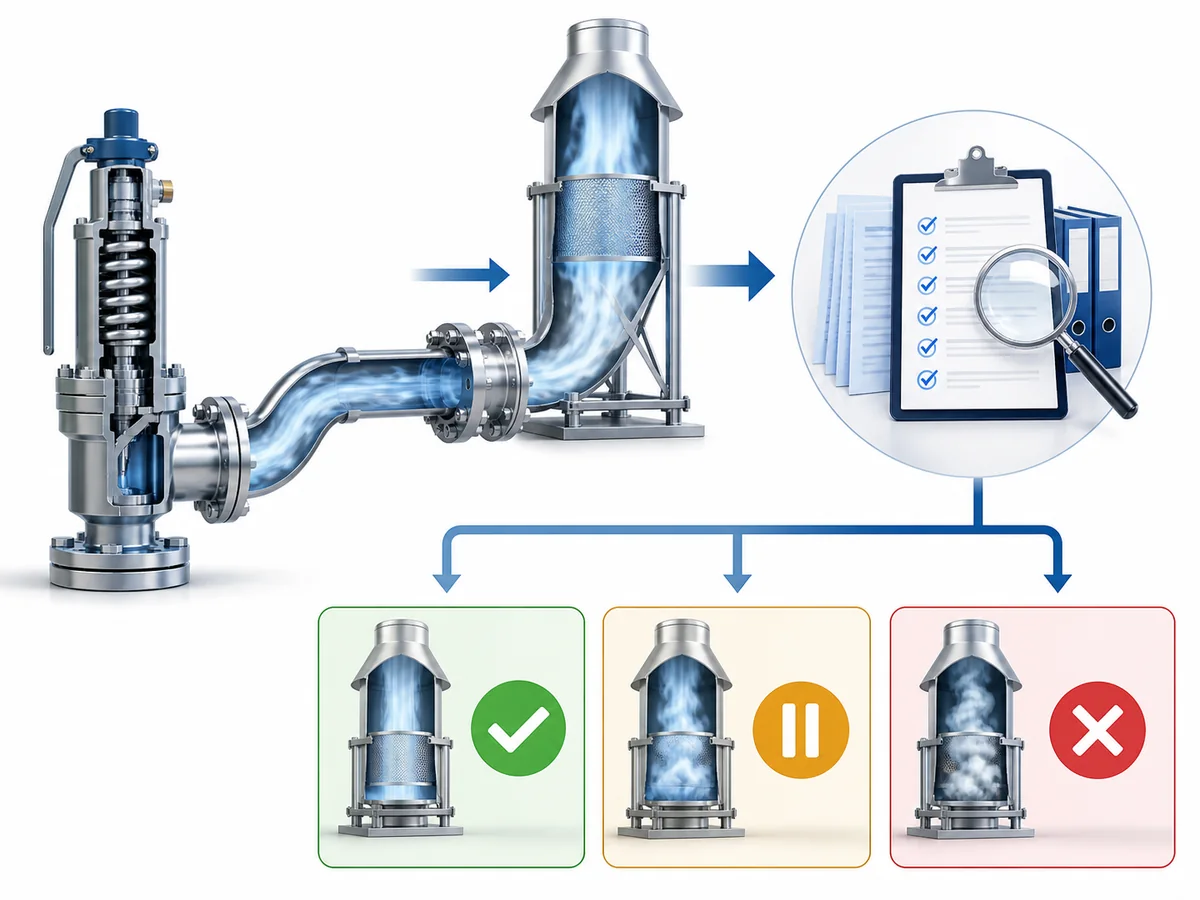
Close the Selection With Documentation, Reject/Hold Logic, and an Evidence-Ready RFQ
The final selection result should not be a vague statement that the valve “looks suitable.” Close the screen with one of three explicit states: PROCEED, HOLD, or REJECT.
PROCEED means the defined LNG duty and the candidate evidence are aligned well enough to continue into final engineering and RFQ review. It does not mean final approval for installation, operation, compliance, or project acceptance.
Use documentation to prove the candidate you are actually reviewing
The evidence package should relate to the specific proposed configuration rather than to a general product family or a generic cryogenic claim. Depending on the applicable project framework, the review may need documentation addressing areas such as:
- the defined relieving duty and phase carried forward from upstream engineering;
- the candidate’s documented cryogenic service scope;
- pressure-containing and functionally important materials;
- seat and sealing construction;
- the leakage or seat-tightness acceptance basis;
- bonnet and thermal configuration;
- outlet and back-pressure applicability;
- design, manufacture, inspection, testing, or other project-required evidence where applicable;
- capacity evidence required by the governing project basis, without recalculating capacity in this selection guide.
Testing, capacity evidence, formal conformity evidence, and project approval are not interchangeable concepts. A document should be used only for the claim and scope it actually establishes.
Apply PROCEED, HOLD, and REJECT consistently
| Decision | Use it when | What happens next |
|---|---|---|
| PROCEED | The upstream relief basis is defined, the duty and phase align with the candidate evidence, cryogenic construction and leakage requirements are sufficiently supported, the relevant outlet condition is established, and the decision-critical documentation is available for review. | Continue to final engineering and RFQ review. |
| HOLD | A decision-critical input, candidate document, outlet condition, project requirement, or supplier-specific fact remains unresolved. | Request the missing information or return the unresolved engineering item to its correct owner. |
| REJECT | A known project requirement conflicts with the documented candidate scope. | Remove that candidate from the current selection path and review another supported configuration. |
Turn unresolved fields into RFQ inputs instead of assumptions
If the final valve has not yet been selected, the RFQ should carry forward unresolved technical fields rather than replace them with supplier assumptions. Those fields can include the defined duty and phase, cryogenic service requirement, seat/leakage requirement, relevant outlet condition, and the documentation that the project expects the supplier to provide.
Supplier-specific facts remain supplier-specific. A buyer should not infer a material, seat configuration, low-temperature capability, back-pressure limit, test result, formal conformity status, or project acceptance simply because another valve or another manufacturer documents that feature.
Keep the final engineering boundary visible
This selection workflow is designed to improve the quality of the candidate presented for engineering review. It does not replace the upstream relief analysis, detailed discharge-system analysis, project-specific compliance review, or final verification of the supplied valve documentation.
The most useful final question is therefore not “Is this an LNG safety valve?” It is:
Does the documented candidate match the defined LNG relief duty closely enough to proceed to engineering review, or is there a known mismatch or unresolved evidence gap that requires REJECT or HOLD?