Learn how safety valve chatter, flutter and simmer differ, what evidence separates them, common look-alikes, and when root-cause analysis is still needed.

A noisy or vibrating safety valve is not automatically chattering. The first job is to identify what the valve is doing before tracing why it is doing it. Chatter and flutter are rapid valve-motion conditions; simmer is a pre-opening fluid-escape condition. The practical separator between chatter and flutter is repeated disc-to-seat contact.
That gives maintenance and reliability teams a better starting point than trying to diagnose the problem from sound alone.
Chatter vs Flutter vs Simmer: What Is the Core Difference?
In API 520 Part I terminology, chatter, flutter, and simmer are separated by what is physically happening inside the pressure-relief valve.
| Behavior | What is happening | Seat-contact relevance | What the observation can establish |
|---|---|---|---|
| Chatter | The valve opens and closes at very high frequency. | The disc repeatedly contacts the seat. | Supports chatter when the rapid motion and repeated seating can be established. |
| Flutter | The moving parts reciprocate rapidly during an unstable open condition. | The disc does not repeatedly contact the seat. | Supports flutter when rapid motion occurs without repeated seating. |
| Simmer | Compressible fluid audibly or visibly escapes across the seating surfaces before opening. | Repeated high-frequency opening and closing is not the defining feature. | Supports a pre-opening escape condition rather than a chatter/flutter severity level. |
These terms do not form a mild-to-severe scale. Chatter and flutter describe unstable mechanical motion. In API terminology, simmer describes compressible fluid escaping between the seating surfaces below set pressure and before opening.
Repeated opening, seat leakage, and a loud relief event should not automatically be assigned one of these labels. The sequence and physical behavior matter.
How Do You Tell Chatter from Flutter?
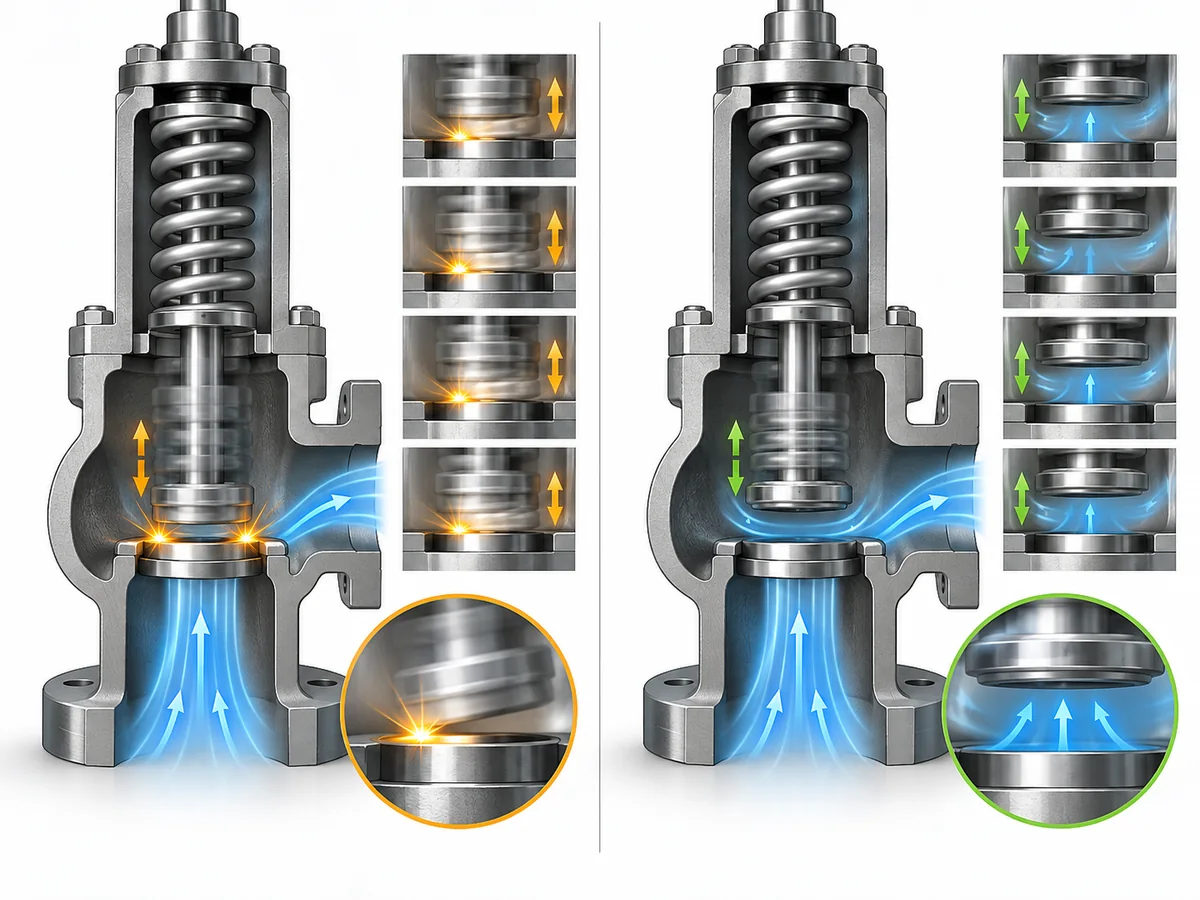
To separate chatter from flutter, look for repeated disc-to-seat contact.
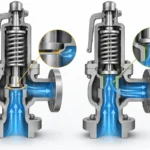
During chatter, rapid opening and closing repeatedly brings the disc back against the seat. During flutter, the valve’s moving assembly also reciprocates rapidly, but the disc does not repeatedly return to the seat.
Noise may be the first clue that something is wrong, but it is not the deciding evidence. Operators may report rattling, vibration, hammering, or another unusual sound; none of those descriptions shows whether the disc is actually striking the seat. Piping and connected equipment can also transmit vibration and sound.
Rapid reciprocating motion with repeated seat contact supports chatter. Rapid reciprocating motion without repeated seat contact supports flutter.
If the available evidence establishes only noise or vibration, the event may have to remain classified simply as valve instability until stronger motion evidence is available.
The distinction also matters mechanically. Flutter can still produce wear and interfere with expected valve behavior, while chatter adds repeated seat-impact loading. The condition and consequence of a particular installed valve, however, cannot be determined from the behavior label alone.
Why Is Simmer Different from Chatter and Flutter?
Simmer sits in a different part of the valve’s operating sequence. In API terminology, it is audible or visible escape of compressible fluid between the seat and disc below set pressure and before the valve opens. Rapid reciprocating motion is not the defining feature.
Calling simmer “mild chatter” therefore creates the wrong mental model. Chatter involves repeated rapid seating; simmer concerns pre-opening fluid escape.
Simmer is also not a generic label for every seat leak. Seat leakage can occur under other operating or test conditions. Whether an observed escape fits the term simmer depends on where it occurs in the opening sequence and on the applicable compressible-fluid service context.
A more useful field description is not simply “the valve was leaking,” but whether the escape appeared as pressure approached opening, whether the service was compressible, and whether rapid valve motion was also present.
What Can Be Mistaken for Chatter, Flutter, or Simmer?
A valve can open, reseat, cycle, or leak without the event necessarily being chatter, flutter, or simmer.
Normal Opening or Reseating
A safety valve opening to relieve pressure and then reseating is not, by itself, evidence of instability. The relevant distinction is whether the valve completed an ordinary opening-and-reclosing event or entered abnormal rapid reciprocating motion. A loud event does not become chatter simply because it was mechanically noticeable.
Process-Driven Cycling
API terminology treats cycling as repeated opening and closing at a substantially lower frequency than chatter. A valve may complete multiple opening and reseating events as system pressure changes without undergoing the very-high-frequency seat impacts associated with chatter.
Repeated opening proves that repeated opening occurred; it does not by itself prove chatter. A substantial mismatch between installed relieving capacity and actual demand can be relevant to repeated cycling or instability, but that relationship belongs to the later root-cause investigation rather than to the initial behavior label.
Seat Leakage
Seat leakage can resemble simmer because both may involve fluid crossing the seating surfaces, but the terms are not interchangeable. Simmer has a specific pre-opening context in compressible-fluid service, while seat leakage may occur outside that condition and may be audible, visible, or difficult to observe.
A report such as “the valve was hissing” is useful evidence, but it does not by itself establish simmer. It is better to preserve uncertainty than to force every unusual valve event into the closest familiar term.
What Evidence Should You Capture Before Classifying the Behavior?
Record what actually happened first, then add evidence that can confirm or eliminate a classification.
Start With the Observed Event
Document the sequence rather than starting with a diagnosis. Useful observations include whether the valve:
- opened once or repeatedly;
- appeared to move rapidly;
- leaked or discharged before a full opening event;
- continued to vibrate around the pressure event;
- showed intermittent or sustained abnormal behavior.
Sound and vibration descriptions are worth preserving, but they should remain observations rather than final diagnoses.
Add Valve-Motion and Pressure Evidence
For chatter versus flutter, the key classification question is whether rapid motion included repeated disc-to-seat contact. Pressure or valve-lift history can also help distinguish high-frequency instability from separate opening and reseating cycles.
Direct evidence of motion and event timing is therefore more useful than relying only on descriptions such as “buzzing,” “rattling,” or “hammering.”
Record the Installed-System Context
Once the behavior has been described, collect the information needed for the next level of engineering review. Depending on the installation, useful information can include:
- valve type and relevant configuration;
- process medium and whether the service is gas, vapor, steam, or liquid;
- operating and set-pressure context;
- available pressure or lift history;
- required relieving duty and the installed valve’s capacity basis;
- inlet arrangement and available pressure-loss information;
- outlet arrangement and back-pressure conditions;
- recent inspection, testing, repair, or adjustment history.
These inputs do not all define chatter, flutter, or simmer. They matter because they help move the investigation from behavior classification toward cause analysis.
Keep the Classification Unresolved When the Evidence Is Not Enough
A noisy valve is not automatically chatter. A vibrating valve is not automatically flutter. An unexplained seat leak is not automatically simmer.
If the available evidence cannot establish the relevant motion, seat-contact behavior, or pre-opening escape condition, keep the classification provisional. Assigning a precise term without the evidence to support it does not improve the diagnosis.
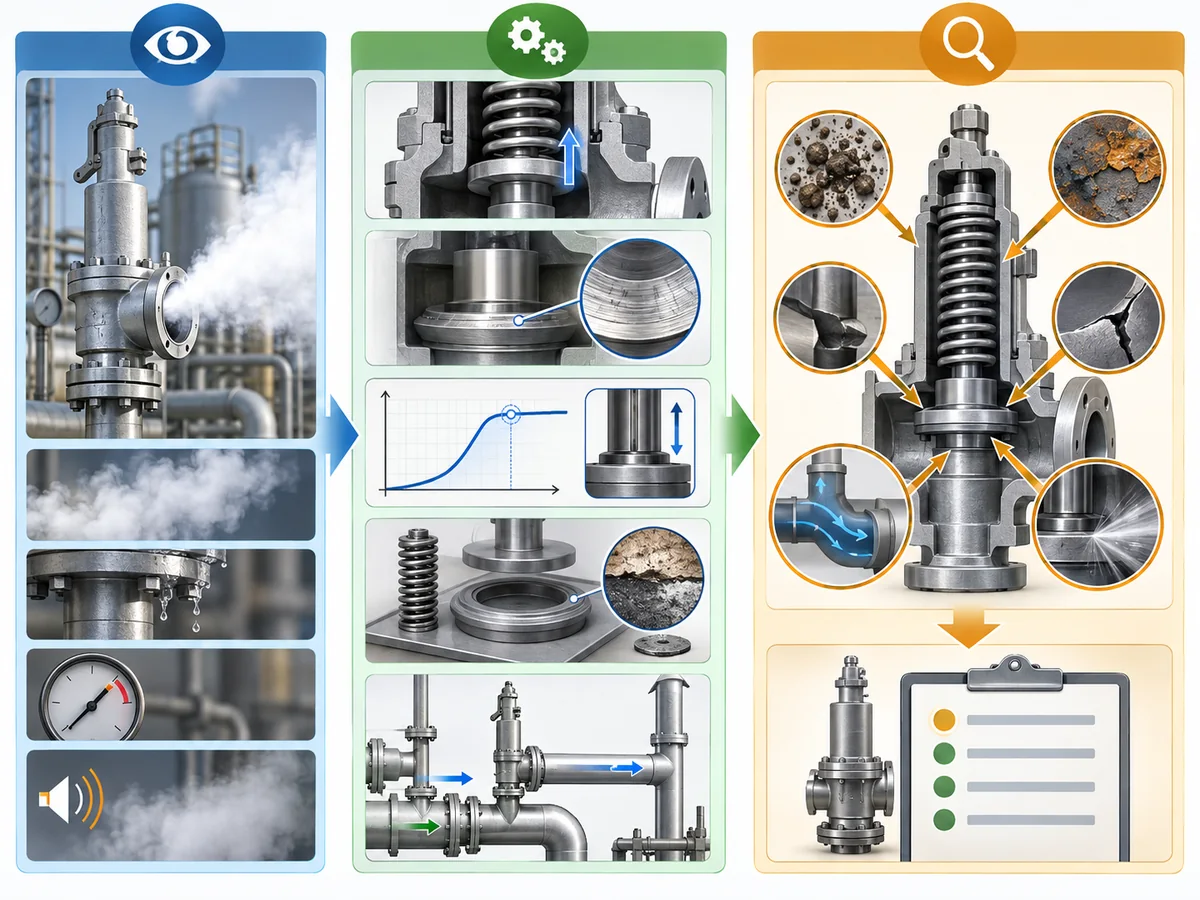
Does Identifying Chatter, Flutter, or Simmer Tell You the Root Cause?
No. Identifying the behavior narrows the investigation; it does not establish why the behavior occurred.
A useful troubleshooting sequence is observation → behavior classification → possible contributors → root-cause determination → corrective action. Skipping directly from the observation to a corrective action can lead to the wrong change.
API 520 Part II installation guidance treats pressure-relief-valve stability as a system-level engineering problem. Instability can involve interactions among the valve, relieving demand, inlet system, outlet system, back pressure, process dynamics, valve configuration, and device condition.
For example, excessive inlet pressure loss can contribute to unstable operation, but one inlet-pressure-loss value does not by itself identify the cause of a particular chatter event. Built-up back pressure can also influence some conventional valve installations, but observing flutter is not proof that back pressure caused it.
The same caution applies to valve sizing. A large mismatch between installed relieving capacity and actual demand can contribute to repeated operating problems, but observing cycling or chatter is not enough reason to resize the valve without reviewing the required relief duty and installed system.
Once the behavior is reasonably classified, root-cause review should move to the valve configuration, relief duty, process history, inlet and outlet conditions, and inspection evidence.
For a confirmed or strongly suspected spring-loaded chatter event, continue with Spring-Loaded Safety Valve Chattering: Causes, Diagnosis and Corrective Actions, which covers the deeper cause and corrective-review task.