China Safety Valve Sourcing & Supplier EvaluationA China safety valve manufacturer should be evaluated by engineering evidence, not by country of origin, catalog size or price alone. Before approval, verify whether the supplier can translate the protected equipment, governing relief scenario, medium and phase, MAWP or design pressure, set pressure, required relieving capacity, relieving temperature, …

China Safety Valve Sourcing & Supplier Evaluation
A China safety valve manufacturer should be evaluated by engineering evidence, not by country of origin, catalog size or price alone. Before approval, verify whether the supplier can translate the protected equipment, governing relief scenario, medium and phase, MAWP or design pressure, set pressure, required relieving capacity, relieving temperature, back pressure, materials, connections and code requirements into a model-specific proposal supported by drawings, test records and traceable documents.
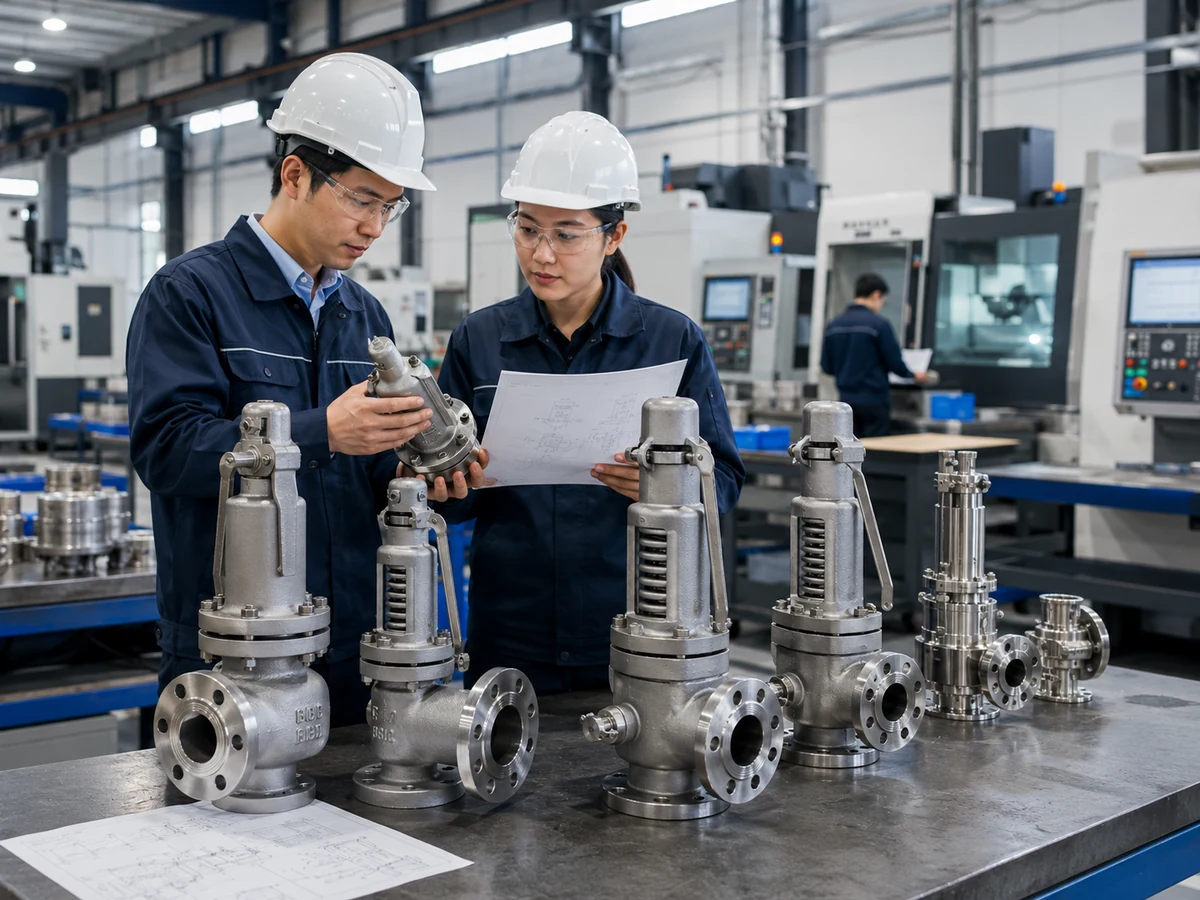
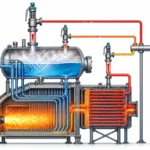
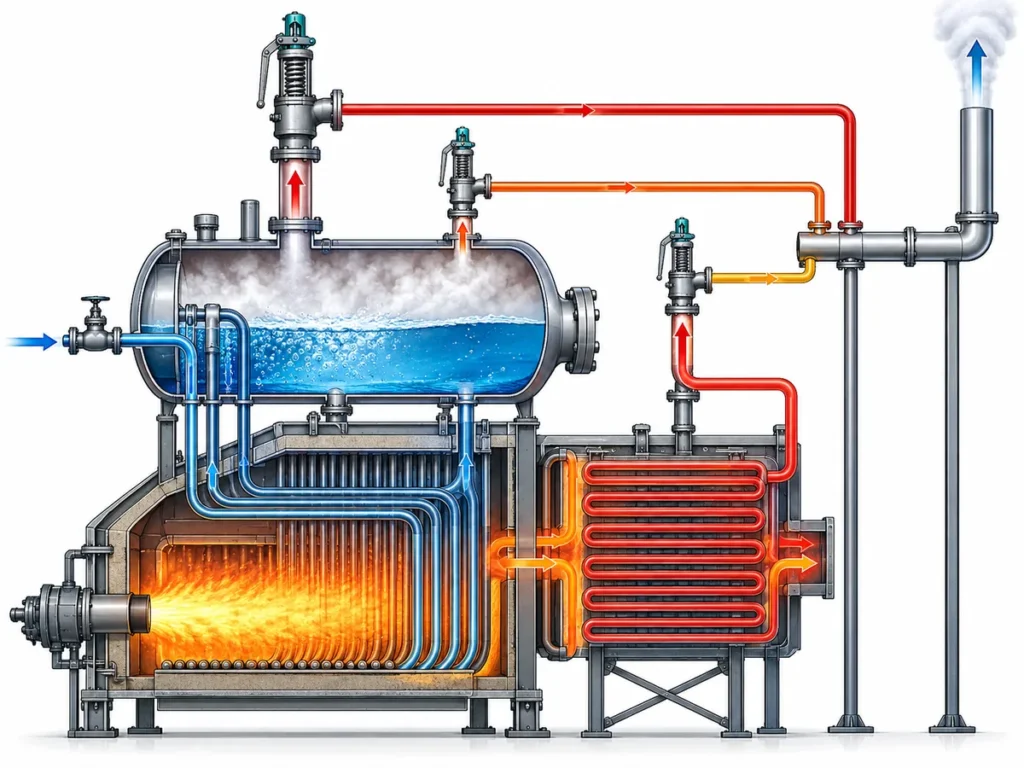
Illustrative industrial image; it is not evidence of a specific ZOBAI factory audit, customer project, certification or test result.
How Should You Evaluate a China Safety Valve Manufacturer?
Use a two-part review. First, confirm the manufacturer can select and document a valve for the actual protection duty. Second, confirm the factory and quality system can reproduce the approved configuration and test it consistently.
The minimum review should cover legal identity, safety-valve specialization, product-family limits, relief-scenario understanding, capacity basis, material control, spring and trim configuration, machining and assembly, set-pressure calibration, seat-tightness testing, traceability, drawings, certificates and project communication. Start with the ZOBAI industrial safety valve product hub, then submit real service data for review.
Critical boundary: A valve that matches the flange size and set pressure can still be unsuitable if its effective orifice, rated capacity, fluid basis, back-pressure limit, materials or installed piping conditions are wrong.
Manufacturer, Trading Company or General Valve Factory?
Specialized safety valve manufacturer
Usually controls model configuration, spring selection, assembly, calibration, testing, nameplate data and technical documentation. The buyer must still verify the exact model and project scope.
General industrial valve factory
May manufacture many isolation or control valves but have limited pressure-relief engineering depth. A broad catalog does not prove capacity or calibration capability.
Trading or export company
May provide useful communication and sourcing, but the buyer should identify the actual manufacturer, production location, test responsibility and document issuer.
Ask the supplier to state the legal manufacturer name, factory address, test responsibility and document issuer. The quotation, drawing, test report, nameplate and certificate package should align.
Check Product-Family Coverage without Assuming Every Model Has the Same Limits
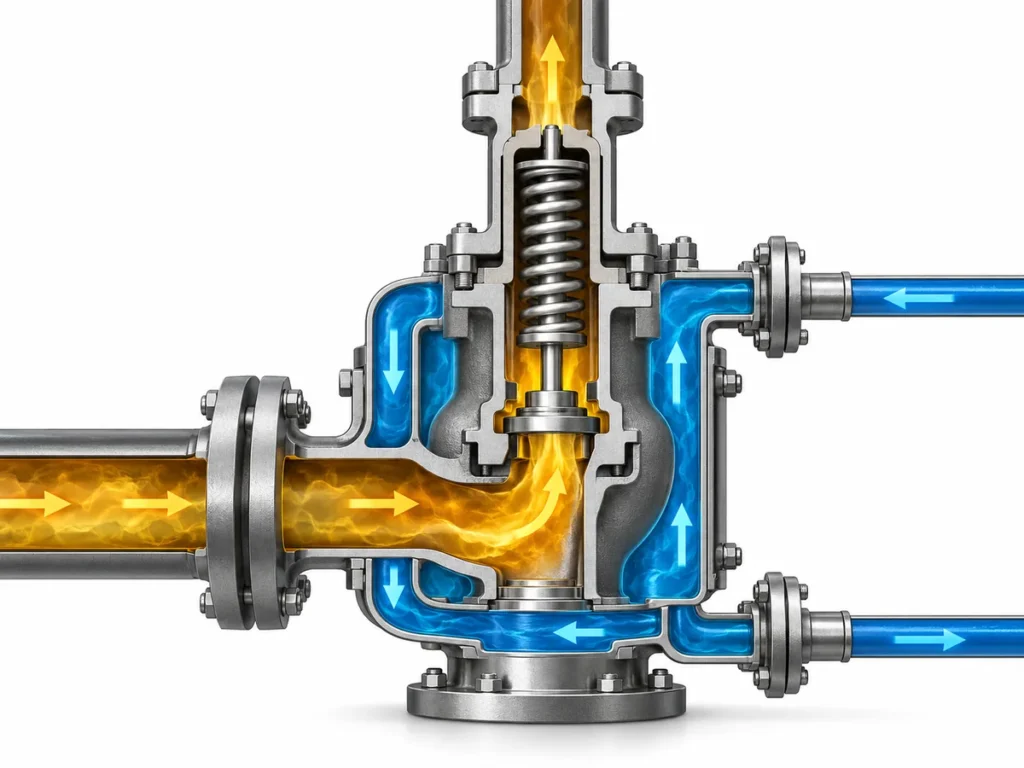
A capable supplier may cover spring-loaded, pilot-operated and bellows-balanced safety valves, plus threaded, flanged, open/closed bonnet, lever and special-service configurations.
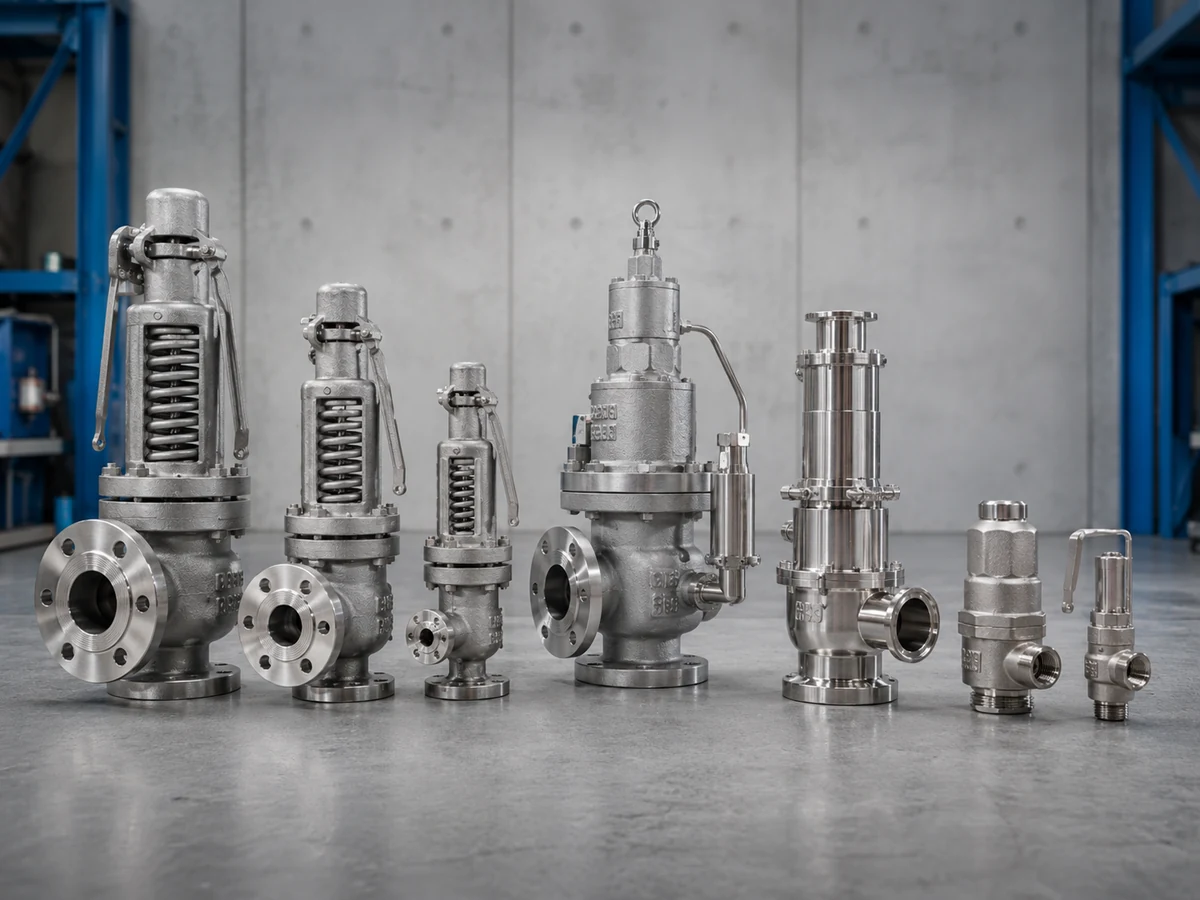
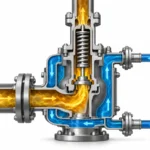
Illustrative product-family visual. Final model availability, dimensions, materials, pressure, temperature and certification must be confirmed for the selected series.
Portfolio range is only an initial screening tool. Confirm the selected series, size, pressure class or PN, effective orifice, set-pressure range, relieving-temperature limit, materials, seat design, spring range, back-pressure capability and document basis.
| Question | Evidence | Risk if assumed |
|---|---|---|
| Which valve type is proposed? | Model code, section drawing and datasheet | A catalog image may not match the quoted construction |
| What is the effective orifice? | Manufacturer data and capacity basis | Connection size may be mistaken for capacity |
| What limits apply? | Series-specific pressure, temperature and material limits | Portfolio-wide claims may be applied to the wrong model |
| Which tests/markings apply? | Project-specific inspection and certification matrix | A standard name may be treated as proof of unverified certification |
Engineering Capability Should Start Before the Quotation
The manufacturer should ask what the valve protects and why pressure can rise. The equipment may be a boiler, vessel, heat exchanger, compressor, pipeline, reactor, tank or skid. The governing case may be blocked outlet, fire, regulator failure, control-valve failure, tube rupture, thermal expansion or another project-defined scenario.
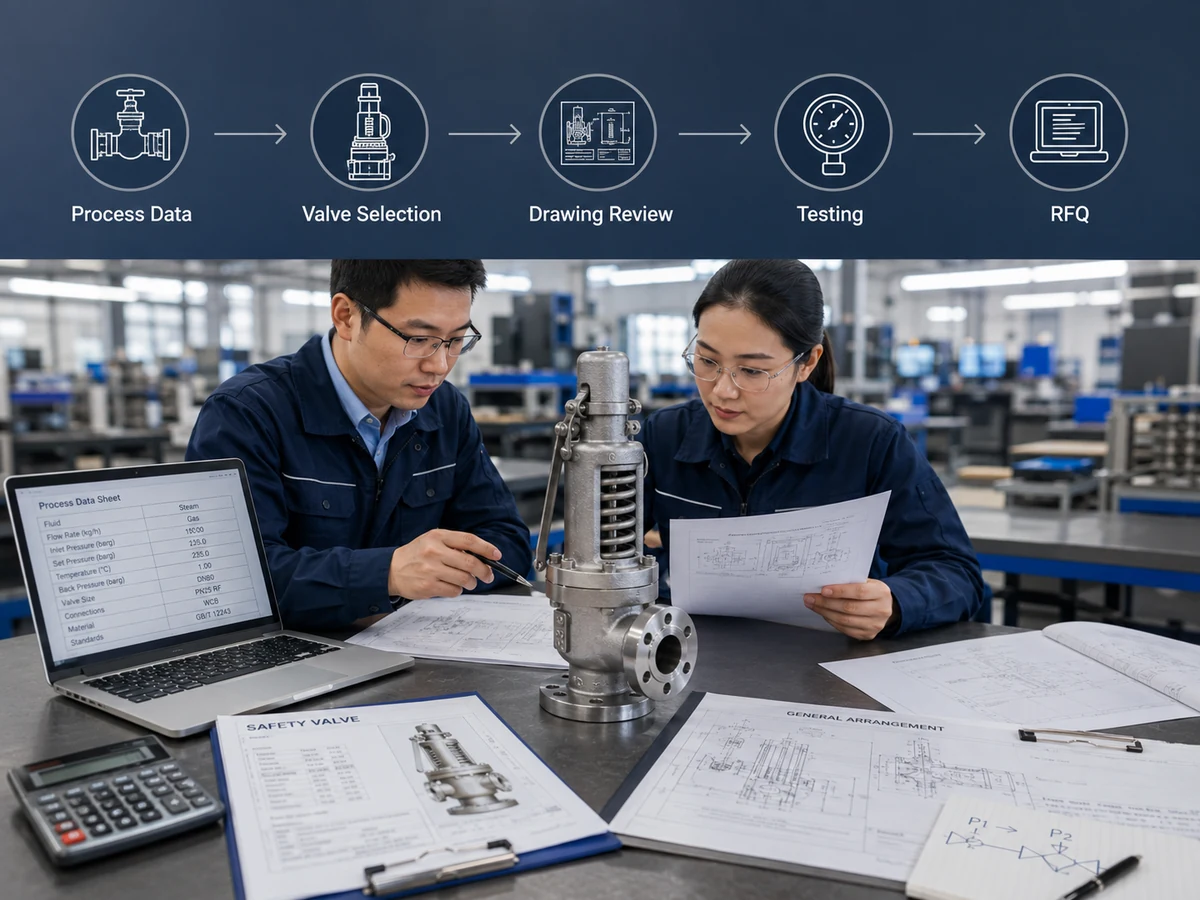
Illustrative engineering workflow; the displayed screens and documents are not actual project records or approved calculations.
Provide operating pressure, MAWP or design pressure, set pressure, required capacity, relieving conditions, superimposed and built-up back pressure, inlet/outlet piping, materials and adopted standards. The broad decision logic is explained in the safety valve selection guide.
Required Capacity, Effective Orifice and Rated Capacity Must Be Separated
Required relieving capacity comes from the governing scenario. The selected effective orifice and rated or certified capacity come from the proposed valve configuration and performance basis. Steam, gas, liquid and two-phase services cannot be interchanged without the applicable method and properties.
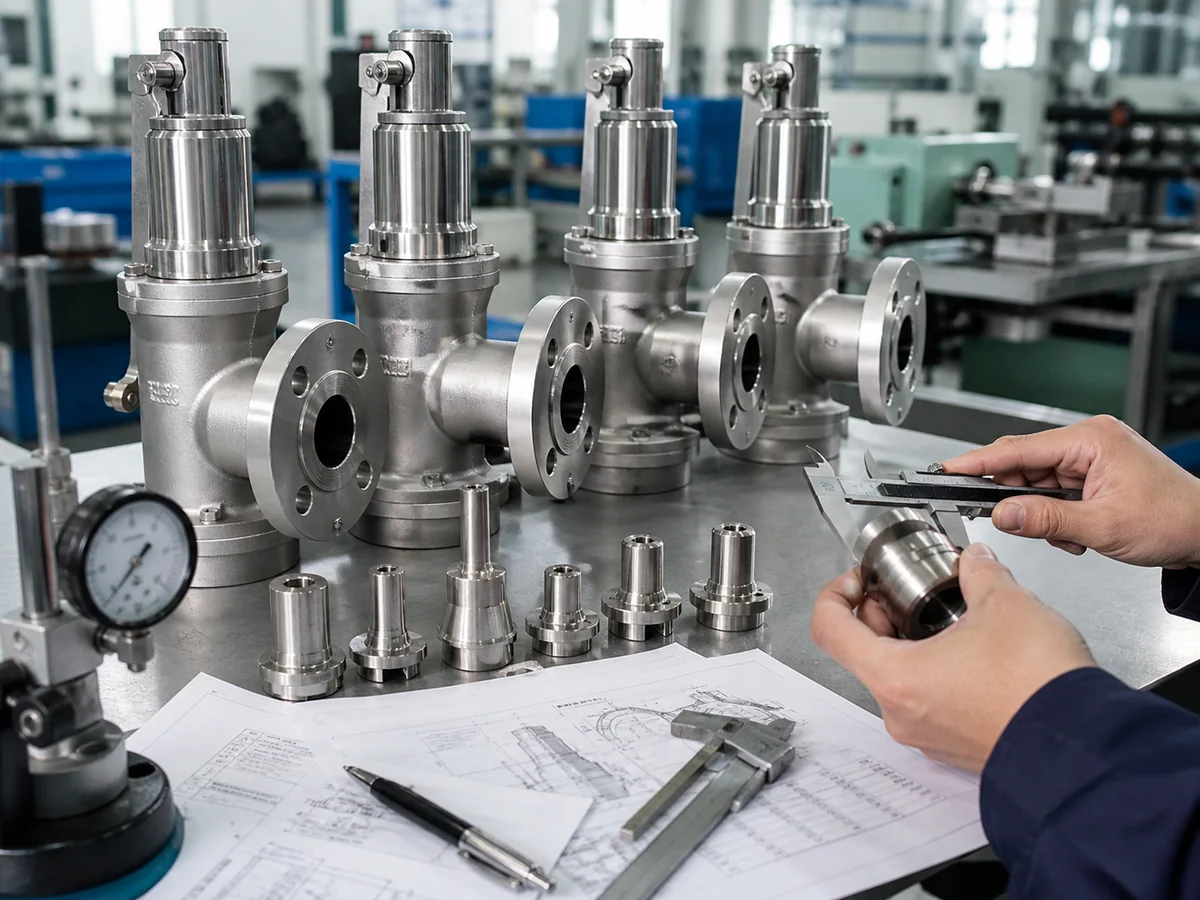
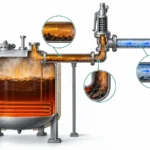
Simplified engineering illustration. Connection size does not establish effective orifice or relieving capacity; use manufacturer-specific certified or documented data.
Connection size describes the piping interface; it does not prove flow capacity. Review safety valve sizing and certified relieving capacity and the ZOBAI API 520 sizing guide.
| Term | What it proves | What it does not prove |
|---|---|---|
| Set pressure | Opening-pressure reference under defined conditions | Required or rated capacity |
| Connection size | Physical interface | Effective orifice or certified capacity |
| Rated/certified capacity | Documented performance for stated conditions | Correctness of the buyer’s relief scenario |
| Seat-tightness result | Leakage performance under the test method | Sizing or capacity compliance |
Back Pressure, Medium and Relieving Temperature Change the Selection
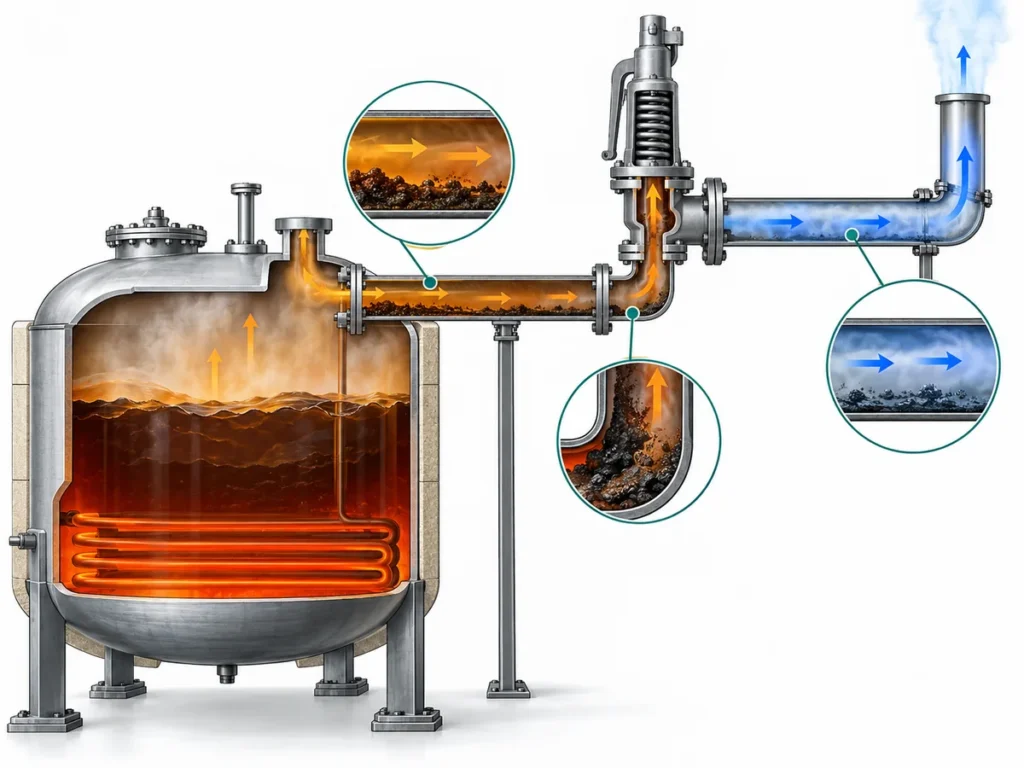
Provide superimposed back pressure before opening and built-up back pressure during discharge. Distinguish constant and variable conditions. Conventional, balanced bellows and pilot-operated designs have different limits.
Medium and phase affect sizing, materials, seat design and discharge behavior. Relieving temperature—not only normal operating temperature—must be used for the relevant material, spring, bellows and seal review. Use the ZOBAI API 521 systems guide and installation guide for system-level review.
Material Review Must Cover More Than the Valve Body
Request component-level material information for the body, bonnet, nozzle, disc, guide, spindle, spring, bellows, gasket and seat/seal. Corrosion-resistant body material does not protect incompatible trim, bellows or seals.
| Component | Main concern | Useful evidence |
|---|---|---|
| Body/bonnet | Pressure-temperature rating and environment | Grade, heat number and rating basis |
| Nozzle/disc | Seat corrosion, erosion and leakage | Trim material and surface specification |
| Guide/spindle | Sticking, galling and deposits | Material pairing and dimensional records |
| Spring | Temperature, corrosion and set stability | Material, range and configuration record |
| Bellows | Differential pressure, corrosion and fatigue | Material and model-specific limit |
| Seat/seal | Chemical compatibility and aging | Material declaration and service limits |
What Should a Factory Audit Cover?
Incoming material
- approved specifications;
- heat/lot identification;
- segregation of similar alloys;
- MTC review and traceability;
- PMI where required.
Machining and dimensions
- drawing revision control;
- seat/nozzle geometry;
- guide and spindle dimensions;
- flange/thread verification;
- calibrated instruments.
Assembly control
- model and BOM verification;
- spring identification;
- trim, bellows and seat confirmation;
- cleanliness;
- nameplate and seal control.
Testing and release
- test-medium suitability;
- gauge calibration;
- set-pressure records;
- seat-tightness method;
- final document release.
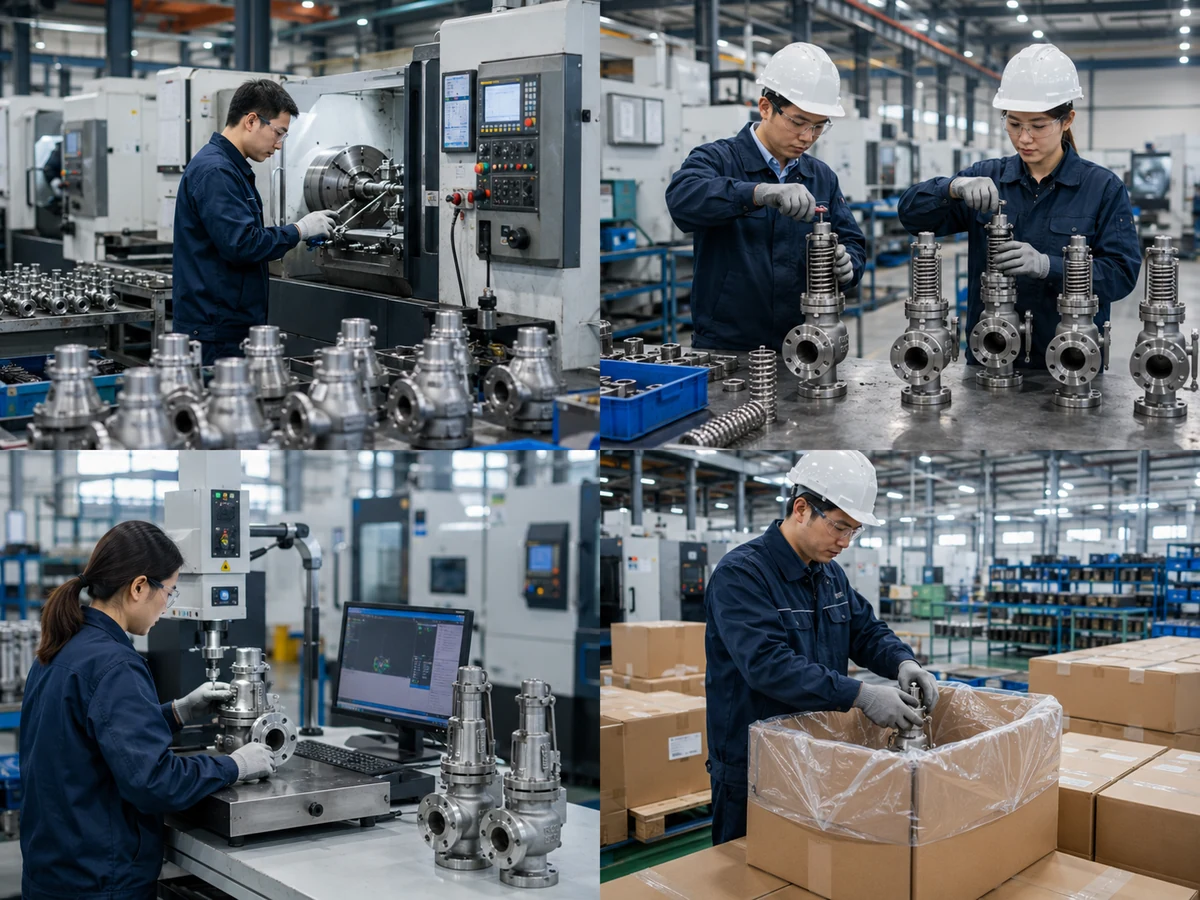
Illustrative manufacturing scene; it should not be interpreted as proof of a specific machine, production line, capacity or customer order.
Set-Pressure Test, Seat Tightness and Capacity Evidence Are Different
Set-pressure calibration confirms opening behavior under defined test conditions. Seat-tightness testing evaluates leakage. Shell testing evaluates pressure-boundary integrity. Capacity evidence addresses flow performance. Ask for the method, medium, pressure, acceptance criteria, instrument range and serial linkage.
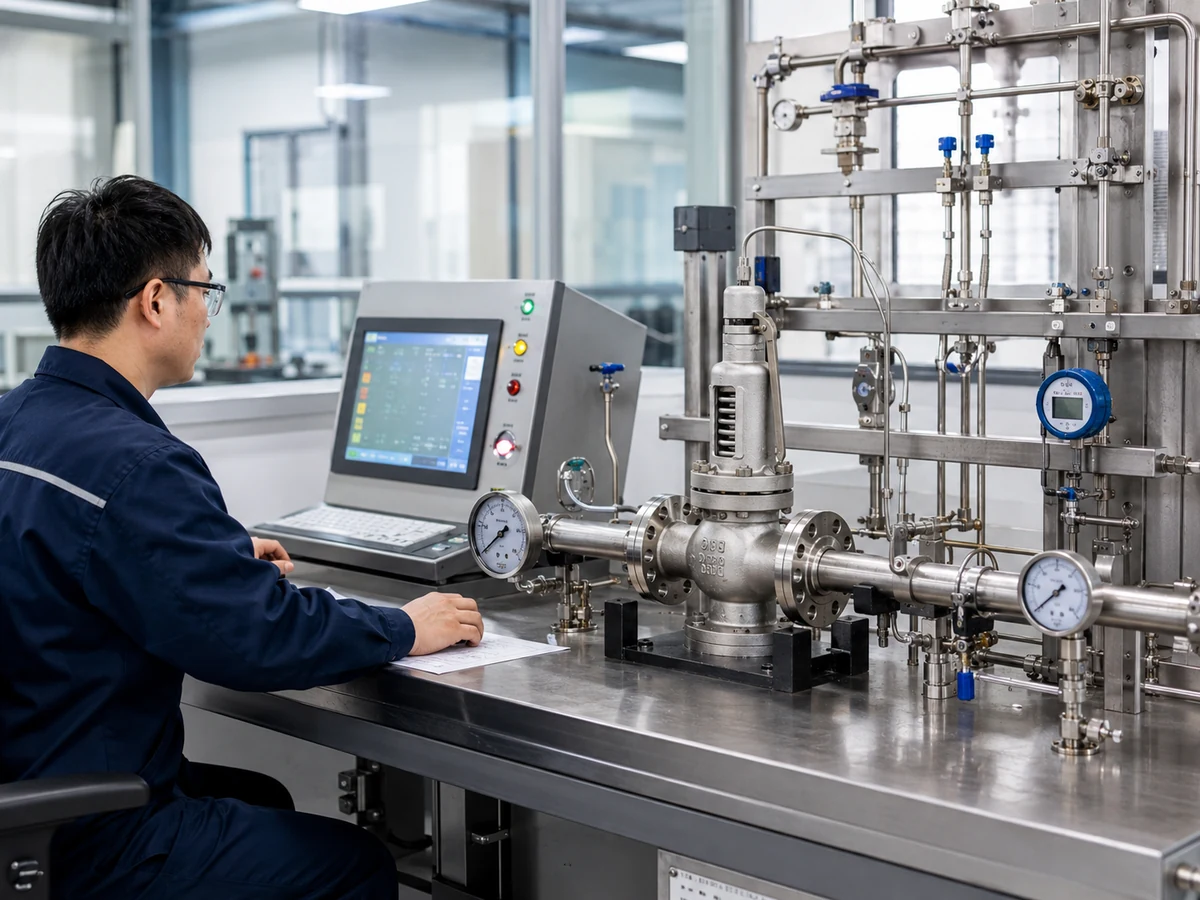
Illustrative test-bench scene; it is not an actual calibration certificate, witnessed test or certified capacity record.
The ZOBAI API 527 seat-tightness guide explains why leakage acceptance is not a sizing standard.
Composite scenario: calibration report without capacity basis
A supplier submits a clear set-pressure report for a replacement valve but no effective orifice or capacity document. The report shows that the valve opened at the requested pressure; it does not show that it can relieve the governing load.
Standards and Certifications Must Match the Model and Project
Separate the product standard, sizing method, installation guidance, test method, jurisdictional code marking and certificate scope. Verify the adopted edition, applicability, manufacturer/factory, model and required deliverables.
- API 520 Part I, 10th Edition addresses sizing and selection within its stated scope.
- API Standard 521 addresses pressure-relieving and depressuring systems.
- ISO 4126-1:2013 is a safety-valve product standard and not an application standard.
- The NBIC covers in-service installation, inspection and repair guidance for pressure relief devices.
A standard reference does not prove that any manufacturer holds every certification for every model. Verify the selected product and actual scope.
Traceability and Document Control Determine Whether the Valve Can Be Approved
| Document | What to check | Common gap |
|---|---|---|
| Datasheet | Service data, model, set pressure, orifice, materials and back pressure | Generic data without project inputs |
| GA/cross-section | Dimensions, connections and configuration | Drawing does not match the quoted model |
| Material certificates | Component scope, heat number and traceability | Body certificate only |
| Test reports | Serial linkage, method, instruments and acceptance | No valve identification or test basis |
| Capacity evidence | Fluid, conditions, coefficient/effective area and approval basis | Calibration report substituted for flow evidence |
| Nameplate/marking | Manufacturer, model, set pressure, size and required marking | Conflicts with datasheet or drawing |
Price and Lead Time Should Be Compared on the Same Technical Scope
A lower quotation may exclude engineering review, special materials, capacity documents, witness testing, export packing, spares or required certificates. Normalize the valve configuration, tests, documents, inspection scope and delivery terms before comparing price.
The delivery schedule should include engineering clarification, drawing approval, material procurement, production, testing, document approval and shipment. A fast shipment that arrives with the wrong capacity or incomplete documents is not a shorter project lead time.
Replacement Valves Require More Than Nameplate Size Matching
Send the existing nameplate, photos, datasheet, GA, process data, service history and reason for replacement. Compare set pressure, effective orifice, capacity, dimensions, connections, pressure rating, materials, seat, spring range, bonnet/lever arrangement, back-pressure limits and marking.
Composite scenario: same flanges, different protection duty
A proposed valve fits the piping but uses a smaller effective orifice and different capacity basis. Dimensional interchangeability does not make it a safe functional replacement.
China Safety Valve Manufacturer Evaluation Scorecard
| Area | Suggested weight | Evidence |
|---|---|---|
| Engineering response | 20% | Relief scenario, capacity, pressure, back pressure and materials |
| Model-specific data | 15% | Datasheet, drawing, orifice and operating limits |
| Capacity/test evidence | 15% | Capacity basis, calibration and leakage reports |
| Materials/traceability | 12% | Component scope, heat/lot control and certificates |
| Factory control | 10% | Machining, assembly, gauges and release procedures |
| Standards accuracy | 10% | Model-specific proof without overclaiming |
| Documentation | 8% | Revision control, serial linkage and MDR scope |
| Communication | 5% | Clear deviations and action ownership |
| Commercial clarity | 5% | Normalized scope, lead-time basis and support |
This is a procurement framework, not a code requirement. Adjust it to the project risk and jurisdiction.
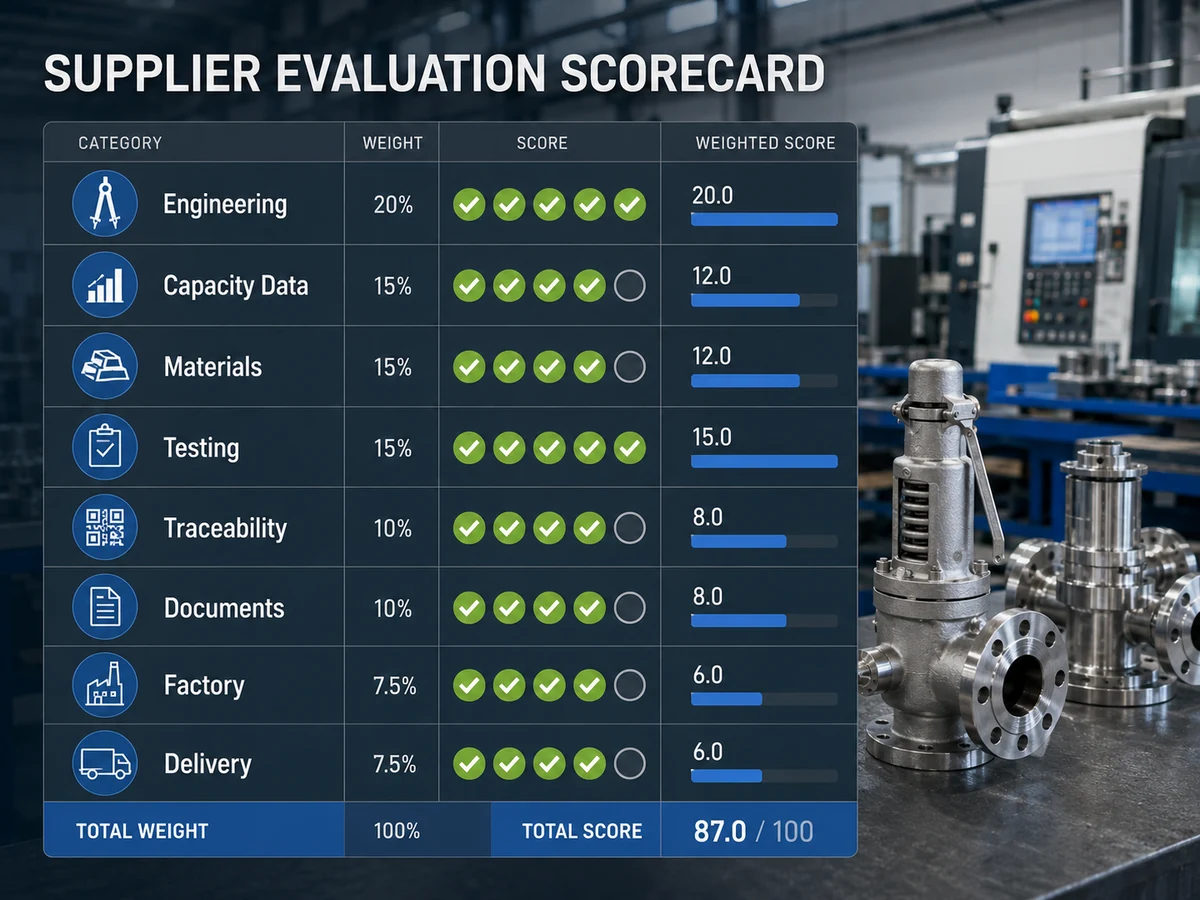
Illustrative supplier-evaluation framework; the weights and score are not code requirements or an audited score for a named manufacturer.
Common Red Flags
- Quotation based only on size and set pressure.
- No model-specific datasheet or orifice information.
- Capacity, set-pressure testing and seat tightness treated as the same proof.
- All products claimed to meet all API, ASME, ISO, PED, CE and GB requirements.
- Manufacturer, factory, test report and nameplate identities do not align.
- Material certificates do not identify the covered components.
- Drawings and reports use inconsistent model codes or revisions.
- No questions about back pressure, phase or relieving temperature.
- “Zero leakage” or “guaranteed approval” without defined evidence.
- Replacement matched by appearance rather than capacity and configuration.
RFQ Checklist for a China Safety Valve Manufacturer
| Field | Information |
|---|---|
| Protected equipment | Boiler, vessel, exchanger, pipeline, compressor, skid or other |
| Relief scenario | Blocked outlet, fire, regulator failure, tube rupture, thermal expansion or other |
| Medium/phase | Composition; steam, gas, vapor, liquid, flashing or two-phase |
| Pressure basis | Operating pressure, MAWP/design pressure, set pressure and overpressure/accumulation |
| Required capacity | Relieving rate, calculation basis, relieving pressure and temperature |
| Back pressure | Superimposed and built-up conditions |
| Connections | Inlet/outlet size, rating, facing/thread and dimensions |
| Materials | Body, trim, spring, bellows, gasket and seat/seal |
| Configuration | Spring loaded, balanced bellows, pilot operated, lever, bonnet and seat |
| Standards/marking | Adopted code, edition, jurisdiction and certification scope |
| Tests/documents | Calibration, shell, seat tightness, drawings, MTC, capacity and MDR |
| Commercial | Quantity, spares, delivery basis, packing and destination |
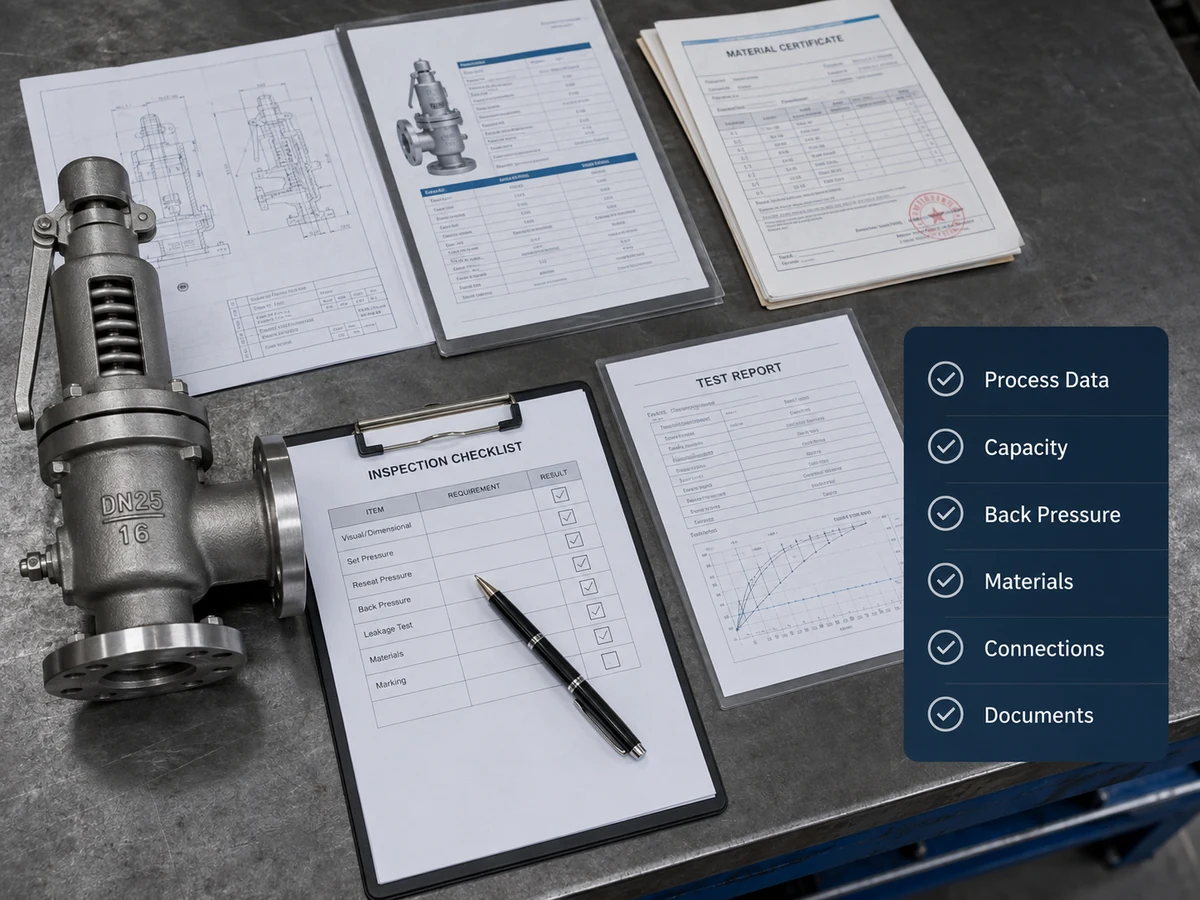
Illustrative document layout; it is not an actual material certificate, inspection release or test report.
ZOBAI as a China Safety Valve Manufacturer
ZOBAI Valve Co., Ltd. was founded in 2010 and operates from a manufacturing base in Lishui, Zhejiang, China. The published company profile identifies a 20,046 m² base supporting product development, machining, assembly, testing and international project supply. Review the verified details on About ZOBAI.
The published portfolio covers spring-loaded, pilot-operated, bellows-balanced, sanitary, jacketed, LNG/LPG, steam, high-pressure and high-temperature directions. Portfolio-level ranges must not be applied automatically to a selected model. Final pressure, temperature, size, material, capacity, standard and document scope remain subject to the actual series and project review.
Frequently Asked Questions
How do I choose a reliable China safety valve manufacturer?
Check safety-valve engineering capability, model-specific capacity data, material control, calibration and test records, traceability, factory process control, document accuracy and project communication. Do not select by price or catalog size alone.
Are safety valves made in China reliable?
They can be reliable when the specific manufacturer, factory, model, materials, capacity basis, testing, documentation and applicable certification are verified. Country of origin alone is neither proof of quality nor proof of poor quality.
What is the difference between a safety valve manufacturer and a general valve supplier?
A safety valve manufacturer should control pressure-relief-specific engineering, spring and trim configuration, calibration, testing, nameplate data and capacity documentation. A general valve supplier may not control all of those activities.
Can I buy a safety valve by size and set pressure only?
No. You also need the governing relief scenario, required capacity, fluid and phase, relieving temperature, back pressure, effective orifice, materials, connections, code and documents.
What documents should a China safety valve supplier provide?
Depending on the project, request the approved datasheet, GA drawing, material certificates, set-pressure report, seat-tightness report, pressure test report, capacity evidence, nameplate information, compliance documents and inspection release records.
Does API 527 prove the valve has enough capacity?
No. API 527 addresses seat-tightness testing. Capacity must be supported by the applicable sizing and rated or certified performance basis.
How should I compare prices from different manufacturers?
Normalize the model, effective orifice, materials, testing, certification, document package, inspection scope, spares, packing and delivery terms before comparing price.
How do I verify a manufacturer’s certifications?
Check the certificate issuer, holder name, factory location, scope, covered model or product family, validity and required code marking. A logo or broad compliance statement is not sufficient.
Can a China safety valve replace an existing European or American valve?
Possibly, but the replacement must be checked for set pressure, required and rated capacity, effective orifice, dimensions, connections, materials, seat design, back-pressure limits, code marking and document requirements.
What information should I send ZOBAI for a quotation?
Send the protected equipment, relief scenario, medium and phase, operating pressure, MAWP/design pressure, set pressure, required capacity, relieving temperature, back pressure, connections, materials, adopted code, documents, quantity and existing valve information.
Request a China Safety Valve Engineering Review
Send the protected equipment, governing relief scenario, medium and phase, operating pressure, MAWP/design pressure, set pressure, required capacity, relieving temperature, back pressure, connections, materials, adopted code and required documents.
Technical review scope: Supplier evaluation, relief scenario, capacity basis, pressure and back-pressure terminology, materials, testing, traceability, standards and RFQ documentation. Final selection depends on real service conditions, manufacturer-specific data, project specifications, adopted standards and local regulatory requirements.