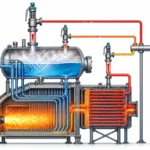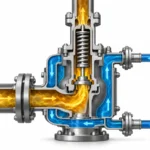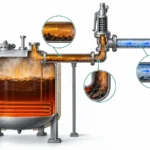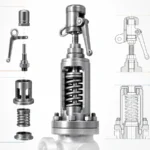
Learn what a vacuum safety valve means in tank and process service, how vacuum protection works, how related terms differ, and what engineers need to verify.

For tank and process equipment, a vacuum safety valve is a vacuum-protection
device that can open to admit air or another suitable gas when an excessive vacuum condition
develops. Because the term is not used identically in every industry, this article uses it only
in that tank/process context.
What Is a Vacuum Safety Valve?
In this context, the device provides a controlled path for replacement gas to enter the
protected system. The device name alone, however, does not establish the complete engineering
duty.
A positive-pressure relief device provides a path for fluid to leave a system when internal
pressure becomes excessive. Vacuum protection works in the opposite flow direction: suitable
replacement gas enters the protected equipment to reduce an excessive-vacuum condition.
How Does a Vacuum Safety Valve Protect Equipment?
Vacuum protection is driven by a pressure differential. As pressure inside the protected
equipment falls relative to the pressure available on the gas-admission side, the differential
can reach the device’s opening condition. The device then allows replacement gas to enter and
reduce the vacuum. In supported valve designs, it closes or reseals as the pressure condition
recovers.
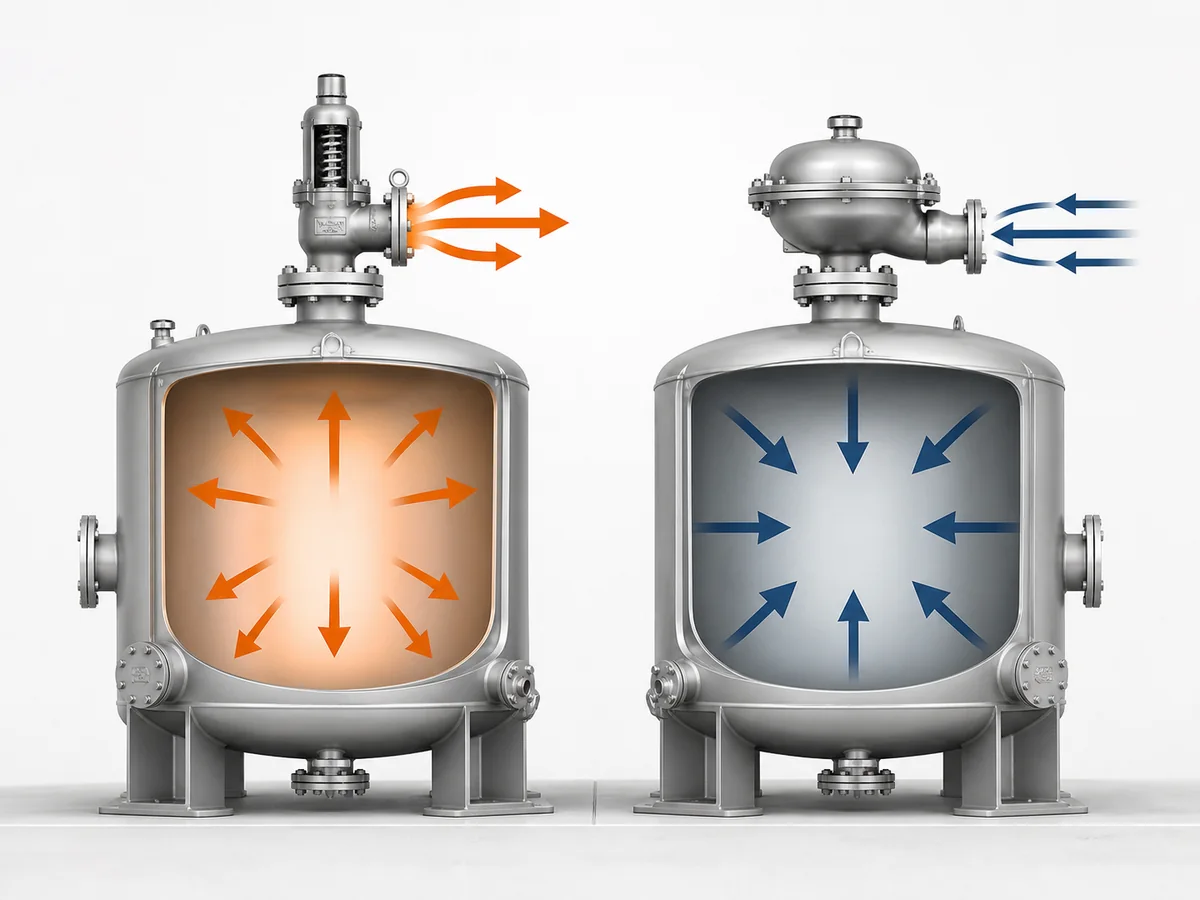
What happens as internal pressure falls
The key engineering question is not simply whether a system is described as being “under
vacuum.” It is whether the pressure condition has reached the point at which the designated
vacuum-protection path needs to open. That boundary comes from the protected equipment and the
project design basis rather than from a generic value that can be applied to every system.
Why admitting gas can relieve excessive vacuum
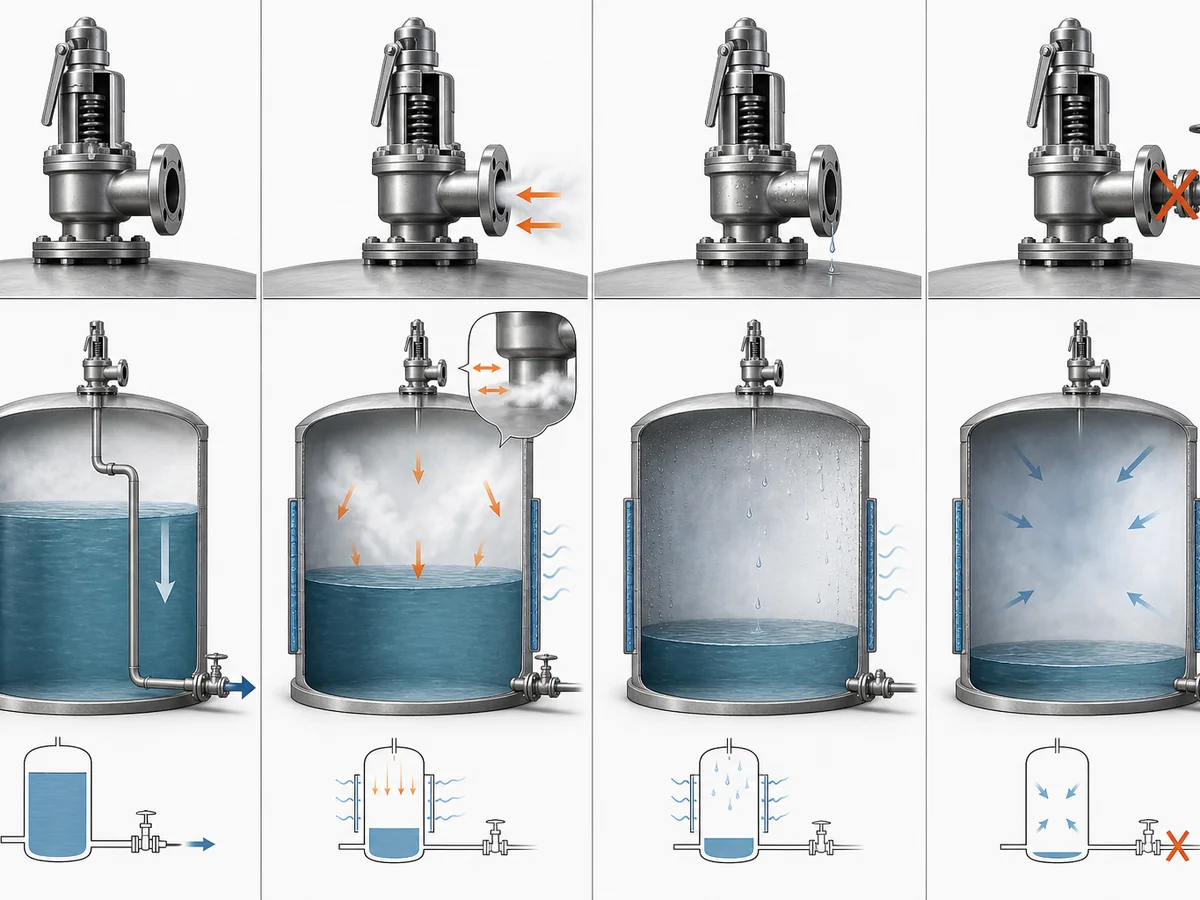
When liquid leaves a tank, gas or vapor cools and contracts, or steam or another vapor
condenses, the vapor space may require additional gas to maintain the intended pressure
condition. Admitting replacement gas can offset that change and reduce the vacuum.
The replacement gas is not automatically atmospheric air. Its suitability depends on the
process and must be considered separately from the basic vacuum-relief function.
What Can Cause Excessive Vacuum in a Tank or Process System?
The required protection cannot be evaluated without understanding what creates the vacuum
demand. Several mechanisms are representative in tank and process service, but the governing
case depends on the actual equipment and operating sequence.
Liquid withdrawal
As liquid leaves a tank, additional gas volume is needed in the vapor space. If replacement
gas cannot enter fast enough to offset that change, internal pressure can fall and a vacuum
condition can develop.
Cooling or vapor contraction
Cooling can reduce the pressure of gas or vapor in a closed or restricted system. A resulting
pressure decrease can create an inbreathing requirement—the need for
replacement gas to enter the system—even when liquid is not being withdrawn.
Steam or vapor condensation
Condensation can reduce the amount of vapor occupying a system. Steam-system vacuum breakers
illustrate the mechanism: as steam condenses during cooling, pressure falls and air can be
admitted to break the vacuum.
Restricted replacement-gas flow
Excessive vacuum can also develop when the required make-up gas cannot enter quickly enough to
offset withdrawal, cooling, or condensation. This is best understood as part of the overall
cause chain rather than as a universal standalone failure mode.
For deeper application-specific discussion of vacuum scenarios, see
ZOBAI Vacuum Service.
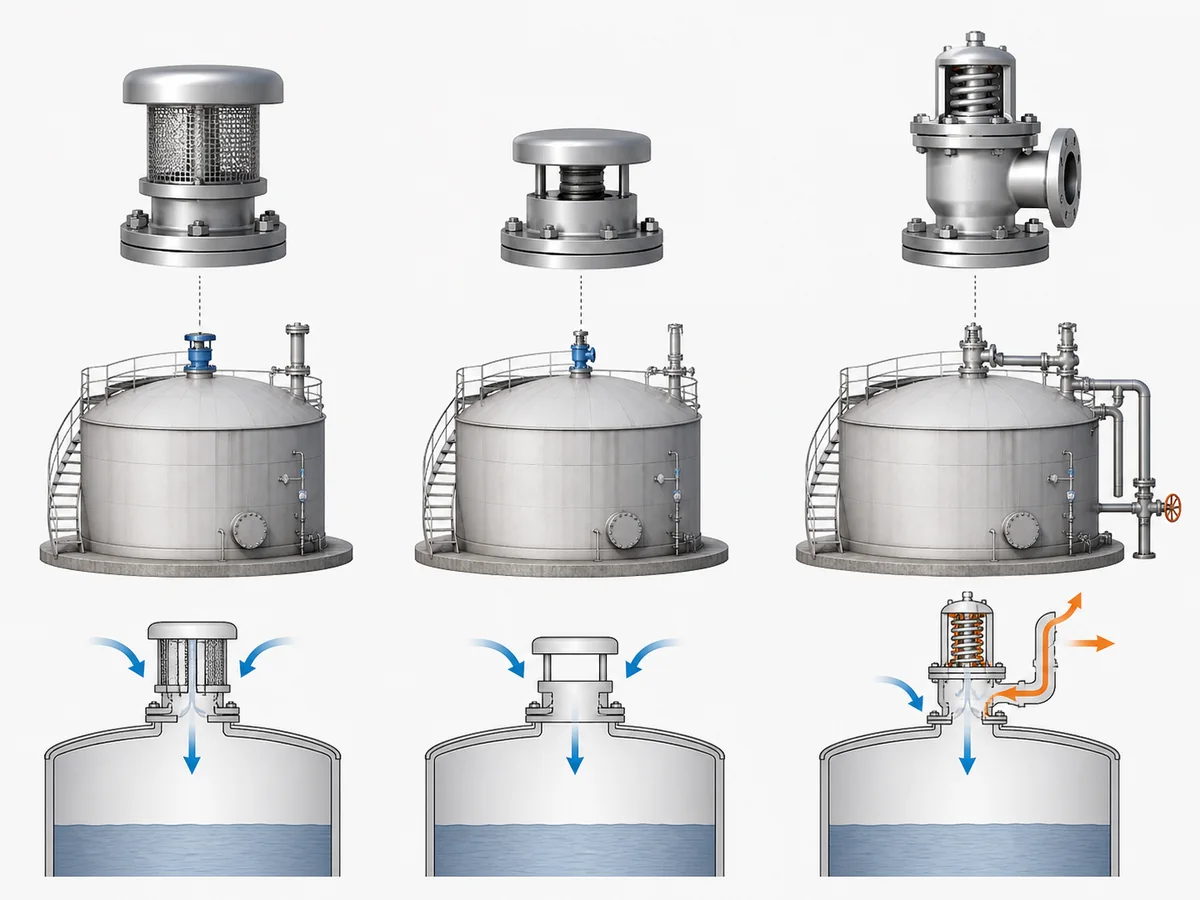
Vacuum Safety Valve vs Vacuum Relief Valve vs Vacuum Breaker vs PVRV
These terms can overlap, but treating them as universal synonyms can create the wrong
engineering assumption. A more reliable approach is to identify what condition the device
protects against and how it responds.
| Term | Useful Working Meaning | Important Boundary |
|---|---|---|
| Vacuum safety valve |
In this article, a device used to protect tank or process equipment against an excessive vacuum condition. |
The phrase is context-dependent and is not a universal cross-industry definition. |
| Vacuum relief valve |
A valve used to relieve an excessive-vacuum condition, commonly by admitting air or another suitable gas. |
Construction and application vary, so the name alone does not establish suitability. |
| Vacuum breaker |
A functional term for a device that breaks a sub-atmospheric condition by allowing gas to enter. |
The term is used in steam and process service and should not automatically be treated as identical to every vacuum relief valve. |
| PVRV / PV valve |
A pressure/vacuum relief configuration that can provide both positive-pressure and vacuum-protection functions. |
A combined pressure/vacuum device is not the generic name for every vacuum-only protection device. |
| Conventional pressure safety or relief valve | A device primarily intended to protect against excessive positive internal pressure. | Positive-pressure relief and vacuum relief operate in different flow directions. |
There is another important terminology boundary. In high-vacuum equipment, the phrase can
carry a different meaning.
VAT Group,
for example, uses vacuum safety valve for a valve that protects an evacuated vessel
against excessive positive internal pressure by releasing pressure outward.
That use is different from the tank/process vacuum-relief meaning used throughout this
article.
When combined pressure and vacuum protection becomes relevant
Some tank applications require both directions of protection: relief of excessive positive
pressure and relief of excessive vacuum. A combined pressure/vacuum relief device can provide
both functions, but whether that arrangement is appropriate remains a project-level
engineering decision.
What Actually Determines the Vacuum-Protection Requirement?
A vacuum-protection device cannot be evaluated simply by matching a connection size. The
required duty comes from the protected equipment and the process conditions that create the
vacuum.
1. What equipment is being protected?
Start with the tank, vessel, or process equipment itself. Its allowable or design vacuum basis
establishes the boundary that the protection system is intended to respect.
2. What vacuum condition can the equipment tolerate?
The relevant vacuum limit is equipment- and project-specific. A generic valve setting cannot
be assumed from the equipment name, connection size, or application category.
3. What event creates the governing vacuum demand?
The engineering review needs to identify the operating event that governs the relevant
inbreathing requirement, such as withdrawal, cooling, or condensation. Different operating
sequences can create different vacuum demands.
4. How much replacement gas may be required?
The device must be evaluated against the required replacement-gas or inbreathing duty for the
governing scenario. Nominal connection size by itself does not establish that the required
flow can be handled.
5. What gas is acceptable to admit?
Atmospheric air may be acceptable in some applications, while other systems may require an
inert or otherwise controlled vapor-space atmosphere. The acceptable make-up gas is therefore
a process-design question as well as a valve-selection question.
6. What restrictions exist in the complete flow path?
The installed venting path can include piping and accessories that add flow resistance.
Components such as flame arresters should therefore be considered as part of the complete flow
path rather than assumed to have no effect on the available pressure drop.
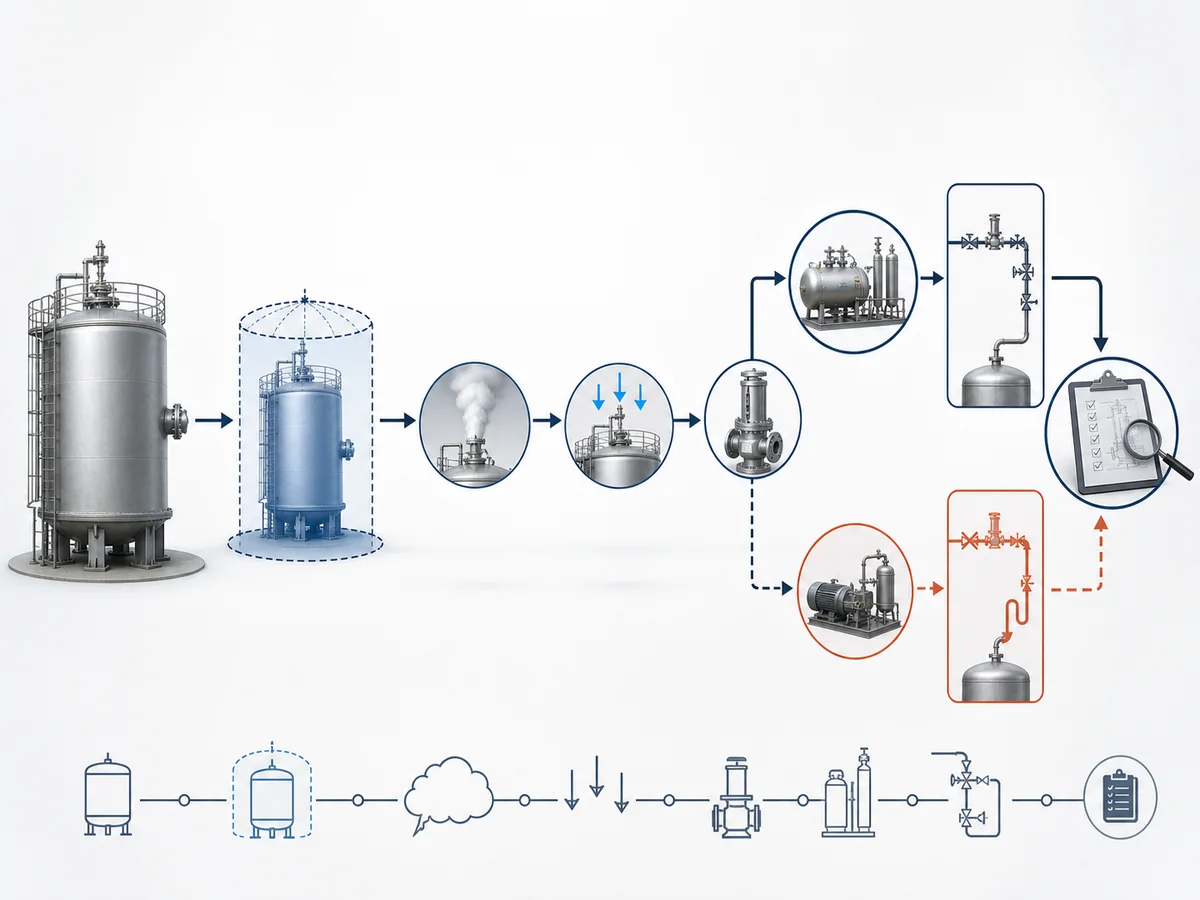
Once these inputs are known, the project can move from general understanding to comparison
with available vacuum-protection solutions. The
ZOBAI Vacuum Safety Valves
page provides the relevant product-family overview.
When Is Atmospheric Air Not a Safe Assumption?
A simplified explanation of vacuum relief often says that the valve “lets air in.” That can
describe many real systems, but it is not a universal design rule.
Some processes are intentionally operated with an inert or otherwise controlled vapor-space
atmosphere. In those cases, unrestricted atmospheric-air admission may conflict with the
process requirement. Relevant concerns can include oxygen exposure, moisture or contamination
control, or a project-specific inerting or blanketing strategy.
This does not mean that every chemical, hygienic, or sanitary tank requires inert-gas
admission. Hygienic vacuum-protection equipment also exists that intentionally admits
atmospheric air within its defined application. The narrower and safer conclusion is that
the permitted make-up gas must be confirmed for the actual process.
Device capability and process suitability are separate questions. A valve may provide a
vacuum-relief function while the proposed admission method is still inappropriate for the
process being protected.
Where Do API 2000 and ISO 28300 Fit?
API 2000 and ISO 28300 belong to the engineering context of venting atmospheric and
low-pressure storage tanks. They should not be treated as universal vacuum-valve standards
for every vessel, vacuum system, or industrial application.
According to
API’s current Digital Catalog,
Standard 2000, Edition 8 is titled
Venting Atmospheric and Low-pressure Storage Tanks. This article uses that verified
information only at the title and scope level. It does not reproduce or claim detailed
Edition 8 sizing rules, formulas, tables, or clause requirements.
ISO’s official listing
identifies ISO 28300:2008 as the published International Standard for
venting atmospheric and low-pressure storage tanks. ISO also lists a
revision under development.
A developing revision should not be presented as though it has already replaced the published
edition.
For a real project, the applicable standard, edition, equipment scope, and contractual
requirements need to be confirmed. Mentioning API 2000 or ISO 28300 does not by itself
establish that a particular manufacturer’s product is certified to, or compliant with, that
standard.
Frequently Asked Questions
Does every storage tank need a vacuum safety valve?
There is no universal yes-or-no answer. The protection method depends on the tank design
basis, operating conditions, venting arrangement, credible vacuum-producing scenarios, and
applicable project requirements. A particular valve configuration should therefore be
evaluated from the actual system rather than assumed from the equipment category alone.
Can a flame arrester or another vent-path restriction affect vacuum-relief performance?
Yes. Flow-path components can introduce resistance, so the installed venting path should be
evaluated as a system. A flame arrester, piping arrangement, or another accessory should not
automatically be assumed to have no effect on the pressure drop available for the required
flow.
Does API 2000 mean a vacuum safety valve is “API certified”?
No. A standard can define or inform engineering requirements for a project without serving as
a certification mark for a particular product. Any product-specific compliance or
certification claim must be supported separately by valid product or manufacturer
documentation.