Safety Valve RFQ Preparation Guide How to Prepare a Safety Valve Datasheet for RFQ A safety valve RFQ datasheet is a controlled engineering inquiry, not a request for a valve that merely matches size and set pressure. It should identify the protected equipment, governing relief scenario, medium and phase at relieving conditions, operating pressure, MAWP …

Safety Valve RFQ Preparation Guide
How to Prepare a Safety Valve Datasheet for RFQ
A safety valve RFQ datasheet is a controlled engineering inquiry, not a request for a valve that merely matches size and set pressure. It should identify the protected equipment, governing relief scenario, medium and phase at relieving conditions, operating pressure, MAWP or design pressure, set pressure, required relieving capacity, relieving temperature, superimposed and built-up back pressure, valve configuration, inlet and outlet connections, component materials, testing, certification, inspection and document requirements. Unknown values should be marked as pending rather than estimated. This guide shows procurement, EPC and maintenance teams which fields are needed for preliminary quotation, which items require engineering confirmation, and which evidence must be approved before purchase or replacement.
What Is a Safety Valve Datasheet for RFQ?
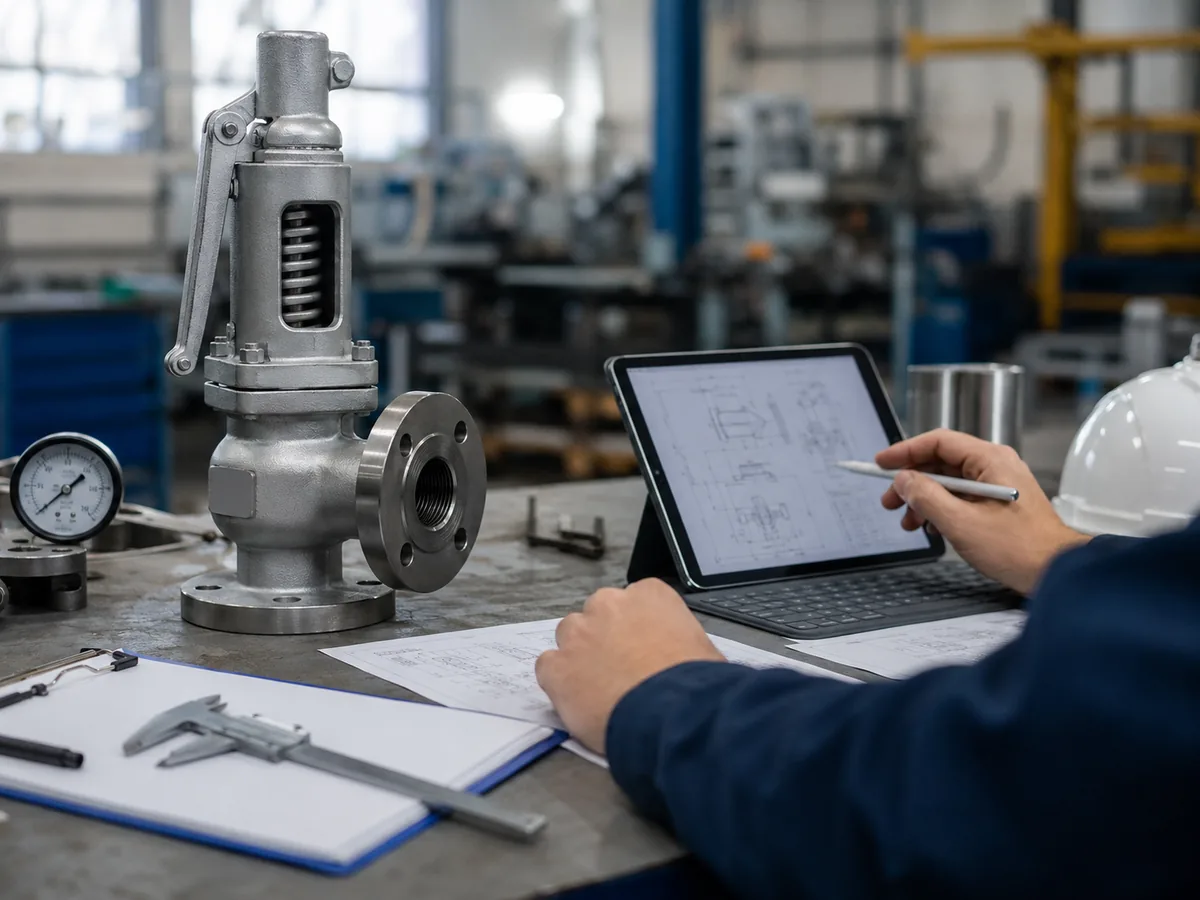
A safety valve datasheet for RFQ is a structured technical inquiry package. It tells the supplier what equipment the valve will protect, why the valve may need to open, what fluid will be relieved, what pressure and temperature conditions apply, what capacity is required, what connection and material requirements exist, and what documents or tests must be included in the quotation.
From a pressure-protection perspective, a datasheet is not just a purchasing form. It is the bridge between process conditions and supplier review. A short inquiry such as “quote one DN50 safety valve, 10 bar” is usually not enough for accurate review because connection size and set pressure do not prove capacity, service suitability, material compatibility or document scope.
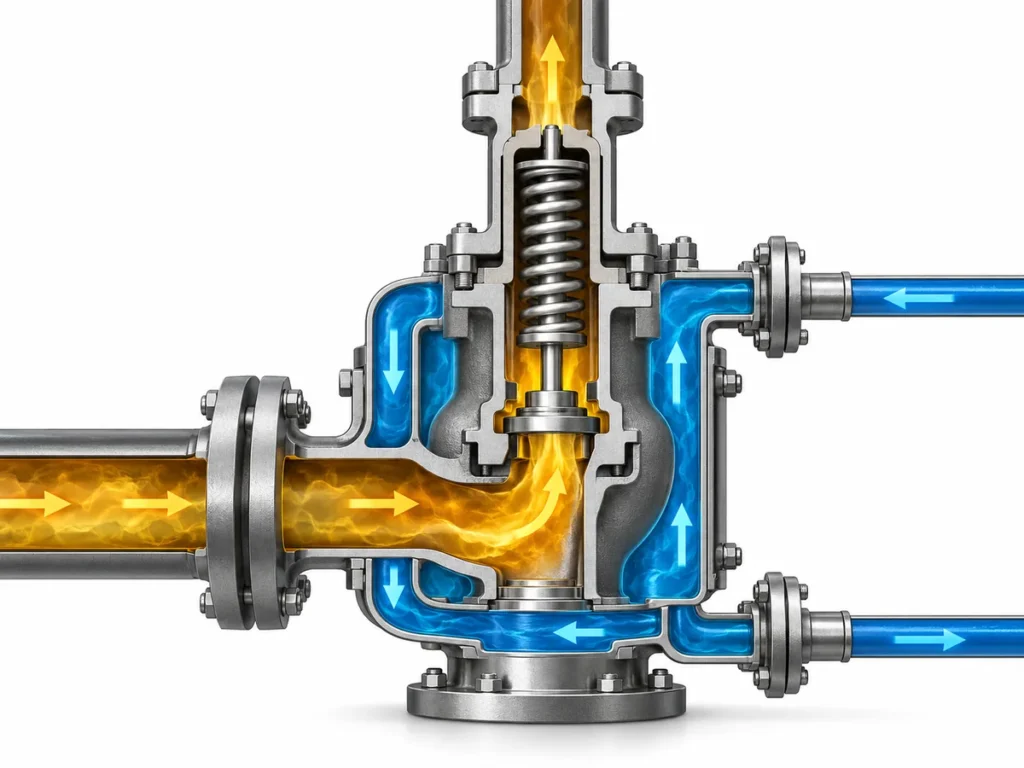
RFQ approval chain: protected-equipment and process data define the duty; the selected valve model and orifice define the available capability; model-specific certificates, tests and drawings provide the evidence. None of these three layers can replace the others.
RFQ Readiness Boundary: Preliminary Discussion vs Quotation Review
Not every inquiry needs a perfectly complete datasheet on day one. However, the buyer should separate a preliminary discussion from a quotation-ready review. If key values are missing, the inquiry can still be sent, but the missing items should be clearly marked as to be confirmed.
| RFQ Stage | What Can Be Reviewed | What Must Be Marked Clearly |
|---|---|---|
| Preliminary discussion | General feasibility, missing-data list, possible review path | Unknown capacity, scenario, back pressure, material or document scope |
| Quotation review | Model boundary, connection, material, testing and document quotation scope | Any data still based on old nameplate, assumption or pending calculation |
| Final technical confirmation | Final selection against confirmed project and manufacturer data | Applicable standard edition, project specification and responsible engineering approval |
Do not guess missing engineering data. Required relieving capacity, relief scenario, MAWP / design pressure, relieving temperature and back pressure should come from project data, equipment records, calculation basis or responsible engineering confirmation.
Three Approval Layers in a Safety Valve RFQ
| Approval Layer | Typical Owner | Required Evidence | What the Supplier Cannot Safely Assume |
|---|---|---|---|
| Process and protected-equipment basis | Process engineer, equipment engineer or responsible owner engineer | Equipment datasheet, governing relief scenario, required relieving load, pressure and temperature basis | MAWP, relief scenario, required capacity or allowable accumulation from valve size alone |
| Valve application and capability | Valve application engineer and purchaser technical reviewer | Selected model, valve type, orifice, supported capacity, back-pressure limits, materials and installation limits | That a catalog family, connection size or old nameplate proves current suitability |
| Order and compliance evidence | QA, inspector, purchaser and supplier | Approved datasheet, drawing, nameplate data, certificates, test reports, material records and deviation list | That a generic brochure or standard name proves order-specific compliance |
Quotation status must be explicit. Label the offer as budgetary, preliminary, technically reviewed or approved for purchase. A commercial quotation should not be mistaken for final engineering approval.
Why Incomplete Safety Valve RFQs Delay Quotation Review
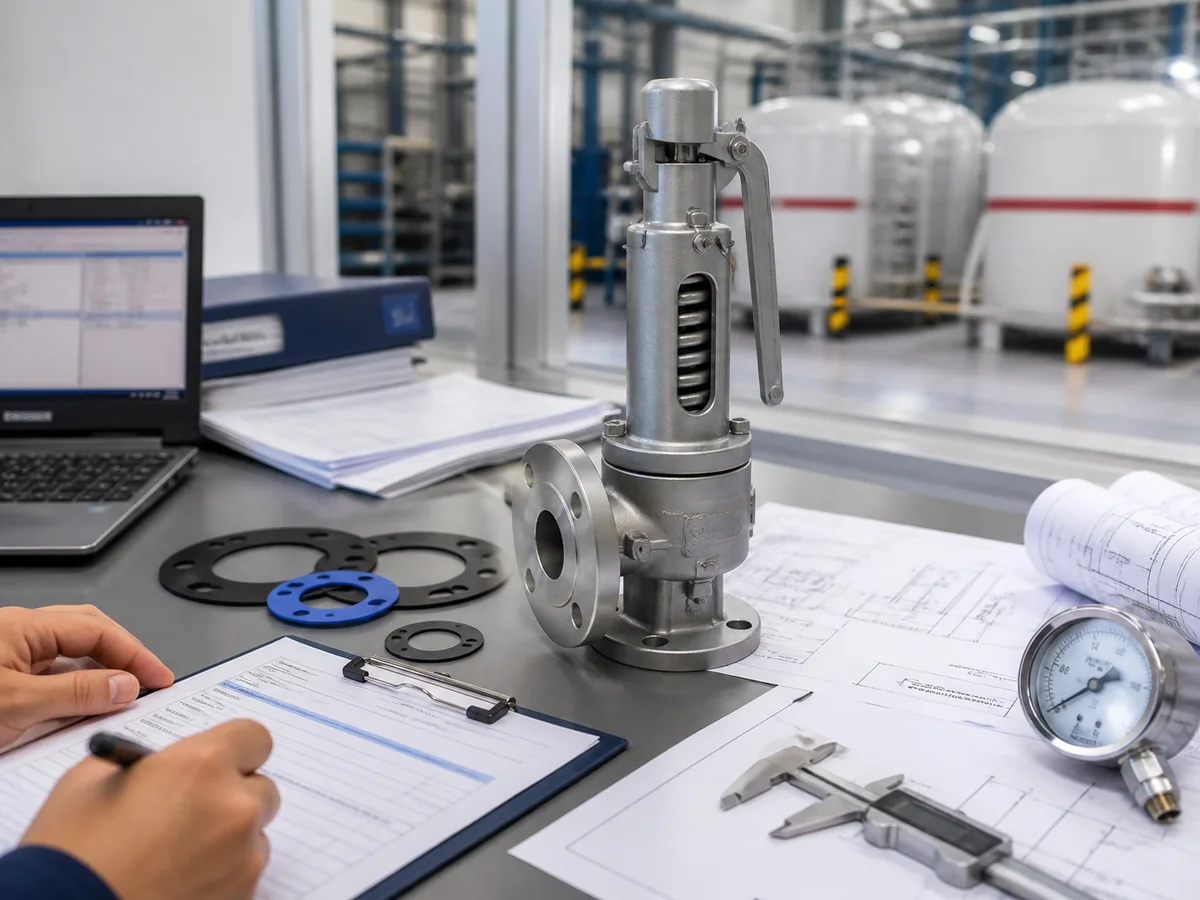
Incomplete RFQs usually delay quotation because the supplier cannot confirm whether the requested valve description matches the actual duty. Missing data may lead to repeated clarification, wrong quotation scope, unsuitable material assumptions, incorrect document requirements or an unsafe replacement decision.
| Incomplete RFQ Wording | What Is Missing | Why It Delays Review |
|---|---|---|
| “Quote DN50 safety valve, 10 bar.” | Protected equipment, medium, capacity, temperature, back pressure, connection standard, materials | Size and set pressure are not enough to review capacity or service suitability. |
| “Same as old valve.” | Old datasheet, nameplate, service condition, test record, current duty | The old valve may not match the current operating condition. |
| “For gas service.” | Gas type, composition, pressure, temperature, required flow | Generic medium description does not support capacity or material review. |
| “Flanged type required.” | Flange standard, rating, facing, inlet/outlet size, gasket requirement | Flanged connection does not define service suitability or pressure-temperature rating. |
If a value is not available, mark it as to be confirmed. A transparent incomplete datasheet is more useful than a guessed complete one.
Illustrative engineering scenario — same connections, insufficient capacity: A maintenance inquiry requested a replacement using the old inlet size, outlet size and set pressure. The quoted valve fitted the piping, but its selected orifice and documented gas capacity were lower than the current blocked-outlet requirement after a plant throughput increase. The cause was treating dimensional equivalence as technical equivalence. The correction was to update the relief calculation and select a model with supported capacity for the actual fluid and relieving conditions. The prevention is to make required capacity and model-specific capacity evidence mandatory RFQ hold points.
Minimum Required Fields Before Sending a Safety Valve RFQ
A complete datasheet can be detailed, but the first RFQ package should at least identify the key engineering fields. The supplier may still ask for more information, but these fields help determine whether the inquiry can move into a meaningful review.
| Field | Minimum Information to Provide | If Unknown |
|---|---|---|
| Protected equipment | Equipment name, tag or service description | Mark as to be confirmed |
| Relief scenario | Why overpressure may occur | Ask project engineer to confirm |
| Medium and phase | Gas, vapor, liquid, two-phase or flashing condition | Provide best known description and mark uncertainty |
| Pressure data | Operating pressure, MAWP / design pressure and set pressure | Request equipment datasheet |
| Required relieving capacity | Required flow rate and units | Mark calculation pending |
| Relieving temperature | Temperature at relief condition, not only normal temperature | Mark as to be confirmed if only normal temperature is known |
| Back pressure | Superimposed and built-up, if known | Mark unknown and provide discharge route |
| Connection and material | Inlet/outlet connection, body, trim, seat and gasket requirements | Provide old datasheet or photos if replacement |
| Documents and tests | MTC, calibration, test report, drawing and inspection requirements | Confirm with QA or procurement |
Record the Source and Status of Every Critical Field
| Data Status | Acceptable RFQ Wording | Use in Review |
|---|---|---|
| Confirmed | “From approved equipment datasheet / approved relief calculation.” | Can support technical selection when the revision is identified. |
| Existing reference | “From existing valve nameplate; suitability not yet reconfirmed.” | Useful for identification only until the current duty is checked. |
| Preliminary assumption | “Assumed for budget quotation; owner confirmation required.” | Supports a conditional offer, not purchase release. |
| Unknown | “To be confirmed / calculation pending.” | Triggers a clarification or technical hold point. |
Protected Equipment: What Is the Valve Protecting?
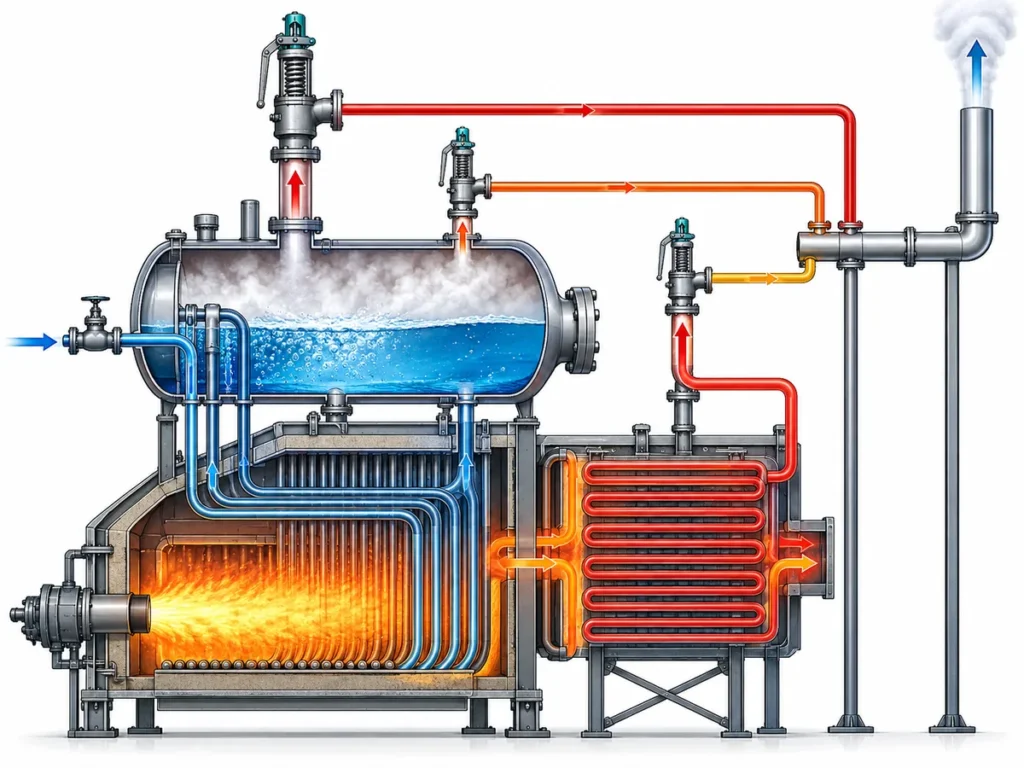
The datasheet should identify the protected equipment, not just the valve. A safety valve protects a pressure boundary. Without knowing the equipment, the supplier cannot understand the design pressure basis, service context, possible overpressure case or document expectation.
Include the equipment name or type, tag number if available, service description and equipment datasheet reference. Common protected equipment may include a vessel, tank, pipeline section, pump discharge line, compressor system, heat exchanger, reactor, package skid or other pressure equipment.
If available, attach the equipment datasheet. This helps confirm design pressure or MAWP, design temperature, normal operating pressure, normal operating temperature, medium, nozzle or connection data and project specification.
Boundary note: Do not infer MAWP or design pressure from visible flange size, nominal connection, old valve size or the buyer’s requested set pressure. Use equipment documentation or responsible engineering confirmation.
Protected-Equipment Code Basis Must Be Named
For ASME projects, the protected equipment section of the Code and the overpressure-protection rules should be identified separately. ASME BPVC Section VIII, Division 1 provides the pressure-vessel construction context, while ASME BPVC Section XIII provides overpressure-protection rules for pressurized equipment and requirements for pressure relief devices. The RFQ should identify the project-adopted code, edition, jurisdiction and owner specification rather than writing only “ASME valve.”
| Protected-Equipment Evidence | Preferred RFQ Source | Common Error |
|---|---|---|
| Equipment identity and pressure boundary | Approved equipment datasheet, P&ID and tag register | Using the valve nameplate as the only equipment record |
| MAWP or design pressure | Equipment manufacturer record or approved project datasheet | Inferring it from flange class or normal operating pressure |
| Applicable code route | Project specification, jurisdictional requirement and owner standard | Writing “API/ASME” without identifying the actual equipment and certification route |
Relief Scenario: Why Must the Valve Open?
The relief scenario explains why pressure may exceed the allowable limit. It is one of the most important datasheet fields because required relieving capacity depends on the governing overpressure case.
The buyer should state the known or assumed scenario, such as blocked outlet, thermal expansion, regulator failure, control failure, tube rupture where applicable, external heating case where applicable, process upset or unknown to be confirmed.
Different scenarios can require different relieving rates, temperatures, phases and discharge assumptions. The datasheet should therefore state whether the required capacity comes from project calculation, old datasheet, nameplate, supplier estimate or pending review.
| Scenario Status | How to Write It in the Datasheet | Review Meaning |
|---|---|---|
| Confirmed | State the governing case and attach calculation or project basis if available | Supplier can review the inquiry against a defined duty |
| Assumed | State that the scenario is preliminary and needs project confirmation | Quotation can be preliminary, not final technical confirmation |
| Unknown | Mark “relief scenario to be confirmed” and send available equipment/service data | Supplier can identify missing information but cannot confirm final suitability |
Common Relief Scenarios and the Data They Require
Where the project falls within its industry scope, API Standard 521 provides guidance for pressure-relieving and depressuring systems in petroleum, gas, LNG and petrochemical facilities. It should be used within its stated scope and does not replace the project’s approved scenario calculation.
| Possible Scenario | Key Input for RFQ | Typical Responsible Source |
|---|---|---|
| Blocked outlet or control failure | Maximum credible incoming flow, relieving pressure and temperature | Process calculation and control-valve data |
| Positive-displacement pump deadhead | Maximum pump flow at relieving pressure and liquid properties | Pump curve and process engineer |
| Thermal expansion of blocked-in liquid | Trapped volume, heat input, liquid expansion and discharge destination | Piping/process calculation |
| Tube rupture or gas blow-by | Upstream source pressure, flow restriction and downstream system response | Heat-exchanger or process study |
| External fire or heating case | Wetted area, insulation/fireproofing basis, latent heat and relieving conditions | Approved fire-case calculation |
Pressure Fields: Operating Pressure, MAWP, Set Pressure and Overpressure Basis
Pressure fields are frequently mixed in RFQs. A safety valve datasheet should separate operating pressure, maximum operating pressure, MAWP or design pressure, set pressure and overpressure basis.

| Pressure Field | What It Means | Why It Matters in RFQ |
|---|---|---|
| Operating pressure | Normal working pressure | Helps check margin below set pressure |
| Maximum operating pressure | Highest expected operating condition | Helps avoid leakage or frequent opening |
| MAWP / design pressure | Pressure limit of the protected equipment | Defines protection boundary |
| Set pressure | Pressure at which the valve is set to open | Must match equipment protection requirements |
| Overpressure / accumulation basis | Allowed pressure rise during relieving | Affects relieving pressure and capacity review |
| Reseating / blowdown requirement | Closing behavior after opening | May affect operating stability and process recovery |
Do not mix pressure terms. Operating pressure, MAWP / design pressure and set pressure are different values. A datasheet that only states one pressure number may not be reviewable for quotation.
Cold Differential Test Pressure Is Not the Field Set Pressure
When temperature or constant back pressure requires a shop correction, the RFQ may need a cold differential test pressure (CDTP). CDTP is a test-setting value derived for the specified valve design and service conditions; it is not a generic percentage and should not be created by procurement. The quotation should state the field set pressure, service temperature, superimposed back pressure and the manufacturer’s correction basis separately.
| Pressure Evidence | What It Supports | What It Does Not Prove |
|---|---|---|
| Equipment MAWP / design pressure record | Protected pressure boundary | Required capacity or correct valve model |
| Approved set-pressure basis | Required field opening setting and code arrangement | Capacity, seat tightness or installed stability |
| CDTP calculation or manufacturer statement | Shop setting under stated test conditions | A universal field adjustment rule |
| As-left calibration report | Final test result after manufacture or repair | That the process basis and installation are correct |
Medium, Phase and Relieving Temperature
The medium and phase affect capacity review, material selection, seat choice, discharge routing, testing expectations and maintenance risk. The datasheet should describe not only the medium name but also the condition during relief.
Include the fluid name, composition if available, and any service notes. State whether the medium is clean, corrosive, dirty, viscous, crystallizing, polymerizing or contains solids.
Normal operating temperature may be different from relieving temperature. The datasheet should include relieving temperature where available because it can affect body material, trim material, seat and seal material, gasket material, spring environment, pressure-temperature ratings and inspection requirements.
| Service Condition | Datasheet Data Needed | Why It Matters |
|---|---|---|
| Gas or vapor | Gas name, composition, molecular data if available, pressure and temperature | Affects capacity review and discharge condition |
| Liquid | Liquid name, density/viscosity if available, trapped volume or flow basis | Affects thermal expansion or liquid relief review |
| Two-phase or flashing service | Relieving condition, phase behavior and calculation basis | May require specific engineering review before quotation |
| Corrosive or dirty service | Composition, concentration, solids, cleanliness and material requirement | Affects body, trim, seat, spring, gasket and maintenance expectations |
| High or low temperature service | Normal and relieving temperature, material and seal requirement | Affects material rating and component compatibility |
Fluid Properties Must Match the Capacity Calculation Basis
| Fluid Condition | Useful RFQ Property Data | Selection Risk if Omitted |
|---|---|---|
| Gas or vapor | Molecular weight, compressibility, relieving temperature and composition | Incorrect gas capacity conversion or material selection |
| Steam | Saturated/superheated condition, relieving pressure and temperature | Using unrelated air or gas capacity data |
| Liquid | Density, viscosity, vapor pressure and possible flashing | Wrong liquid coefficient or failure to identify two-phase behavior |
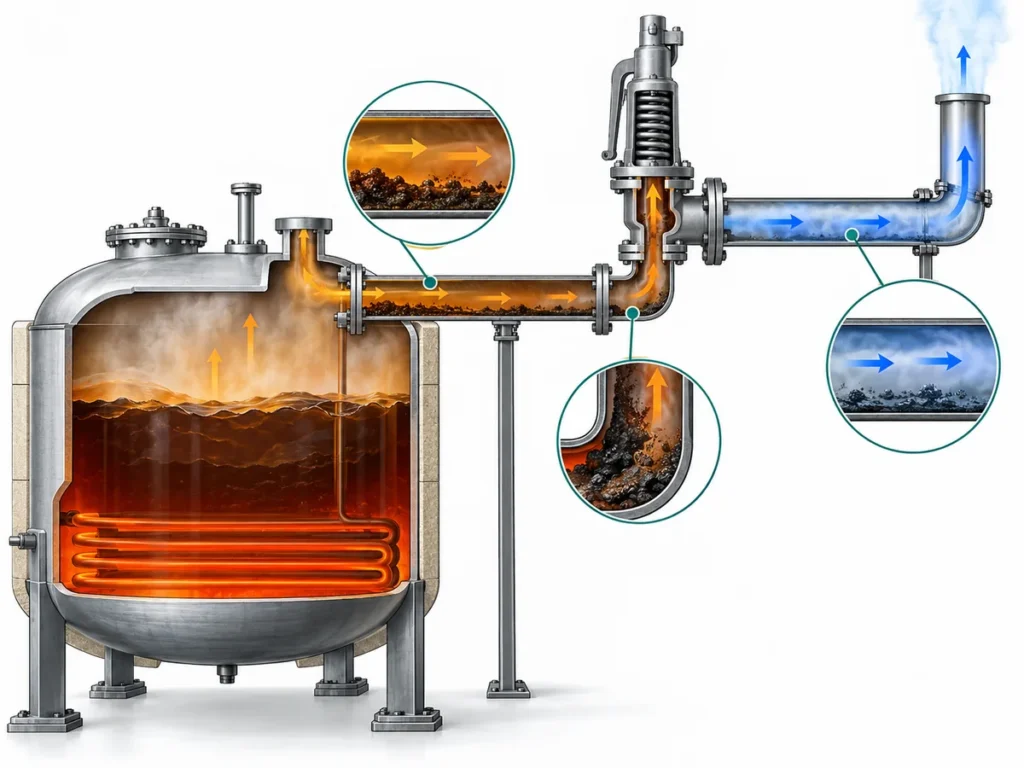
| Dirty, polymerizing or crystallizing service | Solids, fouling tendency, cleaning method and maintenance interval | Seat damage, guide sticking or pilot-passage blockage |
Illustrative engineering scenario — wrong capacity medium: An RFQ compared a catalog air-capacity value with a hot process-gas requirement. The quotation appeared to have margin, but the molecular weight, compressibility and relieving temperature were different. The cause was treating all gas capacities as interchangeable. The correction was to review the exact gas properties and manufacturer-supported capacity basis. The prevention is to state the capacity medium, units and relieving conditions in the datasheet.
Required Relieving Capacity and Capacity Basis
Required relieving capacity is not the same as connection size. Two industrial safety valves with the same inlet and outlet size may have different internal flow areas, different documented capacities and different service limits.
The datasheet should state the required relieving capacity and explain where that value comes from. If the required capacity is unknown, do not replace it with valve size. Use wording such as “calculation pending” or “existing valve nameplate attached for reference only.”
Required Capacity vs Documented Capacity Evidence
Required relieving capacity is the flow rate needed to protect the equipment under the governing relief case. Selected valve or model capacity is what the manufacturer reviews for a specific valve design and operating basis. Documented or certified capacity evidence is the record or document requested by the project to support the selected valve’s capacity claim. These three items should not be treated as the same field in the RFQ datasheet.
| Capacity Field | What to Provide | Notes |
|---|---|---|
| Required relieving capacity | Required flow rate | Include units clearly |
| Capacity basis | Calculation, project datasheet, existing record, nameplate or pending | Do not hide uncertainty |
| Fluid phase | Gas, vapor, liquid, flashing or two-phase | Must match relieving condition |
| Relieving pressure | Pressure basis for capacity review | Should be consistent with set pressure and overpressure basis |
| Relieving temperature | Temperature at relief condition | Needed for service review |
| Documented / certified capacity request | Required document scope if the project asks for capacity evidence | Must be tied to selected valve model and manufacturer data |
RFQ wording example: “Required relieving capacity: 2,500 kg/h vapor, calculation pending final client approval. Existing valve datasheet attached for reference only.” This wording is safer than replacing capacity with a nominal size.
Capacity Evidence Must Match the Exact Fluid and Conditions
API 520 Part I addresses sizing and selection of pressure-relieving devices within its refinery and related-industry scope. ISO 4126-1 provides general product requirements for safety valves and explicitly functions as a product standard rather than a complete application-design standard. The RFQ must therefore connect the project’s relief calculation to the exact selected model and supported capacity data.
| Capacity Evidence Level | Question It Answers | Approval Check |
|---|---|---|
| Required relieving load | How much must the system discharge? | Approved governing-case calculation, units and revision |
| Required flow area | What minimum area follows from the approved method? | Fluid properties, relieving pressure/temperature and correction factors |
| Selected orifice and model | Which actual product configuration is offered? | Model-specific datasheet and drawing |
| Documented or certified capacity | What flow does the exact design support under stated conditions? | Manufacturer/certification record linked to model, orifice, fluid basis and configuration |
| Installed-system verification | Can the valve achieve stable performance in the real piping? | Inlet-loss and outlet/back-pressure engineering review |
Do not use the following as capacity evidence: connection size, flange class, valve weight, a set-pressure certificate, a seat-leakage report or a photograph of the existing valve.
Back Pressure and Discharge Condition
Back pressure and discharge conditions can affect valve performance, capacity, stability and configuration review. The datasheet should not only identify the outlet size but also describe where the valve discharges.
For more detailed engineering context, use ZOBAI’s back pressure and discharge review resource during later review.
| Discharge Field | What to Include | If Unknown |
|---|---|---|
| Discharge destination | Vent, header, return line, safe discharge point or other destination | Attach installation photo or piping note |
| Superimposed back pressure | Pressure existing at valve outlet before opening | Mark unknown if not measured |
| Built-up back pressure | Pressure generated during relieving | Mark calculation pending |
| Constant or variable | Whether outlet pressure is stable or changing | Mark to be confirmed |
| Outlet piping | Length, size, support, bends and restrictions if known | Provide drawing or photos |
| Drainage and safe discharge | Whether liquid can collect and where discharge is routed | Provide site photos or mark to be confirmed |
Do not solve back pressure by name alone. A valve configuration can only be reviewed after the type, amount and variation of back pressure are known together with service condition and project requirements.
Conventional, Balanced-Bellows and Pilot-Operated Review Boundary
API 520 Part II addresses pressure-relieving-device installation and includes an engineering-analysis approach for installation review within its scope. The RFQ should not ask for a “bellows valve” or “pilot valve” as a substitute for actual back-pressure data.
| Valve Configuration | RFQ Data Still Required | Incorrect Assumption to Avoid |
|---|---|---|
| Conventional spring-loaded | Superimposed, built-up and total back pressure; outlet resistance; blowdown impact | That atmospheric-looking discharge means back pressure is negligible |
| Balanced bellows | Back-pressure range, bellows material, bonnet vent and manufacturer correction limits | That bellows eliminate every back-pressure effect |
| Pilot-operated | Main-valve outlet pressure, pilot exhaust, sensing line, cleanliness and freezing/condensation risk | That pilot operation is automatically suitable for dirty or polymerizing service |
Illustrative engineering scenario — modified discharge header: An existing valve had acceptable service history until a new source was connected to the common relief header. Built-up back pressure increased during simultaneous relief, and the valve began to chatter and reseat poorly. The cause was a system modification outside the original RFQ basis. The correction was to recalculate the header and review the valve configuration and capacity correction. The prevention is to require discharge destination, simultaneous-relief assumptions and header modifications in the RFQ/MOC process.
Connection, Material and Installation Data
Mechanical information helps the supplier understand whether the quoted valve can fit the piping and meet project requirements. Material information helps identify whether the requested construction is compatible with the service condition.
For piping and fit-up context, review safety valve installation data together with project layout requirements. If the RFQ uses ASME flanges, confirm flange dimensions and connection standard before quotation review.
When preparing installation data, include inlet piping condition, possible inlet pressure loss, outlet piping support, drainage condition and discharge direction where known. Excessive inlet pressure loss, unsupported outlet piping or unsafe discharge routing may change the engineering review even if the valve size and connection appear correct.
| Datasheet Field | Required Information | Why It Matters |
|---|---|---|
| Inlet size | Nominal size and connection type | Mechanical fit-up |
| Outlet size | Nominal size and connection type | Discharge compatibility |
| Connection standard | Flange/thread standard and rating | Prevents fit-up mismatch |
| Pressure-temperature rating | Class/PN/rating and service temperature basis | Prevents rating mismatch under actual service temperature |
| Body material | Required body material or project material class | Service and rating review |
| Trim / seat / spring / bellows | Specified wetted or functional material where required | Compatibility, leakage and maintenance review |
| Installation note | Orientation, inlet/outlet piping, support and discharge condition | Stability and safety review |
Do Include
- Inlet and outlet size.
- Flange or thread standard.
- Pressure class or rating.
- Facing, gasket or thread details.
- Body, trim, seat and gasket requirements.
- Installation photos for replacement work.
Do Not Assume
- That same connection means same capacity.
- That material grade alone proves service suitability.
- That old valve appearance proves current suitability.
- That flange rating proves equipment MAWP.
- That outlet piping has no back pressure effect.
- That a quotation can be final without confirmed duty data.
Component-Level Material Data
| Component | RFQ Material Concern | Possible Failure if Only Body Material Is Specified |
|---|---|---|
| Nozzle, disc and seat | Corrosion, erosion, galling, hardness pairing and seat geometry | Leakage, wire drawing or loss of sealing surface |
| Guide and spindle | Fouling, corrosion, clearance and anti-galling compatibility | Restricted lift, sticking or unstable movement |
| Spring | Temperature, corrosion, stress relaxation and range | Set-pressure drift or premature failure |
| Bellows or pilot components | Fatigue, process compatibility, seals and small-passage cleanliness | Loss of balancing, leakage or delayed operation |
| Soft seat, gasket and O-rings | Temperature, chemical exposure, swelling, hardening and decompression | Seat leakage, extrusion or seal fragmentation |
Applicable Standard, Testing and Document Requirements
A standard name alone does not complete a safety valve specification. The datasheet should identify the applicable standard or project specification and separately state which documents and tests are required with the quotation or delivery package.
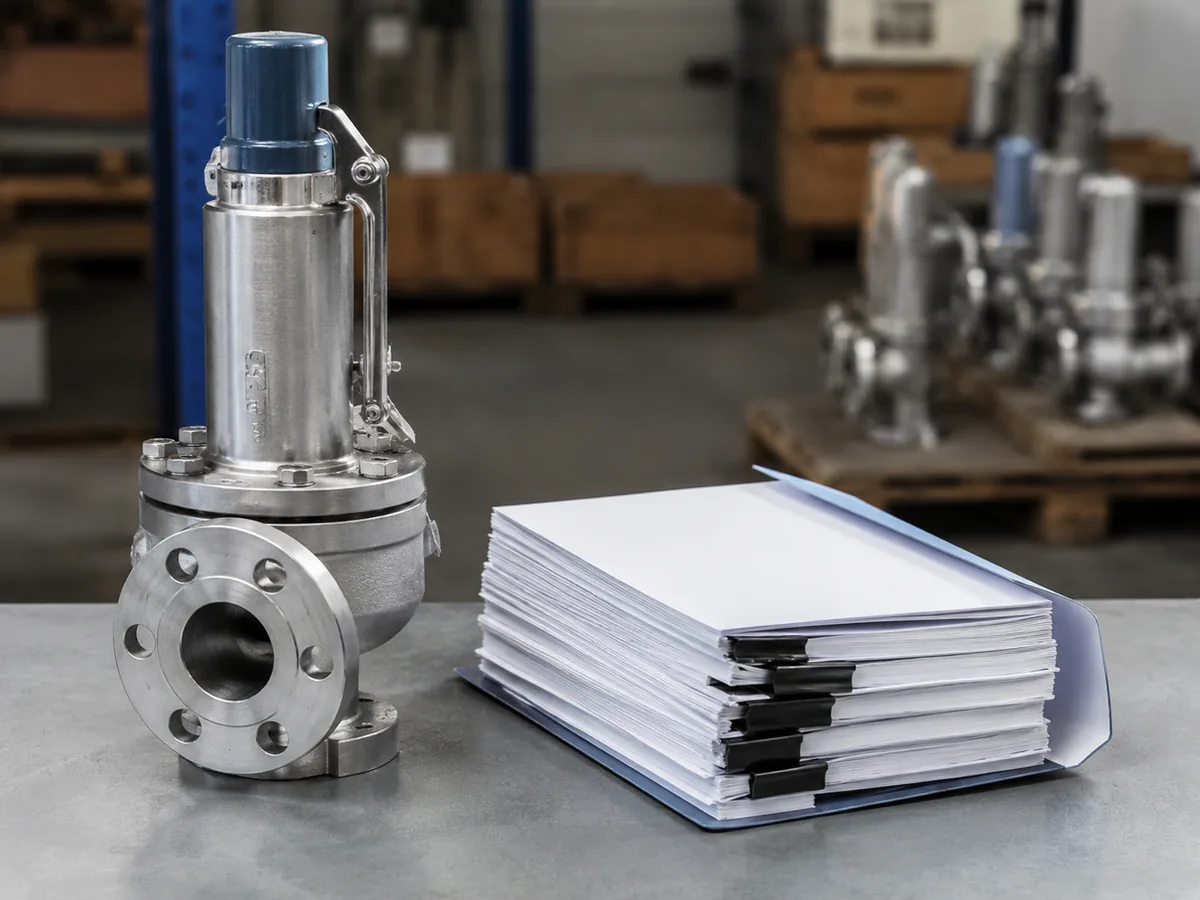
For sizing-related standard context, refer to API 520 sizing context. For seat leakage test context, refer to API 527 seat tightness test. These references help translate RFQ requirements, but they do not replace the applicable project specification.
| Requirement | What to State in RFQ | Notes |
|---|---|---|
| Applicable standard | Project standard, purchaser specification or code basis | Do not assume automatic compliance |
| Datasheet | Buyer datasheet or supplier datasheet format | Confirm required format |
| Drawing / GA | Required or not required | Useful for installation review |
| Material certificate | Required material records | Define scope if needed |
| Set pressure calibration | Required report or record | Usually important for release documents |
| Seat leakage test | Required if applicable | State test expectation clearly |
| Shell / pressure test | Required if applicable | Confirm project specification and witness requirement |
| Capacity basis | Required if the project needs documented or certified capacity evidence | Must be tied to selected valve model and applicable requirements |
| Witness inspection | Required or not required | Confirm before quotation |
What Each Test or Document Proves
| Record | What It Supports | What It Does Not Prove by Itself |
|---|---|---|
| Approved RFQ datasheet | Agreed design and order inputs | That the offered model actually meets every input |
| General arrangement drawing | Dimensions, connections, orientation and accessories | Capacity, material traceability or code certification |
| Set-pressure / CDTP certificate | Opening adjustment under the recorded test conditions | Full lift, certified capacity or installed stability |
| Seat-tightness report | Closing leakage under the applicable test method | Correct set pressure, required capacity or thread/flange joint tightness |
| Pressure-boundary test report | Integrity of the tested pressure-containing parts | Opening performance or flow capacity |
| Material certificate | Material identity and traceability for the stated component scope | Service compatibility of unspecified trim or soft parts |
| Capacity certification/listing | Supported capacity for the certified design and stated conditions | That the project relief calculation and piping system are correct |
Authoritative Standard and Certification Scope
| Official Reference | RFQ Purpose | Boundary |
|---|---|---|
| ASME BPVC Section XIII | Overpressure-protection and pressure-relief-device rules for applicable pressurized equipment | Must be used with the protected-equipment Code section, project edition and jurisdiction |
| API 520 Part I | Sizing and selection within its refinery and related-industry scope | Does not define every relief scenario or provide ASME certification |
| API 520 Part II | Installation and engineering analysis within its scope | Cannot compensate for insufficient valve capacity |
| API 521 | Relieving and depressuring-system guidance for its stated petroleum/gas/petrochemical scope | Not a universal product-certification standard |
| API 527 | Seat-tightness test methods and criteria for applicable PRVs | Does not prove relieving capacity or installed-system stability |
| ISO 4126-1 | General product requirements for safety valves | ISO identifies it as a product standard, not a complete application-design standard |
| National Board NB-18 | Verification of certified pressure-relief-device designs and accredited manufacturers/assemblers | Must be matched to the exact manufacturer, model, design and capacity record |
| ASME Data Report Forms | Identifies applicable conformity/data-report forms such as UV-1 where required | A generic form name is not proof that the supplied valve follows that route |
| National Board VR | Authorized repair quality system where the owner/jurisdiction requires it | Does not replace relief sizing, capacity review or installation analysis |
Replacement RFQ Data for Existing Safety Valves
Replacement inquiries need additional evidence. An old valve’s size, appearance or set pressure does not prove that the same configuration is suitable for the current duty.
Attach Existing Valve Evidence
- Clear nameplate photo.
- Full valve photo.
- Inlet and outlet connection photos.
- Installation photos.
- Tag number.
- Old datasheet if available.
Confirm Service Changes
- Medium change.
- Operating pressure change.
- Temperature change.
- Capacity change.
- Discharge route change.
- Document requirement change.
Replacement Verification Workflow
| Step | Buyer Action | Why It Matters |
|---|---|---|
| 1. Capture old valve evidence | Send nameplate, photos, tag and old datasheet if available | Identifies what was installed, not whether it is still suitable |
| 2. Confirm current service | Provide medium, pressure, temperature and discharge information | Prevents replacing old data into a changed duty |
| 3. Check capacity basis | Send required capacity, old capacity record or mark calculation pending | Prevents nominal-size replacement without capacity review |
| 4. Review installation condition | Provide inlet/outlet photos, outlet routing and back pressure information | Helps identify piping-related leakage, chatter or instability risks |
| 5. Define document scope | State test reports, certificate and inspection requirements | Prevents quotation gaps before order release |
As-Found and As-Left Evidence for Replacement or Repair
| Evidence | Why It Belongs in the RFQ Package | Decision Use |
|---|---|---|
| As-found set pressure and leakage | Shows the condition after service before adjustment | Supports inspection-interval and root-cause review |
| Internal condition photographs | Shows corrosion, deposits, erosion, spring and guide condition | Supports material or valve-type changes |
| Repair and replacement-parts list | Identifies changes to trim, spring, bellows, seals or pilot parts | Confirms whether original configuration was restored |
| As-left set pressure and seat tightness | Records the final bench condition | Supports release after repair, but not current capacity approval |
| Updated process and MOC record | Identifies changes in throughput, medium, pressure or discharge header | Determines whether the original valve duty remains valid |
Composite Engineering Scenario for Training
This is a hypothetical combined scenario used only to explain datasheet logic. It is not a customer case, project record, test report, certification statement or product capacity proof.
A buyer asks for a replacement safety valve with the same inlet size and set pressure as an existing valve. The old nameplate is available, but the required relieving capacity and current discharge back pressure are not confirmed. In this case, the datasheet should list the existing valve data as reference only, mark required capacity and back pressure as to be confirmed, attach the old datasheet and installation photos, and request engineering review before treating the replacement as technically equivalent.
The key lesson is that replacement similarity does not equal final suitability. A supplier can prepare a preliminary quotation, but final technical confirmation still depends on protected equipment, relief scenario, current service conditions, capacity basis, manufacturer data, applicable standards and project requirements.
| Scenario Step | Engineering Finding |
|---|---|
| Problem | The buyer requested a same-size replacement from the old nameplate, but current required capacity and back pressure were unknown. |
| Cause | The old valve was treated as the design basis even though the process and discharge system had not been revalidated. |
| Action | Mark capacity and back pressure as pending, attach the old datasheet and installation evidence, and request process/engineering confirmation before final selection. |
| Prevention | Use a replacement datasheet that separates identity data, current duty data, as-found evidence and final approval evidence. |
Safety Valve RFQ Datasheet Checklist
Use this checklist before sending an RFQ. Mark each field as provided, if available or to be confirmed.
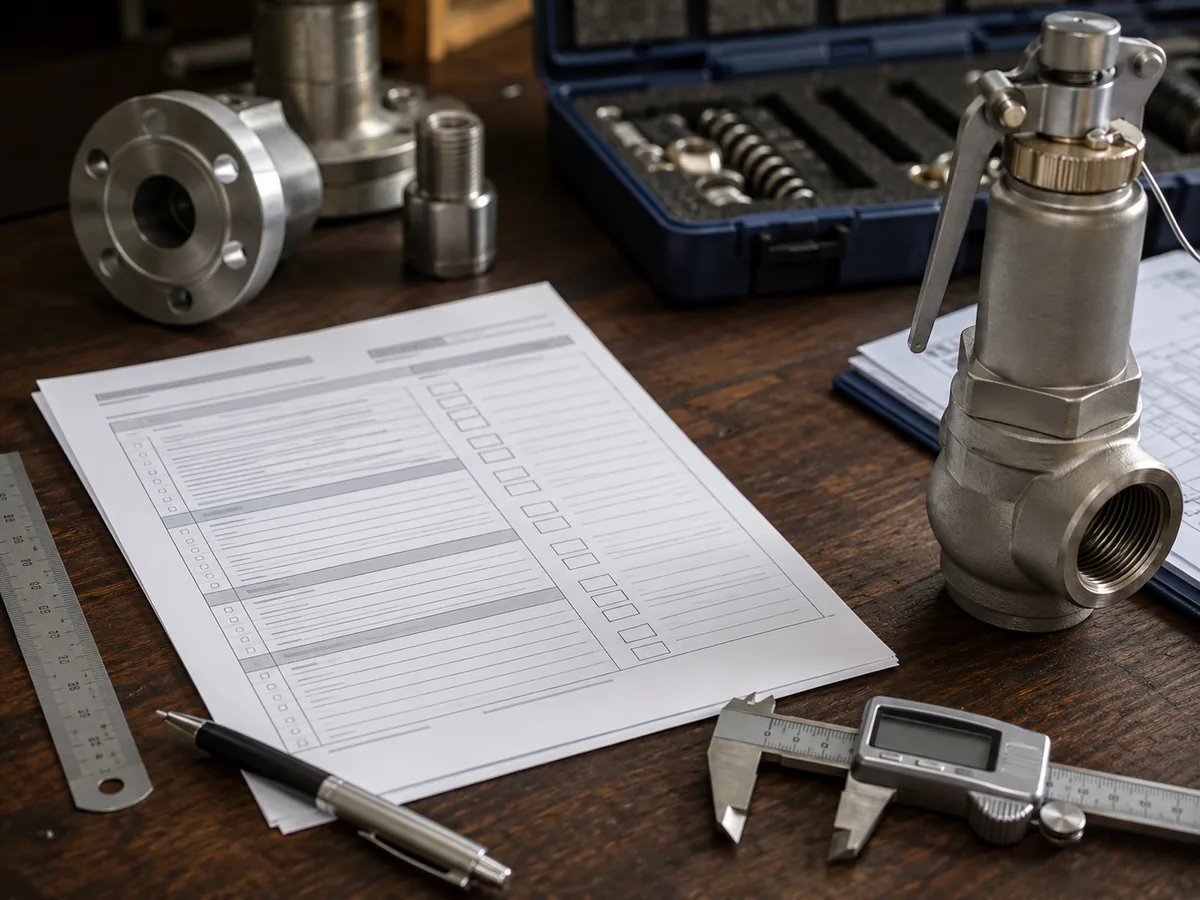
| Category | Field | Status |
|---|---|---|
| Protected equipment | Equipment type, tag, MAWP/design pressure, datasheet | Provided / To be confirmed |
| Relief scenario | Reason for overpressure and scenario basis | Provided / To be confirmed |
| Medium | Fluid name, composition, phase, service notes | Provided / To be confirmed |
| Pressure | Operating pressure, maximum operating pressure, set pressure, MAWP/design pressure | Provided / To be confirmed |
| Capacity | Required relieving capacity, units, capacity basis | Provided / To be confirmed |
| Temperature | Normal operating temperature and relieving temperature | Provided / To be confirmed |
| Back pressure | Superimposed, built-up, constant/variable, discharge destination | Provided / To be confirmed |
| Connection | Inlet/outlet size, standard, rating, facing, gasket or thread | Provided / To be confirmed |
| Materials | Body, trim, seat, spring, bellows, gasket if specified | Provided / To be confirmed |
| Documents | Datasheet, drawing, certificate, test report, nameplate, release package | Provided / To be confirmed |
| Replacement evidence | Photos, old datasheet, nameplate, test record, failure symptom | Provided / To be confirmed |
Technical Hold Points Before Purchase-Order Release
| Hold Point | Minimum Approval Evidence | Release Risk if Missing |
|---|---|---|
| HP-1 Duty basis | Protected equipment, governing scenario and required capacity approved | Wrong valve duty or insufficient capacity |
| HP-2 Pressure basis | Operating pressure, MAWP/design pressure, set pressure and overpressure basis aligned | Incorrect opening or code arrangement |
| HP-3 Model and capacity | Exact model, orifice, fluid basis and supported capacity accepted | Catalog-family or connection-size substitution |
| HP-4 Back pressure and installation | Inlet-loss and outlet-system review completed | Chatter, capacity reduction or poor reseating |
| HP-5 Materials and soft parts | Component-level materials and service compatibility approved | Early corrosion, sticking or leakage |
| HP-6 Documents and deviations | Certificates, tests, inspection scope and deviation list agreed | Late-stage rejection or commissioning delay |
Send the Completed Datasheet for Engineering Review
After preparing the datasheet, send the available data and clearly mark any unknown fields. ZOBAI can review the inquiry more efficiently when the RFQ package includes protected equipment, relief scenario, medium and phase, pressure basis, required relieving capacity, relieving temperature, back pressure, connection, materials, applicable standard, testing requirements and document scope.
For the most efficient review, include the completed datasheet, any old nameplate or datasheet, installation photos for replacement cases, and a separate list of values marked to be confirmed. Do not remove uncertain fields from the RFQ; keeping them visible helps ZOBAI identify what must be confirmed before final quotation or technical approval.
FAQ
What information is required in a safety valve datasheet for RFQ?
Include the protected equipment, governing relief scenario, medium and phase, operating pressure, MAWP or design pressure, set pressure, required relieving capacity, relieving temperature, back pressure, inlet/outlet connections, component materials, valve configuration, standards, tests, documents and quantity.
Is valve size, set pressure and quantity enough for quotation?
Usually not. Those fields can support a budgetary discussion, but they do not prove required capacity, fluid suitability, back-pressure limits, materials, installation or the required certification and document route.
What should I do if required relieving capacity is unknown?
Do not guess or replace it with connection size. Mark the field as calculation pending, identify the protected equipment and possible scenario, and obtain the approved relief calculation before final technical approval.
Why does the datasheet need protected equipment and relief scenario?
The valve protects a specific pressure boundary against a specific credible event. Equipment limits and the governing scenario determine the set-pressure arrangement, required capacity, relieving conditions and code route.
What pressure values should I include?
State normal and maximum operating pressure, MAWP or design pressure, field set pressure, allowable overpressure or accumulation basis, relieving pressure and any CDTP or constant back-pressure correction basis.
What documents should be requested with a safety valve quotation?
Request the supplier datasheet, drawing, nameplate data, model/orifice and capacity evidence, set-pressure report, seat-tightness report where required, pressure-boundary test record, material certificates, inspection documents and deviation list.
Can ZOBAI review an RFQ if some fields are still missing?
A preliminary review can start when unknown fields are clearly marked. Final quotation and technical approval still depend on confirmed duty data, manufacturer-supported application data and the project requirements.
What is the difference between required capacity and certified capacity?
Required capacity is the flow the system must relieve for the governing case. Certified or documented capacity is the supported flow of an exact valve design under stated conditions. The selected capacity must equal or exceed the approved requirement on a compatible basis.
Does a set-pressure certificate prove the valve has enough capacity?
No. It records the opening adjustment under stated test conditions. It does not prove full lift, certified capacity, correct fluid basis or installed-system stability.
How should back pressure be written in the RFQ?
State superimposed, built-up and total back pressure where available, identify whether it is constant or variable, and describe the discharge destination, common header, outlet piping and simultaneous-relief assumptions.
When should a balanced-bellows or pilot-operated valve be requested?
Only after the back-pressure profile, operating margin, medium cleanliness, temperature, pilot sensing/exhaust arrangement and manufacturer limits are reviewed. The valve type should not be selected from the name alone.
What material information is needed beyond body material?
Specify or request the nozzle, disc, seat, guide, spindle, spring, bellows or pilot parts, soft seat, gasket and other wetted or functional materials that control corrosion, sticking, tightness and life.
What should be attached for an existing-valve replacement?
Attach clear nameplate and body photos, old datasheet and drawing, current service conditions, installation photos, as-found test data, repair history and any process or discharge-system changes.
Can the old valve nameplate be used as the current design basis?
It is useful identification evidence but not sufficient design proof. The current protected equipment, relief scenario, required capacity, back pressure, materials and code basis must be revalidated.
Does API 527 prove the safety valve is suitable for the RFQ duty?
No. API 527 addresses seat tightness for applicable pressure relief valves. It does not prove required capacity, correct set pressure, material compatibility or acceptable inlet and outlet piping.
What does National Board NB-18 verify?
NB-18 lists certified pressure-relief-device designs and accredited manufacturers or assemblers. The listing must still be matched to the exact manufacturer, model, design, configuration and capacity record.
When is National Board VR repair relevant?
VR is relevant where the owner, jurisdiction or NBIC-based program requires an authorized pressure-relief-valve repair quality system. It does not replace sizing, capacity or installation review.
What must be approved before the purchase order is released?
Approve the duty basis, pressure basis, exact valve type/model/orifice, supported capacity, back-pressure and installation limits, component materials, certification route, tests, documents and all technical deviations.
Standards and Liability Note
Standards and project specifications should be treated as RFQ inputs, not marketing claims. If the buyer requires API, ASME, ISO, EN, GB or project-specific documentation, the RFQ should state the applicable requirement and document scope clearly.
This article does not reproduce standard text and does not state that any specific ZOBAI model automatically meets all standards or certification requirements. Final technical confirmation depends on the selected model, confirmed operating conditions, manufacturer data, applicable standard edition, project specification and local regulatory requirements.
Prepare Your RFQ Datasheet for ZOBAI Review
Send your completed safety valve datasheet and mark any unknown fields as to be confirmed. Include protected equipment, relief scenario, pressure data, required relieving capacity, capacity basis, medium and phase, relieving temperature, back pressure, connection, material requirements, applicable standard, testing requirements, document scope and replacement evidence if available.
ZOBAI can review the RFQ more efficiently when the inquiry separates confirmed data from pending data. Final technical confirmation still depends on real operating conditions, relief scenario, manufacturer data, applicable standard version, project specification and local regulatory requirements.