Material Comparison · Corrosive-Service Safety Valve RFQ 316L, duplex and Hastelloy / nickel-alloy safety valves are not a simple good–better–best ladder. 316L may suit many clean or moderately corrosive services; duplex may be reviewed for higher strength and certain chloride-related exposure; nickel alloys may be needed for more severe chemical service. The decision must be …

Material Comparison · Corrosive-Service Safety Valve RFQ
316L, duplex and Hastelloy / nickel-alloy safety valves are not a simple good–better–best ladder. 316L may suit many clean or moderately corrosive services; duplex may be reviewed for higher strength and certain chloride-related exposure; nickel alloys may be needed for more severe chemical service. The decision must be based on actual medium chemistry, concentration, temperature, pressure, relief case, back pressure and the exact material scope of each valve component.
Before issuing an RFQ, define material by component, product form and grade. A cast body, wrought stem, formed bellows, spring, bolting, gasket and soft seat may require different material specifications. A material upgrade cannot correct an undersized valve, an unverified relief scenario, excessive inlet pressure loss, unsupported discharge piping or unreviewed back pressure. Final selection still depends on the protected equipment, required relieving capacity, selected valve model, manufacturer data, applicable standard edition, project specification and local regulatory requirements.
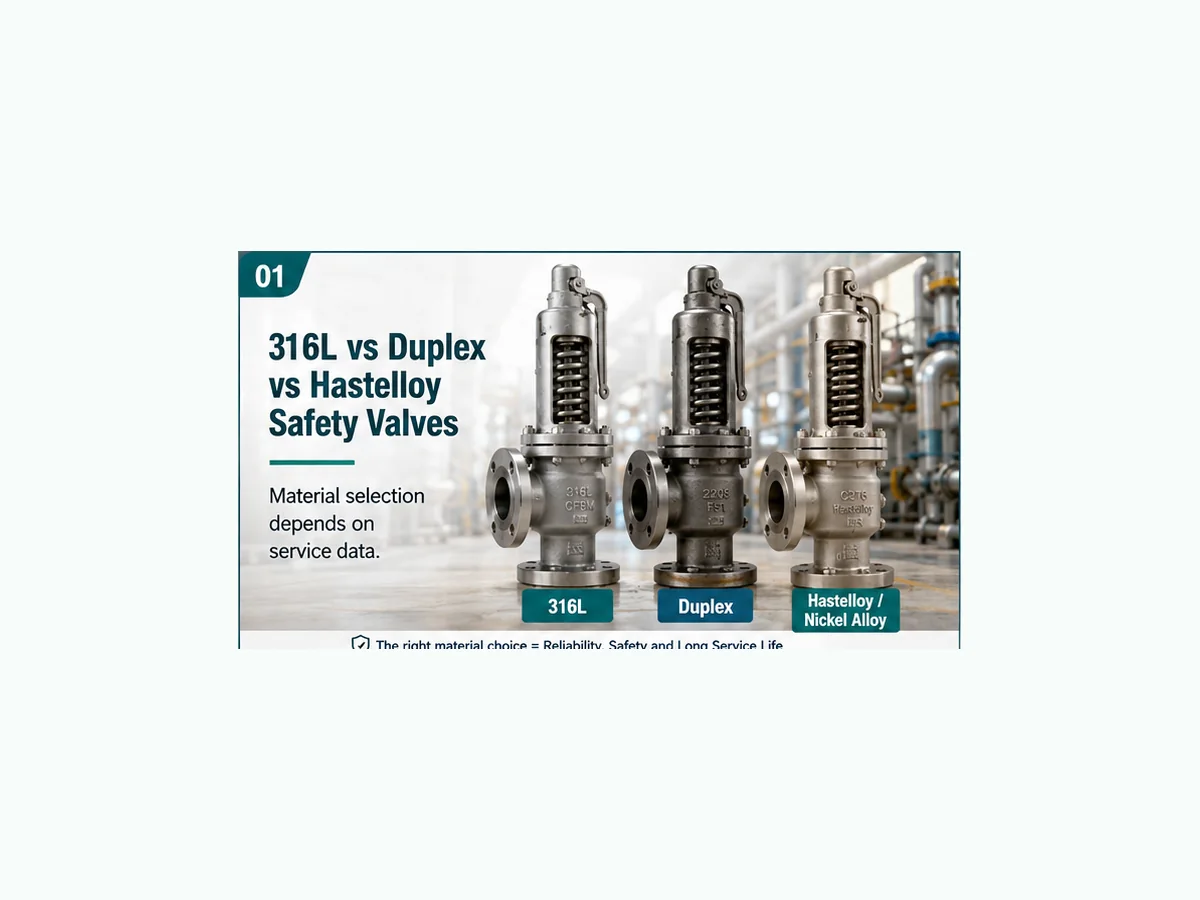
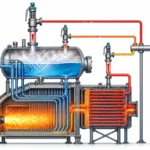
Simplified engineering visual for material comparison; not material certification, product model evidence or project case proof.
Quick Answer: How Should Buyers Compare 316L, Duplex and Hastelloy Safety Valves?
Compare 316L vs duplex vs Hastelloy safety valves by the actual corrosion mechanism and by the valve parts exposed to the process or discharge system. 316L may be suitable for many stainless-steel and moderately corrosive services. Duplex may be considered where a project needs higher strength or improved resistance in certain chloride-related environments. Hastelloy / nickel-alloy construction may be justified for more severe chemical exposure, but the exact alloy grade must be stated.
Do not use the commercial alloy name as the complete purchase specification. For cast pressure-containing parts, ASTM A351/A351M covers austenitic steel castings, ASTM A995/A995M covers duplex stainless-steel castings, and ASTM A494/A494M covers nickel and nickel-alloy castings. Wrought trim, bellows sheet, springs, bolting, gaskets and soft seats may require different product-form specifications and separate compatibility review.
Material selection also does not complete the safety valve selection. Confirm the protected equipment, governing relief scenario, set pressure, required relieving capacity, relieving temperature, pressure–temperature rating, superimposed and built-up back pressure, inlet/outlet piping and required documents. For the wider workflow, use the ZOBAI safety valve selection guide and pressure relief valve product-family page.
Why Material Selection Matters in Safety Valves
A safety valve must open, reach the required lift, pass the required flow and reseat under defined service conditions. Material degradation can interfere with each of those functions. Pitting and crevice corrosion can damage seating surfaces; galling can restrict guide or spindle movement; deposits can block small clearances; spring corrosion or relaxation can shift performance; and incompatible elastomers can swell, harden or lose sealing capability.
The corrosion review must cover both the process side and the discharge side. A body may be compatible with the protected equipment while the outlet, bellows, bonnet cavity or discharge header sees a different chemical environment. Likewise, a stainless-steel body does not prove that the nozzle, disc, guide, stem, spring, bellows, gasket or bolting has the same corrosion resistance.
Material selection also interacts with pressure–temperature rating, manufacturing route, heat treatment, hardness, anti-galling pairs, seat design and document acceptance. A material family that looks suitable on a general corrosion chart may still be unsuitable for the exact concentration, contaminants, temperature, phase, crevice geometry or project specification.
Engineering boundary: Material grade alone does not prove service suitability. Final review must include the real medium, concentration, pH, chloride content, contaminants, phase, operating and relieving temperature, pressure definitions, required capacity, back pressure, component scope, installation and applicable documentation.
Material Selection Boundary: What This Comparison Can and Cannot Decide
This page helps buyers prepare a practical material discussion before requesting a quotation. It does not replace a corrosion study, formal pressure relief calculation, selected-model datasheet, project material specification or local regulatory review.
| Question | This Page Can Help With | This Page Cannot Decide Without Project Data |
|---|---|---|
| Which material family should be reviewed? | Explain when 316L, duplex or Hastelloy / nickel alloy may be discussed. | Confirm final chemical compatibility for every concentration, temperature or contaminant. |
| Which valve parts need material scope? | Separate body, trim, seat, spring, bellows, gasket and bolting requirements. | Guarantee that every component is available in every alloy for every valve model. |
| Is the valve selected once material is chosen? | Show why pressure, capacity, rating, back pressure and installation still matter. | Replace sizing calculation, certified/documented capacity review or project approval. |
| Can an old 316L valve be upgraded? | List replacement data and failure-mode checks before upgrade. | Prove that a material change alone solves corrosion, leakage, chatter or poor installation. |
316L Safety Valves: Where They May Fit and Where They Need Caution
316L stainless steel is commonly requested for stainless-steel piping systems, clean processes, hygienic applications and many corrosion-aware services. It is often a practical baseline when the process chemistry and temperature are compatible and when the project already standardizes on low-carbon austenitic stainless steel.
However, 316L is not a universal corrosion-resistant solution. Chloride concentration, pH, oxidizing or reducing conditions, deposits, stagnant crevices, cleaning chemicals, operating temperature and relieving temperature can materially change the corrosion risk. A service that appears mild during normal operation may be more aggressive during a hot relief event, shutdown cleaning or concentration upset.
For a cast pressure-containing body, the RFQ should identify an approved casting specification and grade rather than writing “316L for all parts.” ASTM A351/A351M covers austenitic steel castings for valves and other pressure-containing parts and places grade selection on the purchaser based on design and service conditions. This standard scope does not itself prove corrosion compatibility for the process.
For hygienic or clean-process applications, compare the alloy request with surface finish, drainability, dead-leg control, seal compatibility and cleaning conditions. The ZOBAI sanitary safety valve page supports that discussion, but 316L material alone does not prove that a valve is sanitary, cleanable or suitable for every CIP/SIP cycle.
Where 316L may be reviewed
General stainless-steel service, clean process conditions, many moderately corrosive applications and project specifications that explicitly accept the relevant 316L-family product form.
Where caution is needed
High chloride, acidic cleaning, deposits, stagnant crevices, elevated temperature, mixed chemicals, galvanic couples or an unclear wetted-part material scope.
Duplex Safety Valves: Strength, Chloride Resistance and Project Limits
Duplex stainless-steel safety valves may be reviewed where a project needs higher mechanical strength, improved resistance to certain chloride-related damage mechanisms or a material specification beyond conventional austenitic stainless steel. Typical discussion areas include marine exposure, chloride-containing process streams, chemical plants and systems where both corrosion resistance and strength matter.
“Duplex” is not one material. The RFQ must identify the exact grade, product form, heat-treatment condition and component scope. ASTM A995/A995M covers duplex stainless-steel castings for valves and other pressure-containing parts and states that their properties depend on balanced composition and proper heat treatment. The same document notes that its covered cast grades are not recommended above 315 °C (600 °F) because embrittling phases may precipitate. That is a screening boundary for those cast grades—not a universal temperature limit for every duplex product form.
Do not approve duplex only from a PREN ranking or alloy nickname. PREN is a comparative screening tool; it does not account for actual acid chemistry, temperature, deposits, crevices, fabrication quality, heat treatment, weld condition, galvanic coupling or the relief-event environment.
A duplex body also does not automatically solve trim, seat, spring, gasket or bellows compatibility. Availability may differ by size, pressure class, casting or forging route, connection standard, heat treatment, NDE scope and material-document requirements.
Hastelloy / Nickel-Alloy Safety Valves: When Higher-Alloy Review May Be Needed
Hastelloy / nickel-alloy safety valves may be reviewed for severe corrosive service, selected acid systems, chloride-containing chemicals and other process conditions where 316L or duplex is not adequate. The decision should come from the actual chemical environment and project material specification—not from the assumption that the most expensive alloy is automatically the safest choice.
“Hastelloy” is a family or commercial description, not a complete engineering grade. The RFQ should state the exact alloy designation, applicable material specification, product form and component scope. ASTM A494/A494M covers nickel and nickel-alloy castings for corrosion-resistant service, but a cast-body specification does not define the correct material for wrought trim, bellows sheet, springs, gaskets or soft seats.
Nickel-alloy construction can increase cost, delivery time, machining complexity, weld-procedure requirements and inspection scope. It may still fail to solve the operating problem if the real cause is contamination, poor operating margin, incorrect seat selection, excessive back pressure, insufficient capacity or installation-induced instability.
Engineering Comparison: 316L vs Duplex vs Hastelloy Safety Valves
Use this table as an RFQ screening guide, not as a universal corrosion chart. The final material must be approved against real process chemistry, temperature, component product forms, valve design and project requirements.
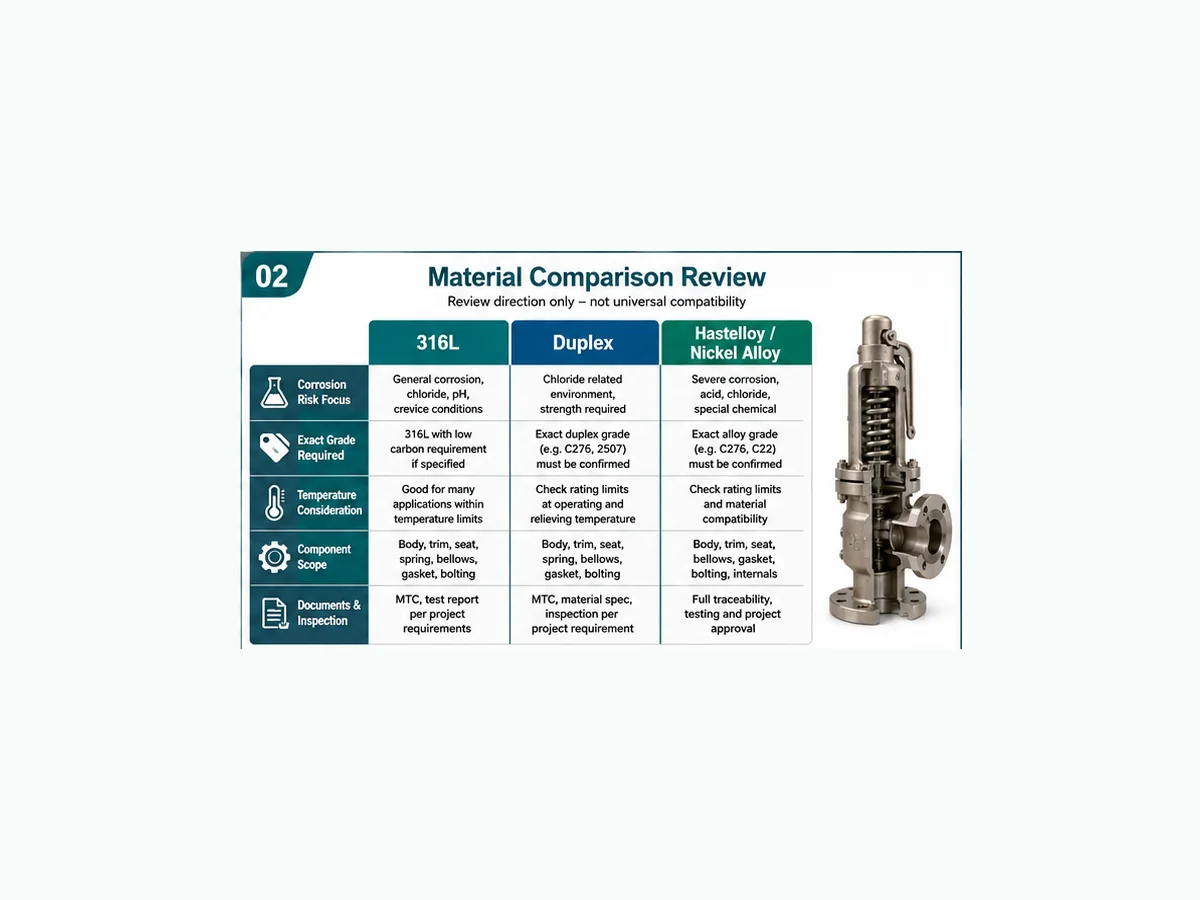
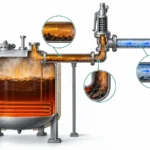
Simplified material comparison graphic; final material compatibility must be confirmed against real service data and project specification.
| Review Item | 316L / Austenitic Stainless | Duplex Stainless | Hastelloy / Nickel Alloy |
|---|---|---|---|
| Typical reason for review | Common stainless-steel requirement, clean service or moderate corrosion duty. | Higher strength and improved resistance for selected chloride-related conditions. | Severe chemical or corrosion duty supported by a defined alloy requirement. |
| Grade precision | Specify the applicable cast, forged, bar, sheet or fastener grade; “316L throughout” is usually incomplete. | State the exact duplex grade, product form and heat-treatment condition. | State the exact nickel-alloy grade / UNS, product form and component scope. |
| Primary corrosion review | Chlorides, pH, cleaning chemicals, crevices, deposits and temperature. | Chloride environment, temperature, phase balance, heat treatment and fabrication route. | Exact acid/chemical chemistry, concentration, contaminants, temperature and oxidizing/reducing conditions. |
| Common procurement error | Assuming a stainless body means all wetted and moving parts are equivalent 316L material. | Treating all duplex grades as interchangeable or approving from PREN alone. | Writing only “Hastelloy” without exact grade, ASTM/UNS designation or product form. |
| Evidence to request | MTC/CMTR, heat treatment where applicable, PMI if required and component material schedule. | MTC/CMTR, heat treatment, project-required phase/ferrite controls, PMI and NDE scope. | MTC/CMTR, exact alloy traceability, PMI, heat treatment, weld/NDE records where applicable. |
| What material selection does not prove | Required relieving capacity, certified/documented capacity, set-pressure correctness, seat tightness, back-pressure acceptability, installation quality or local code compliance. | ||
Preliminary Corrosive-Service Material Screening Matrix
The matrix below is a screening tool for RFQ preparation. It is not a corrosion compatibility chart and should not be used to approve a material by itself.
| Service Clue | Possible Material Review Direction | Data That Can Change the Decision |
|---|---|---|
| General stainless steel piping or clean service | 316L may be reviewed if the medium and temperature are suitable. | Cleaning chemicals, chloride level, pH, temperature, seat and gasket material. |
| Chloride-containing service or higher strength requirement | Duplex stainless steel may need review, subject to exact grade and specification. | Chloride content, temperature, phase, fabrication route, pressure rating and documents. |
| Severe acid, special chemical or high corrosion risk | Hastelloy / nickel alloy review may be needed. | Exact alloy grade, concentration, pH, contaminants, temperature and wetted component scope. |
| Corrosive outlet header or variable back pressure | Bellows material and valve configuration should be reviewed with back pressure data. | Superimposed back pressure, built-up back pressure, outlet medium and discharge path. |
| Existing valve corrosion or leakage | Replacement material upgrade may be reviewed, but failure mode must be identified. | Corrosion location, nameplate, datasheet, service history, installation and capacity basis. |
| Unknown, proprietary or variable chemical composition | Hold final material approval and request the controlling chemistry range or project materials decision. | Worst-case concentration, contaminants, cleaning fluids, upset conditions and relieving temperature. |
Practical rule: If the RFQ says only “316L,” “duplex” or “Hastelloy” without medium chemistry, temperature, pressure, component scope and required documents, the material selection is not ready for final confirmation. When chemistry is unknown or variable, the correct action is to hold the final material decision—not to default automatically to the highest-alloy option.
Do Not Specify Only the Valve Body Material
One of the most common RFQ problems is specifying only the valve body material. For example, a buyer may request a “316L safety valve” but does not state whether the nozzle, disc, guide, seat holder, spring, bellows, gasket or bolting must also follow 316L or another material requirement. This makes supplier quotations difficult to compare.
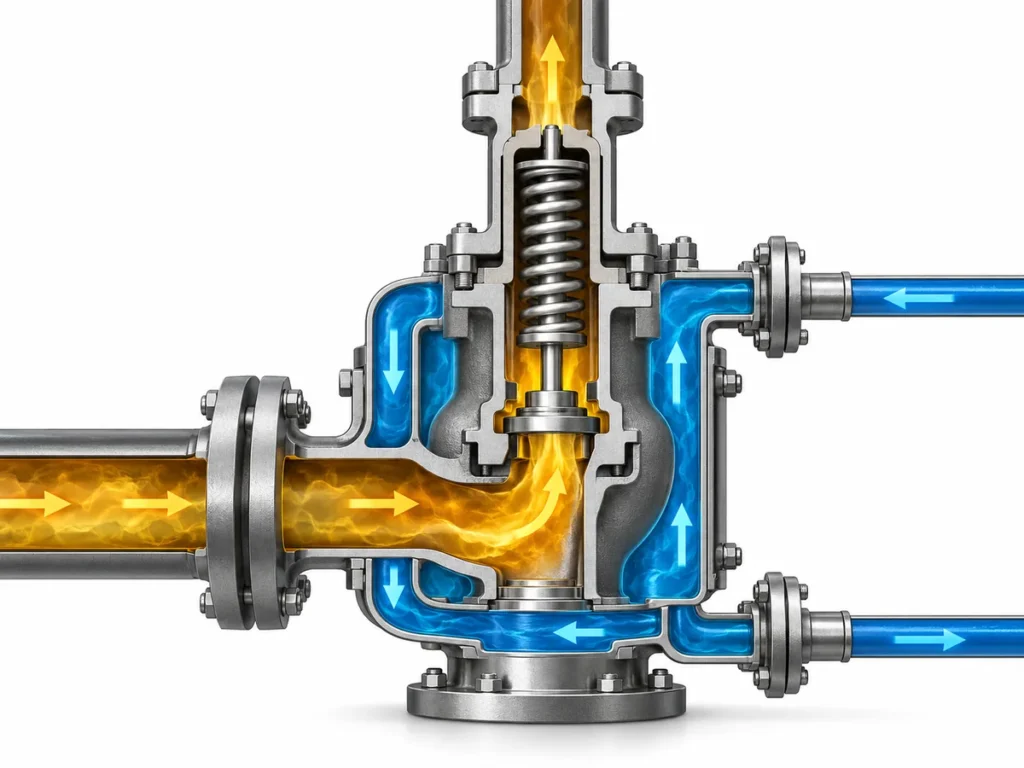
A safety valve contains several material zones. Some parts are pressure-retaining. Some are wetted by the process medium. Some are exposed to outlet back pressure or discharge conditions. Some influence sealing and leakage performance. Some are non-wetted but may still need to meet project material or temperature requirements.
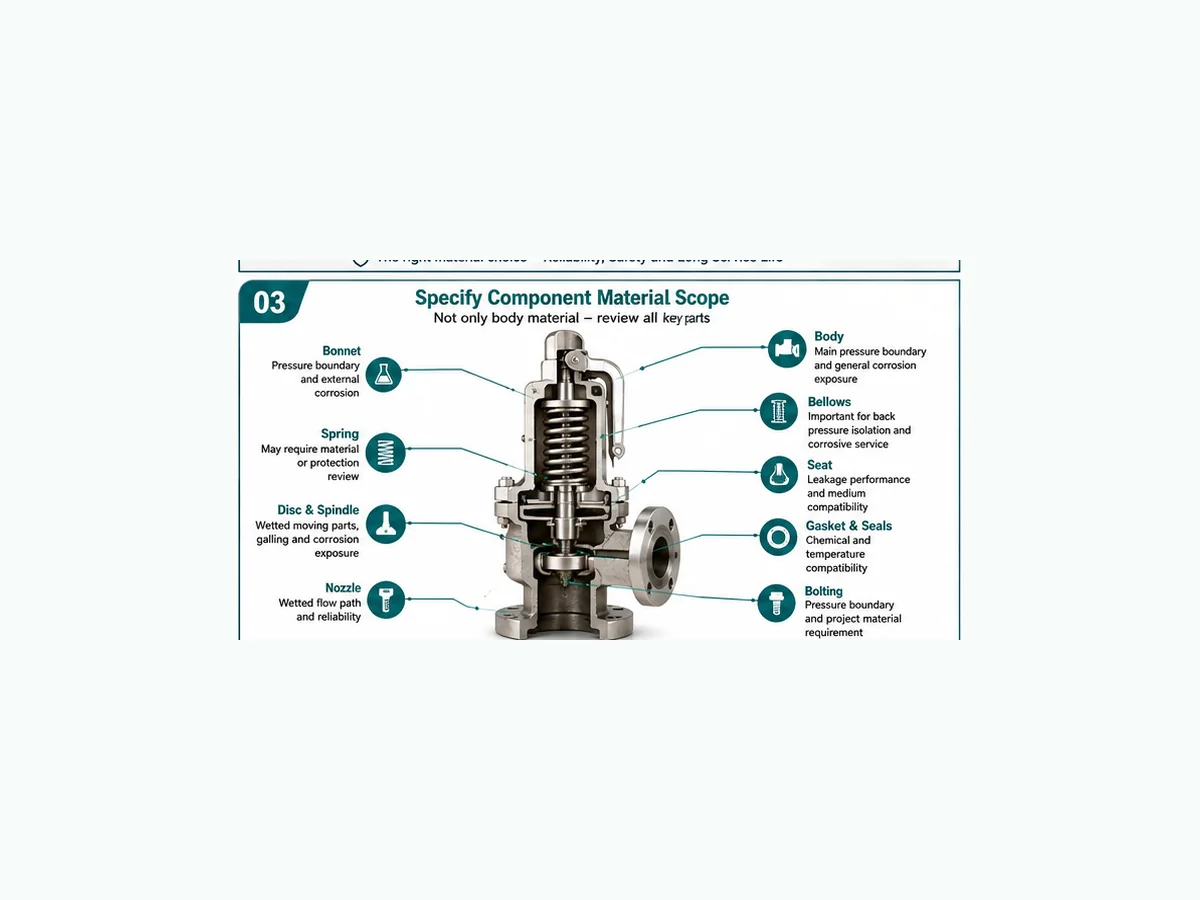
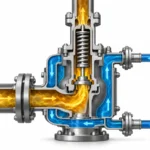
Simplified component scope illustration; actual component material availability depends on selected valve model and manufacturer data.
| Component | Exposure Type | Why It Matters |
|---|---|---|
| Body and bonnet | Pressure boundary / external environment | Pressure-retaining material, project specification, corrosion exposure and pressure-temperature rating. |
| Nozzle and disc | Wetted flow path / seating surface | Corrosion, erosion, galling, seating reliability and compatibility with the relieved medium. |
| Guide and stem | Moving internal parts | Movement, alignment, galling resistance and corrosion exposure can affect lifting and reseating behavior. |
| Seat or soft seal | Sealing interface | Chemical compatibility, temperature limit and leakage expectation must be confirmed. |
| Spring | Protected chamber or exposed chamber depending on design | May require protection or material review depending on bonnet design, medium and temperature. |
| Bellows | Back pressure isolation / outlet exposure | Important for corrosive outlet conditions and back pressure isolation; material must match service limits. |
| Gasket and seals | Static sealing parts | Chemical and temperature compatibility can limit the final valve configuration. |
| Bolting | Pressure boundary / external environment | Project material specification, temperature, corrosion environment and inspection requirements may apply. |
If corrosive outlet service or variable outlet pressure is present, review the ZOBAI guide to back pressure and bellows. If seat leakage expectation is part of the project acceptance, confirm seat design and test requirements, including whether the API 527 seat tightness test is relevant to the project context.
Specify Product Form and Grade for Each Critical Component
The same alloy family can use different standards for castings, forgings, bar, sheet, spring wire and fasteners. Copying one designation across the full valve can create an impossible or misleading specification. The supplier quotation should therefore include a component material schedule that can be checked against the selected valve model.
| Component Group | Product-Form Question | RFQ Requirement |
|---|---|---|
| Body and bonnet | Cast, forged or machined from another form? | State applicable specification, grade, heat treatment, pressure rating and MTC requirement. |
| Nozzle, disc, guide and stem | Bar, forging, casting, hard-faced or coated? | Define wetted grade, anti-galling pair, surface treatment and traceability expectation. |
| Bellows | Thin sheet / formed and welded assembly? | Define exact alloy, outlet exposure, design limits and required manufacturing or inspection records. |
| Spring | Spring wire with protected or exposed chamber? | Confirm spring material, range, temperature exposure, bonnet arrangement and corrosion protection. |
| Gaskets, soft seats and seals | Nonmetallic compound or metallic gasket construction? | State chemical compatibility, temperature limit, decompression behavior and leakage requirement. |
| Bolting and external parts | Pressure-boundary bolting or external environmental exposure? | Define bolting specification, coating, environmental corrosion requirement and inspection scope. |
Typical engineering scenario: A buyer requested a “316L valve,” but the quotation only identified the body material. The nozzle and guide were not included in the material scope and later showed localized attack. The corrective action was not simply “upgrade the body”; it was to define every wetted and moving component, review galling pairs and require a traceable component material schedule in the replacement RFQ.
Medium, Temperature and Pressure Data Required Before Material Selection
Material selection cannot be completed without real service data. A safety valve exposed to a corrosive medium should be reviewed using chemical, thermal, pressure and relief data together.
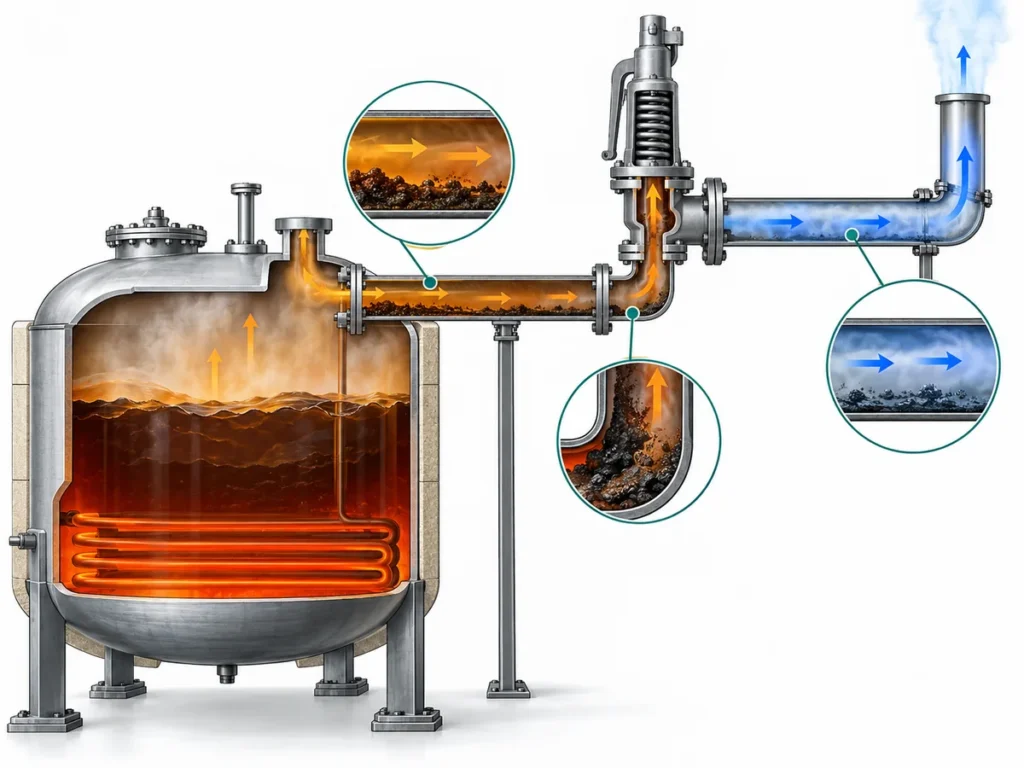
Use the worst credible exposure, not only the normal operating condition. Relief events, startup/shutdown, cleaning cycles, concentration changes, flashing and discharge-header contamination can expose the valve to a different phase, temperature or chemical composition than the steady-state process.
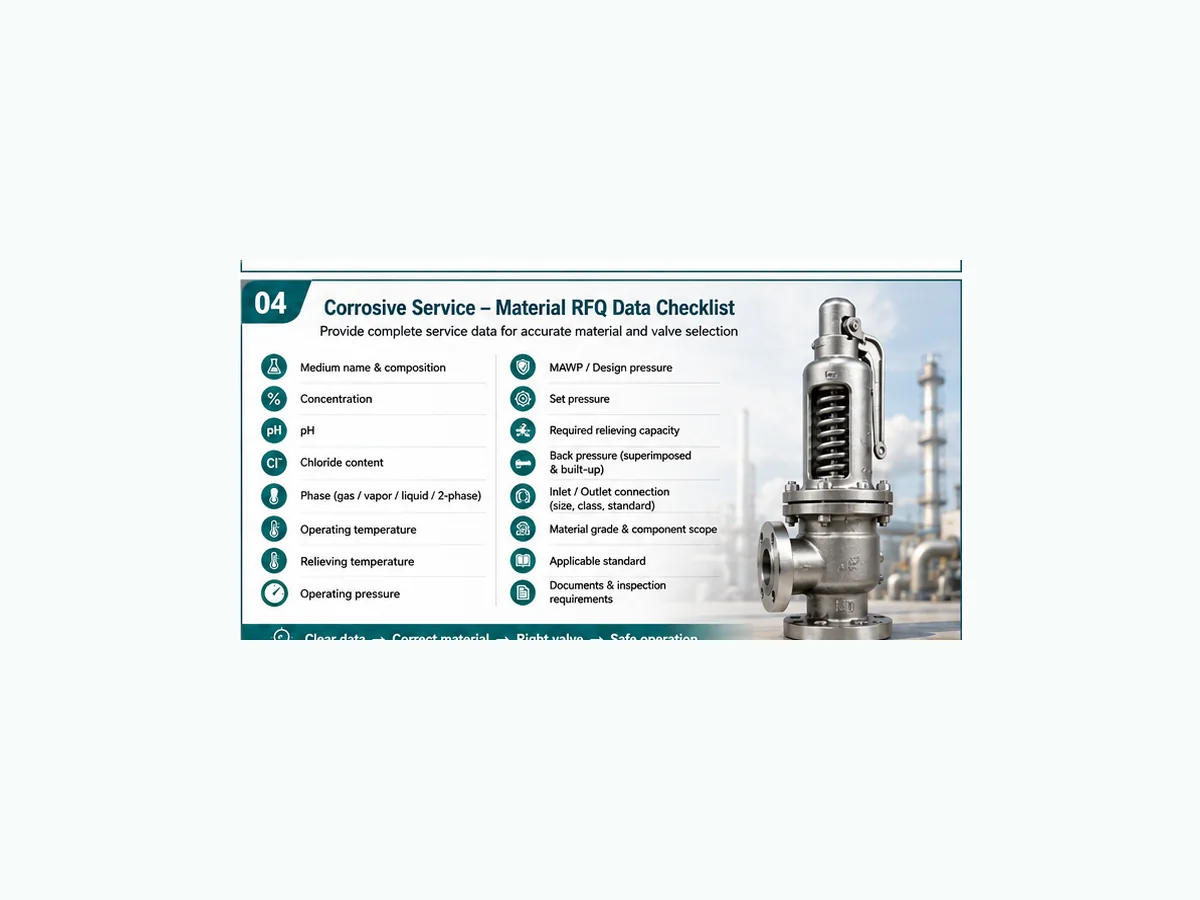
RFQ preparation graphic; not a corrosion compatibility table or final material selection record.
| Required Data | Why It Is Needed |
|---|---|
| Medium name and composition | Basic material compatibility screening. |
| Concentration | Corrosion behavior may change with concentration. |
| pH | Helps define acidic or alkaline service. |
| Chloride content | Important for pitting and crevice corrosion review. |
| Phase | Gas, vapor, liquid or two-phase service affects selection. |
| Operating and relieving temperature | Normal exposure and relief-event conditions may differ. |
| Operating pressure, MAWP/design pressure and set pressure | Defines normal service, protected equipment basis and opening point. |
| Required relieving capacity | Material selection does not replace sizing and capacity review. |
| Back pressure | Affects configuration, bellows review and outlet material exposure. |
| Connection standard and required documents | Needed for pressure-temperature rating, installation and project approval. |
RFQ Data Completeness Grading
Incomplete
Material name only
The inquiry says “316L,” “duplex” or “Hastelloy” but does not include medium, temperature, pressure, capacity or component scope.
Reviewable
Service data included
The inquiry includes medium chemistry, pressure, temperature, phase and connection data, but capacity or document scope may still need confirmation.
Ready for engineering review
Full RFQ basis included
The inquiry includes relief scenario, capacity basis, back pressure, component material scope, documents and replacement records where applicable.
Material Selection Does Not Replace Pressure-Temperature and Capacity Review
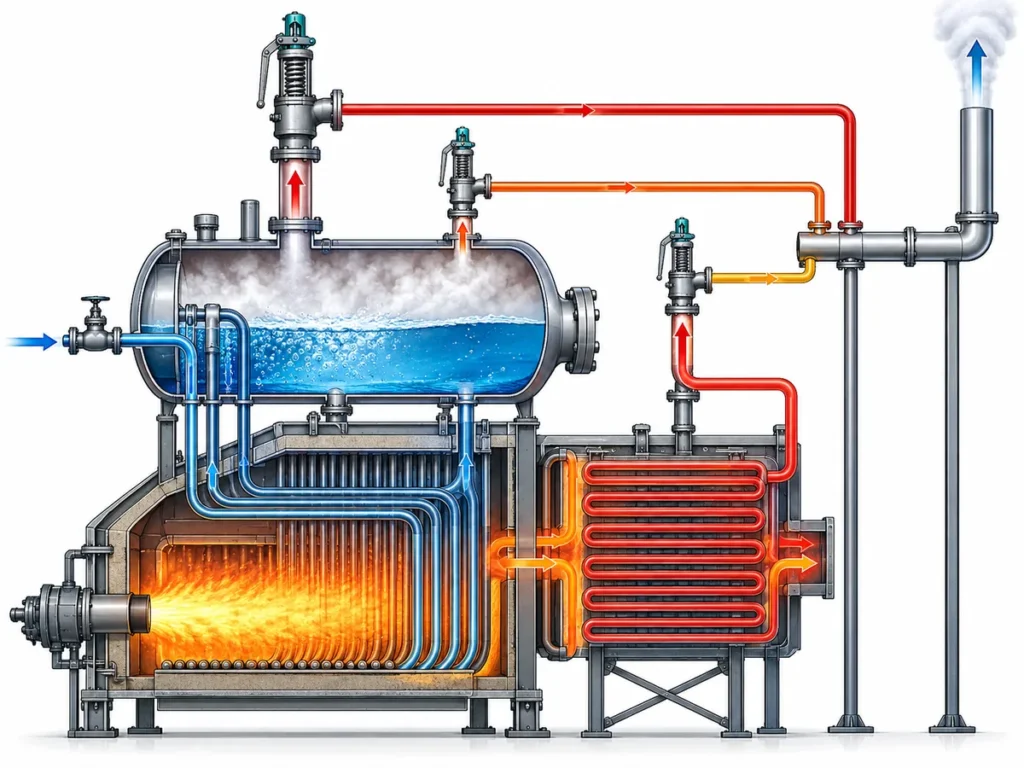
A material choice is not the same as a safety valve selection. Even after choosing 316L, duplex or Hastelloy / nickel alloy, the valve still needs pressure-temperature rating, capacity, set pressure, back pressure and installation review.
ASME BPVC Section XIII addresses overpressure-protection rules including material, testing, marking, capacity and installation topics. In refinery and petrochemical contexts, API 520 Part I supports sizing and selection, while API 520 Part II addresses installation and engineering analysis. These scopes reinforce a key boundary: an alloy choice or material certificate cannot substitute for capacity and installation evidence.
Pressure-temperature rating is especially important when the selected material, flange class, PN rating or connection standard is close to its allowable range. A material that is suitable for corrosion may not automatically be suitable for the required pressure and temperature combination. Review the ZOBAI guide to pressure-temperature ratings when flange class, material group or temperature is part of the RFQ.
Required relieving capacity must also be reviewed separately. Set pressure is the valve opening point; it is not the same as capacity. The selected valve must have a documented capacity basis that matches the service conditions. For more context, see safety valve sizing and certified relieving capacity and API 520 safety valve sizing.
In corrosive discharge service, the outlet header, discharge environment and piping support can affect both material exposure and valve stability, so outlet conditions should be reviewed together with body, bellows, gasket and trim material requirements. For inlet/outlet piping, support and discharge checks, refer to the ZOBAI safety valve installation guide.
| Selection Layer | What It Means | Why Material Alone Cannot Replace It |
|---|---|---|
| Protected equipment and relief scenario | Defines what the valve must protect and which event controls the relief load. | The material cannot define the governing fire, blocked outlet, thermal expansion or other relief case. |
| Operating pressure / MAWP / set pressure | Separates normal operating pressure, equipment design basis and valve opening point. | A material grade does not define the correct set pressure or equipment protection basis. |
| Required relieving capacity | The flow rate the valve must relieve under the governing case. | A corrosion-resistant material does not prove the selected orifice or documented capacity. |
| Back pressure | Outlet pressure before or during relief that can affect opening, capacity and configuration. | Material upgrade does not solve superimposed or built-up back pressure by itself. |
| Inlet/outlet piping | Installation condition affecting inlet pressure loss, discharge support and safe routing. | Material selection does not correct restrictive inlet piping or unsupported outlet loads. |
Failure Mode and Material Upgrade Check Matrix
Before upgrading from 316L to duplex or Hastelloy, identify the actual problem. A material change may be useful if the issue is true material incompatibility, but it may not solve leakage, chatter, incorrect sizing, poor installation or back pressure problems.
| Observed Issue | Possible Cause | What to Check Before Material Upgrade |
|---|---|---|
| Body or bonnet corrosion | Material not suitable for external or process exposure. | Medium, environment, temperature, coating, body material certificate and project material specification. |
| Trim or seating surface attack | Wetted internal parts not suitable for medium or contaminants. | Nozzle, disc, guide, stem and seat material scope; medium chemistry and phase. |
| Seat leakage | Seat damage, incompatible seal, contamination, incorrect operating margin or test condition issue. | Seat material, leakage test requirement, operating pressure vs set pressure and service cleanliness. |
| Spring corrosion | Spring chamber exposure, bonnet design or environmental corrosion. | Bonnet type, spring material, venting, service exposure and maintenance history. |
| Bellows failure or outlet corrosion | Back pressure, corrosive outlet header or bellows material mismatch. | Superimposed and built-up back pressure, outlet medium, bellows material and discharge system. |
| Chatter or unstable operation | Oversizing, excessive inlet pressure loss, back pressure or poor operating margin. | Required capacity, selected orifice, inlet piping, outlet piping and operating pressure margin. |
Typical engineering scenario: A leaking 316L valve was replaced with duplex, but the leakage returned because the process operated too close to set pressure and solids were contaminating the seat. The material upgrade changed the body alloy but did not remove the actual leakage drivers. The preventive action was to review operating margin, seat design, cleanliness and test basis before approving another material change.
Replacement and Upgrade: Moving From 316L to Duplex or Hastelloy
A buyer may want to replace an existing 316L safety valve with duplex or Hastelloy because of corrosion, leakage, seat damage, repeated maintenance or a change in process conditions. This can be reasonable, but it should not be done only by matching the old valve size and changing the material name.
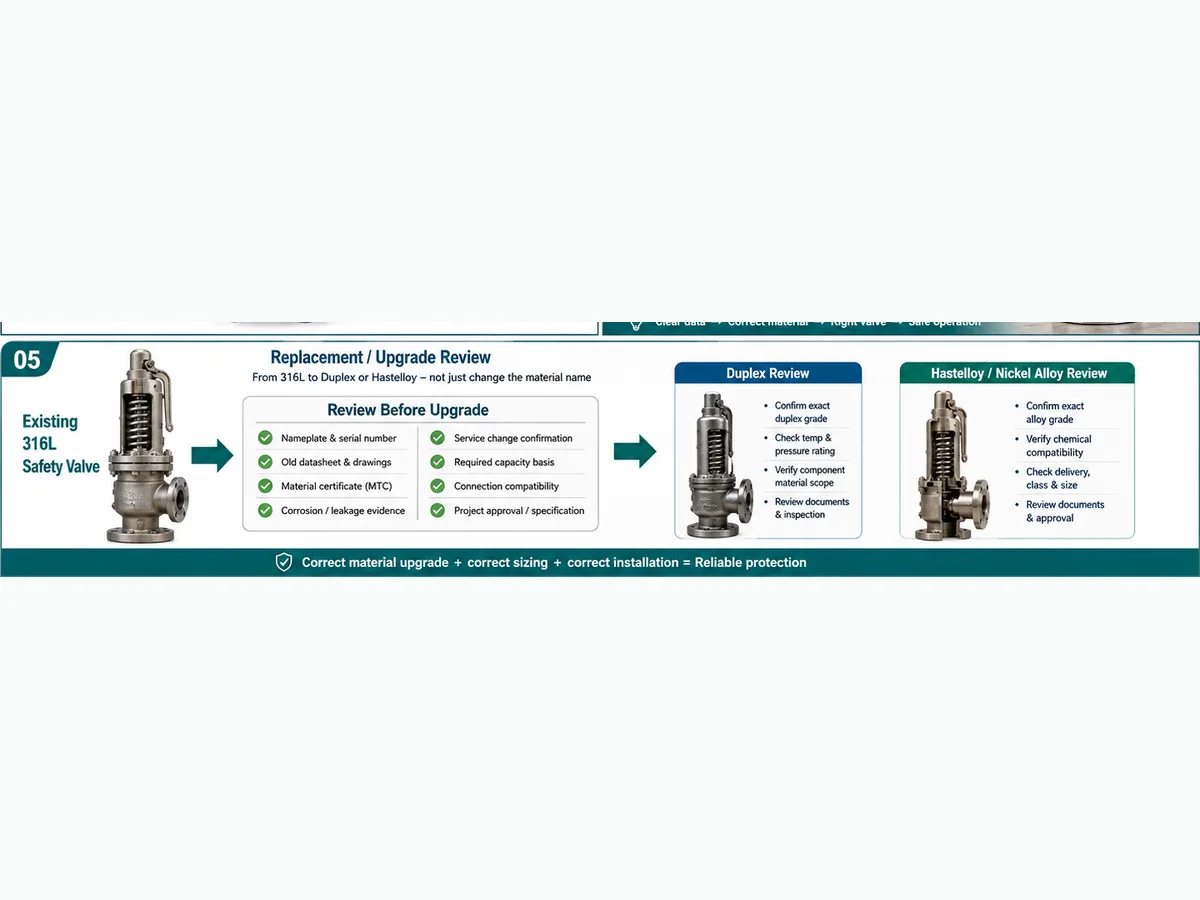
Replacement workflow illustration; not a real customer project, inspection record or upgrade approval document.
- Collect nameplate and datasheet information. Confirm existing size, set pressure, connection, material clues and original selection basis if available.
- Identify the actual failure or upgrade driver. Check whether the issue is body corrosion, trim corrosion, seat leakage, spring corrosion, bellows failure, fouling, erosion, sizing, back pressure or installation.
- Confirm whether service conditions changed. Medium, temperature, pressure, relief scenario or discharge system changes can make the old material basis invalid.
- Review connection and pressure-temperature rating. Material upgrade must remain compatible with the flange, pressure class, gasket, bolting and project documents.
- Confirm approval and documents. Material change may require updated datasheets, MTCs, inspection records or project approval.
Replacement Hold Points Before Approving a Material Upgrade
- Confirm that the observed damage is corrosion or material incompatibility—not erosion, cavitation, contamination, chatter, piping strain or mechanical damage.
- Revalidate the governing relief scenario, required relieving capacity, set pressure and documented capacity.
- Check whether the outlet header, back pressure, relieving temperature or process chemistry has changed since the original valve was selected.
- Confirm flange rating, gasket, bolting, face-to-face dimensions, inlet/outlet orientation and discharge support.
- Update the component material schedule, test plan, MTC/PMI scope, datasheet and project approval records.
Typical engineering scenario: A nickel-alloy body was proposed after corrosion appeared near the outlet. Review showed that the body was not the controlling exposure: corrosive back pressure was reaching the bellows and gasket area. The corrective action was to review total back pressure, discharge chemistry, bellows material and outlet-system configuration together. Specifying a high-alloy body alone would not have closed the failure mechanism.
Test and Document Matrix for Material-Specific Safety Valves
Material-specific RFQs often need more evidence than a basic price inquiry. The required scope depends on the selected model, material grade, project specification, inspection plan and applicable standard edition. Each document proves a limited point; no single certificate proves total service suitability.
| Document or Test | What It Can Support | What It Does Not Prove | RFQ Instruction |
|---|---|---|---|
| MTC / CMTR | Traceability to the stated material specification, heat and reported chemical/mechanical results. | Compatibility with the actual process, correct heat treatment of every component, capacity or valve performance. | List the components requiring certificates and the acceptance standard / document type. |
| Positive Material Identification (PMI) | Field or shop verification of alloy identity at the tested locations. | Full traceability, mechanical properties, heat treatment, corrosion life or untested internal parts. | Define components, sampling extent, method, acceptance criteria and report format. |
| Heat-treatment record | Evidence that the specified thermal cycle was applied where required. | Final corrosion suitability, phase balance at every location or correct valve sizing. | State whether certified heat-treatment records are required for castings or welded assemblies. |
| NDE report | Results of the specified surface or volumetric examination. | Chemical compatibility, pressure-relief capacity or absence of every possible defect. | Define method, extent, acceptance standard and witness / hold points. |
| Pressure-boundary / shell test | Pressure-boundary integrity under the specified shop test. | Set pressure, seat tightness, certified capacity or installed-system performance. | State test pressure, medium, duration, acceptance criteria and report requirement. |
| Set-pressure calibration / CDTP record | Opening setting under defined bench conditions and applicable temperature/back-pressure corrections. | Required relieving capacity, seat tightness under all service conditions or acceptable field installation. | State set pressure, test medium, tolerance, CDTP basis and sealing requirements. |
| Seat-tightness test | Leakage performance under the specified test method and conditions. | Certified capacity, corrosion resistance or stable operation in the installed system. | State applicable test standard, seat type, test medium and any project-specific tighter criterion. |
| Certified / documented capacity evidence | Relieving performance for the selected design, fluid basis and conditions within the applicable certification or manufacturer data. | Material compatibility, correct set pressure, acceptable back pressure or installation quality. | Provide required relieving capacity and request the selected-model capacity basis. |
| Final datasheet and inspection release | Consolidated record of selected configuration, materials, tests, marking and approval status. | Future suitability after process changes or installation modifications. | Require revision control and approval before shipment / return to service. |
Evidence boundary: An MTC or PMI result can support alloy identity, but neither proves that the material is compatible with the process chemistry or that the valve has sufficient relieving capacity. A set-pressure bench test confirms adjustment under test conditions; it does not replace capacity evidence or installation review.
Typical Engineering Scenarios: What the Material Name Misses
The following are composite training examples, not customer cases, certified test results or product-performance claims.
Scenario 1 · Incomplete trim scope
Problem: Localized attack on nozzle and guide after a “316L valve” purchase.
Cause: Only the body material was specified.
Action: Define all wetted/moving parts and anti-galling pairs.
Prevention: Require a component material schedule and traceability matrix.
Scenario 2 · Leakage after alloy upgrade
Problem: Leakage continued after 316L was replaced by duplex.
Cause: Seat contamination and insufficient operating margin, not body corrosion.
Action: Review seat, cleanliness, operating pressure and test basis.
Prevention: Confirm the failure mode before changing alloy.
Scenario 3 · Outlet-side exposure
Problem: Corrosion near bellows/gasket despite high-alloy body.
Cause: Corrosive back pressure and unreviewed outlet exposure.
Action: Review total back pressure, bellows, gasket and discharge system.
Prevention: Treat process-side and discharge-side material zones separately.
RFQ Checklist for 316L, Duplex or Hastelloy Safety Valves
To request a useful quotation for a 316L, duplex or Hastelloy safety valve, provide enough information for both material review and safety valve selection. Relief scenario and system-level context should also be checked against the project basis; for that topic, see ZOBAI’s API 521 pressure relief systems guide.
| RFQ Item | Information to Provide |
|---|---|
| Protected equipment and relief scenario | Vessel, reactor, pipeline, compressor, skid or other system; blocked outlet, fire case, thermal expansion or other case. |
| Medium and chemistry | Medium name, phase, composition, concentration, pH, chloride content and contaminants. |
| Pressure data | Operating pressure, MAWP/design pressure, set pressure and relieving pressure if known. |
| Capacity data | Required relieving capacity and basis if available. |
| Temperature data | Operating temperature and relieving temperature. |
| Back pressure | Superimposed and built-up values if known. |
| Connection | Inlet/outlet size, standard, class/PN rating, facing and flange details. |
| Material requirement | Alloy family plus exact grade / UNS, product form and component-by-component scope for body, trim, bellows, spring, bolting, gasket and seats. |
| Seat, spring, bellows and gasket | Special material, soft seat, metal seat, bellows, seal or compatibility requirements. |
| Documents | MTC, test report, inspection, witness, seat leakage or project approval requirements. |
| Material evidence | MTC/CMTR, PMI scope, heat-treatment records, NDE and traceability requirements by component. |
| Test evidence | Pressure-boundary test, set-pressure/CDTP record, seat-tightness requirement and selected-model capacity basis. |
Technical References to Confirm
These official pages identify the scope of relevant standards. They do not replace the purchased standard, project specification, manufacturer datasheet, material-certificate review, corrosion study or local regulatory approval. Confirm the edition required by the project before purchase or technical acceptance.
- ASME BPVC Section XIII — Rules for Overpressure Protection: overpressure-protection rules covering device design, material, inspection, testing, marking, capacity and installation topics.
- API 520 Part I: sizing and selection of pressure-relieving devices in its stated refinery scope.
- API 520 Part II: installation and engineering-analysis context in its stated refinery scope.
- API Standard 521: pressure-relieving and depressurizing system guidance for the industries within its scope.
- ASTM A351/A351M: austenitic steel castings for valves and other pressure-containing parts.
- ASTM A995/A995M: duplex stainless-steel castings for valves and other pressure-containing parts.
- ASTM A494/A494M: nickel and nickel-alloy castings for corrosion-resistant service.
FAQ About 316L, Duplex and Hastelloy Safety Valves
Is duplex always better than 316L for safety valves?
No. Duplex may offer higher strength and advantages in selected chloride-related environments, but the exact grade, product form, heat treatment, temperature, medium chemistry and component scope must be reviewed.
Is Hastelloy always the best material for corrosive safety valves?
No. A nickel alloy may be justified for severe chemical service, but it is not a universal solution. The exact alloy grade, corrosion mechanism, component scope, pressure–temperature rating, availability and documentation must be confirmed.
Is 316L the same material designation for a cast body, trim, bellows and bolting?
No. Castings, forgings, bar, sheet, spring wire and fasteners can require different material specifications and grades. Define the alloy and product form for each critical component.
Can I specify only the safety valve body as 316L?
Usually not. The nozzle, disc, guide, stem, seat, spring, bellows, gasket and bolting may have different exposure and must be reviewed separately.
What data is needed before selecting 316L, duplex or Hastelloy?
Provide medium composition, concentration, pH, chloride content, contaminants, phase, operating and relieving temperature, pressure data, required relieving capacity, back pressure, connection details, component material scope and document requirements.
Can I replace a 316L valve with duplex or Hastelloy?
Possibly, but first identify the failure mode and revalidate the relief scenario, capacity, set pressure, back pressure, connection rating, component materials and project approval requirements.
Does an MTC or PMI report prove corrosion suitability?
No. These records can support alloy identity and traceability, but they do not prove compatibility with the actual process chemistry, temperature, crevices, contaminants or relief-event conditions.
Does material selection affect seat tightness?
It can. Seating-surface material, hard facing, soft-seat compound, process contamination, temperature and operating margin can affect leakage performance. State the required test method and acceptance criteria in the RFQ.
Does material selection replace safety valve sizing?
No. The selected valve must still have adequate documented capacity for the governing relief case and acceptable performance under the actual back pressure and installation conditions.
Standards and Selection Limitation
References to ASTM, API, ASME, ISO, EN, DIN, GB or project specifications define particular scopes; they do not automatically make every valve model suitable for every service or jurisdiction. Material standards describe defined product forms and requirements, while pressure-relief standards address different aspects of design, sizing, testing, installation or system engineering.
Final acceptance depends on the real service conditions, selected valve design, component material schedule, manufacturer data, required capacity, applicable standard edition, project specification and local regulatory requirements. This article is not a universal corrosion chart and does not replace a formal corrosion study, pressure-relief calculation, selected-model datasheet, MTC/PMI review, test report or inspection approval.
Send a Complete Material-Selection RFQ
Provide the protected equipment, governing relief scenario, medium composition, concentration, chloride level, pH, contaminants, phase, operating and relieving temperature, pressure data, required capacity, back pressure, connection standard, exact component material scope and document requirements.