
What Is Blowdown in a Safety Valve?
Blowdown is the pressure difference between a safety valve’s set pressure and its reseating pressure after a relief event. It describes how far the protected system pressure must fall before the valve closes and remains closed.
This glossary page explains the calculation, related pressure terms, operating effects, valve-design differences and the data that should appear in a PSV datasheet or RFQ.
- Blowdown is referenced between set pressure and reseating pressure.
- It may be stated as a pressure difference or as a percentage of set pressure.
- It is not the same as overpressure, accumulation, back pressure or seat leakage.
- The acceptable value depends on valve design, medium, service, code and manufacturer data.
Blowdown measures the pressure drop required before the valve reseats
Practical interpretation
- The valve opens at its defined set-pressure characteristic
- System pressure falls while the valve relieves
- The valve closes at its reseating pressure
- The set-to-reseat difference is the blowdown
- Final acceptance must match the selected valve and project requirement
Do not confuse blowdown with the other pressures in a relief event
Set Pressure
Overpressure
Accumulation
Reseating Pressure
Blowdown
Back Pressure
Blowdown controls how the valve leaves the relief event
Blowdown can affect
- Valve stability during and after relief
- Repeated lifting or cycling
- Process pressure recovery
- Quantity of fluid discharged
- Seat impact and wear
- Leakage after closing
- Operating-pressure margin
- Suitability for steam, gas, vapor or liquid service
Too little and too much blowdown can create different problems
Blowdown Too Small
Blowdown Too Large
Blowdown behavior depends on how the valve opens, lifts and closes
Spring-Loaded Valves
Balanced Bellows Valves
Pilot-Operated Valves
Observed blowdown is part of the installed relief system
Factors to review
- Operating pressure too close to set pressure
- Inlet pressure loss
- Superimposed and built-up back pressure
- Rapid process pressure recovery
- Oversized valve or insufficient relief flow
- Fluid phase and flashing behavior
- Valve orientation and piping stress
- Seat condition and deposits
- Unauthorized adjustment
- Manufacturer-specific blowdown capability
Four steps for reviewing blowdown in a datasheet or operating problem
Confirm pressure terms
Calculate blowdown
Review the installed system
Verify the selected valve
Information needed to specify or review blowdown
Recommended review data
- Protected equipment and relief scenario
- Medium and fluid phase
- Operating pressure and set pressure
- Required or observed reseating pressure
- Required blowdown percentage or acceptance range
- Relieving pressure and required capacity
- Superimposed and built-up back pressure
- Valve type, size, orifice and model
- Inlet and outlet piping information
- Applicable code, test method and report
Blowdown errors that lead to poor selection or troubleshooting
Confusing blowdown with overpressure
Using MAWP in the formula
Ignoring back pressure
Adjusting a sealed valve in the field
Assuming one value fits every medium
Blaming every cycling issue on blowdown
Omitting reseating pressure
Treating seat leakage as blowdown
Continue from the definition to valve selection and system review
Explore related ZOBAI guides to continue from basic terminology to valve selection, sizing, back pressure review, installation and project documentation.
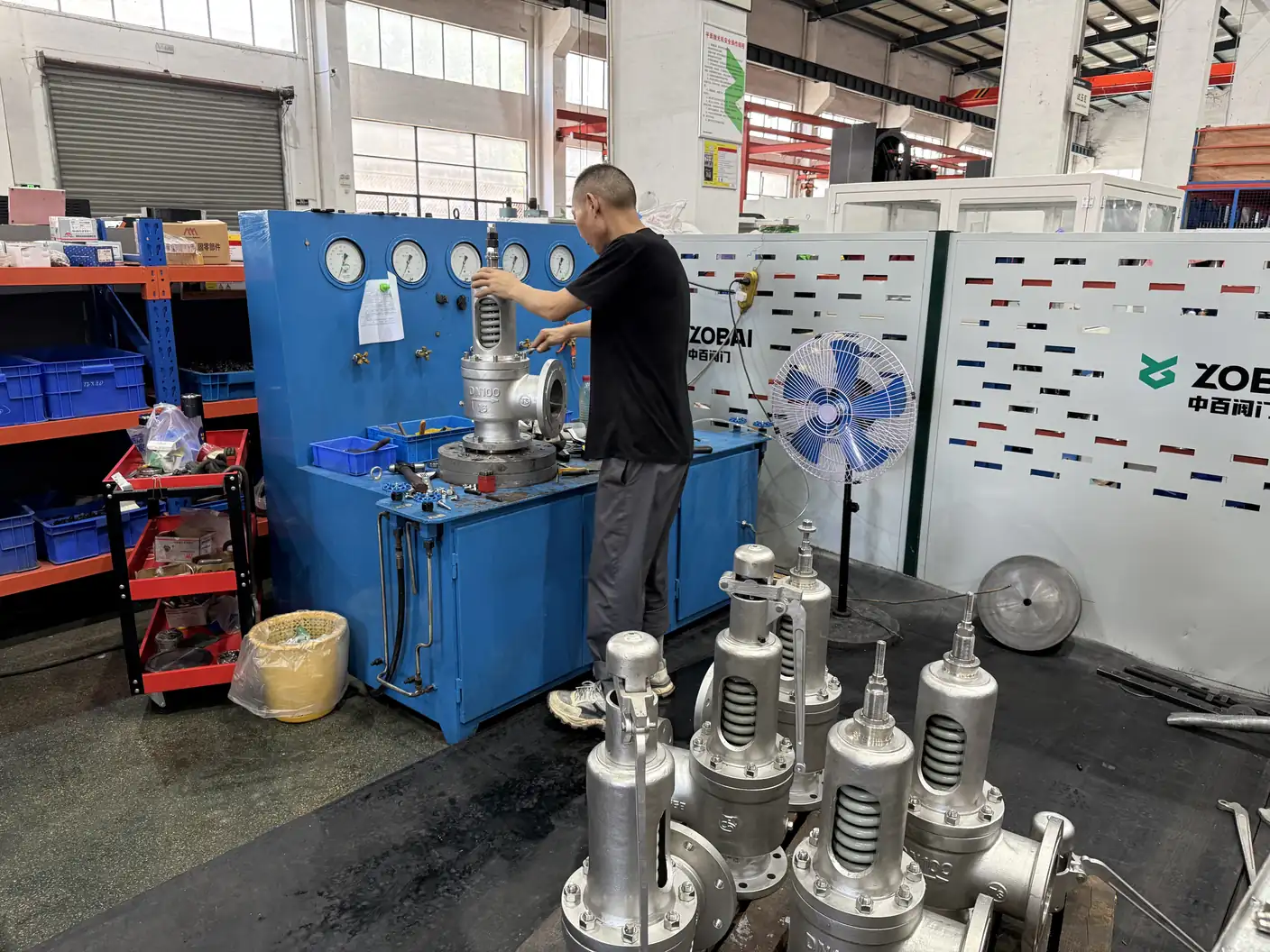
Documentation Connected to Real Production
A certificate or report is useful only when it can be traced to the supplied valve and agreed inspection scope. This actual ZOBAI photograph documents safety valve pressure-testing workstation. Align drawings, material records, pressure-test results and release documents with the purchase specification.
Safety Valve Selection Guide
API 520 Safety Valve Sizing
Back Pressure Glossary
Back Pressure and Bellows
API 527 Seat Tightness
Ask an Engineer
Common questions about safety valve blowdown
Blowdown is the difference between set pressure and reseating pressure after a relief event. It is commonly expressed as a percentage of set pressure.
Subtract reseating pressure from set pressure, divide by set pressure and multiply by 100. Use a consistent pressure basis and units.
No. Overpressure is above set pressure while relieving. Blowdown is the pressure decrease below set pressure before reseating.
The valve may try to close while system pressure remains close to set pressure, which can contribute to unstable reseating or repeated lifting.
The pressure must fall further before closure, which may extend the relief event, increase fluid loss and delay process recovery.
Only where the valve design and approved manufacturer procedure allow it, and only by authorized personnel using proper test, resealing and documentation controls.