Valve Types & Working Principles How Does a Low Lift Safety Valve Work? A low lift safety valve opens when inlet pressure overcomes the calibrated spring force, but the disc travel is intentionally limited. This article explains how that limited lift controls the flow path, when a low lift design may be considered, what can …

Valve Types & Working Principles
How Does a Low Lift Safety Valve Work?
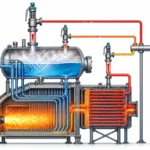
A low lift safety valve opens when inlet pressure overcomes the calibrated spring force, but the disc travel is intentionally limited. This article explains how that limited lift controls the flow path, when a low lift design may be considered, what can go wrong if capacity is assumed from connection size, and what operating data must be confirmed before RFQ or replacement.
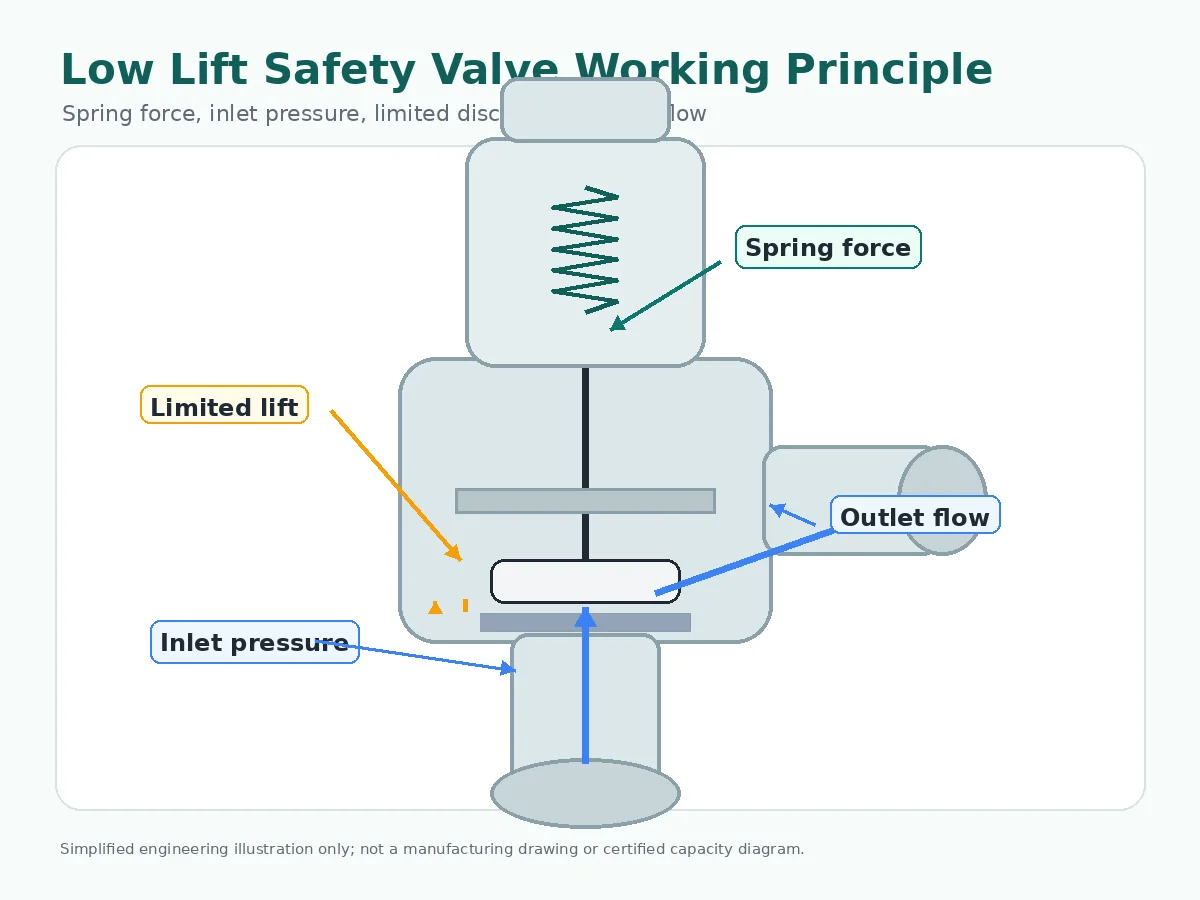
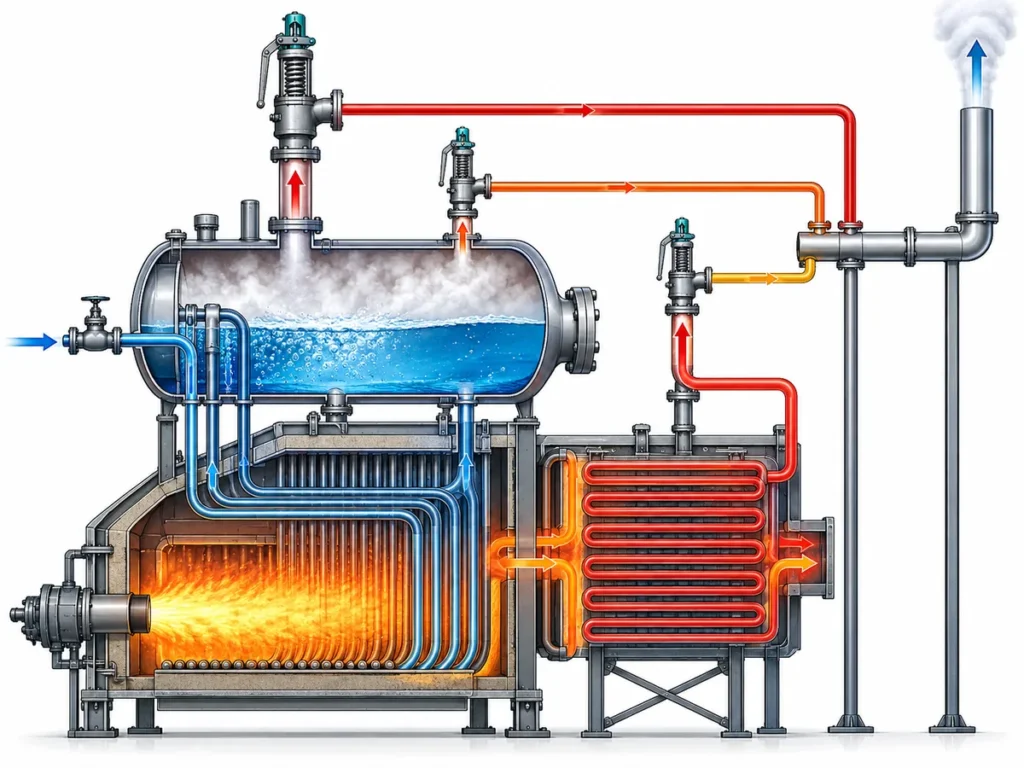
Simplified engineering illustration; not a manufacturing drawing or certified capacity diagram.
Quick Answer: How a Low Lift Safety Valve Works
A low lift safety valve works by using inlet pressure to overcome a calibrated spring force and lift the disc from the seat, but the disc travel is intentionally limited. When the protected equipment pressure reaches the set pressure, the upward force under the disc begins to exceed the closing force from the spring. The disc then opens only to a controlled low-lift position, allowing the fluid to discharge through the seat, nozzle and outlet path.
This page helps buyers understand the working principle, not complete a final valve selection. A low lift valve may be considered where the required relief load is known and the selected model can document enough capacity for the governing relief scenario. The main risk is assuming that set pressure, nominal size or connection type proves capacity. Before quotation, confirm protected equipment, relief scenario, medium and phase, operating pressure, MAWP or design pressure, set pressure, required relieving capacity, relieving temperature, back pressure, inlet/outlet connection, materials, applicable standard and required documents.
Main Parts That Control Low Lift Operation
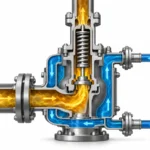
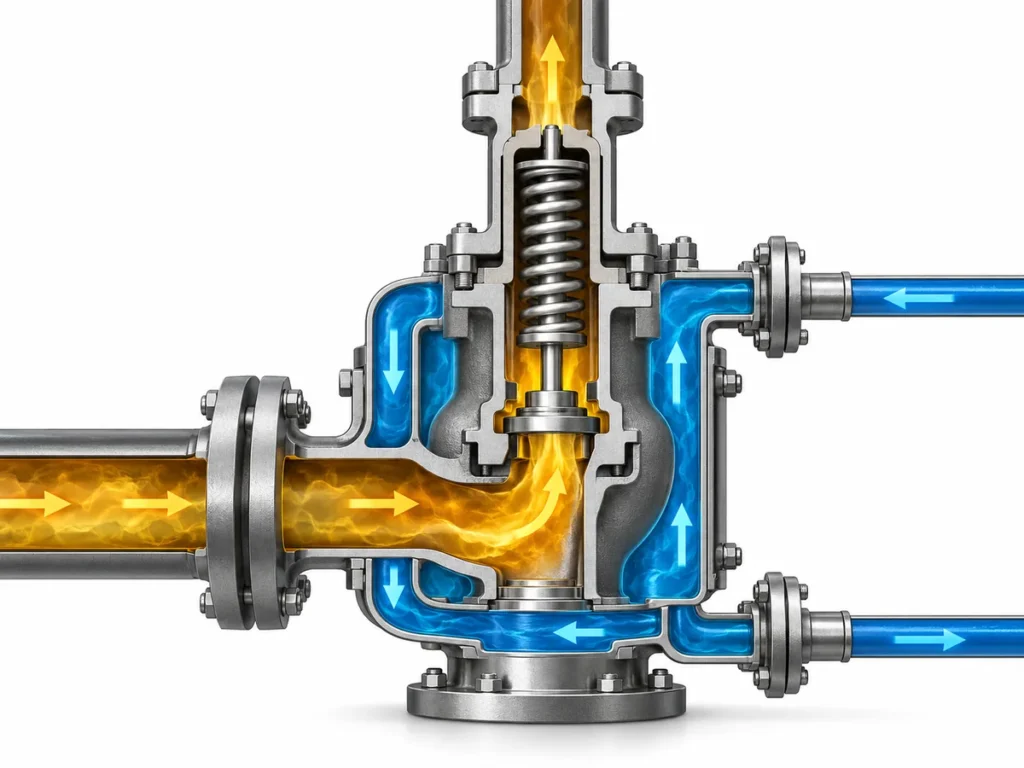
A low lift safety valve is controlled by a group of mechanical parts that must work together. The exact construction depends on the selected model, service condition and project specification, but the basic operating logic usually involves the inlet, nozzle, seat, disc, guide, spindle, spring, bonnet or cap and outlet.
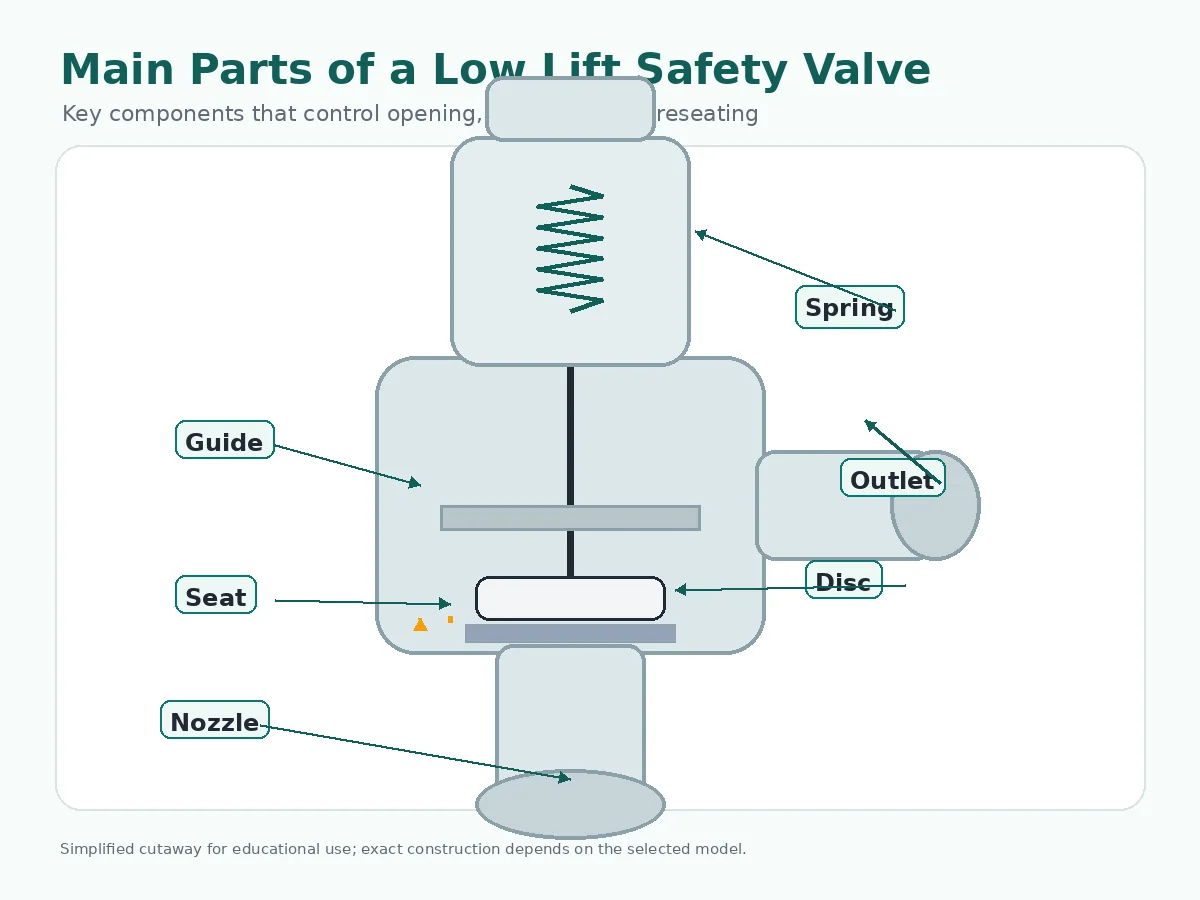
Simplified cutaway for educational use; exact construction depends on selected model.
Inlet, nozzle and seat
The inlet brings pressure from the protected equipment to the underside of the valve disc. The nozzle and seat form the first critical restriction in the flow path. When the valve is closed, the disc seals against the seat. When the pressure force becomes high enough, the disc lifts and fluid begins to pass through the seat opening.
Disc, guide and spindle
The disc is the moving closure element. In a low lift design, the disc movement is limited so the valve does not open as far as a full lift design. The guide helps control disc and spindle movement, reducing unstable motion.
Spring, bonnet and adjustment components
The spring provides the closing force. Spring compression is set during calibration so the valve starts to open at the specified set pressure. Field adjustment should not be assumed to be permitted unless the design, seal rules and project procedures allow it.
Engineering point: A low lift valve is not defined only by its body shape. The seat diameter, lift stop, spring range, guide condition, disc geometry and outlet flow path all affect opening behavior and capacity. For a related general mechanism explanation, review how a spring loaded safety valve works.
Step-by-Step Opening Sequence
The working sequence of a low lift safety valve can be understood as a force balance and movement control process. Set pressure, overpressure, accumulation, blowdown and reseating pressure describe different parts of the pressure-response behavior and should not be used interchangeably.
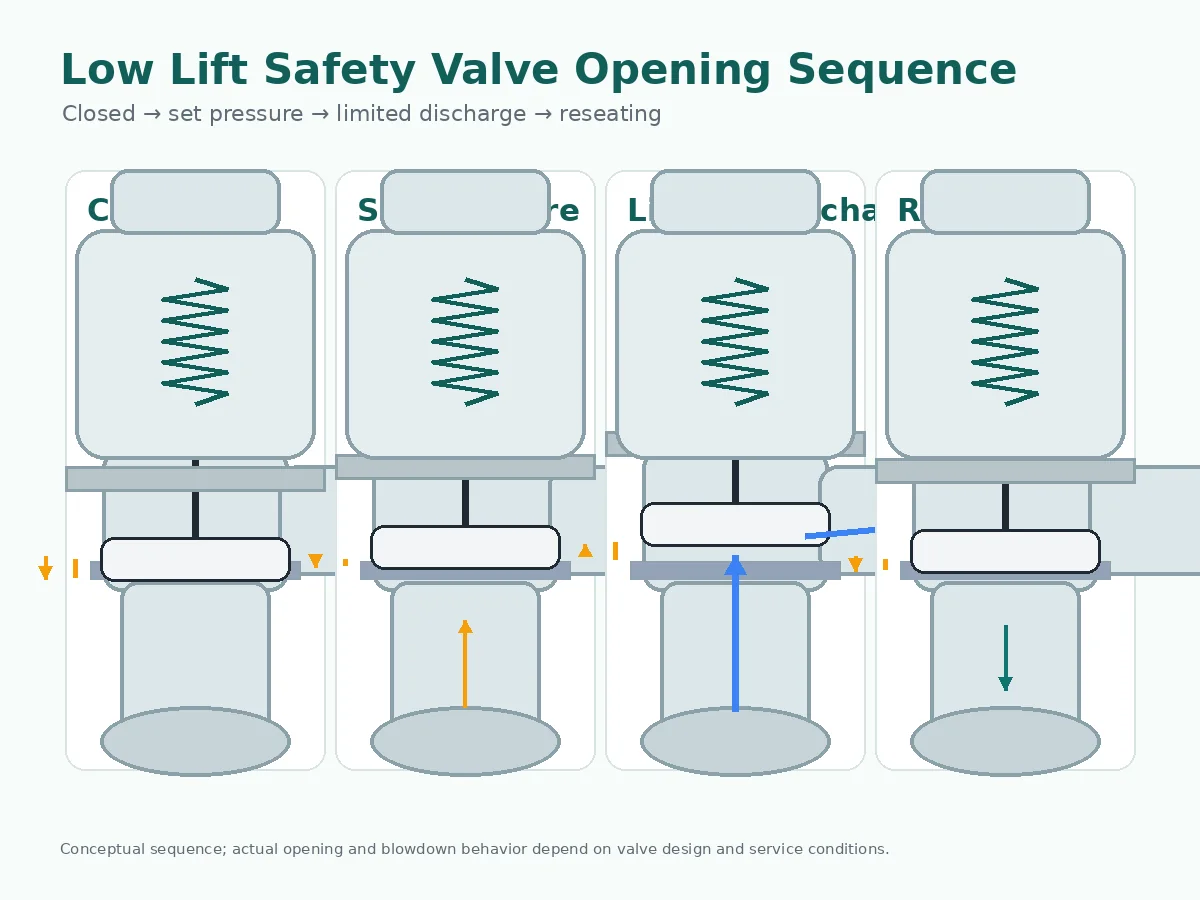
Conceptual sequence; actual opening and blowdown behavior depend on valve design and service condition.
1. Below set pressure
Below set pressure, spring force is greater than the opening force generated by inlet pressure. The disc remains seated, and the valve should stay closed under normal operating conditions. Operating pressure should maintain enough margin below set pressure to reduce leakage, simmer and instability risk.
2. At set pressure
At set pressure, the pressure force under the disc becomes sufficient to start lifting the disc from the seat. This means the valve has started to open; it does not prove the valve has reached the required relieving capacity.
3. During overpressure
As pressure rises above set pressure, the valve opens further within its low-lift limit and discharges fluid. The available discharge path depends on the seat, nozzle, disc position, lift limitation and outlet arrangement.
4. Blowdown and reseating
After the overpressure condition is relieved, system pressure falls. The valve should move back toward the seat and reseat at a pressure below the set pressure. Poor reseating can lead to leakage, product loss, emissions risk and maintenance burden.
| Term | Practical Meaning | Why It Matters for Low Lift Valves |
|---|---|---|
| Operating pressure | Normal pressure during system operation. | Should not sit too close to set pressure without review. |
| MAWP / design pressure | Pressure limit or design basis of the protected equipment, depending on project terminology. | Supports pressure protection review and relief setting decisions. |
| Set pressure | Pressure at which the valve starts to open under specified conditions. | Does not prove relieving capacity. |
| Overpressure / accumulation | Pressure rise above set pressure or above the equipment limit, depending on the applicable code and project basis. | Must be reviewed by the responsible engineer and applicable rules. |
| Blowdown / reseating | Pressure difference and behavior as the valve closes after discharge. | Affects leakage, stability and maintenance risk. |
| Required relieving capacity | Flow rate needed to protect the equipment under the governing scenario. | Must be matched against manufacturer capacity data. |
Why Limited Lift Affects Capacity
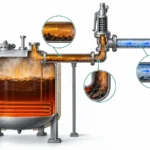
Low lift affects capacity because the disc lift is part of the available flow area. In a safety valve, flow does not depend only on the inlet or outlet connection. The fluid must pass through the nozzle, seat and opening created by the lifted disc. If the lift is limited, the discharge area may also be limited.
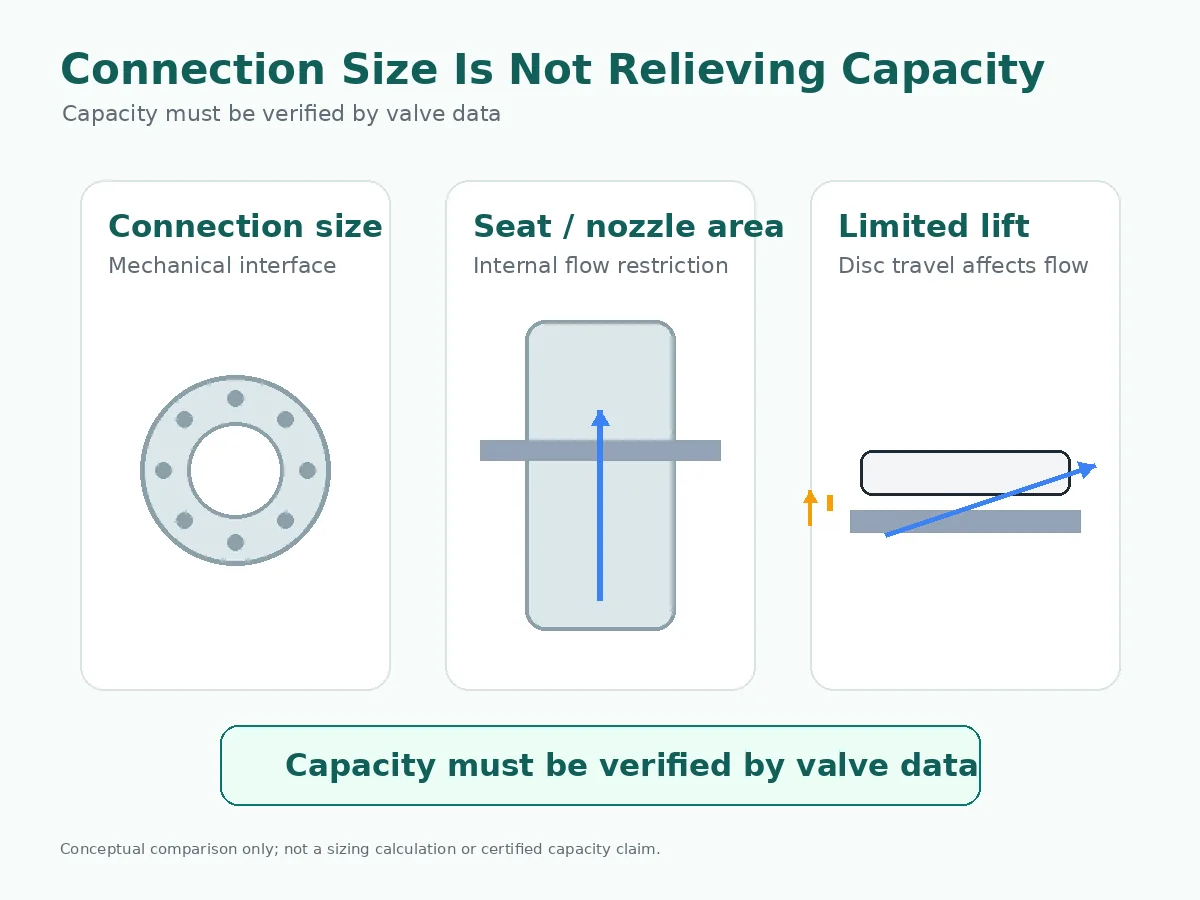
Conceptual comparison; not a sizing calculation.
Lift is part of the flow restriction
When the disc lifts from the seat, it creates an opening for fluid to escape. In a low lift design, that opening is intentionally controlled. The valve may be designed for specific relief duties where limited lift is acceptable, but it should not be assumed to provide the same capacity as a full lift valve of the same connection size.
In many low lift designs, the effective discharge path is strongly influenced by the curtain area: the annular flow area formed around the seat as the disc rises a limited distance. Because this discharge area remains lift-controlled, the valve’s relieving capacity must be checked against documented data for the selected model, medium and service basis rather than inferred from inlet connection size alone.
Connection size is not capacity
Connection size is a mechanical interface. Capacity is a relief performance requirement. Two valves with the same inlet size can have different internal flow areas, lift limits, trims, springs, capacity records and service suitability. For capacity logic and documented capacity review, see the guide to safety valve sizing and certified capacity.
Required capacity must be checked separately
Required relieving capacity should be defined from the protected equipment and relief scenario. A blocked outlet, thermal expansion case, fire case, regulator failure or process upset can create different required loads. The selected valve must then be checked against manufacturer data and applicable project requirements.
| Capacity Question | What Buyers Sometimes Assume | What Must Be Confirmed |
|---|---|---|
| Does the valve fit the connection? | Same DN, NPS, thread or flange size means equivalent performance. | Connection fit is only mechanical. Seat/nozzle area, lift and capacity basis must still be checked. |
| Does the valve open at the required set pressure? | Correct set pressure means the valve is correctly sized. | Set pressure only defines opening pressure. Required relieving capacity must be confirmed separately. |
| Can the selected low lift valve relieve the governing case? | A low lift valve is acceptable if it looks similar to the old valve. | Compare required relieving capacity, relieving pressure, medium, temperature and back pressure with manufacturer data. |
| Is the documented capacity usable for this service? | Any catalog capacity applies to any medium or temperature. | Capacity basis, medium, phase, pressure, temperature and applicable standard must match the project review. |
Low Lift vs Full Lift Safety Valve: What Changes in Operation?
Low lift and full lift safety valves differ mainly in disc travel and the resulting flow path. This does not mean one is always better. The correct choice depends on required capacity, service condition, valve design, applicable code and project requirements.
| Item | Low Lift Safety Valve | Full Lift Safety Valve | Buyer Check |
|---|---|---|---|
| Disc travel | Limited lift from the seat. | Larger lift from the seat. | Confirm actual lift design and model data. |
| Flow path | Controlled and potentially smaller. | Potentially larger. | Do not infer from connection size alone. |
| Capacity potential | May be lower for the same nominal size. | Often selected for higher capacity duties. | Compare required capacity with documented capacity. |
| Selection risk | Undersizing if chosen by size or set pressure only. | Wrong application if chosen without service review. | Check medium, pressure, back pressure, installation and code. |
| Replacement risk | Old valve appearance may not prove equivalent capacity. | The same issue applies. | Use nameplate, datasheet and capacity basis. |
For product-family context, review low lift safety valves. This article remains focused on working principle and RFQ preparation.
Preliminary Suitability Matrix
The table below is a preliminary screening tool, not a final selection rule. A low lift safety valve may be considered only when the protected equipment, relief scenario and required capacity are defined and the selected valve can be checked against manufacturer data.
For a broader end-to-end workflow, use the safety valve selection guide before final model selection.
| Project Situation | Low Lift Review Direction | Engineering Boundary |
|---|---|---|
| Controlled-capacity relief duty with known required flow | May be considered | Required capacity must be lower than or equal to documented capacity for the selected model and service basis. |
| Replacement of an existing low lift valve with complete nameplate and datasheet | May be considered | Verify set pressure, capacity basis, connection, materials, service medium, temperature and documents. |
| Unknown relief scenario or unknown required capacity | Do not finalize selection | Define the governing relief case before selecting by valve size or valve name. |
| High required relieving capacity or uncertain two-phase service | Requires detailed review | Low lift may be insufficient; compare with full lift or other valve configurations using project data. |
| Significant variable back pressure or complex discharge header | Requires back pressure review | Check whether conventional low lift behavior remains stable or whether another configuration is required. |
| Corrosive, viscous, dirty, polymerizing or high-temperature service | Requires material and maintenance review | Body material alone is not enough; check trim, seat, seal, spring, deposits and operating reliability. |
When not to use this page as a selection shortcut: Do not select a low lift valve from this article alone if the required relieving capacity, medium phase, relieving temperature, back pressure, applicable code or original replacement data is missing. Those missing inputs must be confirmed before final valve selection.
Where Low Lift Safety Valves May Be Considered
A low lift safety valve may be considered where controlled, limited-lift relieving action is appropriate and the required capacity is verified. The actual decision must begin with the protected equipment and governing relief scenario, not with the valve name alone.
Controlled-capacity relief cases
Low lift valves may be reviewed where the required relieving load is within the documented capacity of the selected valve and where the medium, temperature, pressure and discharge arrangement are suitable.
Replacement and maintenance review
Replacement should not rely on visual similarity. Collect the existing nameplate, datasheet, connection details, set pressure, service medium, inspection history and capacity records where available.
When low lift may not be enough
A low lift valve may not be appropriate if the required relieving capacity is higher than the selected valve can document, or if medium, phase, back pressure, inlet loss or document requirements exceed the selected model’s limits.
What Can Go Wrong If the Working Principle Is Misunderstood
Misunderstanding the working principle can lead to unsafe or costly selection mistakes. A low lift safety valve is not simply a smaller valve, a low-price substitute or an interchangeable item with the same connection size. It is a pressure protection device that must match the relief scenario.
Engineering warning: Set pressure tells when the valve starts to open. It does not tell how much fluid the valve can relieve. Connection size tells how the valve connects to equipment or piping. It does not prove internal flow area or documented capacity.
| Common Mistake | Why It Is Risky | Required Check |
|---|---|---|
| Selecting by connection size only | Same connection does not prove same flow area or capacity. | Confirm seat/nozzle data and documented capacity. |
| Treating set pressure as capacity | Set pressure is only the opening pressure. | Confirm required relieving capacity and capacity basis. |
| Replacing by appearance | Similar valve bodies may have different trims, springs and lift. | Review nameplate, datasheet, model and service data. |
| Ignoring back pressure | Outlet pressure can affect stability and capacity. | Check superimposed and built-up back pressure. |
| Ignoring inlet loss | Excessive inlet loss can cause instability or reduced performance. | Review inlet piping, pressure drop and installation layout. |
| Assuming material grade is enough | Body material alone does not confirm trim, seat, spring or seal suitability. | Confirm all wetted and functional materials. |
Back Pressure, Inlet Loss and Installation Checks
Low lift operation can be affected by the piping around the valve. A valve that is correctly calibrated can still operate poorly if inlet loss is excessive, outlet back pressure is outside the selected design boundary, discharge piping loads the valve body, or the discharge path is unsafe.
| Condition | Potential Effect | What to Confirm |
|---|---|---|
| Excessive inlet pressure loss | Can reduce pressure at the valve inlet during relief and contribute to unstable operation. | Review inlet piping, fittings, pressure drop and short, direct connection requirements. |
| Built-up back pressure | Can affect discharge capacity and valve stability during relieving flow. | Check outlet piping size, length, bends, header pressure and discharge route. |
| Superimposed back pressure | Can influence opening behavior before the relief event begins. | Confirm constant or variable back pressure and whether the selected design can tolerate it. |
| Unsupported discharge piping | Can impose load on the valve body and nozzle connection. | Provide outlet support and account for reaction forces where applicable. |
| Unsafe discharge direction | Can expose personnel or equipment to hot, toxic, flammable or high-velocity discharge. | Route discharge to a safe location according to project requirements. |
Installation effects should be reviewed against the safety valve installation guide. Outlet pressure effects should be reviewed with back pressure and bellows guidance before assuming the valve type alone solves the discharge condition.
Medium, Temperature and Material Screening
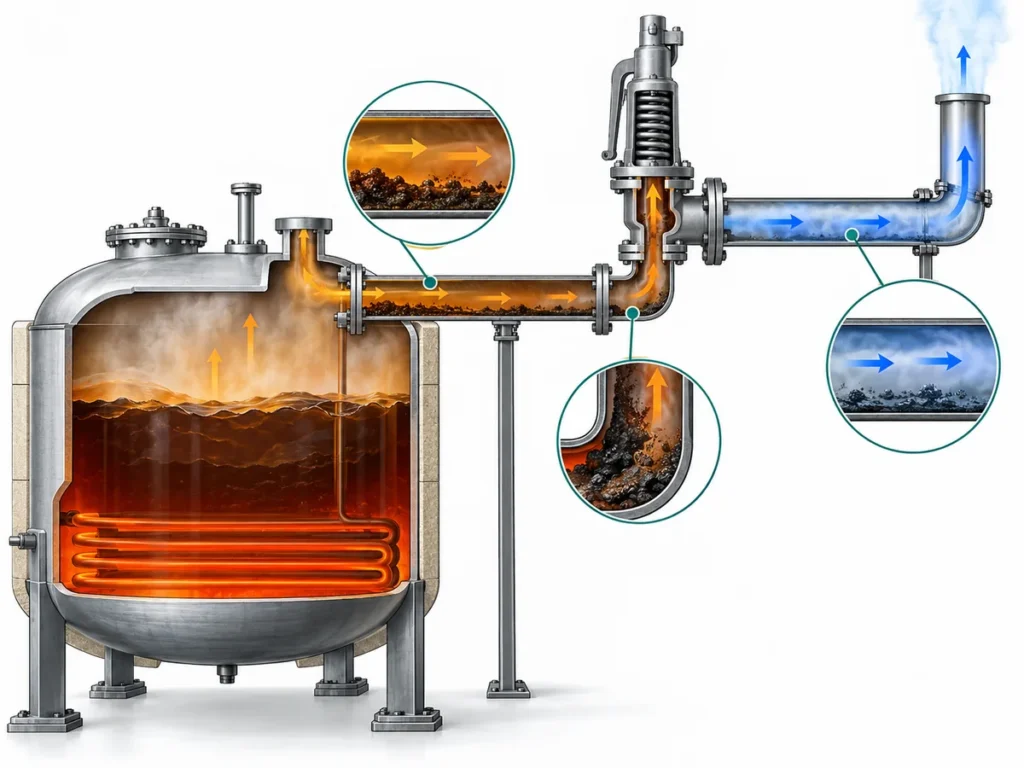
The low lift mechanism does not remove the need to confirm material and service compatibility. Medium phase, temperature, corrosion, deposits and seat requirements can change leakage risk, spring behavior, maintenance interval and service life.
| Service Condition | Why It Matters | Data to Confirm |
|---|---|---|
| Steam or high-temperature vapor | Temperature affects spring, seat, body rating, blowdown and discharge safety. | Steam condition, relieving temperature, set pressure, required steam capacity and applicable documents. |
| Gas or vapor | Capacity behavior, noise, reaction force and discharge routing may be critical. | Molecular weight or gas data where required, relieving pressure, temperature and discharge destination. |
| Liquid service | Opening stability, chattering risk and hydraulic effects may differ from vapor service. | Fluid density, viscosity, required flow, inlet loss and discharge arrangement. |
| Corrosive medium | Body material alone may not protect disc, seat, spring, seals or guiding surfaces. | Medium composition, concentration, temperature, corrosion allowance and wetted material requirements. |
| Viscous, dirty or polymerizing service | Deposits can restrict disc movement, affect seating and change maintenance needs. | Viscosity, solids, crystallization, polymerization risk, cleaning method and inspection interval. |
Data to Confirm Before Selecting or Replacing a Low Lift Valve
A low lift safety valve can only be reviewed properly when the operating and relief data are clear. The RFQ should not be limited to size, pressure and quantity. It should describe the protected system and the required relief duty.
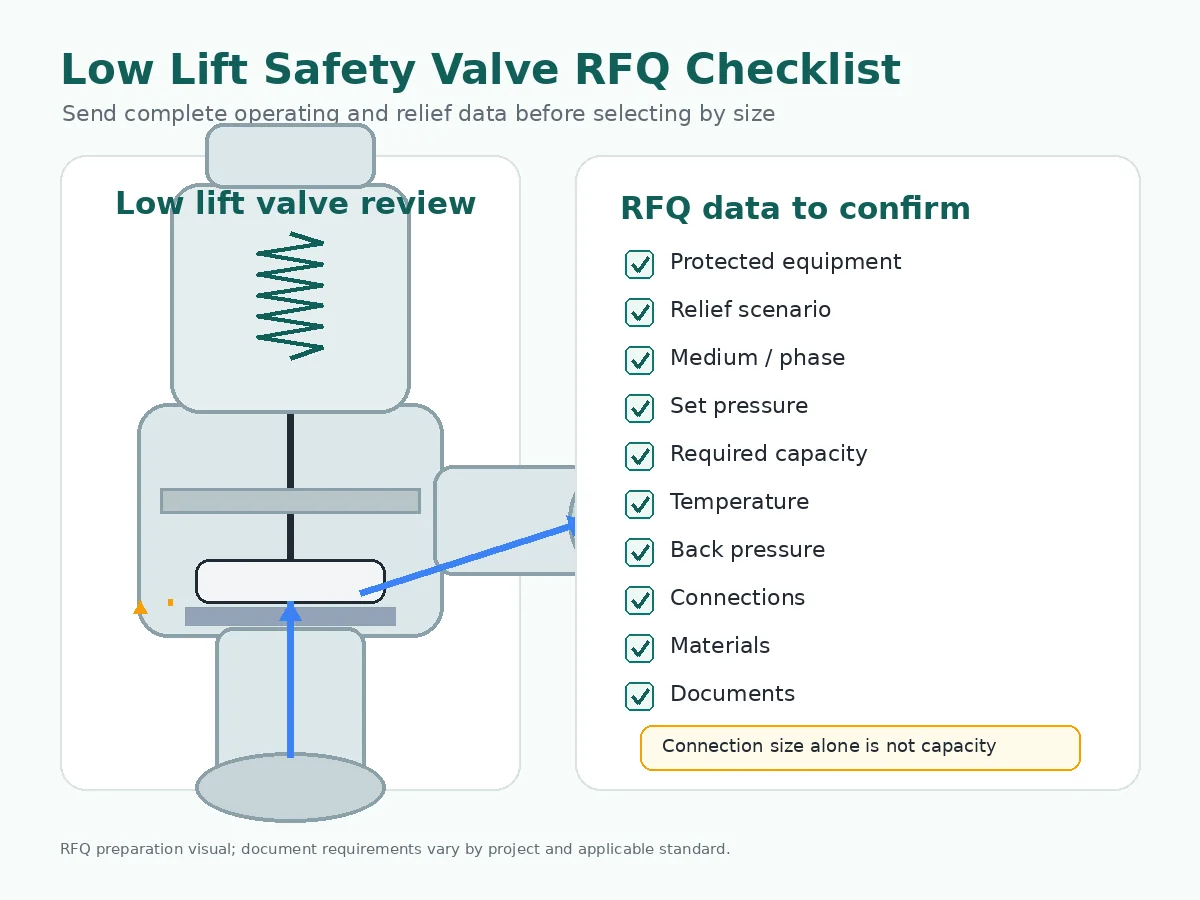
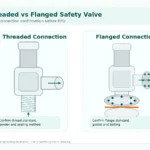
RFQ preparation visual; document requirements vary by project and applicable standard.
RFQ data checklist
| RFQ Item | What to Provide | Why It Matters |
|---|---|---|
| Protected equipment | Boiler, vessel, tank, pipeline, compressor, skid or other equipment. | Defines the protection duty. |
| Relief scenario | Blocked outlet, thermal expansion, fire case, regulator failure, process upset or other case. | Determines required relieving load. |
| Medium and phase | Steam, gas, vapor, liquid, two-phase, corrosive, viscous or other service. | Affects sizing, materials, leakage and stability. |
| Operating pressure / MAWP / set pressure | Normal system pressure, equipment pressure basis and required valve opening pressure. | Prevents pressure terminology errors. |
| Required relieving capacity | Flow rate and capacity basis. | Must be matched with manufacturer capacity data. |
| Relieving temperature | Temperature during the relief event. | Affects material, spring, seat and rating. |
| Back pressure | Superimposed and built-up back pressure if known. | Affects valve type and discharge stability. |
| Connections and materials | Size, rating, standard, facing/thread type, body, trim, seat, seal and spring requirements. | Confirms mechanical fit and service compatibility. |
| Applicable standard and documents | API, ASME, ISO, EN, GB or project specification where applicable; datasheet, test report, material record and capacity basis. | Supports procurement and QA review. |
Replacement verification workflow
| Step | What to Check | Do Not Assume |
|---|---|---|
| 1. Identify the old valve | Nameplate, photos, model, set pressure, size, rating and connection standard. | Do not assume a similar body shape means equivalent performance. |
| 2. Confirm the original duty | Protected equipment, relief scenario, medium, temperature and required capacity basis. | Do not assume the original installation was correctly sized. |
| 3. Review operating history | Leakage, chatter, corrosion, deposits, test failures or repeated maintenance. | Do not repeat an old problem by copying only the size. |
| 4. Compare selected valve data | Set pressure, documented capacity, materials, seat, spring, connection and documents. | Do not treat catalog title or valve type name as final proof. |
| 5. Confirm project acceptance | Applicable standard, inspection scope, documentation and local regulatory requirements. | Do not order before document requirements are clear. |
Where API sizing methods are required by project specification, the RFQ should be reviewed against the applicable standard and manufacturer data. ZOBAI’s API 520 safety valve sizing guide can help translate sizing and selection questions into RFQ inputs without replacing formal calculation review.
Testing, Inspection and Document Matrix
For procurement and replacement, document scope should be agreed before order placement. The exact package depends on selected model, project specification, applicable standard and inspection requirements.
| Document / Check | What It Supports | Important Boundary |
|---|---|---|
| Valve datasheet | Confirms selected size, connection, pressure setting, materials and service basis. | Must match the actual project conditions, not only a generic catalog page. |
| Set pressure calibration record | Shows the pressure setting verification for the selected valve. | Calibration does not prove required relieving capacity. |
| Seat tightness test record | Supports leakage acceptance review where required. | Test method and acceptance basis must match project requirements. |
| Shell / body pressure test record | Supports pressure-retaining part verification. | Does not replace capacity or service compatibility review. |
| Material records | Support material traceability for body, trim or other required parts. | Material grade alone does not prove service suitability. |
| Capacity basis | Supports comparison between required relieving load and selected valve performance. | Must be applicable to the selected model, medium and project basis. |
| Inspection release / witness scope | Supports QA and project acceptance. | Must be agreed before manufacturing or final inspection where applicable. |
For leakage acceptance context, review the API 527 seat tightness test guide before specifying seat tightness documentation in the RFQ.
Standards and Selection Note
This article provides engineering explanation and RFQ preparation guidance only. It does not reproduce standard text and does not certify that any specific valve model complies with a particular code or jurisdiction. Applicable API, ASME, ISO, EN, GB or project requirements must be confirmed against the selected model, manufacturer documentation, project specification and local regulatory authority where applicable.
Final selection depends on the real protected equipment, governing relief scenario, medium and phase, operating pressure, MAWP or design pressure, set pressure, required relieving capacity, relieving temperature, back pressure, inlet and outlet piping, material requirements, selected model, manufacturer data, applicable standard version and project specification.
Technical References
The following official sources are provided for standards orientation only. They do not prove compliance for any specific ZOBAI valve model and do not replace the selected model datasheet, capacity basis, project specification or local regulatory review.
API 520 Part I: Official API standard page for sizing and selection procedures for pressure-relieving devices. View official API page.
ASME Codes & Standards: Official ASME standards source for code and standards orientation. View official ASME page.
FAQ
Is a low lift safety valve the same as a spring loaded safety valve?
Not exactly. A low lift safety valve may be spring loaded, but “low lift” describes the limited disc travel and opening behavior. “Spring loaded” describes how the closing force is generated. The two terms refer to different aspects of valve design.
Does a low lift safety valve have lower capacity than a full lift valve?
A low lift design often has a smaller available opening than a full lift design, so capacity may be lower for the same nominal connection size. However, the correct answer depends on the selected model and manufacturer capacity data. Do not assume capacity from the valve name alone.
Can I select a low lift safety valve by connection size?
No. Connection size only confirms the mechanical interface. It does not prove seat area, lift, discharge coefficient or documented relieving capacity. Required capacity must be checked separately.
What pressure data is needed before RFQ?
Provide operating pressure, MAWP or design pressure, set pressure, allowable overpressure or accumulation basis where applicable, and required relieving capacity. These terms should not be mixed.
Can a low lift safety valve be used for steam service?
It may be considered only if the selected valve design, materials, set pressure, steam capacity, temperature, blowdown behavior, installation and document requirements are suitable for the project. Steam service should not be assumed from valve type alone.
What should I check when replacing an old low lift safety valve?
Check the existing nameplate, datasheet, set pressure, capacity basis, medium, relieving temperature, connection standard, material, back pressure, installation condition and test history. A similar-looking valve may not be an equivalent replacement.
Need to Review a Low Lift Valve for RFQ or Replacement?
Send the protected equipment, relief scenario, medium and phase, operating pressure, MAWP or design pressure, set pressure, required relieving capacity, relieving temperature, back pressure, inlet and outlet connection, material requirements, applicable standard and documents. For replacement, include the existing nameplate, valve photos, datasheet, service history and reason for replacement.