Ventiltypen & Funktionsweisen Wie funktioniert ein Niedrighub-Sicherheitsventil? Ein Niedrighub-Sicherheitsventil öffnet, wenn der Einlassdruck die kalibrierte Federkraft überwindet, aber der Scheibenhub bewusst begrenzt ist. Dieser Artikel erklärt, wie dieser begrenzte Hub den Strömungspfad steuert, wann ein Niedrighub-Design in Betracht gezogen werden kann, was …

Ventiltypen & Funktionsprinzipien
Wie funktioniert ein Niedrighub-Sicherheitsventil?
Ein Niedrighub-Sicherheitsventil öffnet, wenn der Einlassdruck die kalibrierte Federkraft überwindet, aber der Scheibenhub bewusst begrenzt ist. Dieser Artikel erklärt, wie dieser begrenzte Hub den Strömungspfad steuert, wann ein Niedrighub-Design in Betracht gezogen werden kann, was schiefgehen kann, wenn die Kapazität anhand der Anschlussgröße angenommen wird, und welche Betriebsdaten vor einer Angebotsanfrage (RFQ) oder einem Austausch bestätigt werden müssen.
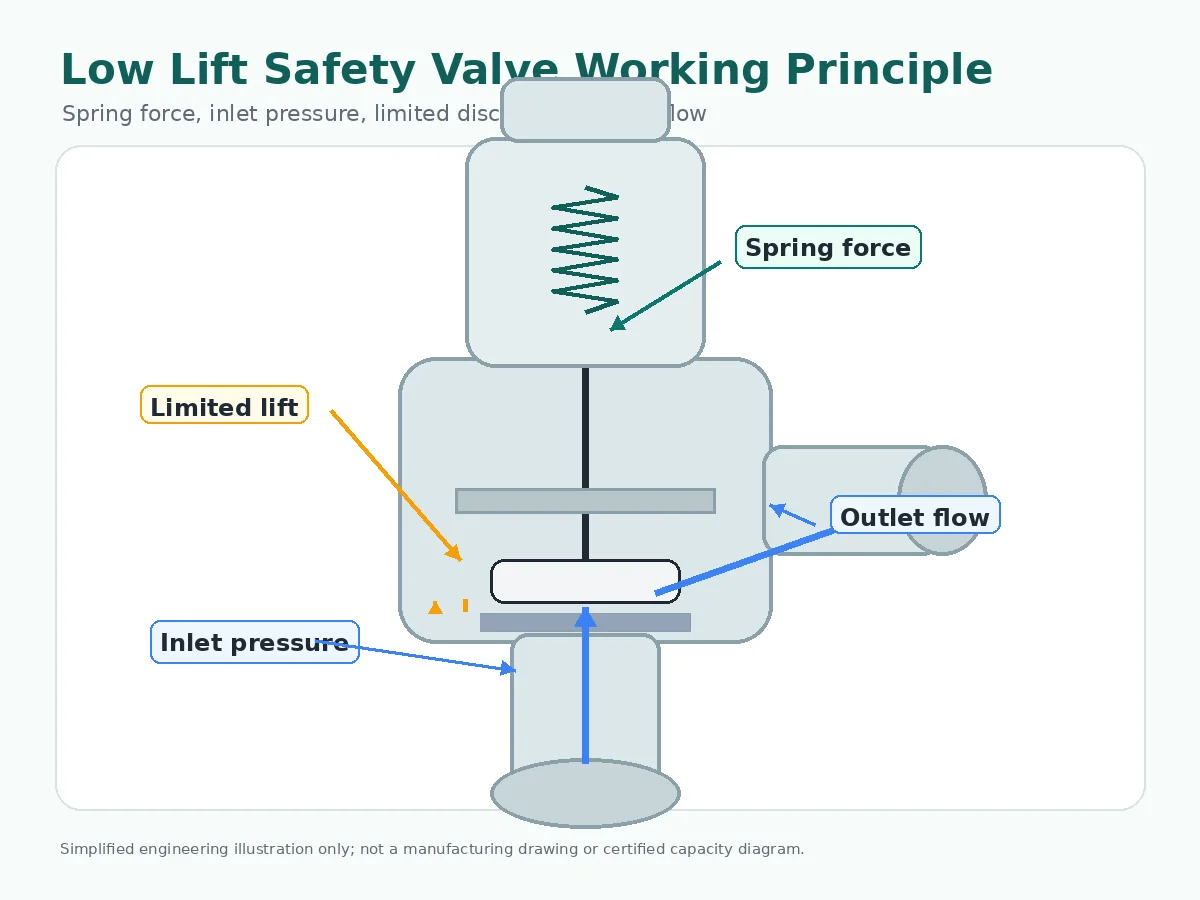
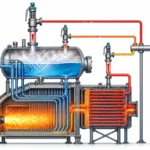
Vereinfachte technische Darstellung; keine Fertigungszeichnung oder zertifizierte Kapazitätsdiagramm.
Schnelle Antwort: Wie ein Niedrighub-Sicherheitsventil funktioniert
Ein Niedrighub-Sicherheitsventil funktioniert, indem der Einlassdruck die kalibrierte Federkraft überwindet und den Ventilteller vom Sitz hebt, wobei der Ventiltellerhub bewusst begrenzt ist. Wenn der Druck des geschützten Geräts den Ansprechdruck erreicht, beginnt die nach oben gerichtete Kraft unter dem Ventilteller, die Schließkraft der Feder zu überwinden. Der Ventilteller öffnet sich dann nur bis zu einer kontrollierten Niedrighub-Position, wodurch das Medium durch den Sitz, die Düse und den Auslassweg abgeleitet wird.
Diese Seite hilft Käufern, das Funktionsprinzip zu verstehen, nicht eine endgültige Ventilauswahl abzuschließen. Ein Niedrighub-Ventil kann in Betracht gezogen werden, wenn die erforderliche Abblaseleistung bekannt ist und das ausgewählte Modell eine ausreichende Kapazität für das maßgebliche Abblaseszenario nachweisen kann. Das Hauptrisiko besteht darin, anzunehmen, dass Ansprechdruck, Nenngröße oder Anschlusstyp die Kapazität belegen. Bestätigen Sie vor der Angebotserstellung: geschütztes Gerät, Abblaseszenario, Medium und Phase, Betriebsdruck, maximal zulässiger Betriebsdruck (MAWP) oder Auslegungsdruck, Ansprechdruck, erforderliche Abblasekapazität, Abblasetemperatur, Gegendruck, Einlass-/Auslassanschluss, Materialien, anwendbarer Standard und erforderliche Dokumente.
Hauptteile, die den Niedrighub-Betrieb steuern
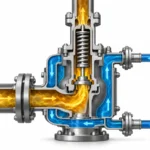
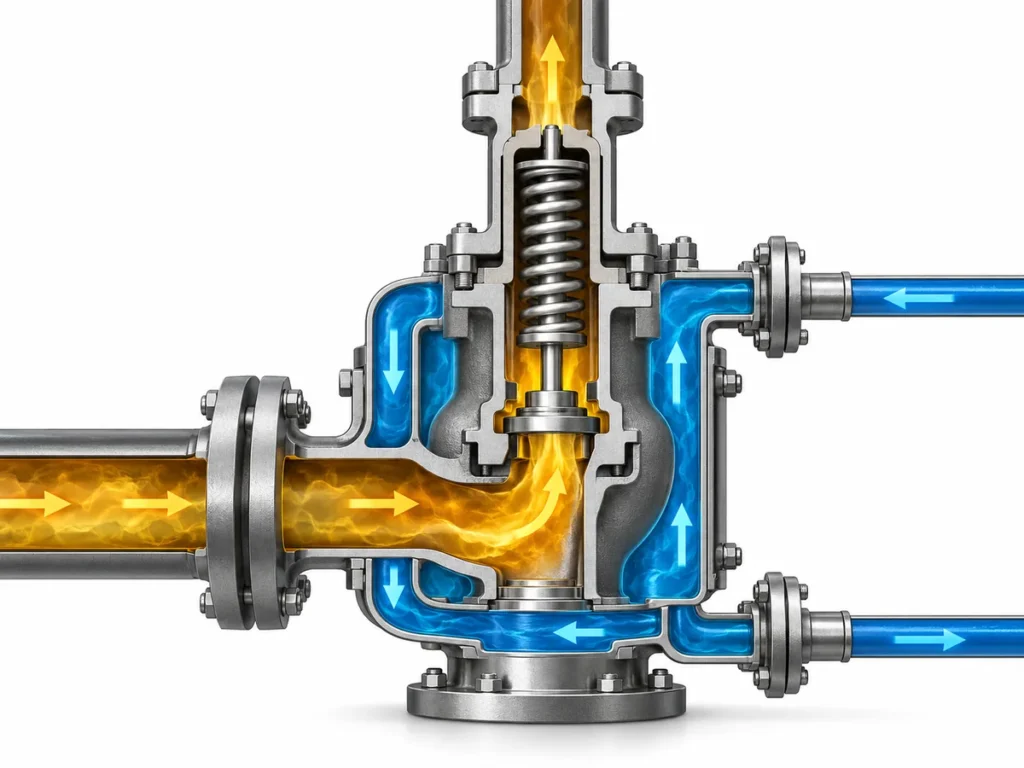
Ein Niedrighub-Sicherheitsventil wird von einer Gruppe mechanischer Teile gesteuert, die zusammenarbeiten müssen. Die genaue Konstruktion hängt vom ausgewählten Modell, den Betriebsbedingungen und den Projektspezifikationen ab, aber die grundlegende Funktionslogik umfasst normalerweise Einlass, Düse, Sitz, Ventilteller, Führung, Spindel, Feder, Haube oder Kappe und Auslass.
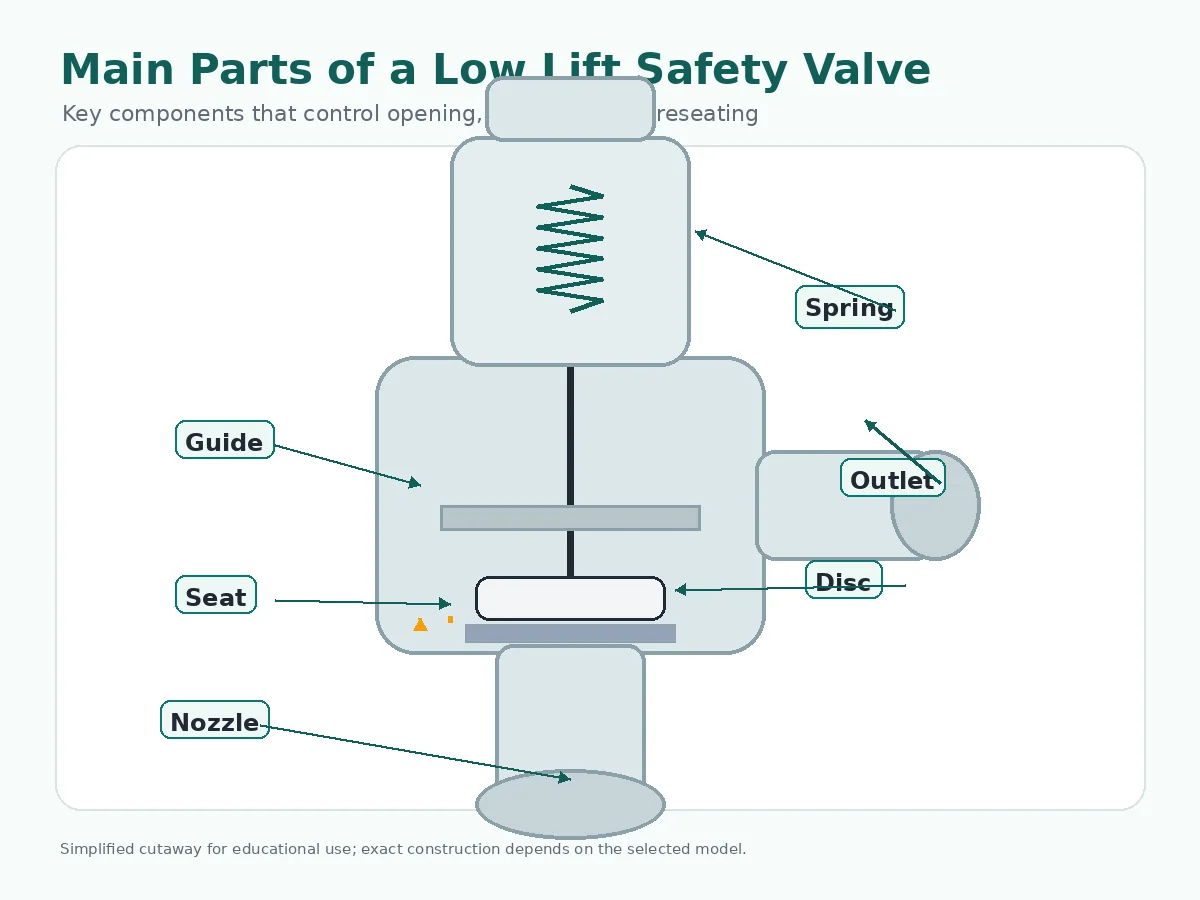
Vereinfachter Schnitt für Bildungszwecke; die genaue Konstruktion hängt vom ausgewählten Modell ab.
Einlass, Düse und Sitz
Der Einlass leitet den Druck vom geschützten Gerät zur Unterseite des Ventiltellers. Die Düse und der Sitz bilden die erste kritische Einschnürung im Strömungspfad. Wenn das Ventil geschlossen ist, dichtet der Ventilteller am Sitz ab. Wenn die Druckkraft hoch genug wird, hebt sich der Ventilteller und das Medium beginnt, durch die Sitzöffnung zu strömen.
Ventilteller, Führung und Spindel
Der Ventilteller ist das bewegliche Schaltelement. Bei einem Niedrighub-Design ist die Bewegung des Ventiltellers begrenzt, sodass sich das Ventil nicht so weit öffnet wie bei einem Vollhub-Design. Die Führung hilft, die Bewegung von Ventilteller und Spindel zu steuern und instabile Bewegungen zu reduzieren.
Feder, Haube und Einstellkomponenten
Die Feder liefert die Schließkraft. Die Federkompression wird während der Kalibrierung eingestellt, sodass das Ventil bei dem angegebenen Ansprechdruck zu öffnen beginnt. Eine Einstellung vor Ort sollte nicht als zulässig vorausgesetzt werden, es sei denn, Konstruktion, Dichtungsregeln und Projektverfahren erlauben dies.
Konstruktionspunkt: Ein Niedrighub-Ventil ist nicht allein durch seine Gehäuseform definiert. Der Sitzdurchmesser, der Hubbegrenzer, der Federbereich, der Zustand der Führung, die Scheibengeometrie und der Auslassströmungspfad beeinflussen das Öffnungsverhalten und die Kapazität. Für eine zugehörige allgemeine Erklärung des Mechanismus siehe Funktionsweise eines federbelasteten Sicherheitsventils.
Schrittweise Öffnungssequenz
Die Arbeitsweise eines Niedrighub-Sicherheitsventils kann als Prozess der Kraftbalance und Bewegungssteuerung verstanden werden. Ansprechdruck, Überdruck, Anstau, Blowdown und Wiederverschließdruck beschreiben verschiedene Teile des Druck-Reaktionsverhaltens und sollten nicht austauschbar verwendet werden.
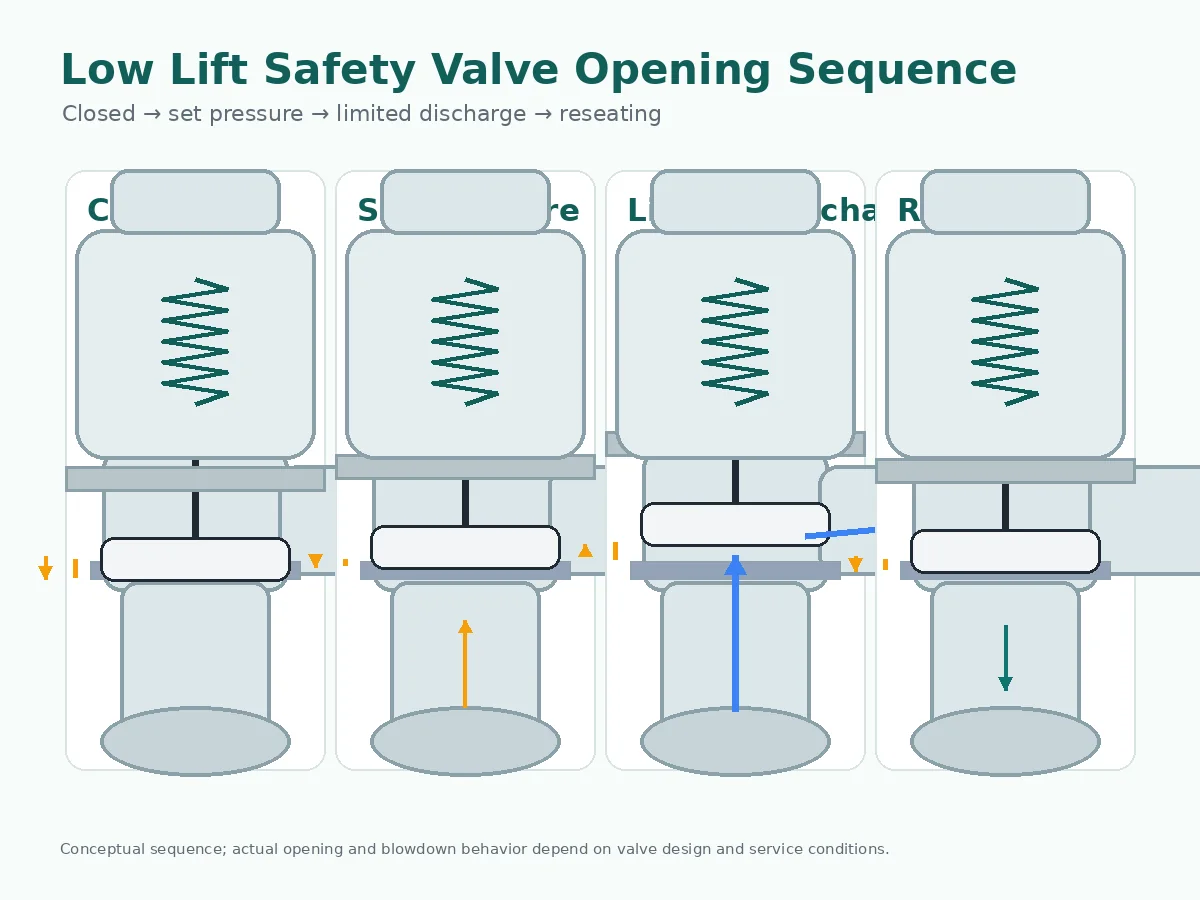
Konzeptionelle Sequenz; tatsächliches Öffnungs- und Blowdown-Verhalten hängen von Ventilkonstruktion und Betriebsbedingungen ab.
1. Unterhalb des Ansprechdrucks
Unterhalb des Ansprechdrucks ist die Federkraft größer als die Öffnungskraft, die durch den Einlassdruck erzeugt wird. Die Scheibe bleibt auf dem Sitz, und das Ventil sollte unter normalen Betriebsbedingungen geschlossen bleiben. Der Betriebsdruck sollte ausreichend unter dem Ansprechdruck liegen, um Leckage-, Simmer- und Instabilitätsrisiken zu reduzieren.
2. Am Ansprechdruck
Am Ansprechdruck wird die Druckkraft unter der Scheibe ausreichend, um die Scheibe vom Sitz zu heben. Dies bedeutet, dass das Ventil zu öffnen begonnen hat; es beweist jedoch nicht, dass das Ventil die erforderliche Entlastungskapazität erreicht hat.
3. Während des Überdrucks
Wenn der Druck den Ansprechdruck überschreitet, öffnet sich das Ventil weiter bis zu seiner Niedrighub-Grenze und gibt Medium ab. Der verfügbare Abströmweg hängt von der Sitzgeometrie, der Düse, der Scheibenposition, der Hubbegrenzung und der Auslasskonfiguration ab.
4. Ansprechdruckdifferenz und Wiederverschließen
Nachdem die Überdruckbedingung behoben ist, fällt der Systemdruck. Das Ventil sollte sich zurück zum Sitz bewegen und bei einem Druck unterhalb des Ansprechdrucks wieder schließen. Ein schlechtes Wiederverschließen kann zu Leckagen, Produktverlust, Emissionsrisiken und erhöhtem Wartungsaufwand führen.
| Begriff | Praktische Bedeutung | Warum es für Niedrighub-Ventile wichtig ist |
|---|---|---|
| Betriebsdruck | Normaler Druck während des Systembetriebs. | Sollte ohne Überprüfung nicht zu nahe am Ansprechdruck liegen. |
| MAWP / Auslegungsdruck | Druckgrenze oder Auslegungsgrundlage der geschützten Ausrüstung, abhängig von der Projektterminologie. | Unterstützt die Überprüfung des Druckschutzes und Entscheidungen zur Einstellung der Sicherheitsventile. |
| Ansprechdruck | Druck, bei dem das Ventil unter spezifizierten Bedingungen zu öffnen beginnt. | Beweist keine Abströmkapazität. |
| Überdruck / Ansammlung | Druckanstieg über den Ansprechdruck oder über die Ausrüstungsgrenze hinaus, abhängig vom geltenden Regelwerk und der Projektgrundlage. | Muss vom zuständigen Ingenieur und den geltenden Vorschriften geprüft werden. |
| Ansprechdruckdifferenz / Wiederverschließdruck | Druckdifferenz und Verhalten beim Schließen des Ventils nach der Entlastung. | Beeinflusst Leckage, Stabilität und Wartungsrisiko. |
| Erforderliche Abblaseleistung | Erforderlicher Durchfluss zur Absicherung der Anlage unter dem maßgeblichen Szenario. | Muss mit den Kapazitätsdaten des Herstellers abgeglichen werden. |
Warum begrenzter Hub die Kapazität beeinflusst
Ein geringer Hub beeinflusst die Kapazität, da der Hub des Ventiltellers Teil der verfügbaren Strömungsfläche ist. Bei einem Sicherheitsventil hängt der Durchfluss nicht nur vom Einlass- oder Auslassanschluss ab. Das Medium muss durch die Düse, den Sitz und die Öffnung strömen, die durch den angehobenen Ventilteller entsteht. Wenn der Hub begrenzt ist, kann auch die Austrittsfläche begrenzt sein.
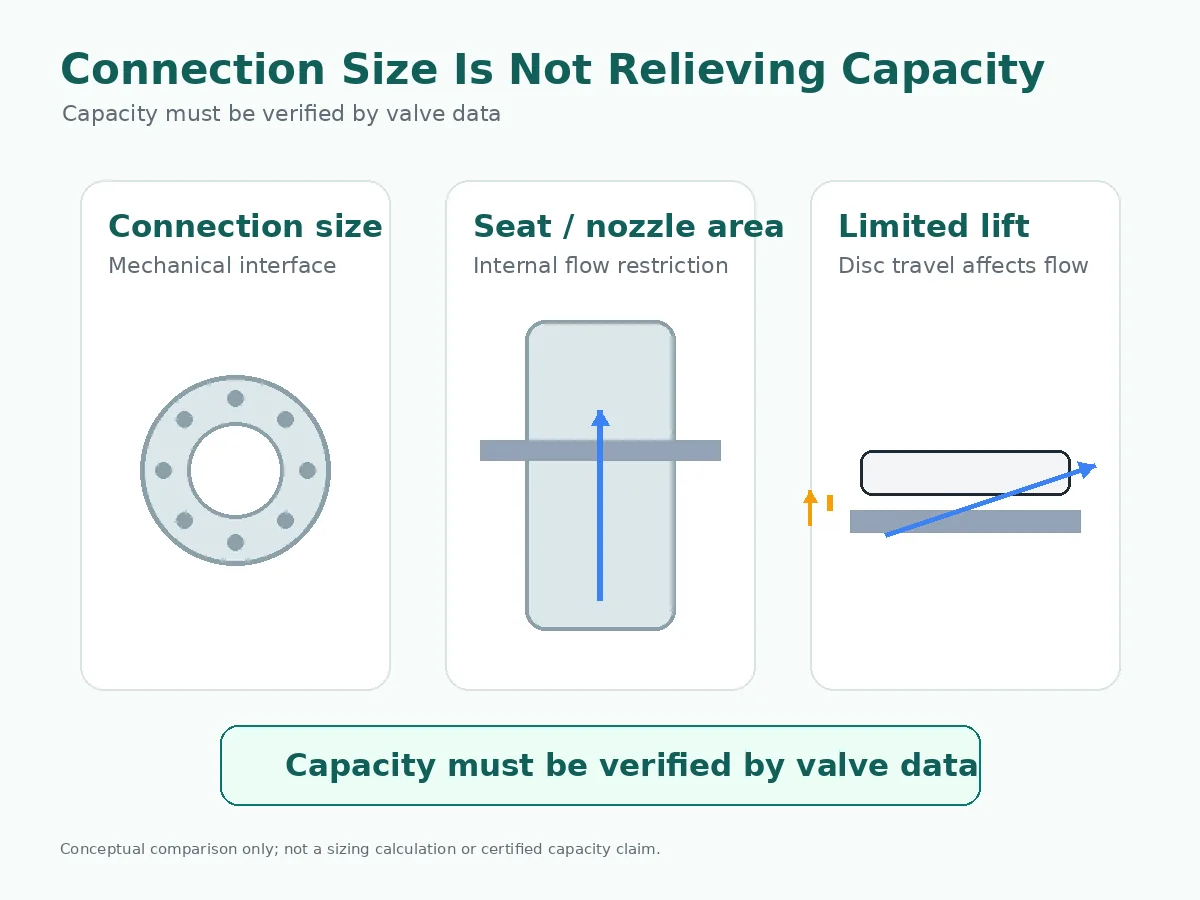
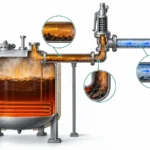
Konzeptioneller Vergleich; keine Auslegungsberechnung.
Der Hub ist Teil der Strömungsbeschränkung
Wenn sich der Ventilteller vom Sitz hebt, entsteht eine Öffnung, durch die das Medium entweichen kann. Bei einem Design mit geringem Hub wird diese Öffnung gezielt gesteuert. Das Ventil kann für spezifische Entlastungsaufgaben ausgelegt sein, bei denen ein geringer Hub akzeptabel ist, es sollte jedoch nicht davon ausgegangen werden, dass es die gleiche Kapazität wie ein Vollhub-Ventil gleicher Anschlussgröße bietet.
Bei vielen Designs mit geringem Hub wird der effektive Austrittspfad stark von der Ringfläche beeinflusst: der ringförmigen Strömungsfläche um den Sitz, die entsteht, wenn sich der Ventilteller nur begrenzt hebt. Da diese Austrittsfläche hubabhängig bleibt, muss die Entlastungskapazität des Ventils anhand dokumentierter Daten für das ausgewählte Modell, das Medium und die Betriebsbedingungen überprüft werden, anstatt allein aus der Einlassanschlussgröße abgeleitet zu werden.
Anschlussgröße ist keine Kapazität
Die Anschlussgröße ist eine mechanische Schnittstelle. Die Kapazität ist eine Anforderung an die Entlastungsleistung. Zwei Ventile mit der gleichen Einlassgröße können unterschiedliche interne Strömungsflächen, Hubbegrenzungen, Einsätze, Federn, Kapazitätsnachweise und Eignungen für den Betrieb haben. Für die Kapazitätslogik und die Überprüfung dokumentierter Kapazitäten siehe den Leitfaden zu Sicherheitsventilauslegung und zertifizierte Kapazität.
Die erforderliche Kapazität muss separat geprüft werden
Die erforderliche Abblaseleistung muss aus der geschützten Ausrüstung und dem Entlastungsszenario ermittelt werden. Ein blockierter Auslass, ein thermischer Ausdehnungsfall, ein Brandfall, ein Reglerausfall oder eine Prozessstörung können unterschiedliche erforderliche Lasten erzeugen. Das ausgewählte Ventil muss dann anhand von Herstellerdaten und den geltenden Projektanforderungen überprüft werden.
| Frage zur Kapazität | Was Käufer manchmal annehmen | Was bestätigt werden muss |
|---|---|---|
| Passt das Ventil zum Anschluss? | Gleiche Nennweite (DN), NPS, Gewinde- oder Flanschgröße bedeutet vergleichbare Leistung. | Der Anschluss passt nur mechanisch. Sitz-/Düsengröße, Hub und Kapazitätsbasis müssen noch geprüft werden. |
| Öffnet das Ventil beim erforderlichen Ansprechdruck? | Der korrekte Ansprechdruck bedeutet, dass das Ventil richtig dimensioniert ist. | Der Ansprechdruck definiert nur den Öffnungsdruck. Die erforderliche Abblaseleistung muss separat bestätigt werden. |
| Kann das ausgewählte Niedrighub-Ventil den maßgebenden Fall abblasen? | Ein Niedrighub-Ventil ist akzeptabel, wenn es dem alten Ventil ähnlich sieht. | Vergleichen Sie die erforderliche Abblaseleistung, den Abblasdruck, das Medium, die Temperatur und den Gegendruck mit den Herstellerdaten. |
| Ist die dokumentierte Kapazität für diesen Anwendungsfall nutzbar? | Jede Katalogkapazität gilt für jedes Medium oder jede Temperatur. | Kapazitätsbasis, Medium, Phase, Druck, Temperatur und anwendbarer Standard müssen mit der Projektprüfung übereinstimmen. |
Niedrighub- vs. Vollhub-Sicherheitsventil: Was ändert sich im Betrieb?
Niedrighub- und Vollhub-Sicherheitsventile unterscheiden sich hauptsächlich in Hub und Strömungsweg. Das bedeutet nicht, dass eine Bauart immer besser ist. Die richtige Wahl hängt von der erforderlichen Kapazität, den Betriebsbedingungen, dem Ventildesign, den geltenden Vorschriften und den Projektanforderungen ab.
| Artikel | Niedrighub-Sicherheitsventil | Sicherheitsventil mit Vollhub | Käuferprüfung |
|---|---|---|---|
| Hub | Begrenzter Hub vom Sitz. | Größerer Hub vom Sitz. | Tatsächlichen Hub und Modelldaten prüfen. |
| Strömungspfad | Gesteuert und potenziell kleiner. | Potenziell größer. | Nicht allein aus der Anschlussgröße ableiten. |
| Kapazitätspotenzial | Kann bei gleicher Nenngröße geringer sein. | Oft für höhere Kapazitätsanforderungen ausgewählt. | Erforderliche Kapazität mit dokumentierter Kapazität vergleichen. |
| Auswahlrisiko | Unterdimensionierung bei Auswahl nur nach Größe oder Ansprechdruck. | Falsche Anwendung, wenn ohne Überprüfung des Einsatzes ausgewählt. | Medium, Druck, Gegendruck, Installation und Norm prüfen. |
| Risiko beim Austausch | Das Aussehen des alten Ventils beweist möglicherweise keine äquivalente Kapazität. | Das gleiche Problem tritt auf. | Typenschild, Datenblatt und Kapazitätsbasis verwenden. |
Für den Produktfamilienkontext, siehe Niedrighub-Sicherheitsventile. Dieser Artikel konzentriert sich weiterhin auf das Funktionsprinzip und die Angebotsvorbereitung.
Vorläufige Eignungsmatrix
Die folgende Tabelle ist ein vorläufiges Prüfinstrument, keine endgültige Auswahlregel. Ein Niedrighub-Sicherheitsventil kann nur dann in Betracht gezogen werden, wenn die geschützte Ausrüstung, das Entlastungsszenario und die erforderliche Kapazität definiert sind und das ausgewählte Ventil anhand der Herstellerdaten geprüft werden kann.
Für einen umfassenderen End-to-End-Workflow verwenden Sie die Leitfaden zur Auswahl von Sicherheitsventilen vor der endgültigen Modellauswahl.
| Projektsituation | Niedrighub-Überprüfung Richtung | Technische Grenze |
|---|---|---|
| Geregelte Abblaseleistung mit bekanntem erforderlichem Durchfluss | Kann berücksichtigt werden | Die erforderliche Kapazität muss kleiner oder gleich der dokumentierten Kapazität für das ausgewählte Modell und die Servicebasis sein. |
| Austausch eines vorhandenen Niedrighub-Ventils mit vollständigem Typenschild und Datenblatt | Kann berücksichtigt werden | Prüfen Sie Ansprechdruck, Kapazitätsbasis, Anschluss, Materialien, Medium, Temperatur und Dokumente. |
| Unbekanntes Entlastungsszenario oder unbekannte erforderliche Kapazität | Auswahl nicht abschließen | Definieren Sie den maßgeblichen Entlastungsfall, bevor Sie nach Ventilgröße oder Ventilnamen auswählen. |
| Hohe erforderliche Abblasekapazität oder unsicherer Zweiphasenbetrieb | Erfordert detaillierte Prüfung | Niedriger Hub könnte unzureichend sein; vergleichen Sie mit Vollhub oder anderen Ventilkonfigurationen anhand von Projektdaten. |
| Signifikanter variabler Gegendruck oder komplexer Abblaseleitung | Erfordert Gegendruckprüfung | Prüfen Sie, ob das konventionelle Verhalten bei niedrigem Hub stabil bleibt oder ob eine andere Konfiguration erforderlich ist. |
| Korrosiver, viskoser, verschmutzter, polymerisierender oder Hochtemperaturbetrieb | Erfordert Material- und Wartungsprüfung | Allein das Gehäusematerial reicht nicht aus; prüfen Sie Dichtung, Sitz, Dichtung, Feder, Ablagerungen und Betriebssicherheit. |
Wann diese Seite nicht als Auswahlhilfe verwendet werden sollte: Wählen Sie kein Niedrighub-Ventil allein aus diesem Artikel aus, wenn die erforderliche Abblaseleistung, das Medium, die Abblasetemperatur, der Gegendruck, der anzuwendende Code oder die ursprünglichen Ersatzdaten fehlen. Diese fehlenden Eingaben müssen vor der endgültigen Ventilauswahl bestätigt werden.
Wann Niedrighub-Sicherheitsventile in Betracht gezogen werden können
Ein Niedrighub-Sicherheitsventil kann in Betracht gezogen werden, wenn eine kontrollierte, begrenzte Hub-Entlastungsfunktion angemessen ist und die erforderliche Kapazität verifiziert wurde. Die tatsächliche Entscheidung muss mit der geschützten Ausrüstung und dem maßgeblichen Entlastungsszenario beginnen, nicht allein mit dem Ventiltyp.
Fälle zur geregelten Kapazitätsentlastung
Niedrighubventile können dort eingesetzt werden, wo die erforderliche Abblaseleistung innerhalb der dokumentierten Kapazität des ausgewählten Ventils liegt und wo das Medium, die Temperatur, der Druck und die Abblaseanordnung geeignet sind.
Überprüfung von Ersatz und Wartung
Der Ersatz sollte nicht auf visueller Ähnlichkeit beruhen. Sammeln Sie, falls verfügbar, die vorhandene Typenschild-, Datenblatt-, Anschlussdetails-, Ansprechdruck-, Betriebsmedium-, Inspektionshistorie- und Kapazitätsaufzeichnungen.
Wenn Niedrighub nicht ausreicht
Ein Niedrighub-Ventil ist möglicherweise nicht geeignet, wenn die erforderliche Abblasekapazität höher ist, als das ausgewählte Ventil dokumentieren kann, oder wenn Medium, Phase, Gegendruck, Einlassverlust oder Dokumentationsanforderungen die Grenzen des ausgewählten Modells überschreiten.
Was kann schiefgehen, wenn das Funktionsprinzip falsch verstanden wird
Ein Missverständnis des Arbeitsprinzips kann zu unsicheren oder kostspieligen Auswahlfehlern führen. Ein Niedrighub-Sicherheitsventil ist nicht einfach ein kleineres Ventil, ein preiswerter Ersatz oder ein austauschbarer Artikel mit der gleichen Anschlussgröße. Es ist ein Druckschutzgerät, das auf das Entlastungsszenario abgestimmt sein muss.
Technische Warnung: Der Ansprechdruck gibt an, wann das Ventil zu öffnen beginnt. Er gibt nicht an, wie viel Medium das Ventil abführen kann. Die Anschlussgröße gibt an, wie das Ventil an Geräte oder Rohrleitungen angeschlossen wird. Sie beweist nicht die interne Strömungsfläche oder die dokumentierte Kapazität.
| Häufiger Fehler | Warum es riskant ist | Erforderliche Prüfung |
|---|---|---|
| Auswahl nur nach Anschlussgröße | Gleicher Anschluss beweist nicht gleiche Strömungsfläche oder Kapazität. | Sitz-/Düsendaten und dokumentierte Kapazität bestätigen. |
| Einstelldruck als Kapazität behandeln | Der Ansprechdruck ist nur der Öffnungsdruck. | Erforderliche Entlastungskapazität und Kapazitätsbasis bestätigen. |
| Austausch nach Aussehen | Ähnliche Ventilgehäuse können unterschiedliche Einsätze, Federn und Hübe haben. | Typenschild, Datenblatt, Modell und Servicedaten prüfen. |
| Gegendruck ignoriert | Der Ausgangsdruck kann Stabilität und Kapazität beeinflussen. | Überlagerten und aufgebauten Gegendruck prüfen. |
| Ignorieren von Einlassverlusten | Übermäßige Einlassverluste können zu Instabilität oder reduzierter Leistung führen. | Prüfung von Einlassleitungen, Druckabfall und Installationslayout. |
| Annahme, dass die Werkstoffgüte ausreichend ist | Das Gehäusematerial allein bestätigt nicht die Eignung von Garnitur, Sitz, Feder oder Dichtung. | Alle medienberührten und funktionellen Werkstoffe bestätigen. |
Prüfung von Gegendruck, Einlassverlust und Installation
Der Niedrighub-Betrieb kann durch die Rohrleitung um das Ventil beeinträchtigt werden. Ein korrekt kalibriertes Ventil kann dennoch schlecht funktionieren, wenn der Einlassverlust übermäßig ist, der Auslass-Gegendruck außerhalb des gewählten Auslegungsgrenzwertes liegt, die Auslassleitung das Ventilgehäuse belastet oder der Auslassweg unsicher ist.
| Bedingung | Mögliche Auswirkung | Was zu bestätigen ist |
|---|---|---|
| Übermäßiger Einlassdruckverlust | Kann den Druck am Ventileinlass während der Entlastung reduzieren und zu instabilem Betrieb beitragen. | Prüfung von Einlassleitungen, Fittings, Druckabfall und Anforderungen an kurze, direkte Anschlüsse. |
| Aufgebauter Gegendruck | Kann die Auslasskapazität und die Ventilstabilität während des abströmenden Flusses beeinträchtigen. | Prüfen Sie die Größe der Auslassleitung, Länge, Bögen, den Sammeldruck und die Abführungsroute. |
| Überlagernder Gegendruck | Kann das Öffnungsverhalten beeinflussen, bevor das Entlastungsereignis beginnt. | Bestätigen Sie den konstanten oder variablen Gegendruck und ob das gewählte Design ihn tolerieren kann. |
| Nicht unterstützte Auslassleitung | Kann das Ventilgehäuse und den Düsenanschluss belasten. | Stellen Sie eine Auslassunterstützung bereit und berücksichtigen Sie gegebenenfalls Rückstellkräfte. |
| Unsichere Auslassrichtung | Kann Personal oder Ausrüstung heißem, giftigem, brennbarem oder Hochgeschwindigkeits-Abfluss aussetzen. | Leiten Sie den Abfluss gemäß den Projektanforderungen an einen sicheren Ort. |
Installationsauswirkungen sollten überprüft werden gegen die Installationsanleitung für Sicherheitsventile. Auslassdruckauswirkungen sollten mit Gegendruck und Faltenbalg Richtlinien überprüft werden, bevor angenommen wird, dass der Ventiltyp allein die Abführungsbedingung löst.
Medien-, Temperatur- und Materialauswahl
Der Niedrighub-Mechanismus entbindet nicht von der Notwendigkeit, Material- und Serviceverträglichkeit zu prüfen. Aggregatzustand, Temperatur, Korrosion, Ablagerungen und Dichtungsanforderungen können das Leckagerisiko, das Federverhalten, das Wartungsintervall und die Lebensdauer beeinflussen.
| Betriebsbedingung | Warum es wichtig ist | Zu bestätigende Daten |
|---|---|---|
| Dampf oder Hochtemperatur-Dampf | Die Temperatur beeinflusst Feder, Sitz, Gehäuse-Nennwert, Blowdown und die Sicherheit der Abblaseleistung. | Dampfzustand, Abblasetemperatur, Ansprechdruck, erforderliche Dampfkapazität und anwendbare Dokumente. |
| Gas oder Dampf | Kapazitätsverhalten, Geräuschentwicklung, Rückstellkraft und Abblaseführung können kritisch sein. | Molekulargewicht oder Gasdaten, wo erforderlich, Abblasedruck, Temperatur und Abblaseziel. |
| Flüssigkeitsbetrieb | Öffnungsstabilität, Schwingungsrisiko (Chattering) und hydraulische Effekte können sich vom Dampfbetrieb unterscheiden. | Flüssigkeitsdichte, Viskosität, erforderlicher Durchfluss, Einlassverlust und Abblaseanordnung. |
| Korrosives Medium | Allein das Gehäusematerial schützt möglicherweise nicht die Scheibe, den Sitz, die Feder, die Dichtungen oder die Führungsflächen. | Medienzusammensetzung, Konzentration, Temperatur, Korrosionszuschlag und Anforderungen an die benetzten Materialien. |
| Viskoser, verschmutzter oder polymerisierender Dienst | Ablagerungen können die Scheibenbewegung einschränken, die Abdichtung beeinträchtigen und den Wartungsbedarf ändern. | Viskosität, Feststoffe, Kristallisation, Polymerisationsrisiko, Reinigungsverfahren und Inspektionsintervall. |
Daten zur Bestätigung vor Auswahl oder Austausch eines Niedrighub-Ventils
Ein Niedrighub-Sicherheitsventil kann nur dann richtig beurteilt werden, wenn die Betriebs- und Entlastungsdaten klar sind. Die Angebotsanfrage (RFQ) sollte nicht auf Größe, Druck und Menge beschränkt sein. Sie sollte das geschützte System und die erforderliche Entlastungsaufgabe beschreiben.
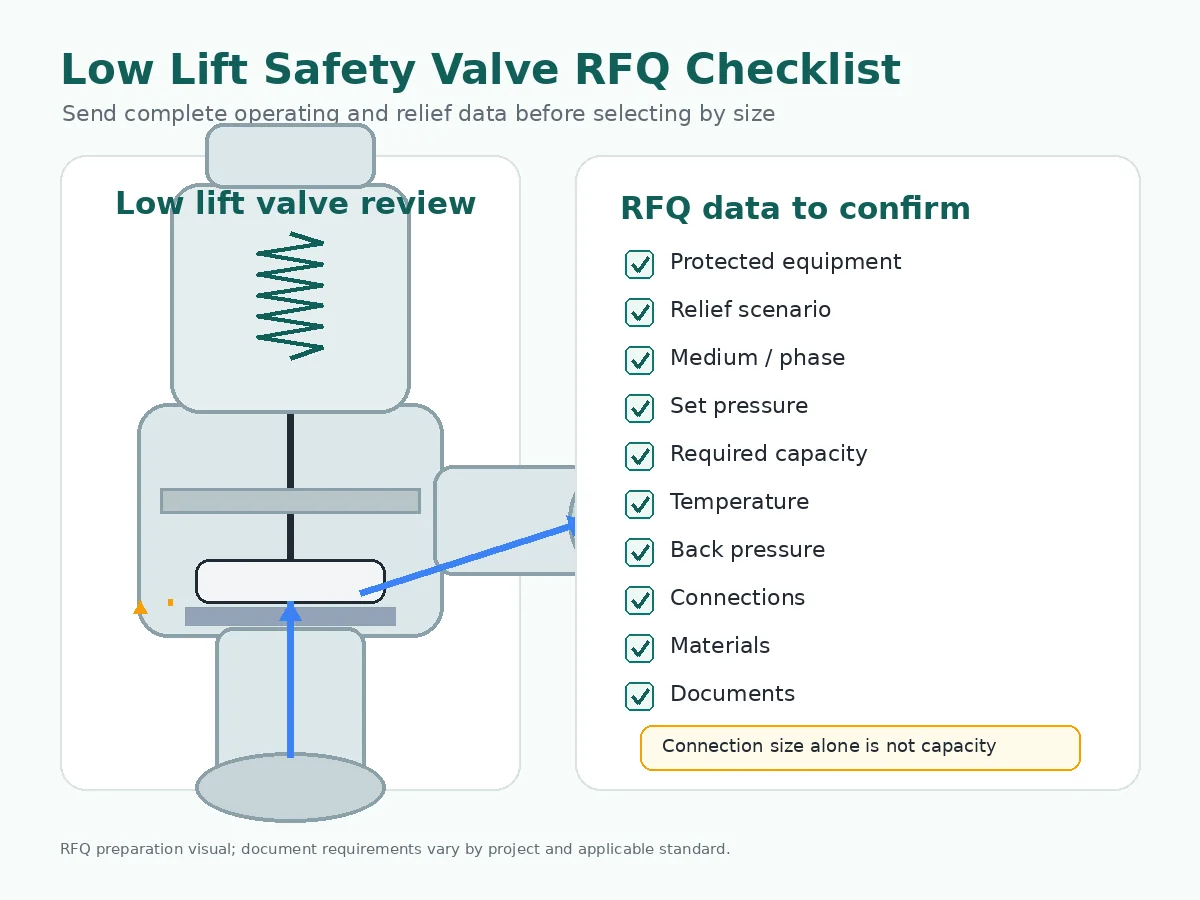
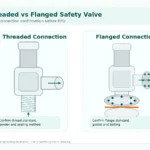
Visuelle Darstellung zur Vorbereitung der Angebotsanfrage (RFQ); die Dokumentationsanforderungen variieren je nach Projekt und anwendbarem Standard.
Checkliste für RFQ-Daten
| Punkt der Angebotsanfrage | Was anzugeben ist | Warum es wichtig ist |
|---|---|---|
| Zu schützendes Gerät | Kessel, Behälter, Tank, Pipeline, Kompressor, Skid oder andere Ausrüstung. | Definiert die Schutzaufgabe. |
| Entlastungsszenario | Blockierter Auslass, thermische Ausdehnung, Brandfall, Reglerausfall, Prozessstörung oder anderer Fall. | Bestimmt die erforderliche Entlastungslast. |
| Medium und Phase | Dampf, Gas, Dampf, Flüssigkeit, Zweiphasen, korrosiv, viskos oder anderer Dienst. | Beeinflusst Auslegung, Materialien, Leckage und Stabilität. |
| Betriebsdruck / MAWP / Ansprechdruck | Normaler Systemdruck, Auslegungsdruck der Ausrüstung und erforderlicher Öffnungsdruck des Ventils. | Verhindert Fehler bei der Druckterminologie. |
| Erforderliche Abblaseleistung | Strömungsgeschwindigkeit und Kapazitätsbasis. | Muss mit den Kapazitätsdaten des Herstellers abgeglichen werden. |
| Entlastungstemperatur | Temperatur während des Entlastungsereignisses. | Beeinflusst Material, Feder, Sitz und Nennleistung. |
| Gegendruck | Überlagerter und aufgebauter Gegendruck, falls bekannt. | Beeinflusst Ventiltyp und Entlastungsstabilität. |
| Anschlüsse und Materialien | Größe, Nennleistung, Standard, Flansch-/Gewindeart, Gehäuse, Garnitur, Sitz, Dichtung und Federanforderungen. | Bestätigt mechanische Passform und Servicekompatibilität. |
| Anwendbarer Standard und Dokumente | API, ASME, ISO, EN, GB oder projektspezifische Vorgaben, falls zutreffend; Datenblatt, Prüfbericht, Materialzeugnis und Auslegungsbasis. | Unterstützt Beschaffungs- und QS-Prüfung. |
Workflow zur Verifizierung des Austauschs
| Schritt | Was zu prüfen ist | Keine Annahmen treffen |
|---|---|---|
| 1. Identifizieren Sie das alte Ventil | Typenschild, Fotos, Modell, Ansprechdruck, Größe, Nennleistung und Anschlussstandard. | Gehen Sie nicht davon aus, dass eine ähnliche Gehäuseform eine gleichwertige Leistung bedeutet. |
| 2. Bestätigen Sie die ursprüngliche Auslegung | Geschütztes Equipment, Entlastungsszenario, Medium, Temperatur und erforderliche Kapazitätsbasis. | Gehen Sie nicht davon aus, dass die ursprüngliche Installation korrekt dimensioniert war. |
| 3. Überprüfen Sie die Betriebshistorie | Undichtigkeiten, Flattern, Korrosion, Ablagerungen, Prüfungsfehler oder wiederholte Wartung. | Wiederholen Sie kein altes Problem, indem Sie nur die Größe kopieren. |
| 4. Vergleichen Sie die ausgewählten Ventildaten | Ansprechdruck, dokumentierte Kapazität, Materialien, Sitz, Feder, Anschluss und Dokumente. | Behandeln Sie den Katalogtitel oder den Ventiltyp-Namen nicht als endgültigen Beweis. |
| 5. Bestätigen Sie die Projektannahme | Anwendbare Norm, Inspektionsumfang, Dokumentation und lokale behördliche Anforderungen. | Bestellen Sie nicht, bevor die Dokumentationsanforderungen klar sind. |
Wo API-Auslegungsmethoden gemäß Projektspezifikation erforderlich sind, sollte die RFQ (Angebotsanfrage) anhand des geltenden Standards und der Herstellerdaten geprüft werden. Der ZOBAI- API 520 Auslegung von Sicherheitsventilen Leitfaden kann helfen, Auslegungs- und Auswahlfragen in RFQ-Eingaben zu übersetzen, ohne die formale Berechnungsprüfung zu ersetzen.
Prüf-, Inspektions- und Dokumentenmatrix
Für Beschaffung und Ersatz muss der Dokumentenumfang vor der Auftragserteilung vereinbart werden. Das genaue Paket hängt vom ausgewählten Modell, der Projektspezifikation, dem geltenden Standard und den Inspektionsanforderungen ab.
| Dokument / Prüfen | Was es unterstützt | Wichtige Randbedingung |
|---|---|---|
| Datenblatt Ventil | Bestätigt ausgewählte Größe, Anschluss, Druckeinstellung, Materialien und Einsatzgrundlage. | Muss den tatsächlichen Projektbedingungen entsprechen, nicht nur einer generischen Katalogseite. |
| Aufzeichung der Einstellung des Ansprechdrucks | Zeigt die Überprüfung der Druckeinstellung für das ausgewählte Ventil. | Kalibrierung beweist nicht die erforderliche Abblasekapazität. |
| Prüfprotokoll für Sitzdichtheit | Unterstützt die Überprüfung der Leckageannahme, wo erforderlich. | Prüfverfahren und Annahmekriterien müssen den Projektanforderungen entsprechen. |
| Prüfprotokoll für Gehäuse-/Körperdruck | Unterstützt die Verifizierung von drucktragenden Teilen. | Ersetzt nicht die Überprüfung von Kapazität oder Servicekompatibilität. |
| Materialaufzeichnungen | Unterstützt die Materialrückverfolgbarkeit für Gehäuse, Garnitur oder andere erforderliche Teile. | Alleinige Werkstoffgüte beweist keine Eignung für den Service. |
| Kapazitätsbasis | Unterstützt den Vergleich zwischen erforderlicher Abblaseleistung und ausgewählter Ventilperformance. | Muss für das ausgewählte Modell, Medium und Projektbasis anwendbar sein. |
| Freigabe der Inspektion / Begleitungsumfang | Unterstützt Qualitätssicherung und Projektannahme. | Muss vor der Fertigung oder der Endinspektion, wo zutreffend, vereinbart werden. |
Für den Kontext der Dichtheitsannahme, überprüfen Sie den API 527 Dichtheitsprüfung Leitfaden, bevor Sie die Dichtheit der Sitzflächen in der Ausschreibung spezifizieren.
Normen und Auswahlhinweis
Dieser Artikel bietet eine technische Erklärung und eine Anleitung zur Vorbereitung von RFQs. Er gibt keinen Standardtext wieder und bescheinigt nicht, dass ein bestimmtes Ventilmodell einem bestimmten Code oder einer bestimmten Gerichtsbarkeit entspricht. Die geltenden API-, ASME-, ISO-, EN-, GB- oder Projektanforderungen müssen gegen das ausgewählte Modell, die Herstellerdokumentation, die Projektspezifikation und die örtliche Aufsichtsbehörde, wo zutreffend, bestätigt werden.
Die endgültige Auswahl hängt von der tatsächlich geschützten Ausrüstung, dem maßgeblichen Entlastungsszenario, dem Medium und der Phase, dem Betriebsdruck, dem MAWP oder dem Auslegungsdruck, dem Ansprechdruck, der erforderlichen Entlastungskapazität, der Entlastungstemperatur, dem Gegendruck, der Einlass- und Auslassrohrleitung, den Materialanforderungen, dem ausgewählten Modell, den Herstellerdaten, der geltenden Standardversion und der Projektspezifikation ab.
Technische Referenzen
Die folgenden offiziellen Quellen dienen ausschließlich der Orientierung bezüglich der Normen. Sie belegen keine Konformität für ein bestimmtes ZOBAI-Ventilmodell und ersetzen nicht das Datenblatt des ausgewählten Modells, die Kapazitätsbasis, die Projektspezifikation oder die lokale behördliche Überprüfung.
API 520 Teil I: Offizielle API-Standardseite für Auslegungs- und Auswahlverfahren für druckentlastende Geräte. Offizielle API-Seite anzeigen.
ASME Codes & Standards: Offizielle ASME-Quellen für Code- und Standardorientierung. Offizielle ASME-Seite anzeigen.
FAQ
Ist ein Niedrighub-Sicherheitsventil dasselbe wie ein federbelastetes Sicherheitsventil?
Nicht ganz. Ein Niedrighub-Sicherheitsventil kann federbelastet sein, aber “Niedrighub” beschreibt den begrenzten Scheibenweg und das Öffnungsverhalten. “Federbelastet” beschreibt, wie die Schließkraft erzeugt wird. Die beiden Begriffe beziehen sich auf unterschiedliche Aspekte des Ventil-Designs.
Hat ein Niedrighub-Sicherheitsventil eine geringere Kapazität als ein Vollhub-Ventil?
Ein Niedrighub-Design hat oft eine geringere verfügbare Öffnung als ein Vollhub-Design, daher kann die Kapazität bei gleicher Nenngröße des Anschlusses geringer sein. Die richtige Antwort hängt jedoch vom ausgewählten Modell und den Hersteller-Kapazitätsdaten ab. Gehen Sie nicht allein vom Ventiltyp auf die Kapazität aus.
Kann ich ein Niedrighub-Sicherheitsventil nach Anschlussgröße auswählen?
Die Anschlussgröße bestätigt nur die mechanische Schnittstelle. Sie beweist nicht die Sitzfläche, den Hub, den Entlastungskoeffizienten oder die dokumentierte Abblaseleistung. Die erforderliche Leistung muss separat geprüft werden.
Welche Druckdaten werden vor der Angebotsanfrage benötigt?
Geben Sie Betriebsdruck, maximal zulässigen Betriebsdruck (MAWP) oder Auslegungsdruck, Ansprechdruck, zulässige Überlast oder Akkumulationsbasis, wo zutreffend, und die erforderliche Abblaseleistung an. Diese Begriffe dürfen nicht vermischt werden.
Kann ein Niedrighub-Sicherheitsventil für Dampfanwendungen verwendet werden?
Dies kann nur berücksichtigt werden, wenn das ausgewählte Ventil-Design, die Materialien, der Ansprechdruck, die Dampfkapazität, die Temperatur, das Ansprechverhalten (Blowdown), die Installation und die Dokumentationsanforderungen für das Projekt geeignet sind. Der Dampfbetrieb darf nicht allein aus dem Ventiltyp abgeleitet werden.
Was sollte ich beim Austausch eines alten Niedrighub-Sicherheitsventils prüfen?
Überprüfen Sie das vorhandene Typenschild, das Datenblatt, den Ansprechdruck, die Auslegungsbasis, das Medium, die Entlastungstemperatur, den Anschlussstandard, das Material, den Gegendruck, die Installationsbedingung und die Prüfhistorie. Ein optisch ähnliches Ventil ist möglicherweise kein gleichwertiger Ersatz.
Müssen Sie ein Niedrighub-Ventil für eine RFQ oder einen Ersatz prüfen?
Senden Sie die geschützten Ausrüstung, das Entlastungsszenario, das Medium und die Phase, den Betriebsdruck, den MAWP oder den Auslegungsdruck, den Ansprechdruck, die erforderliche Abblasekapazität, die Abblasetemperatur, den Gegendruck, den Einlass- und Auslassanschluss, die Materialanforderungen, den anwendbaren Standard und die Dokumente. Für Ersatzteile fügen Sie das vorhandene Typenschild, Ventilfotos, Datenblatt, Servicehistorie und den Grund für den Ersatz bei.