Share your medium, set pressure, temperature, size,standard, or datasheet, and our team will review yourrequirement and respond with the appropriate next step.
A balanced bellows safety valve uses a bellows element to reduce the effect of outlet back pressure on valve opening, lift, relieving capacity and reseating behavior. It is commonly considered when a conventional spring-loaded safety valve may be affected by superimposed back pressure, built-up back pressure, common discharge headers, closed vent systems or variable outlet …
A balanced bellows safety valve uses a bellows element to reduce the effect of outlet back pressure on valve opening, lift, relieving capacity and reseating behavior. It is commonly considered when a conventional spring-loaded safety valve may be affected by superimposed back pressure, built-up back pressure, common discharge headers, closed vent systems or variable outlet pressure. The bellows helps balance the outlet pressure acting around the disc area, so the valve can operate closer to its intended set pressure and discharge behavior. However, a balanced bellows safety valve is not a universal solution for every back pressure problem. The engineer still needs to check required relieving capacity, certified capacity basis, manufacturer allowable back pressure, bellows material, bonnet vent condition, medium compatibility, outlet piping, inspection access and repair documentation before approving the valve.
Quick Answer / Engineering Summary: A balanced bellows safety valve is selected when back pressure could disturb the force balance of a conventional spring-loaded valve. The bellows reduces this influence, but it also introduces new reliability checks: bellows fatigue, corrosion, vent blockage, temperature limits, maintenance access and replacement documentation.
The bellows reduces the influence of back pressure on valve operation.
What Is a Balanced Bellows Safety Valve?
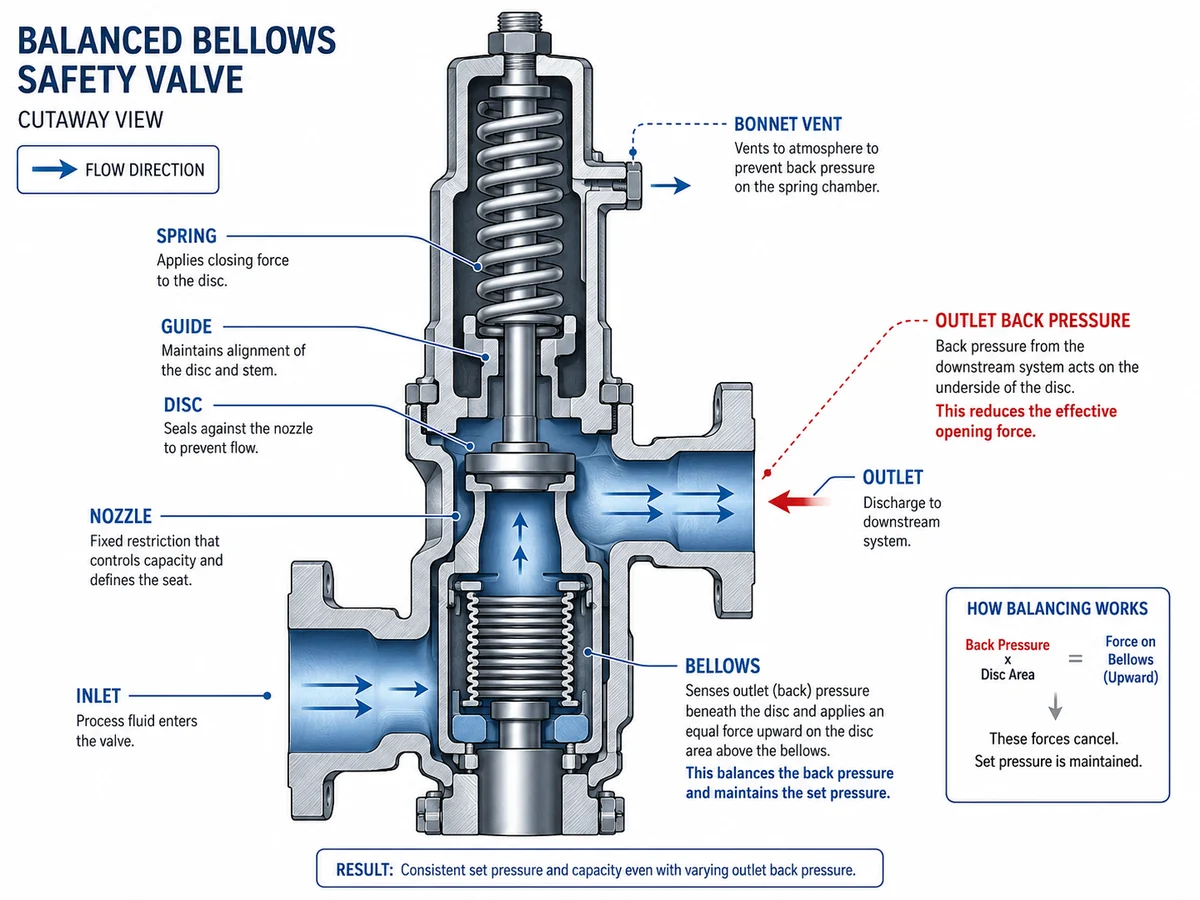
A balanced bellows safety valve is a spring-loaded safety valve or pressure relief valve that includes a bellows element between the disc holder area and the bonnet space. The purpose of the bellows is to reduce the influence of back pressure on the valve’s opening and closing behavior.
In a conventional spring-loaded safety valve, outlet pressure can act on internal areas of the valve and change the force balance around the disc. This may affect opening pressure, lift, capacity, blowdown and reseating. A balanced bellows design is used when that back pressure influence needs to be reduced within the manufacturer’s allowable limits.
Balanced Bellows Safety Valve Definition
In practical engineering language, a balanced bellows safety valve answers this question:
How can a spring-loaded safety valve remain more stable when outlet back pressure is present?
The bellows does not remove back pressure from the discharge system. It changes how back pressure affects the valve internals. The discharge piping, common header, silencer, outlet pressure and simultaneous relief scenarios must still be reviewed.
Where the Bellows Is Located
The bellows is usually located around the spindle or disc holder area between the valve body and the bonnet space. Its exact geometry depends on the manufacturer’s design. It is exposed to movement, temperature, pressure effects and service environment, so it should be treated as a critical pressure relief valve component, not as a minor accessory.
In corrosive, hot, vibrating or frequently cycling service, bellows condition can become a major reliability factor. If the bellows cracks, corrodes or is installed incorrectly, the intended balancing effect may be lost.
What Problem the Bellows Is Designed to Solve
The main problem is back pressure sensitivity. Back pressure may already exist before the valve opens, or it may be generated after the valve opens and flow passes through outlet piping, a silencer, a common header or a flare system.
If this pressure changes the force acting on the disc, the valve may open at a different pressure, fail to reach stable lift, lose effective capacity, chatter, flutter or reseat poorly. A balanced bellows design reduces this influence, but only within the design and service limits confirmed by the manufacturer.
Why Back Pressure Matters Before Choosing a Bellows Design
Back pressure is pressure on the outlet side of the safety valve. It is not only a piping calculation issue. It can change the forces acting on the valve disc and affect how the valve opens, lifts, relieves and reseats.
Superimposed back pressure is the pressure already present at the outlet of the safety valve before the valve opens. It may be constant or variable. It often appears when the valve discharges into a pressurized header, closed vent system, flare header or process system.
Variable superimposed back pressure is more difficult to manage than constant back pressure because the valve may see different outlet conditions during different relief events.
Built-Up Back Pressure
Built-up back pressure is generated after the valve opens and flow passes through the discharge system. It depends on relieving flow, outlet pipe size, pipe length, fittings, elbows, silencer pressure drop, common header pressure and simultaneous relief from other devices.
A balanced bellows safety valve can reduce back pressure influence on valve operation, but it cannot compensate for an outlet system that is outside allowable design limits. The outlet system still has to be checked.
Why Back Pressure Changes Valve Opening and Reseating
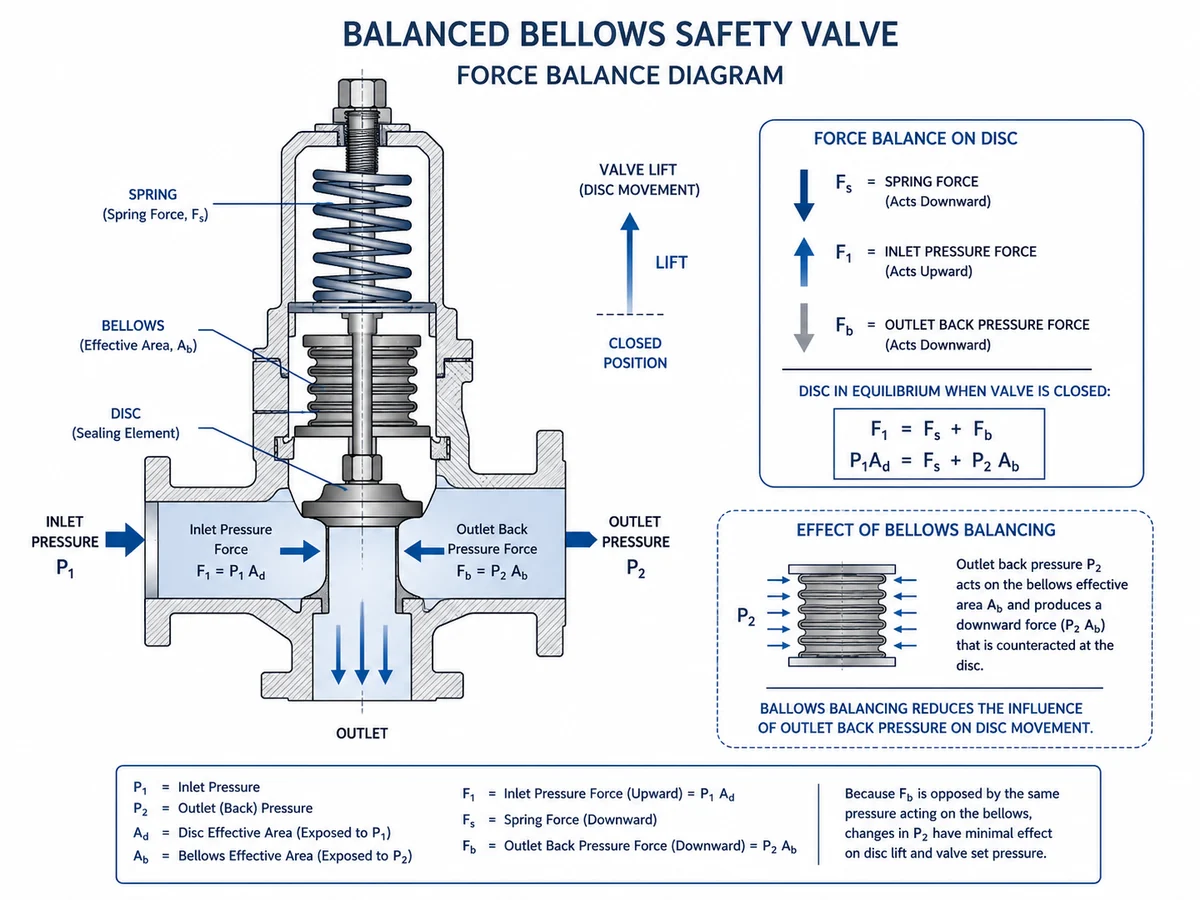
Back pressure can act on the disc and internal areas of the valve. In a conventional design, this can alter the opening force balance. During discharge, changing outlet pressure can also influence valve lift and reseating behavior.
Why this matters: a valve may pass a shop set pressure test and still become unstable after installation. What can go wrong: chatter, flutter, reduced capacity, seat damage and poor reseating. How it affects cost and lead time: the valve may need removal, retesting, piping modification or replacement with a different configuration after installation.
Bellows balancing helps reduce back pressure effect on disc force balance.
How Does a Balanced Bellows Safety Valve Work?
A balanced bellows safety valve works by using the bellows to reduce the outlet pressure effect on the disc force balance. The exact design depends on the manufacturer, but the basic operating sequence is similar to other spring-loaded safety valves: closed during normal operation, opening at set pressure, relieving flow during overpressure and reseating after pressure falls.
Normal Closed Position
During normal operation, the system pressure remains below the set pressure and the spring keeps the disc seated against the nozzle. The seat must remain tight enough for the service requirement. If operating pressure runs too close to set pressure, the valve may simmer or leak even if the bellows design is correct.
The bellows is not a solution for poor operating pressure margin, damaged seating surfaces, dirt in the medium or incorrect set pressure. These issues must be diagnosed separately.
Opening at Set Pressure
When inlet pressure reaches the set pressure under specified conditions, the valve begins to open. Set pressure defines when the valve starts to respond. It does not prove the valve has enough capacity.
When the valve opens and flow passes through the outlet, back pressure may develop at the discharge side. In a balanced bellows design, the bellows helps reduce how much this outlet pressure changes the disc force balance.
This matters because the valve must remain stable during discharge. If back pressure reduces lift or creates unstable disc motion, the valve may not achieve the expected relieving capacity. The result can be chatter, seat damage, noise, vibration and uncertain protection.
After system pressure decreases, the valve should reseat. Reseating behavior depends on spring force, blowdown, guide condition, seat condition, back pressure, discharge piping and valve design.
A balanced bellows design can help reduce back pressure influence, but poor reseating may still occur if the valve is oversized, the guide is contaminated, the outlet system is unstable or the seat has been damaged by chatter.
What Happens If the Bellows Fails
If the bellows fails, the valve may no longer behave like the selected balanced design. Back pressure may affect the valve more strongly than expected. Depending on service and design, bellows failure may also allow process fluid into areas not intended for exposure.
What can go wrong: unstable opening, wrong reseating behavior, leakage, corrosion inside the bonnet area, or loss of the original back pressure compensation. How it affects quality and lead time: the valve may need shutdown access, removal, repair, retesting and documentation update.
Engineering judgment: Do not assume a balanced bellows valve remains balanced for life. Bellows integrity, vent condition and service compatibility must be part of inspection and maintenance planning.
Balanced Bellows vs Conventional Spring-Loaded Safety Valve
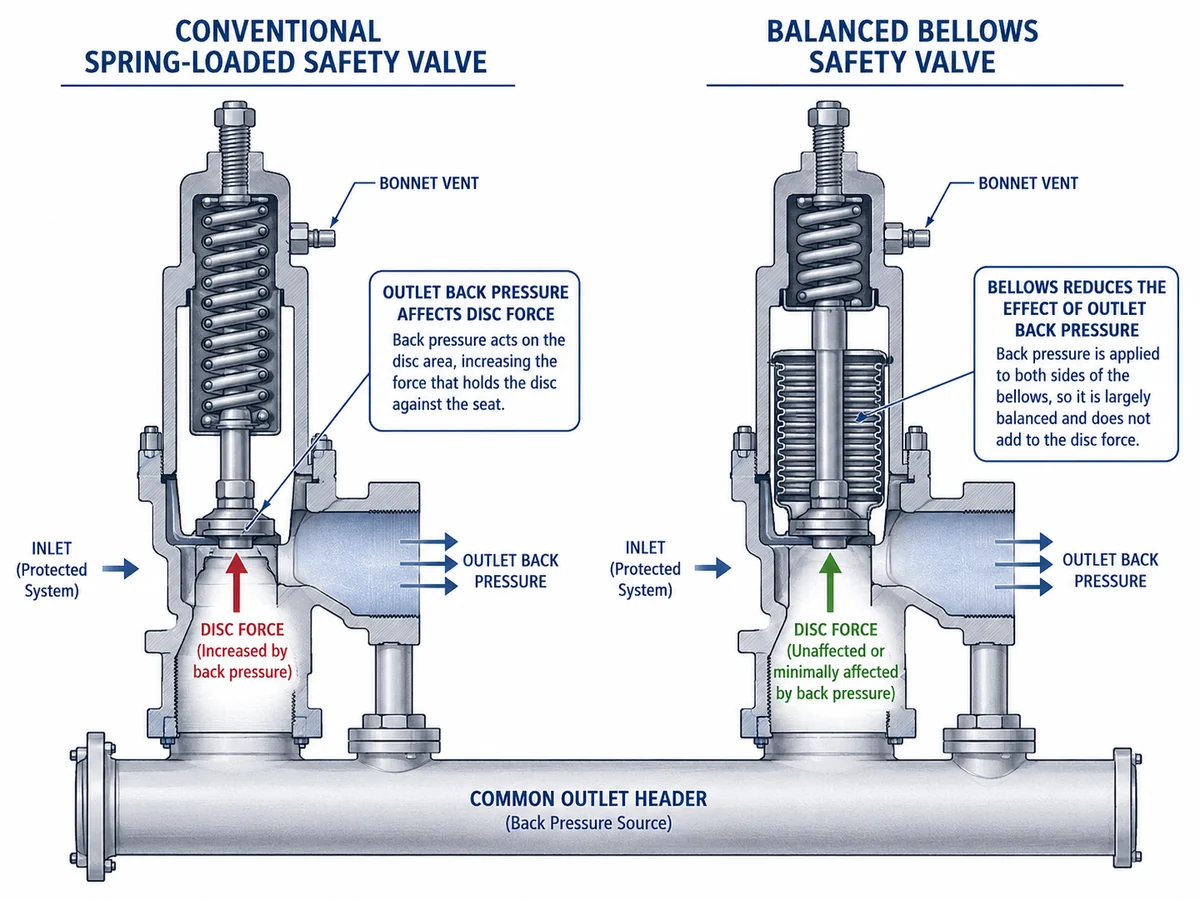
A balanced bellows safety valve is often compared with a conventional spring-loaded safety valve. Both use spring force, but they respond differently to outlet back pressure.
Selection Factor
Conventional Spring-Loaded Safety Valve
Balanced Bellows Safety Valve
Back pressure sensitivity
More sensitive to certain outlet pressure conditions
Designed to reduce back pressure influence within manufacturer limits
Structure
Simpler internal construction
Includes bellows and related vent considerations
Maintenance
Generally simpler
Requires bellows inspection and vent management
Corrosive outlet service
May expose bonnet components depending on design
May help isolate some bonnet areas, depending on design
Failure sensitivity
No bellows fatigue risk
Bellows fatigue, corrosion or rupture must be considered
Typical decision point
Good for clean, simple service with acceptable outlet conditions
Consider where back pressure affects conventional valve operation
A conventional valve and a balanced bellows valve respond differently to back pressure.
Conventional Valve Back Pressure Sensitivity
A conventional spring-loaded safety valve can be suitable for many services. It is widely used because it is simple, familiar and easier to inspect. However, if back pressure is significant or variable, the installed behavior may not match the shop test behavior.
How the Bellows Changes the Force Balance
The bellows reduces the effect of outlet back pressure on the disc force balance. This can improve stability in services where conventional valves may shift, chatter or reseat poorly due to back pressure.
Why this matters: the valve’s installed performance must match the selected protection requirement. What can go wrong: a valve that is acceptable in the workshop may not be acceptable in the actual discharge system. How it affects cost: a late design correction may require new valve purchase, outlet piping changes and delayed commissioning.
When a Conventional Spring-Loaded Valve May Still Be Better
A conventional spring-loaded valve may still be the better choice when the service is simple, outlet pressure is low or stable, maintenance access is limited, or the medium could damage a bellows quickly.
A balanced bellows valve should not be selected only because it sounds more advanced. It should be selected because the service condition requires its function and the maintenance team can support its inspection requirements.
When Should You Use a Balanced Bellows Safety Valve?
A balanced bellows safety valve should be considered when back pressure or outlet conditions could make a conventional spring-loaded valve unstable or unsuitable. The decision should be based on engineering data, not only valve category.
Variable Back Pressure Service
Variable back pressure is one of the main reasons to consider a balanced bellows design. If the outlet pressure changes from one relief event to another, a conventional valve may not behave consistently.
Discharge to Common Header or Closed Vent System
Common headers and closed vent systems can create superimposed or built-up back pressure. They may also experience pressure changes when multiple valves discharge at the same time.
For header and relief system behavior, the valve should be reviewed as part of the system, not as an isolated device.
Corrosive or Toxic Outlet Service
Some services may benefit from a bellows arrangement that helps isolate certain bonnet components from outlet-side fluid, depending on valve design. However, the bellows itself must be compatible with the fluid, temperature and corrosion mechanism.
If the bellows material is wrong, the selected “solution” may become the first failure point.
Applications Where Bonnet Isolation Matters
In some services, keeping bonnet components away from corrosive or hazardous discharge fluid may be important. A balanced bellows design can help, but the actual isolation function must be confirmed from the manufacturer’s design.
When Balanced Bellows Is Not the Right Choice
A balanced bellows valve may not be the best choice when the service is extremely dirty, the bellows is likely to corrode rapidly, temperature exceeds material limits, inspection access is poor, or the actual back pressure exceeds the manufacturer’s allowable range.
If the service involves very high back pressure, clean gas and tight shutoff requirements, a pilot-operated safety valve may also be considered. For valve type comparison, read our Spring-Loaded Safety Valve vs Pilot-Operated Safety Valve.
Key Components That Affect Bellows Valve Reliability
The reliability of a balanced bellows safety valve depends on more than the bellows alone. The disc, nozzle, guide, spring, bonnet vent, trim materials and outlet piping loads can all affect performance.
Bellows Element
The bellows is the defining component of the design. It moves with the valve internals and is exposed to mechanical cycling, temperature and service conditions. It must be selected for pressure, temperature, corrosion and fatigue risk.
Disc and Nozzle
The disc and nozzle form the seating surface. If these surfaces are damaged by corrosion, erosion, particles or chatter, the valve may leak even if the bellows is intact.
Guide and Trim Parts
The guide helps control disc movement. If the guide corrodes, galls or becomes contaminated, the valve may not lift or reseat smoothly. In bellows valves, guide condition is still important because the bellows does not correct mechanical sticking.
Spring and Bonnet
The spring provides the closing force. The bonnet environment and temperature exposure can affect spring performance. If the bellows leaks and process fluid enters the bonnet area, spring corrosion or contamination may become a concern.
Bonnet Vent
The bonnet vent is a critical detail in many balanced bellows safety valve designs. It should not be plugged, capped, painted over or routed incorrectly without engineering and manufacturer review.
What can go wrong: a blocked bonnet vent may defeat the intended balancing function or hide bellows failure. This can affect operation, maintenance diagnosis and safety review.
Engineering Limits and Common Failure Modes
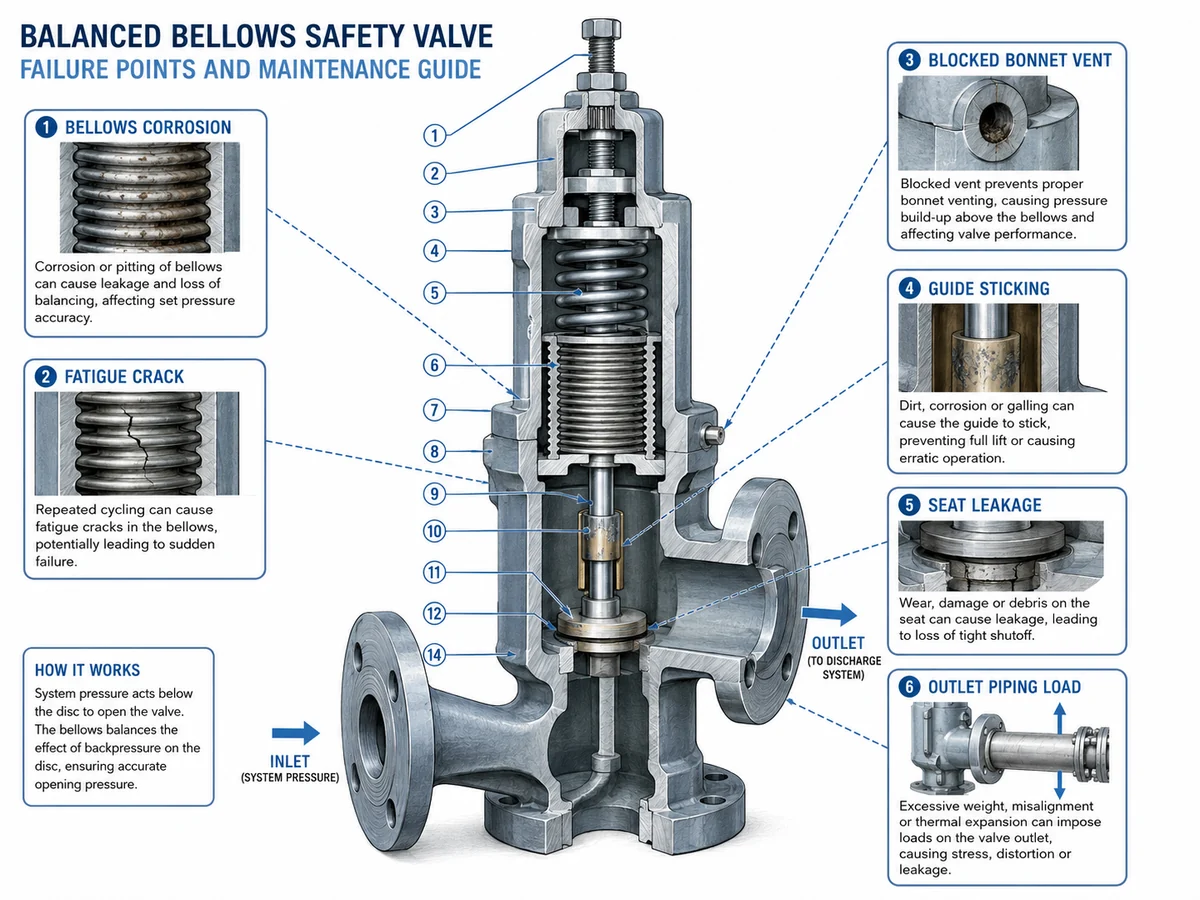
Balanced bellows valves are useful, but they introduce failure modes that must be reviewed during selection and maintenance. The most important point is simple: a bellows is a working mechanical component, not a permanent guarantee.
Loss of balancing function, leakage path or internal damage
Review cycling history, chatter risk and maintenance interval
Bellows corrosion
Wrong material for service chemistry
Early bellows failure and possible bonnet contamination
Confirm bellows material compatibility
Blocked bonnet vent
Incorrect field work, painting, plugging, poor installation
Changed valve behavior or hidden bellows failure
Keep vent condition as specified by manufacturer
Chatter damage
Back pressure, inlet pressure loss, oversizing, unstable flow
Seat damage, guide damage, bellows fatigue
Review inlet and outlet system together
Seat leakage
Damaged disc/nozzle, dirt, corrosion, poor repair
Product loss, emissions, repeated maintenance
Inspect seating surfaces and test leakage requirement
Bellows fatigue, corrosion and blocked vent can defeat the intended balancing function.
Bellows Fatigue
Bellows fatigue may occur when the valve cycles frequently or vibrates during unstable relief. Chatter can accelerate fatigue. This is why valve stability and discharge system review affect bellows life.
Bellows Corrosion
Corrosive outlet service can damage the bellows if the material is not suitable. Bellows material should be reviewed separately from body material because the bellows may be thinner and more mechanically sensitive than the body.
Blocked Bonnet Vent
A blocked bonnet vent can change the valve’s behavior. Field teams should understand that the vent is part of the valve function, not an unused hole.
Chatter and Mechanical Vibration
Chatter and vibration can damage the disc, nozzle, guide, spring and bellows. The root cause may be inlet pressure loss, outlet resistance, built-up back pressure, oversizing or unstable process pressure.
Seat Leakage After Bellows or Guide Problems
Seat leakage may appear after repeated unstable operation. The bellows may not be the direct leakage point, but the conditions that damage the bellows can also damage the seat and guide.
Back Pressure Checks Before Selecting a Balanced Bellows Valve
Balanced bellows selection should start from actual back pressure data. A supplier cannot confirm suitability from set pressure and connection size alone.
Constant vs Variable Superimposed Back Pressure
Confirm whether superimposed back pressure exists before the valve opens. If it exists, determine whether it is constant or variable. Variable back pressure usually requires more careful review because the valve may not see the same outlet condition during every relief event.
Built-Up Back Pressure from Outlet Piping
Built-up back pressure depends on relieving flow and discharge system resistance. Pipe size, pipe length, elbows, reducers, silencers and outlet destination should be reviewed.
Common Header and Simultaneous Relief
When several valves discharge into a common header, simultaneous relief can raise header pressure. A balanced bellows valve should be checked under the actual header condition, not just atmospheric discharge.
Manufacturer Allowable Back Pressure
The manufacturer’s allowable back pressure should be confirmed for the specific valve model, size, set pressure, service and bellows design. Do not apply a general assumption from another valve type or brand.
Capacity Basis Under Back Pressure
The selected valve must still have enough certified relieving capacity under the specified service condition. A balanced bellows design may improve stability, but it does not replace sizing review.
Back Pressure Data to Confirm
Why It Matters
Outlet destination
Atmosphere, header, closed vent and flare systems behave differently
Superimposed back pressure
Affects opening behavior and force balance
Built-up back pressure
Affects lift, capacity and stability during discharge
Header pressure variation
Important for variable back pressure service
Outlet pipe size and length
Controls discharge system resistance
Silencer or muffler pressure drop
Can increase built-up back pressure
Simultaneous relief case
Multiple valves may raise common header pressure
Manufacturer allowable back pressure
Defines the selection boundary for the quoted valve
Material Selection for Balanced Bellows Safety Valves
Material selection should cover the bellows, body, bonnet, nozzle, disc, guide, spring and seat. In many failures, the body material appears acceptable, but trim or bellows material is not suitable for the actual service.
Bellows Material Compatibility
The bellows should be compatible with the medium, temperature, corrosion mechanism and mechanical cycling. It should not be selected only by body material. If the process contains chlorides, acidic components, sour gas, condensate, particles or corrosive vapor, the bellows material should be reviewed carefully.
Trim and Seat Material
The nozzle and disc seating surfaces control leakage performance. Corrosion or erosion at the seating line can cause leakage even if the bellows is still intact. Seat material should be reviewed for temperature, medium and leakage expectation.
Corrosive Gas and Sour Service
For sour service or H2S-containing systems, material selection may need to consider NACE MR0175 / ISO 15156 requirements, project specifications and manufacturer recommendations. This should be verified before publishing or procurement approval.
Temperature Limits
High temperature may affect bellows life, spring behavior and seat material. Steam or hot gas service should be checked for trim temperature limits, discharge piping support, drainage and maintenance access.
A balanced bellows safety valve can be correctly selected and still fail to perform if installed or maintained incorrectly. Installation and maintenance must preserve the bellows function.
Keep the Bonnet Vent Correctly Managed
The bonnet vent condition should follow the manufacturer’s instructions and project requirement. It should not be plugged or modified in the field without engineering review.
Inspect Bellows Integrity During Maintenance
Maintenance inspection should include bellows condition where accessible and practical. Signs of corrosion, cracking, deformation or leakage should trigger further engineering review.
Avoid Outlet Piping Stress and Reaction Loads
Outlet piping should not impose excessive stress on the valve body. Misalignment, unsupported discharge piping, thermal expansion or heavy silencers can distort the valve and contribute to leakage or poor reseating.
After repair, the valve should not be returned to service simply because the parts look clean. Set pressure, seat tightness, bellows condition, reseating behavior, tagging, sealing and documentation should be reviewed according to the applicable procedure.
If the valve is part of a code-controlled system, repair authorization and recertification requirements may apply. For broader maintenance topics, read our Safety Valve Maintenance and Inspection Guide.
Standards note:API 520 Part I may be relevant to sizing and selection; API 520 Part II may be relevant to installation engineering analysis; API 521 may be relevant to pressure-relieving and depressuring system review; API 527, ISO 4126, NBIC / National Board VR and NACE MR0175 / ISO 15156 may also be relevant depending on service and project requirement. Confirm the current edition, jurisdiction and project specification before publishing or procurement approval.
Engineering Examples
The following engineering scenarios show why balanced bellows safety valve selection should be based on real service data, not only valve category.
What problem occurred: A conventional spring-loaded safety valve passed shop testing, but chattered after a plant discharge header modification.
Why it happened: The outlet line was extended and tied into a common header. Built-up back pressure increased during relief.
Real system cause: The valve selection basis did not reflect the modified outlet system. The valve was not defective under shop conditions, but the installed back pressure condition had changed.
Corrective action: The outlet system resistance and common header pressure were recalculated. A balanced bellows design was reviewed for the affected service.
Prevention: Any outlet piping or header modification should trigger a pressure relief review before returning the valve to service.
Blocked Bonnet Vent Defeated the Bellows Function
What problem occurred: A balanced bellows safety valve showed unstable behavior after maintenance.
Why it happened: The bonnet vent had been blocked during field work because it was mistaken for an unnecessary opening.
Real system cause: The vent condition was part of the valve design. Blocking it changed the pressure environment around the bellows and bonnet.
Corrective action: The vent condition was restored according to manufacturer instructions, the bellows was inspected and the valve was retested.
Prevention: Maintenance checklists should clearly identify bonnet vent requirements for balanced bellows valves.
Corrosive Gas Damaged the Bellows and Seat Area
What problem occurred: A balanced bellows valve began leaking after repeated service in a corrosive gas application.
Why it happened: The valve body material was acceptable, but the bellows and seating surfaces were not compatible with the actual corrosive components.
Real system cause: Material review focused on body pressure rating and missed bellows and trim compatibility.
Corrective action: The bellows material, disc, nozzle and guide materials were reviewed against the real medium composition and temperature.
Prevention: RFQ documents should include medium chemistry, temperature, corrosion risk and required material certification for bellows and trim parts.
Same Connection Size Replacement Ignored Bellows and Back Pressure Requirements
What problem occurred: A replacement valve with the same inlet and outlet size was proposed for a service that previously used a balanced bellows design.
Why it happened: The quotation matched the flange size and pressure class, but did not clearly confirm bellows construction, allowable back pressure or certified capacity under the specified service condition.
Real system cause: Procurement review focused on mechanical fit and price instead of the original back pressure protection basis.
Corrective action: The replacement offer was held until the supplier confirmed valve type, bellows material, allowable back pressure, certified capacity and documentation.
Prevention: Replacement RFQs should include original valve type, orifice designation, certified capacity, back pressure basis, bellows requirement and required document package.
Balanced Bellows Safety Valve Selection Checklist
The following checklist can be used during technical review, quotation comparison or replacement approval.
Service Data to Confirm
Check Item
Why It Matters
Confirmed
Protected equipment
Defines pressure boundary and code basis
☐
Set pressure
Defines valve opening point
☐
Required relieving capacity
Confirms protection duty
☐
Certified relieving capacity
Verifies valve capability
☐
Medium and fluid state
Affects valve type, sizing and material
☐
Relieving temperature
Affects bellows, spring, trim and seat
☐
Back pressure type and value
Defines whether bellows balancing is needed and acceptable
☐
Outlet destination
Determines discharge system behavior
☐
Bellows material
Affects corrosion and fatigue resistance
☐
Bonnet vent requirement
Critical for correct function and maintenance
☐
Back Pressure Data to Provide
superimposed back pressure, constant or variable
estimated built-up back pressure
outlet pipe size and length
elbows, reducers and fittings
silencer or muffler pressure drop
common header pressure
simultaneous relief assumptions
flare or closed vent condition
Documents to Request from Supplier
valve datasheet
general arrangement drawing
certified capacity data
allowable back pressure information
bellows material certificate
trim material certificate
pressure test report
seat leakage test report, if required
calibration certificate
installation and maintenance manual
repair or recertification record, if applicable
Questions to Ask Before Approval
Does the valve have enough certified capacity for the required relief load?
Is the bellows design suitable for our superimposed and built-up back pressure?
What is the manufacturer allowable back pressure for this model and service?
What happens if the bellows fails?
Does the bonnet vent need to remain open?
Is the bellows material compatible with the medium and temperature?
Can the valve be inspected and maintained under our plant conditions?
What repair and recalibration documents will be provided?
Project Review CTA: Need help checking whether a balanced bellows safety valve is suitable for your service?
Send us your medium, set pressure, required relieving capacity, relieving temperature, superimposed back pressure, built-up back pressure, outlet destination and material requirement for engineering review.
Author / Engineering Review Box: This article is written from a safety valve and pressure relief valve engineering review perspective, including valve selection, back pressure behavior, certified capacity awareness, installation review, bellows material compatibility, maintenance inspection and procurement documentation. Final selection should follow the applicable project specification, manufacturer-certified data, current standard edition and local regulatory requirements.
FAQ About Balanced Bellows Safety Valves
What is a balanced bellows safety valve?
A balanced bellows safety valve is a spring-loaded safety valve or pressure relief valve that uses a bellows element to reduce the influence of outlet back pressure on valve operation.
How does a balanced bellows safety valve work?
It works by using the bellows to reduce how outlet back pressure affects the disc force balance. This helps the valve maintain more stable opening, lift, capacity and reseating behavior under certain back pressure conditions.
When should I use a balanced bellows safety valve?
You should consider it when superimposed or built-up back pressure may affect a conventional spring-loaded safety valve, especially in common header, closed vent, flare or variable outlet pressure service.
Can a balanced bellows valve handle all back pressure problems?
No. A balanced bellows valve must still be selected within the manufacturer’s allowable back pressure limits. Outlet piping, common header pressure, capacity basis and service conditions must still be reviewed.
What happens if the bellows fails?
If the bellows fails, the valve may lose its intended back pressure compensation. It may also expose bonnet components to process fluid, depending on design and service condition. Inspection and repair review are required.
Should the bonnet vent be plugged?
No, not unless the manufacturer and project engineering requirement specifically allow it. In many balanced bellows designs, the bonnet vent is part of correct valve function and failure detection.
What data should I provide when buying a balanced bellows safety valve?
Provide medium, fluid state, set pressure, required relieving capacity, relieving temperature, superimposed back pressure, built-up back pressure, outlet destination, bellows material requirement and applicable standard or documentation requirement.