Share your medium, set pressure, temperature, size, standard, or datasheet, and our team will review your requirement and respond with the appropriate next step.
GB vs ASME Safety Valve Series: Selection, Certification and Approval Guide
Selecting the right safety valve series goes beyond matching pressure ratings, flange dimensions, or connection sizes. When engineers compare a GB safety valve series with an ASME safety valve series, the real decision affects code compliance, project approval, certified capacity acceptance, nameplate marking, spare-parts strategy, future repair pathway, and long-term inspection acceptance. Many buyers see similar …
Selecting the right safety valve series goes beyond matching pressure ratings, flange dimensions, or connection sizes. When engineers compare a GB safety valve series with an ASME safety valve series, the real decision affects code compliance, project approval, certified capacity acceptance, nameplate marking, spare-parts strategy, future repair pathway, and long-term inspection acceptance. Many buyers see similar nominal pressure data and assume a GB valve can replace an ASME valve, or that an ASME-style valve can automatically satisfy a GB / TSG-governed project. In practice, that assumption often fails at the points that matter most: certification route, V or UV marking expectation, GB / TSG documentation, certified relieving capacity support, owner approval, lead sealing, and inspection acceptance.
Important standards boundary: “GB safety valve series” and “ASME safety valve series” are useful purchasing labels, but neither term identifies one universal valve design. In this article, they describe different product-standard, certification, marking, inspection and project-acceptance routes. A valve can follow API-style dimensions without being ASME Code-certified, while a valve manufactured to a current GB/T product standard still requires the applicable Chinese special-equipment, owner and inspection acceptance route.
For pressure equipment, the valve body is only one part of the decision. The project team must confirm the protected equipment category, set pressure basis, allowable overpressure or accumulation, blowdown and reseating expectation, required relieving capacity, orifice area, back pressure condition, material compatibility, test records, and repair documentation. A valve that is dimensionally suitable may still be rejected if its standard route does not match the project specification. A careful front-end review gives you real overpressure protection and reduces the chance of expensive replacement, delayed commissioning, or failed owner inspection later.
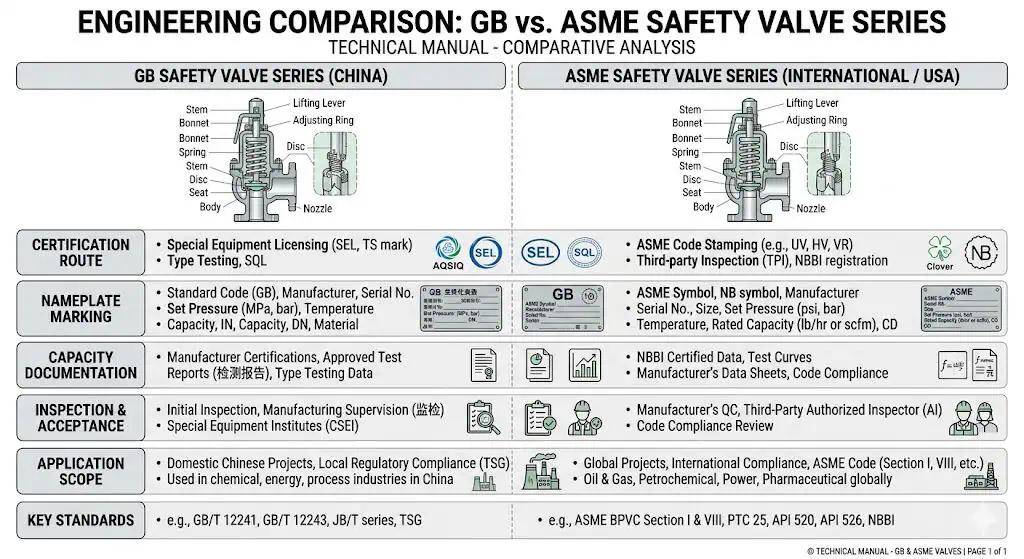
GB and ASME safety valve series should be compared by certification route, capacity documentation, nameplate marking, owner approval, and inspection acceptance rather than by size alone.
GB vs ASME Safety Valve Series: Why the Standard Choice Matters
How Standard Choice Affects Safety and Compliance
The choice of standard directly affects safety, legal acceptance, and the way the valve package is reviewed. Engineers must select the correct standard basis to match the protected equipment category, statutory requirements, owner specification, and inspection route. In ASME projects, the review often focuses on whether the valve follows the correct code certification and marking pathway, such as V for boiler safety valves or UV for pressure-vessel pressure relief devices. In GB projects, the review more often centers on whether the valve and its documentation align with the applicable GB safety valve standards, Chinese special equipment supervision framework, marking requirements, and lead-sealing expectations for the equipment being protected.
These are not cosmetic differences. They change what the supplier must provide, what the owner can approve, what the inspector will accept, and how the valve is maintained after commissioning. A valve may open at the requested set pressure during a bench test, yet still be unsuitable if its certified capacity basis, nameplate marking, or repair documentation does not match the project route.
For ASME-route verification, use the official ASME BPVC Section XIII scope together with the applicable protected-equipment section and confirm the manufacturer/device record through National Board NB-18 where that certification route applies. For a Chinese route, verify the current national product and test standards through the official SAMR records for GB/T 12241-2021, GB/T 12242-2021 and GB/T 12243-2021, then confirm the applicable special-equipment and project acceptance requirements.
Tip: Always verify the governing code, owner specification, and inspection route before comparing quotations. A technically capable valve may still be rejected if its certification route does not match the project basis.
Key impacts on compliance include:
Differences in certification route, stamping or marking expectation, and acceptance basis.
Different expectations for nameplate data, lead sealing, set-pressure records, and capacity evidence.
Variation in how test reports, seat tightness, certified capacity, and type test documents are reviewed.
Different documentation requirements during inspection, audit, repair, recalibration, and recertification.
Different replacement logic when a valve is changed during shutdown or after process modification.
Standard Basis
Typical Focus
Marking / Acceptance Concern
Documentation Emphasis
ASME pathway
Code-based certification for the protected equipment category.
Correct ASME certification mark, nameplate data, and project acceptance route.
Certified capacity basis, code compliance, inspection traceability, and repair acceptance.
GB / TSG pathway
Chinese national design, testing, marking, supervision, and special-equipment compliance framework.
Alignment with Chinese regulatory and project requirements, including marking and lead sealing where required.
GB / TSG compliance records, test reports, type documents, marking, sealing, and supervisory acceptance.
A practical example is an export skid originally designed for an ASME owner specification but quoted with a GB valve because the pressure class, inlet size, and outlet size appeared equivalent. The valve may be mechanically installable, but the owner or third-party inspector may reject it because the required ASME route, marking, and capacity documentation are missing. The prevention is simple: check the project specification and inspection route before treating GB and ASME series as interchangeable.
How Standard Choice Affects Operation and Maintenance
Standard selection also shapes operation, maintenance, repair, and future replacement routines. The standard basis does not stop mattering after the valve is installed. It influences spare-parts availability, inspection intervals, accepted repair pathways, set-pressure verification, seat leakage test requirements, lead sealing, and what evidence you need after bench testing or reconditioning. In ASME / National Board contexts, repair acceptance may involve a recognized VR repair route for pressure relief valves. In GB / TSG contexts, the project may require local inspection, regulated test records, and documentation aligned with Chinese special equipment supervision expectations.
Where a National Board repair route is required, verify the repair organization against the official VR Certificate of Authorization program. The repair authorization confirms the applicable quality-system route; it does not prove that the repaired valve still has adequate capacity for a process that has been debottlenecked or connected to a modified discharge header.
In one common maintenance scenario, a buyer selects a lower-cost valve with acceptable pressure and connection data, but the maintenance team later finds that the documentation package does not support the owner’s inspection process. The hardware is already installed, yet commissioning approval stalls because the paperwork trail does not match the project basis. This is not a purchasing inconvenience; it can become a startup delay, a rework cost, or a replacement requirement.
Operation and maintenance factors include:
Maintenance, recalibration, and resealing pathway after repair or shutdown inspection.
Availability of spare parts and comparable replacement units under the same standard route.
Whether the selected standard basis fits future audits, owner inspection, insurance review, and shutdown planning.
How blowdown, reseating, seat tightness, and leakage are judged in ongoing service.
Whether a repaired valve can legally and practically return to service under the required certification route.
Note: Choosing the wrong standard may not show up immediately during installation. It often appears later during inspection, repair, replacement, or owner acceptance review.
Engineers should review the standard, compliance route, and maintenance implications together. That is usually more useful than comparing list price alone.
GB vs ASME Safety Valve Standards: Key Differences You Should Review
Authoritative standards map: Use the official source that controls the specific question. Product requirements, capacity testing, protected-equipment rules, installation analysis and repair authorization are different layers; one document should not be presented as proof of every layer.
Legal framework for the production, operation, use, inspection and testing of boilers, pressure vessels, pressure piping and other covered special equipment.
It is the legal framework, not a valve sizing table or model certificate.
Authorized pressure-relief-valve repair quality-system route where the project or jurisdiction requires it.
VR repair does not replace current sizing, capacity or installed-system review.
Procurement hold point: Do not accept “ASME style,” “API dimensions,” “GB standard,” or “equivalent to ASME” as a complete approval statement. Verify the manufacturer authorization, selected model, certification mark, certified device listing or Chinese regulatory route, capacity basis, nameplate and order-specific documents.
Set Pressure Requirements
GB and ASME projects do not always frame set pressure review in the same way. Set pressure is the pressure at which the valve is adjusted to start opening under defined test conditions. It affects when the valve begins to relieve and therefore must be tied to the protected equipment limit, operating margin, and governing code basis. In ASME-based work, set pressure review is closely connected with the protected equipment category and the applicable code route, such as boiler or pressure vessel service. In GB-based work, users must also confirm the applicable GB / TSG rules governing the protected equipment and the specific safety valve type.
The practical lesson is that set pressure cannot be reviewed as a number alone. It has to be connected to the code basis, MAWP or design pressure limit, operating pressure margin, allowable overpressure or accumulation, and project approval route. A valve that opens at the requested set pressure on a test bench can still be unacceptable if the project requires a different certification path or capacity documentation basis.
Check whether the selected valve series is accepted for the protected equipment category.
Check how the project defines the allowable pressure boundary for the protected system.
Confirm whether the project uses boiler, pressure vessel, piping, skid, or owner-specific safety philosophy.
Do not assume that similar nominal pressure data means identical approval logic.
Note: Always confirm set pressure against the project’s governing standard and owner specification, not just the equipment datasheet or the supplier’s general catalog.
Overpressure and Accumulation Rules
Overpressure and accumulation review is one of the most important technical checkpoints in a GB vs ASME comparison. Overpressure is the pressure increase above set pressure during relieving. Accumulation is the pressure increase above the protected equipment’s allowable pressure boundary during the event. These terms affect whether the valve protects the equipment during the governing case, not just whether it opens. Two valves can look similar on size and rating but still be non-equivalent if the governing standard basis, allowable pressure rise, and relieving logic are different.
In practice, engineers run into trouble when they copy assumptions from one standards system into another without checking the actual code paragraphs or project requisition. That often leads to overconfidence during procurement and expensive correction during approval review. This is especially risky when equipment is exported, when an EPC project uses ASME documentation, or when a domestic Chinese project requires GB / TSG acceptance.
Review Point
Why It Matters
Common User Mistake
Overpressure / accumulation basis
Affects whether the selected valve protects the equipment under the required relieving case.
Assuming the same percentage or relief logic applies automatically across GB and ASME systems.
Protected equipment category
Changes which rules and acceptance path apply.
Using pressure-vessel logic for a project that is reviewed under a boiler, skid, piping, or local supervision basis.
Capacity support
Links technical selection to project approval.
Comparing size and pressure class but not the certified capacity or test documentation basis.
Relieving scenario
Defines required capacity and discharge conditions.
Copying normal operating data instead of defining blocked outlet, fire, thermal expansion, control failure, or utility failure cases.
Tip: Review the project’s overpressure or accumulation basis before comparing quotations. It is often more decisive than connection size.
Blowdown and Reseating Expectations
Blowdown and reseating expectations are not just performance details; they affect system stability, leakage behavior, and owner acceptance. Blowdown is the difference between set pressure and reseating pressure. In real plant operation, it influences whether the valve closes cleanly after discharge or continues to leak, chatter, or cycle unnecessarily. Blowdown becomes especially important in steam, gas, and vapor systems with narrow operating margins, unstable pressure behavior, or sensitive downstream equipment.
A field example is a steam safety valve that opens at the correct set pressure but does not reseat cleanly after a short pressure upset. The problem may be caused by wrong blowdown expectation, wet steam, damaged seat, incorrect ring adjustment, outlet back pressure, or mechanical distortion from piping load. The prevention is to review blowdown, medium condition, outlet system, and test procedure before purchase and again after maintenance.
Check whether the selected series matches the project’s expected operating behavior after lift.
Review blowdown together with actual service, especially for steam, gas, and high-frequency cycling systems.
Do not treat reseating behavior as a secondary point. Maintenance teams often identify blowdown-related problems only after startup.
Confirm whether blowdown adjustment, lead sealing, and post-maintenance verification are controlled by the applicable standard route.
Always review blowdown and reseating expectations before purchase. A valve that opens at the correct pressure can still become an operating problem if it does not reseat in a way the system can tolerate.
Set pressure, overpressure, accumulation, and blowdown should be reviewed together because they directly affect protection logic, code acceptance, and post-relief behavior.
Certification, Nameplate, and Marking Differences
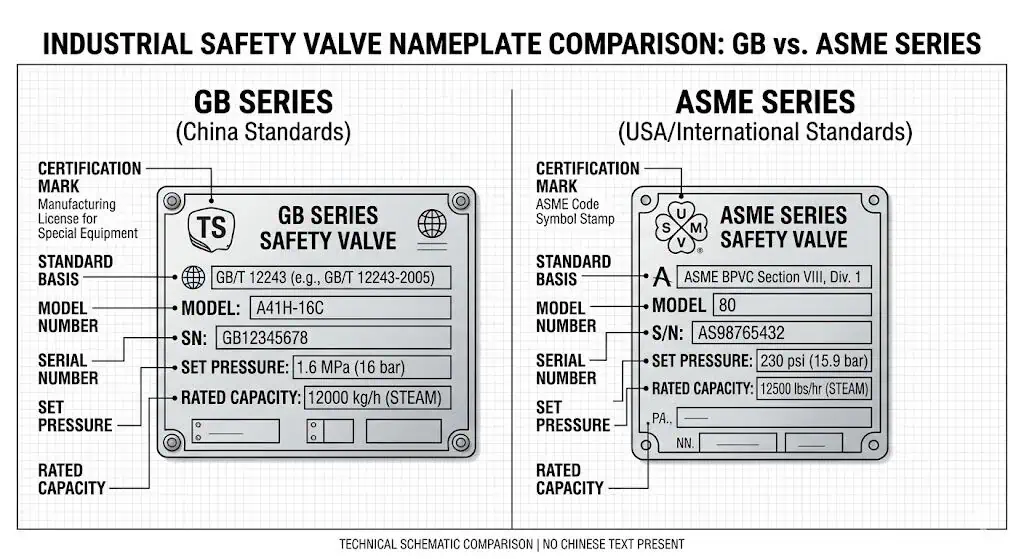
Certification, nameplate, and marking differences often become the real dividing line between GB and ASME valve series during procurement. The engineering team may agree that the pressure range, temperature range, and service appear acceptable, yet approval can still stop because the required stamp, marking logic, certified capacity basis, or documentation package is different. In ASME-based projects, the valve may need a code-specific certification pathway and supporting documentation tied to that route. In GB-based projects, the emphasis often falls on compliance with the applicable national standards and supervision requirements, including model designation, marking, lead sealing, and test records required by the relevant documents.
ASME publishes official pressure-relief-valve certificate forms, while National Board NB-18 provides searchable manufacturer, assembler and certified-device information. A copied form, cast-in “ASME style” appearance or API-dimensional match is not equivalent to a valid certification mark and device listing.
This is where procurement errors are most expensive. If a valve is ordered only by size and set pressure, the missing marking or certificate may not be discovered until factory acceptance, third-party inspection, or site commissioning. At that point, the project may need replacement, engineering concession, or formal owner approval. None of those are guaranteed.
Nameplate and certification differences often determine whether a valve package can pass owner, EPC, or inspection approval.
Certified capacity basis, certification path, inspection and test support, and repair acceptance where applicable.
GB
National marking, model data, set pressure information, lead sealing, and compliance with Chinese marking and supervision expectations.
GB / TSG-based compliance records, test reports, type documentation, and local acceptance documents.
For project approval, always verify that the safety valve’s marking and documentation match the required standard system. A dimensionally suitable valve can still be rejected if the certification route is wrong.
How to Choose Between GB and ASME Safety Valve Series
Check the Application Scope First
Start with the application scope, not the catalog model. The correct safety valve series depends on what equipment is being protected, where the project is located, which regulatory route governs the package, and which owner specification controls acceptance. This is more important than starting from price, pressure class, or availability.
Use the correct safety-valve category and standard route for steam boilers, pressure vessels, piping systems, process skids, and other protected equipment according to the governing project basis.
The ASME route is commonly required in international projects, export skids, EPC specifications, and owner documents that explicitly call for ASME-certified pressure relief devices.
The GB route is commonly used where the project follows Chinese national standards and special-equipment supervision requirements.
For steam boilers, do not automatically apply pressure-vessel PSV logic. Boiler safety valves may follow a different code route and marking expectation.
The safest starting point is not “Which valve is cheaper?” but “Which standard basis governs this equipment and this project?” Once that is clear, engineers can compare valve type, capacity, materials, delivery, and supplier support in the correct context.
For Chinese projects, product-standard compliance and special-equipment acceptance should be treated as related but separate checks. The PRC Special Equipment Safety Law establishes the broader legal framework for covered equipment production, use, inspection and testing, while the current GB/T records define specific safety-valve product and performance-test requirements. The applicable safety technical specifications, equipment category, production licensing, inspection route and owner requirements must still be identified for the actual project.
Review the Sizing Basis and Capacity Documentation
Sizing basis and capacity documentation drive real compliance. ASME-oriented refinery, chemical, and related industry projects commonly use API 520 safety valve sizing as a sizing and selection reference, while GB-based projects rely on accepted national formulas, type test routes, and approval documents. The core point for the user is not just which formula appears on paper. It is whether the sizing basis and supporting records will be accepted by the project reviewer.
Required relieving capacity tells you how much flow the protected system must discharge during the governing scenario. Orifice area affects rated flow. Certified relieving capacity shows whether the selected valve design can pass the required flow under the stated basis. Connection size only confirms mechanical fit. If a buyer compares only DN/NPS size and pressure class, the valve may fit the piping but fail the protection requirement.
Within its stated refinery and related-industry scope, API 520 Part I is an official sizing-and-selection reference. Where an ASME/National Board capacity-certification route is required, check the exact certified device and capacity record through NB-18. A catalog capacity or API 526-style orifice designation should not be described as certified capacity unless the supporting route and exact model are verified.
Standard Basis
Sizing Review Focus
Capacity Documentation Concern
Typical Application Focus
ASME / API pathway
Code-consistent relieving basis, accepted sizing support, and required relieving capacity.
Certified or project-accepted capacity records, nameplate data, and traceability.
International, refinery, chemical, petrochemical, EPC-driven, and owner-specified projects.
GB / TSG pathway
National standard basis, local supervisory acceptance, and approved product/test route.
Chinese test reports, type records, product compliance documents, and local inspection records.
Domestic Chinese or GB-governed projects.
A common engineering mistake is selecting a valve that is physically suitable but unsupported by the required documentation path. In that case, the hardware may arrive on time, but project approval still fails. Before release of order, compare the required relieving case, required capacity, selected orifice, certified or tested capacity, medium, back pressure, and documentation route as one package. For deeper capacity review, see the certified relieving capacity vs connection size guide.
Use STAMPED as a Screening Tool, Not the Final Engineering Basis
STAMPED helps screen options, but it does not replace engineering review. STAMPED stands for Size, Temperature, Application, Media, Pressure, Ends, and Delivery. It is useful for organizing RFQ data and reducing missing inputs. It is not enough to establish code equivalence, capacity acceptability, blowdown suitability, back pressure behavior, material compatibility, or inspection acceptance on its own.
Tip: Use STAMPED to screen candidates, then confirm the governing standard, relieving basis, capacity support, back pressure, material selection, marking, and project documentation requirements before ordering.
STAMPED supports the review process, but only a full check of application scope, standard basis, certified capacity, installation condition, and compliance requirements ensures the right safety valve series. If the service involves dirty gas, corrosive liquid, wet steam, sour service, high back pressure, or common discharge headers, the STAMPED checklist should trigger a deeper engineering review rather than a quick purchase decision.
Can GB Safety Valves Replace ASME Safety Valves
Substitution should be treated as an engineering and compliance decision, not a purchasing shortcut.
When Substitution May Be Considered
Substitution may be considered only in limited cases, and only with written approval. Engineers sometimes review substitution when the project operates under Chinese regulations, the owner accepts GB documentation, and the inspection route does not require an ASME-certified valve. Even then, the decision should be treated as a full engineering and compliance review, not a simple catalog substitution.
Key conditions for possible substitution include:
The project specification explicitly allows GB-certified or GB-compliant safety valves.
The owner, EPC, and inspection body accept the GB documentation package in writing.
The protected system still meets the required set pressure, overpressure, accumulation, blowdown, and capacity criteria.
The valve’s material, trim, seat, spring, guide, bellows if fitted, and sealing arrangement match the service conditions.
Back pressure, inlet pressure loss, outlet system resistance, and discharge reaction have been reviewed for the selected valve design.
The repair, recalibration, resealing, and future replacement route is acceptable under the project basis.
Tip: Always confirm acceptance with the project owner and inspection body before making a substitution decision. Verbal acceptance is weak protection when the valve is later inspected or repaired.
When Substitution Creates Project Risk
Substitution creates major risk in most international or code-driven projects. Using a GB safety valve instead of an ASME-route safety valve can lead to non-compliance, inspection rejection, or startup delay when the project explicitly requires the ASME certification and documentation path. This is especially common in international EPC work, export skids, North American owner specifications, offshore modules, refinery projects, and projects subject to third-party inspection.
Risks of improper substitution include:
Failure to pass owner, third-party, jurisdictional, or insurance inspection.
Missing certified capacity support in the form expected by the project.
Incorrect nameplate, marking, seal, or approval documentation.
Project delay due to rework, re-approval, engineering concession, or valve replacement.
Higher total cost than the original ASME-route purchase.
Unclear repair or recertification pathway after the first shutdown.
A typical failure path is a procurement-driven substitution made after price comparison. The valve is cheaper and faster to obtain, but during final documentation review the inspector asks for the ASME-route certificate, capacity basis, and marking. The supplier cannot provide them because the valve was not manufactured under that route. The project then faces replacement, delay, or non-standard concession. The prevention is to make the certification route a hold point before purchase.
Scenario
Substitution Risk Level
Recommended Action
Domestic, GB-governed project
Lower, but still subject to owner, inspection, and documentation acceptance.
Confirm approval in writing before procurement.
Export, EPC, or ASME-governed project
High.
Use the ASME-route valve required by the project basis unless a formal approved deviation exists.
Existing plant replacement during shutdown
Medium to high, depending on original code basis and owner inspection rules.
Match original certification route or obtain engineering and inspection approval before substitution.
Process debottlenecking or capacity increase
High if capacity is not recalculated.
Revalidate required relieving capacity, certified capacity, back pressure, and installation effects.
Note: Substitution without a full standard and documentation review is one of the fastest ways to create approval delays and replacement cost.
Practical Selection Factors for GB vs ASME Safety Valve Series
Matching Valve Series to System Needs
Choose the valve series that matches the system’s technical, regulatory, and maintenance needs. Engineers must review process medium, pressure behavior, temperature, equipment category, discharge system, project jurisdiction, and owner standard together. Each safety valve series fits a different compliance path, and that path has to make sense for the real system, not just the drawing title.
GB series is better suited to projects governed by Chinese regulations, GB standards, and owner requirements that accept the GB / TSG route.
ASME series is better suited to projects that require ASME code acceptance, ASME marking, or broader international owner approval.
Both series still require testing, inspection, maintenance, and repair control suited to the actual service.
For high back pressure service, review whether a conventional, balanced bellows, or pilot-operated design is acceptable; do not decide by standard route alone.
For corrosive or sour service, review body and trim material, not only pressure class and certification route.
For example, a conventional spring-loaded safety valve may be acceptable in clean gas service with a short atmospheric discharge, but it can become unstable when connected to a shared header with variable outlet pressure. In that case, the standard route does not solve the engineering issue by itself. The designer must also review safety valve back pressure, inlet pressure loss, and valve construction.
The installed-system review should use the relevant official installation and relief-system sources where applicable: API 520 Part II for pressure-relieving-device installation engineering and API Standard 521 for relieving and depressuring systems within its covered industries. These sources support the piping/system review; they do not determine Chinese legal acceptance or create an ASME certification mark.
Tip: Match the valve series to the project’s regulatory path first, then optimize around capacity, materials, back pressure behavior, lead time, cost, and supplier support.
Navigating Project Regulations and Approval Workflows
Understand the approval process before you finalize the valve series. Project success depends on meeting the right regulatory and owner requirements from the start. Different projects involve different authorities, inspectors, document packages, and repair expectations. Safety valves must pass the correct testing, marking, and documentation review before use.
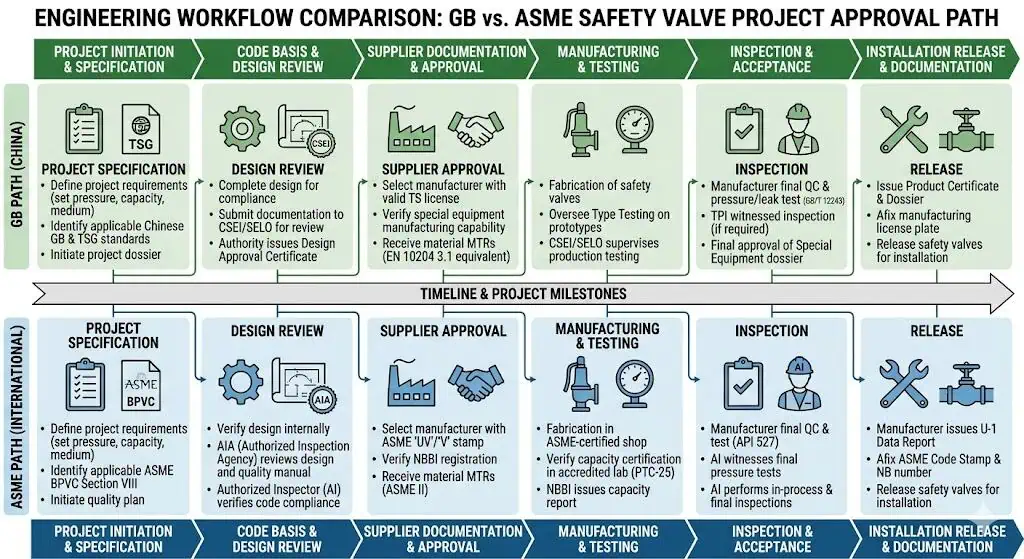
The approval workflow often differs more than the valve appearance, which is why the standard route must be confirmed before ordering.
Step
GB Series Focus
ASME Series Focus
Regulatory Review
Chinese codes, GB standards, special-equipment supervision, and owner acceptance.
ASME code route, owner specification, jurisdictional acceptance, and third-party review.
Documentation
Local compliance records, model data, test documents, marking, and lead sealing records.
Code-specific certificates, nameplate data, capacity basis, test records, and traceability.
Testing and Inspection
National or project-accepted test route and local supervisory requirements.
Project-accepted certified testing, seat tightness records, and code route support.
Approval Workflow
Regional authority, owner, and plant inspection acceptance.
International, EPC, third-party, owner, or jurisdictional acceptance.
Repair / Recalibration
Local inspection and resealing route according to project and regulatory expectations.
Owner-approved repair route, National Board / VR considerations where applicable, and documented recalibration.
Approval often depends as much on documentation as on the valve itself.
Missing or mismatched documents can delay the project even when the hardware is already on site.
Repair route should be checked before purchase, not only after leakage or failed inspection.
Note: Early engagement with the owner, inspection agency, and testing route helps avoid costly late-stage changes.
Comparing Cost, Lead Time, and Technical Support
Evaluate cost, delivery time, and support through the lens of project risk, not just purchase price. Cost and lead time often differ between GB and ASME series, but the cheaper option on paper may become more expensive if it creates approval delays, missing documents, harder replacement support, or unclear repair acceptance later. Technical support also varies by region, certification basis, material availability, and after-sales capability.
GB series may offer shorter lead times for Chinese projects due to local supply familiarity and documentation alignment.
ASME series may cost more upfront but reduce approval risk in ASME-governed projects.
Both series require inspection and maintenance support suited to the project basis and service severity.
Reliable technical support helps during RFQ review, audits, testing, shutdowns, replacement review, and failure investigation.
A supplier should be able to explain where substitution is acceptable, where it is not, and what documents are needed before shipment.
Engineers should balance cost, lead time, and technical support against approval, inspection, repair, and replacement risk, not only against the initial quote.
Common Mistakes When Comparing GB and ASME Safety Valve Series
Assuming Similar Ratings Mean Interchangeability
Similar ratings do not guarantee safe or compliant substitution. Many engineers and buyers assume that if two safety valves share the same nominal pressure rating, connection size, and set pressure, one can replace the other. This approach often fails because the standard basis, certification route, certified capacity support, marking logic, seat tightness expectation, and repair acceptance are not automatically interchangeable.
This mistake also appears after plant modification. An existing valve may be replaced by a same-size unit without rechecking the process relief case. If the system load, heat input, fire case, discharge header, or operating pressure has changed, the old size may no longer provide enough capacity. This is why safety valve sizing and certified relieving capacity must be checked before treating two valve series as equivalent.
Key risks include:
Non-compliance with owner, EPC, or jurisdictional requirements.
Rejection during inspection or approval review.
Insufficient certified relieving capacity even when the flange size matches.
Unstable operation caused by ignored back pressure or inlet pressure loss.
Higher cost due to replacement, delay, or documentation rework.
Always confirm that the selected valve meets the project’s code, capacity, documentation, and installation requirements, not just the pressure and size shown on the datasheet.
Misreading Standard Terminology
Misunderstanding terminology can create serious technical and cost problems. Users sometimes assume that terms such as set pressure, overpressure, accumulation, blowdown, safety valve, relief valve, safety relief valve, and PSV are applied identically across all standards and projects. That is unsafe. Even when the terms look familiar, their acceptance context, test route, and project interpretation may differ. Misreading terminology can lead to wrong supplier communication, wrong valve category selection, or false equivalence between GB and ASME series.
A common example is mixing steam safety valve logic with liquid relief valve expectations. Steam and gas service usually requires quick, stable lift and controlled reseating behavior, while liquid relief service may involve different opening behavior and sizing assumptions. If the project language is copied without checking the fluid state and standard route, the selected valve may pass paperwork review but perform poorly in service.
Common terminology pitfalls:
Assuming definitions or expectations are identical across project standards.
Overlooking differences in testing, marking, and documentation language.
Confusing application terminology with certification terminology.
Using PSV as a broad purchasing term without defining medium, valve type, and certification basis.
Treating blowdown and reseating as catalog details instead of operating behavior that affects leakage and cycling.
Engineers should review the terminology and acceptance basis in the relevant project documents before making a final selection.
Ignoring Documentation and Owner Specifications
Overlooking documentation and owner requirements exposes projects to major risk. Project owners and regulators often require very specific documents for safety valve approval. Missing or incomplete paperwork can stop the project even when the valve itself is already manufactured or delivered. In one common case, procurement approved a substitution based on price and lead time, but the owner later rejected the package because the required certification and nameplate route did not match the project specification.
Documentation problems often occur because procurement requests only model, size, set pressure, and quantity. For safety valves, the RFQ should also ask for certification route, capacity basis, material records where required, seat tightness test requirement, nameplate details, inspection documents, and repair or recalibration expectations. Use a structured safety valve RFQ datasheet when the project involves GB vs ASME comparison, export approval, corrosive service, high back pressure, or owner inspection.
Risk Type
Description
Approval Failure
The project may be halted because the certification, marking, or documentation route is not accepted.
Inspection Delay
Missing records, wrong nameplate data, or incomplete test documents can delay startup and commissioning.
Capacity Dispute
The valve may fit the piping but lack accepted capacity support for the governing relief case.
Repair Uncertainty
The owner may not accept the repair or recalibration route after shutdown inspection.
Cost Escalation
Rework, replacement, concession review, or document correction often costs more than the original price difference.
Always check the project specification and ensure all required documents are complete and aligned with the governing standard before ordering.
What Users Should Check Before Final Safety Valve Selection
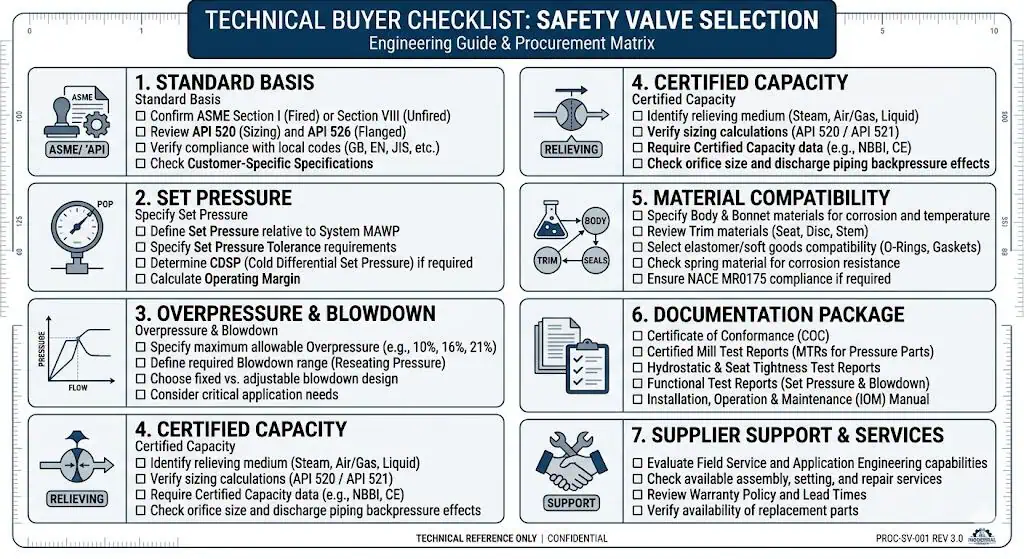
A pre-order checklist helps engineers and buyers catch code, capacity, material, installation, and documentation issues before procurement.
Technical Questions to Confirm
Engineers must confirm key technical details before selecting a safety valve series. These checks help ensure the valve will perform as required and meet project standards.
Is the project governed by GB, ASME, or an owner-specific standard basis? Start by identifying the approval path before comparing models.
What protected equipment is involved? Boiler, pressure vessel, process piping, skid package, heat exchanger, reactor, compressor, and storage systems may follow different approval logic.
Does the valve series match the required set pressure, overpressure, accumulation, and blowdown expectations? Review the governing standard basis instead of assuming equivalence.
Is the certified or project-accepted capacity suitable for the application? The valve’s supported discharge capacity should cover the worst credible relieving scenario.
Is the selected orifice area adequate? Do not assume inlet size proves capacity. Orifice area and certified capacity are decisive.
Are back pressure and outlet resistance reviewed? Superimposed back pressure and built-up back pressure can affect lift, capacity, and reseating.
Are inlet pressure loss and installation layout acceptable? Excessive inlet loss can contribute to chatter and unstable opening.
Are the materials compatible with process media and temperature? Material choice affects nozzle corrosion, disc damage, guide sticking, spring behavior, bellows life, and seat leakage.
Do the valve dimensions and end connections fit the piping design? Confirm installation compatibility after the standard and capacity basis are already accepted.
Can the valve be maintained, recalibrated, resealed, and documented under the required route? Repair acceptance should be reviewed before purchase, not after failure.
Tip: Compare technical datasheets only after you have confirmed the governing standard, approval route, required capacity basis, and documentation package.
Supplier Questions to Confirm
Buyers should verify supplier credentials, test capability, and documentation before purchase. Reliable suppliers provide clear evidence of compliance and explain where substitution is acceptable and where it is not. They should also be able to discuss capacity basis, back pressure, materials, seat tightness, lead sealing, and repair expectations without reducing the discussion to price and delivery.
Confirm whether the supplier holds the certifications required by the project route.
Request nameplate details, signed test records, and capacity-supporting documents as applicable.
Confirm whether the valve is GB-route, ASME-route, or simply manufactured to similar dimensions.
Ensure third-party audit or inspection support is available if the project requires it.
Ask about after-sales support, spare parts, recalibration, and replacement guidance.
Check whether the supplier can provide the exact documentation package needed for project approval.
Confirm whether repair after service requires National Board / VR, local inspection, or owner-approved service procedure.
Supplier Checkpoint
Why It Matters
Applicable certifications
Shows whether the supplier can support the project’s required standard route.
Nameplates and test records
Supports authenticity, traceability, and approval review.
Capacity documentation
Confirms whether the selected valve can support the required relieving case.
Material certificates
Important in corrosive, sour, high-temperature, or owner-controlled service.
Inspection or audit support
Reduces commissioning and approval risk.
After-sales support
Supports long-term maintenance, recalibration, and replacement planning.
Complete documentation package
Helps prevent approval delay and startup disruption.
Note: A thorough supplier review reduces project risk and supports smoother commissioning, inspection, repair, and later replacement planning.
FAQ About GB vs ASME Safety Valve Selection
What is the difference between GB and ASME safety valve series
GB and ASME safety valve series differ mainly in standard basis, certification route, marking logic, documentation package, and project acceptance path. GB safety valves are generally used in projects governed by Chinese standards and special-equipment supervision requirements. ASME safety valves are used in projects that require the ASME code route and related certification logic. The biggest practical differences usually appear in nameplate requirements, certified capacity support, test records, repair pathway, and inspection acceptance rather than in catalog appearance alone.
Feature
GB Series
ASME Series
Standard Origin
China, usually within GB / TSG-governed project framework.
ASME code certification route and related owner / jurisdictional acceptance.
Typical Application Basis
Chinese domestic or GB-governed projects.
International, ASME-governed, EPC, export, or owner-specified projects.
Marking Focus
National marking, model information, lead sealing, and local compliance expectations.
Code-based certification marking, nameplate data, and capacity basis.
Approval Path
Regional, national, owner, and special-equipment supervisory acceptance.
Owner, jurisdictional, EPC, or third-party acceptance under ASME route.
Repair Consideration
Local inspection and resealing requirements according to project basis.
Owner-approved repair route and National Board / VR consideration where required.
Can a GB safety valve be used in an ASME project
In most ASME-governed projects, a GB safety valve cannot simply replace an ASME-route safety valve. Most international or ASME code projects require the certification, marking, and documentation path expected by the owner and inspector. Substituting a GB valve without formal acceptance often leads to failed review, delayed startup, or replacement.
Always confirm substitution with the project owner and inspection agency before considering it, and never assume similarity of pressure rating and size is enough.
Which matters more, valve size or certified capacity
Certified capacity matters more than valve size for protection and compliance. Valve size affects piping fit, but certified or project-accepted relieving capacity determines whether the valve can actually protect the equipment during the governing scenario.
Valve size supports installation, but capacity supports system safety and approval.
Orifice area and capacity basis should be checked before assuming two valve series are equivalent.
What should buyers check before ordering
Buyers should verify certification route, material compatibility, capacity support, back pressure condition, and documentation before ordering. Many project problems start because one of these points was assumed rather than confirmed.
Key checks include:
Certification route: Confirm that the valve matches the governing standard basis.
Material compatibility: Ensure materials suit the process media, especially in corrosive, sour, dirty, or high-temperature service.
Capacity support: Check that the relieving basis and documentation fit the project review route.
Back pressure and installation: Review inlet pressure loss, outlet resistance, common headers, and discharge reaction.
Documentation: Request test reports, nameplate details, certification documents, and inspection-supporting records before release of order.
Careful review of these points prevents costly failure, approval delay, and unnecessary replacement.
Selecting the right safety valve series involves more than comparing price, pressure class, or size. Engineers should review code basis, application scope, set pressure logic, allowable overpressure, accumulation, blowdown behavior, required relieving capacity, certified capacity support, certification package, marking, and project approval requirements together. Most project issues come from incomplete review of standard context, documentation expectations, or system compatibility, not from the valve body alone. A sound selection process should include technical review, project specification review, and supplier documentation review before final release.
Key steps for selection:
Confirm the governing standard basis and owner specification.
Verify set pressure logic, overpressure basis, accumulation basis, blowdown expectation, and capacity support.
Review marking, certification, nameplate data, and documentation requirements.
Check material suitability, back pressure behavior, installation limits, maintenance path, and future replacement risk.
Additional Technical FAQ
Does an ASME-Style Valve Without the Required Certification Mark Count as an ASME Code Valve?
No. Similar dimensions, materials, pressure ratings or API-style geometry do not establish ASME Code certification. Verify the manufacturer’s authorization, the applicable V or UV route, the certification mark, the selected device/model and the supporting record. The official ASME data-report forms and National Board NB-18 help identify the correct evidence path.
Can an ASME Safety Valve Be Used in a GB / TSG-Governed Project?
Only after the Chinese regulatory, owner and inspection route accepts it. ASME certification can be valuable evidence, but it does not automatically replace the applicable Chinese product standards, special-equipment safety technical requirements, production or import controls, local inspection and project documentation. Obtain written acceptance before procurement.
Do Matching Set Pressure and Flange Size Prove Interchangeability?
No. Matching set pressure and flange size confirms only part of the interface. The replacement still needs the governing relief scenario, required capacity, certified or tested capacity, medium, relieving temperature, back pressure, inlet loss, materials, blowdown behavior, marking and approval route to be reviewed.
What Documents Should Buyers Check Before Ordering?
Check documents that identify both the valve and the acceptance route. Typical items include the approved datasheet, general arrangement drawing, nameplate layout, manufacturer authorization, exact device/model listing where applicable, capacity evidence, set-pressure and seat-tightness reports, materials documentation, lead-sealing or final-seal record, inspection plan and repair/recalibration requirements.
Why is supplier selection important for safety valves?
Supplier selection affects compliance, documentation quality, and long-term support as much as hardware availability. A supplier should support the required standard route, provide clear test records, explain certification boundaries, and help with maintenance and replacement planning.
Checkpoint
Importance
Certification support
Shows whether the supplier can serve the correct project route.
Test records
Confirms set pressure, seat tightness, and approval support.
Capacity evidence
Supports engineering acceptance and owner review.
After-sales support
Supports long-term maintenance, recalibration, replacement, and troubleshooting.
How does back pressure affect GB vs ASME safety valve selection?
Back pressure affects lift stability, certified capacity application, blowdown behavior, and reseating. This engineering issue exists regardless of whether the valve follows GB or ASME route. Superimposed back pressure exists before the valve opens, while built-up back pressure develops during relieving flow. If outlet resistance or a shared discharge header is not reviewed, a correctly marked valve can still chatter or fail to reseat properly.
When should a pilot-operated safety valve be considered?
A pilot-operated safety valve may be considered where tight shutoff, high operating pressure ratio, large capacity, or certain back pressure conditions are important. However, it should not be selected only because it looks technically advanced. Dirty gas, sticky media, wax, hydrate formation, corrosion products, or poor maintenance access can reduce pilot circuit reliability. For pilot-operated designs, service cleanliness and pilot maintenance must be reviewed before approval.
Why can a safety valve leak after installation?
Leakage after installation can be caused by seat damage, dirt, incorrect operating margin, thermal distortion, piping stress, corrosion, back pressure, or improper recalibration after maintenance. The first step is to compare shop test records with installed conditions. Then check inlet cleanliness, outlet load, operating pressure relative to set pressure, seat material, and whether the valve was correctly resealed after adjustment.
Which Official GB Standards Are Most Relevant to This Comparison?
The core current national-standard records are GB/T 12241-2021 for general safety-valve requirements, GB/T 12242-2021 for pressure-relief-device performance testing and GB/T 12243-2021 for spring-loaded safety valves. Their official status can be checked through the SAMR national standards platform. Project acceptance may also require applicable special-equipment safety technical specifications, licensing, inspection and owner requirements.
What Does National Board NB-18 Verify?
NB-18 provides searchable certification information for pressure-relief-device manufacturers, assemblers and certified device types. It is useful for checking the ASME/National Board capacity-certification route, but the engineer must still match the exact manufacturer, model or device type, pressure range, configuration and capacity basis to the supplied valve.
When Is National Board VR Repair Relevant?
VR is relevant when the jurisdiction, owner or project requires the National Board authorized pressure-relief-valve repair route. The VR program controls the repair organization’s quality system and authorization. It does not replace a current relief calculation, certified-capacity check or installed piping review.
Do API 520 or API 526 Alone Prove ASME Code Compliance?
No. API 520 supports sizing, selection and installation within its scope, while API 526 addresses standardized flanged steel pressure-relief-valve features within its scope. Neither standard alone grants the ASME certification mark or proves that the supplied valve is listed for the required V or UV route.
What Should Be Rechecked After a Capacity Increase or Discharge-Header Change?
Recheck the governing relief load, required capacity, selected orifice, certified capacity, inlet pressure loss, simultaneous relief assumptions, superimposed and built-up back pressure, valve stability, blowdown, outlet reaction force and support. A valve can remain mechanically intact and correctly set while becoming unsuitable after the process or discharge system changes.
How Should a GB-to-ASME or ASME-to-GB Deviation Be Approved?
Use a formal technical deviation or management-of-change process. Record the original requirement, proposed substitute, protected equipment, relief calculation, capacity comparison, materials, dimensional differences, certification and marking gap, inspection impact, repair route and written approvals from the responsible engineer, owner and inspection authority where required. Verbal acceptance is not adequate evidence for future audits or repairs.
Engineering and publishing note: Final GB-versus-ASME acceptance depends on the actual equipment category, project location, adopted code edition, owner specification, manufacturer authorization, exact valve model, capacity evidence, nameplate, inspection route and local authority requirements. Do not display ASME, National Board or Chinese regulatory marks unless the exact product and scope are verified.
To provide the best experiences, we use technologies like cookies to store and/or access device information. Consenting to these technologies will allow us to process data such as browsing behavior or unique IDs on this site. Not consenting or withdrawing consent, may adversely affect certain features and functions.
Functional
Always active
The technical storage or access is strictly necessary for the legitimate purpose of enabling the use of a specific service explicitly requested by the subscriber or user, or for the sole purpose of carrying out the transmission of a communication over an electronic communications network.
Preferences
The technical storage or access is necessary for the legitimate purpose of storing preferences that are not requested by the subscriber or user.
Statistics
The technical storage or access that is used exclusively for statistical purposes.The technical storage or access that is used exclusively for anonymous statistical purposes. Without a subpoena, voluntary compliance on the part of your Internet Service Provider, or additional records from a third party, information stored or retrieved for this purpose alone cannot usually be used to identify you.
Marketing
The technical storage or access is required to create user profiles to send advertising, or to track the user on a website or across several websites for similar marketing purposes.