Share your medium, set pressure, temperature, size, standard, or datasheet, and our team will review your requirement and respond with the appropriate next step.
How Capacity, Set Pressure and Back Pressure Affect Safety Valve Performance
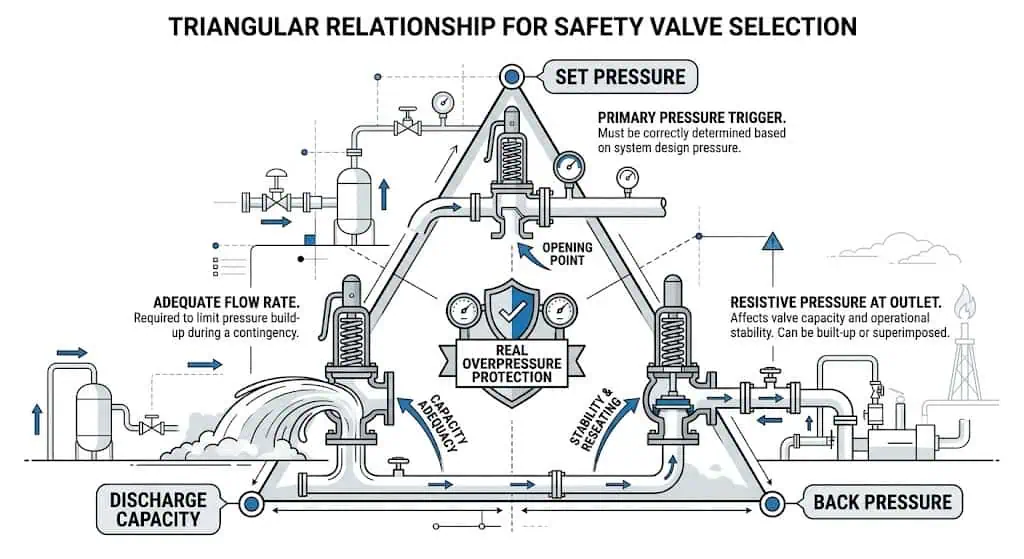
Discharge capacity, set pressure, and back pressure are the three variables that decide whether a safety valve can deliver real protection during an overpressure event. Many users still start with connection size or pressure rating, but experienced engineers usually start from the protection basis. They first confirm the governing relieving scenario, then the required relieving capacity, …
Discharge capacity, set pressure, and back pressure are the three variables that decide whether a safety valve can deliver real protection during an overpressure event. Many users still start with connection size or pressure rating, but experienced engineers usually start from the protection basis. They first confirm the governing relieving scenario, then the required relieving capacity, then the set pressure basis, and then the inlet and outlet conditions that can change how the valve behaves in service. When one of these three variables is underestimated, the result is rarely a clean “wrong model” problem. It usually appears as chatter, simmer, repeated seat leakage, unstable reseating, insufficient relief, or a valve package that cannot pass technical review after the purchase order has already been issued.
Safety valve selection works only when discharge capacity, set pressure, and back pressure are reviewed together rather than as separate checklist items.
Field experience shows that many recurring valve problems come from incomplete relief-system review, not from the valve body alone.
Connection size confirms whether the valve can be installed; certified relieving capacity confirms whether the protected equipment can actually be relieved during the governing case.
Discharge capacity, set pressure, and back pressure must be reviewed together because capacity, opening point, inlet pressure loss, and outlet effects jointly determine protection quality.
Why Discharge, Set Pressure, and Back Pressure Matter in Safety Valve Selection
Why These Three Factors Must Be Reviewed Together
Discharge capacity, set pressure, and back pressure must be reviewed together because each one changes how the other two perform in real service. A valve may have the correct set pressure and still fail the duty because its certified relieving capacity is too low. A valve may have adequate rated capacity and still become unstable because the outlet system creates built-up back pressure that was ignored during selection. A valve may fit the nozzle and pressure class perfectly and still be the wrong choice if the protected system runs too close to the set pressure during normal operation.
Discharge capacity affects whether the valve can pass enough flow to keep the protected system within its allowable pressure boundary during the governing overpressure case.
Set pressure affects when the valve starts to open and how close the relief device sits to normal operating pressure.
Overpressure / accumulation affects the temporary pressure rise the system can tolerate during a relieving event.
Blowdown affects where the valve reseats and whether it closes cleanly after discharge.
Back pressure affects lift stability, effective relieving behavior, capacity application, and reseating after the event.
These variables interact. The correct way to review them is to start from the governing relieving scenario, confirm set pressure logic against the protected equipment limit, verify the valve can relieve the required load, and then check that inlet pressure loss and outlet system resistance will not make the selected design unstable. For a deeper selection framework, see the safety valve sizing and certified relieving capacity guide.
Parameter
What It Controls
What Can Go Wrong
Set Pressure
The pressure at which the valve is intended to start opening.
Too high may delay protection; too low may cause simmer, leakage, or nuisance lifting.
Required Relieving Capacity
The amount of flow the valve must pass under the governing overpressure case.
Undersizing can leave the equipment pressurizing even after the valve opens.
Certified Relieving Capacity
The documented capacity accepted under the relevant standard or project basis.
The valve may fit the piping but fail the technical review if certified capacity is not sufficient.
Back Pressure
The downstream pressure effect that can influence opening stability, effective capacity, and reseating.
High or variable outlet pressure can cause chatter, poor lift, reduced capacity, or leakage after reseating.
In practice, engineers who review these three together catch problems earlier. Engineers who review them one by one usually find the problem later, during startup, audit, or failure investigation.
How Selection Errors Show Up in Real Systems
Selection errors usually appear as unstable valve behavior, inadequate overpressure protection, or review failures rather than obvious catalog mismatch. When discharge, set pressure, and back pressure are treated as independent variables, several patterns appear again and again in service:
The valve opens near the correct pressure but cannot pass enough flow to protect the vessel, exchanger, receiver, compressor discharge line, or thermal expansion case.
The valve lifts on the bench but chatters in service because outlet pressure buildup, inlet pressure loss, or acoustic interaction was underestimated.
The valve remains tight after testing but starts leaking after installation because the operating pressure sits too close to set pressure for long periods.
The valve is accepted by procurement because the inlet flange matches, but engineering later rejects it because the orifice area or certified capacity is not adequate.
One common revamp case is worth mentioning. A plant replaces an older valve with a new unit of the same inlet size and similar pressure rating. The set pressure is correct, so the purchase looks safe. During relief review, however, the new valve’s effective orifice and certified capacity do not match the original case assumptions. The valve fits. The protection basis does not. The prevention is to check the required relieving capacity, selected orifice, certified capacity, inlet loss, outlet back pressure, and documentation route before approving a like-for-like replacement.
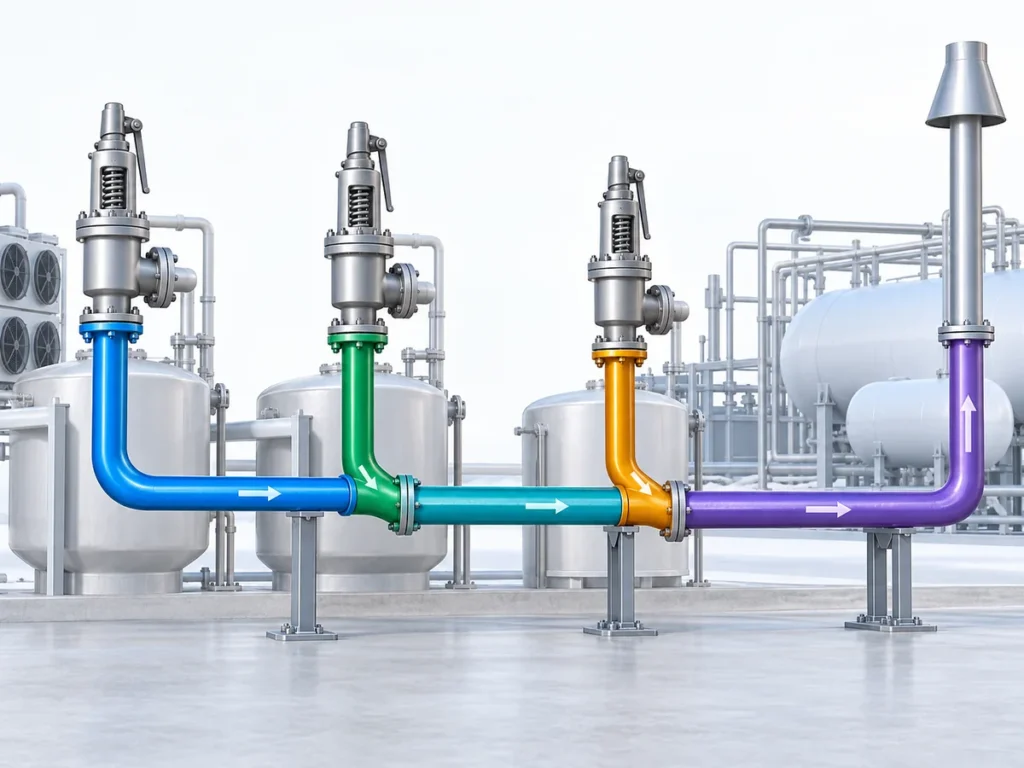
Another common case appears in flare-connected systems. A conventional spring-loaded safety valve passes shop testing but becomes unstable after startup because several relief devices share a common discharge header. The built-up back pressure rises under simultaneous relief conditions, and the valve starts to chatter and reseat poorly. In that case, the root cause is not simply the spring. The discharge system, valve type, back pressure allowance, and installation basis must be reviewed together.
Tip: Always review discharge capacity, set pressure, inlet pressure loss, and back pressure together during safety valve selection. The most expensive mistakes are usually found after installation, not during quotation.
Discharge Capacity in Safety Valve Selection
Why Discharge Capacity Matters More Than Connection Size
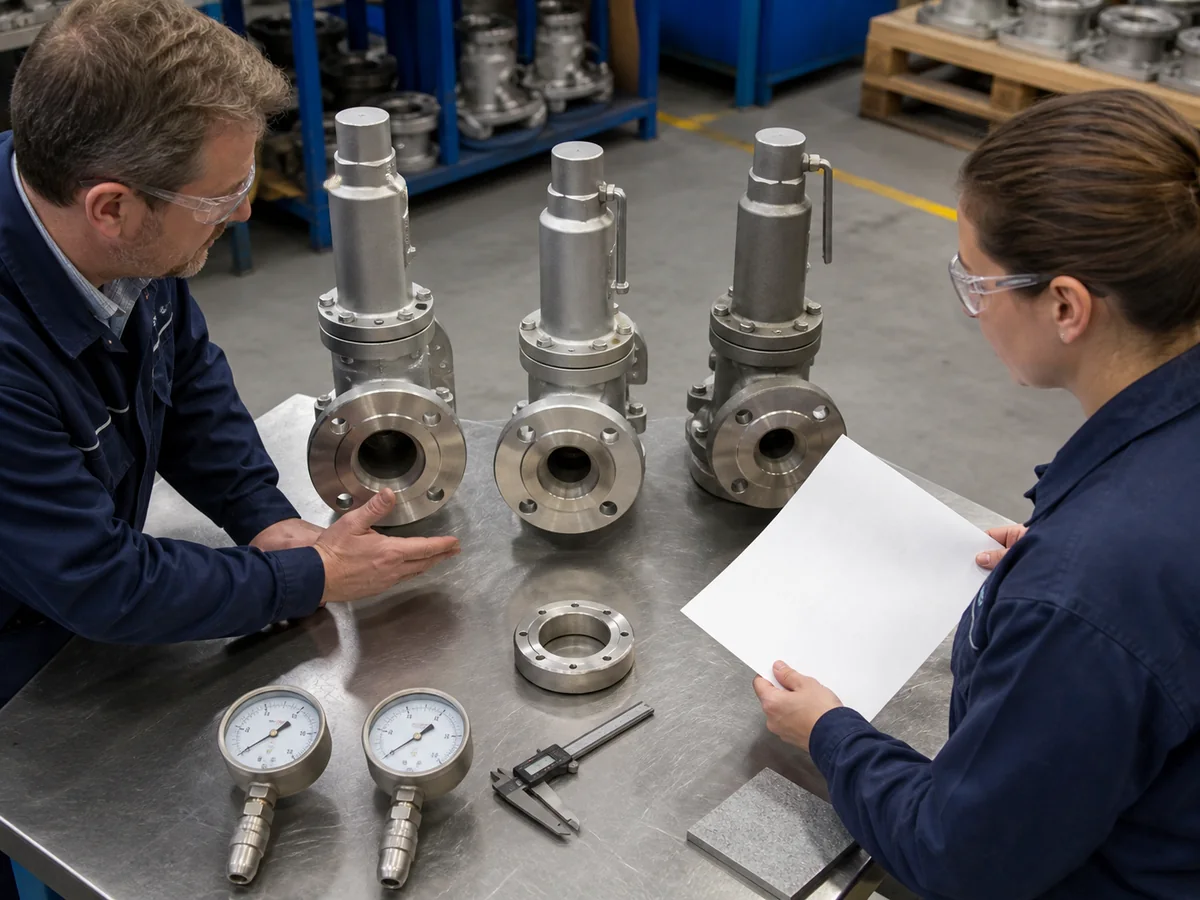
Discharge capacity determines whether the valve can protect the system. Connection size only determines how the valve fits into the piping. Users often compare inlet size first because it is visible on the drawing and easy to match to the nozzle. That is a weak shortcut. The real protection question is whether the selected valve can pass the required load during the governing upset case. This is why certified relieving capacity and orifice selection matter more than nominal size alone.
Discharge capacity controls real overpressure protection.
Connection size affects installation compatibility, but not protection adequacy by itself.
A valve can match the nozzle perfectly and still be undersized for the actual relieving duty.
Orifice area directly influences rated flow, but the project must still confirm certified or accepted relieving capacity.
A recurring procurement mistake is to treat two valves with the same inlet flange as interchangeable. They are not automatically interchangeable if their certified capacity basis, effective area, pressure-temperature limit, discharge coefficient, or accepted sizing route differs. In B2B RFQs, the buyer should provide the required relieving capacity and the governing case, not only “2 x 3, 150 lb, set pressure 10 bar.”
Sizing for Discharge Capacity
Correct sizing starts with the relieving scenario, not with the catalog page. Industry practice requires engineers to calculate the required load from the governing case and then select a valve with sufficient supported capacity. In refinery, chemical, and related industries, API 520 Part I is the core reference for sizing and selection of pressure-relieving devices, while installation issues are handled separately in API 520 Part II. That separation matters because a valve may be sized correctly on paper and still perform poorly when installed incorrectly.
Review the actual relieving fluid and relieving scenario, such as blocked outlet, external fire, control valve failure, thermal expansion, tube rupture, utility failure, or runaway reaction.
Confirm whether the project expects a code-certified or otherwise project-accepted capacity basis.
Check units carefully and confirm that density, molecular weight, compressibility, viscosity, relieving temperature, and liquid properties are consistent with the selected method.
Confirm whether the relief case is gas, steam, vapor, liquid, flashing liquid, or two-phase flow; terminology and sizing assumptions can change with fluid state.
Review whether a rupture disk, inlet strainer, silencer, discharge header, or long outlet line changes the final protection basis.
Oversizing can also create trouble. In high-cycle service, an oversized valve may lift too abruptly, reseat poorly, and suffer premature seat wear. Undersizing is the more dangerous mistake, but oversizing is not harmless. This is a typical engineering experience range, and the final decision depends on medium, pressure, temperature, valve type, blowdown, discharge system, and manufacturer data.
Tip: Accurate process data matters more than catalog similarity. A clean sizing file is often worth more than a lower quoted price.
How Discharge Capacity Affects System Safety
Discharge capacity directly affects whether the protected system stays within its allowable pressure boundary during the relief event. If the valve cannot relieve enough flow, the equipment can continue to pressurize even though the valve has started to open. That is why “the valve opened” is not the same as “the system was protected.”
Aspect
Why It Matters
Required Relieving Capacity
Determines the minimum flow the valve must pass during the governing upset case.
Certified / Accepted Capacity
Shows whether the valve’s tested or documented performance supports the design basis.
Orifice Selection
Directly influences rated flow, pressure loss behavior, acoustic energy, and discharge reaction.
Relieving Fluid State
Gas, steam, liquid, flashing liquid, and two-phase flow require different review logic.
Documentation Basis
Determines whether the owner, inspector, or EPC reviewer will accept the capacity claim.
In actual plant work, capacity problems are often found late. A review team may approve the set pressure and materials first, only to discover later that the valve’s documented capacity support does not align with the case basis. That is why experienced reviewers examine capacity before convenience details such as lever style, paint color, or short delivery time.
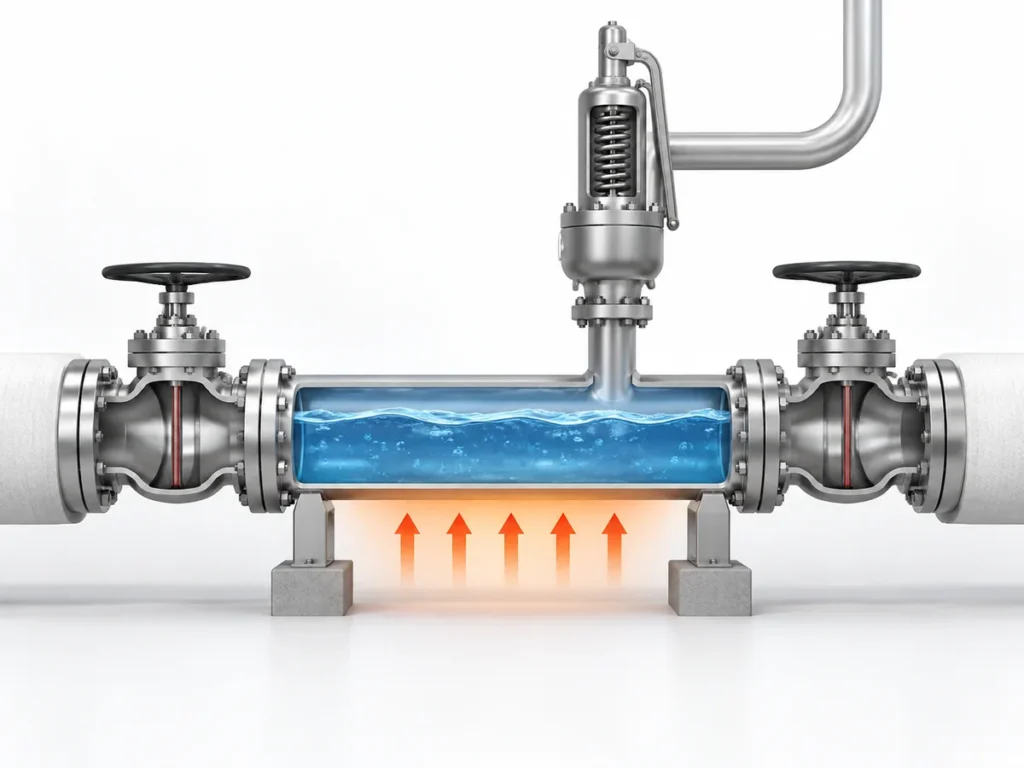
A typical failure path is a thermal expansion case on a liquid-filled blocked-in section. The line size is small, the valve looks minor, and the purchasing team treats it as a standard item. If the liquid expansion case is not defined correctly, the selected relief valve may be too small or may chatter because the inlet piping and valve lift are not matched to the real thermal expansion behavior. The prevention is to define the case, confirm the fluid state, and size the device rather than assuming the connection size is adequate.
Standards and Capacity Review
Industry standards define how capacity review should be approached, even though the exact certification path depends on the application and code basis. For process-industry PRD selection, API 520 Part I covers sizing and selection, while API 520 Part II covers installation. API 527 covers seat tightness of pressure relief valves. ISO 4126-1 specifies general product requirements for safety valves and states that it is a product standard, not an application standard. For pilot-operated designs, product requirements are addressed separately in ISO 4126-4.
Standard
Main Relevance
Selection Boundary
API 520 Part I
Sizing and selection of pressure-relieving devices in refineries, chemical facilities, and related industries.
Use for sizing / selection logic, not for installation details alone.
API 520 Part II
Installation of pressure-relieving devices, including inlet and outlet considerations.
Use for installation review; do not treat installation as solved by sizing alone.
API 527
Seat tightness testing of pressure relief valves.
Useful for leakage test expectations, not for full relief-system design.
ISO 4126-1
General product requirements for safety valves.
Product standard, not an application standard for the whole relief system.
ISO 4126-4
General product requirements for pilot-operated safety valves.
Relevant to pilot-operated valve product requirements; service cleanliness still requires engineering review.
ASME BPVC Section VIII, Division 1
Pressure vessel code basis.
Relevant when the protected equipment is a pressure vessel under ASME route.
Manufacturers and users should not blur these boundaries. Good selection work depends on using the right standard for the right question. If an RFQ includes pressure vessels, boilers, refinery process units, sour service, or export approval, the standard route and document package should be confirmed before final model selection.
Note: Good capacity review is not only about equations. It is also about whether the project reviewer will accept the sizing basis, test route, certified capacity record, and supporting documentation.
Set Pressure in Safety Valve Selection
Determining Set Pressure
Set pressure should be determined from the governing code basis and the protected equipment limit, not from convenience or habit. The set pressure defines when the valve starts to open. If it is too high, the valve may not protect the system in time. If it is too low, the valve may simmer, leak, or lift during normal operating fluctuations. The correct set pressure therefore depends on both the protected equipment and the actual operating behavior of the system.
The set pressure must reflect the protected system’s allowable pressure limit.
The selected value should leave a practical operating margin between normal operating pressure and valve opening behavior.
The review must account for service conditions, not just the nominal design number.
Blowdown should be reviewed because it determines where the valve reseats after opening.
Accumulation or allowable overpressure should be reviewed because it defines the system’s acceptable temporary pressure rise during relief.
A common field problem appears when the set pressure is technically correct, but the unit spends long periods operating too close to that value. Over time, the valve may simmer or leak, and the maintenance team blames the seat. In reality, the operating strategy and pressure margin were the real cause. For more detail on pressure terms, see set pressure, overpressure, accumulation, and blowdown in safety valves.
Set pressure should be reviewed with allowable pressure rise and reseating behavior, not as a standalone number.
MAWP and Operating Pressure
The relationship between MAWP and normal operating pressure is one of the most important practical checks in set pressure selection. The MAWP is the maximum allowable working pressure of the protected equipment and forms the basis for pressure-relieving device settings in the code context. In pressure vessel service, the set pressure is normally established from the protected equipment limit and the applicable code route. At the same time, users should remember that a correct set pressure on paper does not automatically produce stable operation if the normal operating pressure sits too close to the valve’s opening region for long periods.
The set pressure should be established against the MAWP or protected equipment limit required by the governing code basis, but good engineering practice also checks whether normal operating pressure is close enough to set pressure to create simmering, leakage, or unstable behavior in service.
Experienced engineers review this as an operating problem, not just a code problem. The code defines the upper boundary. The process determines whether the chosen setting will behave well in daily operation. In clean gas service with stable pressure control, a narrow operating margin may be manageable if the valve design and seat tightness are suitable. In dirty, pulsating, wet steam, or high-cycle service, the same margin may lead to repeat leakage and seat damage.
Regulatory and Project Requirements
Set pressure selection must also satisfy the project’s code, owner specification, and documentation route.ASME BPVC Section VIII, Division 1 provides pressure vessel rules for design, fabrication, inspection, testing, and certification. API 520 and API 521 support pressure-relieving device sizing, selection, installation, and system review in process industries. The National Board and NBIC framework become especially important when the user is dealing with installed devices, repair traceability, or post-repair documentation. ASME certification scopes distinguish between boiler and pressure vessel certification routes, and the National Board’s VR Certificate of Authorization addresses repair of pressure relief valves.
Aspect
Practical Meaning
Set Pressure Basis
Must be tied to the protected equipment limit and code route.
Operating Margin
Should be checked to avoid simmer, nuisance leakage, or unstable operation.
Project Review
May require documented set-pressure basis, certification category, and supporting records.
Seat Tightness
Should be tested using the project-accepted method, such as API 527 where applicable.
Repair / Recalibration
May fall under NBIC / National Board repair expectations depending on service, owner requirements, and jurisdiction.
Project specifications often go beyond the basic code wording. That is why a technically reasonable set pressure can still be rejected if the supporting documentation does not follow the project’s review route. After maintenance, the valve should be recalibrated, tested, documented, and sealed according to the required repair or inspection pathway. A valve that is repaired but not properly reset and sealed can return to service with an actual opening point that no longer matches the datasheet.
Back Pressure and Safety Valve Performance
Types of Back Pressure
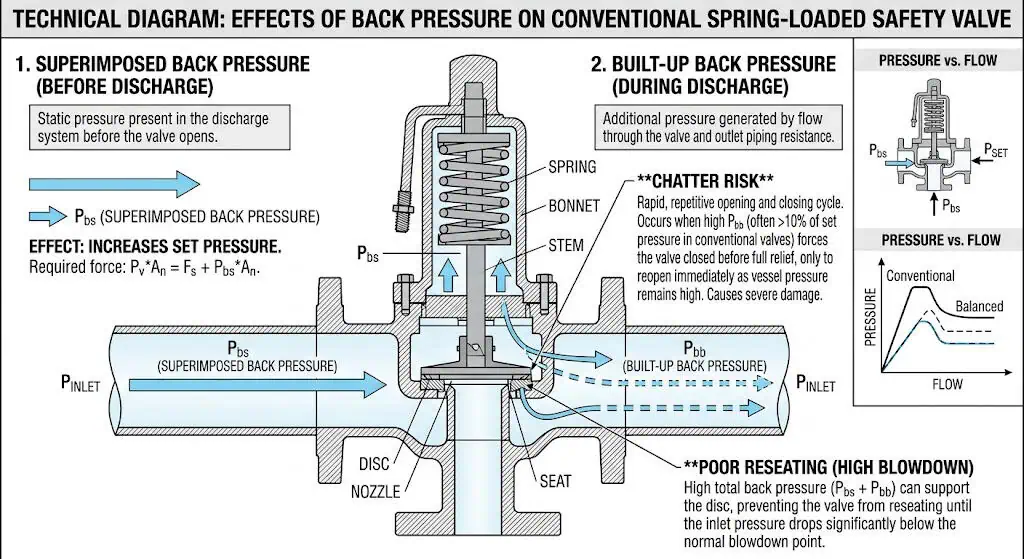
Back pressure changes how a safety valve behaves and must be identified early in selection. In practical review, engineers distinguish between superimposed back pressure and built-up back pressure. The distinction matters because the valve may see outlet pressure even before it opens, and then experience additional outlet pressure rise after flow starts moving through the discharge system.
Type of Back Pressure
Definition
Engineering Impact
Superimposed Back Pressure
Pressure present at the valve outlet before the valve opens.
Can change the force balance and affect set pressure behavior depending on valve design.
Built-up Back Pressure
Pressure that develops in the outlet system after the valve opens because of flowing discharge.
Can reduce effective relieving performance, affect blowdown, and promote instability.
Both matter. Users sometimes focus only on the flare header or downstream piping after opening, but constant or intermittent superimposed pressure can also change how the selected valve behaves. For practical details, see superimposed vs built-up back pressure in safety valves.
How Back Pressure Changes Valve Operation
Back pressure can change opening stability, effective relieving behavior, and reseating performance. For conventional spring-loaded valves, excessive or varying back pressure can promote unstable lift or reduce the margin needed for clean reseating. In real systems, the most common symptom is not a dramatic rupture. It is a valve that opens, closes, opens again, and damages its own seating surfaces through repeated instability.
Superimposed back pressure can influence the force balance acting on the valve.
Built-up back pressure can reduce effective flow performance and promote instability.
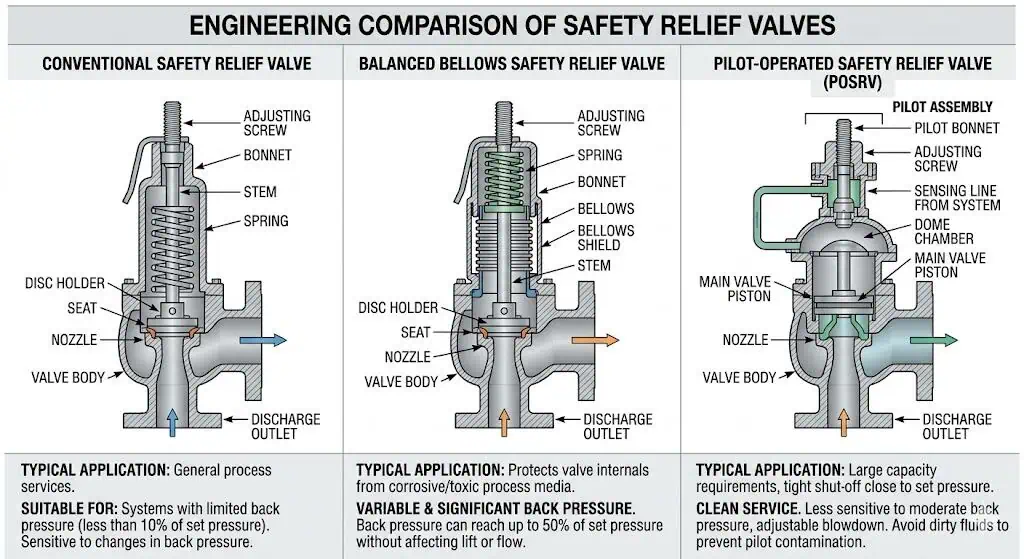
Variable outlet pressure is often a signal to review whether a conventional spring-loaded design is appropriate.
Outlet system resistance directly affects built-up back pressure, acoustic energy, discharge reaction, and reseating behavior.
Inlet pressure loss can also create instability because the pressure at the valve inlet may collapse after lift, causing cycling or chatter.
One real-world pattern appears after flare-header modifications. The original valve behaved acceptably for years. After a revamp, the header hydraulics changed, built-up back pressure increased, and the installed valve began to chatter. The set pressure did not change. The outlet system did. The prevention is to revalidate the relief-system hydraulics after discharge-header changes, capacity increases, new relief devices, or flare-system modifications.
Note: For constant, limited back pressure, a conventional valve may remain acceptable. For variable or more demanding outlet conditions, balanced bellows or pilot-operated designs often deserve review, subject to manufacturer limits, service cleanliness, temperature, and maintenance capability.
Outlet pressure can change valve stability, effective discharge behavior, blowdown, and reseating after lift.
Managing Back Pressure in Practical Projects
Managing back pressure is usually a system-level decision, not just a valve-body decision. Engineers review inlet loss, discharge routing, common header interaction, discharge reaction, acoustic risk, thermal movement, and valve type together. They do not simply “correct the set pressure” and hope the problem goes away.
Aspect
Description
Piping Design
Review inlet and discharge piping to limit instability and support the selected valve type.
Support Design
Ensure reaction loads and thermal movement are addressed, especially in larger valves, high set pressure, steam discharge, or long discharge piping.
Valve Type Selection
Check whether conventional, balanced bellows, or pilot-operated construction is more suitable for the outlet condition.
Service Cleanliness
Confirm whether dirty, sticky, waxy, or fouling media could affect pilot lines, guides, seat surfaces, or bellows life.
Maintenance Access
Ensure the valve can be tested, removed, recalibrated, resealed, and documented without compromising protection.
Engineers often use the following strategies in demanding applications:
Use a balanced bellows safety valve when outlet pressure variability would otherwise disturb a conventional valve, while still checking bellows pressure limit, fatigue, corrosion, and bonnet venting requirements.
Consider a pilot-operated safety valve when back pressure, operating margin, or tight shutoff justify it, but review service cleanliness and pilot maintenance carefully before committing to that design.
Reduce unnecessary outlet resistance where possible, especially long horizontal runs, undersized discharge piping, liquid pockets, and common-header configurations that were not included in the original relief study.
Recheck inlet pressure loss, especially when the valve is connected through a long inlet branch, multiple elbows, reducing fittings, or small nozzles.
Pilot-operated safety relief valves can isolate the main valve from some downstream pressure effects, but they are not universal problem solvers. In dirty, sticky, or fouling service, the pilot circuit itself can become the source of instability. That is one reason why pilot-operated selection should be tied to actual service condition review, not just brochure advantages. ISO 4126-4 provides product requirements for pilot-operated safety valves, but application suitability still depends on medium, temperature, pressure, contamination, back pressure, and maintenance practice.
Valve type selection should follow actual outlet conditions, service cleanliness, material compatibility, and maintenance capability, not only catalog preference.
Common Pitfalls When Reviewing Discharge, Set Pressure, and Back Pressure
Treating the Three Factors as Independent
Reviewing discharge capacity, set pressure, and back pressure as separate issues is one of the fastest ways to create a poor selection. These variables interact in every real safety valve application. When they are split across different reviewers or checked in isolation, the selection loses engineering integrity. One team may confirm the set pressure, another may check the nozzle size, and nobody may verify whether the discharge system makes the chosen valve unstable.
Common issues include:
Valve chatter caused by inlet or outlet conditions that were reviewed too late.
Reduced protection because discharge capacity was accepted without checking the true case basis.
Inadequate performance after plant modifications changed the relief-system hydraulics.
Seat leakage after installation because the valve operates too close to set pressure for long periods.
Failed technical review because certified capacity, nameplate data, or test documentation does not support the project basis.
Experienced engineers usually work in the opposite order: they define the relief case first, confirm the set pressure basis second, verify capacity third, and then review inlet and outlet behavior together with valve type, materials, seat tightness, and documentation.
Relying Too Much on Pressure Rating and Size
Focusing mainly on pressure rating and connection size often produces a technically incomplete selection. Pressure rating and size matter, but they do not prove that the valve can relieve the required load, remain stable in service, or pass project review. The discharge capacity and set-pressure logic must still match the system requirements.
Key risks:
The valve may not provide adequate protection during the actual overpressure event.
The valve may open at the nominal set pressure but still perform poorly because outlet conditions were ignored.
Complex, corrosive, two-phase, dirty, or variable service may require more than a size-and-rating match.
A same-size replacement may fail if the plant has been debottlenecked or if the discharge header has changed.
Pitfall
Impact on Protection
Engineering Check
Overreliance on size
False confidence in capacity adequacy.
Verify required relieving capacity, orifice area, and certified capacity.
Ignoring set pressure behavior
Nuisance leakage, simmer, or delayed protective response.
Check MAWP, operating margin, blowdown, and service fluctuation.
Neglecting back pressure
Unstable operation or degraded effective performance.
Review superimposed and built-up back pressure plus outlet system resistance.
Ignoring inlet pressure loss
Chatter or unstable lift after opening.
Review inlet piping, fittings, branch length, and nozzle arrangement.
Skipping documentation review
Purchase approval but technical rejection later.
Check test records, capacity basis, seat tightness, and repair pathway.
Ignoring Documentation and Service Conditions
Failure to review documentation and service conditions can turn a technically plausible valve into a field problem. Users should confirm actual service medium, fouling risk, corrosion potential, temperature range, pressure cycling, discharge route, and the project’s documentation route before final release. In one recurring field pattern, a pilot-operated valve is selected for tight shutoff advantages, but the service contains contaminants or condensable material. The pilot loop becomes unstable, the valve performance deteriorates, and the maintenance burden rises sharply.
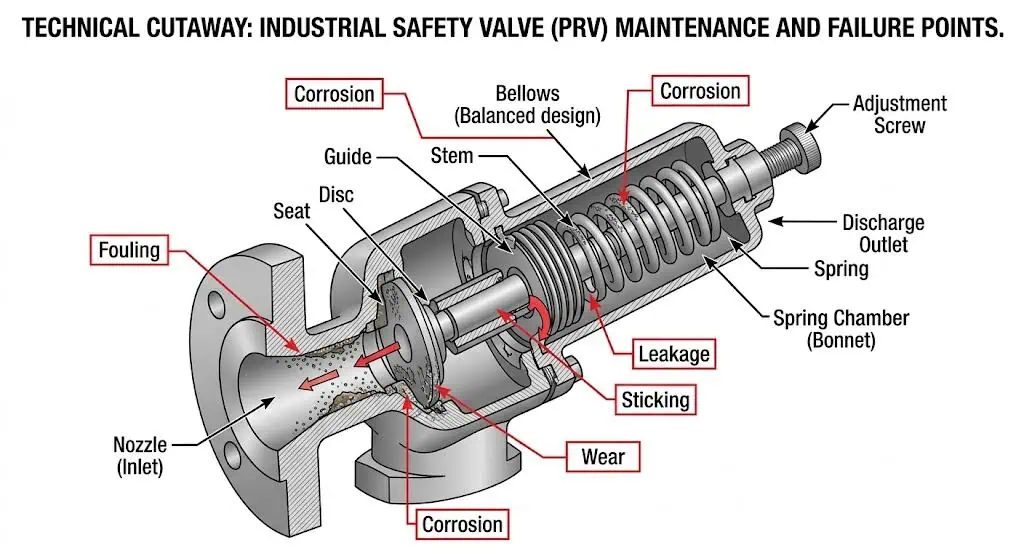
Another field pattern appears in corrosive service. The body material looks acceptable, but the nozzle, disc, guide, or spring environment is not compatible with the real medium. Chloride-bearing condensate, acidic vapors, sour components, or deposits attack the trim first. The first symptom is often seat leakage or guide sticking, not visible external corrosion. The prevention is to review safety valve material compatibility for body, nozzle, disc, guide, spring, bellows, and soft-seat components rather than body material alone.
Checklist for avoiding this pitfall:
Confirm the valve type suits the real service condition, not just the idealized fluid name.
Review required documents, inspection records, seat tightness records, and test support before purchase.
Update the relief review after facility modifications that change inlet conditions, outlet conditions, capacity requirement, or operating margin.
Confirm whether repair, recalibration, and resealing require a National Board / VR pathway, local inspection, or owner-approved procedure.
Check whether the service requires sour-service material review under NACE MR0175 / ISO 15156 or other owner material requirements.
Tip: Always verify that documentation, service condition review, and installation basis are aligned. Many late-stage failures are paperwork-plus-service failures, not casting failures.
Many recurring performance problems originate in the seating, guiding, bellows, spring, and pilot components rather than in the body alone.
Best Practices for Selecting Safety Valves
Step-by-Step Selection Guide
A structured approach improves both protection quality and approval success. Engineers should follow a practical sequence rather than selecting by catalog habit:
Define the governing relieving scenario: Identify the actual upset case, fluid state, relieving temperature, and required load.
Confirm the code and project basis: Check which standards, owner specifications, and inspection route govern the selection.
Establish the set pressure basis: Relate the setting to MAWP or protected equipment limit, operating margin, and blowdown behavior.
Verify required relieving capacity: Check the valve’s supported or certified capacity against the governing case.
Review inlet and outlet conditions: Evaluate inlet pressure loss, superimposed back pressure, built-up back pressure, discharge routing, and reaction loads.
Select the valve type: Decide whether conventional, balanced bellows, or pilot-operated design is appropriate for the medium and outlet condition.
Check materials and service compatibility: Review corrosion, fouling, temperature, sour service, soft-seat limits, and maintenance exposure.
Confirm documentation and maintenance path: Verify records, inspection route, repair expectations, recalibration procedure, and sealing requirements.
Prepare a controlled RFQ: Use a safety valve datasheet for RFQ so capacity, pressure, back pressure, materials, and documentation requirements are not missed.
Best Practice
Description
Case-first review
Start with the governing relief scenario, not with valve size.
Capacity verification
Confirm the selected valve can pass the required load using an accepted capacity basis.
Set-pressure discipline
Establish the setting from protected equipment limits, operating margin, and code route.
Installation review
Check inlet and outlet conditions before finalizing the valve type.
Material review
Check body, nozzle, disc, guide, spring, bellows, gaskets, and seat materials against the real medium.
Documentation control
Confirm inspection, test, seat tightness, repair, and recertification pathway before purchase.
Engineer’s Checklist
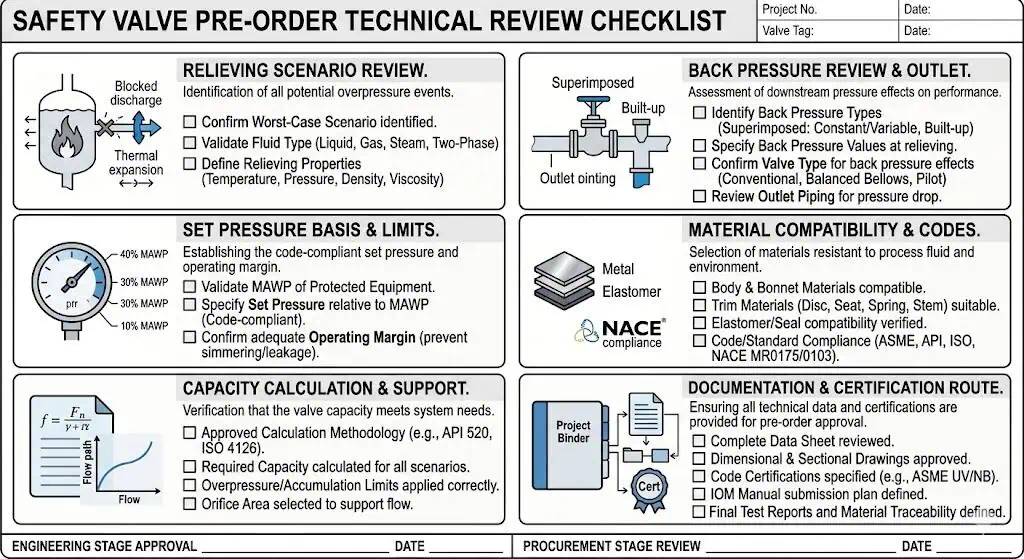
A structured pre-order check reduces the chance of approving a valve that fits the nozzle but not the duty.
A disciplined checklist helps engineers avoid the selection mistakes that are easiest to miss under schedule pressure.
Checklist Item
Description
Relieving Scenario Defined
Confirm the actual governing overpressure case and fluid state.
Set Pressure Basis
Verify against MAWP or protected equipment limit, code route, and operating margin.
Capacity Support
Check that certified or accepted capacity matches the required load.
Orifice Area
Confirm the effective or certified orifice selection is adequate for the relieving case.
Back Pressure Review
Evaluate superimposed and built-up back pressure effects.
Inlet Pressure Loss
Review inlet piping, nozzle, branch length, reducers, and fittings that can affect stability.
Confirm the applicable leakage test expectation and acceptance basis.
Documentation Route
Verify code, inspection, capacity, test, and repair records required by the project.
Tip: Update this checklist after any system modification. Relief problems often appear after revamps, flare changes, feed-rate increases, operating envelope changes, or maintenance work that changes the valve condition.
When to Consult Experts
Specialist review becomes especially valuable when the relief system has narrow operating margin, unstable back pressure, corrosive media, complex approval requirements, or uncertain service cleanliness. Engineers should consult experienced safety-valve specialists, qualified manufacturers, or relief-system engineers when:
Back pressure is variable, high, or difficult to predict.
The service is dirty, corrosive, sour, high-temperature, wet steam, flashing, two-phase, or likely to foul pilot passages or seating surfaces.
System modifications have changed the inlet or outlet hydraulics.
The project requires detailed ASME, API, ISO, National Board, NBIC, or owner-specific inspection and repair-path review.
The valve has repeated seat leakage, chatter, poor reseating, or unstable lift after maintenance.
The existing valve is being replaced by another series, another manufacturer, or another certification route.
Consulting specialists early is usually cheaper than correcting chatter, repeat leakage, insufficient capacity, or documentation failure after commissioning.
Discharge capacity, set pressure, and back pressure form the foundation of reliable safety valve selection because they determine whether the valve can deliver real protection during overpressure events. Users should always review these three factors together. Real engineering experience shows that most failures come from incomplete capacity review, weak pressure-setting logic, underestimated outlet effects, ignored inlet pressure loss, incompatible trim materials, or poor documentation rather than from the casting alone.
Review of opening, relieving, and reseating behavior is as important as review of nominal pressure rating.
Repeated analysis of service conditions and plant modifications helps prevent late-stage protection failures.
Post-maintenance recalibration, testing, documentation, and sealing are part of the protection system, not administrative details.
A practical selection process combines technical review, project documentation, installation review, and service-condition checking before any valve is ordered or replaced.
A complete RFQ reduces wrong substitutions, missing capacity data, and late-stage documentation disputes.
Correct selection of safety valves leads to safer operation, stronger compliance, better stability, and lower long-term maintenance risk.
FAQ
What is the most important factor when selecting a safety valve?
No single parameter should be isolated, but required relieving capacity is often the first technical screen.
It determines whether the valve can actually protect the equipment during the governing case.
It must be reviewed together with set pressure, back pressure, inlet pressure loss, and valve type.
Connection size alone does not prove the valve is suitable.
How does back pressure affect safety valve performance?
Back pressure can change opening stability, effective relieving performance, capacity application, and reseating behavior.
Type
Effect on Valve
Superimposed
Can influence the force balance acting on the valve before opening.
Built-up
Can reduce effective relieving performance and promote instability after opening.
Why must set pressure match system requirements?
Set pressure determines when the valve starts to protect the equipment.
It should be established from the protected equipment’s allowable pressure limit and code basis.
It should be selected with attention to normal operating pressure and operating margin.
It must fit the governing code and project review basis.
It should be reviewed together with overpressure, accumulation, and blowdown.
When should engineers consult safety valve specialists?
Specialist input is most useful when service conditions or relief-system behavior are not straightforward.
Variable or uncertain back pressure.
Dirty, corrosive, sour, high-temperature, flashing, or two-phase service.
System modifications or revamps.
Complex code, inspection, repair, or documentation requirements.
Repeated chatter, seat leakage, poor reseating, or unexplained instability.
What standards guide safety valve selection?
Different standards answer different questions in safety valve work.
Standard
Main Use
ASME BPVC Section VIII, Division 1
Pressure vessel code basis and protection framework.
API 520 Part I
Sizing and selection of pressure-relieving devices.
API 520 Part II
Installation of pressure-relieving devices.
API 521
Pressure-relieving and depressuring systems.
API 527
Seat tightness testing.
ISO 4126-1 / 4126-4
Product requirements for safety valves and pilot-operated safety valves.
National Board / NBIC / VR
Inspection, repair, and repair authorization framework where required by the project or jurisdiction.
What is the difference between set pressure and overpressure?
Set pressure is the pressure at which the valve is adjusted to start opening; overpressure is the pressure increase above set pressure during relieving. Accumulation is related to the protected equipment pressure boundary, and blowdown is the pressure difference between opening and reseating. These terms must be reviewed together because they define opening, allowable pressure rise, and closing behavior.
Why is certified relieving capacity more important than connection size?
Certified relieving capacity proves whether the valve can pass the required flow. Connection size only proves whether the valve can be connected to the piping. A valve can match the inlet nozzle and still be undersized if the required relieving load is higher than the valve’s certified or project-accepted capacity.
Why does a safety valve leak after installation?
Leakage after installation can come from seat damage, dirt, incorrect operating margin, thermal distortion, corrosion, back pressure, vibration, or improper recalibration after maintenance. The first step is to compare shop test records with installed conditions, then check operating pressure, inlet cleanliness, outlet load, seat material, and whether the valve was correctly resealed after adjustment.
To provide the best experiences, we use technologies like cookies to store and/or access device information. Consenting to these technologies will allow us to process data such as browsing behavior or unique IDs on this site. Not consenting or withdrawing consent, may adversely affect certain features and functions.
Functional
Always active
The technical storage or access is strictly necessary for the legitimate purpose of enabling the use of a specific service explicitly requested by the subscriber or user, or for the sole purpose of carrying out the transmission of a communication over an electronic communications network.
Preferences
The technical storage or access is necessary for the legitimate purpose of storing preferences that are not requested by the subscriber or user.
Statistics
The technical storage or access that is used exclusively for statistical purposes.The technical storage or access that is used exclusively for anonymous statistical purposes. Without a subpoena, voluntary compliance on the part of your Internet Service Provider, or additional records from a third party, information stored or retrieved for this purpose alone cannot usually be used to identify you.
Marketing
The technical storage or access is required to create user profiles to send advertising, or to track the user on a website or across several websites for similar marketing purposes.