Share your medium, set pressure, temperature, size, standard, or datasheet, and our team will review your requirement and respond with the appropriate next step.
Where Is a Safety Relief Valve Usually Located? Installation Rules and Common Mistakes
A safety relief valve is usually located as close as practical to the protected vessel, boiler, pressurized equipment, or blocked-in piping section, using a short, direct, and non-restrictive inlet connection. That is the correct general answer, but the real engineering decision goes further. The selected location must allow the valve to sense the protected equipment pressure …
A safety relief valve is usually located as close as practical to the protected vessel, boiler, pressurized equipment, or blocked-in piping section, using a short, direct, and non-restrictive inlet connection. That is the correct general answer, but the real engineering decision goes further. The selected location must allow the valve to sense the protected equipment pressure correctly, open without instability, pass the required relieving capacity, discharge to a safe destination, and remain accessible for inspection, testing, removal, recalibration, and resealing.
A safety relief valve placed too far from the pressure source, mounted in an unapproved orientation, isolated by an incorrectly managed block valve, or connected through restrictive inlet piping may still look acceptable in a three-dimensional model while performing poorly during an actual overpressure event. Users commonly ask whether the valve can be installed on piping instead of directly on the vessel, whether horizontal mounting is acceptable, and how much inlet piping is too much. These are not minor layout questions. They directly affect inlet pressure loss, lift stability, certified capacity application, back pressure, commissioning acceptance, and long-term reliability.
Poor location can increase inlet pressure loss and contribute to unstable opening, flutter, or chatter.
Poor discharge routing can create built-up back pressure, unsafe reaction loads, condensate accumulation, and reduced effective relieving performance.
Poor access can turn an otherwise compliant installation into a recurring inspection and maintenance problem.
An incorrectly located isolation valve can leave the protected equipment without an available pressure-relief path.
A correct set pressure does not compensate for a restrictive or poorly supported installation.
In most systems, the best location is the one that protects the actual source of overpressure with the least inlet resistance and the clearest path for safe discharge, inspection, testing, and recertification. The final arrangement must still comply with the applicable code, owner specification, manufacturer instructions, and relief-system design basis.
Where Is a Safety Relief Valve Usually Located in Real Systems
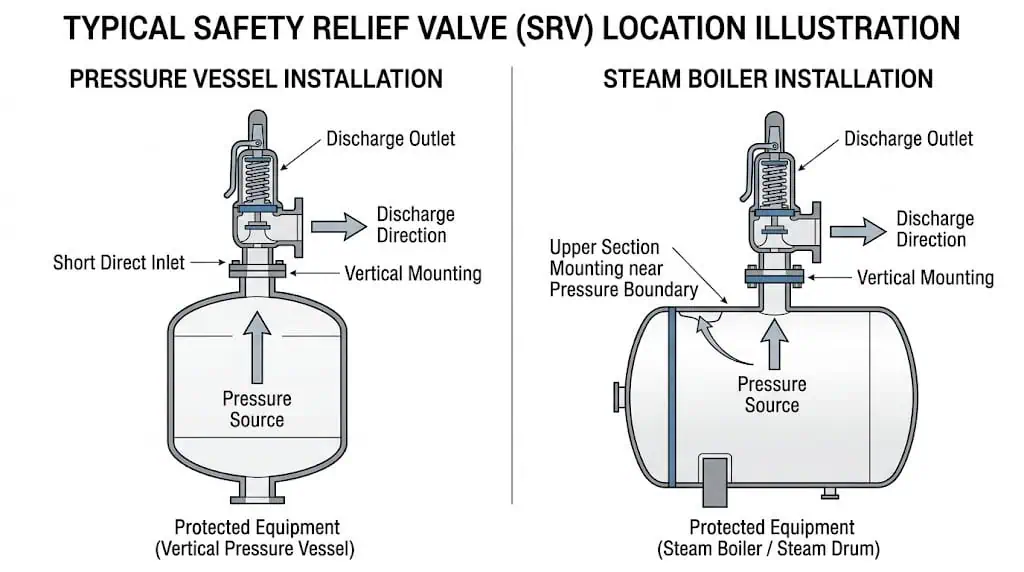
The usual installation point is close to the protected pressure source, with a short inlet path, upright mounting, safe discharge routing, and practical maintenance access.
On Pressure Vessels and Protected Equipment
In most pressure-vessel applications, the safety relief valve is installed directly on the vessel nozzle or on a very short inlet connection from the protected equipment. This arrangement reduces inlet pressure loss and allows the valve to respond to the actual vessel pressure with minimal hydraulic delay. For gas and vapor service, the connection is commonly taken from the vapor space or another point that accurately represents the pressure of the protected volume.
The valve location should protect the same pressure boundary used in the relief calculation. Installing a valve on a nearby process line does not automatically protect the vessel if an isolation valve, check valve, restriction, control valve, or operating configuration can separate that line from the vessel during the overpressure scenario.
Engineering principle: “Close to the vessel” is not merely a piping preference. It helps the valve see the correct pressure, reduces inlet loss, and preserves the assumptions used in sizing and certification review.
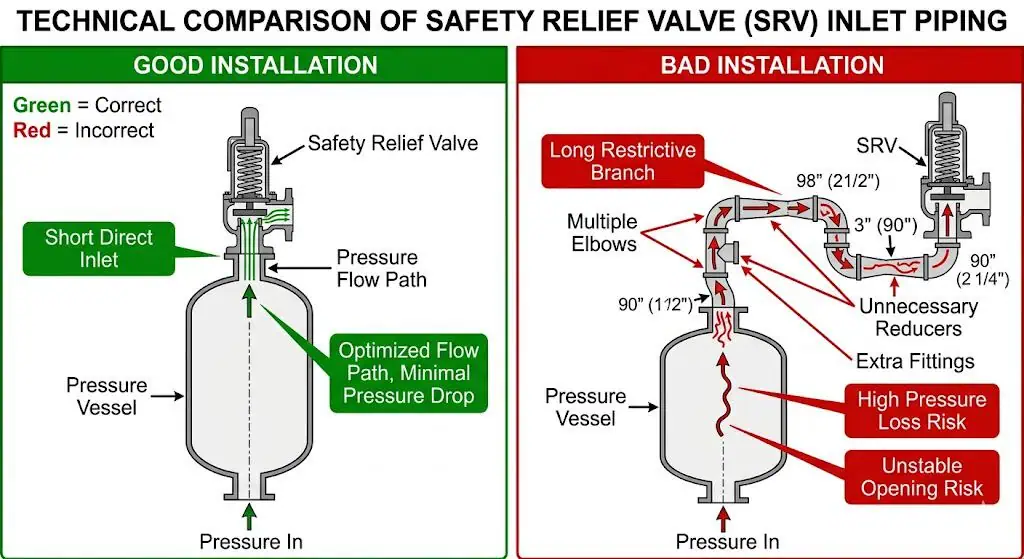
Users sometimes assume that a safety relief valve can be moved several metres away if the nominal pipe size remains unchanged. In real projects, this assumption can create problems. Additional pipe length, reducers, branch connections, elbows, strainers, isolation valves, and fittings all add resistance. During relieving flow, the pressure at the valve inlet may then fall below the pressure inside the protected equipment, causing unstable valve lift.
Composite engineering scenario: A replacement PSV was moved farther from a separator vessel to improve platform access. The inlet connection size was unchanged, but two elbows, a reducer, and a longer spool were added. The valve passed its shop set-pressure test but chattered during commissioning. Investigation showed that the added inlet resistance caused the pressure at the valve inlet to collapse after lift. The corrective action was to shorten and enlarge the inlet arrangement and restore a more direct connection to the protected vessel.
Typical Location
Why It Is Used
Common Risk If Misapplied
Directly on the vessel nozzle
Fast pressure sensing and minimum inlet resistance.
Maintenance access may be poor if clearance and lifting arrangements are ignored.
Very short branch from the protected equipment
May be acceptable when direct mounting is impractical.
Fittings, reductions, or isolation valves can still increase inlet pressure loss.
Remote point selected for layout convenience
Usually driven by access or structural constraints rather than protection logic.
Higher inlet loss, delayed response, unstable lift, and more difficult engineering justification.
Nearby process line
Sometimes assumed to represent vessel pressure.
May not protect the vessel if operating valves or check valves can isolate the connection.
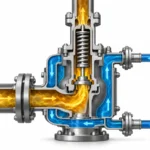
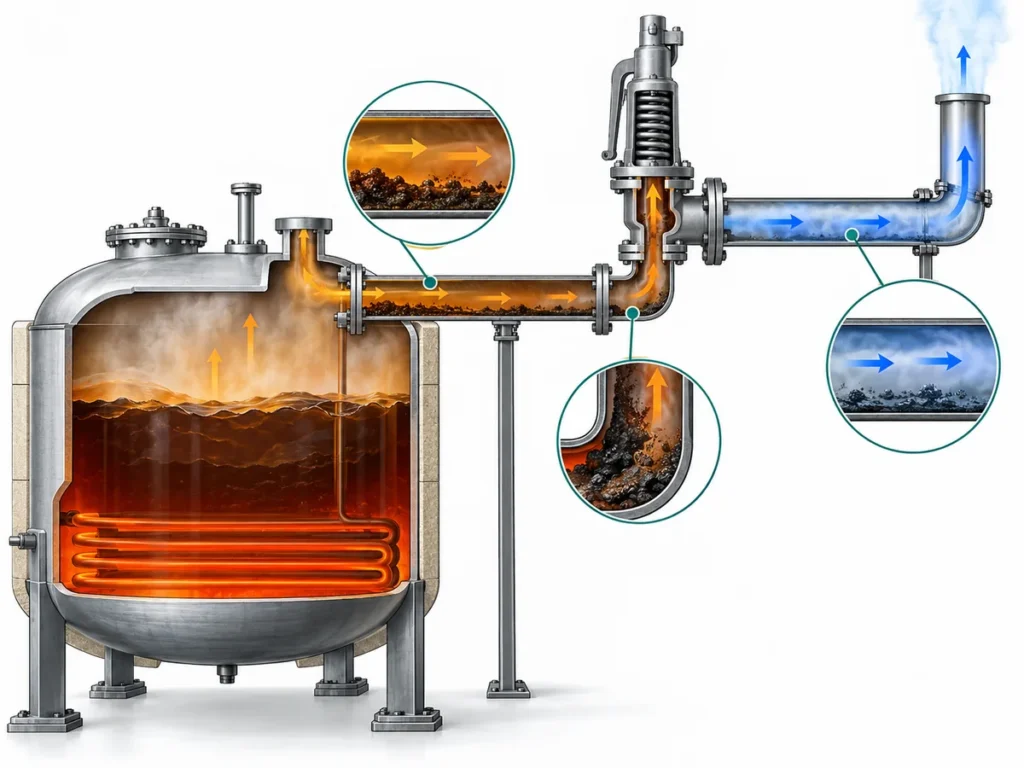
The valve’s inlet connection should also avoid process conditions that can block or impair the pressure path. Polymerizing media, coke, wax, solids, corrosion products, and frozen condensate can obstruct a small branch even when its hydraulic sizing originally appeared acceptable.
On Boilers and Steam Systems
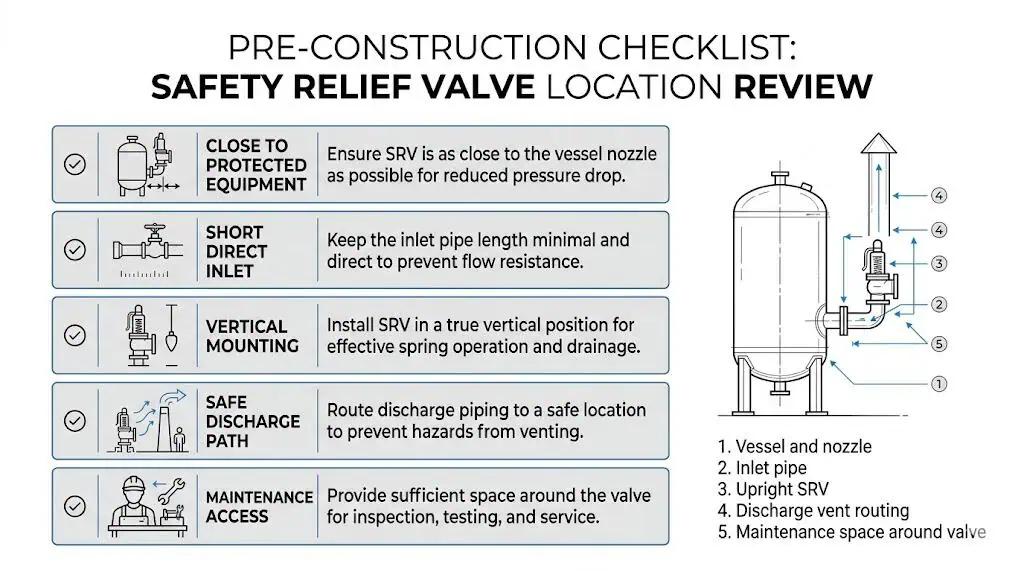
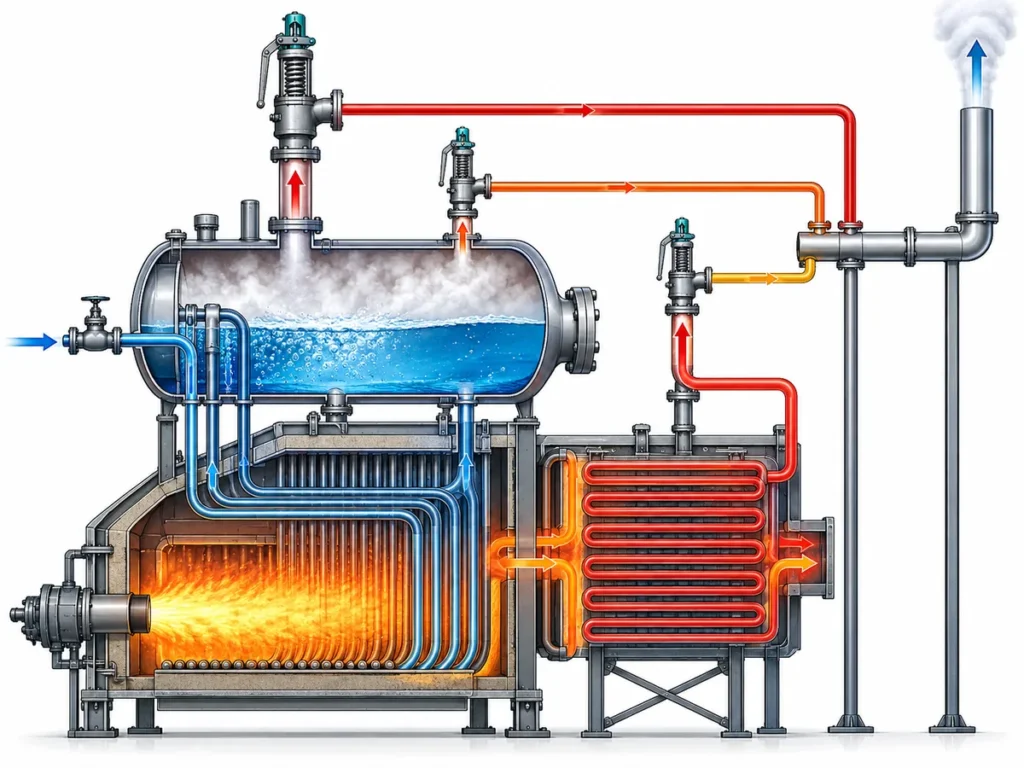
In boiler and steam service, the safety valve is normally installed directly on the boiler, steam drum, superheater outlet, or another designated protected opening required by the applicable boiler code. Boiler safety valves are not interchangeable with ordinary pressure-vessel relief installations simply because the pressure and connection size appear similar. Boiler protection, certification, capacity, blowdown, discharge piping, and installation details follow the applicable boiler code route.
Remote installation at an easy-to-pipe point in the steam line may fail to represent the protected boiler pressure correctly. Steam installations also require particular attention to condensate drainage, thermal expansion, discharge reaction loads, vibration, vertical spindle alignment, and the possibility of water accumulation in the outlet piping.
Inspection teams commonly review:
Whether the valve is installed on the correct protected section of the boiler or steam system.
Whether the valve type, certification marking, set pressure, and certified capacity match the boiler duty.
Whether the spindle is upright and the valve body is free from excessive piping loads.
Whether discharge piping permits drainage and does not impose damaging back pressure or mechanical load.
Whether operating levers, test devices, nameplates, seals, and adjustment components remain accessible.
Whether maintenance and testing can be completed without compromising another required relief path.
Engineering experience: Steam service exposes installation weaknesses quickly. Poor drainage can cause water accumulation and corrosion. Unsupported discharge piping can transfer reaction and thermal loads into the valve body. Operating too close to set pressure can cause simmer and seat damage. These problems cannot be corrected by changing the spring alone.
For boiler service, the applicable requirements should be checked against ASME BPVC Section I or the governing local boiler code. Pressure-vessel assumptions should not be copied into a boiler installation without confirmation.
In Piping Systems and Thermal Relief Applications
In piping systems, a safety relief valve, relief valve, or thermal relief valve may be installed on the piping itself when the protected hazard exists inside that piping section rather than inside a vessel. This is common in blocked-in liquid segments, heat-traced lines, solar-heated piping, LNG or LPG transfer lines, jacketed systems, positive-displacement pump systems, and equipment packages where liquid expansion can create high pressure.
This distinction matters because users often confuse two different protection duties:
Vessel overpressure protection: The pressure-relieving device normally protects the vessel directly and should be connected close to the protected vessel pressure boundary.
Line or thermal relief protection: The device protects a trapped or isolated liquid volume, so it must be located where the entire blocked-in segment remains connected to the relief path.
Pump discharge protection: The device must protect the pump and downstream system against blocked discharge or excessive differential pressure, subject to the actual process design.
Installing a relief device somewhere “on the piping” is therefore not automatically wrong. What matters is whether the selected point remains connected to the protected volume under every credible operating configuration and whether the inlet path is suitable for the intended fluid, flow, and relieving scenario.
For thermal relief duty, a small connection may be sufficient for the calculated expansion load, but that does not justify selecting the device by connection size alone. The required relieving capacity, set pressure, liquid properties, relieving temperature, discharge destination, and possibility of flashing should still be confirmed.
Why Safety Relief Valve Location Affects Real Performance
Inlet Piping Length, Pressure Loss, and Stable Opening
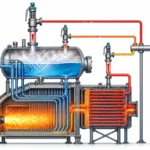
The inlet arrangement has a direct effect on whether the safety relief valve opens stably and delivers its intended protective function. Long inlet piping, undersized branches, unnecessary block valves, reducers, strainers, and multiple elbows can create pressure loss between the protected system and the valve inlet. Once the valve begins to flow, this pressure loss may increase rapidly.
If the pressure at the valve inlet falls enough after opening, the valve may begin to close even while the protected equipment remains above the required pressure. Pressure then rebuilds, the valve opens again, and a repeated opening-and-closing cycle develops. This is one common mechanism behind chatter.
Short, direct inlet piping improves pressure transmission to the valve.
Restrictive inlet piping can contribute to chatter, flutter, reduced lift, and seat damage.
A set-pressure test verifies valve adjustment under test conditions; it does not prove that the installed inlet piping is acceptable.
Inlet pressure loss must be reviewed at relieving flow, not only during normal operation when there may be little or no flow through the branch.
A correctly sized valve can still be unstable if its inlet connection is poorly designed.
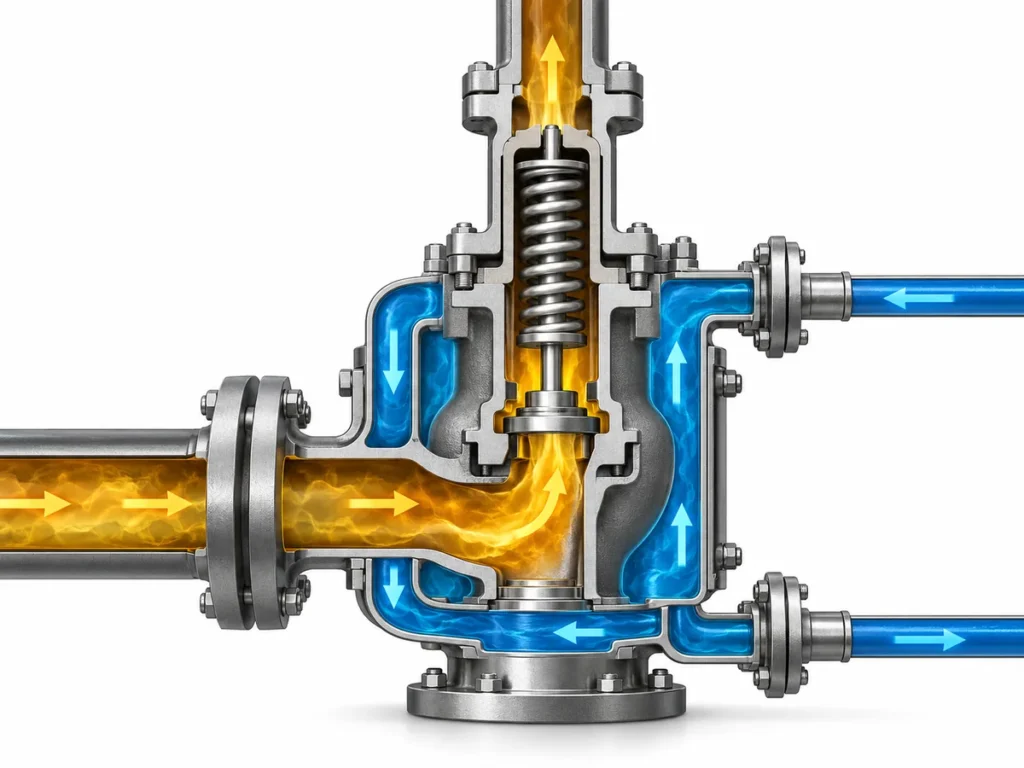
Inlet geometry affects pressure loss, stable opening, disc lift, chatter risk, and the ability to deliver certified relieving capacity.
Composite engineering scenario: A pressure-vessel PSV met the required set pressure on the test bench. After installation, it opened with repeated chatter during an upset test. Field routing had introduced a long branch line with several fittings. The installation created a pressure-drop problem that was absent during bench testing. Reworking the inlet branch solved the instability without changing the valve spring.
Practical rule: Keep the inlet connection as short, direct, and non-restrictive as practical, then verify it against the applicable code, manufacturer instructions, and relieving-flow calculation.
API 520 Part II includes installation guidance for pressure-relieving devices and provides a framework for performing an engineering analysis where the installation requires more detailed review. Users should not rely on a general rule of thumb when the inlet is long, the fluid flashes, acoustic interaction is possible, or multiple relief devices interact.
Outlet Routing, Back Pressure, and Discharge Safety
The safety relief valve location also determines how the discharge system behaves, affecting valve stability, relieving performance, mechanical loading, and personnel safety. A technically correct inlet location can still become a poor installation if the outlet piping creates excessive built-up back pressure, poor drainage, damaging reaction loads, or an unsafe discharge direction.
Outlet Routing Factor
What It Influences
Why It Matters
Closed discharge header or flare tie-in
Superimposed and built-up back pressure.
Can affect lift, effective capacity, blowdown, and reseating.
Long or undersized outlet piping
Flow resistance and discharge reaction.
May increase back pressure, noise, vibration, and mechanical stress.
Poor support at elbows and risers
Mechanical reaction and thermal loads.
Can overload the valve outlet, vessel nozzle, or connected piping.
Unsafe atmospheric vent direction
Personnel exposure, ignition, toxicity, and environmental release.
Can create a serious site hazard even when the valve itself operates correctly.
No drainage or poor condensate handling
Corrosion, freezing, water accumulation, and outlet blockage.
Can damage the valve or prevent reliable future operation.
Silencer or downstream restriction
Additional outlet resistance.
Can change built-up back pressure and must be included in the discharge review.
A correctly selected valve can still perform poorly if its discharge system creates excessive back pressure, retained liquid, unsafe release, or unbalanced reaction loads.
For a valve connected to a flare or common header, the outlet pressure should be evaluated for both the valve’s own relieving flow and other credible simultaneous relief loads. A conventional spring-loaded valve, a back pressure balanced safety valve, and a pilot-operated valve do not respond identically to outlet pressure.
Composite engineering scenario: A conventional valve operated acceptably for several years before a new relief device was connected to the same header. During a later upset, the original valve chattered and reseated poorly. The valve had not changed, but the discharge system had. The added relief load increased built-up back pressure. The corrective action was to revalidate the header hydraulics and review whether a balanced or pilot-operated configuration was required.
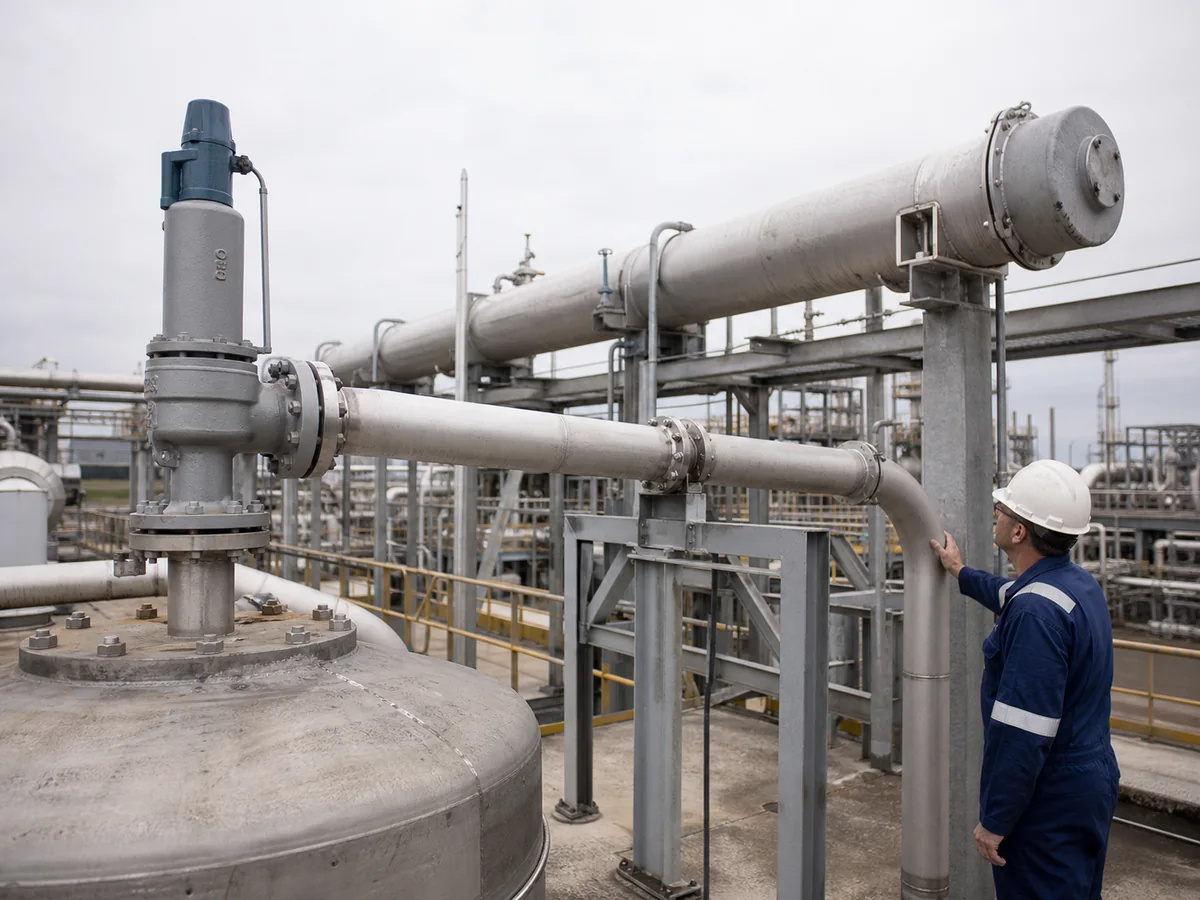
A safety relief valve should be located where technicians can inspect, remove, test, and reinstall it safely without major dismantling or uncontrolled exposure to the process. Maintenance access is often underestimated during design. A valve may satisfy the basic pressure-protection logic but become a poor lifecycle installation if maintenance crews cannot reach it safely.
Good access supports:
Visual inspection for corrosion, leakage, missing seals, damaged vents, or altered nameplates.
Safe removal for bench testing, repair, or recertification.
Verification of set pressure, seat tightness, serial number, and service identification.
Use of lifting equipment without placing load on small-bore connections or instrumentation.
Access to bellows bonnet vents, pilot tubing, drains, test gags, and lifting levers where applicable.
Efficient reinstatement and confirmation that isolation valves have returned to their required operating position.
After repair or adjustment, the valve should be recalibrated, tested, documented, and resealed in accordance with the applicable owner, jurisdictional, and repair-quality-system requirements. Where a recognized National Board repair route is required, the VR Certificate of Authorization framework may apply.
Lifecycle warning: One of the most common retrofit mistakes is solving the protection problem on paper while creating an unsafe removal, testing, or reinstatement problem in the field.
What Mounting Orientation Is Usually Required
Why Vertical Installation Is the Standard Practice
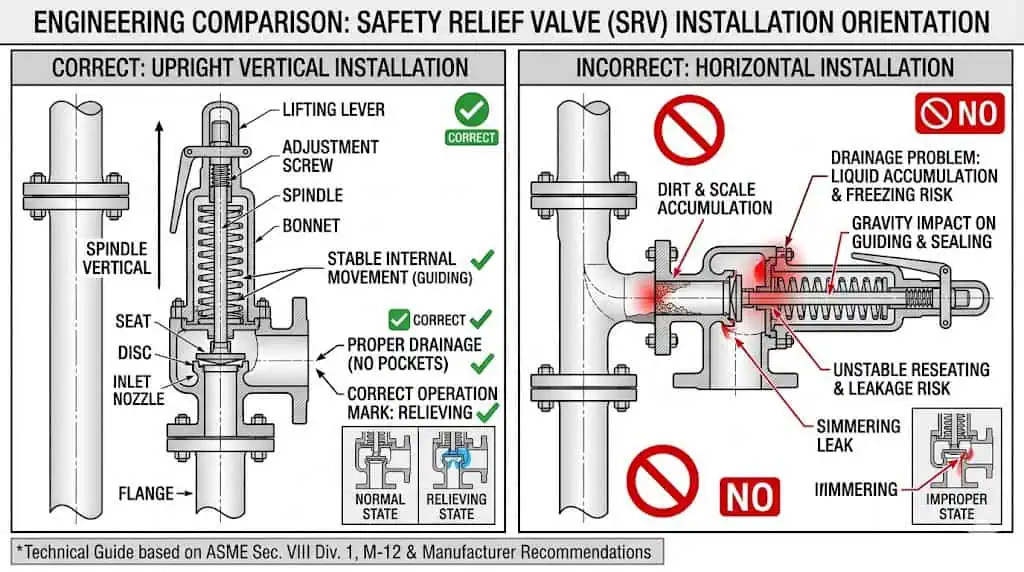
Most direct spring-loaded safety relief valves are installed upright with the spindle vertical unless the manufacturer explicitly approves another orientation for the specific model. The internal moving parts, spring alignment, guide clearances, drainage, and test basis are generally developed around upright installation.
Vertical installation helps:
Maintain predictable disc, spindle, and guide movement.
Reduce uneven side loading and friction on moving components.
Support consistent opening and reseating behavior.
Reduce the chance of condensate, deposits, or debris collecting against the seating and guiding surfaces.
Keep the installed arrangement consistent with the manufacturer’s test and certification basis.
Users sometimes ask whether horizontal installation is acceptable when space is limited. For a standard spring-loaded valve, the answer should not be assumed. Horizontal, angled, or inverted mounting requires explicit manufacturer confirmation for that design, together with acceptance by the responsible engineer and applicable inspection authority.
Most direct spring-loaded safety relief valves are intended for upright installation unless the manufacturer specifically approves another orientation.
Orientation Practice
Engineering Basis
Potential Risk
Vertical with spindle upright
Supports normal spring, guide, disc, drainage, and reseating behavior.
Usual and preferred installation basis.
Non-vertical with specific manufacturer approval
May be acceptable for a model designed and tested for that orientation.
Must match product documentation and project approval.
Non-vertical without approval
Usually selected for layout convenience only.
Sticking, leakage, uneven wear, drainage problems, or failed inspection.
What Happens If Orientation Is Wrong
Incorrect orientation can reduce reliability even when the valve does not fail immediately. A horizontal or angled valve may continue to open during an initial test, yet experience uneven guide wear, condensate retention, contaminated seating surfaces, or unstable reseating after repeated operation.
Disc, spindle, or guide components may experience side loading.
Dirt and condensate may collect at sensitive internal locations.
The valve may fail to reseat cleanly after lifting.
Seat tightness can deteriorate over repeated cycles.
Drainage and bonnet vent arrangements may no longer function as intended.
The installation may be rejected because it does not match manufacturer instructions or the approved design basis.
Composite engineering scenario: A compact retrofit skid used horizontal mounting to clear structural steel. The valve did not fail immediately, but repeated leakage developed after several cycles. Inspection found condensate and deposits around the guide and seat area. The long-term correction required redesigning the support and restoring the manufacturer-approved orientation rather than repeatedly lapping the seat.
Codes, Standards, and Manufacturer Rules That Influence Location
ASME, API, and Other Applicable Code Expectations
Codes and standards do not merely require that pressure-relief protection exists. They also influence the protected pressure boundary, sizing basis, inlet arrangement, discharge system, inspection pathway, and repair requirements. Different documents answer different engineering questions, so they should not be treated as interchangeable.
ASME BPVC Section I applies to power boilers and the associated boiler safety-valve code route.
ASME BPVC Section VIII, Division 1 provides requirements for pressure-vessel design, fabrication, inspection, testing, and certification.
API 520 Part I addresses sizing and selection of pressure-relieving devices in refinery and related process-industry service.
API 520 Part II addresses installation, including inlet and discharge-system considerations.
API 521 addresses pressure-relieving and depressuring systems and supports system-level relief-scenario review.
API 527 addresses seat tightness testing for pressure relief valves.
API RP 576 provides inspection guidance for pressure-relieving devices and supports lifecycle inspection planning.
ISO 4126-1 provides general product requirements for safety valves; it is a product standard and does not replace application-specific installation analysis.
National Board and NBIC requirements may influence inspection, repair, recalibration, and return-to-service acceptance.
Code or Standard Direction
Primary Scope
Why It Matters to Location
ASME BPVC Section I
Power boilers and boiler safety valves.
Defines the boiler code route, protected openings, certification, and safety-valve requirements.
ASME BPVC Section VIII, Division 1
Pressure vessels.
Connects relief protection to the vessel pressure boundary and code acceptance basis.
API 520 Part I
Sizing and selection.
Confirms required capacity and valve selection before installation details are finalized.
API 520 Part II
Installation.
Supports inlet-loss, outlet-piping, back-pressure, support, and engineering-analysis review.
API 521
Relief and depressuring systems.
Supports definition of the overpressure scenario and discharge-system interaction.
API 527
Seat tightness.
Supports leakage acceptance and post-repair or procurement test requirements.
API RP 576
Inspection practices.
Supports inspection planning, access, failure evaluation, and maintenance records.
A code-compliant valve can still be installed incorrectly. Conversely, an apparently neat installation may fail technical review if it does not protect the correct pressure boundary, match the certified capacity basis, or comply with the approved installation route.
Standards boundary: The applicable code route controls project approval and inspection acceptance. Catalog preference or a previous installation at another plant does not replace the project-specific review.
Why Manufacturer Instructions Still Matter
Even when the code framework is clear, the manufacturer’s installation instructions remain essential because they define product-specific limitations. The valve manufacturer may specify orientation, allowable back pressure, bonnet vent arrangements, inlet and outlet connection limits, vibration precautions, lifting methods, storage requirements, drain provisions, and minimum service clearances.
Manufacturer documentation commonly covers:
Permitted installation orientation.
Inlet and outlet configuration restrictions.
Back pressure limits and correction requirements.
Bonnet vent handling for balanced bellows valves.
Pilot sensing-line routing for pilot-operated safety valves.
Drainage and weather protection.
Handling, lifting, storage, and preservation.
Inspection, disassembly, testing, and maintenance procedures.
Manufacturer instructions do not replace the relief-system design, but they establish how the selected product must be installed to remain within its tested and supported operating boundary.
Document-control tip: Keep the installation and maintenance manual in the turnover dossier and valve history file, not only in the original procurement correspondence.
Special Cases Users Often Get Wrong
Space Constraints, Retrofits, and Existing Plant Limitations
Space constraints do not remove the engineering requirements governing safety relief valve location. Retrofit projects often try to place the valve in the only available space instead of the correct protective location. This can create longer inlet runs, excessive fittings, compromised support, poor maintenance access, or non-vertical mounting.
Common retrofit mistakes include:
Adding spool length simply to clear a platform, cable tray, or structural member.
Moving the valve to improve access while increasing inlet pressure loss.
Installing the valve where removal later requires line cutting, hot work, or extensive scaffolding.
Accepting horizontal or angled mounting because the existing layout is crowded.
Transferring heavy discharge piping loads into the valve outlet.
Reusing an old discharge header without checking the new required relieving capacity.
Installing a block valve for maintenance without defining its locking, sealing, interlocking, or operating-control requirements.
Common Issue
Why It Happens
Better Engineering Direction
Long inlet piping
Routing around existing equipment or structures.
Rework the local layout to keep the inlet path short and verify inlet pressure loss.
Hard-to-reach valve location
Access was not included in early design.
Provide permanent access, clearance, and lifting arrangements.
Compromised mounting angle
Structural interference or limited skid height.
Modify support steel or equipment layout instead of rotating the valve without approval.
Heavy outlet load
Discharge piping was routed without load review.
Provide independent support and evaluate reaction and thermal loads.
Uncontrolled isolation valve
Maintenance convenience was prioritized over protection availability.
Apply an approved locking, sealing, interlocking, or operating procedure that preserves relief protection.
An isolation valve between protected equipment and a safety relief valve requires particular caution. Such arrangements should only be used where the governing code and owner procedures permit them and where the system ensures that adequate pressure-relief protection remains available. A block valve left closed after maintenance can defeat the complete protection system even when the PSV itself is correctly sized and calibrated.
Unusual System Designs, Remote Mounting, and Manifolded Systems
Remote mounting and manifolded layouts can be acceptable only when treated as full engineering cases rather than convenience decisions. Packaged skids, compact modules, flare-connected systems, spare-valve changeover arrangements, and manifolded relief systems can create interactions that are not visible from the valve datasheet alone.
Remote mounting increases inlet length and can undermine stable opening.
Shared inlet manifolds can create interaction between valves or protected equipment.
Shared discharge systems can create superimposed and built-up back pressure.
Changeover valves can leave equipment unprotected if their position is not controlled and verified.
Weak support design can transmit reaction or thermal loads into the valve and equipment nozzle.
Rupture disks installed upstream or downstream can change pressure loss, inspection, and monitoring requirements.
Pilot-operated valves may need special sensing-line routing, drainage, filtering, and freeze protection.
Industry lesson: When unusual layouts fail, the pressure relief valve is often blamed first. Detailed review frequently shows that inlet loss, support, outlet back pressure, isolation practices, pilot tubing, drainage, or installation geometry created the real problem.
Engineering boundary: A special layout is not automatically wrong, but it requires documented analysis and approval rather than reliance on available space or visual similarity to another installation.
What Users Should Check Before Finalizing Safety Relief Valve Location
Installation Checklist Before Construction
Before construction starts, the project team should confirm that the selected location protects the actual pressure boundary and preserves the assumptions used in the relief calculation. A structured pre-installation review helps prevent rework, failed inspection, unstable startup behavior, and unsafe maintenance conditions.
Confirm the valve protects the correct vessel, boiler, equipment item, or blocked-in piping section.
Confirm no process valve, check valve, or operating configuration can unintentionally isolate the valve from the protected pressure source.
Confirm the inlet connection is as short and direct as practical and free of unnecessary restrictions.
Confirm inlet pressure loss is acceptable under relieving flow, not only during normal operation.
Confirm the mounting orientation is upright unless the manufacturer specifically approves another arrangement.
Confirm the outlet system will not create unreviewed superimposed or built-up back pressure.
Confirm discharge piping is independently supported and reaction loads have been evaluated.
Confirm atmospheric discharge is routed away from personnel, ignition sources, occupied areas, and vulnerable equipment.
Confirm drains, bonnet vents, pilot lines, and weather protection are correctly arranged.
Confirm technicians have safe access for inspection, removal, testing, and recertification.
Confirm the valve nameplate, datasheet, set pressure, material, service medium, and installation basis match the actual duty.
Confirm isolation-valve positions and control methods preserve required relief protection.
Confirm set pressure, seat tightness, capacity documentation, and material records are included in the turnover package.
A pre-construction review should confirm the protected pressure boundary, inlet arrangement, orientation, discharge routing, support, access, capacity, and documentation.
Project-control tip: Include the location review in relief-system design, constructability review, piping stress review, mechanical completion, pre-startup safety review, and maintenance planning.
A controlled safety valve RFQ datasheet should include the protected equipment, relief scenario, set pressure, required capacity, back pressure, inlet and outlet piping, materials, orientation, documentation, and inspection requirements before the purchase order is released.
Common Placement Mistakes That Lead to Rework
Most location-related rework comes from a limited number of repeated installation mistakes. These issues often look minor during layout development but become obvious during commissioning, inspection, or the first actual relieving event.
Placement Mistake
Likely Consequence
How to Prevent It
Valve located too far from the protected equipment
Higher inlet pressure loss, unstable opening, or delayed pressure response.
Keep the valve close to the protected pressure source and verify the inlet calculation.
Restrictive inlet arrangement
Chatter, flutter, reduced lift, or seat damage.
Minimize fittings, avoid unnecessary reductions, and evaluate relieving-flow pressure loss.
Horizontal mounting without approval
Uneven wear, condensate retention, leakage, sticking, or failed inspection.
Use upright installation unless the manufacturer approves another orientation.
Unknown discharge back pressure
Reduced capacity, unstable lift, altered blowdown, or poor reseating.
Evaluate the complete outlet and header system before startup.
Poor discharge support
Valve-body, nozzle, or piping damage during relief.
Provide independent support and evaluate thermal and reaction loads.
Poor access for testing and removal
Delayed maintenance, unsafe work, or incomplete inspection.
Provide permanent access, lifting space, and service clearance.
Uncontrolled isolation valve
Protected equipment may be left without an available relief path.
Use an approved position-control, interlock, locking, sealing, and operating procedure.
Copied nameplate data without revalidation
Replacement valve may have insufficient capacity or unsuitable materials.
Reconfirm the relief scenario, required capacity, back pressure, and current process conditions.
Composite engineering scenario: During a turnaround, a plant installed a same-size replacement PSV using the original flange dimensions and set pressure. The process unit had been debottlenecked, however, and the required relieving load had increased. The replacement fit perfectly but did not have enough documented capacity. The error was discovered during final engineering review. The prevention was to revalidate required relieving capacity rather than treating physical interchangeability as proof of protection.
Careful location review before construction or replacement normally costs less than correcting inlet instability, discharge back pressure, poor access, or insufficient capacity after startup.
A safety relief valve is usually located as close as practical to the protected equipment, mounted upright, and connected through a short, direct, and non-restrictive inlet path. That basic rule answers the search question, but good engineering also requires a safe discharge route, acceptable back pressure, adequate certified relieving capacity, proper support, controlled isolation arrangements, maintenance access, and alignment with the actual overpressure scenario.
Correct location helps the valve sense the real protected-equipment pressure.
Correct inlet design supports stable opening and full relieving performance.
Correct orientation supports predictable movement, drainage, and reseating.
Correct outlet routing controls back pressure, reaction loads, drainage, and release risk.
Correct access supports inspection, testing, repair, recalibration, and lifecycle traceability.
FAQ
Where should a safety relief valve be installed?
A safety relief valve should normally be installed as close as practical to the protected vessel, boiler, pressurized equipment, or blocked-in piping section. This reduces inlet pressure loss and helps the valve respond to the actual protected-system pressure. The preferred location normally provides the shortest direct path from the pressure source to the valve inlet while preserving safe discharge and maintenance access.
Can a safety relief valve be mounted horizontally?
Most direct spring-loaded safety relief valves should be mounted vertically with the spindle upright unless the manufacturer specifically approves another orientation. Horizontal mounting can affect guide movement, drainage, seat tightness, wear, and reseating. A non-vertical installation should be supported by model-specific manufacturer documentation and project approval.
How much inlet piping is too much?
An inlet arrangement is too restrictive when pressure loss, geometry, or dynamic interaction can prevent stable valve operation or invalidate the relief-system design basis. There is no single length that applies to every service. Pipe size, fittings, fluid phase, relieving flow, acoustic effects, and valve design must be considered. The general principle is to keep the inlet as short, direct, and non-restrictive as practical.
Is it acceptable to install a safety relief valve on piping instead of the vessel?
It may be acceptable when the piping location remains directly connected to the protected pressure source under every relevant operating condition. For vessel protection, direct or near-direct vessel mounting is normally preferred. For thermal relief or blocked-in piping segments, installation on the line may be appropriate because the trapped piping section is the protected volume.
What should users check before finalizing valve location?
Users should confirm protection logic, inlet pressure loss, mounting orientation, discharge safety, back pressure, support, access, certified capacity, and documentation together. A practical review should include:
Correct protected equipment or piping section.
Short and direct inlet connection.
Upright mounting unless otherwise approved.
Safe and supported discharge routing.
Acceptable superimposed and built-up back pressure.
Safe access for testing, removal, and maintenance.
Consistency with the code basis, datasheet, relief calculation, and manufacturer instructions.
Can a block valve be installed between the vessel and the safety relief valve?
An inlet isolation valve should only be used where the governing code, owner requirements, and operating procedures permit it and where adequate pressure-relief protection remains continuously available. The arrangement may require locking, car sealing, interlocking, changeover controls, position indication, or formal operating procedures. A closed isolation valve can completely defeat the safety relief function.
How does back pressure affect where a safety relief valve is installed?
The location determines outlet-piping length, discharge-header connection, and therefore the back pressure seen by the valve. Excessive superimposed or built-up back pressure can affect lift, capacity, blowdown, and reseating. The outlet system should therefore be reviewed together with the valve location and valve type.
Does a short inlet connection guarantee enough relieving capacity?
No. A short inlet connection supports stable operation, but certified relieving capacity must still be checked against the required relieving load. Connection size and installation location do not prove that the selected valve orifice can pass the governing relief case.
Why is maintenance access part of safety relief valve location?
The valve must remain inspectable, removable, testable, and repairable throughout its service life. Poor access can delay testing, encourage incomplete inspection, complicate valve removal, and increase the chance of incorrect reinstatement or isolation-valve positioning after maintenance.
Related Engineering Guides
Continue with these focused guides when the broader selection or maintenance review reaches the corresponding application question:
To provide the best experiences, we use technologies like cookies to store and/or access device information. Consenting to these technologies will allow us to process data such as browsing behavior or unique IDs on this site. Not consenting or withdrawing consent, may adversely affect certain features and functions.
Functional
Always active
The technical storage or access is strictly necessary for the legitimate purpose of enabling the use of a specific service explicitly requested by the subscriber or user, or for the sole purpose of carrying out the transmission of a communication over an electronic communications network.
Preferences
The technical storage or access is necessary for the legitimate purpose of storing preferences that are not requested by the subscriber or user.
Statistics
The technical storage or access that is used exclusively for statistical purposes.The technical storage or access that is used exclusively for anonymous statistical purposes. Without a subpoena, voluntary compliance on the part of your Internet Service Provider, or additional records from a third party, information stored or retrieved for this purpose alone cannot usually be used to identify you.
Marketing
The technical storage or access is required to create user profiles to send advertising, or to track the user on a website or across several websites for similar marketing purposes.