
Hexagon Head Bolts – Coarse Thread Series (DIN 931 / DIN 933)
In applications involving cast iron, aluminum housings, or field-assembly environments, fine threads often fail due to cross-threading or stripping (thread shear). Sunhy Coarse Thread Hex Bolts are engineered to solve this assembly bottleneck. With a larger thread pitch and deeper flank engagement, these bolts provide superior resistance to fatigue cycles and stripping forces compared to fine threads. Designed for structural steel, heavy machinery, and automotive chassis, they ensure reliable preload retention even when assembled with impact wrenches or in conditions where thread damage is a risk.
- Resists stripping in soft metals.
- Rapid assembly, tolerates minor damage.
- High fatigue strength (Grade 10.9).
- ISO 4014/4017 dimensional precision.
- Consistent torque-tension relationship (K-factor).
- Plating options: Zinc, HDG, Geomet.
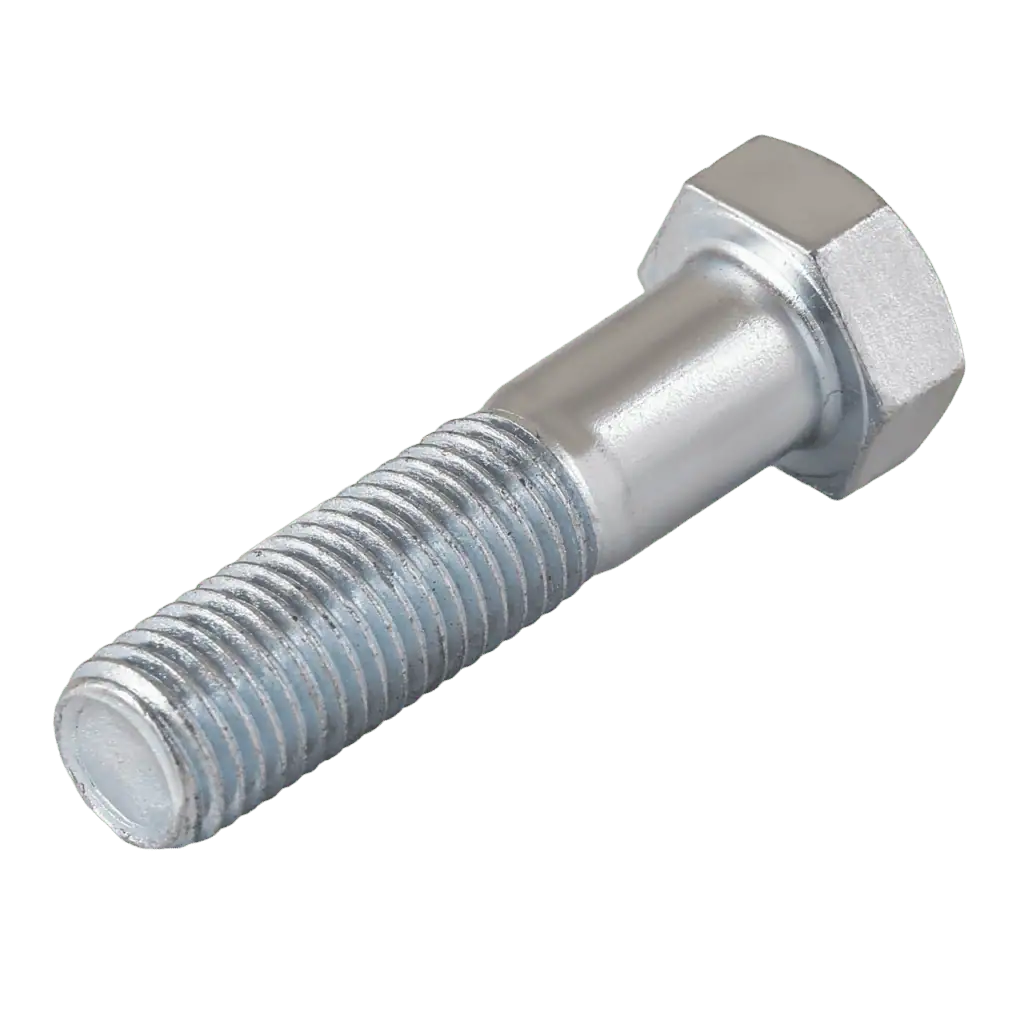
Technical Specifications
Standards
DIN 931 (Partial Thread), DIN 933 (Full Thread), ISO 4014, ISO 4017, ANSI B18.2.1
Material Grades
Carbon Steel: Class 4.8, 8.8 (Med. Carbon), 10.9 (Alloy Steel SCM435), 12.9
Stainless: A2-70 (SS304), A4-80 (SS316)
Tolerance Class
Product Grade A (d≤M24 and l≤10d), Product Grade B (>M24)
Thread Type
Metric Coarse (M), UNC / BSW
Diameter Range
M6 – M64 (1/4″ – 2-1/2″)
Surface Finish
Black Oxide, Zinc Plated (Cr3+), Hot Dip Galvanized (HDG), Geomet 500A, Dacromet
Certifications
ISO 9001:2015, EN 10204 3.1 Mill Test Certificate
Why Specify Coarse Thread (UNC/Metric Coarse)?
Stripping Resistance in Soft Materials: When bolting into lower-strength materials like Cast Iron (engine blocks) or Aluminum (casings), Coarse Thread is mandatory. The larger thread pitch results in a greater volume of material between threads, significantly increasing the shear area. This prevents the internal threads of the expensive casting from stripping before the bolt reaches its yield point.
Mitigation of Galling (Cold Welding): For Stainless Steel (A2/A4) applications, galling is a frequent failure mode during installation. Coarse threads have a larger helix angle and more clearance than fine threads, reducing the friction heat generation per rotation. This makes them less susceptible to seizing during high-speed assembly.
Fatigue & Impact Durability: While fine threads have a slightly larger stress area, coarse threads offer better fatigue distribution in imperfectly aligned joints. In structural steel connections subject to slight settlement or vibration, the robust thread profile of a Grade 10.9 coarse bolt handles cyclic loading without crack initiation at the thread root.
Based on ISO 4017 / DIN 933 (Full Thread)
| Thread Size (d) | Pitch (P) | Head Width (s) | Head Height (k) | Proof Load (8.8 Grade) |
| M6 | 1.00 mm | 10.00 mm | 4.00 mm | 11,600 N |
| M8 | 1.25 mm | 13.00 mm | 5.30 mm | 21,200 N |
| M10 | 1.50 mm | 17.00 mm | 6.40 mm | 33,700 N |
| M12 | 1.75 mm | 19.00 mm | 7.50 mm | 48,900 N |
| M16 | 2.00 mm | 24.00 mm | 10.00 mm | 91,000 N |
| M20 | 2.50 mm | 30.00 mm | 12.50 mm | 147,000 N |
Torque Control & Lubrication:
Do not rely solely on dry torque charts. The Torque Coefficient (K-factor) varies drastically by finish. For example, a dry zinc-plated bolt has K\approx 0.20, whereas adding Molybdenum Disulfide paste drops K to 0.12. Applying dry torque values to lubricated bolts will cause yield failure. We recommend establishing torque procedures based on ISO 16047.
Hole Clearance (ISO 273):
Proper clearance is critical to prevent shear stress on the shank. For an M12 coarse thread bolt, use a 13.5mm clearance hole (Medium Series). Tight tolerances (13.0mm) should only be used where alignment is precision-machined to avoid bolt bending.
Washer Selection:
Always use hardened washers (HV 200 min) under the turned element (nut or bolt head) to prevent embedding into the clamped part. For Grade 10.9 bolts, utilize ISO 7089 (DIN 125A) washers with 300 HV hardness to maintain preload.
Related Products
FAQ
Safety Valve FAQs
How do I choose the right safety valve for my application?
The right safety valve depends on your service medium, set pressure, temperature, back pressure, connection type, and applicable standard. For most projects, selection starts with the process conditions first, then moves to valve type, materials, and documentation review.
What is the difference between GB and ASME safety valve series?
GB and ASME safety valve series differ in standard framework, dimensional references, code systems, and project compliance requirements. The right choice depends on the market, project specification, and the standard your system must follow.
What operating range can your safety valves cover?
Zobai safety valves cover sizes from DN10 to DN600, pressure ratings from 0.6 to 42 MPa, and service temperatures from -196°C to 570°C, depending on the model and application. Specific selection should always be confirmed against the working conditions and product data.
Which industries and systems are your safety valves used in?
Zobai safety valves are used in oil and gas, petrochemical, chemical, technical gas, LNG/LPG, pharmaceutical, food and beverage, HVAC, shipbuilding, and other industrial process systems. Application suitability depends on the operating medium, temperature, pressure, and hygiene or compliance requirements.
What technical documents should I review before requesting a quotation?
Before RFQ, buyers usually review the datasheet, applicable standard, model or code reference, materials, dimensions, and key selection data such as set pressure and operating conditions. Having these documents ready helps speed up technical review and quotation accuracy.