
Hygienic Pressure Protection • Sanitary Safety Valves
Sanitary Safety Valves Manufacturer for Food, Beverage and Pharmaceutical Systems
Sanitary safety valves are hygienic pressure relief devices designed for clean process systems where pressure protection, cleanability, stainless steel wetted parts, sanitary connections and seal compatibility must be considered together.
ZOBAI supplies sanitary safety relief valves and sanitary pressure safety valves for food, beverage, dairy, pharmaceutical, biotech, clean utility and CIP/SIP applications. Selection support includes set pressure, required relieving capacity, 316L wetted material, tri-clamp connection, seal material, surface finish, cleaning condition and documentation requirements.
Service: Food / Beverage / Dairy / Pharma / Biotech
Valve Type: Sanitary Safety Valve / Sanitary Safety Relief Valve
Connections: Tri-Clamp / Sanitary Union / Weld End
Key Checks: Set Pressure / Capacity / CIP / SIP / Seal Material
Materials: 316L Stainless Steel Wetted Parts
Docs: Material Certificate / Calibration Record / Test Report
Safety Valve Categories
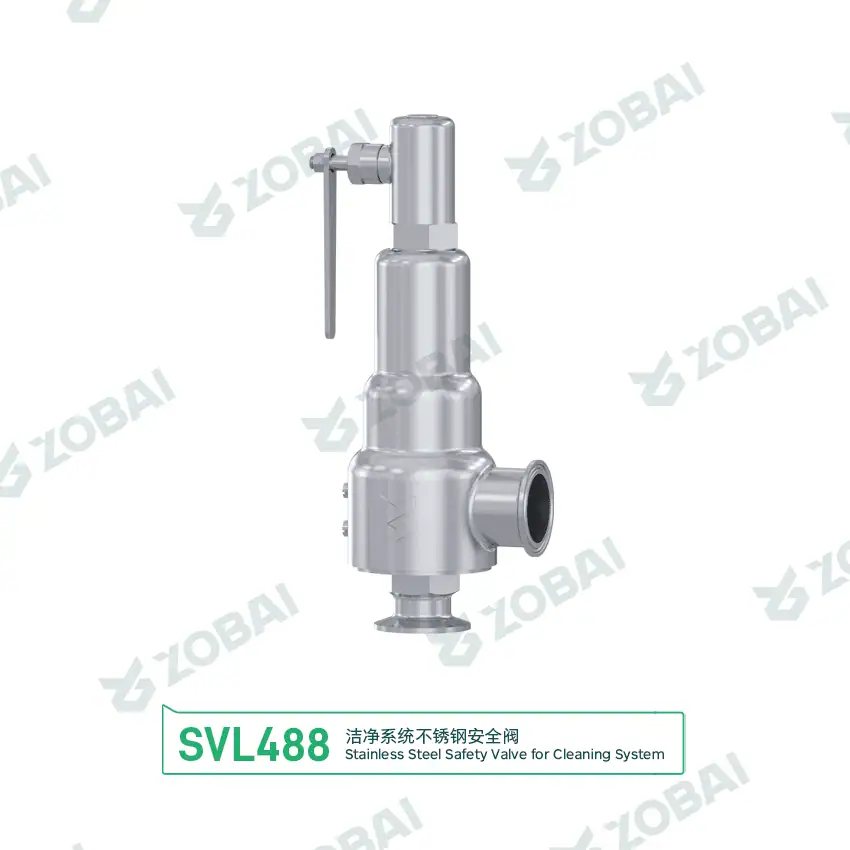
Sanitary Safety Valves for Hygienic Pressure Protection
Sanitary safety valves are pressure relief valves designed for hygienic process systems where cleanability, stainless steel wetted parts, smooth product contact surfaces, sanitary connections and seal compatibility are as important as set pressure and certified relieving capacity. They are commonly used in food, beverage, dairy, pharmaceutical, biotech, clean utility and CIP/SIP systems.
Why sanitary design changes valve selection
A standard industrial safety valve may protect pressure, but it may not be suitable for hygienic service if it creates dead legs, product traps, rough surfaces, difficult-to-clean cavities or incompatible elastomer contact points. In sanitary applications, the valve must relieve pressure while supporting cleaning, drainage, inspection and material traceability requirements.
Sanitary safety relief valve selection should consider set pressure, relieving capacity, medium viscosity, cleaning method, CIP/SIP temperature, connection type, wetted material, seal material, surface finish, drainability, installation orientation and documentation requirements.
Selection boundary
Sanitary pressure safety valves are usually selected for clean liquids, process fluids, sterile water, clean steam, purified water, product transfer lines and hygienic tanks. They may not be suitable for dirty, crystallizing, high-solid, abrasive or highly viscous media without special review.
Stainless steel alone does not make a valve sanitary. Cleanability, internal geometry, surface finish, elastomer compatibility, drainage and documentation must be reviewed together.
How a Sanitary Safety Valve Works
A sanitary safety valve works by keeping the valve closed during normal process operation and opening automatically when pressure reaches the set pressure. The spring, disc and seat must provide reliable pressure relief, while the wetted surfaces, seals and body geometry must support hygienic cleaning and avoid product retention.
Normal Process Flow
The valve remains closed while the system operates below set pressure. Wetted areas should remain cleanable and drainable.
Pressure Reaches Set Point
When pressure reaches the calibrated set pressure, the valve starts to lift and relieve excess pressure.
Relieving Flow
The valve discharges enough flow to reduce pressure while preventing product traps or hard-to-clean internal pockets.
Cleaning and Reseating
After relief or cleaning cycles, the valve must reseat properly. Seal material and surface condition affect leakage risk.
Key Components of a Sanitary Safety Relief Valve
A sanitary safety valve should be reviewed by both pressure relief performance and hygienic design. The body, seat, disc, spring chamber, seal, clamp connection, wetted surface finish and drain path all affect whether the valve is suitable for clean process service.
Wetted Parts and Surface Finish
Wetted parts are the surfaces that contact product, cleaning fluid or clean utility media. For sanitary service, these surfaces should be smooth, corrosion-resistant and easy to clean. 316L stainless steel is commonly requested, but the final material should match the product, cleaning chemicals, temperature and documentation requirement.
Surface finish should be confirmed before manufacturing. In food and pharmaceutical service, rough internal surfaces may hold residue and increase cleaning difficulty.
Seat and Seal Material
Elastomers and soft seats affect both leakage and hygienic compatibility. EPDM, FKM, PTFE and other seal options may be used depending on product, steam, cleaning chemicals, temperature and certification needs.
A seal that works for water may not work for oil, alcohol, acid cleaning, alkaline cleaning or repeated SIP cycles. Seal compatibility should be reviewed before quotation.
Tri-Clamp and Sanitary Connections
Sanitary safety valves often use tri-clamp or other hygienic connections for fast installation, cleaning and maintenance. The connection type should match the tubing standard, gasket material, pressure rating and installation practice.
Connection size alone does not prove relieving capacity. The orifice, set pressure, medium properties and certified flow capability still need to be confirmed.
CIP and SIP Compatibility
Clean-in-place and steam-in-place systems expose the valve to cleaning chemicals, hot water, steam, pressure cycling and temperature changes. The valve should be reviewed for cleanability, drainability, seal life, spring protection and whether the valve needs to cycle during cleaning.
Poorly selected sanitary safety valves may pass pressure testing but still create cleaning blind spots, dead zones or repeated post-cleaning leakage.
Quick Sanitary Safety Valve Fit Check
Use this quick guide to identify what should be reviewed before ordering. It does not replace sizing calculation, hygienic design review or project standard verification.
Select your main sanitary service concern
Click one condition below to see the engineering checks that matter most.
Parameters That Decide Whether a Sanitary Safety Valve Is Suitable
Sanitary Safety Valve vs Industrial Safety Valve
A sanitary safety valve is not just an industrial valve made from stainless steel. It must be selected for pressure protection and hygienic process requirements at the same time.
| Item | Sanitary Safety Valve | General Industrial Safety Valve |
|---|---|---|
| Main focus | Pressure relief plus hygienic cleanability. | Pressure relief and mechanical protection. |
| Typical service | Food, beverage, dairy, pharmaceutical, biotech and clean utilities. | Steam, gas, liquid, chemical, boiler and process systems. |
| Connection | Tri-clamp, hygienic union or sanitary tubing connection. | Threaded, flanged, welded or standard pipe connection. |
| Surface requirement | Smooth wetted surfaces and cleanable internal geometry. | Surface finish depends on service severity and industry requirement. |
| Seal concern | Product compatibility, cleaning chemicals and SIP temperature. | Pressure, temperature, leakage and chemical compatibility. |
| Documentation | Material traceability, surface finish, seal certification and hygiene-related records may be required. | Material certificate, pressure test, calibration and capacity documentation are often requested. |
Where Sanitary Safety Valves Are Used
Food and beverage processing
Sanitary safety valves are used on product tanks, transfer lines, pasteurization systems, clean water skids, dairy equipment and beverage systems where pressure protection and cleanability must be reviewed together.
Pharmaceutical and biotech systems
Pharmaceutical and biotech systems may require higher documentation control, surface finish confirmation, seal compatibility, clean steam compatibility and material traceability before valve acceptance.
CIP and SIP systems
Cleaning and sterilization systems expose the valve to hot water, steam, alkaline cleaning, acid cleaning and pressure cycling. Seal life, spring stability and post-cleaning leakage should be reviewed.
Clean utility and hygienic tanks
Clean utility skids, purified water loops and hygienic tanks may require sanitary pressure safety valves with tri-clamp connections, cleanable flow paths and certificates matching project requirements.
Sanitary Safety Valve Selection Table
| Service Condition | Common Requirement | Recommended Review | Key Engineering Check | Main Risk |
|---|---|---|---|---|
| Food and beverage product line | Cleanable pressure protection | Sanitary stainless steel safety valve | Surface finish, seal material, tri-clamp connection and capacity | Product retention or post-cleaning leakage |
| Dairy and beverage tanks | Tank overpressure protection | Sanitary safety relief valve | Set pressure, tank rating, drainability and cleaning cycle | Wrong set pressure or poor drainage |
| CIP / SIP system | Repeated cleaning and thermal cycling | CIP/SIP-compatible sanitary safety valve | Seal material, steam temperature, chemical compatibility and reseating | Seal degradation or leakage after sterilization |
| Pharmaceutical clean utility | Traceability and cleanability | Sanitary pressure safety valve with documentation package | Material certificate, surface finish, elastomer certificate and calibration | Missing documentation delaying project approval |
| Viscous product | Reliable relief without product trapping | Sanitary safety valve with product-specific review | Viscosity, product residue, cleaning access and seat design | Slow relief, seat contamination or cleaning difficulty |
| Replacement project | Match existing valve and system requirement | Nameplate and datasheet verification | Set pressure, capacity, connection, material, seal and surface finish | Replacing by size but missing hygiene or capacity details |
This table is for preliminary engineering screening. Final selection must be confirmed against medium, product contact requirements, set pressure, required relieving capacity, cleaning method, temperature, surface finish, seal material, connection standard and applicable project requirements.
Common Engineering Mistakes to Avoid
Using stainless steel as the only sanitary criterion
A valve can be stainless steel and still fail hygienic review if it has poor drainability, rough product contact surfaces or internal pockets that retain product. Sanitary selection should include geometry, surface finish, seal design and cleanability.
Selecting by tri-clamp size only
Tri-clamp size only confirms the installation interface. It does not prove that the valve can relieve enough flow. Required relieving capacity, orifice area, medium properties and set pressure must still be checked.
Ignoring CIP and SIP conditions
A valve may work during process operation but leak after repeated cleaning or steam sterilization. Cleaning temperature, chemicals, pressure cycling and seal material should be reviewed before ordering.
Sanitary Safety Valve Troubleshooting Table
| Symptom | Possible Cause | Engineering Check | Corrective Action |
|---|---|---|---|
| Valve leaks after CIP or SIP | Seal degradation, thermal cycling, dirt on seat or wrong elastomer | Check seal material, cleaning temperature, steam exposure and seat condition | Replace seal, review compatibility and retest seat tightness |
| Product residue remains after cleaning | Poor drainability, internal pocket, wrong orientation or viscous product | Review installation angle, internal geometry and cleaning flow path | Change installation, improve cleaning procedure or select suitable valve design |
| Valve opens too frequently | Set pressure too close to operating pressure or pressure pulsation | Check operating pressure, pump behavior and set pressure margin | Review set pressure and system pressure control |
| Valve does not relieve enough flow | Undersized orifice, wrong medium data or high viscosity | Review required capacity, viscosity, temperature and valve flow path | Recalculate capacity and select correct valve size or design |
| Documentation not accepted | Missing material, seal, surface finish or calibration records | Check project documentation list before production | Confirm required certificates in RFQ stage |
Sanitary Standards and Documents to Confirm Before Purchase
Standards and hygienic design references
Sanitary safety valve projects may reference ASME BPE, applicable 3-A Sanitary Standards, EHEDG hygienic valve guidance, applicable FDA food-contact regulations, USP <88>/Class VI test documentation when specified, or customer-specific hygienic design specifications. The correct requirement depends on the industry, region, product contact risk and validation process.
- ASME BPE for bioprocessing, pharmaceutical and high-hygiene equipment requirements.
- 3-A Sanitary Standards for sanitary equipment and accepted practices.
- EHEDG Guideline Catalogue (GL 14) for valve-specific hygienic design review.
- ISO 4126 Safety Valve Standards for safety devices and international pressure protection terminology.
- API 520 Safety Valve Sizing when capacity, sizing basis and installation data are part of the RFQ.
- API 527 Seat Tightness Test only where the valve design and project specification use API 527; otherwise confirm the manufacturer or project-specific leakage criterion.
- ASME Safety Valve Standards where boiler, vessel or pressure equipment rules apply.
- Project-specific surface finish, elastomer, material, inspection and validation requirements.
Documents buyers often request
Documentation should be confirmed before quotation, especially for pharmaceutical, biotech, dairy and validated clean process projects. Late certificate requests often delay approval, shipment or installation acceptance.
- Valve datasheet and model specification.
- Set pressure calibration record.
- Pressure test report and seat tightness record when required.
- Material certificate for wetted stainless steel parts.
- Seal material certificate or compliance document.
- Surface finish record if specified.
- Nameplate, tagging and inspection documentation.
Continue Your Sanitary Safety Valve Selection Review
These internal pages connect sanitary pressure relief selection with the wider safety valve category, food and pharmaceutical applications, sizing inputs, installation review and project documentation.
Authority Links for Hygienic Design, Food Contact and Bioprocessing Review
These external references support hygienic design, sanitary equipment, food-contact materials and bioprocessing documentation discussions. Use them alongside project specifications and local pressure equipment rules.
Sanitary Safety Valve FAQ
These answers summarize the main selection boundaries. Final valve selection still requires project-specific pressure, capacity, medium, cleaning and documentation review.
RFQ Checklist for Sanitary Safety Valves
| Required Data | Why It Matters | Example Input |
|---|---|---|
| Medium or product | Determines sizing, seal compatibility and hygienic risk. | Milk, purified water, clean steam, syrup, beverage, WFI loop |
| Set pressure | Defines the valve opening point. | 3 bar g, 6 bar g, 10 bar g |
| Operating pressure | Confirms pressure margin and leakage risk. | 2.5 bar g |
| Required relieving capacity | Confirms whether the valve can protect the system. | kg/h, L/min, m³/h, GPM |
| Temperature | Affects seal, spring and material selection. | Process 80°C, SIP 121°C or 135°C |
| CIP / SIP condition | Confirms cleaning chemicals, steam exposure and seal life. | Alkaline CIP, acid CIP, steam sterilization |
| Connection type | Ensures installation compatibility. | Tri-clamp, sanitary union, weld end |
| Wetted material | Prevents corrosion and supports hygienic documentation. | 316L stainless steel |
| Seal material | Affects leakage, cleaning life and product compatibility. | EPDM, FKM, PTFE |
| Surface finish | Supports cleanability and project acceptance. | Ra requirement or project specified finish |
| Documentation | Prevents approval delays. | Material certificate, seal certificate, calibration record |
| Existing drawing or nameplate | Reduces replacement selection risk. | Photo, datasheet, model number, connection size |
Need Help Selecting a Sanitary Safety Valve?
Send us your product medium, set pressure, operating pressure, relieving capacity, cleaning method, temperature, connection type, wetted material, seal requirement and documentation list. Our engineering team can review whether a sanitary safety valve or sanitary safety relief valve is suitable before quotation.
Prepare these data before RFQ
TECHNICAL INSIGHTS
Related Sanitary Safety Valves Articles
FAQ
Spring Loaded Safety Valve FAQs
What is a sanitary safety valve?
A sanitary safety valve is a hygienic pressure relief valve used to protect clean process systems from excessive pressure. It is designed with cleanable wetted surfaces, sanitary connections and compatible materials for food, beverage, dairy, pharmaceutical, biotech and clean utility applications.
What is the difference between a sanitary safety valve and a general industrial safety valve?
A general industrial safety valve focuses mainly on pressure protection. A sanitary safety valve must provide pressure relief while also meeting hygienic requirements such as cleanability, drainability, stainless steel wetted parts, sanitary connections, surface finish and seal compatibility.
Where are sanitary safety relief valves used?
Sanitary safety relief valves are used in food and beverage systems, dairy tanks, pharmaceutical process lines, biotech systems, clean utility skids, purified water loops, clean steam systems and CIP/SIP applications.
What materials are commonly used for sanitary safety valves?
316L stainless steel is commonly specified for wetted parts in sanitary service. Seal materials may include EPDM, FKM, PTFE or other options depending on product, cleaning chemicals, steam exposure, temperature and project documentation requirements.
Can sanitary safety valves be used in CIP and SIP systems?
Yes, but the valve must be reviewed for cleaning chemicals, steam exposure, temperature, thermal cycling, elastomer compatibility, seat leakage, drainability and whether the valve can be cleaned effectively in the installed position.
Is tri-clamp size enough to select a sanitary safety valve?
No. Tri-clamp size only confirms the connection interface. The valve must still be selected by set pressure, required relieving capacity, medium, temperature, viscosity, surface finish, seal material and applicable project requirements.
Why does a sanitary safety valve leak after cleaning?
Leakage after cleaning may be caused by seal degradation, thermal cycling, dirt on the seat, incompatible elastomer material, excessive operating pressure or damage from repeated CIP/SIP cycles. The valve should be inspected, cleaned, tested and resealed if required.
What information is needed before requesting a sanitary safety valve quotation?
Provide the product medium, set pressure, operating pressure, required relieving capacity, temperature, CIP/SIP condition, connection type, wetted material, seal material, surface finish requirement, documentation list, quantity and any existing drawing or nameplate.
What information should I provide before requesting a quotation?
What is a sanitary safety valve?
Raymon Yu
“When a safety valve fails to pop on site, it’s rarely because someone can’t read a standard. It’s usually because critical operating parameters (like backpressure or relief temperature) were assumed instead of specified. I reviewed the key technical content on this page to keep it practical, API/ASME spec-aligned, and RFQ-ready. (We prefer assumptions for lunch choices.)”
What I work on daily: reviewing drawings and project specs, supporting engineer-to-engineer questions, resolving capacity calculations, material selection, and backpressure impacts so production and quoting stay consistent. (Yes—set pressure and seat tightness test records get plenty of attention.)