
Pilot-Controlled Pressure Relief • High-Capacity Safety Valves
Pilot Operated Safety Valves Manufacturer for High-Capacity Pressure Relief
Pilot operated safety valves are pressure relief devices that use a pilot valve and system pressure to control the opening and closing of the main valve. They are commonly selected for clean gas, vapor, LPG, LNG, storage vessels, compressor discharge systems and process applications where tight shutoff, high relieving capacity or stable operation near set pressure is required.
ZOBAI supplies pilot operated safety relief valves with engineering support for pilot type selection, set pressure confirmation, certified relieving capacity, back pressure review, remote sensing arrangement, material compatibility and project documentation.
Valve Types: Pop Action / Modulating / Flowing / Non-Flowing
Service: Clean Gas / Vapor / LPG / LNG / Process Media
Key Checks: Set Pressure / Dome Pressure / Back Pressure / Capacity
Options: Internal Sensing / Remote Sensing / Soft Seat / Metal Seat
Docs: Datasheet / Test Report / Material Certificate / Calibration Record
Pilot operated safety valve selection should be confirmed against the actual medium, set pressure, operating pressure, required relieving capacity, pilot type, sensing method, back pressure, discharge system, material requirement and applicable code.
Safety Valve Categories
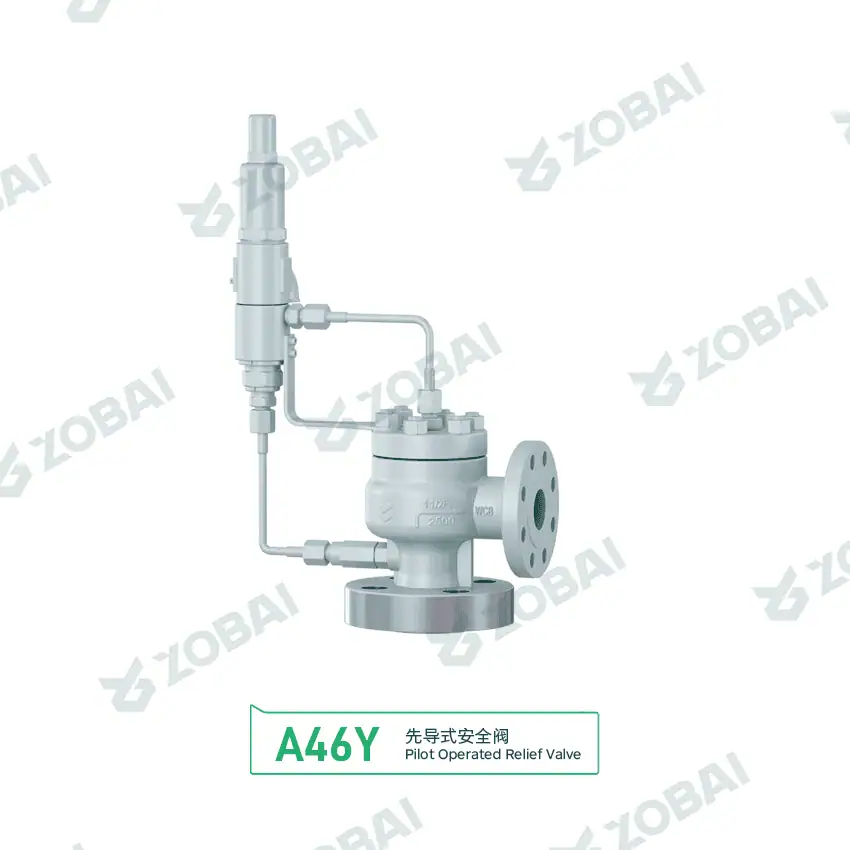
Pilot Operated Safety Valves for Stable Pressure Relief in High-Capacity Systems
A pilot operated safety valve is a pressure relief valve that uses a pilot valve and system pressure to control the opening and closing of the main valve. Compared with a conventional spring loaded safety valve, a pilot operated safety relief valve can help reduce seat leakage, improve operating pressure margin and support large-capacity relief applications when the medium, pilot circuit and discharge system are suitable.
When this valve type makes engineering sense
Pilot operated safety valves are often considered when the process operates close to the set pressure, when the required relieving capacity is large, when inlet pressure loss must be carefully managed, or when back pressure has to be reviewed as part of the relief system. They are used in gas processing, petrochemical units, LNG and LPG systems, storage vessels, compressor discharge systems and high-capacity pressure vessels.
The design is not selected simply because it is more advanced. A pilot operated pressure safety valve depends on clean pilot passages, stable sensing pressure and proper installation and maintenance planning. If the medium is dirty, sticky, crystallizing or polymerizing, the pilot circuit may become restricted and the valve may respond slowly or unstably.
Selection boundary
A pilot operated safety valve is usually a strong option for clean gas, vapor and selected liquid services where tight shutoff, large capacity or high operating pressure ratio is important. It needs more attention in dirty, waxy, corrosive, wet, freezing or particulate-laden service.
The valve type, pilot style, sensing method, back pressure condition, medium cleanliness and maintenance plan must be reviewed together before replacing a spring loaded valve with a pilot operated design.
How a Pilot Operated Safety Valve Works
A pilot operated safety relief valve uses system pressure to keep the main valve closed during normal operation. The pilot valve senses inlet pressure. When pressure reaches the set pressure, the pilot changes the pressure balance above the main valve piston or dome, allowing the main valve to open and relieve the protected system.
System Pressure Sensed
The pilot valve senses pressure from the protected equipment through an internal or remote sensing line.
Main Valve Held Closed
System pressure is directed to the dome or piston area, creating a closing force that helps keep the main valve seat tight.
Pilot Reaches Set Pressure
At set pressure, the pilot changes state and reduces or controls dome pressure depending on pop-action or modulating design.
Main Valve Relieves
The main valve opens to discharge the required flow. As system pressure falls, the pilot restores closing pressure and the main valve reseats.
Key Components of a Pilot Operated Safety Relief Valve
A pilot operated safety valve should be evaluated as a control-and-relief assembly, not only as a valve body. The main valve, pilot valve, dome chamber, sensing line, filter, seals, soft goods, piston and discharge arrangement all affect response stability and seat tightness.
Main Valve and Dome Chamber
The main valve provides the primary relieving flow path. During normal operation, dome pressure or piston pressure helps keep the main valve closed. When the pilot relieves or modulates dome pressure, the main valve opens. The main valve capacity must be checked by certified relieving capacity, orifice area and actual relieving conditions.
In replacement projects, matching the inlet and outlet size is not enough. The model, orifice, rated capacity, pressure class, temperature limit and pilot configuration should be confirmed before ordering.
Pilot Valve and Control Circuit
The pilot valve senses system pressure and controls the main valve opening. A pop-action pilot provides rapid opening near set pressure, while a modulating pilot opens the main valve in proportion to the required relief demand. The suitable choice depends on process behavior, allowable overpressure, discharge system and cycling risk.
Dirty or sticky media can restrict pilot passages. In such service, filtration, material selection, maintenance interval and possible use of a spring loaded or bellows design should be reviewed.
Internal or Remote Sensing
A pilot operated safety valve can use internal sensing or remote sensing. Remote sensing may be useful when pressure drop at the valve inlet needs to be separated from the protected vessel pressure. However, the sensing line must be protected from blockage, freezing, condensate accumulation and mechanical damage.
A remote sensing pilot operated safety valve should never be treated as a simple piping detail. The sensing point, tube routing, isolation practice and maintenance access affect whether the valve sees the real protected system pressure.
Seats, Seals and Soft Goods
Pilot operated safety relief valves are often selected when tight shutoff is important. The actual leakage performance depends on seat design, seal material, temperature, medium compatibility and pressure cycling. Soft seats may improve tightness in suitable service, but they require careful review for chemical attack, aging and high-temperature limits.
For corrosive or sour service, the body, trim, pilot components, springs, elastomers and tubing materials should be reviewed as a complete package.
Quick Service Fit Check
Use this quick check as an engineering screening guide. It does not replace sizing calculation, certified capacity review or code verification.
Select your main service concern
Click one condition below to see what should be checked before selecting a pilot operated safety valve.
Parameters That Decide Whether a Pilot Operated Valve Is Suitable
Pilot Operated vs Spring Loaded Safety Valve
A pilot operated safety valve is not a universal replacement for a spring loaded valve. The selection depends on capacity, pressure margin, medium cleanliness, back pressure, maintenance capability and project standards.
| Item | Pilot Operated Safety Valve | Spring Loaded Safety Valve |
|---|---|---|
| Opening mechanism | Pilot controls dome or piston pressure to open the main valve. | Process pressure directly overcomes spring force under the disc. |
| Operating pressure margin | Often suitable where operating pressure is closer to set pressure. | Usually needs more margin to avoid simmering or leakage. |
| Capacity potential | Suitable for large-capacity relief applications when correctly sized. | Reliable for many general pressure protection duties. |
| Medium cleanliness | More sensitive to dirty, sticky or crystallizing media because of pilot passages. | Generally more tolerant in many utility and dirty services. |
| Back pressure behavior | Can be favorable in certain back pressure conditions depending on design. | Conventional type is more affected by variable back pressure. |
| Maintenance | Requires pilot, sensing line, filters and soft goods inspection. | Simpler mechanical inspection and recalibration process. |
Where Pilot Operated Safety Valves Are Used
Gas processing and compressor systems
Pilot operated pressure safety valves are often used where high gas flow, tight shutoff and stable relief performance are important. Compressor discharge systems should be reviewed for pulsation, discharge piping, built-up back pressure and remote sensing requirements.
LNG, LPG and storage vessels
Storage and cryogenic-related services may require careful review of temperature limits, seal materials, pilot tubing, icing risk, vent routing and relief capacity. The pilot and sensing circuit must remain reliable under the actual operating environment.
Petrochemical and process units
In refinery and petrochemical service, selection should consider credible overpressure cases, relief header pressure, medium composition, corrosive components, fouling risk and maintenance access. The pilot style should match both relief demand and process cleanliness.
High-capacity pressure vessels
Large vessels and process skids may need a high certified relieving capacity. A pilot operated safety relief valve can be suitable when the flow requirement, pressure class, operating margin and discharge system are verified together.
Pilot Operated Safety Valve Selection Table
| Service Condition | Common Requirement | Possible Pilot Valve Choice | Key Engineering Check | Main Risk |
|---|---|---|---|---|
| Clean gas service | Tight shutoff and stable relief | Pop-action or modulating pilot operated safety valve | Set pressure, certified capacity, pilot type, back pressure | Wrong pilot action or undersized capacity |
| Large capacity relief | High flow at relieving condition | Large-orifice pilot operated safety relief valve | Orifice area, relieving pressure, temperature and certified flow | Selecting by connection size instead of capacity |
| High operating pressure ratio | Operation close to set pressure | Soft-seated pilot operated pressure safety valve | Operating margin, seat tightness, seal compatibility | Leakage from wrong seal or pressure cycling |
| Variable back pressure | Relief into common header | Back-pressure-suitable pilot design | Superimposed and built-up back pressure calculation | Capacity reduction or unstable reseating |
| Dirty or sticky medium | Reliable actuation despite contamination risk | Use with caution, filtration or alternative valve type | Pilot passage cleanliness, filter, maintenance plan | Blocked pilot circuit or delayed opening |
| Remote sensing requirement | Pressure sensed away from valve inlet | Remote sensing pilot operated safety valve | Sensing line routing, isolation, freezing and blockage risk | Pilot senses wrong pressure or sensing line fails |
This table is for preliminary engineering screening. Final selection must be confirmed against medium, pressure, temperature, required relieving capacity, pilot type, back pressure, sensing arrangement, discharge system and applicable code requirements.
Common Engineering Mistakes to Avoid
Using pilot valves in dirty service without review
A pilot operated safety valve may work well in clean gas service but become unstable in dirty or sticky media. Deposits in the pilot circuit can delay opening or prevent proper reseating. The preventive action is to review medium cleanliness, filtration, purge options and maintenance access before selection.
Remote sensing line installed incorrectly
Remote sensing can help the pilot read protected vessel pressure, but a poorly routed sensing line can collect condensate, freeze, vibrate or be isolated by mistake. The sensing point and line routing should be treated as part of the pressure relief system, not as a minor accessory.
Replacing by connection size only
A buyer may request the same inlet and outlet size as an old valve, but the new valve may have a different orifice, pilot action and rated capacity. The correct process is to check nameplate data, required relieving capacity, relieving pressure and certified flow before confirming replacement.
Pilot Operated Safety Valve Troubleshooting Table
| Symptom | Possible Cause | Engineering Check | Corrective Action |
|---|---|---|---|
| Main valve does not open as expected | Blocked pilot passage, wrong sensing pressure or damaged pilot components | Check pilot circuit, sensing line, filter and set pressure calibration | Clean, repair, recalibrate and verify sensing arrangement |
| Valve leaks near operating pressure | Seat damage, soft goods degradation or operating pressure too close to set pressure | Inspect seat, seals, pressure margin and leakage test record | Replace seals, repair seat or review operating margin |
| Unstable opening or cycling | Wrong pilot action, poor sensing line layout or discharge header pressure fluctuation | Review pilot type, remote sensing point and back pressure behavior | Modify sensing layout, adjust pilot selection or review discharge system |
| Delayed response | Contamination, wax, hydrate, ice or condensate in pilot circuit | Check medium condition, tubing, drains, heat tracing and filter condition | Clean circuit, improve protection or select a more suitable valve type |
| Main valve does not reseat cleanly | Dome pressure not restored, pilot malfunction or seat contamination | Check pilot reseat behavior, dome pressure and seat condition | Service pilot, clean seat and verify reseat pressure |
Continue the Pilot Operated Safety Valve Selection Path
These internal links connect pilot operated PSV selection with ZOBAI product categories, sizing guidance, back pressure review, installation details, capacity checks and application-specific pages. They also help search engines understand the page relationship inside the safety valve topic cluster.
Standards and Documents to Confirm Before Purchase
Standards to review
Pilot operated safety valve selection may involve ASME, API, ISO, National Board, NBIC and project-specific pressure equipment requirements. The correct standard depends on the protected equipment, country or region, application industry and buyer specification.
- ISO 4126-4 for general requirements for pilot operated safety valves.
- API 520 for sizing, selection and installation guidance in refinery and process applications.
- API 521 for pressure-relieving and depressuring system design context.
- API 526 where flanged steel pressure relief valve dimensions and orifice designation are relevant.
- API 527 when seat tightness test requirements are specified.
- NBIC / National Board requirements where repair, recalibration or VR-related work applies.
Documents buyers often request
Documentation should be confirmed before quotation when the valve is used in pressure vessels, petrochemical units, LNG/LPG systems, compressor skids or regulated equipment. Late documentation requests often cause shipment or acceptance delays.
- Datasheet and model specification.
- Set pressure calibration record.
- Certified relieving capacity information.
- Seat tightness test report when required.
- Material certificate and heat number traceability where specified.
- Pilot configuration, sensing method and tubing arrangement.
- Nameplate, tagging and inspection documentation.
Official Standards Sources for Pilot Operated PSV Review
Use ZOBAI internal pages for selection guidance, sizing inputs and RFQ preparation. Use the issuing-organization sources below when a project requires current verification of pilot-operated safety-valve, pressure-relief-system, pressure-vessel, flanged-valve, seat-tightness or certified-capacity requirements.
RFQ Checklist for Pilot Operated Safety Valves
| Required Data | Why It Matters | Example Input |
|---|---|---|
| Medium | Determines sizing method, pilot cleanliness risk and material selection. | Natural gas, LPG, nitrogen, steam, liquid hydrocarbon |
| Set pressure | Defines pilot actuation point and main valve opening behavior. | 25 bar g |
| Operating pressure | Confirms pressure margin and seat tightness requirement. | 22 bar g |
| Required relieving capacity | Confirms whether the valve can protect the equipment. | kg/h, Nm³/h, lb/h, SCFM, GPM |
| Relieving temperature | Affects material, seal selection and capacity calculation. | -45°C, 80°C, 180°C |
| Back pressure condition | Determines suitability of pilot design and discharge arrangement. | Constant, variable, built-up, superimposed |
| Pilot preference | Helps confirm pop-action, modulating, flowing or non-flowing pilot. | Modulating non-flowing pilot |
| Sensing method | Confirms internal or remote pressure sensing arrangement. | Internal sensing or remote sensing line |
| Connection standard | Ensures piping and installation compatibility. | ASME, EN, GB, JIS |
| Material requirement | Prevents corrosion, seal failure and pilot circuit damage. | WCB, CF8M, low-temperature steel, alloy |
| Applicable code | Defines documentation, test and acceptance requirements. | ASME, API, ISO, GB, project specification |
| Existing drawing or nameplate | Reduces replacement selection risk. | Photo, datasheet, model number, orifice, capacity |
Need Help Selecting a Pilot Operated Safety Valve?
Send us your medium, set pressure, operating pressure, relieving capacity, back pressure, pilot preference, sensing method, material requirement and existing datasheet. Our engineering team can review whether a pilot operated safety relief valve is suitable before quotation.
Prepare these data before RFQ
TECHNICAL INSIGHTS
Related Pilot Operated Safety Valves Articles
FAQ
Pilot Operated Safety Valve FAQs for Selection and Specification
What is a pilot operated safety valve?
A pilot operated safety valve is a pressure relief valve that uses a pilot valve to control the main valve. The pilot senses system pressure and changes the pressure balance above the main valve piston or dome. When the set pressure is reached, the main valve opens to relieve the protected equipment.
How does a pilot operated safety valve work?
During normal operation, system pressure helps keep the main valve closed. The pilot valve senses inlet pressure. When pressure reaches the set pressure, the pilot vents or controls the dome pressure, allowing the main valve to open. As pressure decreases, the pilot restores closing pressure and the main valve reseats.
What is the difference between a spring loaded safety valve and a pilot operated safety valve?
A spring loaded safety valve opens when process pressure directly overcomes spring force. A pilot operated safety valve uses a pilot circuit to control the main valve. Pilot operated designs can be useful for tight shutoff, high capacity, high operating pressure ratio and certain back pressure conditions, but they require cleaner media and more careful maintenance.
When should you use a pilot operated safety valve?
A pilot operated safety valve is often considered for clean gas, vapor, LPG, LNG, compressor systems, storage vessels and high-capacity process applications. It may be suitable when the system operates close to set pressure, when tight shutoff is important or when a large certified relieving capacity is required.
What is a remote sensing pilot operated safety valve?
A remote sensing pilot operated safety valve senses pressure from a selected point on the protected equipment instead of only at the valve inlet. It can help when inlet pressure loss must be separated from the protected vessel pressure. The sensing line must be protected from blockage, freezing, condensate and accidental isolation.
What is the difference between pop action and modulating pilot operated safety valves?
A pop action pilot operated safety valve opens the main valve rapidly when set pressure is reached. A modulating pilot operated safety valve controls main valve lift according to the relief demand. The correct choice depends on the process condition, medium, required capacity, allowable overpressure, discharge system and cycling risk.
Can a pilot operated safety valve be used in dirty service?
Pilot operated safety valves should be used carefully in dirty, sticky, waxy, crystallizing or particulate-laden service. Pilot passages, filters and sensing lines may become restricted, which can delay opening or affect reseating. Medium cleanliness, filtration, purge options and maintenance access should be reviewed before selection.
How does back pressure affect a pilot operated safety valve?
Back pressure can affect relieving capacity, main valve stability and reseating behavior. Pilot operated safety valves may perform better than conventional spring loaded valves in some back pressure conditions, but constant, variable, superimposed and built-up back pressure still need to be reviewed with the selected valve design.
What information is needed before requesting a quotation?
Provide the medium, set pressure, operating pressure, required relieving capacity, relieving temperature, back pressure condition, pilot type preference, sensing method, inlet and outlet size, connection standard, material requirement, applicable code, quantity and any existing drawing or nameplate.

Raymon Yu
“When a safety valve fails to pop on site, it’s rarely because someone can’t read a standard. It’s usually because critical operating parameters (like backpressure or relief temperature) were assumed instead of specified. I reviewed the key technical content on this page to keep it practical, API/ASME spec-aligned, and RFQ-ready. (We prefer assumptions for lunch choices.)”
What I work on daily: reviewing drawings and project specs, supporting engineer-to-engineer questions, resolving capacity calculations, material selection, and backpressure impacts so production and quoting stay consistent. (Yes—set pressure and seat tightness test records get plenty of attention.)