
Solución de problemas de válvulas de seguridad pilotadas Las válvulas de seguridad pilotadas pueden volverse poco fiables en servicios sucios, cerosos, con incrustaciones o polimerizantes porque el circuito piloto depende de pequeños caminos de detección, filtros, restricciones, asientos piloto y pasajes de presión de domo. Una deposición no necesita bloquear la boquilla de la válvula principal para crear un problema grave de protección contra la presión. Si el piloto no puede detectar ...

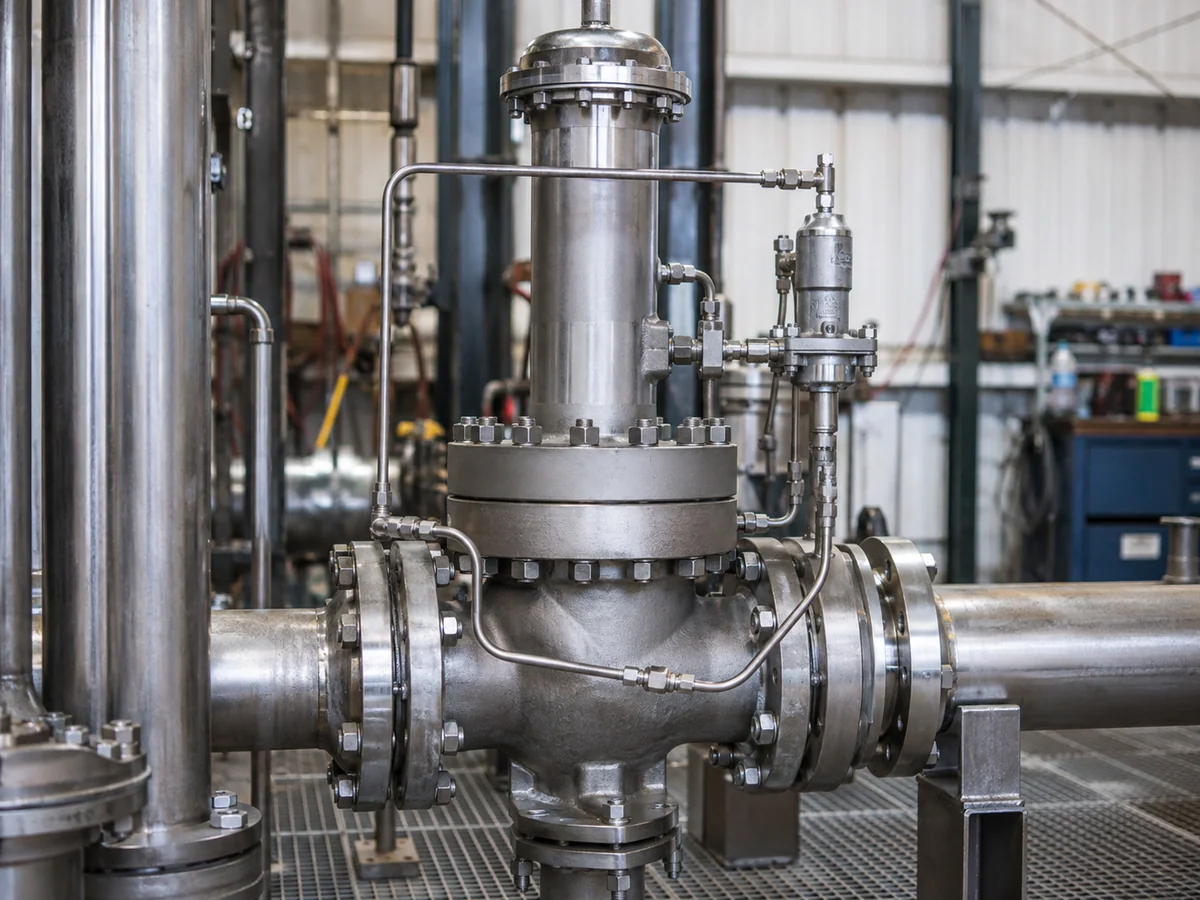
Solución de problemas de válvulas de seguridad pilotadas
Las válvulas de seguridad pilotadas pueden volverse poco fiables en servicios sucios, cerosos, con incrustaciones o polimerizantes porque el circuito piloto depende de pequeños caminos de detección, filtros, restricciones, asientos piloto y pasajes de presión de domo. Una deposición no necesita bloquear la boquilla de la válvula principal para crear un problema grave de protección contra la presión.
Si el piloto no puede detectar la presión correctamente, cargar o ventilar el domo en el momento adecuado, o reasentar limpiamente, la válvula principal puede abrir tarde, operar de manera inestable, fugarse o no reasentar. La pregunta más importante no es si la válvula se llama pilotada, sino si el circuito piloto seleccionado puede seguir siendo funcional en el servicio real.
Esto no significa que una válvula de seguridad pilotada sea automáticamente inadecuada para todo servicio sucio. Significa que el servicio debe revisarse en cuanto al tipo de contaminante, formación de cera o polímero, perfil de temperatura, datos de presión, capacidad de alivio requerida, contrapresión, instalación y accesibilidad de mantenimiento antes de la cotización o reemplazo.
Respuesta rápida: Por qué el servicio sucio crea un riesgo especial para las válvulas de seguridad pilotadas
Una válvula de seguridad pilotada utiliza un sistema piloto para controlar la presión sobre el disco o pistón de la válvula principal. En servicio limpio, esto puede soportar alta presión de operación, asiento hermético y comportamiento de apertura controlado. En servicio sucio, ceroso o polimerizante, el mismo circuito de control puede convertirse en el punto débil.
El riesgo principal no es solo “suciedad en la válvula”. La pregunta de ingeniería es si el piloto aún puede transmitir, ventilar y restaurar la presión de control con la sincronización requerida para el escenario de alivio gobernante.
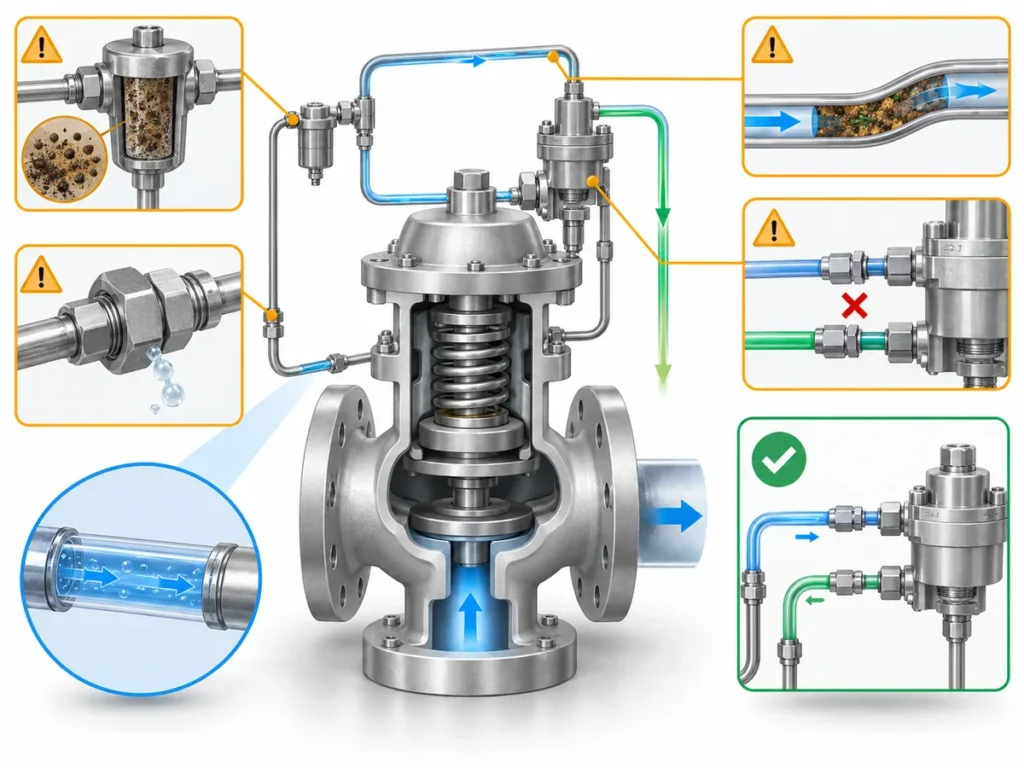
La válvula principal puede estar limpia mientras el circuito piloto ya está comprometido
Un error común en la resolución de problemas es inspeccionar solo el asiento, la tobera y la salida de la válvula principal, y luego asumir que la válvula es aceptable porque el paso más grande no está visiblemente bloqueado. En un diseño pilotado, la válvula principal y el circuito piloto realizan tareas diferentes.
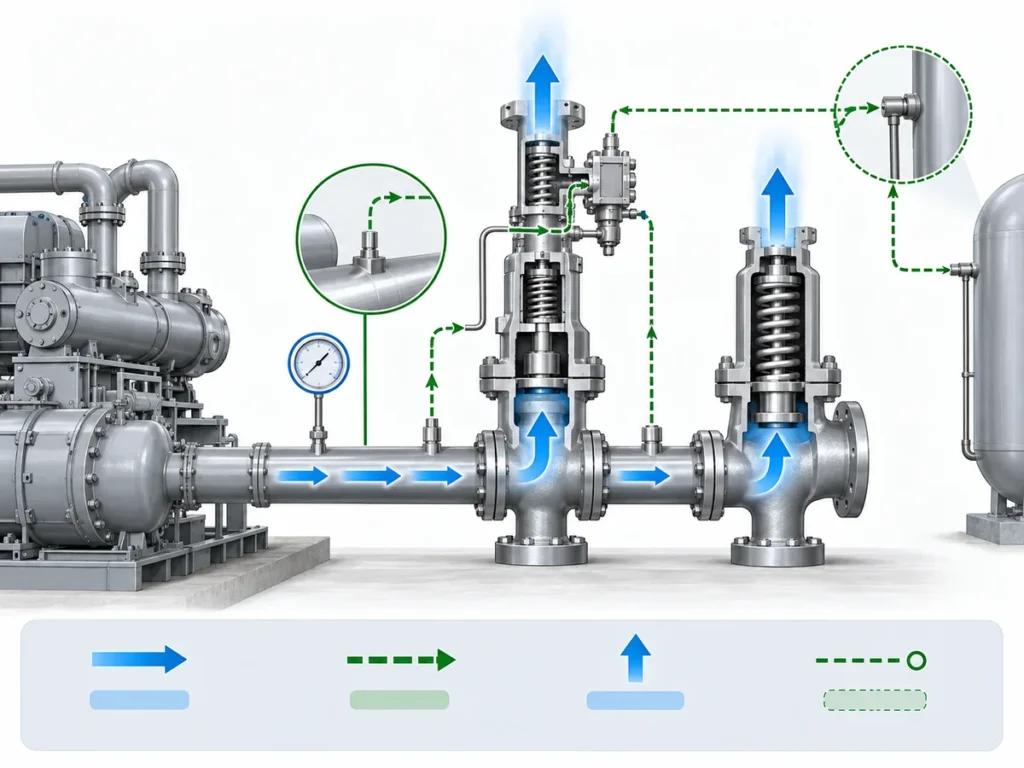
La válvula principal proporciona la ruta de flujo de alivio. El circuito piloto decide cuándo y cómo se permite que la válvula principal se abra y se reasiente. Si una línea de detección o una restricción del piloto está parcialmente bloqueada, es posible que el piloto no vea la presión real del recipiente o de la línea con la suficiente rapidez. Si la ruta de ventilación del domo está restringida, es posible que la válvula principal no se abra como se espera. Si la ruta de carga del domo está restringida después del alivio, la válvula puede reasentarse lentamente o continuar fugando.
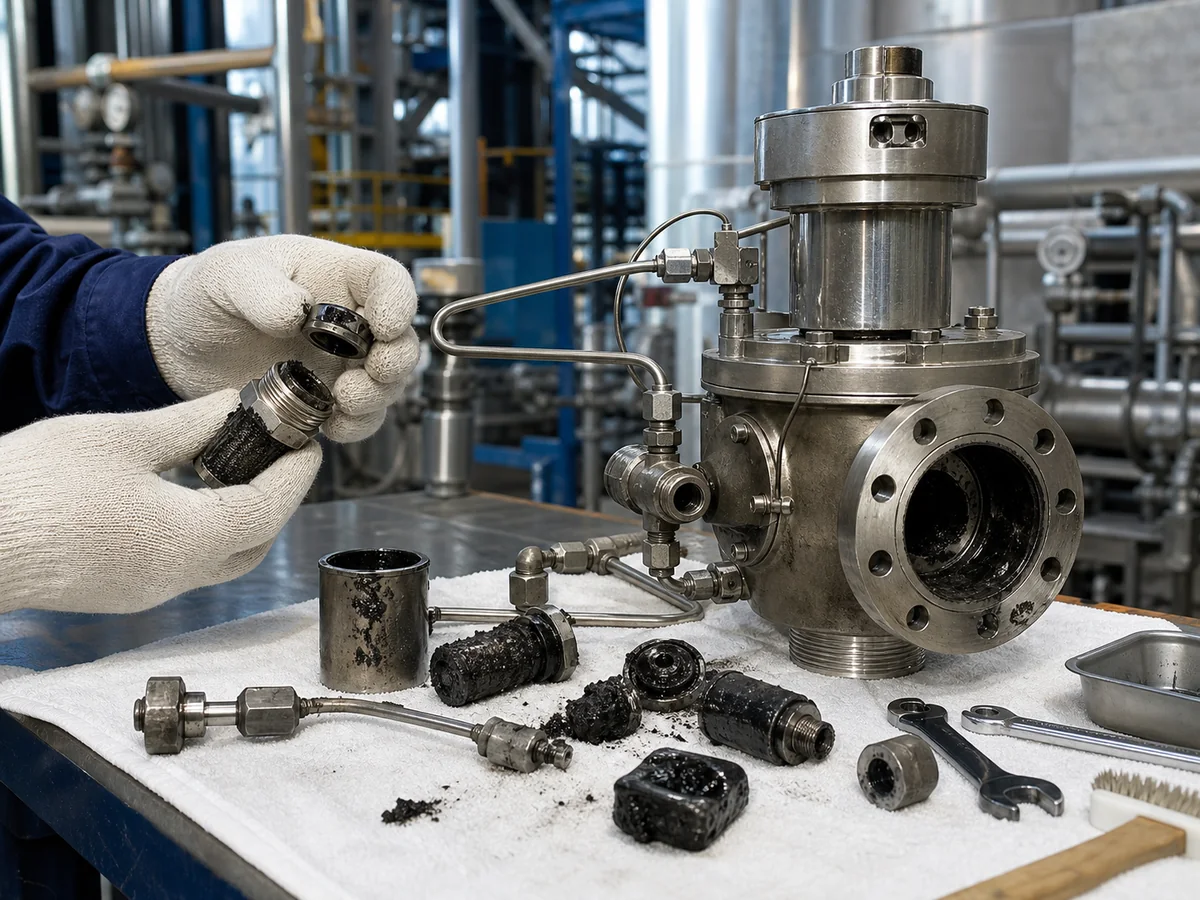
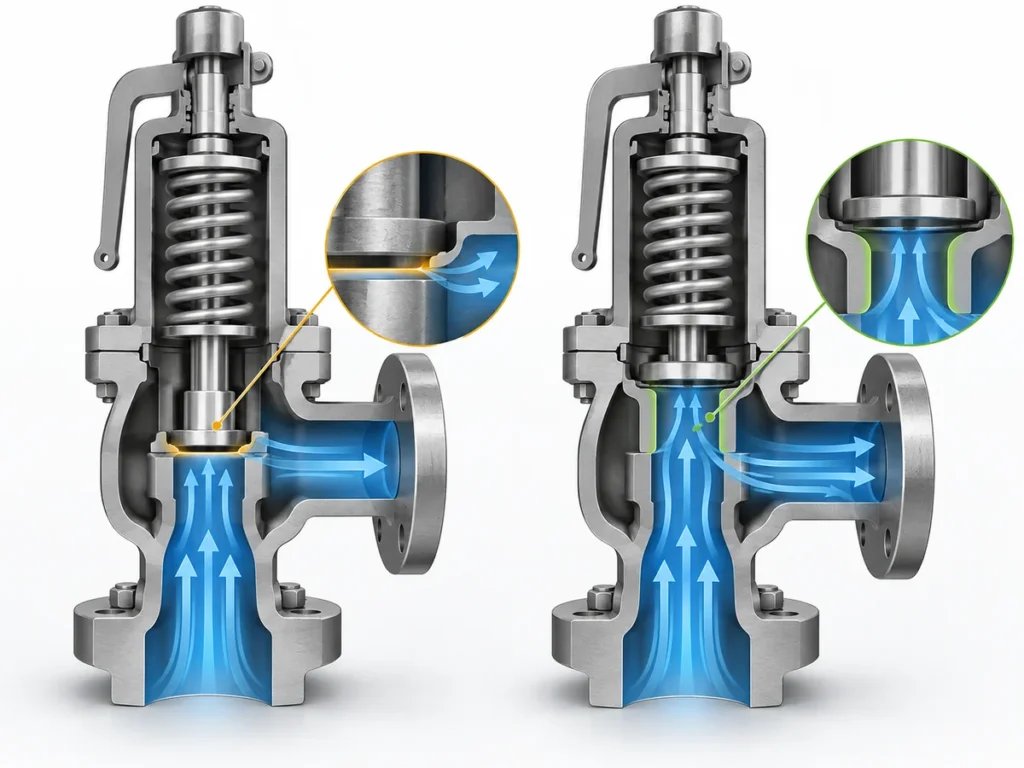
Ilustración técnica simplificada; no es un dibujo de fabricación ni una sección de modelo certificado.
Cadena de fallo: la contaminación del proceso entra o se forma dentro de un pasaje pequeño → el pasaje se restringe, se vuelve pegajoso o se bloquea → la transmisión de presión o el venteo del domo cambian → la respuesta del piloto cambia → la apertura, estabilidad o reasentamiento de la válvula principal se vuelven poco fiables.
Por eso es que Válvulas de seguridad pilotadas en servicio sucio deben revisarse como sistemas de control completos, no solo como cuerpos de válvula principal.
Piezas del circuito piloto que requieren revisión por separado
| Área del circuito piloto | Riesgo en servicio sucio | Verificación de Ingeniería |
|---|---|---|
| Línea de detección | Bloqueado, parcialmente restringido, enfriado, con cera o lleno de depósitos | Recorrido, pendiente, longitud, riesgo de aislamiento, pérdida de calor y depósitos encontrados |
| Entrada / restricción del piloto | Los sólidos o depósitos pegajosos ralentizan la respuesta del piloto | Limpieza, condición del filtro y geometría del pasaje según el diseño del fabricante |
| Asiento del piloto | Las partículas o depósitos impiden un asiento hermético del piloto | Superficie del asiento, historial de fugas, registro de limpieza y materiales blandos compatibles |
| Vía de carga del domo | Represurización lenta del domo después del alivio | Restauración de la presión del domo, depósitos y estado de la tubería del piloto |
| Vía de ventilación / escape del domo | La válvula principal puede abrir lentamente o no alcanzar el comportamiento de apertura esperado | Limpieza de la vía de ventilación, enrutamiento de la ventilación y disposición aprobada por el fabricante |
| Filtro o colador | Protege los pasajes del piloto pero puede convertirse en el punto de restricción | Intervalo de inspección, estado del elemento, efecto de la presión y acceso de mantenimiento |
No todos los servicios sucios fallan de la misma manera
Los servicios con partículas sucias, cerosos y polimerizantes no deben tratarse como una categoría genérica de “servicio sucio”. Cada mecanismo afecta al circuito piloto de manera diferente, y cada uno cambia la decisión de ingeniería.
| Mecanismo de servicio | Ubicación típica de falla | Qué cambia la decisión |
|---|---|---|
| Contaminación por partículas | Filtro, línea de sensado, entrada del piloto, restricción, asiento del piloto | Carga de partículas, fuente de residuos, disposición del filtro, limpieza inicial y acceso de mantenimiento |
| Deposición de hidrocarburos cerosos o pesados | Líneas de pequeño diámetro más frías, tubería estancada, pasajes de flujo bajo del piloto | Perfil de temperatura, comportamiento de aparición de cera, condición de parada, temperatura ambiente y pérdida de calor |
| Medio polimerizante o reactivo | Pasaje de control de flujo bajo, bolsillo estancado, asiento del piloto o tubería | Tiempo de residencia, química, dependencia de inhibidores, ventana de temperatura y recurrencia después de la limpieza |
| Comportamiento de incrustación desconocido | No se puede asumir | No finalizar la selección hasta que se definan el medio, los depósitos y el historial de mantenimiento |
Servicio con partículas sucias: cómo los sólidos obstruyen o restringen el circuito de control
El servicio con partículas sucias puede incluir óxido, incrustaciones, finos de catalizador, residuos de tuberías, productos de corrosión, arena, sólidos del proceso o arrastre de equipos aguas arriba. Estas partículas pueden ser intermitentes en lugar de constantes. Una válvula puede pasar una inspección inicial y aun así volverse poco fiable después del arranque, el mantenimiento, la limpieza de líneas, el cambio de catalizador o una perturbación aguas arriba.
Retardo de detección
Una línea de detección parcialmente restringida puede retrasar la señal de presión que llega al piloto. La válvula puede parecer aceptable en una inspección estática, pero responder demasiado lentamente durante un evento real.
Carga del filtro
Un filtro piloto puede proteger los pasajes aguas abajo, pero se convierte en un elemento de mantenimiento. Si se carga con sólidos, puede convertirse en el siguiente punto de restricción.
Error de presión de la cámara
La carga o ventilación restringida puede hacer que la válvula principal responda en el momento equivocado, se abra lentamente, se reasiente tarde o tenga fugas después de la operación.
La restricción parcial suele ser más difícil de diagnosticar que el bloqueo total. Una línea completamente bloqueada puede detectarse durante la inspección. Una vía parcialmente restringida puede seguir pasando algo de presión, pero no lo suficientemente rápido para una acción protectora estable durante un evento de alivio real.
Límite importante: La filtración no es lo mismo que la calificación para servicio sucio. Un filtro puede reducir las partículas sólidas aguas arriba del filtro, pero no puede evitar automáticamente la precipitación de cera, la formación de polímeros, los depósitos pegajosos en el asiento del piloto, un mal trazado de las líneas de sensado o una exposición a temperatura inadecuada.
Servicio con ceras e hidrocarburos pesados: la deposición puede depender de la temperatura
El servicio con ceras es diferente del servicio sucio ordinario. El fluido puede parecer aceptable a la temperatura normal de operación, pero depositar cera cuando la temperatura desciende en una línea de sensado de pequeño diámetro, tubería del piloto, conexión externa o volumen estancado.
La línea de proceso principal puede permanecer caliente y con flujo, mientras que el circuito del piloto experimenta menor velocidad y condiciones térmicas diferentes. Esto puede crear deposición localizada incluso cuando el equipo protegido no parece estar muy incrustado. Para medios calentados, viscosos o solidificantes, Válvulas de seguridad con camisa pueden ser parte de una revisión más amplia de las condiciones de servicio, pero no son un sustituto automático de una evaluación POSV para servicio sucio.
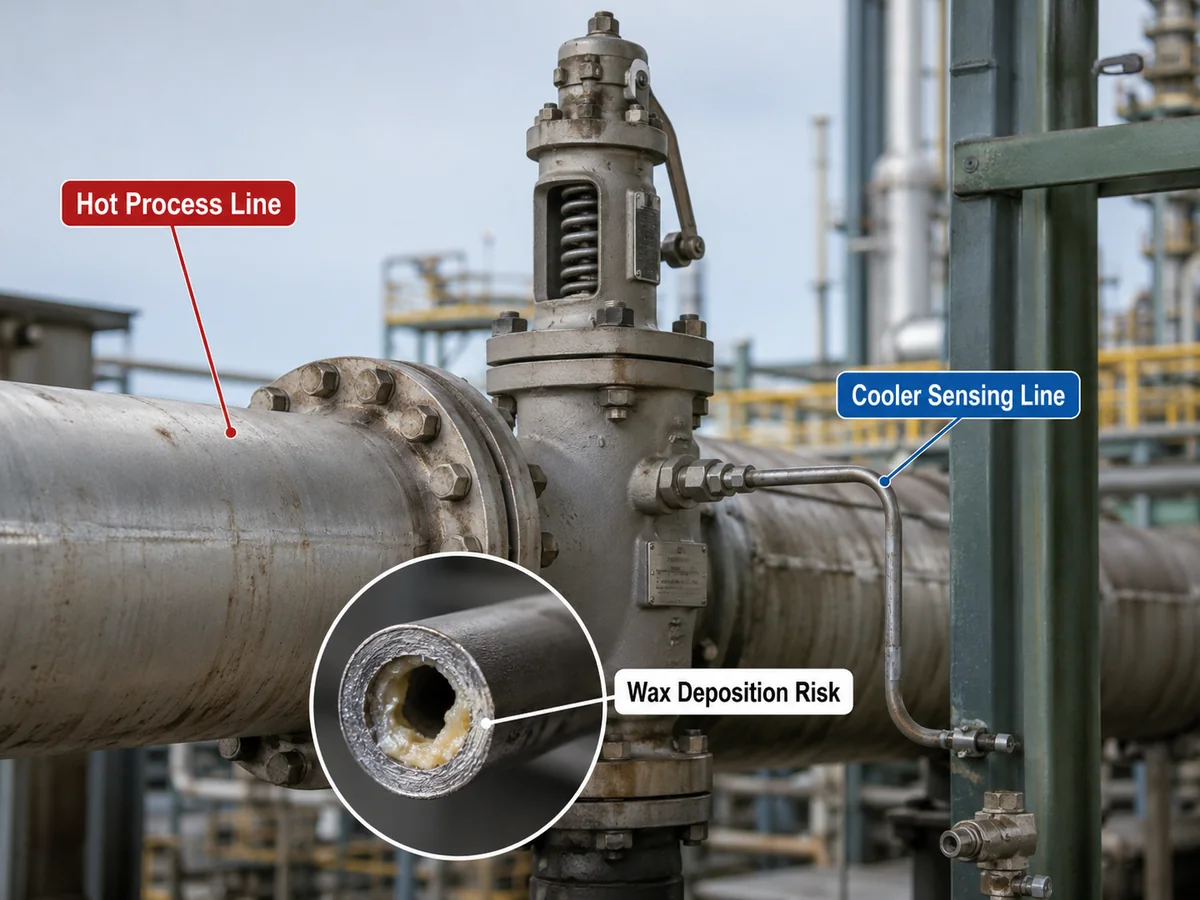
Visual conceptual de ingeniería; la temperatura y el comportamiento de la cera deben confirmarse para el fluido de proceso real.
Los puntos de revisión importantes incluyen la temperatura normal de operación, la temperatura de alivio, la temperatura de arranque y parada, la temperatura ambiente mínima, la pérdida de calor en líneas de sensado de pequeño diámetro, ubicaciones estancadas o de extremo muerto, el trazado y la pendiente de las líneas, los requisitos de aislamiento o trazado térmico, y si el servicio se enfría por debajo de una condición de aparición o deposición de cera.
El aislamiento o el trazado térmico no deben tratarse como una solución automática. Deben revisarse contra el fluido de proceso, el diseño de la válvula, la disposición del sensado, el acceso de mantenimiento y los requisitos de seguridad del proyecto. En algunos casos, la condición más severa no es la operación normal, sino el arranque en frío, la parada, el modo de espera, la operación invernal o el servicio intermitente.
Servicio con polimerización: una pequeña restricción puede convertirse en un depósito creciente
El servicio con polimerización requiere una revisión aún más cuidadosa porque el depósito puede formarse dentro del circuito del piloto en lugar de simplemente llegar como suciedad desde la tubería aguas arriba. Si el medio de proceso puede polimerizarse bajo ciertas condiciones de temperatura, tiempo de residencia, exposición al oxígeno, catalizador, inhibidor, presión o flujo estancado, los pequeños pasajes de control se convierten en ubicaciones de alto riesgo.
La diferencia más importante es la progresión. Una pequeña acumulación de polímero puede cambiar la respuesta de presión. Ese cambio puede aumentar el tiempo de residencia o reducir el lavado. La restricción puede entonces empeorar con el tiempo.
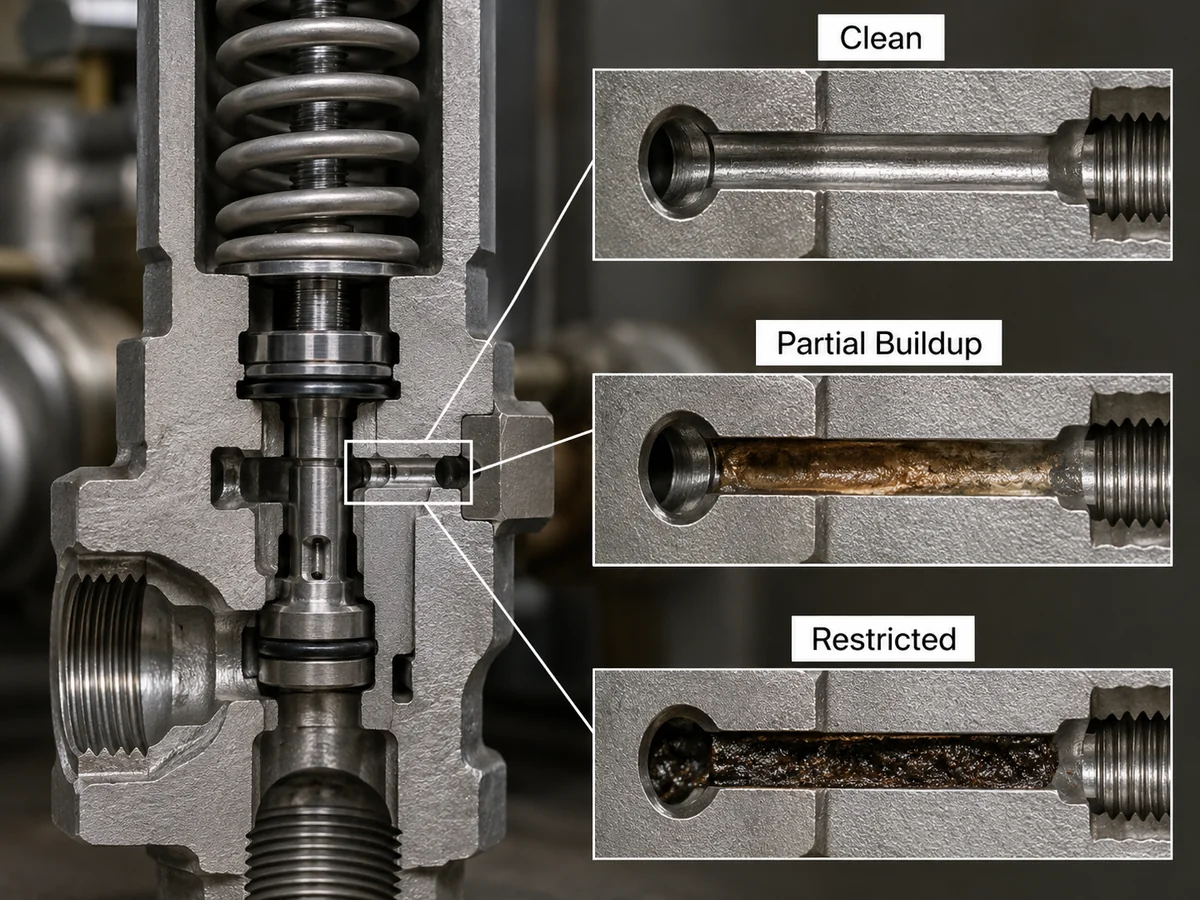
Ilustración de ingeniería simplificada; el riesgo real de polimerización depende de la química del proceso y de las condiciones de operación.
Un patrón repetido de limpieza y retorno al servicio es una señal de advertencia. Si la limpieza del piloto restaura temporalmente la operación pero los mismos síntomas reaparecen, la causa raíz puede no ser un mantenimiento deficiente. Puede ser que la disposición del piloto seleccionada cree o exponga una bolsa estancada donde el fluido no es estable.
Para medios polimerizantes, la solicitud de cotización o la revisión de reemplazo no debe limitarse al tamaño de la válvula, la presión de ajuste y la clase de brida. Debe incluir la composición del proceso, el mecanismo de polimerización, la dependencia del inhibidor, la ventana de temperatura, la sensibilidad al volumen estancado, el historial de mantenimiento y la evidencia del fabricante para la configuración de piloto propuesta.
¿Qué comportamiento de falla deben buscar los ingenieros?
El servicio sucio, ceroso o polimerizante puede crear varios síntomas observables. Estos síntomas no prueban la causa raíz por sí mismos, pero indican dónde debe comenzar la inspección.
- respuesta de apertura retardada;
- comportamiento de ajuste inconsistente en servicio;
- modulación o ciclado inestable cuando el diseño del piloto es modulante;
- apertura de la válvula principal más lenta de lo esperado;
- venteo incompleto de la cámara del domo;
- represurización lenta del domo;
- fuga después de la operación;
- fallo al reasentar correctamente;
- aumento de la frecuencia de mantenimiento;
- incrustaciones repetidas después de la limpieza;
- comportamiento diferente después de una parada, clima frío o cambio en la composición del proceso.
| Síntoma observado | Mecanismo de contaminación posible | Qué comprobar primero | No asuma |
|---|---|---|---|
| Respuesta retardada | Línea de detección o entrada del piloto restringida | Limpieza de la ruta de detección, condición del filtro y recorrido | La presión de ajuste es incorrecta |
| Apertura lenta de la válvula principal | Venteo del domo o escape del piloto restringido | Ruta de venteo del domo, escape del piloto y pasajes de control | La boquilla principal es de tamaño insuficiente |
| Fallo al reasentar | Contaminación del asiento del piloto o represurización lenta del domo | Asiento del piloto, vía de carga del domo y depósitos | El asiento principal está dañado únicamente |
| Fuga intermitente | Depósitos en el asiento del piloto o control del piloto inestable | Condición del piloto, materiales blandos e historial de servicio | El material del asiento es la única causa |
| Ciclado o inestabilidad | Combinación de ensuciamiento, pérdida de presión de entrada, contrapresión o dimensionamiento incorrecto | Circuito del piloto, pérdida de presión de entrada, sistema de salida y dimensionamiento de la válvula | El servicio sucio es la única causa |
| Aumento de la frecuencia de mantenimiento | Ensuciamiento progresivo, acumulación de cera o formación de polímeros | Tipo de depósito, registros de limpieza y ciclo de operación | Un intervalo de mantenimiento más corto es una solución permanente |
| Problemas después de una parada en frío | Depósito de cera o fluido pesado en líneas de pequeño diámetro | Perfil de temperatura, trazado de líneas y secciones estancadas | La temperatura normal de operación demuestra la idoneidad |
| Ensuciamiento repetido después de la limpieza | Formación de depósitos dentro de la vía de control | Tendencia a la polimerización, volumen estancado y química del proceso | La limpieza por sí sola resuelve el problema |
No diagnostique la obstrucción de la piloto hasta que excluya las causas a nivel de sistema
La obstrucción de la piloto es solo una explicación posible. Un dispositivo de alivio de presión forma parte de un sistema instalado. Antes de decidir que el servicio sucio ha causado la falla, los ingenieros también deben revisar las causas a nivel de sistema.
Pérdida de presión de entrada
La pérdida excesiva de presión entre el equipo protegido y la entrada de la válvula puede causar un funcionamiento inestable. Un circuito piloto restringido puede crear un síntoma similar, por lo que ambos deben verificarse. La guía de instalación de válvulas de seguridad debe revisarse cuando la conexión de entrada, la ubicación de detección, el soporte de tuberías o la disposición de descarga puedan afectar el comportamiento de la válvula.
Contrapresión de salida
La contrapresión puede cambiar el comportamiento de la válvula de seguridad según el tipo de válvula, la configuración y el sistema de descarga. La contrapresión superpuesta y la contrapresión acumulada deben revisarse por separado. Una válvula pilotada no resuelve automáticamente todas las condiciones de contrapresión, y el servicio sucio no elimina la necesidad de verificar la tubería de descarga y la resistencia del sistema de salida. Para antecedentes, revise Contrapresión y fuelle.
Dimensionamiento y margen de operación
Una válvula sobredimensionada, un flujo estable insuficiente, un margen de operación deficiente o un orificio seleccionado incorrectamente también pueden causar un funcionamiento inestable. La presión de ajuste no es capacidad. El tamaño de la conexión no es una capacidad de alivio certificada o documentada. Una válvula puede estar físicamente conectada al sistema y aun así ser incorrecta para la carga de alivio requerida. La base de capacidad debe verificarse contra dimensionamiento de válvulas de seguridad y capacidad de alivio certificada.
Revisión del sistema de alivio
Si el síntoma puede involucrar la tubería de descarga, la despresurización, la pérdida de entrada, la definición del escenario de alivio o la interacción del sistema, la revisión no debe detenerse en el cuerpo de la válvula. El Sistemas de alivio de presión API 521 contexto más amplio puede ser relevante al evaluar si el sistema instalado aún respalda la función protectora prevista.
Problemas de mantenimiento o ensamblaje
Después de la reparación o limpieza, un error de ensamblaje, sellos dañados, materiales blandos incorrectos, tuberías obstruidas, ajuste piloto incorrecto o pruebas incompletas pueden crear síntomas que parecen ensuciamiento del proceso. Revise los registros de as-found y as-left antes de tomar una decisión de reemplazo.
Atajos inseguros que se deben evitar en el reemplazo de POSV en servicio sucio
No reemplace solo por el tamaño de la brida
El tamaño de conexión solo acredita la conexión física. No acredita el orificio seleccionado, el coeficiente, la capacidad certificada, la base del fluido ni la idoneidad para el escenario de alivio aplicable.
No tratar la presión de ajuste como capacidad
La presión de ajuste identifica el valor de tarado. No demuestra la capacidad de alivio requerida, la capacidad nominal, el comportamiento bifásico ni la idoneidad tras un cambio de proceso.
No añadir un filtro sin revisión
Un filtro puede ayudar, pero también puede convertirse en la restricción. El tamaño del filtro, el acceso, el estado del elemento, el intervalo de mantenimiento y la aprobación del fabricante son importantes.
No cambiar el tubo piloto de manera informal
La ubicación de detección, el recorrido del tubo, las ventilaciones, la purga, el trazado térmico y las disposiciones de suministro limpio afectan la función de protección y no deben modificarse en campo sin revisión de ingeniería.
La purga, la detección remota, el suministro limpio, el calentamiento y otras opciones de mitigación requieren revisión de diseño
Existen posibles estrategias de mitigación para algunos servicios sucios, cerosos o polimerizantes, pero deben revisarse como disposiciones de ingeniería, no como improvisaciones de campo.
Suministro piloto limpio o externo
Esto puede reducir la exposición del circuito piloto a la contaminación del proceso, pero debe confirmarse la compatibilidad con el diseño de la válvula y la función de protección de presión.
Purga o detección remota
Un sistema de purga no debe comprometer la precisión de la detección, y una línea de detección remota debe seguir representando la presión del equipo protegido.
Control de temperatura
El trazado térmico o el aislamiento pueden ser relevantes para servicios con fluidos cerosos, pero deben revisarse en función del comportamiento del fluido, los requisitos de seguridad y el acceso para mantenimiento.
Otras direcciones de revisión pueden incluir filtros piloto aprobados por el fabricante, rutas alternativas de líneas de detección, volúmenes estancados minimizados, configuraciones piloto específicas del servicio, puntos de inspección accesibles y evidencia de mantenimiento definida basada en el historial real del servicio.
No modifique un circuito piloto en campo sin la aprobación de ingeniería. Los cambios no aprobados en líneas de detección, filtros, venteos, suministro limpio, flujo de purga o calefacción pueden comprometer la función de protección.
Evidencia y límites del fabricante
La documentación del fabricante para válvulas de alivio pilotadas comúnmente muestra que pueden existir accesorios o configuraciones específicos del servicio para ciertas familias de productos. Los ejemplos incluyen detección de presión remota, filtrado piloto, disposiciones de fuente de medio limpio, opciones para servicio sucio y otras modificaciones del circuito piloto. Esto respalda la necesidad de revisión por parte del fabricante, pero no convierte la filtración, la purga, la detección remota o la calefacción en una solución universal para todos los servicios sucios.
- La documentación de la válvula de alivio pilotada Emerson Anderson Greenwood muestra opciones de familia de productos, como la detección de presión remota. Estas son opciones específicas del producto, no una aprobación general para todos los servicios.
- La documentación de la POSRV Baker Hughes Consolidated 3900 incluye contexto de opciones para servicio sucio / precipitación / fluido viscoso para una familia de productos POSRV definida. Esto debe usarse como evidencia específica del fabricante, no como una afirmación del modelo ZOBAI.
Para la revisión de RFQ de ZOBAI, esto significa que el comprador debe proporcionar el medio de proceso real, la fase, los contaminantes, el perfil de temperatura, los datos de presión, la capacidad requerida, la contrapresión, la disposición de detección y la evidencia de mantenimiento. La configuración final debe confirmarse contra la serie de válvula seleccionada, los datos del fabricante, la edición del código aplicable, la especificación del proyecto y los requisitos regulatorios locales.
¿Cuándo debería reconsiderar el uso de una válvula de seguridad pilotada?
Una válvula de seguridad pilotada puede seguir siendo adecuada en algunos servicios contaminados si se comprende el mecanismo de contaminación y la configuración aprobada por el fabricante aborda el riesgo. Debe reconsiderarse cuando el servicio tiene una alta probabilidad de obstrucción, deposición, crecimiento de polímeros o fallo de mantenimiento en el circuito de control.
| Condición de servicio | Dirección de revisión de POSV | Preocupación principal |
|---|---|---|
| Gas o vapor limpio | Revisión normal de POSV | Entradas estándar de presión, capacidad, contrapresión y material |
| Sólidos finos ocasionales | Revisión especial de piloto/filtro | Evidencia de restricción y mantenimiento |
| Carga pesada de partículas | Revisión de alto riesgo | Ensuciamiento rápido del filtro o del paso |
| Hidrocarburo ceroso | Revisión de temperatura y deposición | Puntos fríos de pequeño diámetro y secciones estancadas |
| Fluido polimerizante | Revisión de servicio especializada | Crecimiento de depósitos en vías de control de bajo flujo |
| Mecanismo de contaminación desconocido | No finalizar la selección | Definición de servicio insuficiente |
| Ensuciamiento frecuente y repetido | Reevaluar la configuración de la válvula | La limpieza puede no resolver la causa raíz |
| Servicio crítico con acceso deficiente | Revisión de fiabilidad exhaustiva | La inspección y el mantenimiento pueden ser impracticables |
Dirección de selección final: Mantener, Revisar o Reconsiderar
Mantener la ruta de revisión de la POSV
Utilice la ruta de revisión POSV normal solo cuando el medio sea lo suficientemente limpio, el circuito piloto sea compatible con el servicio, se confirmen la capacidad requerida y la contrapresión, y el acceso de mantenimiento sea realista.
Se requiere revisión especial de POSV
Utilice esta ruta para sólidos ocasionales, tendencia a la cera, riesgo de carga del filtro, incertidumbre en la línea de detección o historial de servicio que muestre incrustaciones intermitentes pero no crecimiento de depósitos no controlado.
Reconsiderar la configuración
Reconsidere la configuración de alivio de presión cuando el servicio tenga sólidos pesados, bloqueo repetido por cera, crecimiento de polímeros, depósitos desconocidos, mal acceso de mantenimiento o fallas repetidas después de la limpieza. La selección de válvulas más amplia se puede revisar a través de la Guía de selección de válvulas de seguridad.
Las configuraciones alternativas deben evaluarse contra el escenario de alivio real, la capacidad de alivio requerida, la contrapresión, la compatibilidad de materiales, la instalación y la base del código aplicable. No deben seleccionarse solo porque el servicio se describe como sucio.
Evidencia de inspección y mantenimiento que debe revisarse
Para una válvula existente, la evidencia más útil suele ser la condición encontrada. Antes de ordenar un reemplazo, recopile información que muestre dónde comienza la cadena de fallas.
- fotos de la condición del filtro piloto;
- depósitos encontrados en las líneas de detección;
- contaminación del asiento del piloto;
- condición del tubo de la cúpula;
- frecuencia de limpieza;
- fecha y condición después del último evento de mantenimiento;
- presión de ajuste tal como se encontró y tal como se dejó;
- resultados de la prueba de estanqueidad del asiento cuando corresponda;
- historial de fugas;
- historial de temperatura de operación;
- historial de paradas o condiciones de clima frío;
- cambios en la composición del proceso;
- eventos de mantenimiento aguas arriba o de residuos;
- hoja de datos y placa de identificación existentes;
- piezas de reparación y materiales blandos anteriores;
- registros de gestión de cambios.
Una prueba de presión de ajuste por sí sola no demuestra que la válvula instalada sea adecuada para servicio sucio. La estanqueidad del asiento, la respuesta del piloto, la base de capacidad, la tubería instalada y la contaminación del servicio deben revisarse por separado.
Datos de RFQ y reemplazo para servicio sucio, ceroso o polimerizante
Antes de solicitar una cotización o recomendación de reemplazo, envíe suficientes datos para definir el deber de protección y el riesgo de contaminación.
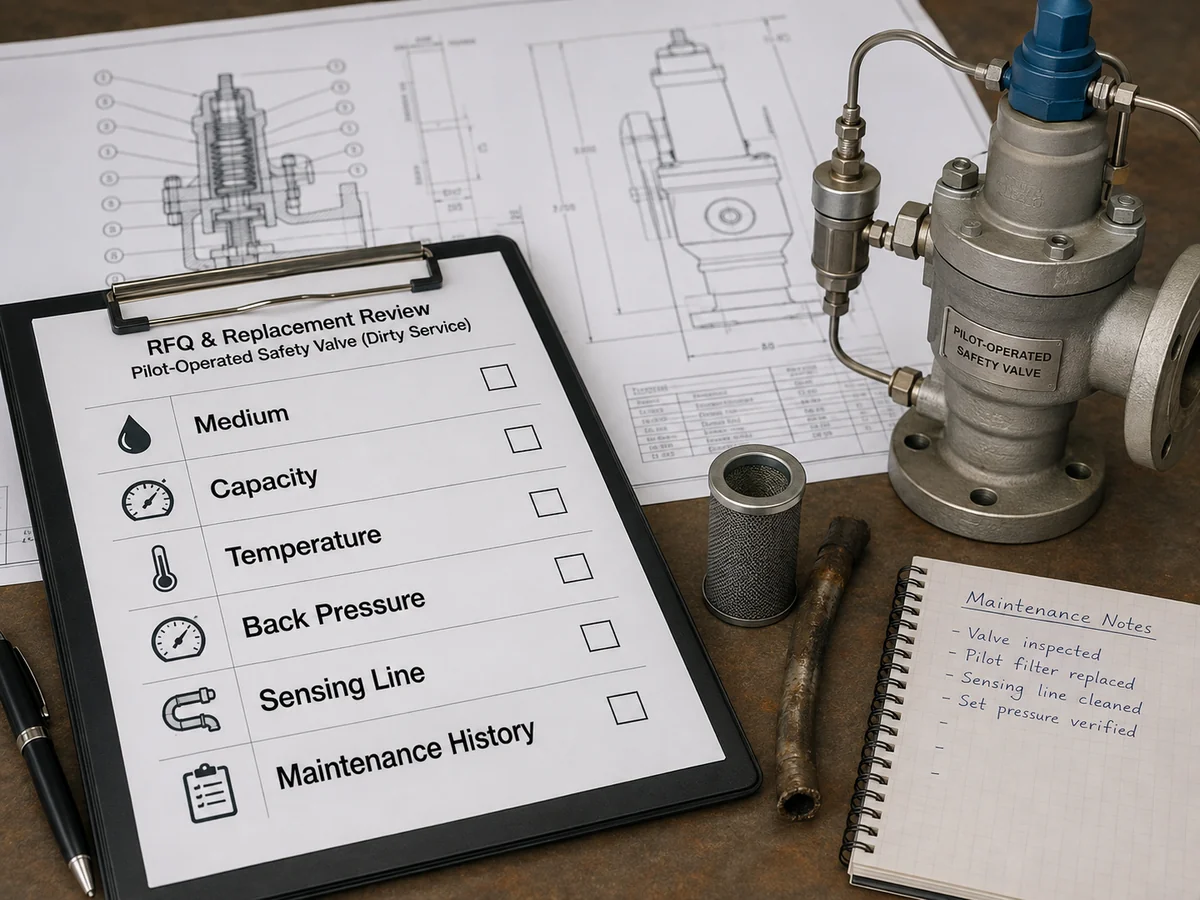
Lista de verificación solo visual; no reemplaza la revisión de ingeniería del proyecto.
| Datos requeridos | Por qué es importante |
|---|---|
| Equipo protegido | Confirma qué debe protegerse |
| Escenario de alivio principal | Define por qué la válvula debe aliviar |
| Medio y composición | Identifica riesgos de contaminación, cera o polímeros |
| Base de fase | Los deberes de gas, vapor, líquido y dos fases no pueden intercambiarse |
| Descripción de sólidos o contaminación | Define el riesgo de obstrucción y filtro |
| Tendencia a la cera o deposición | Determina el riesgo de ensuciamiento relacionado con la temperatura |
| Tendencia a la polimerización | Determina el riesgo de crecimiento de depósitos en pasajes estancados |
| Presión de operación / MAWP / presión de tarado | Separa la operación normal, el límite del equipo protegido y el ajuste de la válvula |
| Capacidad de alivio requerida y base de capacidad | Confirma el caudal a proteger |
| Temperatura de alivio | Afecta el material, los depósitos y la base de dimensionamiento |
| Contrapresión superpuesta y acumulada | Afecta el comportamiento de la válvula antes y durante la descarga |
| Disposición de entrada, salida y línea de detección | Ayuda a evaluar la pérdida de entrada, los efectos de descarga y la geometría propensa a la contaminación |
| Disposición existente de filtro, purga o suministro limpio | Muestra la estrategia actual de control de contaminación |
| Materiales y consumibles | Confirma la compatibilidad con el medio y la temperatura |
| Placa de identificación, hoja de datos e historial de mantenimiento existentes | Evita la sustitución basada únicamente en la apariencia |
| Código y documentos aplicables | Define la base de aceptación del proyecto |
El principal riesgo de selección es sustituir la válvula basándose únicamente en la apariencia, el tamaño de la brida o la presión de ajuste de la placa de identificación. El tamaño de la conexión por sí solo no demuestra la capacidad, y la presión de ajuste por sí sola no demuestra que la válvula seleccionada pueda proteger el caso de alivio gobernante.
Para la revisión relacionada con el dimensionamiento, consulte la guía de ZOBAI sobre Dimensionamiento de válvulas de seguridad API 520.
Flujo de trabajo de investigación de fallas antes del reemplazo
- Confirmar el equipo protegido y el escenario de alivio aplicable. No solucione problemas de la válvula por separado del sistema que protege.
- Recopile evidencia tal como se encontró. Fotografíe el filtro del piloto, la línea de detección, los depósitos, la tubería, el asiento del piloto y los hallazgos de mantenimiento antes de la limpieza.
- Identifique el mecanismo de contaminación. Separe sólidos particulados, deposición de cera, crecimiento de polímeros, arrastre de líquido y ensuciamiento desconocido.
- Verifique los efectos del sistema. Revise la pérdida de entrada, la contrapresión de salida, el margen de operación, el dimensionamiento de la válvula y la tubería de descarga antes de culpar únicamente al piloto.
- Revise los arreglos aprobados por el fabricante. Confirme si el diseño de la válvula seleccionada admite filtro, purga, suministro limpio, detección remota o calefacción.
- Vuelva a verificar la capacidad y la base del código. La capacidad requerida, la capacidad certificada/documentada, la fase del medio y la edición de la norma adoptada aún deben confirmarse.
- Decida si es aceptable reemplazar por el mismo tipo. Si el mecanismo de falla sigue sin resolverse, repetir la misma configuración de válvula puede repetir la falla.
Escenarios de Ingeniería Compuestos
Los siguientes escenarios son ejemplos ilustrativos de capacitación. No son casos de clientes de ZOBAI y no deben tratarse como prueba del rendimiento del producto.
Escenario compuesto 1: Ensuciamiento por partículas después del mantenimiento aguas arriba
Una válvula pilotada comienza a responder de manera inconsistente después de que se abre el equipo aguas arriba para mantenimiento. El asiento de la válvula principal parece aceptable, pero se encuentran residuos en la ruta de detección y en el filtro del piloto. La cadena de falla probable es la migración de residuos, la restricción parcial del piloto y la transmisión retardada de presión.
La acción correctiva no es simplemente restablecer la válvula. Se deben revisar la ruta de detección, el filtro del piloto, el asiento del piloto y la limpieza aguas arriba. La medida de prevención puede incluir control de limpieza al arranque, revisión de filtración y requisitos de evidencia de mantenimiento.
Escenario compuesto 2: Hidrocarburo ceroso después de parada en frío
Una válvula funciona aceptablemente durante la operación normal en caliente, pero se vuelve poco fiable después de una parada en frío. La inspección encuentra depósitos cerosos en una conexión externa de detección de pequeño diámetro. La cadena de fallos probable es la caída de temperatura, la deposición de cera y la comunicación de presión restringida.
La revisión debe incluir la temperatura ambiente mínima, la condición de parada, el trazado de la línea, los bolsillos de fluido estancado y las opciones de control de temperatura aprobadas por el fabricante. No se debe asumir que el aislamiento por sí solo resuelve el problema.
Escenario compuesto 3: Fluido polimerizante con limpieza repetida
Una válvula vuelve a la normalidad después de la limpieza del piloto, pero aparecen síntomas similares nuevamente después de un período de operación. La cadena de fallos puede ser la formación de polímeros en un paso de piloto de bajo flujo o en un volumen de control estancado.
La limpieza repetida puede restaurar la operación a corto plazo sin resolver la causa raíz. Se debe revisar la química del servicio, el tiempo de residencia, la disposición del piloto y la idoneidad de la configuración de la válvula antes de seleccionar el mismo diseño de reemplazo.
Estándares y límites de ingeniería
Las válvulas de seguridad pilotadas pueden especificarse y revisarse bajo los estándares de alivio de presión y códigos de equipos a presión adoptados por el proyecto. ISO 4126-4 es una norma de producto para válvulas de seguridad pilotadas y no debe tratarse como una aprobación de selección de aplicación para cada servicio sucio, ceroso o polimerizante. ZOBAI también proporciona una descripción general interna de Normas ISO 4126 para válvulas de seguridad para compradores que necesitan un contexto más amplio de estándares. API 520 Parte I es una referencia de dimensionamiento y selección para dispositivos de alivio de presión en servicio de refinería. API 521 aborda los sistemas de alivio de presión y despresurización. ASME BPVC Sección XIII es una referencia para las reglas de protección contra sobrepresión.
La edición adoptada, los requisitos jurisdiccionales, los datos del fabricante y la especificación del proyecto deben verificarse para cada proyecto. Este artículo no reemplaza el cálculo del sistema de alivio, la revisión del fabricante ni la aprobación regulatoria local.
Preguntas frecuentes
¿Se pueden utilizar válvulas de seguridad pilotadas en servicios con suciedad?
A veces, pero no por suposición. El servicio sucio requiere revisión del mecanismo de contaminación, circuito piloto, vía de detección, disposición de filtro o purga, acceso de mantenimiento, condiciones de temperatura y configuración aprobada por el fabricante.
¿Puede un filtro piloto evitar fallos en la POSV?
Un filtro puede reducir la contaminación sólida que entra en el circuito piloto, pero también puede convertirse en una restricción. No previene automáticamente la deposición de cera, la formación de polímeros, los depósitos pegajosos en el asiento del piloto ni un mal trazado de la línea de detección.
¿Por qué se acumula cera en las líneas de detección del piloto?
La cera puede permanecer móvil en la línea de proceso caliente, pero depositarse cuando las líneas de sensado de pequeño diámetro o los tubos piloto se enfrían. Las secciones de baja velocidad, estancadas, el paro en frío y un mal trazado pueden aumentar el riesgo de deposición.
¿Por qué es difícil el servicio de polimerización para una válvula pilotada?
El servicio con polimerización puede formar depósitos en el interior de pasos de control de bajo flujo o estancados. Incluso una pequeña acumulación puede alterar la respuesta del piloto, el venteo de la cámara o el comportamiento de reasentamiento.
¿Puede un servicio sucio provocar que una válvula pilotada se abra tarde?
Sí. Si la línea de detección, la entrada del piloto, el filtro o la restricción de control están parcialmente bloqueados, la presión puede no llegar al piloto de manera correcta o suficientemente rápida. La respuesta de la válvula puede retrasarse o ser inestable.
¿Cómo puedo saber si la inestabilidad se debe a la obstrucción del piloto o a la tubería?
Compruebe ambos. La pérdida de presión en la entrada, la contrapresión en la salida, la selección de una válvula sobredimensionada, un margen de operación insuficiente y los efectos de la tubería de descarga también pueden causar inestabilidad. La contaminación del piloto debe confirmarse con evidencia de inspección.
¿Cuándo se debe considerar otra configuración de válvula de alivio de presión?
Considere otra configuración cuando el servicio presente sólidos pesados, deposición recurrente de cera, formación de polímeros, acceso deficiente para mantenimiento, comportamiento de contaminación desconocido o incrustaciones repetidas del piloto a pesar de la limpieza y la revisión del fabricante.
Solicite una revisión de ingeniería antes de reemplazar una POSV en servicio sucio
Si su válvula de seguridad pilotada se utiliza en servicio sucio, ceroso o polimerizante, envíe las condiciones de proceso antes de seleccionar una válvula de reemplazo. Una revisión adecuada debe determinar si el circuito piloto puede diseñarse para el servicio, o si se debe evaluar otra configuración de alivio de presión.
Incluya el equipo protegido, el escenario de alivio que rige, el medio y la fase, la descripción de la contaminación, la presión de operación, la MAWP o presión de diseño, la presión de ajuste, la capacidad de alivio requerida, la temperatura de alivio, la contrapresión, las tuberías de entrada y salida, la disposición de la línea de detección, los materiales, la hoja de datos existente, la placa de identificación y el historial de mantenimiento.
Comentarios
Kesari Alloys
El énfasis en tratar las válvulas de seguridad operadas por piloto como sistemas de control completos, en lugar de centrarse únicamente en la válvula principal, es crucial. El artículo destaca acertadamente cómo una línea de detección parcialmente restringida puede provocar una respuesta lenta de presión, lo que puede ser catastrófico durante eventos de alivio. ¿Ha observado casos de estudio específicos en los que una evaluación inadecuada del circuito piloto haya provocado fallos en las válvulas? Sería interesante saber qué tan común es este problema en diversas industrias.