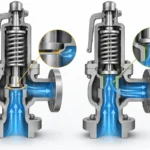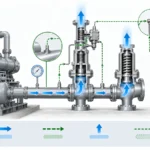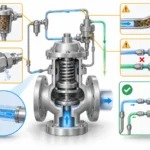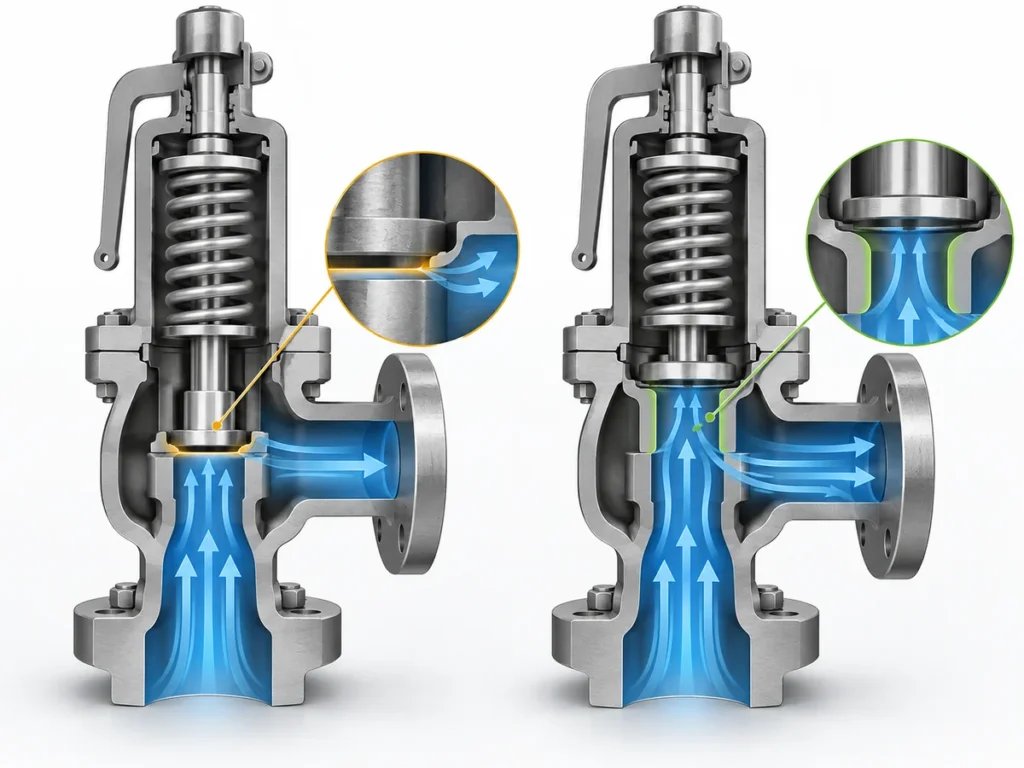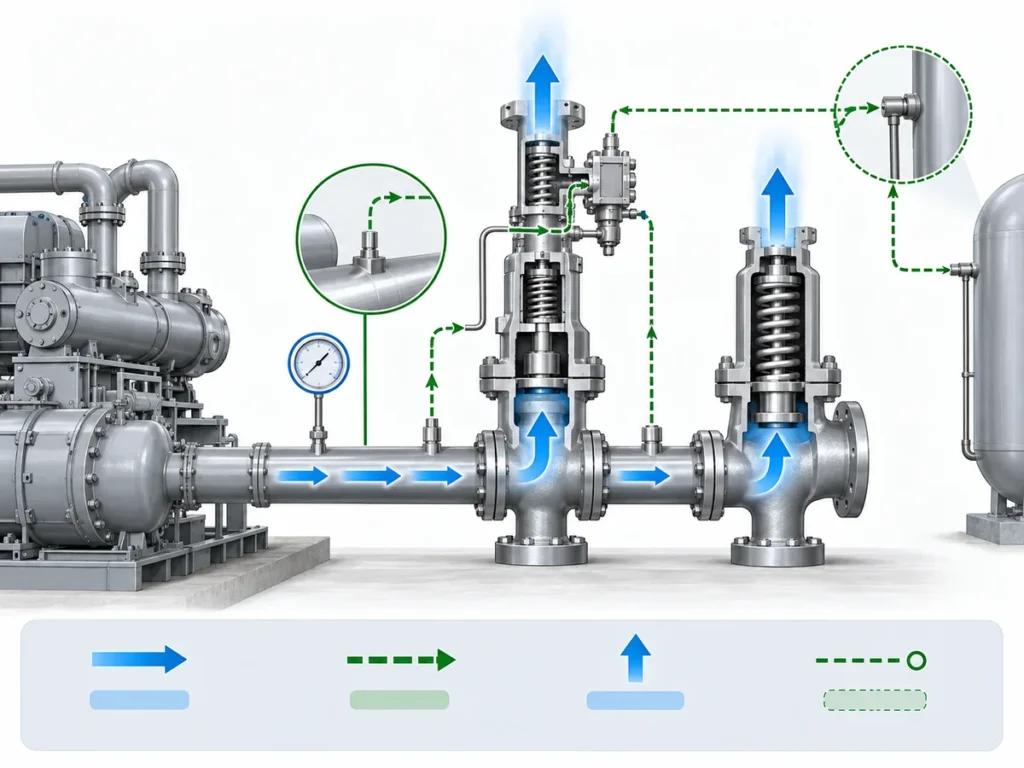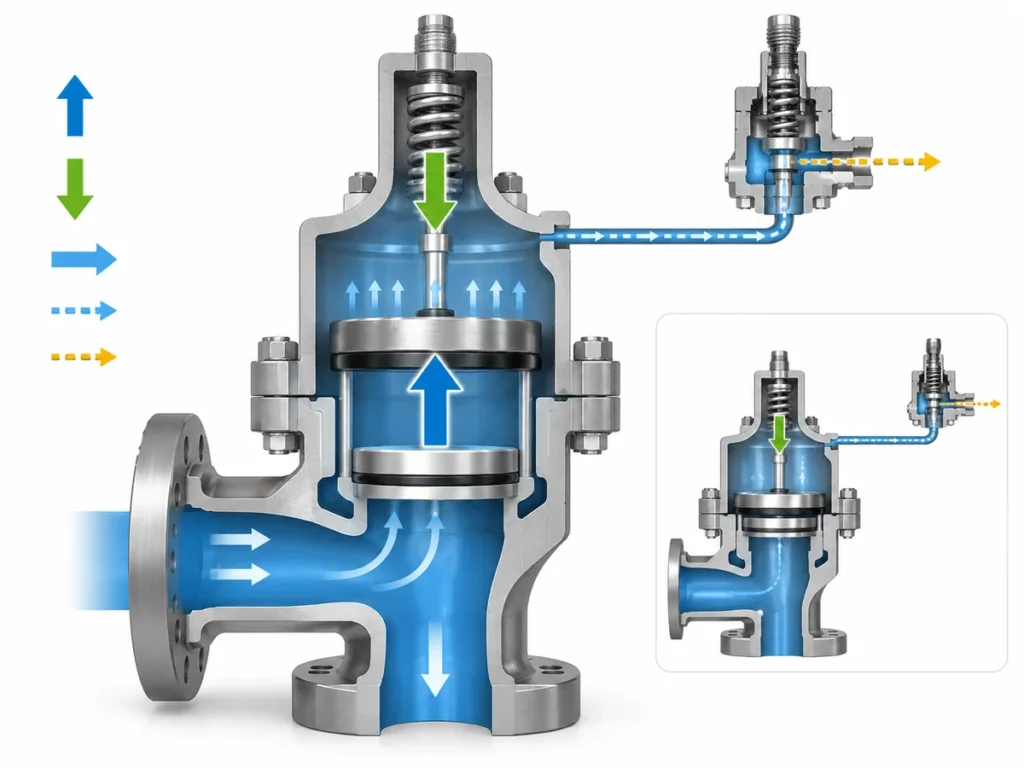
了解如何检查先导式安全阀的过滤器、导压管和密封件,并根据回装投用前所需的验证依据匹配功能试验。.

先导式安全阀的维护不能把先导阀当作简单安装在主阀上的附件来处理。先导阀、过滤器、感应或供压连接、密封件与主阀共同构成一个控制系统。即使主阀阀体本身看起来仍可使用,该控制回路中的污染、泄漏、堵塞或连接恢复不当仍可能造成影响。.
第二个维护误区是把每次维护后的“测试”都视为等同。先导阀整定压力检查、密封性试验、整机功能试验和排量试验所验证的内容各不相同。.
因此,本文遵循两条原则:
- 检查阀门上实际安装的先导/控制回路。.
- 在回装投用前,使试验与所需证据相匹配。.
本文采用 先导式安全阀 作为工作术语。制造商和标准文件也可能使用 先导式泄压阀, POSV 或 POSRV. 如果操作顺序本身尚不明确,请参阅 先导式安全阀的工作原理 . 特定阀门的精确维护说明仍以适用的制造商文件和现场要求为准。.
维护前,确认阀门配置和拆检状态
在清洗过滤器、断开管路或更换密封件之前,,
应准确确认所处理的阀门和先导阀配置。.
先导式设计在系统压力到达先导阀的方式、
传感是内置还是远程、控制压力或膜室压力
如何连接,以及哪些部件单独维护或试验方面可能有所不同。.
适用于一种配置的维护步骤不应
自动套用到另一种配置。.
首先确认:
- 阀门及先导阀标识;;
- 适用的制造商维护说明;;
- 感应方式,包括使用远程感应的情况;;
- 工艺介质及相关工况;;
- 阀门被拆卸、检查或开启的原因;;
- 拆卸时的原始状态;;
- 相关的以往维护或试验记录(如有)。.
承压系统或先导系统上的作业必须遵循适用的
工厂和制造商隔离与泄压程序。对于
示例,,
Anderson Greenwood 727 系列维护说明
要求隔离相应的 POSRV 组件并泄压
在指定的先导阀维护作业之前。该示例并不构成
通用的隔离顺序;具体方法仍取决于现场和
具体型号。.
保留 拆卸前原始状态 在清洁去除
有用证据之前。堵塞的滤芯、先导阀连接处泄漏、
管路连接错误或异常沉积物,有助于解释
组件为何未按预期工作。.
有关更全面的整阀维护计划、检验计划以及
拆卸前/回装后状态记录,请参阅
安全阀维护与检查指南
.
本文重点介绍先导阀/控制回路及
该项工作完成后所需的证据。.
维护决策: 在确认其周边配置之前,
不要对部件下诊断结论。.
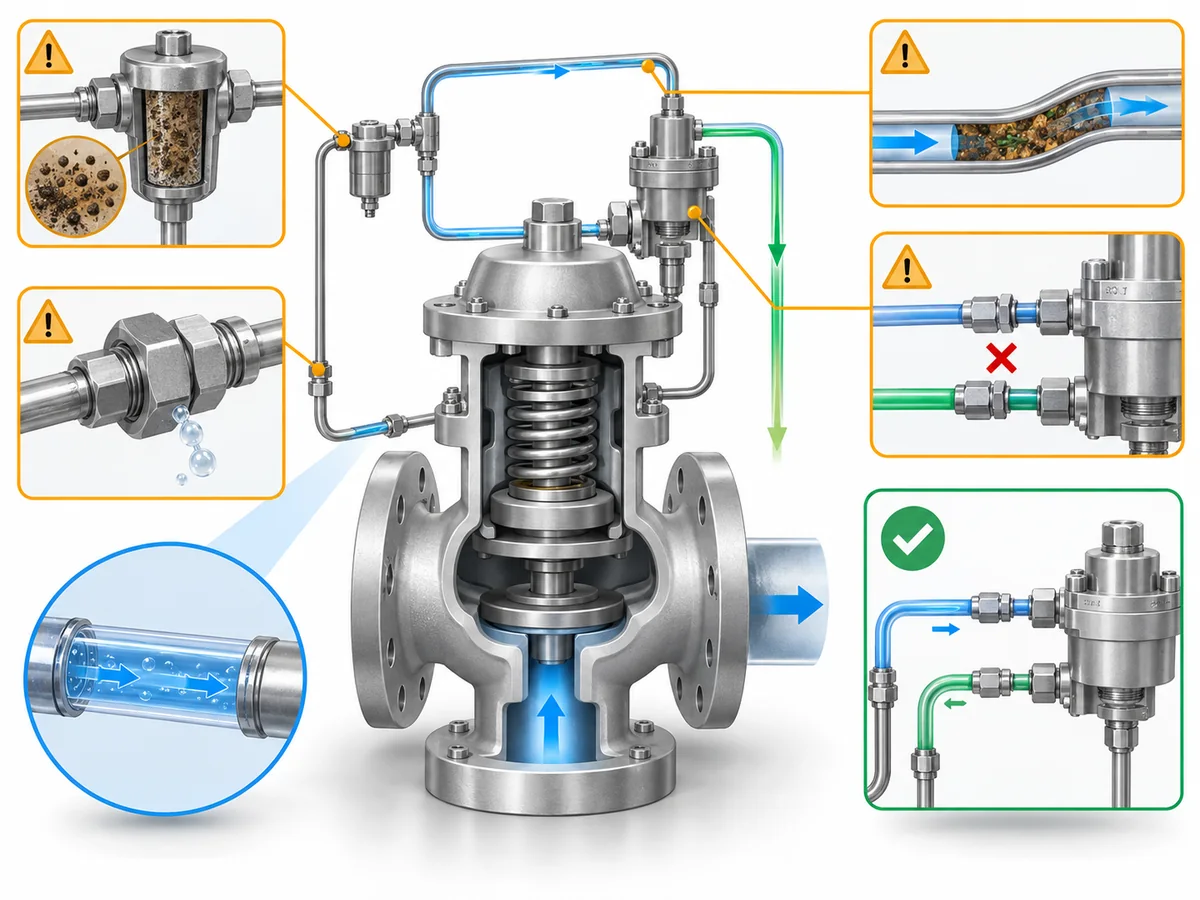
将过滤器作为先导控制回路的一部分检查,而非孤立部件
在感测或先导供气回路中设有过滤器的先导式阀门设计中,
过滤器的状态所能说明的问题,远不止过滤器本身
是否需要维护。.
过滤器的用途是限制污染物进入下游先导
通道或相关控制部件。如果其中积聚了明显
污染物,仅清洗或更换这一个部件可能并不能
解决维护问题。.
接下来的问题是:
同样的污染物是否已经影响到相连的
先导/控制通路?
过滤器被污染并不能 不 证明先导阀已
堵塞。但它确实为维护工程师提供了检查
相关下游通道和连接处的理由,当污染物的量或性质
使进一步节流变得可信时。.
过滤器本身应按照适用的阀门
规程进行处理。已发布的制造商说明并不支持一条
通用规则:某些过滤器组件可在
规定条件下检查并重复使用,而其他设计则要求更换。.
维护频率也有同样的界限。过滤器的关注应
基于适用的制造商要求、使用历史以及
污染工况,而非对每个先导式安全阀套用固定周期
每个先导式安全阀。.
| 过滤器检查结果 | 应采取的整改措施 |
|---|---|
| 清洁且无损伤 |
继续完成先导回路其余所需检查;仅凭过滤器清洁 并不能证明先导阀状态正常。. |
| 污染严重 |
检查相连的控制回路是否存在相关污染或 堵塞。. |
| 按适用规程判定为损坏或不合格 | 按该型号的具体要求进行更换。. |
| 反复出现严重污染 |
检查污染为何持续进入先导系统 而不是把每次过滤器维护当作孤立事件。. |
因此,过滤器状态可以作为诊断证据,反映
先导系统所处的环境,而不仅仅是日常维护事项。.
检查传感与控制管路是否堵塞、泄漏及复装错误
先导式安全阀周围的每根小管并非都具有相同
用途。根据设计不同,技术文件可能区分
压力传感管线、先导供压接口、膜室或控制管线、,
远程传感接口及其他先导管路。.
因此,管路问题应按失效模式分别排查。.
| 发现 | 重要性 | Maintenance check |
|---|---|---|
| Restriction or blockage | The intended pressure signal or pilot supply path may be impeded. |
Inspect the affected passage and connected components using the applicable procedure. |
| Leakage | Pressure integrity in the sensing or control path may be lost. |
Identify the leaking connection or component and verify the restored assembly. |
| Kink, corrosion or mechanical damage |
The flow path or mechanical integrity may no longer match the intended configuration. |
Repair or replace in accordance with approved documentation. |
| Loose or incorrect reconnection |
The valve may no longer be sensing or controlling pressure through the intended path. |
Compare routing and connection points with the correct valve documentation. |
| Unverified modification to a remote-sensing line |
The sensing arrangement may no longer match the engineered configuration. |
Refer the arrangement for engineering or manufacturer review. |
The distinction between restriction 和
泄漏 matters. A restricted path can interfere with
pressure communication through that path. A leaking connection presents a
different problem: loss of pressure integrity. The inspection and
corrective action are not interchangeable.
Remote sensing adds another boundary. Manufacturer documentation shows
that remote-sensing arrangements can depend on the intended connection
point and design-specific line geometry. Those details should not be
copied from one valve family to another.
Maintenance rule: Do not shorten, resize, reroute or
reconnect a sensing line merely because the new arrangement physically
fits. Restore the approved configuration or obtain engineering
confirmation.
A tube can look physically sound yet still be wrong because it has been
connected to the wrong point or restored differently from the approved
arrangement.
For maintenance closeout, “the tubing looks fine” is weaker evidence than
confirming that the correct pressure path has been restored and
checked for relevant restriction and leakage under the applicable
maintenance procedure.
Evaluate Seals by Location, Condition and Service Compatibility
A seal decision should not begin and end with, “Does this O-ring look
damaged?”
Pilot-operated valves can contain several seals in different functions,
and manufacturer repair instructions do not necessarily treat every
sealing component the same way. Some soft goods may be mandatory
replacement items under a particular overhaul procedure; another component
may have a different inspection or replacement rule.
Two generic shortcuts should therefore be avoided:
Reuse every seal that still looks good.
和
Replace every seal on every pilot-operated valve whenever the valve is opened.
Instead, separate four questions.
1. Which seal is it?
Identify the location and function of the part. A pilot seal, main-valve
sealing element and connection seal should not automatically inherit the
same maintenance rule.
2. Is the part and material correct?
Pilot-operated valve families can use different soft-goods materials for
different configurations and services. A replacement part should match
the approved valve configuration rather than merely having the same
apparent dimensions.
For deeper material-selection context, see the
安全阀材质选择指南
.
3. Is its condition acceptable?
Inspect the component for the forms of damage or deterioration addressed
by the applicable manufacturer procedure. Appearance is useful evidence
of physical condition, but it does not establish material identity or
service compatibility.
4. Does the applicable procedure permit reuse?
This is separate from appearance. If the manufacturer procedure requires
replacement of that component during the applicable service operation, an
apparently intact seal is not evidence for ignoring the requirement.
The same distinction matters during procurement. A “similar” elastomer is
not automatically an acceptable substitute simply because it fits.
Seal decision sequence:
identity → material/configuration → condition → permitted
reuse/replacement → post-assembly verification.
Match the Functional Test to What You Need to Prove
A post-maintenance test is only as broad as its test scope.
Instead of asking only, “Did the valve pass?” ask:
Which test was performed, which variable or function did it verify, and
what remains untested?
For standards context,
API RP 576
covers inspection and repair of pressure-relieving devices including
pilot-operated pressure relief valves;
API 527
addresses seat tightness; and
ASME PTC 25
distinguishes pressure-relief-device test purposes including
flow-capacity testing from other testing activities.
A broader standards overview is available in the
安全阀标准指南
.
Those are not interchangeable forms of evidence.
| Check or test | What the result can support | What it does not automatically prove |
|---|---|---|
| Visual inspection | Visible condition, configuration and assembly observations | Set pressure, seat tightness or rated capacity |
| Pilot/set-pressure verification |
Pilot actuation or set-pressure behavior under the approved test method |
Rated flow capacity or complete installed-system acceptance |
| 密封性试验 | Leakage performance under the applicable test basis | Complete pilot/main-valve functional performance |
| Complete-assembly functional test |
Defined operation and integrity of the assembled pilot/main valve under that procedure |
Certified flow capacity unless capacity is actually tested |
| Flow-capacity test | Flow capability under defined test conditions | Correct installation or suitability of every field-system detail |
Pilot Set-Pressure or Pilot-Function Verification
On applicable designs, a field test connection can provide a way to
verify pilot or set-pressure behavior.
That can be useful without proving everything about the assembled valve.
Some manufacturer procedures distinguish pilot-oriented artificial
actuation from actual main-valve operation. A valid pilot test can
therefore confirm the variable it was designed to check while leaving
other main-valve characteristics outside the evidence.
The same boundary applies to characteristics such as blowdown when the
test method does not fully exercise the main valve.
A useful record is not simply “Pilot test: PASS.” Record what pilot
function was verified and which required valve functions remain subject
to another acceptance basis.
Seat-Tightness and Leakage Testing
Seat-tightness testing answers the leakage question.
API 527 is specifically concerned with determining the seat tightness of
pressure relief valves within its scope, including pilot-operated designs.
A result under the applicable API 527 test basis therefore supports a
seat-leakage conclusion.
It does not automatically support the broader statement:
The entire valve has been functionally verified.
Seat tightness is one evidence category.
Complete-Valve Functional Verification
For some pilot-operated valve designs, manufacturer procedures separately
test the assembled pilot and main valve after maintenance. Such testing
can evaluate defined pilot/main-valve interaction and can include leakage
checks at relevant assembled connections.
That is broader than a pilot-only set-pressure check. It is still not
automatically a flow-capacity test.
Evidence rule: A complete-assembly functional test proves
the functions included in that approved procedure—not every
characteristic of the installed relief system.
What a Field or Functional Test Does Not Prove
The largest post-maintenance interpretation error is to expand a narrow
PASS result beyond the question that was tested.
- Pilot set-pressure verification ≠ rated capacity evidence.
- Seat-tightness PASS ≠ complete functional proof.
-
Complete-assembly functional test ≠ flow-capacity certification.
-
Bench or field valve test ≠ proof that the entire installed relief
system is correctly sized and arranged.
For maintenance records and engineering review, document enough
information to answer:
- What test was performed?
- What valve/pilot configuration was tested?
- What variable or function was evaluated?
- What acceptance basis was used?
- What did the test not evaluate?
- Does another maintenance question still remain open?
That makes the test result usable evidence instead of a generic “PASS”
label.
Decide Whether the Valve Is Ready to Return to Service
Reassembly is not the same as maintenance closure.
The return-to-service decision should combine:
- what was found;
- what was corrected;
- whether the pilot/control path was restored;
- whether parts and seals were verified;
- which tests were performed;
- what those tests actually established;
- whether any relevant question remains unresolved.
该 PROCEED / HOLD / ESCALATE labels below are an
engineering screening framework used in this article. They are not API,
ASME, ISO or regulatory classifications and do not replace the valve
owner’s, manufacturer’s or applicable jurisdictional acceptance process.
| Screening outcome | Use it when |
|---|---|
| 通过 |
The applicable maintenance scope is complete, the approved configuration is restored, parts/materials required by that scope are verified, and the required post-maintenance checks provide acceptable evidence for the questions they were intended to answer. |
| 暂缓 |
Relevant contamination, blockage, leakage, incorrect configuration, uncertain seal identity, failed test response or another unresolved maintenance condition remains. |
| ESCALATE |
The correct configuration cannot be established, repeated contamination may warrant review for a broader application or system cause, test behavior conflicts with expected valve response, or the next step requires engineering/manufacturer input outside the validated maintenance scope. |
Before closeout, ask:
-
Has a contaminated filter triggered the necessary inspection of the
connected pilot path? -
Have sensing, supply and control connections been checked for relevant
restriction and leakage and restored to the approved configuration? -
Are replacement or retained seals correct for the applicable valve
configuration and maintenance procedure? -
Did the test actually examine the function that the maintenance work
could have affected? - Is each PASS result being used only within the scope of that test?
-
Does any unresolved condition still require engineering, manufacturer
or owner review?
A useful maintenance handoff contains more than “valve failed” or “valve
repaired.”
Provide, where available:
- 阀门及先导阀标识;;
- relevant service conditions;
- as-found observations;
- filter and tubing findings;
- components replaced or retained;
- seal/soft-goods identification relevant to the work;
- tests performed;
- test results and acceptance basis;
- the specific unresolved question if engineering review is still required.
That information helps the next reviewer distinguish a component
maintenance problem from a configuration, service or wider application
issue.
Closeout principle: Maintenance is not complete merely
because the last part has been reassembled. It is complete when the
relevant maintenance question has been answered by evidence appropriate
to that question.