安全阀是正常运行与超压事件之间最后一道自动压力保护装置。它必须在要求的压力下开启,排放足够的介质,在安装工况下保持稳定,并在系统压力恢复到安全水平后回座。因此,安全阀选型绝不能仅依据进口尺寸、出口……

安全阀是正常运行与超压事件之间最后一道自动压力保护装置。它必须在规定的整定压力下开启,排放足够的介质,在安装工况下保持稳定,并在系统压力恢复到安全水平后回座。
因此,安全阀选型绝不能仅依据进口尺寸、出口尺寸、法兰等级或价格。DN50 或 NPS 2 的安全阀可能能够安装在设备管口上,但认证排量仍然不足。安全阀也可能整定压力正确,但如果进口压力损失过大、出口系统产生过大背压、介质在泄放过程中发生相变,或阀瓣与阀座材料不适用,其性能仍然会很差。
工程要点:
应首先根据被保护设备和可信的泄放工况选择安全阀。然后确认整定压力、所需泄放量、制造商认证排量、介质状态、泄放温度、背压、材料、安装方式以及适用的规范或项目规格书。
本指南适用范围
本页面涵盖用于压力保护的回座式安全阀和泄压阀,并非爆破片、真空泄放装置、压力调节阀、HIPPS、火炬管网设计或紧急泄压系统的完整设计方法。项目专用计算、正式标准、属地法规及制造商认证数据仍为控制依据。
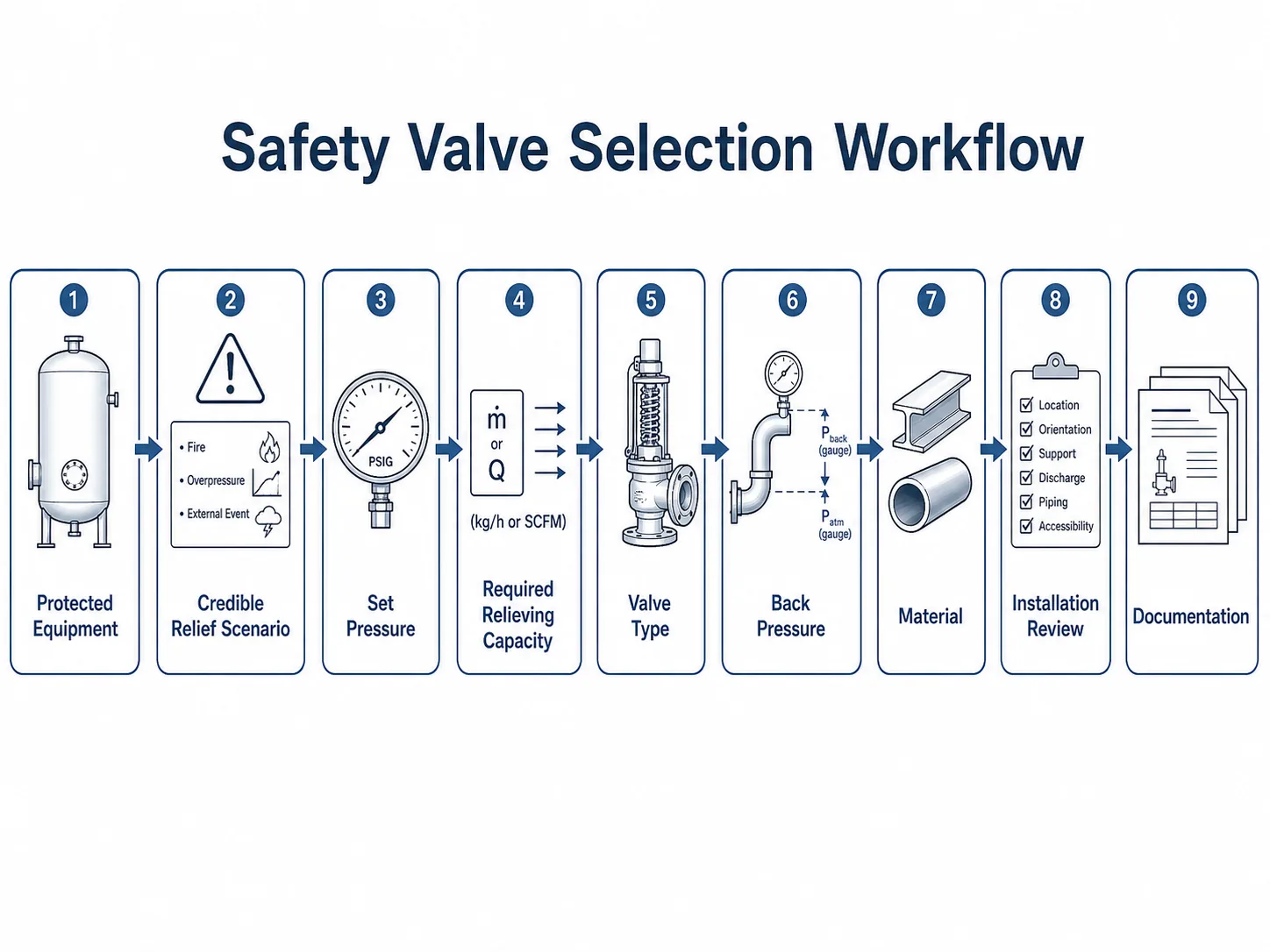
60-Second Safety Valve Selection Checklist
在选型或询价之前,请先确认这十项输入参数是否齐全。资料缺失并不一定影响初步沟通,但会导致最终选型缺乏可靠依据。
受保护设备
压力容器、锅炉、换热器、管道、压缩机或橇装系统。
压力容器、锅炉、换热器、管道、压缩机或橇装系统。
MAWP 或允许极限
阀门必须保护的压力边界。
阀门必须保护的压力边界。
整定压力
规定的开启条件。
规定的开启条件。
主导泄放工况
火灾、出口堵塞、管束破裂、热膨胀或其他工况。
火灾、出口堵塞、管束破裂、热膨胀或其他工况。
所需泄放量
基于经批准的泄放量计算基准得出的质量流量或体积流量。
基于经批准的泄放量计算基准得出的质量流量或体积流量。
介质及相态
蒸汽、气体、液体、闪蒸或两相流。
蒸汽、气体、液体、闪蒸或两相流。
泄放温度
不仅是正常工作温度。
不仅是正常工作温度。
背压
出口处的叠加背压和积聚背压。
出口处的叠加背压和积聚背压。
材料与密封座
阀体、内件、弹簧、波纹管、密封件及密封座要求。
阀体、内件、弹簧、波纹管、密封件及密封座要求。
规范与文件
所需标准、版本、试验、证书及标记。
所需标准、版本、试验、证书及标记。
已有数据表或工艺规格书?
请连同所需泄放量和背压数据一并发送,以便进行初步技术评审。
压力保护中什么是安全阀?
安全阀是一种自作用式泄压装置,当其进口压力达到规定的整定条件时自动开启。它排放流体,以防止被保护设备或压力系统超过其允许的压力边界。
术语 安全阀 , 泄压阀 , 安全泄放阀 , 压力安全阀 , 泄压阀 , PSV 和 PRV 有时因行业、地区及项目规范不同而有不同用法。仅凭缩写无法确定正确的阀门。选型仍须确认使用介质、开启特性、所需排量、背压、温度、材料、安装及认证依据。
安全阀
通常用于蒸汽、空气、气体等可压缩流体,根据设计不同,常具有快速开启或突跳式开启特性。
泄压阀
Often associated with liquid or thermal-relief service and may open more progressively, depending on design and application.
安全泄放阀
A broader term that may cover gas, vapor, steam or liquid service when the design and certification support the specified application.
PSV / PRV
Useful project abbreviations, but they should be defined in the datasheet because PRV can also mean pressure-reducing valve in other contexts.
Steam, gas, liquid and two-phase flow do not behave the same during pressure relief. A valve suitable for clean compressed air may be unsuitable for flashing liquid, wet steam, corrosive gas or a polymerizing medium even when its pressure class and connection size appear acceptable.
The Core Principle of Safety Valve Selection
Do not select a safety valve by connection size alone. Connection size confirms mechanical fit. It does not prove relieving capability or installed stability.
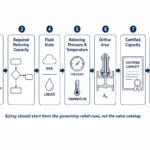
Protected equipment → credible relief scenario → required relieving capacity → valve type → certified capacity → materials → installation review → documentation
The main selection variables are:
- protected equipment and applicable pressure boundary;
- credible overpressure scenario and governing relief case;
- set pressure, relieving pressure, overpressure, accumulation and blowdown;
- required relieving capacity and manufacturer-certified capacity;
- fluid composition, phase, density or molecular properties and relieving temperature;
- 叠加背压与积聚背压;;
- inlet pressure loss and outlet-system resistance;
- body, trim, spring, bellows, seat and seal materials;
- connection standard, pressure-temperature rating and installation orientation;
- applicable code, test, certification and documentation requirements.
A replacement valve may bolt directly onto an existing nozzle and still reduce the original protection if its orifice, flow coefficient or certified capacity is lower. The first procurement question should therefore be “What relief case must this valve protect against?” rather than “What flange size is required?”
Step 1: Identify the Protected Equipment and Credible Relief Scenario
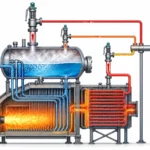
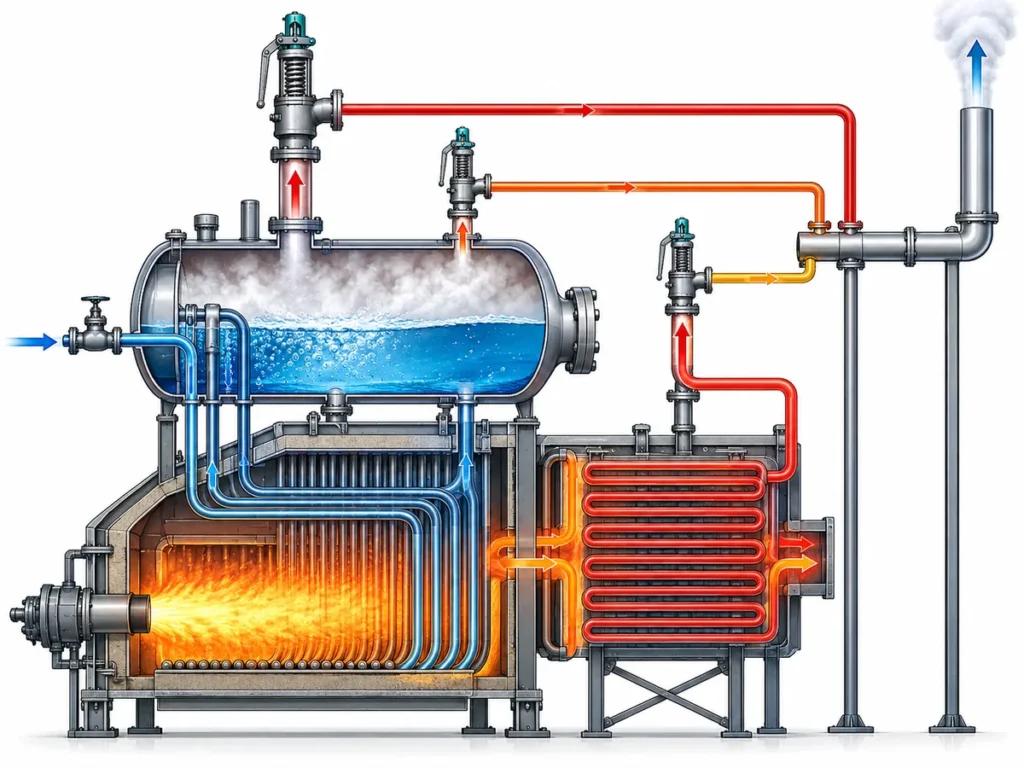
Start by defining what the valve protects. A steam boiler, pressure vessel, LPG vessel, compressor package, reactor, heat exchanger, pump discharge line and blocked-in liquid section can have very different relief requirements.
Typical protected equipment includes pressure vessels, boilers, steam headers, air receivers, separators, filters, heat exchangers, reactors, storage vessels, compressor systems, process skids and liquid-filled piping sections.
Then identify the credible overpressure cases. Common examples include:
- blocked outlet or closed downstream valve;
- external fire exposure;
- thermal expansion of trapped liquid;
- control valve or pressure regulator failure;
- heat exchanger tube rupture;
- utility, cooling or power failure;
- gas blow-by from a higher-pressure system;
- chemical reaction, vapor generation or runaway conditions;
- compressor discharge overpressure;
- other project-specific operating or fire contingencies.
Do not size from normal operation.
The governing case may be a fire, tube rupture, blocked outlet or another emergency condition with a much higher relieving load than normal pressure fluctuation.
The relief scenario and required relief rate should be established by qualified personnel using the equipment design basis, process data, applicable code, project specification and current operating conditions. For more detail, see the 安全阀选型与认证泄放能力指南 以及 API 521 泄压系统指南 .
Step 2: Confirm Set Pressure, Overpressure, Accumulation and Blowdown
The pressure terms must be reviewed together because they describe different parts of the protection function.
| 术语 | 实际意义 | 重要性 |
|---|---|---|
| 工作压力 | 运行期间的系统正常工作压力。. | Must provide an appropriate margin below set pressure for the selected valve and service. |
| 整定压力 | The inlet pressure at which the valve demonstrates the specified opening characteristic under defined conditions. | Determines when overpressure protection begins. |
| 超压 | 泄放期间超过整定压力的压力升高值。 | Used with the sizing and rated-capacity basis. |
| 压力积聚 | The pressure rise above the protected equipment’s MAWP or applicable allowable pressure limit during relief. | Relates to the equipment pressure boundary, not merely the valve set point. |
| 启闭压差 | The difference between set pressure and reseating pressure, normally expressed as a percentage of set pressure. | Affects how far system pressure falls before the valve closes. |
| 回座压力 | 泄放后阀门关闭时的进口压力。 | 影响启闭循环、泄漏和工艺恢复。 |
工作压力过于接近整定压力会增加频跳、泄漏或启闭循环。通过提高整定压力来止漏不是可接受的捷径,除非该变更经过工程审批、规范审查、重新整定、重新铅封并更新相关文件。
超压与压力积聚相关,但两者不可互换。超压以整定压力为基准,并与阀门排量相关。压力积聚以被保护设备的允许压力边界为基准。
有关压力术语的详细说明,请阅读 安全阀整定压力、超压与启闭压差详解 .
第 3 步:计算所需泄放量
所需泄放量是指在控制泄放工况下必须排出的流量,以使被保护设备保持在适用压力限值以内。在选型产品目录型号之前,必须先确定该值。
定径输入通常包括:
- 被保护设备及 MAWP 或设计压力基准;;
- 整定压力及允许超压或压力积聚;;
- 控制泄放工况;;
- 泄放条件下的流体组成和相态;;
- 泄放温度及上游压力;;
- 所需质量流量或体积流量;;
- 背压与泄放去向;;
- 适用的定径方法、标准及修正系数。
所选安全阀在指定工况下的制造商认证排量应等于或大于所需排量。仅凭公称进口尺寸、出口尺寸和压力等级无法证明这一点。
筛选示例说明——非项目数据
为什么法兰尺寸匹配仍可能无法通过排量校核
| 受保护设备 | 压缩空气储罐 |
|---|---|
| MAWP | 10 bar(g) |
| 正常工作压力 | 7.5 bar(g) |
| 整定压力 | 10 bar(g) |
| 所需泄放量 | 依据已批准控制工况计算得出的 1,250 kg/h |
| 候选方案 A | 进口法兰相同,认证排量 900 kg/h——因排量不足予以排除 |
| Candidate B | Certified capacity 1,420 kg/h — may proceed to back-pressure, material, connection and installation review |
This example demonstrates the screening logic only. It is not a sizing calculation and the values must not be reused for another installation.
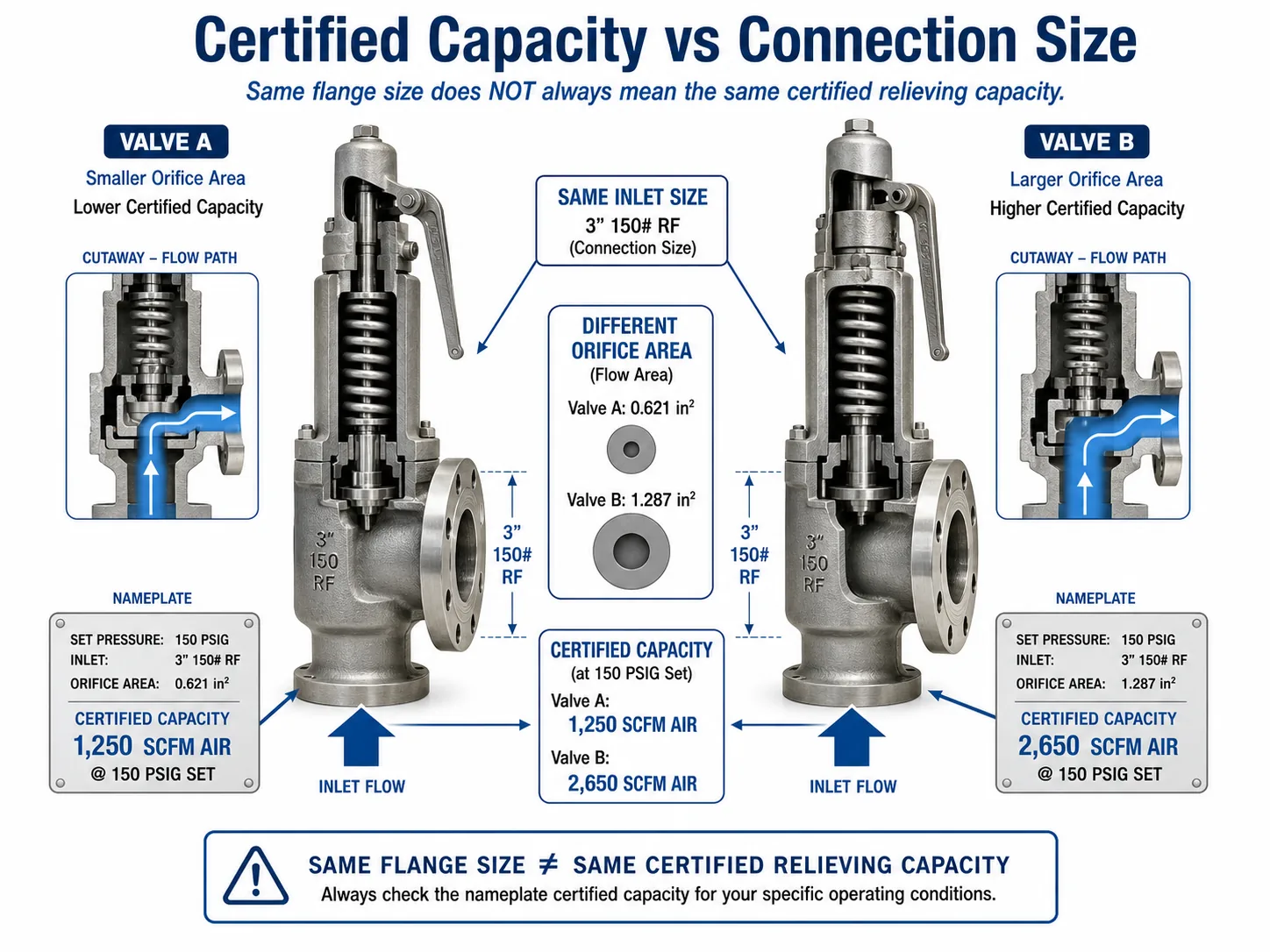
Review the nameplate, datasheet, model identification and capacity documentation together. Confirm the set pressure, orifice designation, rated capacity, capacity basis or test medium, temperature basis, inlet and outlet size, code marking, manufacturer and valve identification.
Special calculation review is required
for two-phase flow, flashing liquid, high-viscosity or non-Newtonian fluids, reactive systems and unusual mixtures. A gas-only or liquid-only catalog assumption should not be used unless the method is technically justified.
For process-industry sizing, review the API 520 安全阀定径指南 together with project calculations and manufacturer-certified data.
Do you know the required relief load but not the valve model?
Provide the calculation basis, set pressure, medium, temperature and back pressure so the candidate capacity can be screened correctly.
Step 4: Choose the Right Safety Valve Type
| 阀门类型 | Typical strengths | Main review points |
|---|---|---|
| 常规弹簧式 | Simple construction, broad availability, familiar maintenance and suitability for many steam, air, gas and liquid duties. | Back pressure, operating margin, inlet loss, outlet resistance, seat tightness and service cleanliness. |
| 平衡波纹管 | Reduces the effect of back pressure on the spring-loaded valve’s force balance and may isolate upper parts from some process exposure. | Bellows pressure and temperature limits, corrosion, fatigue, bonnet venting, inspection access and manufacturer limits. |
| 先导式 | Can provide tight shutoff, high-pressure capability, large capacity and operation closer to set pressure in suitable clean services. | Pilot and sensing-line cleanliness, plugging, liquid carryover, icing, polymerization, variable back pressure and maintenance capability. |
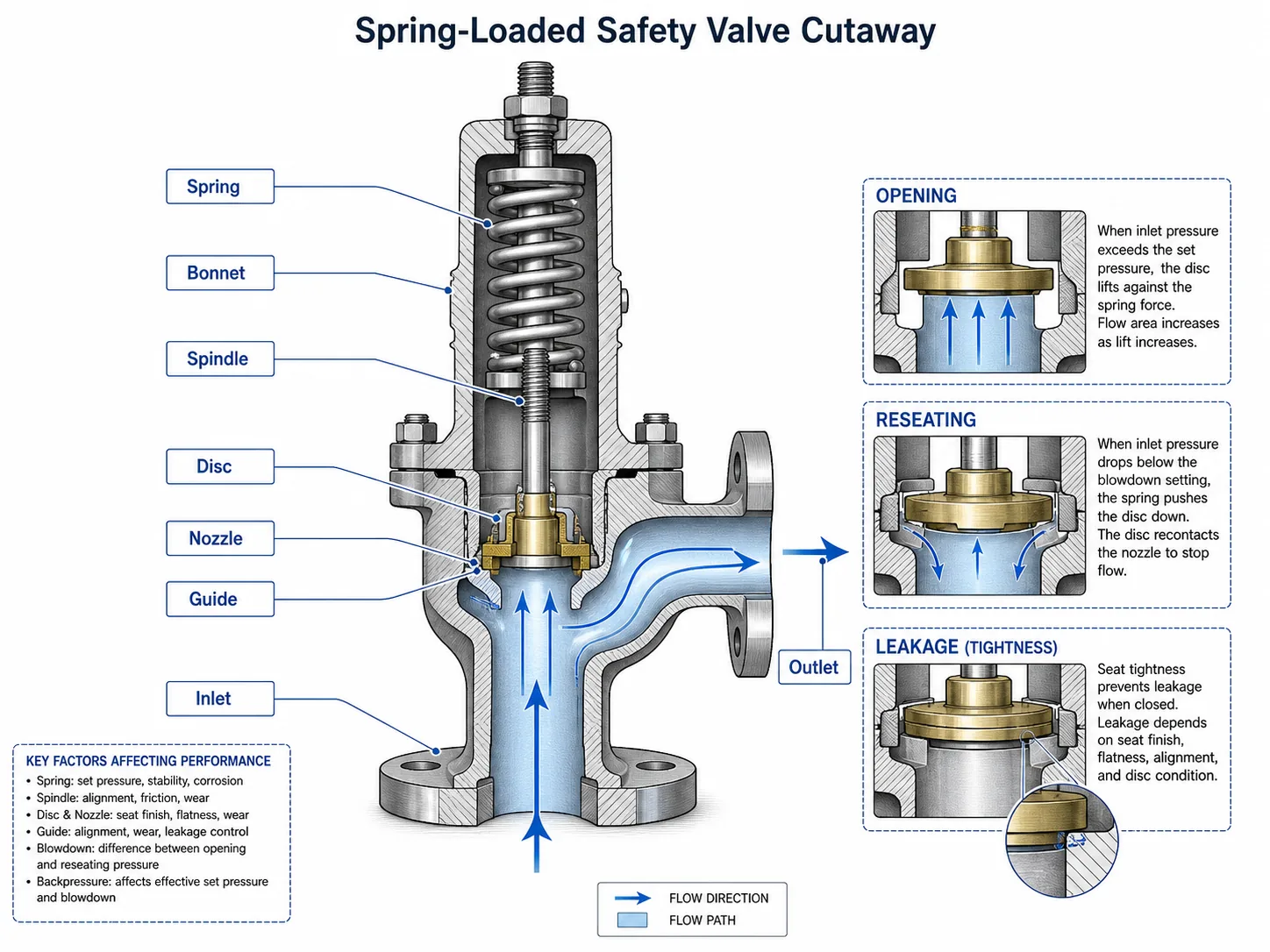
Conventional Spring-Loaded Safety Valve
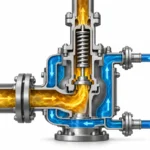
This is the most common design. A spring applies closing force to the disc. It is often suitable where the service is reasonably clean, the operating pressure margin is acceptable and the discharge condition remains within the manufacturer’s limits.
波纹管平衡式安全阀
A bellows can reduce back-pressure influence on the valve’s force balance, but it is a critical pressure- and movement-sensitive component. The bellows material, corrosion exposure, cyclic fatigue, vent arrangement and inspection requirements must be reviewed. A blocked bonnet vent can invalidate the intended behavior.
Pilot-Operated Safety Valve
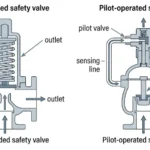
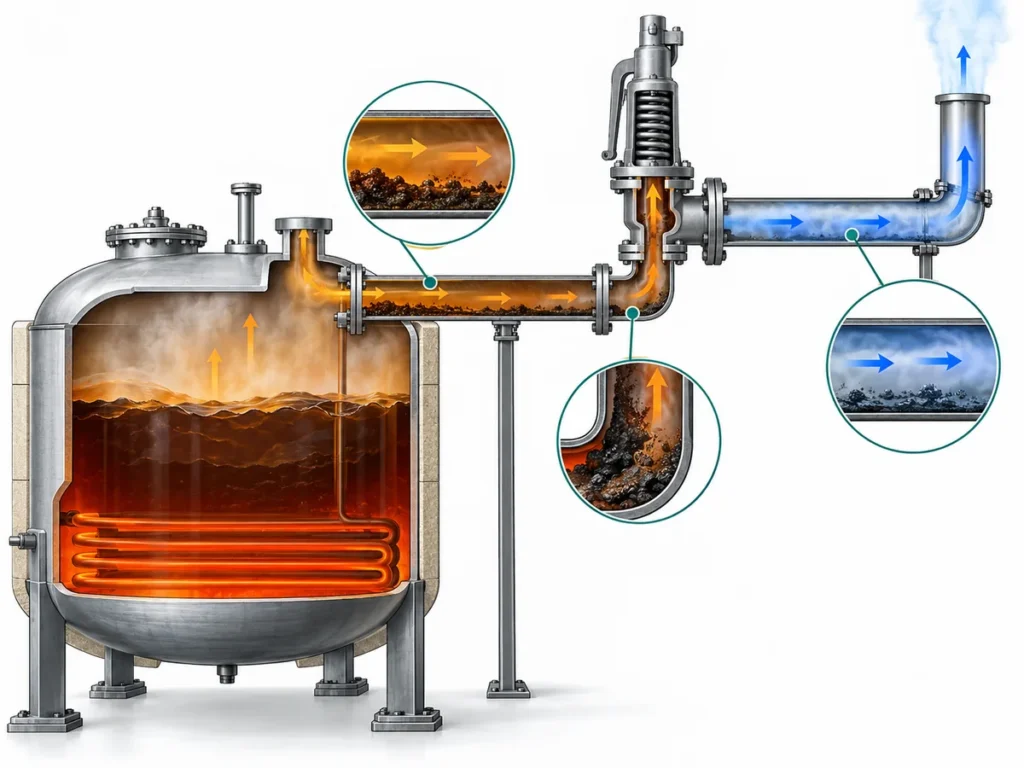
A pilot-operated valve uses system pressure and a pilot mechanism to control the main valve. It may be advantageous in high-pressure, large-capacity or tight-shutoff applications. It requires particular caution with dirty, sticky, crystallizing, waxy, polymerizing or particle-containing media because the sensing path and pilot circuit can become restricted.
For a direct comparison, read 弹簧式安全阀与先导式安全阀 . For back-pressure applications, also review 安全阀中的背压与波纹管 .
弹簧式安全阀
Direct-acting designs for many steam, gas, vapor and liquid duties where operating margin and back pressure remain suitable.
波纹管平衡式安全阀
Spring-loaded designs used where back-pressure effects, bonnet isolation or service exposure require additional review.
先导式安全阀
Main-valve and pilot configurations for suitable clean-service, high-pressure, large-capacity or tight-shutoff applications.
Step 5: Confirm the Medium and Fluid State at Relieving Conditions
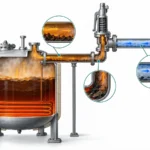
The valve must be selected for the fluid condition during the relief event, not only for normal operation. Pressure reduction through the valve can change phase, temperature and flow behavior.
蒸汽
Check saturated versus superheated conditions, temperature limits, trim and spring exposure, drainage, reaction force, outlet support and condensate accumulation.
Gas or air
Review compressible-flow capacity, high discharge velocity, noise, reaction force, gas composition, entrained liquid, corrosion and outlet-system resistance.
液体
Consider density, viscosity, thermal expansion, pump deadhead, pressure surge, flashing potential, stable opening and the safe discharge destination.
两相流或闪蒸流
Use a validated engineering method and manufacturer review. Do not assume that a gas-only or liquid-only equation represents the actual relieving condition.
Also identify contamination, solids, corrosion products, crystallization, polymerization, toxicity, sour-gas exposure, oxygen cleanliness, sanitary requirements and other properties that affect valve design, materials, cleaning, maintenance and documentation.
When Engineering or Manufacturer Review Is Mandatory
Do not complete the selection from a general catalog table alone when any of the following conditions apply:
- two-phase or flashing flow;
- high-viscosity, non-Newtonian, crystallizing or polymerizing media;
- toxic, sour, oxygen, cryogenic or otherwise hazardous service;
- variable superimposed back pressure or high built-up back pressure;
- discharge to a common flare, vent or closed header;
- multiple relief devices protecting one pressure system;
- severe pulsation, vibration, liquid carryover or frequent cycling;
- unusual installation orientation or remote sensing arrangement;
- process changes affecting pressure, temperature, composition or relief load;
- uncertain certification, capacity basis, code marking or standard edition.
所需措施: document the uncertainty, provide the full process and piping data, and obtain review from the responsible project engineer and the valve manufacturer before purchase or installation.
Step 6: Evaluate Back Pressure Before Final Selection
Back pressure is pressure at the outlet of the safety valve. It may exist before the valve opens or be generated by discharge flow after opening.
叠加背压
Superimposed back pressure is present in the discharge system before the valve opens. It may be constant or variable, for example when the valve connects to a pressurized header.
积聚背压
Built-up back pressure is generated after the valve opens as flow passes through outlet piping, elbows, silencers, vent stacks, flare headers or other restrictions.
Back pressure can affect opening behavior, available lift, capacity, flow stability, blowdown and reseating. Its effect is design-dependent; there is no single universal formula that can be applied to conventional, balanced bellows and pilot-operated valves in the same way.
审查内容:
- maximum and minimum superimposed back pressure;
- whether superimposed back pressure is constant or variable;
- built-up back pressure at the required relieving rate;
- outlet pipe size, length, fittings and elevation;
- silencer, vent stack, flare or common-header resistance;
- simultaneous relief from other devices;
- reaction force, drainage and piping support;
- manufacturer limits for the selected design.
A valve can pass a bench set-pressure test and still chatter or lose stability after installation if the outlet system creates excessive or variable back pressure.
使用 背压与波纹管指南 for design selection and the 安全阀安装指南 for outlet-piping review.
Step 7: Select Suitable Materials and Seat Design
Material selection must be component-specific. The body, bonnet, nozzle, disc, guide, spindle, spring, bellows, seat, gasket, O-ring and fasteners do not necessarily require the same material.
| 部件 | Main exposure | Potential failure |
|---|---|---|
| 阀体与阀盖 | Pressure, temperature, external atmosphere and process exposure | Corrosion, leakage, loss of pressure-boundary integrity |
| 阀座与阀瓣 | Sealing, erosion, corrosion and thermal distortion | Seat leakage, wire drawing and poor reseating |
| 导向套与阀杆 | Sliding contact, deposits, galling and alignment | Sticking, chatter or restricted lift |
| 弹簧 | Temperature, corrosion and mechanical cycling | Set-pressure drift or loss of required force |
| 波纹管 | Back pressure, corrosion and cyclic movement | Fatigue, leakage and loss of balancing function |
| 软阀座与密封件 | Chemical compatibility, temperature and compression | Swelling, hardening, extrusion or leakage |
金属密封与软密封
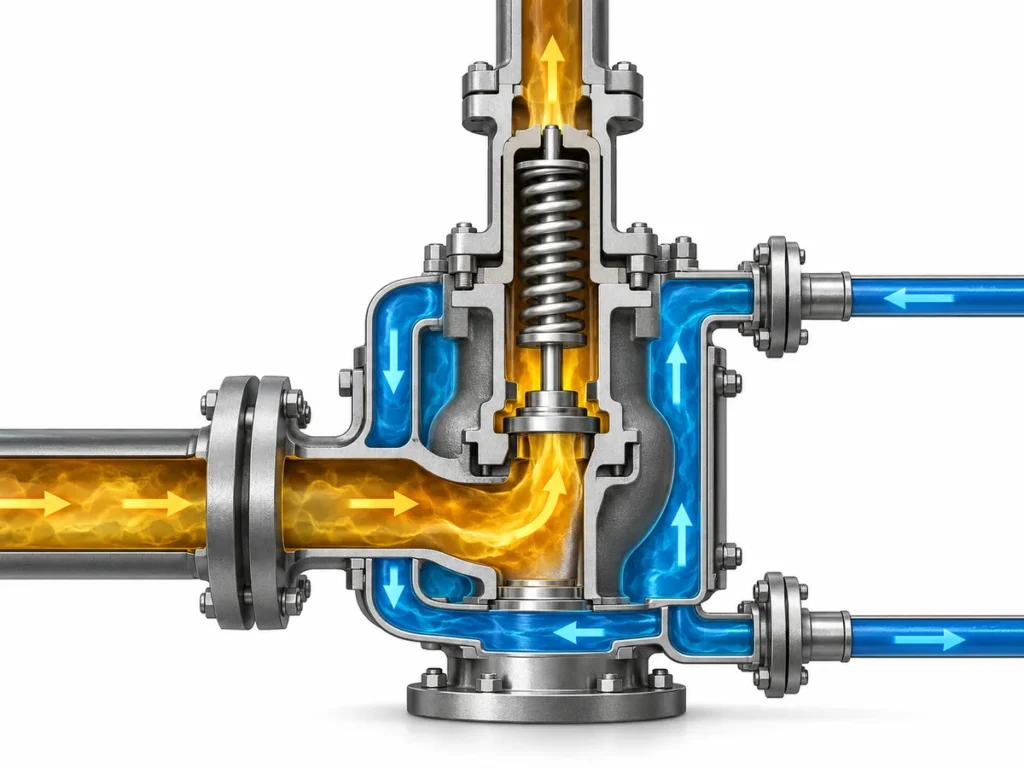
Metal seats are often preferred for high-temperature steam and severe service because they tolerate heat and erosion better. Soft seats can provide tighter shutoff in suitable clean service, but the material must be compatible with the temperature, pressure, medium and required service life.
Where seat leakage testing is specified, use the current project requirement and the applicable acceptance basis. The API 527 密封性试验指南 explains the role of API 527 for conventional, bellows and pilot-operated pressure relief valves.
For component-by-component selection, read the 安全阀材料选用指南 .
Step 8: Review Installation Conditions
A correctly sized valve can still perform poorly if the inlet or outlet piping is unsuitable. The valve and piping should be reviewed as one pressure-relief installation.
Inlet Piping
Keep the inlet path direct and adequately sized. Restrictions, undersized nozzles, long runs, excessive fittings, poorly selected isolation valves and pressure drop can destabilize the valve. Excessive inlet pressure loss can cause rapid opening and closing, chatter, seat damage and reduced service life.
出口管道
Review back pressure, reaction force, support, drainage, thermal expansion, discharge direction and safe disposal. Outlet piping should not impose damaging loads or misalignment on the valve body. Closed headers require evaluation of header pressure and simultaneous relief cases.
Orientation, Drainage and Temperature Control
Install the valve in the manufacturer-approved orientation. Many spring-loaded valves are intended for upright vertical installation unless another orientation is specifically approved. Steam and wet-gas systems may require drainage. Viscous, crystallizing, freezing or polymerizing services may require insulation, tracing, flushing or other controls, but heating must not exceed the limits of the spring, seat, seals, pilot or other components.
See the complete 安全阀安装指南 for inlet, outlet, support and discharge review.
Step 9: Check Applicable Standards and Certification Requirements
The applicable requirements depend on the protected equipment, country, jurisdiction, industry, owner specification and valve design. Standards should be connected to a specific engineering or procurement decision rather than listed as marketing labels.
| 参考 | Typical role | Useful links |
|---|---|---|
| ASME BPVC | Boiler and pressure-vessel construction and overpressure-protection framework where ASME Code applies. | ZOBAI ASME guide · ASME 官方页面 |
| API 520 第 I 部分 | 涵盖工艺工业应用领域中压力泄放装置的定径与选型。 | ZOBAI API 520 guide · API 官方页面 |
| API 520 第 II 部分 | Installation and engineering analysis for pressure-relieving-device installations. | Installation guide · API 官方页面 |
| API 521 | System-level relief scenarios, pressure-relieving and depressuring-system design. | ZOBAI API 521 guide · API 官方页面 |
| ISO 4126 | International safety-device requirements, including safety valves and pilot-operated safety valves. | ZOBAI ISO 4126 guide · ISO 4126-1 · ISO 4126-4 |
| API 527 | Seat-tightness test methods and acceptance communication when specified. | Current API 527 guide |
| NBIC / National Board VR | Repair authorization and controlled repair documentation in applicable ASME/NBIC contexts. | 美国国家锅炉与压力容器检验师协会官方页面 |
标准使用说明:
ZOBAI overview pages do not replace official copyrighted standards, the project specification, manufacturer-certified data, jurisdictional requirements or authorized engineering review. Always confirm the edition required by the project.
Browse the complete 安全阀标准中心 for API, ASME, ISO, DIN/EN, GB, flange and pressure-temperature references.
Step 10: Prepare a Safety Valve Procurement Checklist
A supplier cannot correctly select a safety valve from connection size and pressure class alone. Provide enough process, equipment and documentation data for a meaningful review.
| RFQ item | Why it is required |
|---|---|
| 受保护设备 | Defines the pressure boundary and applicable code context. |
| MAWP / 设计压力 | Identifies the protected equipment limit. |
| 工作压力 | 用于核查运行裕量和泄漏风险。 |
| 整定压力 | Defines the required opening condition. |
| 泄放工况 | Identifies the governing emergency case. |
| 所需泄放量 | Determines the minimum required certified capacity. |
| 介质及其成分 | Affects sizing, materials, valve type and safety controls. |
| Fluid state at relief | Distinguishes gas, steam, liquid, flashing or two-phase methods. |
| 泄放温度 | Affects capacity and component temperature limits. |
| 背压 | Affects design selection, capacity and stability. |
| Inlet / outlet connections | Confirms dimensions, pressure class, facing and piping compatibility. |
| Body / trim / seat materials | Controls corrosion, temperature, leakage and service life. |
| 适用标准及版本 | Defines the required compliance and documentation basis. |
| Testing and certificates | Clarifies calibration, pressure test, leakage test and handover records. |
Documents to Request
- approved valve datasheet;
- general arrangement drawing;
- manufacturer-certified capacity data or applicable capacity certificate;
- material test certificates for specified components;
- shell or pressure test report where required;
- seat-tightness test report where required;
- set-pressure calibration certificate;
- nameplate and tagging information;
- installation, operation and maintenance instructions;
- code, conformity or certification documents required by the purchase order;
- repair and recertification records for repaired valves.
Use the detailed 面向工程师和采购人员的安全阀采购检查清单 when preparing an inquiry.
Common Safety Valve Selection Mistakes
-
Selecting by nominal size instead of capacity.
Equal inlet sizes do not guarantee equal orifice areas, flow coefficients or certified capacities. -
Using normal operation as the sizing case.
The governing relief case may be fire, blocked outlet, tube rupture, reaction or another emergency scenario. -
Ignoring back pressure.
Outlet piping, silencers, flare headers and simultaneous relief can change installed behavior. -
Using the wrong design for dirty service.
Pilot passages, sensing lines, soft seats and close-clearance parts may be affected by particles, deposits or polymerization. -
仅指定阀体材料。
The seat, nozzle, disc, guide, spring, bellows, seals and fasteners may control reliability. -
Reusing an old valve after a process change.
Changes in pressure, temperature, composition, relief load or discharge piping require renewed review. -
Repairing without controlled testing.
Cleaning or lapping alone does not confirm set pressure, seat tightness, reseating behavior, tagging or code compliance. -
Treating a code name as proof of suitability.
The exact edition, scope, marking, capacity basis, test documentation and project requirement must be confirmed.
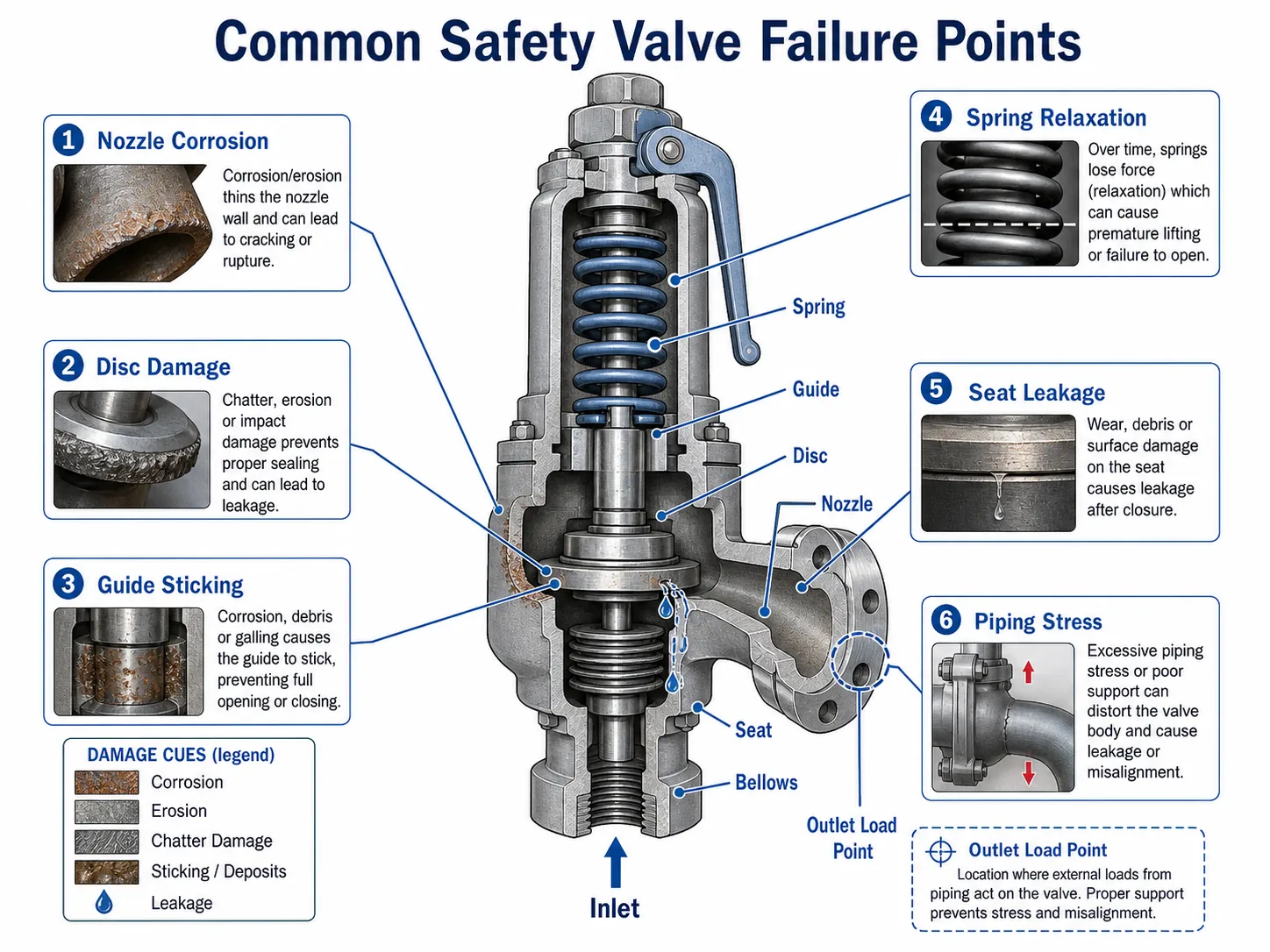
For leakage after opening or maintenance, read 安全阀起跳后为何泄漏 .
Expert Selection Summary
A complete safety valve selection should answer four questions:
- When will it open? Confirm set pressure, operating margin and the protected equipment limit.
- How much can it relieve? Confirm the governing load, calculation basis, orifice and manufacturer-certified capacity.
- Will it operate stably after installation? Review inlet loss, outlet resistance, back pressure, piping loads, drainage and valve design.
- Will it survive the service? Review medium, phase, temperature, corrosion, erosion, materials, seat design and maintenance conditions.
The best safety valve is not the valve with the largest connection or highest pressure class. It is the valve whose set pressure, capacity, design, materials, installation and documentation match the actual pressure-protection duty.
FAQ About Safety Valve Selection
如何选择合适的安全阀?
识别受保护设备及主导泄放工况,计算所需泄放量,然后确认整定压力、介质状态、泄放温度、背压、阀门结构、认证排量、材质、安装方式及适用要求。
安全阀与泄压阀有什么区别?
安全阀通常与蒸汽、气体或其他可压缩流体工况下的快速开启相关联。泄压阀通常与液体或热泄放工况相关,开启过程可能更为渐进。实际术语取决于设计、规范、行业及项目规格。
为什么认证泄放量比连接尺寸更重要?
连接尺寸确认机械配合。认证泄放能力确认阀门在规定基准下可排放的流量。两个入口尺寸相同的阀门,其流道孔径和排量可能不同。
背压如何影响安全阀选型?
背压会影响力平衡、阀瓣升程、排量、稳定性、启闭压差及回座特性。其影响取决于阀门为常规式、波纹管平衡式还是先导式,以及背压是恒定、可变还是由排放流量产生的积聚背压。
何时应考虑选用先导式安全阀?
对于需要高压、大排量、严密关闭或更接近整定压力运行且介质洁净的适用工况,可考虑选用。对于脏污、粘稠、易结晶、易聚合或含颗粒的介质,由于先导阀及感压通道可能发生堵塞,需进行仔细审查。
腐蚀性工况应选用哪些材质?
应逐一审查各零部件,而不是只规定阀体材质。根据腐蚀机理、温度、压力及运动要求,阀体、阀座接口、阀瓣、导向套、阀杆、弹簧、波纹管、阀座、垫片、密封件及紧固件可能需要采用不同的材料。
安全阀安装后为什么会出现泄漏?
可能原因包括阀座损坏或污染、工作压力过于接近整定压力、腐蚀、阀座材料不适用、热变形、管道应力、颤振、校准问题或背压波动。
安全阀应多久进行一次校验或重新整定?
并非所有安装场合都适用统一的检验周期。检验周期取决于当地法规、设备规范、工况严苛程度、介质、运行历史、工厂规程、以往检验结果及制造商建议。
购买安全阀前应核对哪些标准?
具体取决于设备和项目。常用依据包括 ASME BPVC、API 520、API 521、ISO 4126、API 527 以及适用的 National Board 或 NBIC 要求。请务必确认所需版本和适用范围。
应向供应商索取哪些文件?
典型文件包括数据表、图纸、认证排量信息、材质证明、压力与阀座泄漏试验报告、校准证书、铭牌信息、安装手册以及项目要求的合格证明或维修记录。
Need Help Reviewing a Safety Valve Selection?
Send the protected equipment, MAWP, operating pressure, set pressure, relief scenario, required capacity, medium, relieving temperature, back pressure, connection, material and certificate requirements for technical review.
工程师咨询 获取报价