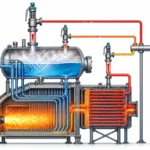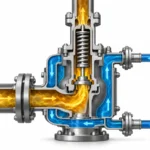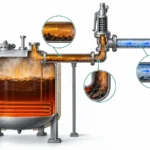
A safety valve RFQ should not be issued from connection size and set pressure alone. Before requesting a quotation, engineers should confirm the protected equipment, governing relief scenario, required relieving capacity, relieving conditions, back pressure, valve configuration, materials, testing and required documents. Use the 26-point checklist below before issuing an RFQ, comparing quotations or releasing …

A safety valve RFQ should not be issued from connection size and set pressure alone. Before requesting a quotation, engineers should confirm the protected equipment, governing relief scenario, required relieving capacity, relieving conditions, back pressure, valve configuration, materials, testing and required documents. Use the 26-point checklist below before issuing an RFQ, comparing quotations or releasing a purchase order.
A safety valve, pressure relief valve (PRV), pressure safety valve (PSV) or safety relief valve is part of the final automatic overpressure-protection system. The tag name alone does not define the required capacity, fluid basis, opening characteristic, back-pressure performance or certification scope. The RFQ must state the actual protection duty.
This page is intentionally focused on procurement and RFQ review. For the complete engineering selection sequence, use the 安全阀选型指南. For sizing and capacity verification, use the 安全阀选型与认证泄放能力指南. For line-by-line datasheet preparation, use 如何编制安全阀数据表用于询价.
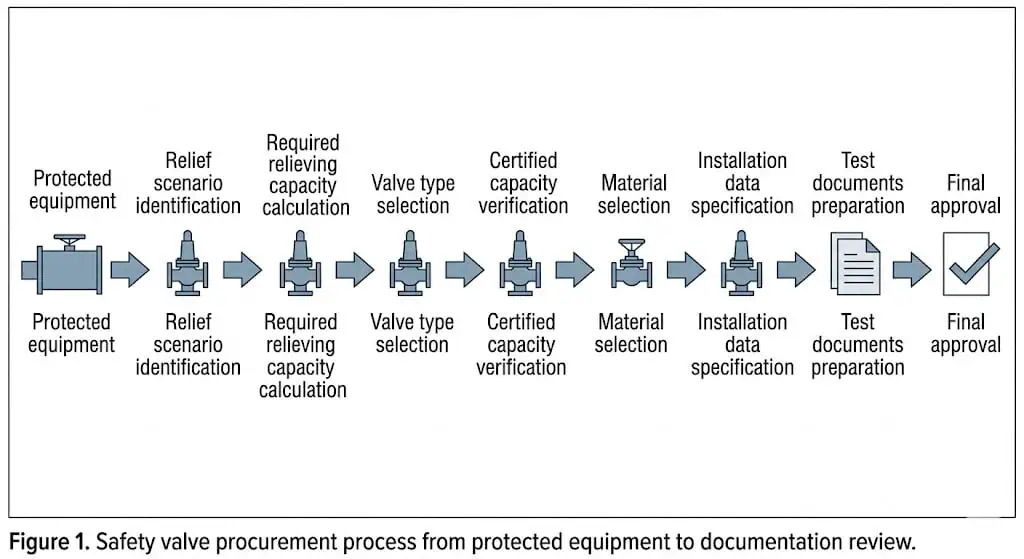
安全阀询价清单:采购前需确认的 26 项内容
Use this checklist before sending an RFQ, approving a technical bid or releasing a purchase order. If a critical item is unknown, mark it as an engineering hold point rather than allowing the supplier to assume it.
| 检查清单项目 | 已确认 |
|---|---|
| 1. Protected equipment and tag identified | ☐ |
| 2. MAWP or other applicable allowable pressure limit confirmed | ☐ |
| 3. Design pressure and design temperature confirmed where applicable | ☐ |
| 4. Normal and maximum operating pressure confirmed | ☐ |
| 5. Set pressure confirmed against the approved protection basis | ☐ |
| 6. Governing overpressure / relief scenario identified | ☐ |
| 7. Required relieving capacity approved | ☐ |
| 8. Allowable overpressure / accumulation basis confirmed | ☐ |
| 9. Medium and composition identified | ☐ |
| 10. Fluid phase at relieving conditions confirmed | ☐ |
| 11. Relieving pressure and relieving temperature confirmed | ☐ |
| 12. Superimposed back pressure range confirmed | ☐ |
| 13. Built-up back pressure reviewed at the governing relief flow | ☐ |
| 14. Inlet pressure-loss and outlet-system conditions reviewed | ☐ |
| 15. Valve type / design selected or supplier selection basis defined | ☐ |
| 16. Effective orifice / designation identified | ☐ |
| 17. Certified or project-accepted relieving capacity verified | ☐ |
| 18. Body, trim, spring, bellows and seat materials defined as required | ☐ |
| 19. Seat construction and tightness requirement defined | ☐ |
| 20. Inlet / outlet connection size, rating and facing confirmed | ☐ |
| 21. Applicable code, standard, marking and conformity route confirmed | ☐ |
| 22. Required testing and inspection scope stated in the RFQ / PO | ☐ |
| 23. Required supplier document package defined | ☐ |
| 24. Supplier assumptions, deviations, substitutions and exclusions reviewed | ☐ |
| 25. Nameplate and certificate traceability requirements defined | ☐ |
| 26. Pre-shipment document and physical acceptance requirements defined | ☐ |
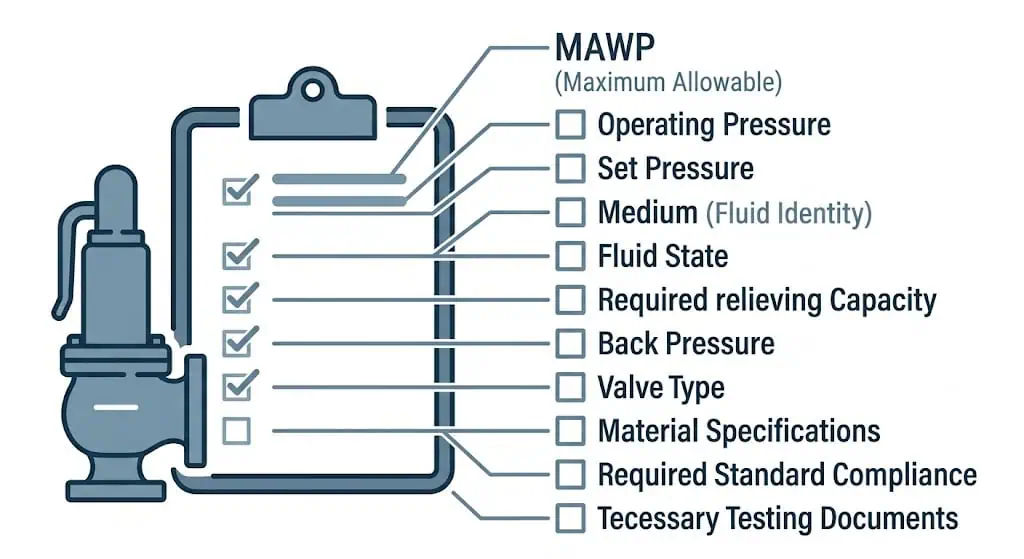
Do not treat a preliminary quotation as an approved technical selection. If the governing relief scenario, required capacity, relieving phase, relieving temperature or back-pressure basis is unknown, the supplier can provide only a preliminary configuration.
Five Safety Valve RFQ Items That Should Never Be Guessed
1. Required Relieving Capacity
The required load comes from the governing overpressure scenario. Normal operating flow, connection size or a catalog maximum is not a substitute for an approved relief load.
2. Fluid Phase at Relief
Gas, steam, liquid, flashing and two-phase flow use different sizing and review bases. State the phase at relieving conditions, not only at normal operation.
3. Relieving Temperature
Temperature affects capacity calculations and the suitability of the body, trim, spring, bellows, gaskets, O-rings and seat materials.
4. Back Pressure
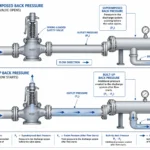
Superimposed and built-up back pressure can affect valve type, capacity, stability, blowdown, CDTP and reseating. The downstream system must be part of the RFQ basis.
5. Capacity / Certification Basis
The quotation should identify the model, effective orifice, capacity medium, relieving pressure and temperature, coefficient or certification basis, and the resulting capacity for the approved case.
采购边界: the relief calculation establishes the required duty; certified or manufacturer-accepted capacity data supports the selected valve’s flow capability; test reports document specific tests; and installation review checks whether the inlet and outlet system supports stable operation. None of these replaces the others.
What Information Should Be Included in a Safety Valve RFQ?
A useful safety valve RFQ should allow every bidder to evaluate the same duty. At minimum, organize the information into equipment and pressure data, relief conditions, valve configuration, installation conditions, and acceptance documents.
Equipment and Pressure Data
Identify the protected equipment, tag number, MAWP or applicable allowable pressure limit, design pressure and temperature where relevant, normal and maximum operating pressure, normal operating temperature, set pressure, and the applicable overpressure or accumulation basis. MAWP and design pressure should not automatically be treated as interchangeable where the equipment documentation distinguishes them.
Set pressure should be established against the approved equipment and code basis. It should not be raised casually to stop leakage. For pressure terminology, see 安全阀整定压力、超压与启闭压差详解.
Relief Scenario, Required Capacity and Relieving Conditions
State the governing scenario used for sizing, such as blocked outlet, external fire, thermal expansion, regulator failure, control-valve failure, heat-exchanger tube rupture, cooling failure, gas blow-by or another approved process upset. Provide the required relieving capacity and the medium, phase, composition, relieving pressure and relieving temperature for that case.
Capacity hold point: do not accept “suitable for NPS 2,” “capacity available on request” or a catalog maximum as proof of protection. The offered capacity must be traceable to the selected model and effective orifice under an approved capacity basis.
Back Pressure and Installation Data
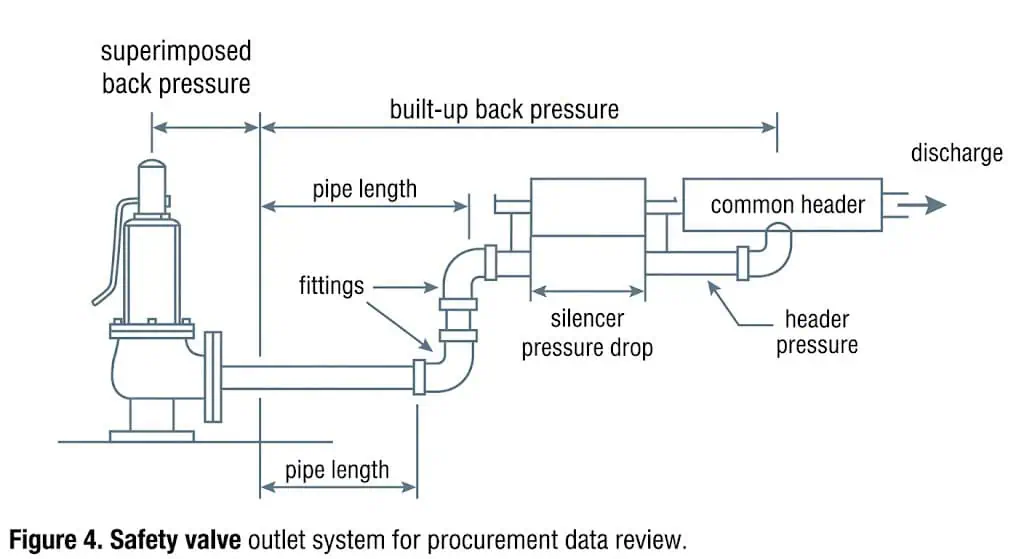
State the superimposed back-pressure range, whether it is constant or variable, the built-up back pressure at the governing relief flow where known, discharge destination, outlet-pipe size and length, major fittings, silencers or mufflers, common-header or flare conditions, drainage requirements and relevant inlet-line restrictions.
Back pressure is a procurement input because it can change the suitability of a conventional spring-loaded, balanced bellows or pilot-operated design. For the detailed engineering treatment, use the 背压与波纹管工程指南 和 安全阀安装指南.
Valve Type, Materials and Seat Construction
The RFQ should identify the required valve design when it is already established, or provide enough service data for the supplier to propose one. Define body and trim materials, spring and bellows material where applicable, gasket and seal requirements, and metal-seat or soft-seat requirements that matter to the project.
Do not specify body material as though it proves the suitability of every wetted or stressed component. For detailed design comparison, see 弹簧式安全阀与先导式安全阀. For detailed metallurgy, see the 安全阀材料选用指南.
Standards, Marking and Inspection Requirements
Connect every referenced standard to a specific procurement requirement. Depending on the equipment, service, jurisdiction and owner specification, the RFQ may reference ASME BPVC requirements, API 520 Parts I and II, API 521, API 526, API 527, API RP 576, ISO 4126 or recognized repair requirements. Do not use “ASME,” “API,” “ISO,” “PED,” “CE” or “National Board” as a complete supplier statement without the applicable scope, edition or conformity route.
RFQ scope rule: this page does not replace the engineering standards or the protected equipment’s construction code. The project specification and jurisdiction determine the governing requirements.
How to Review a Safety Valve Quotation Before Comparing Price
Technical comparison should come before commercial comparison. Two quotations can show the same inlet size and set pressure while offering different effective orifices, certified capacities, materials, test scope or document packages.
| Quotation Item | 审查问题 |
|---|---|
| Model / valve type | Does the offered design match the RFQ service and back-pressure basis? |
| Inlet / outlet connection | Do size, rating, facing and dimensions match the approved piping interface? |
| 整定压力 | Does it match the approved protection basis? |
| 有效流通孔口尺寸 | Is the selected discharge area explicitly identified? |
| 认证/认可排量 | Is it equal to or greater than the approved required relieving capacity under the stated basis? |
| 排量基准 | Are medium, pressure, temperature, coefficient and conversion assumptions defined? |
| 材料 | Are body, nozzle, disc, guide, spring, bellows, seat and seals defined where required? |
| Back-pressure limit | Is the offered design suitable for the specified superimposed and built-up back pressure? |
| 测试 | Are pressure-boundary, set-pressure and seat-tightness requirements included where specified? |
| Marking / certification | Does the offered valve fall within the required product and conformity scope? |
| 文件资料 | Are drawings, certificates, test reports and manuals included in the quoted scope? |
| Deviations | Are substitutions, assumptions, exclusions and exceptions listed in one controlled register? |
| Delivery | Does lead time include drawing approval, testing, inspection, document review and release? |
Common hidden deviation: the quotation matches the requested inlet and outlet sizes but substitutes a different effective orifice, seat material, spring range, bellows material, capacity basis, code mark or document scope. These differences can change the technical acceptance of the valve even when the commercial description looks similar.
Require every bidder to identify deviations, substitutions, exclusions and assumptions. Silence should not be treated as confirmation that every RFQ requirement is included.
What Documents Should a Safety Valve Supplier Provide?
The required document package should be defined in the RFQ or purchase order rather than requested after manufacture. Each document proves a different part of the supplied configuration.
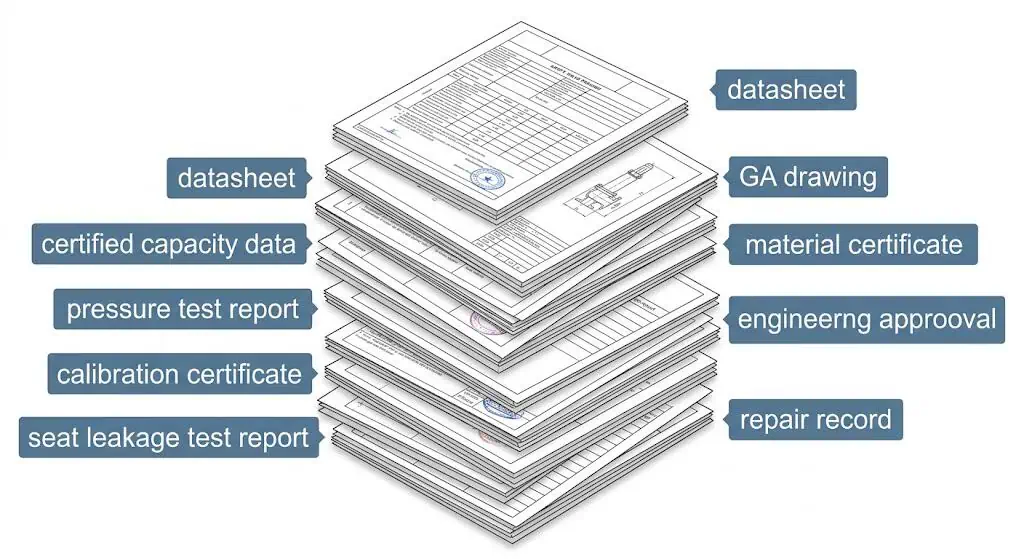
| 文件 | 可确认的内容 |
|---|---|
| Approved valve datasheet | Selected valve configuration and project-specific technical basis. |
| 总布置图 | Dimensions, connections, flow direction and installation envelope. |
| Capacity evidence / certificate | Documented relieving capability for a defined model, orifice and basis. |
| 材质证明 | Material grade and traceability where required by the project. |
| 承压边界试验报告 | Specified shell or pressure-boundary test performed under the stated test condition. |
| 整定压力标定记录 | As-left set pressure and stated test basis for the supplied valve. |
| 密封性报告 | Leakage performance under the specified closed-valve test method and acceptance criterion. |
| Nameplate / marking record | Physical valve identity and consistency with approved records. |
| 安装及维护说明 | Orientation, piping, venting, drainage, storage and maintenance precautions. |
| Deviation / assumption register | Approved differences between the RFQ and supplier offer. |
| Repair / recertification record, if applicable | As-found condition, repair scope, replaced parts, as-left setting and recognized authorization where required. |
Certificate Scope and Traceability
A website badge, generic sample or certificate image should not be treated as proof that every valve, size, material or manufacturing location is covered. Review the legal entity, manufacturing location, product family, model or range, referenced standard, validity or revision status, and connection to the supplied serial number where order-specific traceability is required.
证据的优先顺序: a datasheet describes the selected configuration; a relief calculation defines the required duty; capacity evidence supports flow capability; a nameplate identifies the physical valve; material certificates support material traceability; and test reports document specific tests. Procurement approval should reconcile them rather than use one document as a substitute for another.
Where seat tightness is specified, API 527 may be relevant for applicable pressure relief valves. Where recognized repair authorization is required, confirm the applicable National Board, NBIC, owner or jurisdictional route before purchase or repair release.
When Safety Valve Procurement Approval Must Be Held
Do not release the purchase order or shipment while a critical protection or acceptance item remains unresolved.
所需排量不明
The valve cannot be proven adequate for the governing relief case.
Unclear Relieving Phase
Flashing, two-phase, wet-gas or contaminated service may invalidate a single-phase or clean-service assumption.
背压问题未解决
Valve design, capacity basis and installed stability cannot be confirmed without the downstream condition.
Capacity Basis Mismatch
The supplier capacity does not refer to the offered model, orifice or approved relieving conditions.
Certificate Scope Mismatch
The submitted document does not cover the quoted design, product range, manufacturing entity or required conformity route.
Unapproved Material Substitution
The proposed change can affect corrosion, temperature, leakage, fatigue or code compliance.
Missing Required Test Evidence
The RFQ, purchase order or inspection plan requires records that are absent or not traceable to the supplied valve.
Unlisted Supplier Deviations
The quotation appears compliant but depends on different assumptions, exclusions or substituted components.
Final approval question: can the offered valve discharge the approved required load under the actual medium, phase, relieving pressure and temperature, back pressure, material condition and installation arrangement—and can the supplier prove that configuration with consistent, traceable documents? If not, keep the item on technical hold.
Pre-Shipment Safety Valve Acceptance Checklist
Before shipment, confirm that the physical valve and final document package match the approved technical bid. This is particularly important for code-controlled equipment, shutdown replacements and international shipments.
| Pre-Shipment Item | 已确认 |
|---|---|
| Nameplate matches the approved datasheet | ☐ |
| Model, serial number, set pressure and effective orifice are consistent across records | ☐ |
| Capacity evidence matches the approved valve and duty basis | ☐ |
| Required material certificates are complete and traceable | ☐ |
| Set-pressure calibration record is available | ☐ |
| Seat-tightness report is available where required | ☐ |
| Pressure-boundary test record is available where required | ☐ |
| Supplier deviations are closed or formally approved | ☐ |
| Flange faces / threads and inlet / outlet openings are protected for shipment | ☐ |
| Seal, lock and tag condition is correct after final adjustment | ☐ |
| Bonnet vent, drain and pilot connections are protected and correctly identified | ☐ |
| Installation / maintenance instructions are included | ☐ |
| Shipping gag or transit restraint status is clearly identified where applicable | ☐ |
| Final document package is released before shipment | ☐ |
Common Safety Valve RFQ and Procurement Mistakes
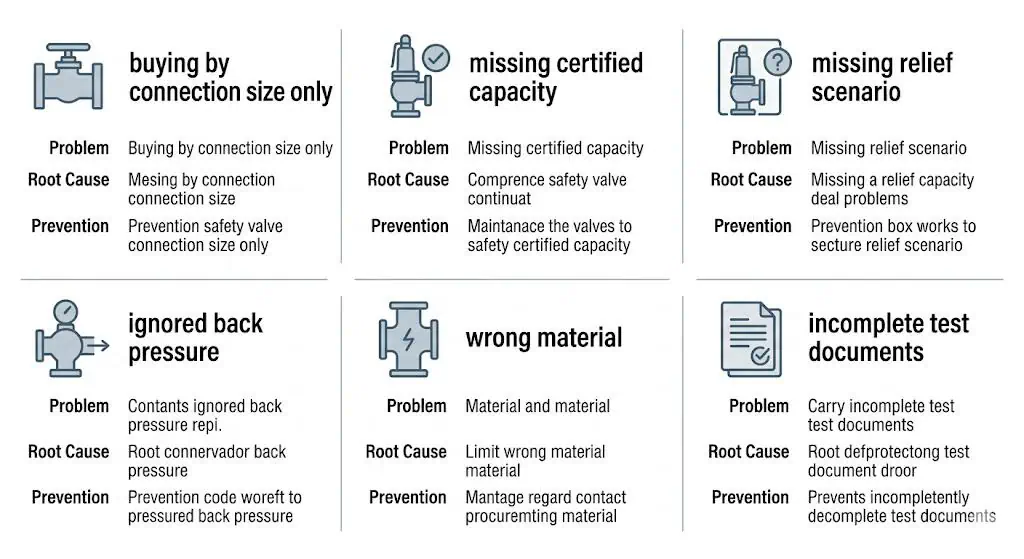
Buying by Connection Size and Set Pressure Only
A physically interchangeable valve can have a different effective orifice and relieving capacity. Mechanical fit is not proof that the replacement provides equivalent overpressure protection.
Omitting the Governing Relief Scenario
A supplier cannot confirm the required capacity without the approved duty. Fire exposure, blocked outlet, regulator failure and tube rupture can produce very different relieving loads.
Ignoring the Outlet System and Back Pressure
A valve may pass a shop set-pressure test but operate unstably after installation if outlet resistance, a silencer, common header or flare pressure was omitted from the procurement data.
Specifying Only the Body Material
Nozzle, disc, guide, spring, bellows, gaskets, O-rings and seat materials may control corrosion, sticking, leakage or temperature suitability. Review the components that matter to the actual service.
Requesting Certificates After the Order
If capacity evidence, material certificates, calibration records, seat-tightness reports, third-party inspection or specific markings are required, include them in the RFQ and purchase order. Requesting them after manufacture can delay release or expose a scope mismatch.
Comparing Price Before Technical Scope
A lower quotation may exclude testing, certificates, special trim, inspection, documentation or a required valve feature. Normalize the technical scope before making a commercial comparison.
相关安全阀工程指南
- 安全阀选型指南 — overall engineering selection sequence.
- 安全阀选型与认证泄放能力指南 — required load, orifice and capacity review.
- 如何编制安全阀数据表用于询价 — line-by-line RFQ data preparation.
- 整定压力、超压与启闭压差详解 — pressure terminology and boundaries.
- 背压与波纹管工程指南 — downstream pressure effects and balanced designs.
- 安全阀安装指南 — inlet, outlet, orientation and field installation checks.
- 安全阀材料选用指南 — body, trim, spring, bellows and seat compatibility.
- API 527 密封性试验指南 — seat leakage test scope and acceptance.
- Safety Valve Resources Center
- 安全阀知识中心
Prepare a Complete Safety Valve RFQ
Send the protected equipment, relief scenario, required relieving capacity, medium and phase, relieving conditions, set pressure, back pressure, connections, materials, installation arrangement and document requirements for a technically comparable quotation.
Upload RFQ or Datasheet 获取安全阀报价FAQ About Safety Valve RFQs and Procurement
What information is needed for a safety valve RFQ?
Provide the protected equipment, MAWP or applicable allowable pressure limit, operating pressure, set pressure, governing relief scenario, required relieving capacity, medium and phase at relieving conditions, relieving pressure and temperature, superimposed and built-up back pressure, valve design requirements, effective orifice or capacity basis, materials, seat construction, connections, tests, markings and required documents.
Can I buy a safety valve by connection size and set pressure only?
No. Connection size confirms the piping interface and set pressure confirms the specified opening point, but neither proves the effective orifice, relieving capacity, fluid suitability, back-pressure performance, material compatibility or documentation scope.
所需泄放量与认证泄放量有什么区别?
Required relieving capacity is the flow demand established from the governing overpressure scenario. Certified or project-accepted capacity is the documented flow capability of the selected valve configuration under a defined basis. The offered capacity must meet or exceed the approved required load under the applicable service basis.
Should back pressure be included in the RFQ?
Yes. State the superimposed back-pressure range, whether it is constant or variable, the built-up back pressure at the governing relief flow where known, outlet piping, silencers, common-header or flare conditions and the discharge destination.
What documents should a safety valve supplier provide?
Depending on the project, the package may include an approved datasheet, general arrangement drawing, capacity evidence, material certificates, pressure-boundary test report, set-pressure calibration record, seat-tightness report, nameplate details, installation and maintenance instructions, inspection release, deviation register and repair records where applicable.
How should safety valve quotations be compared?
Compare every bid against the same relief duty, required capacity, relieving conditions, back pressure, effective orifice, valve type, materials, tests, markings, documents, deviations and delivery scope before comparing price.
When should safety valve procurement approval be held?
Hold approval when required capacity, relieving phase or temperature, back pressure, effective orifice, capacity basis, material compatibility, code route, certificate scope, supplier deviations or required test evidence remains unresolved.
What should be checked on a safety valve nameplate?
Check the manufacturer, model or type, serial number, set pressure, inlet and outlet size and rating, effective-orifice or designation data where marked, applicable capacity or code marking, and consistency with the approved datasheet and order-specific records.