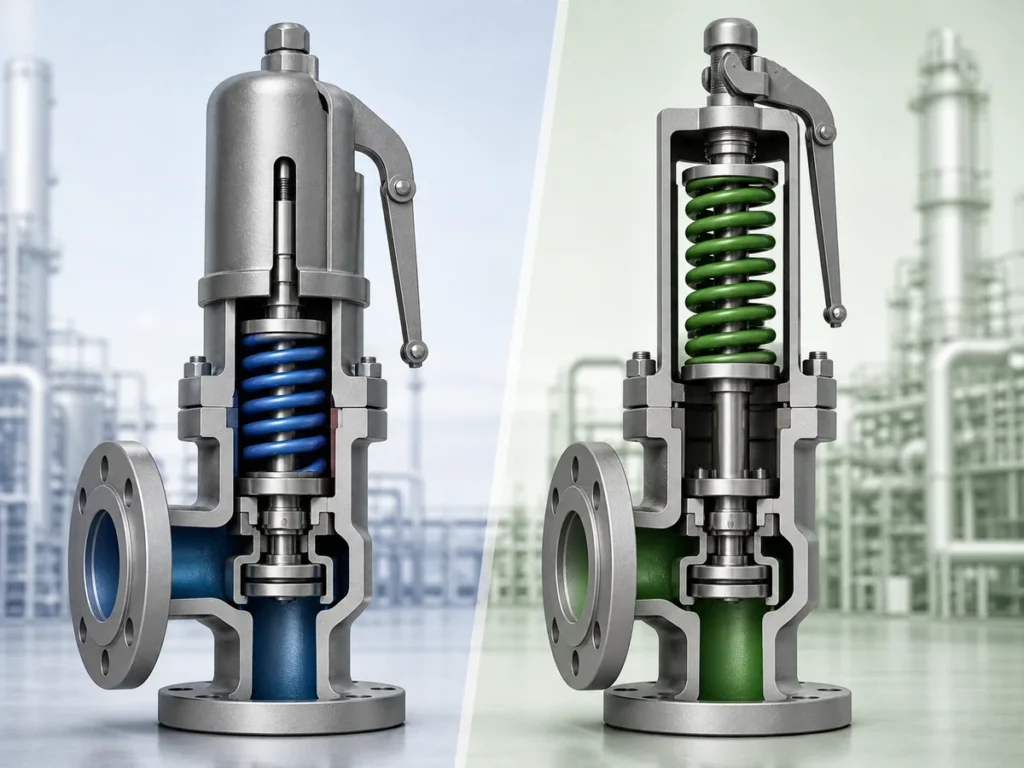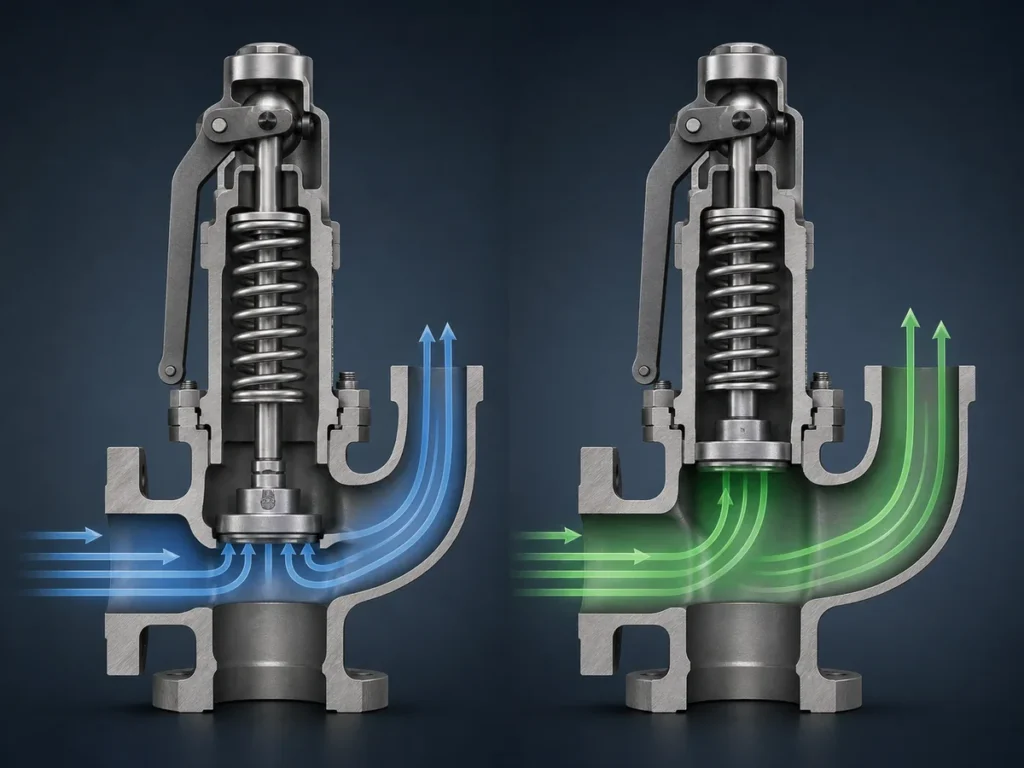
A spring-loaded safety valve is usually the practical choice for straightforward pressure-relief duties, dirty or mildly contaminated service and sites that need simple maintenance. A pilot-operated safety valve may be the stronger option for suitable clean, high-pressure or large-capacity gas service, especially when tight shutoff or operation close to set pressure is important. The choice …

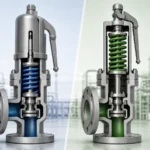
A spring-loaded safety valve is usually the practical choice for straightforward pressure-relief duties, dirty or mildly contaminated service and sites that need simple maintenance. A pilot-operated safety valve may be the stronger option for suitable clean, high-pressure or large-capacity gas service, especially when tight shutoff or operation close to set pressure is important.
The choice is not about which design appears more advanced. It should be based on the governing relief scenario, medium cleanliness, operating pressure margin, required and certified capacity, back pressure, seat tightness, temperature, installation and the site’s ability to maintain the valve.
Engineering takeaway: Use a spring-loaded valve as the simpler default when the service and back pressure allow it. Consider a pilot-operated valve when the service is clean and the benefit of tight shutoff, high pressure, large capacity or selected back-pressure performance outweighs the added pilot-system complexity.
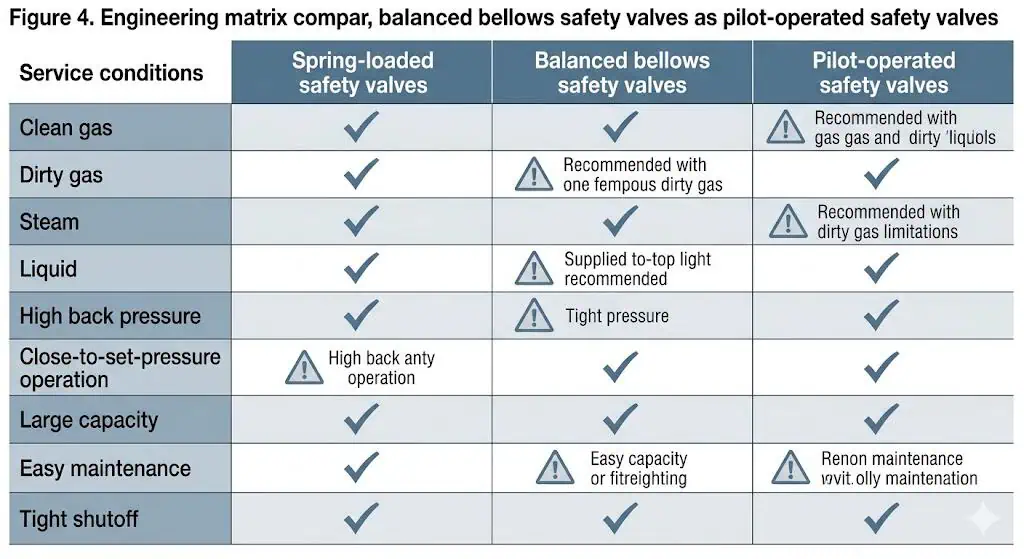
60-Second Valve-Type Decision
| Service Condition | More Likely Starting Point | Main Verification |
|---|---|---|
| General steam, air or utility service | Spring-loaded | Temperature, capacity, drainage and back pressure |
| Dirty, wet or particle-containing medium | Usually spring-loaded | Trim, guide, seat and fouling resistance |
| Clean high-pressure gas | Pilot-operated may be advantageous | Pilot circuit, certified capacity and exhaust arrangement |
| Operating pressure close to set pressure | Pilot-operated may be advantageous | Medium cleanliness, seat tightness and maintenance |
| Variable or significant back pressure | Balanced bellows or suitable pilot design | Manufacturer performance envelope and outlet system |
| Poor maintenance access or limited specialist skills | Spring-loaded often safer | Inspection and recalibration capability |
| Two-phase, flashing or reactive service | Case-specific engineering review | Sizing method, valve design and manufacturer confirmation |
Do not decide from this table alone. A final selection still requires the approved relief load, certified capacity, fluid state, downstream pressure condition, material limits and installation review.
What This Comparison Covers
This article compares direct spring-loaded and pilot-operated pressure-relief devices from an application and lifecycle perspective. It does not replace the broader 安全阀选型指南, the sizing calculation or the manufacturer performance envelope.
It also does not treat a balanced bellows valve as a completely separate operating family. A balanced bellows valve is still a spring-loaded design, but the bellows changes how back pressure affects the force balance and adds its own material, vent and fatigue considerations.
Use This Page For
Comparing the two operating concepts, screening service suitability, identifying failure risks and preparing an RFQ.
Use Other Pages For
Detailed sizing, product data, back-pressure calculations, installation design, materials and certificate review.
How a Spring-Loaded Safety Valve Works
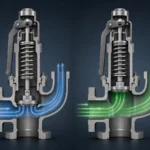
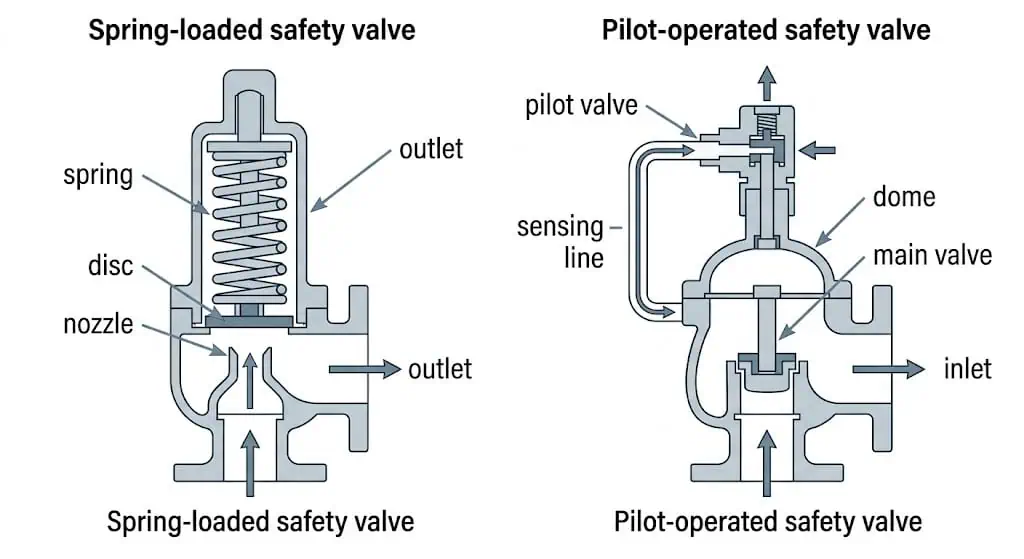
A spring-loaded safety valve uses a spring to apply closing force to the disc. Inlet pressure creates an opening force. When the defined set-pressure condition is reached, the disc begins to lift and the valve discharges.
After the overpressure event, the inlet pressure falls. The spring returns the disc toward the seat, and the valve reseats at a pressure determined by its design, adjustment and installed conditions.
Main Strengths
- simple direct-acting construction;
- broad experience in steam, air, gas and suitable liquid service;
- fewer small control passages than a pilot system;
- easier inspection, repair and recalibration in many plants;
- often more tolerant of dirty or mildly contaminated service;
- usually lower initial purchase and spare-parts complexity.
Main Limitations
- conventional designs can be sensitive to back pressure;
- seat tightness can become difficult when operating pressure remains close to set pressure;
- inlet loss, oversizing or outlet resistance can contribute to chatter;
- spring, guide and seat condition can affect repeatability and leakage;
- high temperature can limit spring, seat and bonnet arrangements.
For the full operating sequence, see How a Spring-Loaded Safety Valve Works. For products, see Spring-Loaded Safety Valves.
How a Pilot-Operated Safety Valve Works
A pilot-operated safety valve uses a smaller pilot valve and system pressure to control a larger main valve. In many designs, pressure in a dome or control chamber helps keep the main valve closed. When the pilot responds at the set condition, it changes the dome pressure and allows the main valve to open.
The exact sequence varies by manufacturer and by pop-action or modulating design. The pilot, sensing path, dome, seals and exhaust arrangement are therefore part of the selection, not secondary accessories.
Main Strengths
- tight shutoff in suitable clean service;
- potentially better operation when system pressure stays close to set pressure;
- useful for selected high-pressure or large-capacity gas duties;
- some designs support demanding back-pressure conditions;
- reduced simmer in certain clean-service applications.
Main Limitations
- sensitivity to contamination in small pilot and sensing passages;
- more complex maintenance and troubleshooting;
- dependence on correct pilot exhaust and dome behavior;
- possible problems from liquid carryover, icing, waxing or polymerization;
- greater reliance on trained personnel and design-specific spare parts.
For the full operating sequence, see How a Pilot-Operated Safety Valve Works. For products, see Pilot-Operated Safety Valves.
Spring-Loaded vs Pilot-Operated Safety Valves: Detailed Comparison
| Selection Factor | Spring-Loaded | Pilot-Operated |
|---|---|---|
| Closing method | Spring force acts directly on the main disc | Pilot and system pressure control the main valve |
| Mechanical complexity | Lower | Higher |
| Cleanliness requirement | Often more tolerant | Usually requires cleaner service and small-bore control integrity |
| Operation near set pressure | Can simmer or leak depending on design and condition | Often advantageous in suitable clean service |
| Back-pressure behavior | Conventional type may be sensitive; bellows can reduce influence | Design-specific; some configurations support demanding conditions |
| Steam service | Widely used | Requires design-specific temperature and condensate review |
| High-pressure clean gas | Suitable in many cases | Often advantageous where tightness or operating margin matters |
| Dirty or deposit-forming service | Usually the more robust starting point | Higher risk of pilot or sensing-path restriction |
| Maintenance | Generally simpler | Requires pilot, sensing, dome and exhaust checks |
| Initial cost | Usually lower | Usually higher |
| Primary failure concerns | Seat wear, spring condition, guide sticking, chatter | Pilot blockage, seal failure, sensing-line or exhaust problems |
| Best fit | General, dirty, simple or maintenance-limited service | Clean, high-pressure, close-to-set or selected high-capacity service |
Selection Factor 1: Medium Cleanliness and Fouling Risk
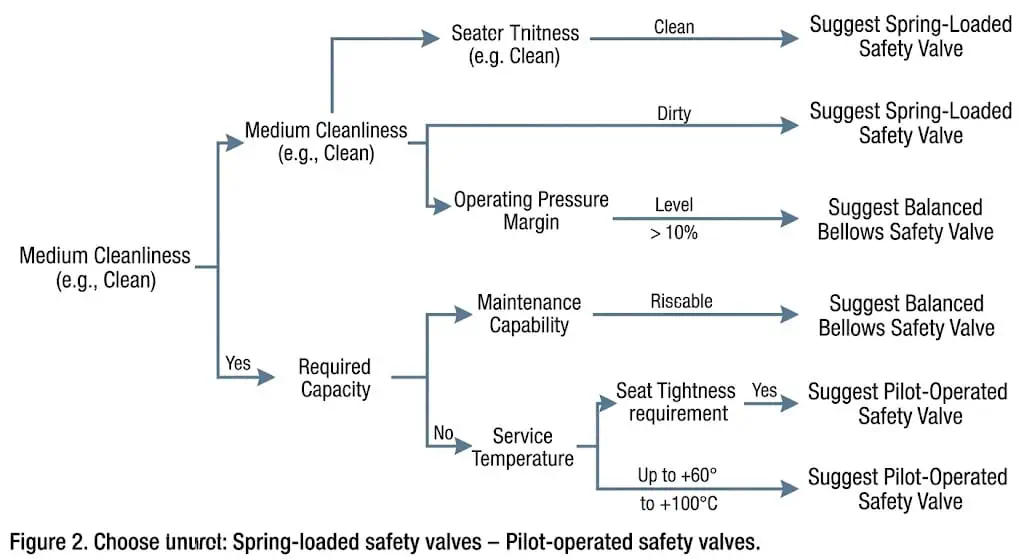
Medium cleanliness is one of the strongest differentiators. Pilot-operated valves contain small control passages and sensing paths that can be affected by contaminants which might not prevent a larger spring-loaded main valve from opening.
Review the risk of:
- liquid carryover in gas service;
- rust, scale or catalyst particles;
- wax, heavy hydrocarbons or crystallization;
- polymerizing or reactive deposits;
- icing or freezing in sensing lines;
- corrosion products from aging pipework;
- viscous or sticky fluids.
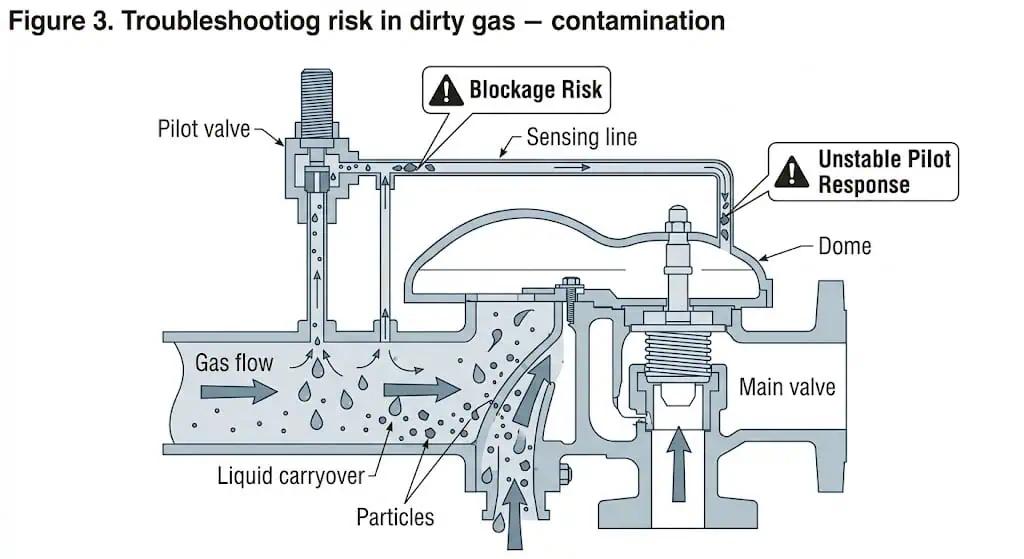
Do not accept “clean gas” without evidence. Review separation, drainage, startup conditions, compressor carryover and long-term corrosion products, not only the normal P&ID service description.
Selection Factor 2: Operating Pressure Close to Set Pressure
When operating pressure remains close to set pressure, seat leakage, simmer and nuisance lifting become more important. A pilot-operated design can provide tighter shutoff in suitable clean service because the main closing force can remain high until the pilot responds.
That benefit must be balanced against pilot-system cleanliness and maintenance. A tight pilot-operated valve that cannot sense or exhaust correctly is not a safer choice.
Review:
- normal and maximum operating pressure;
- pressure fluctuations and compressor or control-valve cycling;
- seat material and leakage acceptance;
- set-pressure tolerance and blowdown behavior;
- cleanliness and temperature at the pilot;
- the consequences of nuisance leakage or lifting.
For pressure terminology, use Set Pressure, Overpressure and Blowdown Explained.
Selection Factor 3: Back Pressure and the Discharge System
A conventional spring-loaded valve can be influenced by outlet pressure because back pressure may act on internal areas and change the valve’s force balance. A balanced bellows design reduces this influence within its limits. A pilot-operated design may also support selected back-pressure conditions, but performance depends on the pilot and exhaust configuration.
Before comparing valve types, determine:
- superimposed back pressure before opening;
- whether it is constant or variable;
- built-up back pressure at the required relief flow;
- common-header or flare pressure;
- simultaneous-relief combinations;
- pilot exhaust destination;
- bellows bonnet vent arrangement;
- manufacturer allowable limits.
使用 Safety Valve Back Pressure Guide 和 Back Pressure and Bellows Engineering Hub for the detailed review.
High back pressure does not automatically mean “use a pilot valve.” A balanced bellows spring-loaded valve may be more robust in some services, while a pilot design may be unsuitable when the fluid is dirty or the pilot exhaust condition is unfavorable.
Selection Factor 4: Required Capacity, Orifice and Valve Size
Valve type should be selected after the governing relief case and required flow are understood. The same nominal connection size does not prove equal orifice area or equal certified capacity.
Compare each proposal using:
- required relieving capacity and calculation revision;
- set and relieving pressure;
- fluid and capacity medium;
- selected orifice or effective area;
- manufacturer-certified capacity;
- back-pressure or downstream basis;
- installed inlet and outlet conditions.
Pilot-operated valves can be attractive for large-capacity and high-pressure gas duties, but this is not a substitute for capacity verification. Use the Safety Valve Sizing and Certified Capacity Guide.
Selection Factor 5: Steam, Gas, Liquid and Two-Phase Service
蒸汽
Spring-loaded valves are common. Review temperature, spring exposure, trim, reaction force and drainage. Pilot designs require explicit steam-service confirmation.
Clean Gas
Either design may work. Pilot-operated valves can be advantageous for tight shutoff, high pressure or operation close to set pressure.
Wet or Dirty Gas
A spring-loaded design is often the safer starting point. Review contamination, corrosion and guide or seat fouling.
Liquid
Use only a valve design certified or approved for the liquid service. Review viscosity, flashing and stable opening behavior.
Two-Phase or Flashing
Requires qualified calculation and manufacturer review. Do not make the decision from a simple gas-versus-liquid comparison.
腐蚀性工况
Valve type alone is insufficient. Review body, nozzle, disc, guide, spring, bellows, pilot and seal materials.
Selection Factor 6: Temperature, Materials and Seat Design
High temperature can affect spring performance, soft seats, seals, pilot components and sensing tubing. Low temperature can affect materials, seals and ice formation. Corrosion can damage both the main valve and the control system.
| Component | Spring-Loaded Review | Pilot-Operated Review |
|---|---|---|
| Main seat | Metal or soft seat, erosion, lapping and operating margin | Main seat plus pilot seat and seal condition |
| Spring | Temperature exposure, corrosion and relaxation | Main-valve spring where present plus pilot spring or control components |
| Guide / moving parts | Galling, fouling and alignment | Main-valve piston or guide plus pilot moving parts |
| Seals | Seat insert, O-rings or bonnet seals where used | Dome, piston, pilot and tubing seals are critical |
| Back-pressure component | Bellows material and vent if balanced design | Pilot exhaust, dome and sensing-system compatibility |
使用 Safety Valve Material Selection Guide 和 压力-温度额定值 for supporting review.
Selection Factor 7: Maintenance Capability and Lifecycle Risk
A design that is technically suitable on paper may still be the wrong plant choice if it cannot be inspected, tested and repaired reliably.
| Lifecycle Factor | Spring-Loaded | Pilot-Operated |
|---|---|---|
| Initial cost | Usually lower | Usually higher |
| Routine inspection | Fewer control components | Main valve plus pilot, sensing, dome and exhaust |
| Specialist skill | Generally lower | Generally higher |
| Spare parts | Spring, seat, guide and trim | Main-valve parts plus pilot internals, seals and tubing |
| Failure diagnosis | Usually more direct | May require system-level troubleshooting |
| Leakage savings | Can be lower near set pressure | May justify cost in suitable clean service |
| Dirty-service robustness | Often better | Often worse unless specifically engineered |
The best lifecycle choice is the valve whose failure modes the site can prevent, detect and manage.
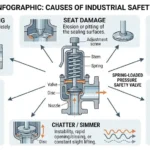
Failure-Mode Comparison
| Observed Problem | Possible Spring-Loaded Causes | Possible Pilot-Operated Causes |
|---|---|---|
| Seat leakage | Simmer, seat damage, contamination, corrosion, poor lapping | Main or pilot seat damage, seal damage, contaminated pilot circuit |
| Fails to open correctly | Wrong setting, sticking guide, blocked inlet, spring damage | Blocked sensing line, pilot malfunction, dome pressure not released |
| Chatter or flutter | Inlet loss, oversizing, back pressure, unstable process | Pilot instability, sensing/exhaust restriction, back pressure, process oscillation |
| Poor reseating | Seat damage, blowdown issue, back pressure, guide friction | Pilot not resetting, dome pressure recovery problem, seal or exhaust issue |
| Capacity concern | Insufficient orifice, reduced lift, outlet resistance | Main valve orifice, incomplete opening, pilot restriction, outlet condition |
Do not treat the observed symptom as the root cause. Replacing a spring, cleaning a pilot or lapping a seat can fail again if sizing, inlet loss, back pressure or process instability is not corrected.
For seat-tightness acceptance, use the API 527 Seat Tightness Guide. For installation, use the 安全阀安装指南.
Illustrative Engineering Case: Clean Gas Becomes Wet Gas
Fictional training example — not project data
Initial Basis
- compressor discharge gas;
- high operating pressure close to set pressure;
- tight shutoff required;
- service originally classified as clean, dry gas;
- pilot-operated valve selected.
Observed Problem
After operation, the main valve response became inconsistent. Inspection found liquid carryover and fine corrosion particles in the pilot sensing path.
Engineering Finding
The original valve type was reasonable for the stated clean service, but the actual medium condition had changed. The failure was not proof that all pilot-operated valves were unsuitable; it showed that the cleanliness assumption and maintenance controls were inadequate.
Required Actions
- review upstream separation and drainage;
- inspect and clean the pilot and sensing system;
- confirm the pilot-line arrangement with the manufacturer;
- reassess whether the service can remain clean over the lifecycle;
- compare a robust spring-loaded or balanced design if contamination cannot be controlled;
- update the process and maintenance basis.
When to Choose a Spring-Loaded Safety Valve
A spring-loaded valve is often the stronger choice when:
- the duty is general steam, air, gas or suitable liquid relief;
- the medium may contain contamination or deposits;
- maintenance simplicity and local repair capability are important;
- the system has low and stable back pressure or a suitable balanced design is available;
- pilot-line blockage would create unacceptable risk;
- initial cost and spare-parts simplicity matter;
- the site prefers a proven direct-acting failure mode.
It still requires sizing, certified capacity, back-pressure, materials and installation review.
When to Choose a Pilot-Operated Safety Valve
A pilot-operated valve may be the better choice when:
- the service is demonstrably clean and stable;
- the system operates close to set pressure and tight shutoff is valuable;
- the pressure is high or the required gas capacity is large;
- the manufacturer design supports the actual back-pressure condition;
- the pilot exhaust and sensing arrangement can be installed correctly;
- trained maintenance personnel and design-specific spare parts are available;
- the lifecycle value of leakage reduction justifies added complexity.
It should be used cautiously where liquid carryover, particles, waxing, crystallization, icing or polymerization may occur.
Need Help Comparing the Two Designs?
Send the medium, cleanliness risk, set pressure, operating pressure, required capacity, back pressure and current valve datasheet for a valve-type review.
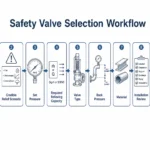
Upload Service Data Request a QuoteEight-Step Valve-Type Selection Workflow
- Define the protected equipment and relief scenario.
Start from the actual pressure-protection duty. - Confirm required capacity.
Do not select the valve family from connection size. - Determine fluid phase and cleanliness.
Include upset, startup and long-term contamination conditions. - Review operating margin.
Check how close normal pressure remains to set pressure. - Calculate back pressure.
Review superimposed and built-up conditions and the exhaust arrangement. - Compare failure modes.
Decide which risks the plant can prevent and maintain. - Verify manufacturer-certified performance.
Confirm capacity, materials, temperature and design limits. - Document the final decision.
Record assumptions, deviations, maintenance and inspection requirements.
RFQ Data Needed Before Selecting the Valve Type
Protected equipment and tag
MAWP and design temperature
Operating pressure and temperature
Set pressure and pressure-rise basis
Governing relief scenario
Required relieving capacity
Medium, composition and phase
Cleanliness, liquid carryover and fouling risk
Relieving pressure and temperature
Superimposed and built-up back pressure
Inlet and outlet piping arrangement
Seat-tightness requirement
Material and seal requirements
Maintenance and inspection capability
Applicable standard and document package
Manufacturer allowable limits
使用 Safety Valve Procurement Checklist when issuing the quotation package.
Common Selection Mistakes
Choosing Pilot Because It Looks Advanced
Added complexity is valuable only when the service and maintenance system support it.
Choosing Spring-Loaded Only on Price
A lower initial cost may not solve tightness, high-pressure or back-pressure requirements.
Ignoring Actual Cleanliness
Wet or dirty gas can invalidate the original pilot-operated assumption.
Ignoring Back Pressure
Conventional, bellows and pilot designs respond differently to the downstream system.
Selecting by Connection Size
Same size does not prove the same orifice or certified capacity.
Ignoring Maintenance Capability
A design that cannot be tested or repaired correctly is not a robust plant choice.
Assuming Tightness Equals Safety
Seat tightness does not replace relief capacity and stability.
Skipping Review After Process Change
Throughput, composition, back pressure and contamination can change the correct valve type.
Standards and Technical References
| Reference | Role in the Decision | Link |
|---|---|---|
| API 520 Part I | Sizing and selection basis for pressure-relieving devices in covered process-industry applications | ZOBAI API 520 Guide |
| API 520 Part II | Installation and engineering analysis, including inlet and outlet-system concerns | API official page |
| API 521 | Relief scenarios, flare, depressuring and system-level back-pressure context | ZOBAI API 521 Guide |
| API 527 | Seat-tightness testing and report acceptance | ZOBAI API 527 Guide |
| ISO 4126-4:2013 | General product requirements for pilot-operated safety valves | ISO official page |
| ASME BPVC | Overpressure-protection and equipment-code context where ASME applies | ASME 安全阀标准 |
Compliance note: Do not claim API, ASME, ISO, PED, CE or National Board compliance unless the exact certificate, legal entity, product scope, edition and market applicability have been verified.
FAQ About Spring-Loaded and Pilot-Operated Safety Valves
弹簧式安全阀与先导式安全阀的主要区别是什么?
弹簧式安全阀在主阀瓣上直接施加弹簧力。先导式安全阀则通过先导阀和系统压力来控制较大的主阀。.
先导式安全阀是否优于弹簧式安全阀?
并非自动如此。对于选定的清洁、高压、接近整定压力或大容量气体工况,先导式安全阀可能更优。而对于更简单、较脏或维护受限的工况,弹簧式安全阀通常更为合适。.
哪种设计更适合脏气体工况?
弹簧载荷式设计通常是更安全的起点,因为先导阀和传感通道可能被液体、颗粒、蜡或沉积物堵塞。.
当工作压力接近整定压力时,哪种设计更好?
先导式安全阀在清洁介质工况下可实现更严密的密封关闭,但必须确保先导回路、排放通道、温度及维护要求均适用。.
哪种阀型更适合高背压工况?
这取决于背压的类型和变化情况。在制造商允许的范围内,可考虑采用波纹管平衡式弹簧安全阀或合适的先导式安全阀设计。.
哪种设计更容易维护?
弹簧式安全阀通常更简单,因为其控制部件较少。先导式安全阀需要额外检查先导阀、感应通道、气室和排气口。.
弹簧式安全阀能否用先导式安全阀替代?
仅在完成对排量、介质清洁度、压力裕量、背压、安装、材料、标准及维护能力的工程审查之后。.
先导式安全阀能否用于蒸汽工况?
仅当特定制造商的设计支持蒸汽压力、温度、凝结水及维护条件时方可选用。弹簧式安全阀在蒸汽工况中仍为常见选择。.
Does a pilot-operated valve always have better seat tightness?
It often has an advantage in suitable clean service, but tightness still depends on seat design, seals, temperature, contamination, pressure fluctuation and maintenance.
What information should be sent to a supplier?
Provide the protected equipment, relief scenario, required capacity, medium, cleanliness risk, operating and set pressure, relieving temperature, back pressure, piping, materials, seat-tightness and document requirements.
Choose the Right Valve Type for the Real Service
Send the process medium, cleanliness risk, operating pressure, set pressure, required capacity, relieving temperature, back pressure and outlet arrangement for a spring-loaded versus pilot-operated review.
Upload Service Data 获取安全阀报价