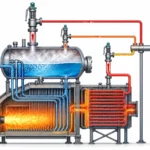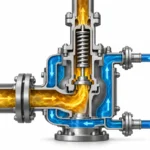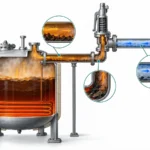
弹簧式安全阀是一种自力式泄压装置。压缩弹簧提供关闭力,将阀瓣压在阀座密封面上。进口压力产生相反方向的开启力。当达到规定的整定压力条件时,阀瓣开始开启,阀门从被保护系统中排放介质。整个动作过程……

弹簧式安全阀是一种自力式泄压装置。压缩弹簧提供关闭力,将阀瓣压在阀座密封面上。进口压力产生相反方向的开启力。当达到规定的整定压力条件时,阀瓣开始开启,安全阀从被保护系统中排放介质。
完整的动作过程不只是“压力克服弹簧力”。阀门必须从初始开启过渡到稳定升程,通过足够的流量以满足批准的泄放工况,并在压力下降后回座。阀瓣几何形状、有效受压面积、弹簧压缩量、流动反作用力、入口压力损失、背压、启闭压差调整、导向摩擦以及管道系统都会影响实际运动。
工程要点: 弹簧式安全阀通过不断变化的力平衡来实现工作。整定压力启动规定的开启响应;超压和流动作用力使阀瓣产生升程;阀门通过其内部流通面积进行泄放;只有当压力降至回座条件后,弹簧才使阀门关闭。
60 秒工作顺序
| 阶段 | 会发生什么 | 主要工程关注点 |
|---|---|---|
| 1. 封闭式 | 弹簧将阀瓣压紧在阀座密封面上。 | 工作压力裕度、密封面状态及泄漏情况。 |
| 2. 压力上升 | 入口压力作用在有效面积上的力增大。 | 压力波动、前泄与试验定义。 |
| 3. 初始开启 | 阀门在整定压力下呈现规定的开启特性。 | 整定压力基准、温度和背压。 |
| 4. 升程形成 | 流动反作用力和有效面积变化可加速开启。 | 阀门结构、超压、缓冲腔和稳定性。 |
| 5. 泄放 | 流体通过喷嘴、阀体和出口。 | 所需排量、孔径、入口损失和出口阻力。 |
| 6. 压力下降 | 随着系统泄压,关闭力逐渐占据主导。 | 工艺压力衰减、背压与启闭压差。 |
| 7. 回座 | 阀瓣在低于整定压力的压力下重新回到阀座。 | 阀座损伤、导向摩擦、介质污染与关闭稳定性。 |
并非所有弹簧式安全阀的“起跳”方式都完全相同。 开启特性随气体、蒸汽或液体工况、阀门结构、升程设计及所适用产品标准而变化。实际型号请以制造商认证数据为准。
什么是弹簧式安全阀?
A 弹簧式安全阀 是一种直接作用式泄压装置,利用机械弹簧使主阀瓣保持关闭。被保护系统的压力提供自动开启所需的能量。其基本安全动作无需外部执行机构、电源或控制信号。
弹簧式结构适用于压力容器、锅炉、蒸汽系统、储气罐、压缩机、工艺橇块、气体系统及适用的液体工况。其形式可为常规式、波纹管平衡式、全启式、微启式、开式阀盖、闭式阀盖或其他制造商特定结构。
安全阀、泄压阀、PSV 和 PRV 等术语在不同行业中可能有所不同。术语使用请参考 PRV、PSV、安全阀与泄压阀的区别.
工作原理问题
弹簧力、进口压力和流动反作用力如何推动阀瓣?
选型问题
所选型号能否满足所需的排量、介质、温度及安装工况?
直接作用式边界: “弹簧式”描述的是主关闭机构,并不能说明该阀是常规式还是波纹管平衡式、全启式还是微启式、金属密封还是软密封、开式阀盖还是闭式阀盖。这些结构细节会改变背压响应、温度限值、泄漏特性及维护要求。
本文回答第一个问题。关于第二个问题,请使用 如何选择弹簧式安全阀.
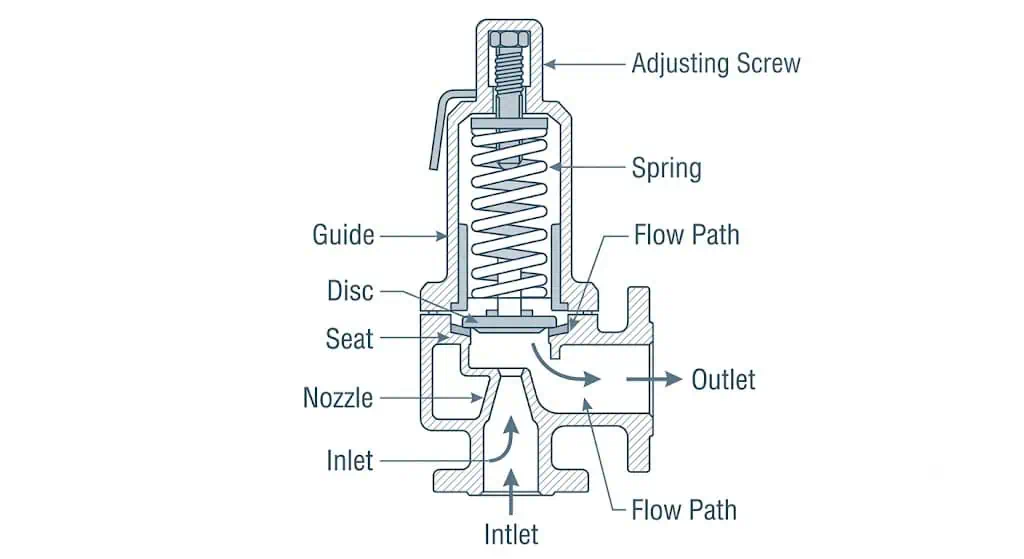
弹簧式安全阀的主要零件
| 零件 | 主要功能 | 典型性能风险 |
|---|---|---|
| 阀体 | 包含内部流道并连接进口与出口。 | 压力等级、冲蚀、腐蚀和管道载荷。 |
| 阀嘴 | 构成进口喉部和精密密封面。 | 冲蚀、流道面积不正确、阀座损坏和沉积物。 |
| 阀瓣 | 关闭阀座并开启以形成泄放流道。 | 不对中、振动损坏、卡涩和密封面损坏。 |
| 阀瓣座/反冲盘结构 | 传递运动,并可能利用流体作用力促进开启。 | 装配不当、沉积物或动态特性改变。 |
| 导向套 | 保持受控的轴向运动。 | 摩擦、腐蚀、咬合、结垢及回座不良。 |
| 阀杆 | 将弹簧力传递至阀瓣组件。 | 弯曲、不对中、摩擦及装配误差。 |
| 弹簧 | 提供关闭力并支撑校准后的整定压力。 | 量程错误、腐蚀、松弛、温度影响及未经授权的调整。 |
| 弹簧垫圈 | 传递并分配弹簧载荷。 | 装配不当或支承面损坏。 |
| 调节螺钉 | 在受控校准过程中改变弹簧压缩量。 | 未经授权的整定压力变更及追溯性缺失。 |
| 启闭压差调节圈(如配备) | 改变局部流道几何形状及开启/回座特性。 | 位置不正确、调整未记录及运行不稳定。 |
| 阀盖与阀帽 | 保护弹簧及调整机构。 | 排放不当、腐蚀及环境暴露。 |
| 提升机构(如配备) | 允许在特定应用中进行受控手动提升。 | 不安全排放、阀座损坏及误操作。 |
| 阀座或弹性密封件(如配备) | 提供阀瓣与喷嘴之间的最终关闭密封界面。 | 温度极限、化学侵蚀、压缩永久变形、污染以及阀瓣升程后的泄漏。 |
| 波纹管,用于平衡式结构 | 降低出口侧指定压力作用力影响,并可将导向机构或弹簧腔与工艺介质隔离。 | 疲劳、腐蚀、泄漏、阀盖排放口堵塞及平衡功能失效。 |
设计变型: 并非每台阀门都包含相同的零件或调节结构。部分阀门设有一个或多个启闭压差调节圈;其他阀门采用固定几何结构。部分阀门采用开放式阀盖用于蒸汽工况,其他则采用封闭式阀盖。实际阀门请以制造商图纸为准。
零部件级材料审查: 仅凭阀体材料无法确定工况适用性。阀座喷嘴、阀瓣、导向套、阀杆、弹簧所处环境、波纹管、垫片及软密封材料均可能影响腐蚀、咬合、卡涩、泄漏及使用寿命。
简化力平衡
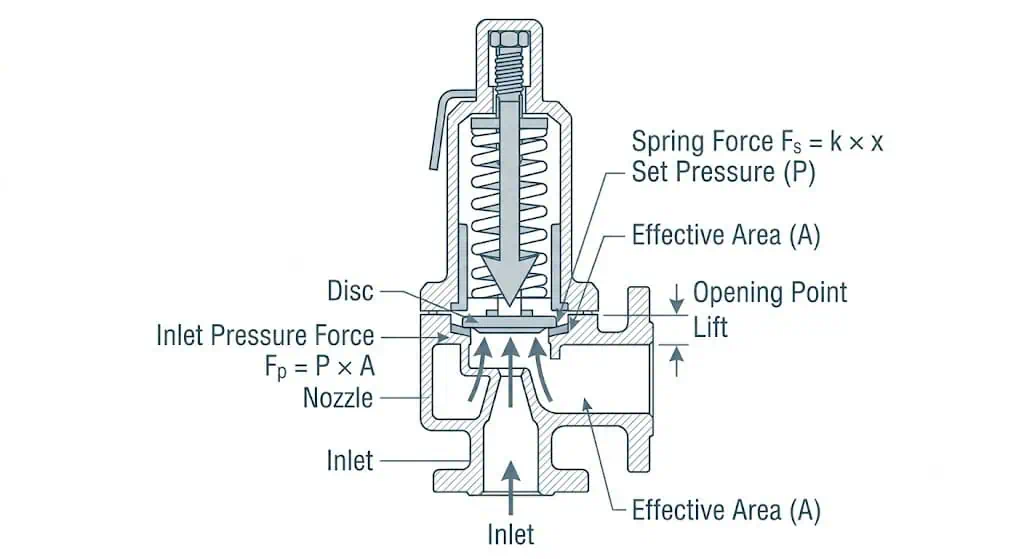
该原理可通过两个基本关系式引入:
弹簧力:Fs ≈ F预紧 + kx
压力作用力:Fp ≈ Pin × A有效
其中:
- Fs 为弹簧产生的关闭力;;
- F预紧 为校准时建立的初始弹簧载荷;;
- k 为有效弹簧刚度;;
- x 为阀瓣移动时的附加弹簧压缩量;;
- Pin 为进口压力;;
- A有效 为有效受压面积。
阀门关闭时,弹簧载荷及其他关闭力大于净开启力。随着进口压力升高,压力作用力增大。在规定的整定压力工况下,力平衡与阀门几何结构允许初始开启响应。
定性净运动:Fnet ≈ pressure forces + flow-reaction forces − spring force − friction and resisting forces
For a conventional valve connected to a pressurized outlet, the outlet-side pressure force must also be considered. The effective areas are geometry-dependent and can change as the disc lifts. This is why a bench set-pressure result cannot by itself predict installed lift, blowdown or stability.
These equations do not size the valve. Capacity calculations require the applicable gas, steam, liquid or two-phase method, certified coefficients and relieving conditions.
Why Opening Is More Than a Static Force Balance
After the disc begins to lift, the exposed pressure area and local flow pattern can change. High-velocity fluid acts on the disc holder, huddling chamber or related geometry and can create additional opening force. In a pop-action design, this feedback promotes rapid movement toward a larger lift.
At the same time:
- the spring compresses further and produces greater closing force;
- flow momentum creates forces on the disc assembly;
- inlet pressure can fall because of inlet-line resistance;
- outlet pressure can rise because of discharge-system resistance;
- the process pressure source may continue adding mass or energy;
- disc inertia and guide friction influence motion.
The operating point is therefore dynamic. Stable lift requires the valve, relief load and connected piping to work as one system.
Compressible-service valves may use pop-action geometry to develop rapid lift, while liquid-service designs may open more proportionally. Steam behavior also depends on the applicable valve design and test definition. The words “pop,” “proportional” and “full lift” should therefore be tied to the actual certified model rather than used as universal descriptions.
Huddling Chamber and Blowdown Adjustment
Many spring-loaded safety valves use a huddling chamber, disc-holder profile or blowdown ring to control how flow forces develop. These features can influence rapid opening, lift and closing behavior.
Do not move a blowdown ring as a casual field adjustment. Its position can change opening and reseating behavior. Adjustment should follow the manufacturer’s procedure, authorized calibration controls and documented final settings.
The Seven-Stage Working Cycle
-
Closed during normal operation.
Spring preload keeps the disc seated. Tightness depends on seat condition, alignment, operating margin, temperature and medium cleanliness. -
Pressure approaches the set condition.
The net opening force increases. Depending on design and service, small leakage or simmer may appear before decisive lift. -
阀门呈现规定的开启特性。
整定压力依据适用的试验定义确定,不应简化为“首次可见动作”这类通用说法。” -
流动作用力使阀瓣产生升程。
随着流道开启,压力和动量作用于更大或不同的有效面积。突开式结构可能迅速加速至更高升程。 -
安全阀泄放所需流量。
介质通过内部孔径和出口。认证排量与规定的压力、介质及试验条件相对应。 -
系统压力下降。
随着泄放源被控制或物料被排出,开启作用力减小。弹簧力占据主导,并受背压和动态效应影响。 -
阀门回座。
阀瓣在回座压力下返回喷嘴。整定压力与回座压力之差即为启闭压差。
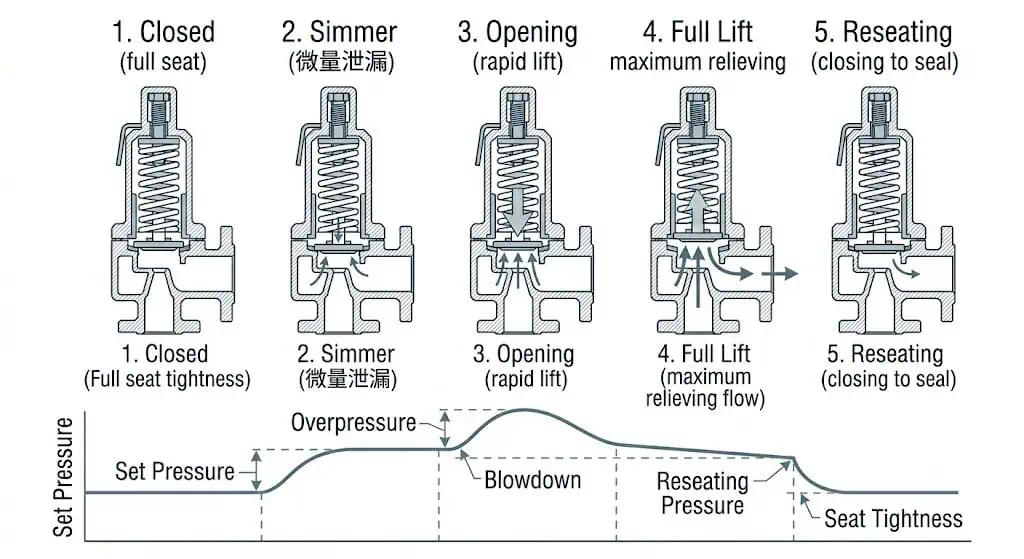
整定压力、超压、泄放压力与启闭压差
| 术语 | 在工作循环中的含义 | 常见误解 |
|---|---|---|
| 工作压力 | 阀门应保持关闭时的正常工艺压力。 | 将其视为可在整定压力下连续运行的允许做法。 |
| 整定压力 | 在规定试验条件下,与指定开启特性相对应的进口压力。 | 将其视为全排量的证明。 |
| 超压 | 泄放期间压力超过整定压力的升高值。 | 将其视为常规运行裕量。 |
| 压力积聚 | 超压事件期间,压力超过被保护设备 MAWP 或其他允许边界的升高值。 | 将其视为超压的另一种说法,而不涉及设备边界。 |
| 泄放压力 | 用于确定排量的压力条件。 | 假定其与整定压力相同。 |
| 回座压力 | 泄放后阀门回座时的压力。 | 假定其等于整定压力。 |
| 启闭压差 | 整定压力与回座压力之间的差值。 | It is treated as an arbitrary spring adjustment. |
| 密封性 | Leakage performance while the valve is closed. | It is treated as proof of capacity or stability. |
| CDTP, where applicable | Cold differential test pressure used to account for service temperature or back-pressure effects during controlled calibration. | It is treated as permission to change the operating set pressure without an approved basis. |
| 背压 | Pressure at the outlet before opening or developed while the valve relieves. | It is assumed to affect only outlet piping and not the valve force balance. |
使用 安全阀整定压力、超压、压力积聚与启闭压差 for detailed definitions, formulas and CDTP discussion.
How a Spring-Loaded Valve Relieves Capacity
The valve protects equipment only when its available relieving capacity is adequate for the governing scenario. The inlet connection size does not determine this capacity.
排量取决于:
- internal flow area or certified orifice;
- 整定压力与泄放压力;;
- gas, steam, liquid or two-phase condition;
- relieving temperature and fluid properties;
- valve lift and discharge coefficient;
- back pressure and applicable correction basis;
- manufacturer-certified configuration.
所需泄放量
The flow produced by the approved overpressure scenario.
Certified or Documented Capacity
The valve performance established under stated conditions for the identified design.
A valve can open at the correct set pressure and still be undersized. The set-pressure test checks an opening characteristic; it does not recreate the full emergency relief load.
| 证据 | 证明的事项 | 不能证明的内容 |
|---|---|---|
| 整定压力证书 | 在规定的试验介质和条件下进行开启调整 | 全紧急排量、安装稳定性或正确的泄放工况 |
| 经认证或认可的排量数据 | 针对已确定的阀门、孔径和基准所支持的流量性能 | 买方所需泄放负荷已正确计算 |
| 连接尺寸和压力等级 | 机械接口和压力-温度范围 | 有效流通面积或泄放能力 |
| 密封性报告 | 在规定试验方法下的关闭阀泄漏 | 整定压力精度、启闭压差、排量或颤振阻力 |
使用 安全阀选型与认证泄放能力指南 用于定径工作流程。
常规式与平衡式弹簧载荷特性
在常规弹簧式安全阀中,出口压力会作用于内部承压面积并影响净力平衡。其影响取决于阀门结构,以及背压是在开启前已存在还是在排放过程中产生。.
平衡波纹管结构增设波纹管组件,用于在制造商规定范围内减小出口压力对力平衡的影响。该阀仍为弹簧式安全阀,但需额外考虑波纹管材质、疲劳、排放口及失效模式。.
叠加背压
阀门开启前已存在的出口压力。该压力可能恒定或变化,并可能改变常规式安全阀的净开启条件。.
积聚背压
泄放介质流经排放系统时产生的出口压力。该压力会降低阀瓣升程、改变启闭压差,并可能导致颤振或回座不良。.
平衡波纹管可减小规定出口压力对力的影响,但并不能消除排放系统压降、排量修正、排放反作用力、排放管路排液、波纹管疲劳,以及阀盖排放口必须保持畅通并正确接至安全地点的要求。.
| 结构 | 力平衡特性 | 附加审查 |
|---|---|---|
| 常规弹簧式 | 出口压力可能影响开启、阀瓣升程和回座。. | 附加背压与排放背压、阀盖状态及排量基准。. |
| 平衡波纹管弹簧式 | 波纹管可减小出口压力对规定内部承压面积的影响。. | 波纹管使用限制、材质、疲劳、阀盖排放口及失效后果。. |
如需进行完整系统复核,请使用 背压对安全阀性能的影响 和 背压与波纹管工程中心.
哪些因素会改变安装后的性能?
| 因素 | 对工作循环的影响 | 可能的结果 |
|---|---|---|
| 工作压力过于接近整定压力 | 在正常波动期间降低关闭力裕度。. | 颤振、泄漏或误动作起跳。. |
| 入口压力损失过大 | 流动开始后,阀入口压力下降。. | 颤振、循环动作及稳定升程降低。. |
| 叠加背压 | 在开启前改变出口侧受力状态。. | 敏感设计中开启点偏移或不稳定。. |
| 积聚背压 | 阀门排放时提高出口压力。. | 升程降低、颤振、排量问题或回座不良。. |
| 选型过大 | Actual flow demand may be too low for stable high lift. | Flutter, chatter and repeated seat impact. |
| 介质脏污或黏附 | Increases seat leakage and moving-part friction. | Sticking, delayed opening or poor reseating. |
| 腐蚀 | Changes seat, guide, spring or pressure-boundary condition. | Leakage, drift, restricted motion or failure. |
| 温度 | Affects spring load, material strength, clearances and seats. | Calibration error, leakage or shortened service life. |
| Piping load or misalignment | Can distort the body or moving-part alignment. | Seat leakage and guide friction. |
| Incorrect spring range or high spring temperature | Changes available preload, spring rate or long-term spring condition. | Set-pressure drift, unstable adjustment or reduced service life. |
| 启闭压差环位置不正确 | 在开启和关闭过程中改变局部流动力。. | 启闭压差过大、频繁启闭、颤振或回座延迟。. |
| 出口侧积液或冷凝液积聚 | 增加变化的出口阻力和动态反作用力。. | 水锤、升程不稳定、阀座冲击及泄放后泄漏。. |
| 排放管道支撑不足或反作用载荷过大 | 将作用力和弯矩传递至阀体和进口连接处。. | 对中不良、法兰泄漏、阀体变形及导向摩擦。. |
使用 安全阀安装指南 用于进口、出口、排放、支撑及调试检查。.
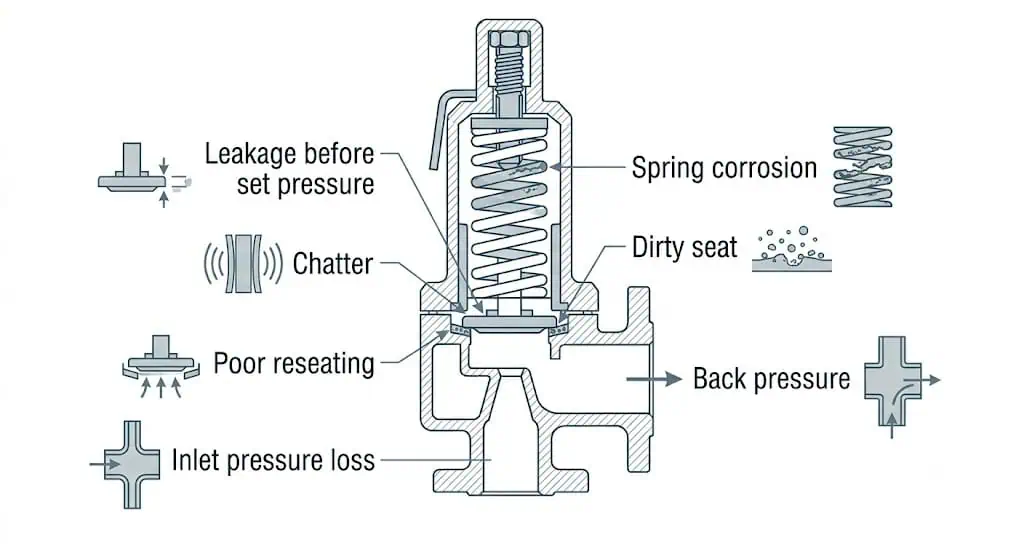
常见问题及其通常含义
| 故障现象 | 可能原因 | 维修前检查 |
|---|---|---|
| 低于整定压力泄漏 | 工作压力裕量不足、介质污染、密封面损伤、腐蚀、热变形或管道应力 | 压力趋势、密封面状态、对中情况、介质及校验记录 |
| 泄放时颤振 | 入口压力损失、积聚背压、选型过大、工艺不稳定或启闭压差不合适 | 泄放负荷、进出口水力条件、阀门规格及压力历史记录 |
| 开启后压力持续上升 | 排量不足、泄放工况选择错误、开启高度不够、出口堵塞或背压过大 | 所需负荷、认证排量、流体相态及泄放路径 |
| 回座不严密 | 阀座损伤、导向摩擦、介质污染、背压波动或回座特性不匹配 | 内部零件、出口压力、启闭压差与工艺压力衰减 |
| 检修后整定压力变化 | 弹簧选型错误、装配变更、阀座修研、未按工况修正或调整失控 | 零部件、校验基准、CDTP、密封件、铭牌与记录 |
| 在预期试验压力下不开启 | 弹簧选型错误、CDTP基准不正确、入口堵塞、导向摩擦、调整机构损伤或试验方法不匹配 | 铭牌、工况修正、试验介质、弹簧标识、入口通道与校验程序 |
| 开启后立即猛烈关闭 | 入口压损过大、泄放需求不足、选型过大、液体出口载荷或压力源不稳定 | 动态入口压力、所需泄放量、出口排放、阀瓣升程与管道布置 |
先记录拆卸前数据: Record leakage, set pressure, blowdown-ring position, spring identification, seat condition, deposits and installation observations before cleaning or adjustment. Otherwise the repair may remove the evidence needed to identify the real failure mechanism.
Do not tighten the adjusting screw to stop leakage. Raising the set pressure may hide the symptom while reducing the intended protection. Diagnose the seat, operating pressure, installation and calibration basis first.
Illustrative Case: Correct Bench Test, Unstable Installed Operation
虚构培训示例,并非现场数据
情况
- spring-loaded gas safety valve;
- set pressure verified on a test stand;
- valve connected to a longer outlet line and common header after a plant modification;
- rapid opening followed by repeated impact and vibration during relief.
Why the Spring Was Not the First Suspect
The test stand confirmed the opening setting under its test conditions. It did not reproduce the installed inlet loss, built-up back pressure, header pressure and mechanical response of the modified piping.
工程审核
- recalculate the required relief load and valve operating range;
- calculate inlet pressure loss and outlet back pressure;
- confirm the manufacturer’s allowable back-pressure basis;
- check whether the valve is oversized for the governing case;
- inspect the disc, seat and guide for chatter damage;
- review a balanced design or piping modification if justified.
示例要点: The spring initiates and controls the mechanical response, but installed stability belongs to the complete pressure-relief system.
Composite engineering example — not project design data
Correct Set Pressure, Insufficient Relieving Capacity
问题: A replacement valve opened at the specified set pressure, but protected-equipment pressure continued to rise during the governing event.
原因: The replacement matched the inlet connection and pressure class but used a smaller effective orifice. Its supported capacity was below the approved required relieving load.
纠正/预防: Reconfirm the relief scenario and compare required capacity with the identified valve’s certified or accepted capacity. Do not raise set pressure or infer capacity from connection size.
Composite engineering example — not project design data
High-Temperature Steam Caused Early Leakage and Set-Pressure Drift
问题: A steam valve required repeated seat work and showed inconsistent as-found settings after service.
原因: The spring environment, seat construction and trim materials had not been reviewed for the actual steam temperature and condensate condition. Thermal exposure and corrosion affected the spring, guide and seating surfaces.
纠正/预防: Verify the relieving temperature, bonnet arrangement, spring and trim material limits, drainage and any cold differential test pressure correction before calibration and return to service.
Composite engineering example — not project design data
Valve Reassembled After Repair Without Controlled Recalibration
问题: A repaired valve was returned to the line with a clean seat but later opened away from the required setting.
原因: Seat machining, replacement parts and spring compression changed the assembly, but no traceable final calibration, tagging or resealing was completed.
纠正/预防: Treat seat work, spring replacement, internal-part changes and blowdown-ring movement as controlled repair activities. Perform the required pressure-boundary, set-pressure and seat-tightness tests, record the final settings and restore the required seal and identification.
When Is a Spring-Loaded Safety Valve a Good Starting Point?
A spring-loaded design is often a practical starting point when:
- the service is steam, air, gas or a suitable liquid duty;
- the medium and deposits will not prevent reliable movement;
- the required capacity is available in the selected model;
- the back-pressure condition is within the design limits;
- the operating pressure provides suitable margin below set pressure;
- the plant can inspect, calibrate and repair the valve correctly;
- a direct mechanical device is preferred for lifecycle simplicity.
Extra review is required for:
- high or variable back pressure;
- dirty, polymerizing, crystallizing or sticky medium;
- very close operation to set pressure;
- two-phase or flashing flow;
- high temperature or cryogenic service;
- corrosive or toxic discharge;
- repeated cycling or severe vibration.
When a pilot-operated design enters the review: Consider a pilot-operated valve when supported manufacturer data shows an advantage for the operating margin, pressure level, required capacity or back-pressure condition. Do not assume it is automatically better for dirty, wet, polymerizing, crystallizing or particle-containing service; small pilot passages and sensing lines can become the controlling reliability risk.
使用 如何选择弹簧式安全阀 for detailed selection and 弹簧式安全阀与先导式安全阀 for the design comparison.
Adjustment, Testing and Maintenance Boundary
The working principle may appear simple, but the adjustment and repair controls are safety-critical.
Use the approved set-pressure and test procedure
Confirm the correct spring range and part identification
Apply documented service corrections or CDTP where required
Use traceable test instruments
Record the opening characteristic and final setting
Perform seat-tightness testing when specified
Seal and tag the final adjustment
Record blowdown-ring positions where applicable
Match the test report to the valve serial number
Reinspect installation after repeated chatter or piping modification
Return-to-Service After Repair or Internal Adjustment
- 保留拆卸前原始状态证据。
Record the valve identity, set pressure, leakage, ring positions, spring and internal condition before cleaning or machining. - Control parts and repair scope.
Verify the spring range, nozzle, disc, guide, spindle, bellows, gaskets and soft-seat materials against the approved configuration. - Reassemble to the manufacturer procedure.
Control alignment, clearances, torque and any blowdown-ring setting. - Repeat the required tests.
Perform pressure-boundary testing, set-pressure calibration, blowdown or functional checks and seat-tightness testing as required by the governing route. - 恢复可追溯性。
Match reports to the serial number, record replacement parts and final settings, then restore tags, locks and seals. - Verify the installation cause.
If the valve chattered, leaked after lift or suffered repeated damage, inspect inlet loss, back pressure, supports and drainage before reinstalling the same configuration.
Where the owner, jurisdiction or repair route requires National Board authorization, confirm that the repair organization holds the appropriate VR scope. VR authorization addresses controlled pressure-relief-valve repair; it does not replace the owner’s application, installation and operating review.
API 527 may be specified for seat-tightness testing, but it does not prove capacity, correct set-pressure selection or stable installation. See the API 527 密封性试验指南.
For inspection intervals, repair scope and return-to-service controls, use the 安全阀维护与检查指南.
RFQ and Replacement Data for a Spring-Loaded Safety Valve
| 数据组 | 需提供的信息 |
|---|---|
| 受保护设备 | Equipment type, tag, MAWP/design basis and applicable code. |
| 泄放工况 | Governing scenario, required capacity, units and calculation revision. |
| 压力数据 | Operating, set, relieving and downstream pressure conditions. |
| 介质 | Composition, gas/steam/liquid/two-phase state, cleanliness and hazards. |
| 温度 | Operating and relieving temperature, plus environmental limits. |
| 阀门结构 | Conventional, balanced bellows, full lift, bonnet and lifting-device requirements. |
| 连接方式 | Inlet/outlet size, rating, facing, thread, orientation and dimensional limits. |
| 材料 | Body, nozzle, disc, guide, spring, bellows, seat and seal requirements. |
| 安装 | Inlet line, outlet line, back pressure, drainage, support and discharge destination. |
| 文件资料 | Datasheet, capacity evidence, material certificates, calibration, pressure and leakage reports. |
| Operating behavior | Pressure pulsation, expected lifting frequency, operating margin, previous leakage or chatter history. |
| 替换选型证据 | Old nameplate, serial number, orifice, certified capacity, spring identification, repair history and as-found condition. |
| Testing and repair route | Test medium, CDTP basis, seat-tightness method, witness points, seal/tag requirements and VR route where applicable. |
Need a Spring-Loaded Safety Valve Review?
Send the protected equipment, medium, set pressure, required capacity, relieving temperature, back pressure, connections, materials and document requirements.
上传阀门资料 View Spring-Loaded Safety Valves 获取报价标准与权威参考资料
The applicable standard depends on the protected equipment, service, jurisdiction and project specification. A product-standard name does not replace the actual relief calculation or manufacturer-certified data.
| 参考 | 与本文主题的关联 | 链接 |
|---|---|---|
| ASME BPVC 第 XIII 卷 | Overpressure-protection rules and pressure-relief-device requirements under the ASME framework | ASME 官方页面 |
| ASME BPVC 第 I 卷 | Power-boiler construction and safety-valve context where boiler service is within scope | ASME BPVC overview |
| ASME BPVC 第 VIII 卷 第 1 分册 | Pressure-vessel construction and pressure-relief-device context where applicable | ASME 官方页面 |
| API 520 第I部分,第10版 | Sizing and selection of pressure-relieving devices within its refinery and process-industry scope | API 官方页面 |
| API 520 第II部分,第7版 | Installation and engineering analysis of pressure-relieving-device installations within its scope | API 官方页面 |
| API RP 576,第5版 | Inspection, testing and repair practices for pressure-relieving devices in applicable process-industry service | API inspection training page |
| API 527 | Seat-tightness testing for applicable pressure-relief valves; not sizing or installed-system validation | API official publication preview |
| ISO 4126-1:2013 | 安全阀的通用产品要求,不区分流体介质 | ISO 官方页面 |
| National Board VR / NBIC | Authorized pressure-relief-valve repair framework where adopted or required | National Board VR page |
标准边界: ASME equipment sections, Section XIII, API 520, API RP 576, API 527, ISO 4126 and NBIC/VR serve different purposes. Verify the adopted edition, jurisdiction, legal manufacturer or repair organization, model, marking, capacity certificate and repair scope. A generic standards list is not evidence that the supplied valve is acceptable for the actual application.
FAQ About How Spring-Loaded Safety Valves Work
弹簧式安全阀是如何工作的?
压缩弹簧将阀瓣压紧在喷嘴阀座上。入口压力升高时,开启力随之增大。当达到规定的整定压力条件时,阀瓣开始升起,流体力促使阀瓣进一步开启,阀门泄放流体;压力下降后,弹簧使阀瓣回座。
弹簧式安全阀是自动的吗?
是的。其基本安全动作由过程压力自行驱动,无需外部电源或执行机构。
阀门是否在整定压力下完全开启?
不一定。整定压力表示规定的开启特性。要达到额定或认证排量所对应的开启高度,可能需要额外的压力升高和流体力。
弹簧式安全阀起跳的原因是什么?
在全启式设计中,初始升程会暴露对流动敏感的结构,如反冲腔或阀瓣座区域。由此产生的流体作用力可迅速增大升程。具体动作方式因设计而异。
弹簧式安全阀中的启闭压差是什么?
启闭压差是整定压力与回座压力之间的差值,它描述了系统压力在阀门关闭前下降的程度。
为什么阀门在整定压力之前会发生泄漏?
可能的原因包括操作余量不足、密封面污染、密封面损坏、腐蚀、热变形、管道应力或维修不当。
弹簧式安全阀为何会发生频跳?
常见原因包括入口压力损失过大、积聚背压、阀门选型过大、工艺压力不稳定以及阀门或管道条件不适用。
整定压力能否证明安全阀具有足够的排量?
序号 整定压力确认开启特性。所需泄放量必须与制造商在所述泄放工况下经认证或记录的排量进行比较。
常规弹簧式安全阀与平衡式弹簧安全阀有什么区别?
常规安全阀可能受到作用于内部面积的出口压力的影响。平衡波纹管设计采用波纹管,在制造商规定的限值内减小该影响。
整定调节螺钉或启闭压差调节环能否在现场进行更换?
不得随意更改。调整应遵循工程审批、制造商程序、受控校准、最终铅封、挂牌及文档记录。
选择弹簧式安全阀需要提供哪些信息?
请提供被保护设备、泄放工况、MAWP、工作压力与整定压力、所需泄放量、介质及相态、泄放温度、背压、连接方式、材质及所需证书。
整定压力与超压有什么区别?
整定压力是指安全阀开始开启动作的规定压力。超压是指安全阀泄放并达到排放所需阀瓣升程时,压力超过整定压力的增量。
背压如何影响弹簧式安全阀?
背压会改变净力平衡、阀瓣升程、有效排量、启闭压差和回座。常规安全阀通常更敏感;波纹管平衡式设计在制造商限定范围内可减小指定力的影响。
为什么认证泄放量比连接尺寸更重要?
连接尺寸仅用于确定机械接口。认证排量或认可排量取决于阀门结构、有效孔径、压力、流体及试验基准,必须与所需泄放量进行对比。
弹簧式安全阀能否用于脏污或黏稠介质?
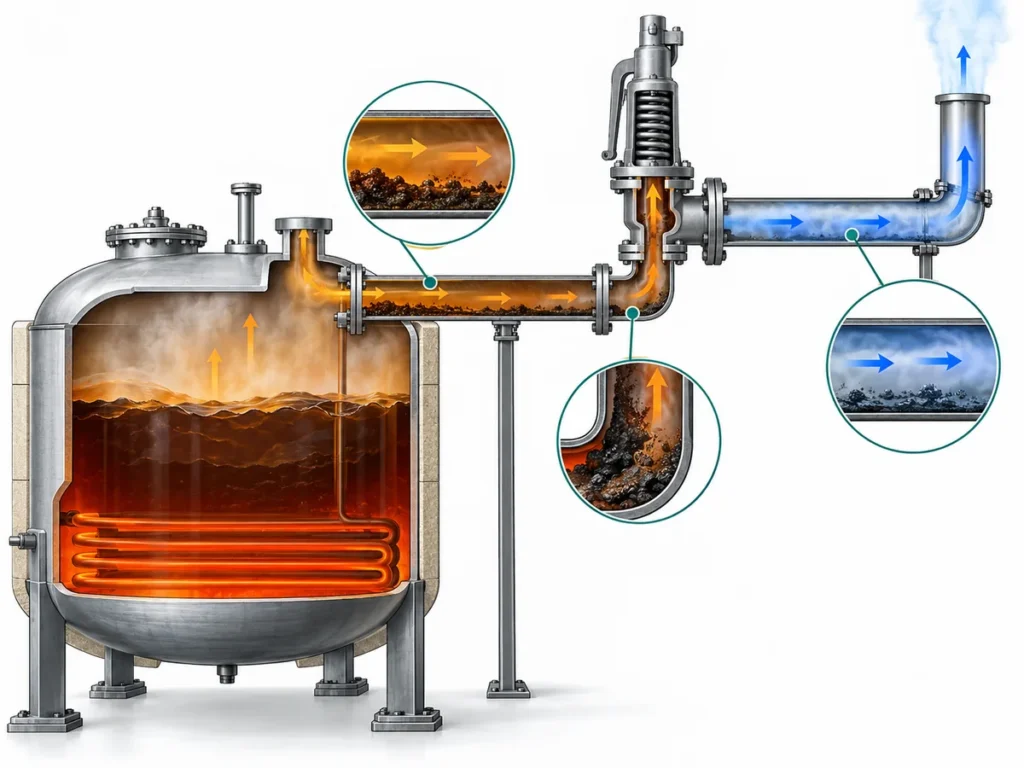
有时,沉积物、聚合物、结晶、焦炭、固体或黏性物料会污染密封面、限制入口并增大导向摩擦。使用与维护策略需经制造商明确评审。
何时应考虑选用先导式安全阀?
当有数据支持其在工作裕度、压力、排量或背压方面具有优势时,可考虑采用先导式结构。先导通道、引压管、密封件、排放口及使用清洁度也必须满足要求。
弹簧式安全阀应多久检查或重新整定一次?
不存在通用的校验周期。应根据适用规范与业主管理程序、工况严苛程度、运行裕量、腐蚀或结垢风险、阀瓣升程历史、以往校验实测结果以及制造商说明确定。
弹簧式安全阀检修后需要检查哪些项目?
核对零件与弹簧标识、内部对中情况、启闭压差环设定、压力边界完整性、整定压力、所需密封性、序列号可追溯性、最终标牌与铅封,以及此前任何损坏的安装原因。
Understand the Working Principle—Then Verify the Real Duty
Send the relief calculation, medium, set pressure, required capacity, relieving temperature, back pressure and piping information for a spring-loaded safety valve review.
Upload Engineering Data Request a Spring-Loaded Safety Valve Quote