Compare inbreathing and outbreathing capacity for tank vents, what drives each duty, and what to verify in supplier data before reviewing a candidate.

Inbreathing and outbreathing are two separate tank-vent capacity duties. Inbreathing is inward flow used to address a vacuum-side condition; outbreathing is outward flow used to address a pressure-side condition. For vent capacity review, each required duty should be established independently and checked against the corresponding manufacturer performance data.
That distinction matters even when one pressure/vacuum vent performs both functions. A single physical vent does not turn the tank’s inward and outward flow requirements into one interchangeable capacity number.
Inbreathing vs Outbreathing: What Changes in the Capacity Requirement?
The practical difference is the direction of the required flow and the tank
condition being controlled.
| Capacity question | Inbreathing | Outbreathing |
|---|---|---|
| Flow direction | Into the tank | Out of the tank |
| Tank tendency | Falling internal pressure | Rising internal pressure |
| Vent function to verify | Vacuum side | Pressure side |
| Project requirement | Required inward flow | Required outward flow |
| Candidate evidence | Vacuum-side capacity data | Pressure-side capacity data |
A combined pressure/vacuum vent may provide both functions, but its two sides
still need to be checked against different project duties. Industry application
worksheets reflect this separation: they ask for total inbreathing and total
outbreathing requirements independently rather than requesting one generic
vent-capacity value.
Protectoseal’s conservation breather vent worksheet
is one example of this engineering practice.
This also separates required capacity from
published or rated capacity. Required capacity originates with
the tank and its operating cases. Published capacity describes how a candidate
device performs under stated conditions. The capacity-review task is to determine
whether the second adequately covers the first.
In practical terms:
required tank duty ≠ nominal connection size ≠ manufacturer capacity at
stated conditions.
For broader system context, see ZOBAI’s
storage tank pressure and vacuum protection
Informazioni sull'applicazione.
What Determines the Inbreathing Capacity a Tank Needs?
Inbreathing is required when the vapor-space pressure tends to fall and gas must
enter the tank to prevent an excessive vacuum condition.
One important operating cause is liquid withdrawal. As liquid
leaves, additional vapor-space volume becomes available and the tank’s
gas-management or venting system must accommodate that change. Atmospheric
cooling can create a second inward-flow requirement as vapor contracts or,
where applicable, condenses.
Within its specific U.S. flammable-liquid tank scope,
OSHA 29 CFR 1910.106
also identifies filling or emptying and atmospheric temperature changes as
normal-venting causes.
A project-side inbreathing review commonly needs the maximum relevant withdrawal
condition, the applicable thermal/cooling basis, the tank’s vacuum design or
allowable basis, the proposed vacuum setting, and the way replacement gas enters
the tank.
That last point can change the system being reviewed. In some arrangements,
atmospheric air enters through a vacuum-relief function. In a blanketed system,
replacement gas may instead be supplied through a blanketing arrangement. The
existence of blanketing should not be treated as proof that the vacuum-side
protection question has disappeared.
Supplier application documents commonly request tank design vacuum, vacuum
setting, emptying rate, thermal inbreathing and total inbreathing as separate
fields. Those inputs help establish the duty; they do not create a universal
calculation formula.
For product-level questions specifically concerning vacuum protection, use the
dedicated
valvole di sicurezza per vuoto
owner rather than treating this comparison article as a product catalogue.
What Determines the Outbreathing Capacity a Tank Needs?
Outbreathing addresses the opposite pressure tendency, but it is not simply an
inbreathing calculation with the sign reversed.
When liquid enters a tank, it displaces available vapor-space volume. Gas or
vapor must leave as required by the operating condition. Warming of the tank
and its contents can create another outward-flow contribution through vapor
expansion and, where applicable under the selected method, additional vapor
generation.
That normally requires the relevant filling condition, thermal basis, pressure
design or allowable limit, pressure-side vent setting, and any fluid or process
information required by the project’s chosen calculation method.
A pressure setting should not be confused with capacity. The setting describes
a pressure condition associated with operation of the device; it does not state
how much flow the tank requires or how much a particular vent can pass.
For the same reason, maximum filling rate alone is not automatically a complete
outbreathing specification. The applicable normal outward-flow sources must first
be identified and combined according to the governing engineering basis.
Protectoseal’s application worksheet separates filling-related venting, thermal
outbreathing, additional outbreathing and total outbreathing. Emerson’s
pressure/vacuum application data likewise separates filling and emptying,
pressure and vacuum settings, backpressure, and the two directional capacities.
Vedi la
Protectoseal application worksheet
e
Emerson Enardo tank-management catalog
.
That still leaves an important boundary:
not every outward-flow relief case is normal outbreathing.
Normal Venting vs Emergency Venting: Why the Duties Must Stay Separate
Normal venting and emergency venting are related to the same tank, but they are
not the same engineering duty.
ISO 28300
covers both normal and emergency vapor venting for atmospheric and low-pressure
storage tanks. The separation itself is important: completion of a normal
inbreathing/outbreathing check should not be presented as evidence that a
separate emergency case has also been resolved.
Commercial tank-protection practice reflects the same distinction: emergency
pressure vents may be used to provide emergency capacity beyond the operating
vent in relevant applications. This is a duty boundary, not a rule that every
installation must use two separate physical devices.
Check the standard edition before using sizing tables or formulas
Edition-sensitive information deserves special care. API’s current Standards
Plan lists
Standard 2000
as Edition 8 in 2026. ISO continues to list ISO 28300:2008 as its current
published edition while a replacement is under development.
A project that relies on API 2000 or ISO 28300 should therefore confirm the
edition adopted by that project before reusing formulas, factors or tables from
older online guides.
How to Compare Required Capacity with a Tank Vent’s Published Rating
Once required inbreathing and outbreathing duties have been established,
candidate capacity screening becomes a direction-by-direction
evidence check.
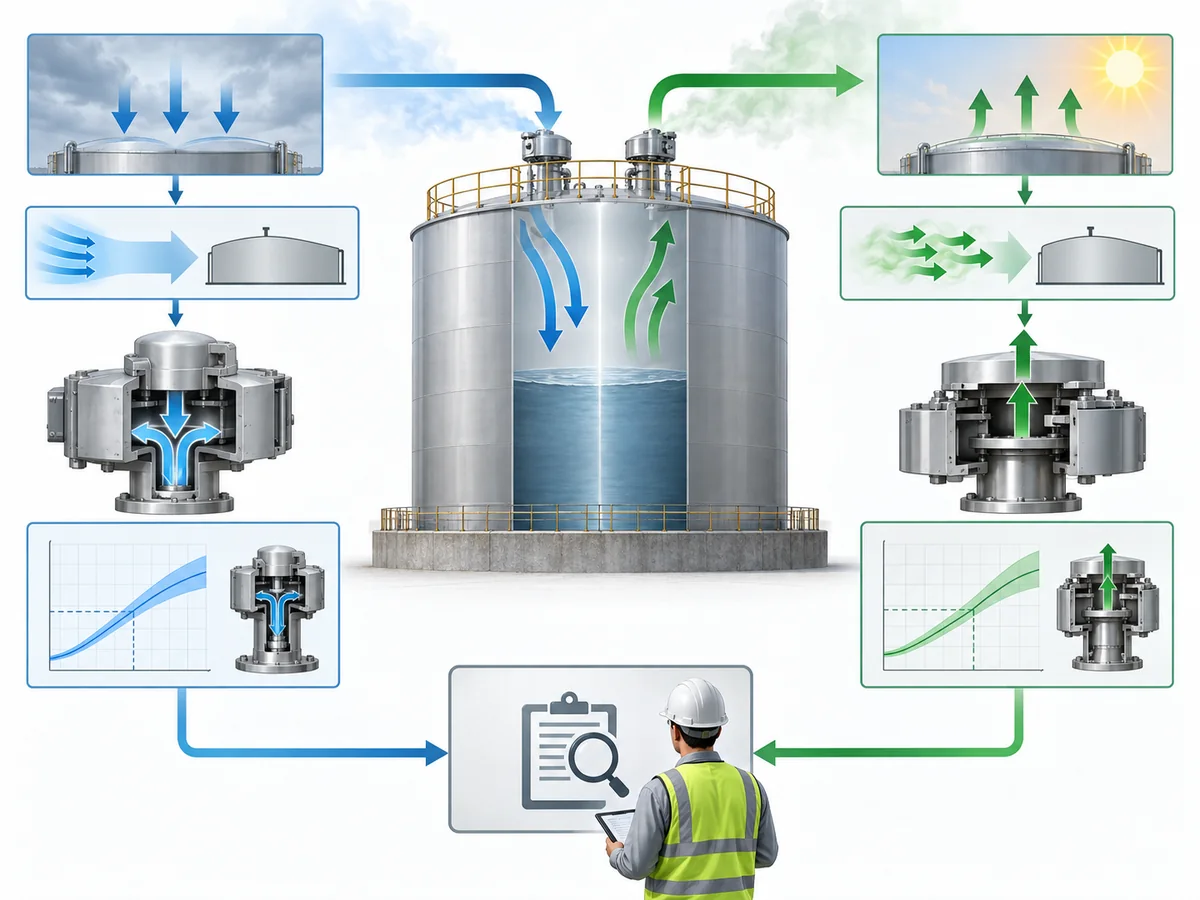
The question is not whether a catalogue contains a flow number that looks large
enough. The question is whether the published performance corresponds to the
correct direction, pressure or vacuum condition, reference basis and device
configurazione.
| Elemento di verifica | Inbreathing check | Outbreathing check | Se non risolto |
|---|---|---|---|
| Required project duty | Required inward flow | Required outward flow | Keep the candidate unconfirmed |
| Manufacturer performance | Vacuum-side data | Pressure-side data | Request the missing data |
| Setting | Impostazione vuoto | Pressure setting | Clarify the comparison basis |
| Units / reference basis | Confirm compatibility | Confirm compatibility | Reconcile before comparing |
| Exact configuration | Confermare | Confermare | Hold the capacity review |
| Installed flow path | Check if relevant | Check if relevant | Revisione ingegneristica |
Match the correct direction first
Pressure-side performance does not establish vacuum-side performance, and vice
versa. Published vent literature may use separate flow curves for the two
directions. Protectoseal, for example, notes that vacuum flow is represented on
a separate curve in its
weight-loaded vent flow guidance
.
Compare capacity at a meaningful operating condition
Flow performance is related to the pressure or vacuum condition under which the
vent is flowing. A set point by itself is therefore not a capacity value.
The capacity review needs performance data that can be related to the applicable
project condition, not merely confirmation that the proposed set pressure or set
vacuum exists.
Normalize the basis before comparing numbers
A required-duty value and a supplier capacity value are useful only if their
units and reference conditions can be reconciled.
If the two values use different reference bases, obtain the necessary rating
conditions or conversion basis before treating the comparison as valid.
Do not select from nominal size alone
Connection size is relevant to equipment configuration, but it does not by
itself establish relieving capacity. Flow performance can depend on direction,
vent design, setting or flowing condition and configuration.
Manufacturer flow data—not the DN or NPS designation by itself—provide the
evidence needed for the capacity comparison.
Include the installed flow path when it changes the comparison
A bare-vent capacity curve does not automatically describe every installed
system. If the arrangement adds piping, a closed discharge path, a flame
arrester or another significant restriction, review its effect where applicable
rather than assigning an unsupported generic derating factor.
The correct outcome when essential evidence is missing is not to guess.
A candidate should remain unconfirmed for capacity until the
required duty and applicable manufacturer performance can be compared on a
defensible basis. Capacity confirmation alone should not be read as proof of
complete product suitability.
What to Include in a Tank Vent RFQ for Both Flow Directions
A technically useful tank-vent RFQ should give the supplier enough information
to review both duties without inferring critical project conditions.
“Quote one DN100 tank vent” does not establish whether the proposed device can
handle either direction.
Tank and project basis
Depending on the project and applicable method, prepare the relevant:
- tank service and stored medium;
- tank capacity or geometry where needed;
- pressure and vacuum design or allowable limits;
- operating and design temperature information needed for the review;
- applicable project specification or venting standard;
- blanketing or vapor-management arrangement.
Inbreathing duty
Keep the vacuum-side data explicit:
- required total inbreathing capacity;
- maximum withdrawal or emptying condition;
- applicable thermal inbreathing basis;
- vacuum setting;
- replacement-gas arrangement where relevant.
Outbreathing duty
Keep the pressure-side requirement separate:
- required total outbreathing capacity;
- maximum filling condition;
- applicable thermal outbreathing basis;
- pressure setting;
- any additional normal outward-flow source established by the project basis.
Installation configuration
Where relevant, also identify:
- vent-to-atmosphere versus pipe-away arrangement;
- inlet and outlet configuration;
- expected backpressure;
- flame or detonation arrester;
- other significant restrictions in the flow path.
These fields are not presented as a universal regulatory checklist. They reflect
the types of engineering data that established vent manufacturers request when
matching pressure/vacuum equipment to a tank duty.
Evidence to request from the supplier
The return package should allow the engineer to review the proposed
configuration rather than rely on a model number alone. Relevant evidence may
includere:
- the exact candidate configuration;
- vacuum-side capacity data;
- pressure-side capacity data;
- applicable pressure and vacuum settings;
- flow curves or capacity tables and their rating basis;
- units and reference conditions;
- installation or configuration limitations that affect the comparison.