Узнайте, как проверять фильтры, импульсные трубки и уплотнения предохранительных клапанов с пилотным управлением, а затем сопоставлять функциональные испытания с доказательствами, необходимыми перед возвратом в эксплуатацию.

Предохранительный клапан с пилотным управлением не следует обслуживать так, как будто пилот —
это просто вспомогательный элемент, прикреплённый к главному клапану. Пилот, фильтры,
импульсные или питающие линии, трубки управления, уплотнения и главный клапан образуют единую систему
регулирования давления. Загрязнение, утечка, засорение или неправильно восстановленный путь
давления могут иметь значение, даже если сам корпус главного клапана выглядит исправным.
Вторая ошибка при обслуживании — считать любую “проверку” после обслуживания равноценной.
Проверка давления настройки пилота, проверка герметичности седла, проверка сборки на утечки,
функциональная проверка собранного клапана и проверка пропускной способности отвечают на разные
вопросы. Результат PASS полезен только в рамках той проверки, в которой он получен.
Поэтому в данной статье соблюдаются два правила:
- Проверяйте фактический пилотный/управляющий контур, установленный на клапане.
- Выбирайте испытание в соответствии с доказательствами, которые вам нужны перед возвратом в эксплуатацию.
В данной статье в качестве рабочего термина используется предохранительный клапан с пилотным управлением как его рабочий термин.
В документации производителя и стандартах также может использоваться
предохранительный клапан с пилотным управлением, POSV или POSRV.
ISO 4126-4 — это стандарт ISO на продукцию, специально предназначенный для предохранительных клапанов с пилотным управлением;
ISO указывает, что это стандарт на продукцию, а не стандарт на применение. Поэтому он
не заменяет руководство по техническому обслуживанию конкретной модели, процедуру владельца или
требования надзорных органов к возврату в эксплуатацию. См.
ISO 4126-4.
Если сама последовательность операций еще не ясна, см.
как работает предохранительный клапан с пилотным управлением.
Перед техническим обслуживанием убедитесь в конфигурации клапана и его фактическом состоянии
Перед очисткой фильтра, отсоединением трубопроводов или заменой уплотнений,
точно установите, с каким главным клапаном, пилотом и схемой импульсной линии вы работаете.
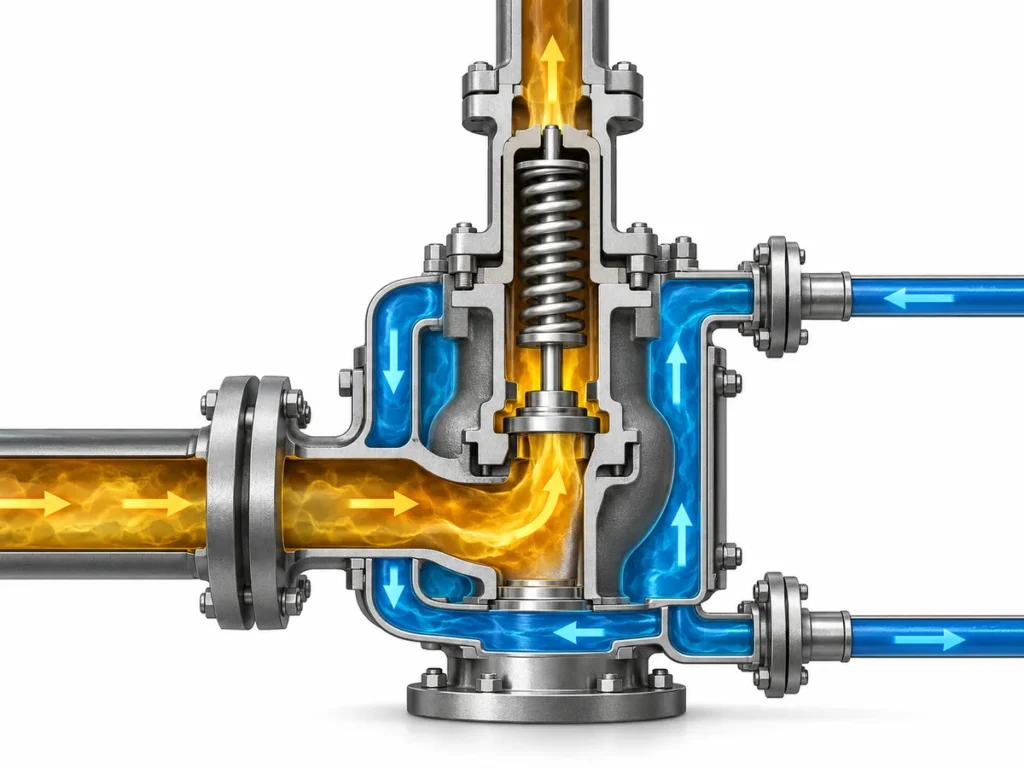
Конструкции с пилотным управлением различаются тем, как давление на входе подводится к пилоту, является ли импульсная линия
встроенной или выносной, как направляется давление в надклапанной полости/управляющее давление, где установлены фильтры
и какие компоненты обслуживаются или испытываются как отдельные узлы.
Этап технического обслуживания, действительный для одной схемы, не следует
автоматически переносить на другую. Руководство Anderson Greenwood Series 727, например,
включает схемы со встроенным импульсом, выносным импульсом и демпфером и содержит конкретные
указания для таких конфигураций. Руководство Baker Hughes Consolidated 2900-40
также различает варианты дистанционного отбора и отбора с помощью измерительного кольца. Эти производители
примеры подтверждают общее правило технического обслуживания: определить точный путь давления
перед его вскрытием или восстановлением. См.
инструкции по техническому обслуживанию серии Anderson Greenwood 727
и
руководство по POSRV Baker Hughes Consolidated 2900-40.
Начните с подтверждения:
- идентификация главного клапана и пилота, включая информацию о модели/серийном номере, необходимую для получения правильной процедуры и запасных частей;
- применимые инструкции производителя по техническому обслуживанию и процедура владельца;
- схема отбора, включая дистанционный отбор, демпферы или соединения для полевых испытаний, где они применяются;
- технологическая среда и условия эксплуатации, влияющие на загрязнение, коррозию, совместимость с эластомерами и отложения;
- причина снятия, осмотра или вскрытия клапана;
- состояние на момент обнаружения до очистки или разборки, которые уничтожают доказательства; и
- соответствующие записи предыдущих испытаний или технического обслуживания, если они имеются.
Работы на системе, находящейся под давлением, или на пилотной системе должны выполняться в соответствии с действующими
процедуры изоляции и сброса давления на установке и у производителя. Серия 727
например, предупреждает, что перед клапаном система должна быть сброшена под давлением
демонтаж или разборка и примечания о том, что жидкость может оставаться запертой в полости купола
предохранительного клапана с пилотным управлением. Это инструкция для конкретного изделия, а не
универсальная последовательность отключения. План отключения на объекте должен соответствовать фактическому
монтажу и опасностям.
Сохраните состояние на момент поступления до очистки удаляет полезные
свидетельства. Загрязненный фильтр, продукты коррозии в штуцере датчика, утечка вокруг
a pilot connection, an incorrectly connected line or an unexpected deposit can
explain why the assembly behaved abnormally. API RP 576 covers inspection and
repair practices for pressure-relieving devices, including pilot-operated PRVs,
and its current API catalog entry emphasizes inspection/repair practices intended
to support proper device performance. See
API RP 576 in the API refining catalog.
Для более широкой программы обслуживания клапана в целом, планирования inspections и
контекста состояния на момент поступления и после обслуживания см.
Руководство по техническому обслуживанию и инспекции предохранительных клапанов.
The present article stays focused on the pilot/control path and the evidence
needed after work on filters, tubing, seals and functional tests.
Решение по обслуживанию: Не диагностируйте и не заменяйте компонент
до тех пор, пока конфигурация вокруг него не будет известна достаточно хорошо, чтобы объяснить, какое давление
компонент должен принимать, удерживать, сбрасывать или передавать.
Проверяйте фильтры как часть пилотного контура управления, а не как отдельный элемент
В конструкциях клапанов с пилотным управлением, где в линии отбора импульса или питания пилота используется фильтр,
состояние фильтра может сообщить больше, чем просто необходимость
обслуживания самого фильтра. Фильтр является частью пути давления, питающего пилотную систему.
Если этот путь ограничен, проблема не в “загрязнённом оборудовании” как таковом;
она в том, получает ли пилот сигнал давления и реагирует ли на него так,
как требует конструкция.
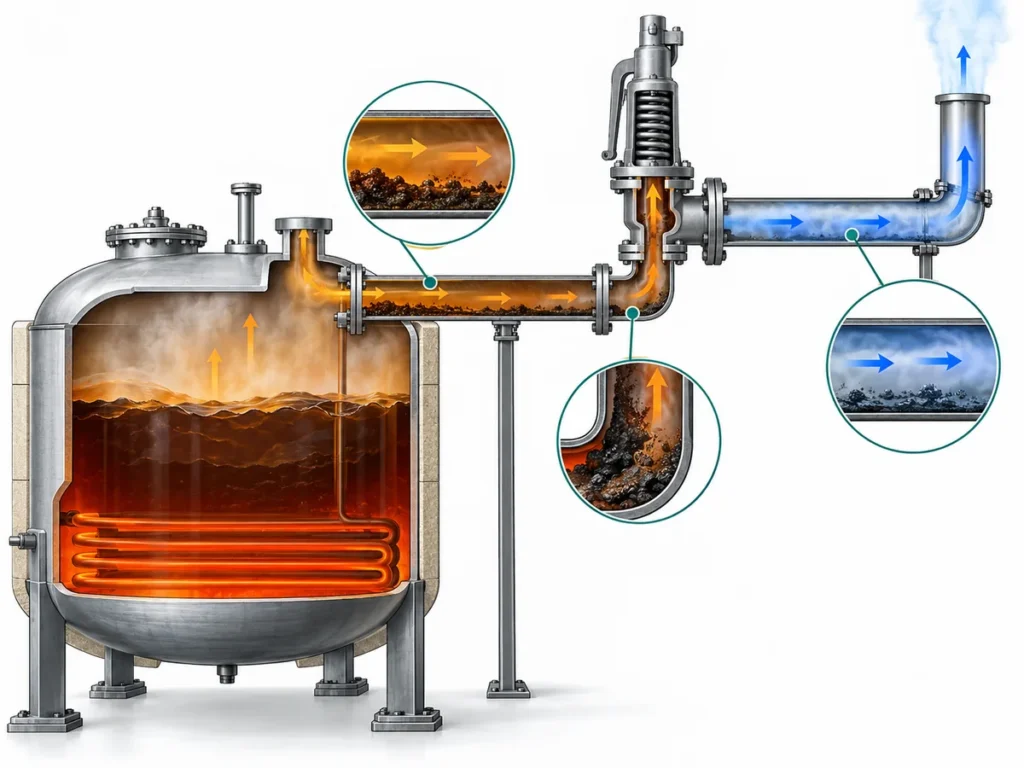
Загрязненный фильтр не доказывает, что пилот заблокирован.
Это служит свидетельством того, что тот же загрязнитель мог попасть в смежные
каналы, фитинги или компоненты пилота. Поэтому при техническом обслуживании следует
следовать пути распространения загрязнения, а не ограничиваться первой загрязнённой деталью.
Инструкции производителя также показывают, почему не существует универсального правила по фильтрам.
В руководстве на Anderson Greenwood серии 727 фильтрующий узел главного клапана
снимается для очистки и осмотра и может быть использован повторно, если он не повреждён,
при этом связанное уплотнение фильтрующего канала отбрасывается и заменяется. В других семействах клапанов
могут применяться иные схемы фильтрации и правила замены. Правильное
действие — то, которое указано для конкретной конфигурации клапана, а не “всегда использовать повторно”
или “всегда заменять”.”
| Результат осмотра фильтра | Что следует изменить |
|---|---|
| Чистый и без повреждений |
Продолжите остальной требуемый осмотр пилотного тракта. Чистый фильтр не доказывает, что импульсные каналы, фитинги, седла пилота или управляющие соединения свободны от засорения или утечки. |
| Значительное загрязнение |
Осмотрите подключённый управляющий тракт на предмет связанного загрязнения или ограничить и по возможности задокументировать тип загрязнителя перед очисткой. |
| Повреждение или несоответствие требованиям применимой процедуры |
Соблюдайте требование замены для конкретной модели и проверьте правильность заменяемой детали. |
| Повторяющееся сильное загрязнение |
Проанализируйте, почему загрязнение продолжает поступать в пилотную систему, вместо того чтобы рассматривать каждое обслуживание фильтра как отдельное событие. |
Maintenance frequency has the same boundary. API RP 576 is an inspection-practice
reference, but neither that scope nor the manufacturer manuals reviewed here
support one universal filter-cleaning interval for every pilot-operated valve.
Frequency should be based on the applicable procedure, service severity, contamination
history and owner inspection program.
Filter condition can therefore be diagnostic evidence about the environment
seen by the pilot system, not merely a housekeeping item.
Проверка импульсных и управляющих трубок на засорение, утечки и ошибки при повторной сборке
Not every small tube around a pilot-operated safety valve has the same purpose.
Depending on the design, documentation may distinguish a pressure-sensing line,
pilot-supply connection, dome/control line, remote-sensing connection, discharge
connection and field-test connection. Before loosening a fitting, identify what
pressure that line is supposed to communicate and to which component.
Manufacturer maintenance instructions reinforce this point. The Series 727 manual
calls for inspection of remote-sense and snubber fittings for blockage in applicable
configurations. Baker Hughes’ 2900-40 manual shows that remote sensing is its standard
pilot pressure connection while a sensing-ring option changes the pickup location.
These are design-specific arrangements, but together they show why “the tubing looks
similar” is not enough to establish correct routing.
Поэтому проблемы с трубками следует разделять по виду отказа.
| Поиск | Почему это важно | Проверка при техническом обслуживании |
|---|---|---|
| Засорение или блокировка |
The intended pressure signal or pilot-supply path may be delayed, attenuated or prevented from reaching the intended component. |
Inspect the affected passage, fitting, snubber/filter and connected pilot components using the applicable procedure. |
| Утечка |
Pressure integrity in the sensing, dome or control path may be lost. The effect depends on where the leak is located in the circuit. |
Identify the leaking joint/component and perform the specified post-assembly leakage check after correction. |
| Перегиб, коррозия или механическое повреждение |
The flow area or mechanical integrity may no longer match the intended конфигурацией. |
Repair or replace with the specified material, size and routing from approved documentation. |
| Ослабленное или неправильное повторное подключение | The valve may no longer sense, load or vent pressure through the intended path. |
Compare routing and connection points with the correct valve/manifold documentation, then leak-check the restored connection as required. |
| Неподтверждённое изменение линии дистанционного отбора давления | The sensing point or line characteristics may no longer match the engineered configuration. |
Return the arrangement for engineering/manufacturer review instead of нормализация модификации при техническом обслуживании. |
Различие между ограничение и утечка
важно, поскольку механизмы отказа различаются. Ограниченный путь может нарушить
передачу давления. Утечка изменяет целостность по давлению. Поэтому один и тот же симптом на
клапане может иметь разные причины, и доказательства технического обслуживания, необходимые для
закрытия работы, не являются взаимозаменяемыми.
Дистанционное измерение требует особой дисциплины. Не сокращайте, не изменяйте размеры, не меняйте трассировку и не
не подсоединяйте импульсную линию заново только потому, что новое расположение физически подходит.
Точка отбора давления, трассировка линии, фитинги и любое устройство фильтрации/демпфирования являются частью
утверждённого пути давления.
Правило технического обслуживания: Восстановите документально подтверждённый путь давления, затем проверьте
соответствующие соединения на отсутствие засорения и утечек. Если утверждённая трассировка
не может быть восстановлена, задержите клапан для рассмотрения инженерной службой или производителем.
For maintenance closeout, “the tubing looks fine” is weaker evidence than confirming
that the correct pressure path has been restored and checked for the restriction and
leakage modes relevant to the applicable procedure.
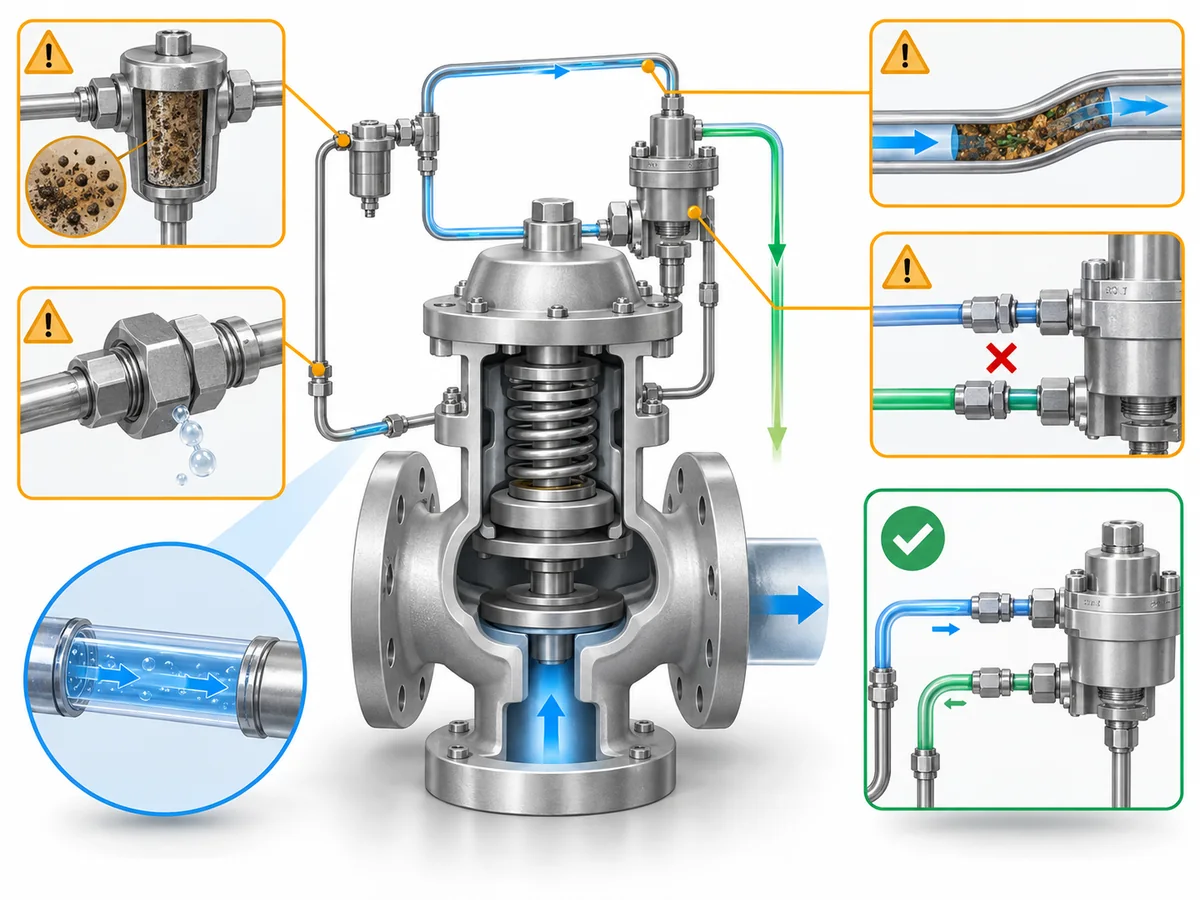
Оценка уплотнений по месту установки, состоянию и совместимости со средой
A seal decision should not begin and end with, “Does this O-ring look damaged?”
Pilot-operated valves contain seals in different functions: some retain dome or
pilot pressure, some seal the main valve, and some seal fittings or filter/manifold
joints. The consequence of damage, wrong material or wrong reuse decision depends
on where the seal sits in the pressure-control system.
Manufacturer repair instructions also do not treat every sealing component the same
way. The Anderson Greenwood Series 727 manual is a useful example: it allows the
filter assembly to be reused if undamaged, while it specifically tells the technician
to discard certain seals and other listed parts during the applicable repair steps.
Its repair kits are selected by valve model/serial information. That is exactly why a
generic “reuse if it looks good” rule is not defensible.
Two shortcuts should therefore be avoided:
Повторно использовать каждое уплотнение, которое ещё выглядит исправным.
и
Заменяйте каждое уплотнение на каждом предохранительном клапане с пилотным управлением при каждом вскрытии клапана.
Вместо этого разделите четыре вопроса.
1. Какое это уплотнение?
Identify the location and function of the part. A pilot seat/seal, main-valve sealing
element, dome seal, filter-port seal and tubing/connection seal should not inherit the
same maintenance rule simply because each is called a “seal.”
2. Соответствуют ли деталь и материал?
Pilot-operated valve families can use different soft goods or metallic sealing
components for different pressure, temperature and process conditions. A replacement
should match the approved bill of materials or repair kit for the exact configuration,
not merely the apparent dimensions of the removed part.
Для более подробного выбора материалов см.
руководство по выбору материалов для предохранительных клапанов.
3. Допустимо ли его состояние?
Inspect for the damage modes addressed by the applicable manufacturer procedure:
cuts, extrusion, compression damage, wear, corrosion or deposit-related damage where
relevant. Appearance can identify physical deterioration, but it cannot prove the
material grade, prior chemical attack, or compatibility with the process.
4. Допускает ли соответствующая процедура повторное использование?
This is separate from appearance. If the model-specific procedure requires
replacement during the applicable service operation, an apparently intact part is
not evidence for reuse. Conversely, a part the manufacturer permits to be cleaned,
inspected and reused should not be subjected to an invented universal replacement rule.
Последовательность принятия решения по уплотнению:
identity → function → approved material/configuration → physical condition →
permitted reuse/replacement → post-assembly leakage/functional verification.
Соответствие функционального испытания поставленной задаче
A post-maintenance test is only as broad as its test scope. Instead of asking only,
“Did the valve pass?” ask:
Which test was performed, which part of the pilot/main-valve system did it
exercise, what acceptance basis was used, and what remains untested?
The standards have different roles. The current API catalog lists
API RP 576
as an inspection and repair practice covering pilot-operated PRVs;
API 527
addresses seat tightness, with the current API digital catalog listing API 527,
5th Edition, as the seat-tightness standard; and
API’s digital catalog
confirms the current API 527 entry.
ASME PTC 25-2023
is a performance test code for pressure relief devices and includes flow-capacity,
in-service and bench testing. These documents do not make a pilot set-pressure
check, seat-leakage test, assembly function test and capacity test interchangeable.
Manufacturer procedures make the same distinction at the equipment level. The
Anderson Greenwood Series 727 manual separates valve-assembly leak tests, pilot
set-pressure testing, and pilot/manifold internal leak testing. Its field test
procedure can verify pilot set pressure while the main valve does not cycle during
that procedure. That is strong evidence for a narrow but important maintenance rule:
a valid pilot test proves the pilot variable it actually exercises; it does
not automatically prove full main-valve operation or rated flow capacity.
| Проверка или испытание | Что может подтвердить результат | Что он не доказывает автоматически |
|---|---|---|
| Visual / configuration inspection | Visible condition, correct routing, part identity and assembly observations within the inspection scope | Set pressure, seat tightness, pilot response under pressure or rated flow capacity |
| Проверка пилота/настроечного давления | Pilot actuation or set-pressure behavior under the approved test method | Main-valve cycle, seat tightness, rated flow capacity or installed-system acceptance unless the procedure also tests those items |
| Seat-tightness / leakage test | Leakage performance for the seat or connections covered by the applicable test basis | Complete pilot/main-valve functional performance or flow capacity |
| Функциональное испытание в сборе | Defined operation/integrity of the assembled pilot and main valve under that procedure | Certified flow capacity unless capacity is actually tested under the required basis |
| Испытание пропускной способности | Flow performance under the defined test conditions | Correct field sensing-line routing, installation condition or every maintenance detail not represented in the test setup |
Проверка настройки пилотного клапана или функционирования пилота
On applicable designs, a field-test connection can allow pilot or set-pressure
behavior to be checked without reproducing every installed operating condition.
The Series 727 manual provides a field-test arrangement in which the pilot can be
pressurized and its pop/set behavior observed while the main valve does not cycle
during that procedure. That distinction should be preserved in the maintenance record.
A useful record is therefore not simply “Pilot test: PASS.” It should identify the
valve/pilot, the test method, the set-pressure basis being checked, the medium and
condition required by the procedure, and the function that was не exercised.
Do not import the Series 727 test pressures, warm-up periods or tolerances into another
valve family. Those values are model/procedure-specific. Use the correct manual and
project acceptance basis for the valve being maintained.
Испытания на герметичность затвора и утечку
Seat-tightness testing answers a leakage question. API Standard 527 is specifically
titled Герметичность седла предохранительных клапанов, and API’s current catalog
lists it for pressure-relief-valve seat tightness. That makes it appropriate evidence
for a seat-leakage conclusion within its scope—not for the broader statement that the
pilot/main-valve control system has been functionally verified.
Manufacturer procedures may also require connection or internal leak checks that are
outside the main-seat leakage question. The Series 727 manual, for example, separates
external-joint leakage, pilot/manifold internal seat tightness and other assembly checks.
The maintenance record should say which leakage path was tested.
Функциональная проверка клапана в сборе
A complete-assembly functional test is broader than a pilot-only set-pressure check
because it can exercise the interaction between the pilot and main valve under the
approved procedure. It is still bounded by the setup. If the procedure does not measure
rated flow capacity, the result should not be reported as capacity certification.
Baker Hughes’ Consolidated 2900-40 manual contains a distinct functional-testing
section and model-specific instructions for sensing/filter options. That is another
reminder that the exact functional test depends on the valve configuration. Use the
procedure for the actual assembly rather than creating a generic test sequence from
another manufacturer’s manual.
Правило доказательности: A complete-assembly functional test proves the
functions included in that approved procedure—not every characteristic of the
installed relief system.
What a Field or Functional Test Does Not Prove
The largest post-maintenance interpretation error is to expand a narrow PASS result
beyond the question that was tested.
- Pilot set-pressure verification ≠ rated capacity evidence.
- Seat-tightness PASS ≠ complete functional proof.
- Complete-assembly functional test ≠ flow-capacity certification.
- Bench or field valve test ≠ proof that the entire installed sensing/control system is restored correctly unless that configuration is represented and checked.
For maintenance records and engineering review, document enough information to answer:
- What test was performed and under which approved procedure?
- What valve/pilot configuration was tested?
- What pressure path, seat, connection or operating function was evaluated?
- What acceptance basis was used?
- What did the test not evaluate?
- Does another maintenance question still remain open?
That makes the test result usable evidence instead of a generic “PASS” label.
Более широкий обзор стандартов доступен в разделе
руководство по стандартам предохранительных клапанов.
Decide Whether the Valve Is Ready to Return to Service
Reassembly is not the same as maintenance closure. The return-to-service decision
should combine what was found, what was corrected, whether the correct pilot/control
path was restored, whether the required seals and parts were verified, and whether
the post-maintenance tests actually answer the questions created by the work.
Это PROCEED / HOLD / ESCALATE labels below are an engineering
screening framework used in this article. They are not API, ASME, ISO or regulatory
classifications and do not replace the valve owner’s, manufacturer’s or applicable
jurisdictional acceptance process.
| Результат предварительной оценки | Используйте его, когда |
|---|---|
| ПРОДОЛЖИТЬ |
The applicable maintenance scope is complete, the documented configuration is restored, required parts/materials are verified, leakage or restriction concerns raised by the work are closed, and the required post-maintenance checks provide acceptable evidence for the questions they were intended to answer. |
| HOLD |
Relevant contamination, blockage, leakage, incorrect routing, uncertain seal identity/material, failed or ambiguous test response, or another unresolved maintenance condition remains. |
| ESCALATE |
The correct configuration cannot be established, repeated contamination suggests a broader service/system cause, test behavior conflicts with expected valve response, or the next step requires engineering/manufacturer input outside the validated maintenance scope. |
Before closeout, ask:
- Has a contaminated filter triggered the necessary inspection of the connected pilot path?
- Have sensing, supply, dome/control and field-test connections been restored to the documented configuration?
- Have relevant tubing/passages been checked for restriction and the reassembled pressure path checked for leakage as required?
- Are replacement or retained seals the correct parts/materials for the valve and permitted by the applicable procedure?
- Did the post-maintenance test actually examine the function that the maintenance work could have affected?
- Is each PASS result being used only within the scope of that test?
- Does any unresolved finding still require engineering, manufacturer or owner review?
A useful maintenance handoff contains more than “valve failed” or “valve repaired.”
Provide, where available, valve and pilot identification, relevant service conditions,
as-found observations, filter/tubing findings, components replaced or retained,
seal/soft-goods identification, tests performed, results/acceptance basis, and the
specific unresolved question if engineering review is still required.
That information helps the next reviewer distinguish a component maintenance issue
from a configuration, contamination, sensing-path or wider application problem.
Closeout principle: Maintenance is not complete merely because
the last part has been reassembled. It is complete when the relevant maintenance
questions have been closed with evidence appropriate to each question.
Frequently Asked Questions About Pilot Operated Safety Valve Maintenance
Can I clean a pilot filter and return the valve to service?
Not on the basis of the filter alone. Follow the exact manufacturer procedure for
cleaning or replacement, then consider whether the as-found contamination could also
have affected connected sensing/supply passages or pilot components. A clean filter
does not prove that the rest of the control path is unrestricted.
What should be checked after pilot sensing or control tubing is disconnected?
Confirm that the documented sensing/control path has been restored, the line is free
of relevant restriction or mechanical damage, and the reassembled connections meet
the required leakage/integrity checks. Remote-sensing lines should not be resized,
rerouted or reconnected to a different point without engineering or manufacturer approval.
Should every O-ring or seal be replaced whenever a pilot operated valve is opened?
There is no safe universal rule. Some manufacturer overhaul procedures require
specified seals or soft goods to be discarded and replaced, while other parts may be
inspected and reused under defined conditions. Identify the exact component, approved
material/part number and model-specific procedure before deciding.
Does a pilot set-pressure test prove the whole valve works?
Not necessarily. Some manufacturer field-test methods verify pilot set-pressure
behavior without cycling the main valve. The maintenance record should state what the
test exercised and what still requires another leak, functional or assembly check.
Does a seat-tightness test prove rated capacity?
No. Seat-tightness testing evaluates leakage under its applicable test basis.
Rated or certified flow capacity is a different performance question and should not
be inferred from a seat-tightness PASS result.
How often should a pilot operated safety valve be inspected?
A universal interval is not appropriate. Use the governing owner/jurisdictional
inspection program, the applicable manufacturer instructions, service severity,
contamination/corrosion history and prior as-found results. API RP 576 is an
inspection-practice reference for pressure-relieving devices, including pilot-operated PRVs.