了解如何识读安全阀铭牌数据与认证排量记录,核对阀门与文件资料的一致性,并在工程审查前发现缺失项。.

A safety valve nameplate and a certified-capacity record should be read together, not as two unrelated pieces of information. The nameplate helps establish which valve and configuration you are looking at; the capacity record tells you what capacity evidence applies to a defined pressure-relief-device design and rating basis.
The common mistake is to find a familiar model, set pressure or capacity number and begin comparing values immediately. A technically correct number can still be the wrong evidence if it belongs to another valve type, configuration, certified medium or rating condition.
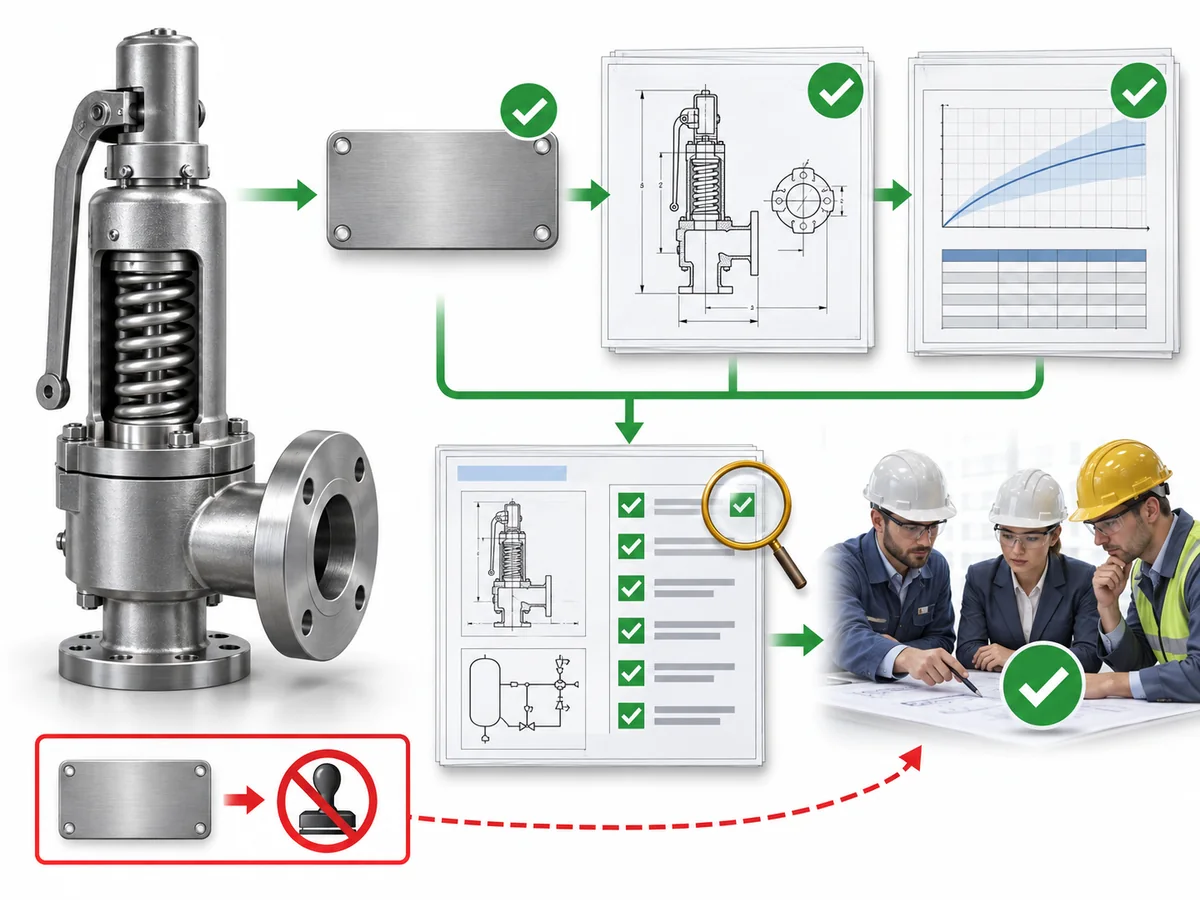
A better review follows an evidence chain: physical valve → nameplate and traceability → design/configuration → certified-capacity record → applicable rating basis.
“Certified-capacity record” is deliberately broader than “capacity curve.” Depending on the source and certification method, capacity information may be presented as a value, table, listing, flow factor, coefficient or curve. The National Board NB-18 explanatory material, for example, recognizes several methods of establishing certified capacity values rather than requiring one universal plotted curve.
This guide therefore focuses on how to interpret and reconcile the documents. It does not replace the relief-load calculation, full valve sizing process or installed-system review.
Match the Valve to the Document Before Reading the Capacity
Before reading the capacity, establish that the capacity information actually belongs to the valve being reviewed.
Start with the identifiers available on the physical valve, nameplate and supporting documents. Depending on the manufacturer and certification route, useful matching information may include the manufacturer, model or design type, inlet and outlet size, set pressure, serial or tag information, certification designator and capacity-related configuration data.
These identifiers do not all perform the same job.
For National Board records, the capacity certification number is assigned to the valve type. It should not be confused with a manufacturer serial number used to trace an individual physical valve. NB-18 also records the manufacturer’s commercial design-type name and the applicable construction-code designator.
During replacement or document review, a model family can identify the general design, but a capacity-relevant configuration still needs to be checked where applicable. National Board NB-500 requires review when design modifications affect the flow path, lift or performance characteristics of the pressure-relief device.
- Identify the physical valve from the available nameplate and tags.
- Match the manufacturer and design/model information to the supporting documentation.
- Check the size and any capacity-relevant configuration information.
- Confirm the applicable certification or designator context.
- Only then use the capacity information for comparison.
The objective is simple: do not perform an accurate capacity calculation or comparison against documentation for the wrong valve.
Read the Nameplate by What Each Field Proves
There is no benefit in memorizing one manufacturer’s nameplate layout and assuming every safety valve will look the same. Read the safety valve nameplate by the evidence function of the information instead.
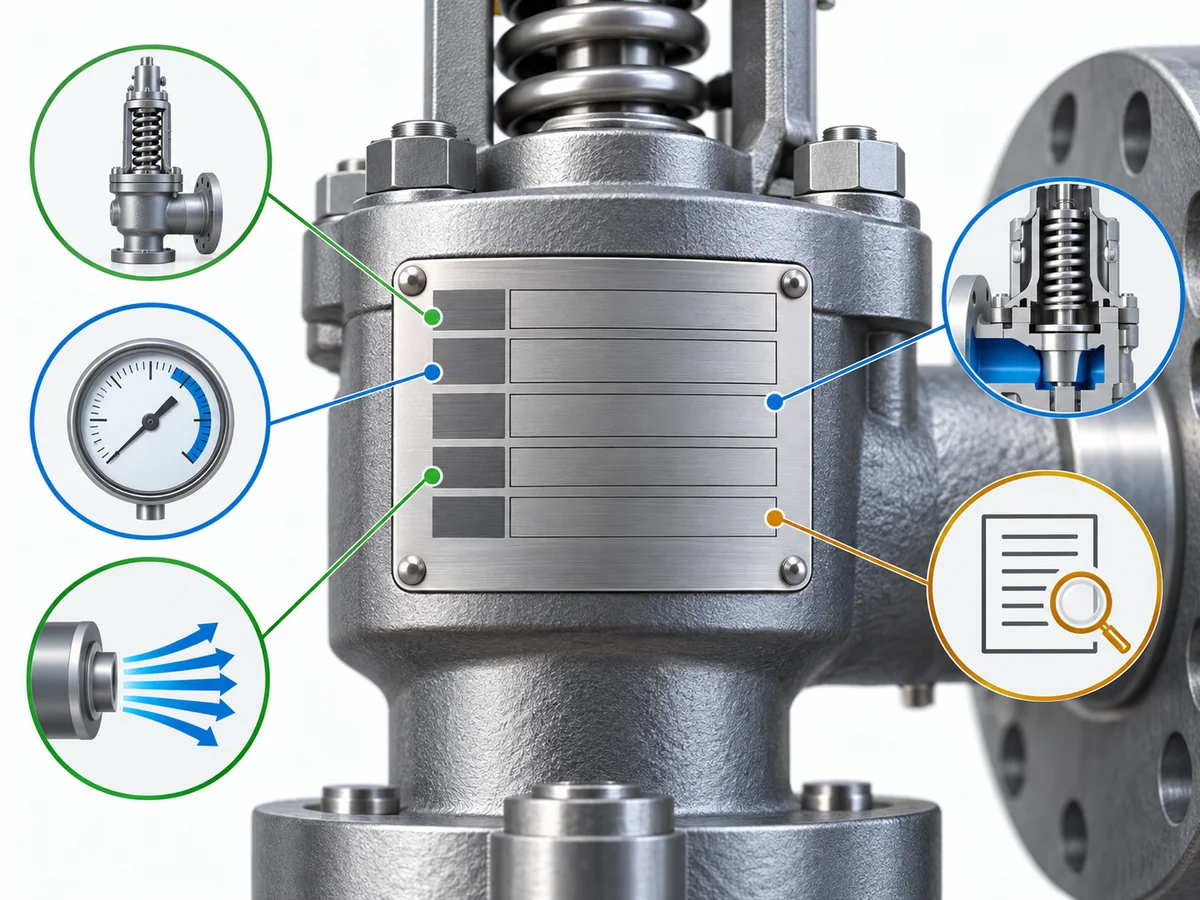
| Evidence function | Information you may encounter | What it helps establish | 其本身不能确定的内容 |
|---|---|---|---|
| Identity and traceability | Manufacturer, model/design, serial or tag information where provided | Which physical valve or design is being reviewed | Certified capacity or application suitability |
| Pressure information | Set pressure, pressure unit and other pressure-related data where applicable | Pressure-related identity and rating context | The complete capacity basis |
| Flow and capacity information | Capacity, flow area, coefficient or orifice-related information where applicable | Capacity-related characteristics of the design | The protected system’s required relieving load |
| Certification information | Applicable code designator, ASME marking or National Board marking | Certification context and scope | Automatic project acceptance |
| Configuration or service context | Temperature or manufacturer-specific configuration information where present | Additional evidence for matching the valve to documentation | Complete process or installed-system suitability |
This “field → evidence function → limit” approach is more useful than a field glossary because a valid field can still be asked to prove something it was never intended to prove.
For example, an inlet or outlet connection size helps identify the piping interface. It is not a substitute for relieving-capacity evidence. For the deeper distinction between nominal connection size, internal flow geometry and capacity, see Certified Relieving Capacity vs Connection Size.
For National Board-marked devices, NB-500 adds a narrower rule: when an organization applies the NB mark, the relieving-capacity or flow-resistance value marked on the pressure-relief device or attached nameplate is required to be the value certified by the National Board. The marked device must also be a National Board-certified type within the applicable authorization scope.
That is strong capacity evidence within that certification framework. It still does not turn every other nameplate field into a universal requirement, and it does not establish the complete suitability of the valve for a specific process system.
Read a Certified Capacity Curve or Table from Its Basis, Not Just the Number
A certified capacity number should never be separated from the basis under which it was established.
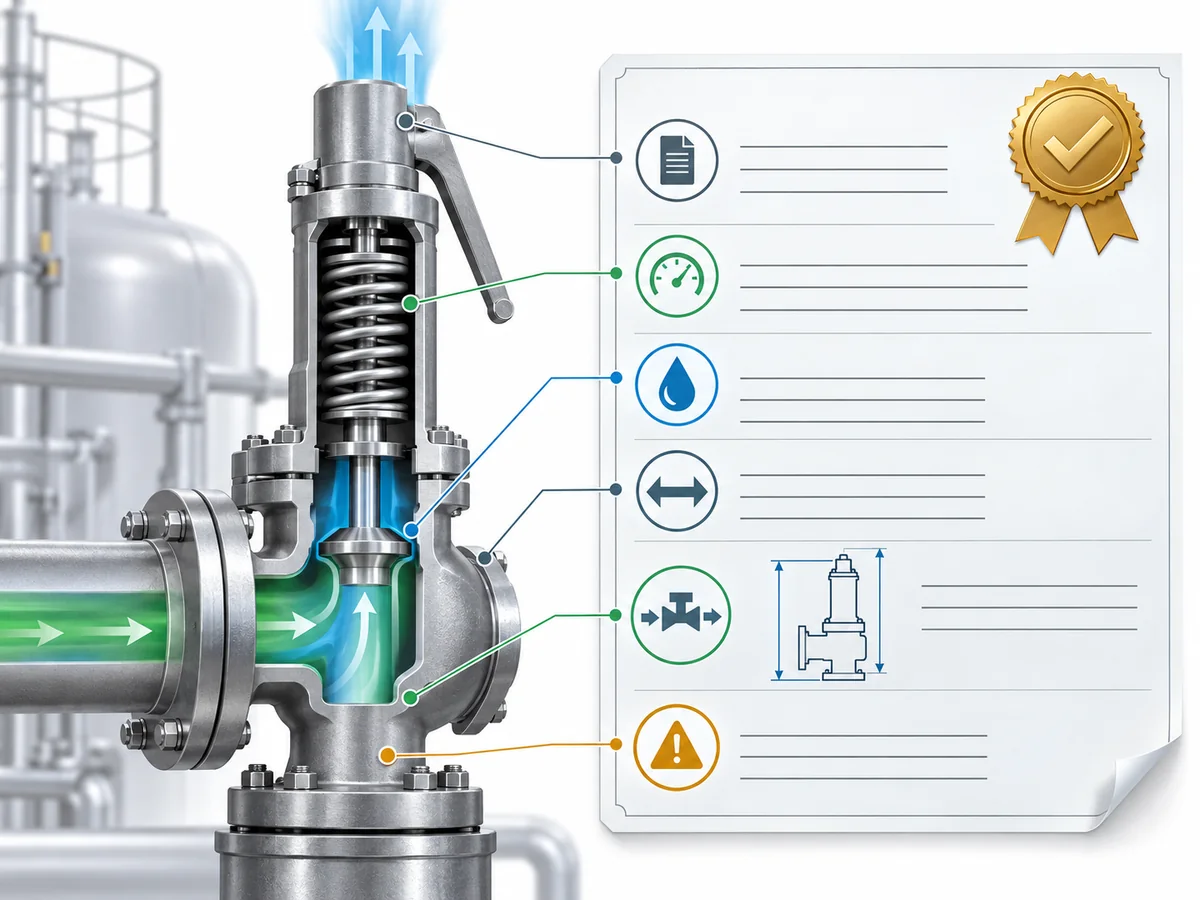
National Board NB-18 illustrates this clearly. Its certification records can associate a quantitative capacity value with units, test medium, certified medium, inlet/outlet size, flow area, orifice diameter, minimum lift, valid set-pressure ranges and code designators. NB-18 also recognizes different methods for establishing certified values, including direct capacity, flow-factor or slope methods, and coefficient-based methods.
-
Identify what the number represents.
Determine whether the document gives a direct flow capacity, coefficient, flow factor or another rating value. Do not assume that two numbers labelled “capacity” were established by the same method. -
Check the unit before comparing values.
A capacity number without its unit and basis is not ready for comparison. Mass-flow and volumetric-flow values should not be treated as interchangeable merely because they are both flow quantities. -
Identify the certified medium.
NB-18 distinguishes the test medium used during initial certification testing from the certified media covered by the certification record. -
Check the size and flow geometry associated with the record.
Connection size, flow area and orifice diameter are separate pieces of information. NB-18 records these independently and also identifies minimum lift for pressure-relief valves. -
Confirm that the set pressure falls within the applicable record.
NB-18 associates minimum and maximum set pressures with size, designator and certified medium. A stamped set pressure is therefore a useful matching point, but it does not by itself define the entire capacity basis. -
Read the limitations before using the value.
NB-18 specifically states that its listed rating values were established under atmospheric-discharge conditions and cautions that calculated capacities may not remain applicable where discharge back pressure exists. It also states that capacities are certified only for the conditions under which they were obtained.
That NB-18 limitation should not be generalized into a claim that every capacity document from every certification system has exactly the same boundary. It demonstrates the broader engineering principle: a certified capacity is condition-bound evidence, not a universal flow number.
Only after the valve identity, rating method, unit, certified medium, applicable size/configuration, pressure range and relevant limitations align should the value be compared with the engineering requirement.
If the task is still to determine the 所需泄放量, relieving conditions or required orifice, use the separate 安全阀选型与认证泄放能力指南. That calculation belongs to a different engineering step.
Cross-Check the Capacity Record Against the Physical Valve
Understanding the nameplate and understanding the capacity record are not enough if you never reconnect them.
The next task is to verify that the physical valve and the capacity evidence describe the same capacity-relevant design.
| Cross-check | Physical valve / nameplate side | Certified-capacity side | Question to answer |
|---|---|---|---|
| Manufacturer | Manufacturer identification | Certified manufacturer/assembler information | Are you reviewing evidence from the correct source? |
| Design | Model, style or other design identity | Certified design type | Does the record belong to this design? |
| Size | Marked inlet/outlet size where available | Listed applicable size or range | Is the certified record for this size? |
| Flow geometry | Orifice, flow area or related data where available | Certified flow area/orifice data | Does the capacity evidence describe the same flow configuration? |
| Pressure | Stamped set pressure | Applicable certified set-pressure range | Does this valve fall within the rating range? |
| 介质 | May be established in supporting documentation rather than on the plate | Certified medium | Is the capacity basis relevant to the service being compared? |
| Certification | Mark or designator where applicable | Certification listing and designator | Does the certification context align? |
Not every valve nameplate will contain every field in this table. The purpose is not to demand an identical set of markings from every manufacturer. The purpose is to obtain enough independent matching information to establish that the capacity record applies to the design actually in front of you.
Capacity certification is tied to pressure-relief-device designs. NB-500 states that changes affecting flow path, lift or performance require review, while National Board NB-501 describes design review, initial certification testing and production certification testing as parts of the certification process.
In practice, keep the evidence chain traceable: physical valve → identifying information → certified design/configuration → capacity record → rating conditions.
Do not collapse that chain into “the model looks right.”
There is also an important historical-data limitation. The current NB-18 database does not list organizations that no longer hold certification or device-design certifications no longer in production. For an older installed valve, no current NB-18 result is not proof that the valve type was never historically certified. Historical verification may require a different path through the National Board.
Know What Certification Evidence Proves—and What It Does Not
Certification evidence becomes most useful when its scope is kept intact.
ASME’s current pressure-relief-device conformity-assessment framework uses BPVC Section XIII for pressure-relief-device certification requirements, while other applicable BPVC Sections can remain relevant to particular certification scopes. For example, ASME’s current Required Code Books guidance identifies both Section VIII Division 1 and Section XIII within the UV certification requirements. The correct interpretation therefore depends on the applicable designator, certification route and project code basis rather than on a simplified “old section versus new section” rule.
The National Board program adds a related but distinct layer. NB-500 requires a pressure-relief device bearing the NB mark to be a National Board-certified type, while NB-501 describes design review, initial certification testing and production certification testing as parts of the program.
| Certification evidence can support | Certification evidence does not establish by itself |
|---|---|
| A defined pressure-relief-device design or type has been certified within the applicable program | The protected system’s required relieving load |
| Capacity or flow-resistance evidence has been established under that certification framework | That a specific project calculation is correct |
| The applicable certification/designator context | That the installed inlet and outlet piping are acceptable |
| Authorized marking within the defined scope | Material compatibility with every possible process medium |
| A traceable basis for reviewing the device rating | Acceptance by every owner, jurisdiction or project specification |
The National Board cautions against interpreting its records too broadly: NB-18 states that it has not tested each production device and that installation, operating conditions and manufacturer recommendations still need to be considered when selecting a pressure-relief device for service.
The practical boundary is not certification mark → valve automatically approved for the project. It is certification evidence → one verified part of the project’s overall technical evidence.
The same distinction works in the other direction. Missing or inconsistent documentation does not automatically prove that a valve is physically defective, unsafe or noncompliant. It means the evidence available to the reviewer is insufficient for the conclusion being attempted.
For a broader explanation of certification and standards roles, see the 安全阀标准指南.
For current ASME conformity-assessment scope information, refer to the ASME conformity-assessment requirements.
Stop the Review When the Evidence Does Not Match
A good nameplate review does not have to end with “approved” or “rejected.” Often the correct result is simply: the current evidence is not sufficient yet.
Mismatches That Require Further Verification
| What you find | 重要性 | Appropriate next action |
|---|---|---|
| Physical valve identity cannot be established | You cannot reliably connect the capacity record to the device | Recover readable nameplate/tag and manufacturer identification |
| Design or capacity-relevant configuration differs | The certified rating may belong to a different design | Obtain the exact configuration and corresponding capacity documentation |
| Certified medium is unclear or different | The capacity basis may not be comparable | Verify the applicable certified medium and rating basis |
| Set pressure is outside or cannot be tied to the applicable range | The record may not cover the valve being reviewed | Obtain the applicable certification or rating record |
| Connection size matches but flow/orifice evidence does not | Mechanical fit is not capacity equivalence | Confirm exact flow area/orifice and supported capacity |
| NB-18 atmospheric-discharge capacity is being applied where back pressure matters | The published rating may not apply directly | Obtain the applicable manufacturer or project engineering basis |
| Nameplate capacity conflicts with the certification record | At least one part of the evidence chain is unresolved | Resolve the discrepancy before choosing either value |
| Mark or designator scope is unclear | The meaning of the certification cannot be established | Confirm the applicable certification scope |
| Older valve is absent from today’s NB-18 database | Current search results do not necessarily show historical certification | Request historical verification instead of assuming non-certification |
The National Board’s NB-18 limitations support this cautious approach: its listed capacities are condition-specific, the database has current-versus-historical limitations, and installed operating conditions still have to be considered.
使用 verify before relying here—not automatically “unsafe,” “noncompliant” or “must be replaced.”
What to Request Before the Review Continues
Do not answer an evidence gap with the vague request “please send the certificate.” Ask for the document that closes the actual gap.
For an unclear valve identity, request a readable nameplate/tag record and manufacturer identification. If the certified design is unclear, request the applicable certification listing or manufacturer record. If capacity is the problem, request the capacity table, listing or certificate with its unit, certified medium and relevant rating basis.
If the configuration does not match, obtain documentation identifying the exact certified configuration. If the installed conditions differ from the basis of the capacity record, the missing input is not another nameplate photograph—it is the manufacturer or project engineering evidence that addresses those conditions.
Continue review: the valve identity, capacity evidence and relevant rating basis align.
Verify further: an important relationship is unresolved but can be closed with additional evidence.
Do not rely on the capacity comparison yet: known information conflicts or the rating basis does not match the condition being evaluated.
These are practical document-review states used in this guide, not ASME or National Board regulatory classifications.
For the broader purchasing and document-control process, continue with the Safety Valve Procurement Checklist.
The final decision should still be made against the applicable project code, equipment design basis, service conditions and authorized engineering review—not from a nameplate field in isolation.