Compare thermal relief and pressure safety valve duties in LNG/LPG piping, including trapped liquid, capacity, phase, back pressure and RFQ checks.

在 LNG 和 LPG 管道中, 热膨胀泄压阀与压力安全阀并非两种对立的保护原理.
热膨胀泄压阀本身即为压力泄放装置。其实际区别在于 泄放工况: 是什么导致压力升高、被保护的是哪一段管路、到达装置的流体状态,以及装置必须泄放的负荷。
CGA PS-28
将热膨胀泄压阀描述为用于管道系统的压力泄放装置,用于防止因有限封闭工艺流体体积的热膨胀而引起的超压,包括低温液体或冷气体被封堵在阀门或其他装置之间的情况。
该定义范围明确且实用:它界定的是特定的超压机理,而非通用的阀门类别。
因此,可靠的工程流程是: 确定被保护系统 → 识别可信的压力升高机理 → 确定所需泄放工况 → 核实阀门及已安装的泄放通道。
整定压力、超压、压力积聚、启闭压差、泄放能力和背压相互关联,但并非可互换的术语。其允许关系取决于所依据的规范、被保护设备和阀门配置,因此本文不采用通用的百分比或阈值。
隔离管段内被封闭的液体升温可产生热膨胀泄放工况。另一系统则可能存在封闭流动、泵相关、蒸汽生成、火灾或其他可信的超压工况。这些工况不应被简化为单一的“TRV 与 PSV”产品选择。
API 521
涵盖包括 LNG 终端在内的设施的压力泄放与降压系统,而 API 的压力泄放系统框架将原因识别、所需泄放量和下游排放系统审查分开处理。
因此,阀门名称只是起点——而非工程规格。
热膨胀泄放与压力安全泄放:真正的区别是什么?
真正的区别在于 先确定泄放工况,再选择硬件.
热膨胀泄放工况之所以存在,是因为封闭流体状态发生变化并在升温时产生压力。保护装置仍然响应压力。
“热”描述的是超压的原因;它并不会使该装置变成温度操作型阀门。CGA PS-28 通过将热膨胀泄放阀归类为压力泄放装置,使这一区别尤为明确。
“PSV,” “PRV,” “safety valve” and “relief valve” also should not be treated as universally interchangeable product classes.
ISO 4126-1, for example, specifies general product requirements for safety valves and explicitly states that it is a product standard rather than an application standard.
ASME BPVC 第 XIII 卷
separately provides overpressure-protection rules covering pressure-relief devices, capacity certification, installation and related requirements. The governing project standard, datasheet and valve documentation therefore matter more than the abbreviation alone.
In practical review, keep four pressure terms separate. 整定压力 is the valve setting used as the opening reference under specified test or service conditions. 超压 is the pressure rise above set pressure during relieving. 压力积聚 concerns the pressure rise of the protected system above its governing allowable basis during an overpressure event. 启闭压差 is the pressure difference between opening and reseating behavior. API 520 and ASME overpressure-protection documentation treat these as distinct design or performance parameters; the exact limits are code- and application-dependent.
| 对比项 | Thermal-expansion relief duty | Other pressure-relief duty |
|---|---|---|
| Primary question | Can a trapped fluid volume build pressure as its condition changes? | What other credible mechanism can overpressure the protected system? |
| First thing to define | Isolated protected section and trapped inventory | Protected system and overpressure scenario |
| Does the valve name establish capacity? | 否 | 否 |
| Does pipe size establish required capacity? | 否 | 否 |
| Does correct set pressure prove adequate protection? | No; the device must also have adequate relieving capacity and be connected to the correct protected volume. | No; capacity, relieving state and installation conditions still have to be verified. |
| What ultimately controls selection? | Required duty plus actual service and installed conditions | Required duty plus actual service and installed conditions |
For a broader terminology comparison, see the
PRV vs PSV vs safety valve vs relief valve guide.
This article only uses the terminology needed to make the LNG/LPG piping decision.
When Does LNG or LPG Piping Become a Thermal-Relief Case?
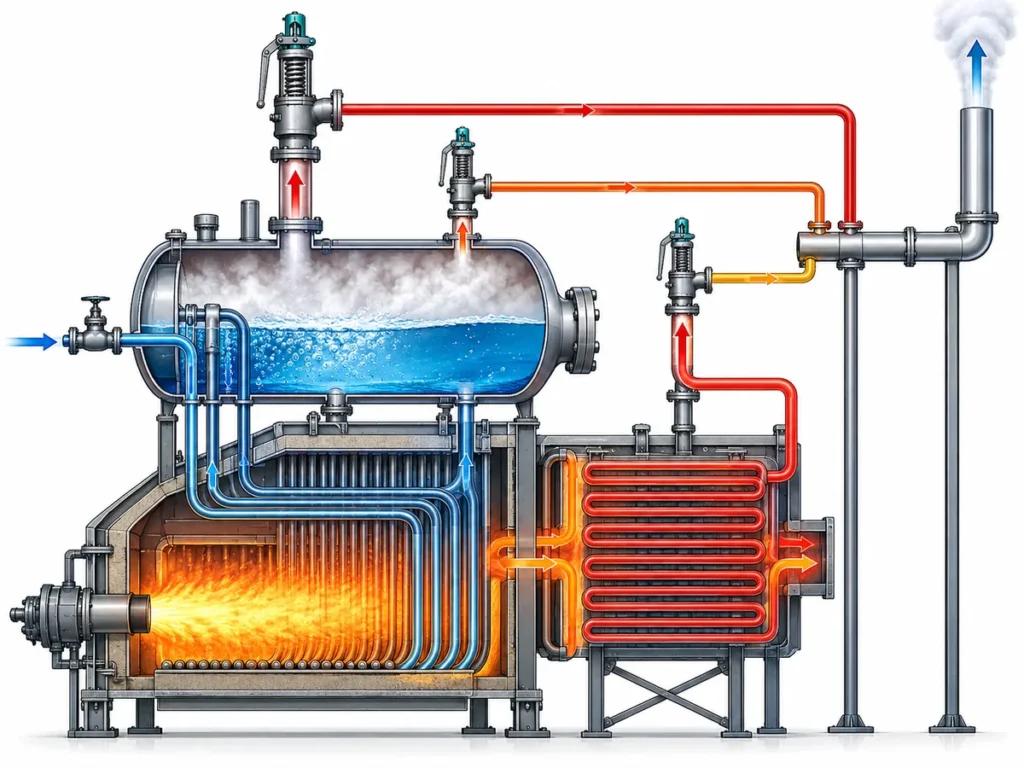
Start with the pressure boundary, not the valve catalogue. A thermal-relief case becomes a credible candidate when a finite fluid volume can become isolated and warming, thermal expansion or an applicable cryogenic state change can increase pressure while that section remains blocked in.
- Define the protected section. Identify the valves, equipment or other boundaries that isolate it.
- Confirm whether fluid can actually become trapped. An LNG or LPG line does not become a thermal-relief case simply because the medium is liquefied gas.
- Establish the trapped fluid and state. Liquid, cold gas and a potentially changing phase should not be assumed interchangeable.
- Identify the pressure-rise mechanism. Determine whether warming or thermal expansion is actually the credible cause.
- Only then establish the thermal-relief duty and required capacity.
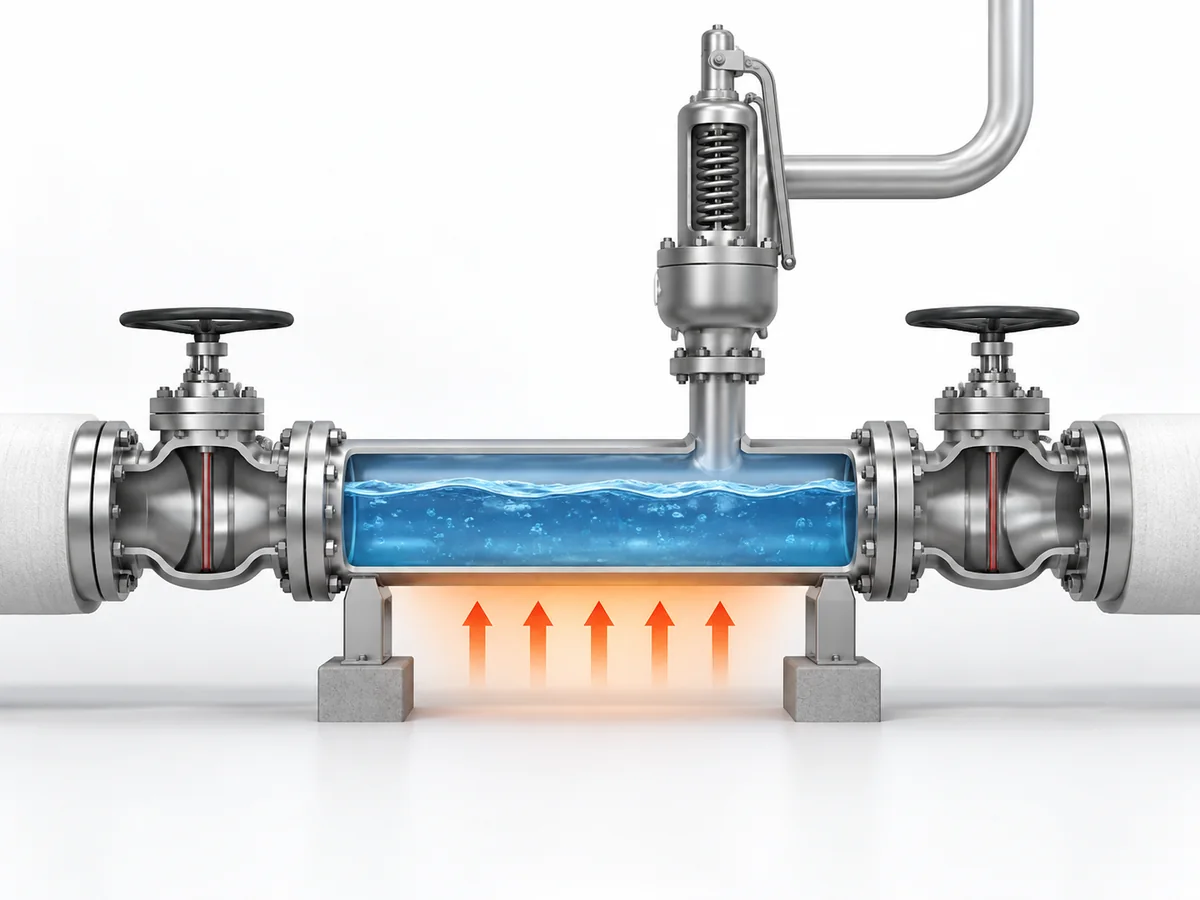
Within its specific scope for LNG road-vehicle fuelling stations,
ISO 16924:2026
defines a thermal relief valve around protection against excess pressure caused by cryogenic liquid vaporization or by warming of cold gas trapped in an isolated pipeline section or other small component.
That definition is useful for understanding the LNG thermal-relief mechanism, but the standard’s fuelling-station scope should not be expanded into a universal rule for every LNG terminal or process plant.
A typical isolated section between two shutoff boundaries is easy to visualize, but it is not the only possible configuration. What matters is whether the proposed relief device has an unobstructed pressure connection to the actual trapped volume throughout the operating and isolation states that create the case.
示例工程场景: a transfer line is isolated at both ends after LNG or LPG movement stops. A small trapped liquid inventory remains in the line and subsequently warms from ambient heat leak. No pump has to be running for the pressure to rise. The engineering response is not to choose a “thermal valve” by connection size; it is to define the trapped volume, establish the thermal-relief load, verify the pressure basis, and confirm that the selected device protects that exact section.
Identifying a thermal-expansion case also does 不 complete the valve selection. Set-pressure basis, required relieving capacity, phase, temperature, inlet and outlet conditions, back pressure and discharge destination remain separate verification items. The fact that thermal-relief loads are often smaller than major process-upset loads does not justify assuming that any small valve will be adequate.
When Is a Thermal-Relief Valve Not Enough?
A thermal-only assumption is no longer sufficient when another credible pressure-rise mechanism exists—or when the actual relieving condition has not yet been established.
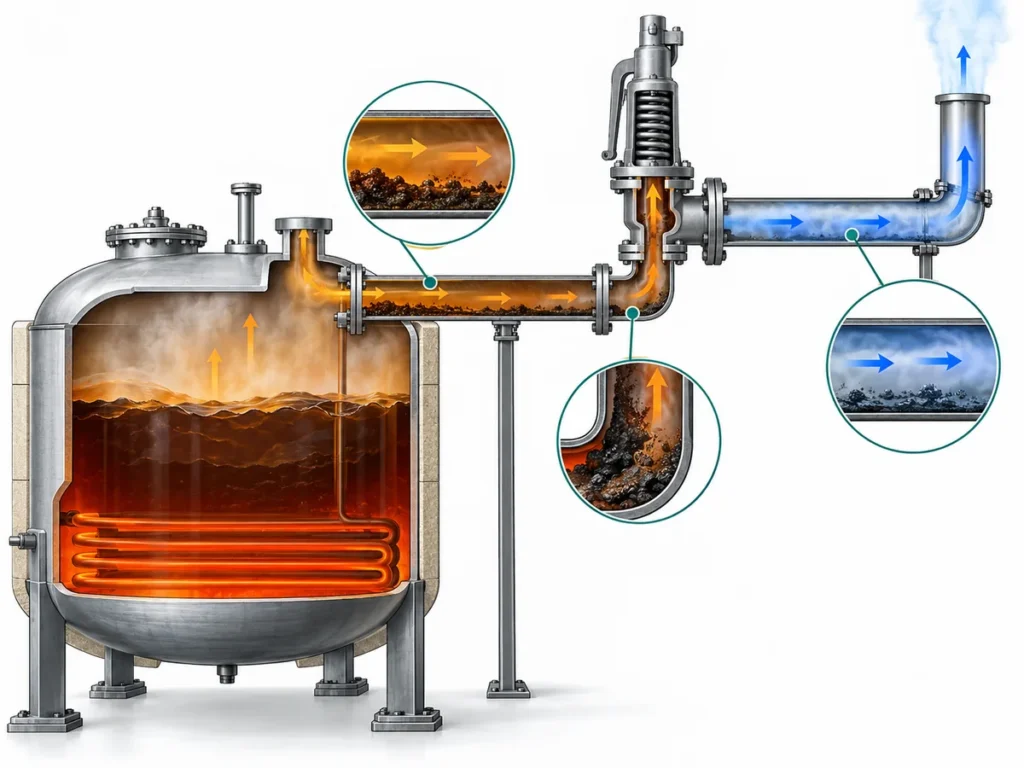
API 521 针对的是压力泄放与降压系统,而不是把压力泄放当作一项目录选型工作来处理。视受保护系统的具体情况,当存在其他工艺压力源、出口堵塞或持续流入、与泵相关的超压工况、蒸气生成或其他显著相变、适用情况下的外部受热、受保护边界未明确、所需泄放量未知,或液体、蒸气、两相泄放状态不确定时,可能需要进一步复核。.
重点不在于罗列所有可能的泄放工况,而在于识别何时 热膨胀模型已无法描述完整问题.
两相不确定性尤为重要。.
ISO 4126-10:2024
为包括管道在内的承压系统中气液两相流提供了专门的定径框架。因此,尚未解决的 LNG/LPG 泄放工况不应被默认为单相假设。.
| 若此问题尚未解决 | 重要性 |
|---|---|
| 受保护区段 | 你尚不清楚该阀实际保护的对象。. |
| 可信的泄放原因 | 无法可靠确定所需泄放能力。. |
| 所需泄放量 | 连接尺寸不能替代定径计算。. |
| 泄放相态 | 液体、蒸气和两相假设不可互换。. |
| 进口管道条件 | 被保护系统与装置之间的压力损失或阻力会影响开启稳定性和可用进口压力。. |
| 下游条件 | 出口阻力和积聚背压会改变安全阀的安装后行为。. |
API 520 第 II 部分
具体是 API 520 压力泄放装置标准中的安装部分。因此,进口和出口管道不能被视为阀门选型计算的附属项。允许的进口压力损失和背压限值取决于适用标准、阀门设计和使用工况;应依据项目基础文件和制造商资料进行核对,而不是照搬通用百分比。.
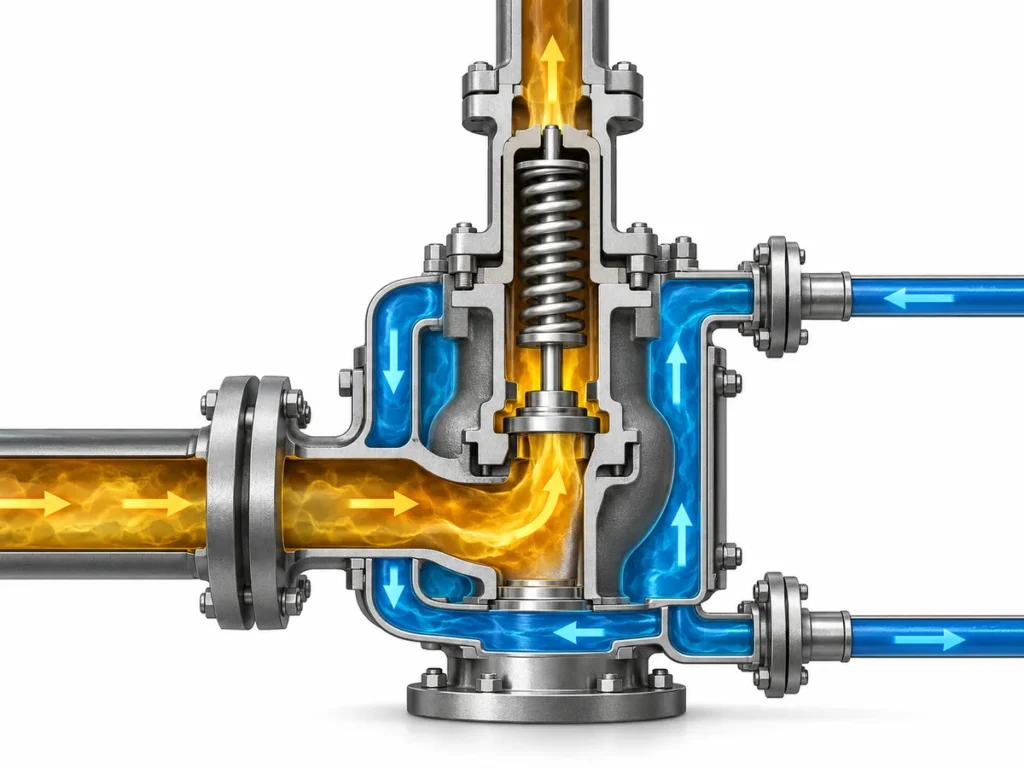
示例工程场景: 某弹簧式泄压阀最初是按一种排放布置进行审核的,但工厂后来将其出口接入公共排放总管。新的总管可能在泄放期间增大积聚背压或可变背压。即使阀门的整定压力未变,其开启/回座行为和有效排量也可能需要重新评估。预防措施是:每当排放系统发生变化时,都应重新校核出口水力工况,而不仅仅是在阀门本身更换时才进行。.
完整的排量计算和认证排量流程,请使用
安全阀选型与认证泄放能力指南
而不是将本页扩展为定径手册。.
一个泄放装置能否同时覆盖热膨胀和其他超压工况?
有可能——但前提是相关工况均已独立校核。.
“主 PSV 更大,因此自动覆盖热膨胀”和“热膨胀始终需要单独设置一个物理阀门”都不是可靠的选型规则。.
API 520 第 I 部分
涉及泄压装置的定径与选型,而
API 520 第 II 部分
涉及安装。因此,工程审查需要同时考虑所需泄放 duty 和已安装系统。.
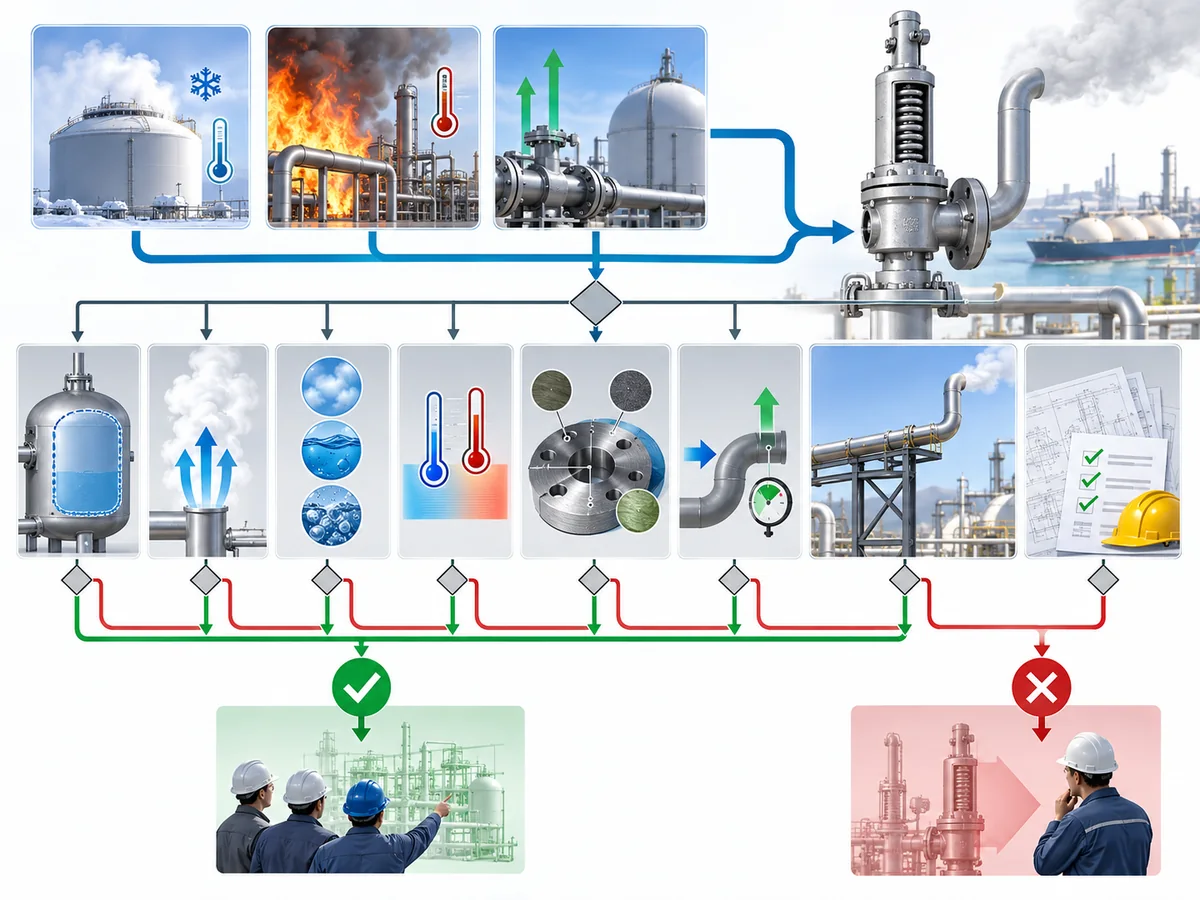
| 核实问题 | 为何会改变判定结论 |
|---|---|
| 该装置是否对每个工况都能保护所需边界? | 系统其他位置的一台阀门可能无法保护被隔离的管段。. |
| 相关泄放原因是否已识别? | 遗漏的工况不能靠假设来覆盖。. |
| 每个适用工况的所需泄放负荷是否已确定? | 阀门铭牌和连接尺寸不能确定负荷。. |
| 候选阀门是否具备适当的排量依据? | 可用排量必须与所需泄放负荷进行对比。. |
| 泄放相态是否已知? | 液相工况不能证明适用于气相或两相泄放。. |
| Is the set-pressure basis compatible with the protected system? | Opening pressure cannot be reviewed independently of the pressure boundary. |
| Are operating and relieving temperatures within documented limits? | Suitability at one temperature does not prove suitability at another. |
| Are body, trim, spring, guide, seat and seal arrangements supported for the service? | Component suitability is configuration-specific and can affect corrosion resistance, friction, leakage and stable motion. |
| Are back-pressure conditions supported? | Outlet pressure can affect opening, lift, capacity and reseating behavior depending on valve design. |
| Is the discharge path acceptable? | The valve is only one part of the complete relief path. |
| Are project documentation requirements satisfied? | Technical capability is not the same as project acceptance. |
What matters here is that capacity dominance is not the same as complete suitability. A candidate with enough capacity for a larger-flow scenario may still need separate verification for a lower-flow thermal case if that case involves a different protected section, phase, temperature, component limitation, back pressure or discharge route.
Capacity evidence also matters more than connection size. For code-covered pressure-relief devices, ASME Section XIII includes capacity and flow-resistance certification in its overpressure-protection scope, and the National Board’s
NB-18 压力泄放装置认证数据库
provides manufacturer/device certification information and certified relieving-capacity resources. A matching flange does not demonstrate that the candidate can pass the required relief load.
示例工程场景: a valve can be adjusted to the intended set pressure yet still be an inadequate protective device if its verified relieving capacity is below the required case. The correction is not to “turn up” the set pressure or choose a larger connection by appearance; it is to compare the scenario’s required relieving rate with the candidate’s applicable certified or otherwise project-accepted capacity basis.
Spring-loaded and pilot-operated pressure-relief valves also should not be treated as interchangeable upgrades. Back pressure, operating margin, service cleanliness, sensing/pilot configuration, temperature and maintenance strategy can all influence architecture choice. Baker Hughes technical guidance on pilot-operated safety relief valves notes that severe dirty service can require filtration or isolation features and that clogging of interconnecting tubing can make a pilot-operated design a poor fit in some services.
Review the pilot-operated SRV technical note.
Likewise, nothing in this comparison means thermal expansion always requires a physically separate device. Whether one device can serve multiple duties is an engineering conclusion based on the complete system, not a rule that follows from the names “TRV” or “PSV.” This is a candidate-screening principle, not a statement that one valve has already received project, code or regulatory approval.
What Changes Between LNG and LPG Relief Service?
LNG and LPG can use the same decision framework, but they should not inherit the same service assumptions.
The shared questions are straightforward: What is protected? What causes the pressure rise? What fluid and phase reach the valve? What capacity is required? What temperature applies? What back pressure exists? Where does the relieved fluid go? What component and documentation evidence supports the candidate?
| Review variable | LNG | LPG |
|---|---|---|
| 温度 | Cryogenic exposure can become a primary suitability boundary. | Use actual operating and relieving temperatures; do not inherit LNG assumptions. |
| 流体状态 | Establish the actual LNG state at the protected section and during relief. | Establish actual LPG state rather than assuming liquid or vapor from the medium name. |
| Flashing / two-phase | Review when process conditions make it credible. | Review when process conditions make it credible. |
| 材料 | Verify the configured valve for the required low-temperature duty. | Verify compatibility and actual temperature requirements. |
| 阀座/密封 | Low-temperature performance may become a model-level constraint. | Fluid, temperature and leakage requirements still control. |
| 背压 | Check the installed outlet system and valve architecture. | Check the installed outlet system and valve architecture. |
| 排放去向 | Define it for the actual project. | Define it for the actual project. |
Cryogenic pressure-relief equipment deserves model-level verification rather than a generic statement such as “stainless steel is suitable for LNG.”
Baker Hughes technical guidance on cryogenic pressure-relief valves
identifies construction materials, trim design, anti-galling measures and sealing features as cryogenic design considerations. That evidence supports the need to verify the configured product; it does not establish that any specific ZOBAI model has the same construction or service capability.
Material review should therefore cover the full moving and sealing system, not only the pressure-retaining body: nozzle and disc surfaces, guides, spring environment, trim interfaces and seat/seal materials can all affect corrosion, galling, leakage or stable movement under the actual temperature and medium. For LNG service, differential contraction and low-temperature suitability must be confirmed from the product documentation rather than inferred from a generic alloy name.
Seat tightness is a separate purchase and test question from set pressure and certified capacity. API’s current catalog lists API Standard 527, Seat Tightness of Pressure Relief Valves; the standard covers test methods for metal- and soft-seated PRVs. If the project has a leakage requirement, state the required test basis and acceptance criteria in the purchase specification instead of assuming that “soft seat” or “metal seat” alone predicts field tightness.
示例工程场景: a valve can fit the line mechanically and meet the intended set-pressure basis, yet still be a poor LNG candidate if its trim, guide or sealing materials are not supported for the actual low-temperature condition. The prevention step is to review the documented temperature/material configuration as a complete assembly, not to infer cryogenic suitability from body material alone.
For the broader application context, see
LNG and LPG pressure-relief applications.
For deeper component-level selection, see the
安全阀材料选用指南.
For engineering review, the same questions can be used for LNG and LPG, but the answers should be verified separately for the actual service.
What Should You Confirm Before Selecting a Valve or Sending an RFQ?
Do not send only “Need a thermal relief valve, LNG, DNxx.” That does not define the protection duty.
A useful engineering enquiry should describe the system first and let the supplier verify the candidate second.
Define the protected system
- equipment or piping section being protected;
- isolation arrangement or system boundaries;
- credible overpressure scenario or scenarios;
- process reason pressure can rise.
If one relief device is expected to cover more than one case, identify every credited protected section and scenario instead of supplying only the “largest” case. A lower-flow thermal case can still have a different isolation boundary or different relieving state.
Provide the process and relief basis
- medium and relevant composition;
- normal fluid phase;
- 预期泄放相态;;
- 工作压力;;
- design or allowable pressure basis;
- required set-pressure basis;
- 工作温度;;
- minimum relevant service temperature;
- expected relieving temperature;
- required relieving rate or the approved calculation basis.
If the phase is uncertain or two-phase relief is credible, state that uncertainty rather than assuming liquid-only or vapor-only sizing. If the governing code or owner specification limits set pressure, overpressure, accumulation or blowdown, provide that basis rather than asking the supplier to infer it from normal operating pressure.
Define the installed outlet conditions
- 排放去向;;
- downstream system or header;
- expected superimposed and built-up back pressure where applicable;
- relevant outlet piping restrictions;
- flare, vent, process-return or other project-defined destination where applicable.
Back pressure is not merely a piping detail. Depending on valve architecture, it can affect opening pressure, lift, capacity and reseating behavior. Changes to a shared disposal header should trigger a valve/application review even when the protected equipment and set pressure are unchanged.
State the mechanical and material requirements
- 进口与出口连接要求;;
- pressure class;
- spring-loaded, balanced or pilot-operated architecture if already fixed by the project;
- project material requirements for body, trim, nozzle, disc, spring/guide environment and seat/seal;
- medium compatibility requirements;
- leakage or seat-tightness test requirements;
- installation constraints, including orientation or accessibility where relevant.
Ask the supplier to confirm the candidate evidence
- 确切型号与配置;
- pressure and temperature limits;
- construction materials;
- seat and seal arrangement;
- applicable relieving-capacity evidence;
- supported fluid / phase basis;
- back-pressure limitations;
- connection details;
- set-pressure and blowdown adjustment/test basis where applicable;
- seat-tightness test basis where required;
- test, traceability and documentation package;
- conformity or certification only where it actually applies.
For inspection and repair planning, API RP 576 is the API recommended-practice framework for inspection of pressure-relieving devices in the oil and petrochemical industries. If the governing jurisdiction or owner specification requires National Board repair or test accreditation, verify the actual organization and scope in the
National Board Manufacturer and Repair Directory;
do not assume a VR or T/O requirement applies globally.
The buyer or process engineer defines the protected system and required duty; the supplier confirms what a specific valve configuration can support.
For the broader selection workflow, see the
安全阀选型指南.
Classify the relief scenario before classifying the valve.
Once the protected boundary, relief cause, capacity, phase, temperature and installed conditions are defined, “thermal relief valve versus PSV” stops being a terminology debate and becomes a traceable engineering review.
常见问题
Is a thermal relief valve the same as a pressure safety valve?
A thermal-expansion relief valve is a pressure-relief device, but “thermal relief” describes a specific overpressure duty rather than proving a universally separate hardware class. The exact device terminology and configuration depend on the governing standard, service and project specification.
Can one pressure safety valve cover thermal expansion and another relief case?
It can be evaluated as a candidate for multiple cases, but capacity alone is not enough. The review must confirm that the device protects the required boundary and that set-pressure basis, required relieving rate, phase, temperature, materials, back pressure and discharge path are acceptable for each credited case.
How does back pressure affect a relief valve in LNG or LPG piping?
Back pressure can change opening, lift, capacity and reseating behavior depending on valve design. Built-up back pressure comes from outlet-system resistance during discharge; superimposed back pressure already exists at the valve outlet. The acceptable limits and the choice between conventional, balanced or pilot-operated designs must come from the governing standard and the specific valve documentation rather than a universal percentage.
为什么认证泄放量比连接尺寸更重要?
Connection size tells you how the valve connects to the piping; it does not prove how much mass or volume the valve can discharge under the required relieving conditions. The required relief load must be compared with applicable capacity evidence for the actual fluid, pressure, temperature and valve configuration.
整定压力、超压、压力积聚和启闭压差之间有什么区别?
Set pressure is the valve’s opening reference under specified conditions. Overpressure is the rise above set pressure during relieving. Accumulation refers to the protected system’s pressure rise above its governing allowable basis during the event. Blowdown is the pressure reduction between opening and reseating behavior. Do not apply generic limits without the applicable code and project basis.
How often should an LNG or LPG pressure-relief valve be inspected or recertified?
There is no single interval that is correct for every service. Inspection and test frequency should follow the applicable jurisdiction, code, owner mechanical-integrity program, service severity and device history. API RP 576 and the relevant National Board/NBIC requirements can be part of that framework where they apply; project-specific requirements should control the published maintenance interval.