Learn what API 527 seat-tightness evidence proves for an LPG safety valve, what it does not prove, and what to verify before acceptance.

API 527 proves one narrow but important point: the tested pressure-relief valve met the applicable seat-tightness acceptance criterion under defined test conditions. It does not, by itself, prove zero leakage in LPG service, adequate relieving capacity, complete pressure-performance behavior, material compatibility, or acceptance of the installed relief system.
That boundary is consistent with API’s own standards architecture. API’s refining standards catalog describes Standard 527 as addressing pressure-relief-valve seat tightness, while API 520 Part I addresses sizing and selection, API 520 Part II addresses installation, and API 526 provides separate valve specification requirements. A seat-tightness result therefore belongs in an evidence chain; it is not a substitute for the rest of the protection design.
For an engineer or technical buyer, the useful question is not simply “Does the certificate say API 527?” It is whether that test result supports the conclusion being requested for this valve under the applicable test basis. In LPG service that distinction is especially important because a technically acceptable bench seat test does not answer questions about required relieving capacity, service temperature, sealing-material compatibility, back pressure, discharge-system behavior, or the project-specific acceptance basis.
For detailed test-method and leakage-limit information, use ZOBAI’s API 527 seat-tightness test guide. This article stays focused on interpreting the evidence for an LPG safety-valve decision.
What an API 527 Seat-Tightness Result Actually Proves
An API 527 PASS should be read as a three-part statement:
this tested valve + this applicable acceptance criterion + this documented test basis.
When those elements line up, the result supports the conclusion that the valve met the applicable seat-tightness requirement for that test. API’s published description of Standard 527 covers metal- and soft-seated pressure-relief valves, including conventional, bellows and pilot-operated designs. It also states that the test medium is part of the test basis and that a purchaser may specify greater seat tightness in the purchase order. API’s published Standard 527 scope is the authority basis for those distinctions.
That evidence is useful, but it is deliberately narrower than saying that:
- the valve is suitable for the complete LPG duty;
- the valve has adequate relieving capacity;
- every material and sealing element is compatible; or
- the installed relief system is acceptable.
Those are separate engineering questions. A seat-tightness test evaluates closed-valve leakage under the specified test basis; it does not calculate the required relief load, confirm the selected orifice area, demonstrate certified relieving capacity, or evaluate the installed discharge system.
A defensible summary is: the tested valve met the applicable API 527 seat-tightness acceptance basis under the documented test conditions.
This wording keeps the test result useful without asking it to prove something the test did not examine. It also prevents the common documentation error of turning one passing test into a blanket statement that the complete valve or LPG installation is “API approved.”
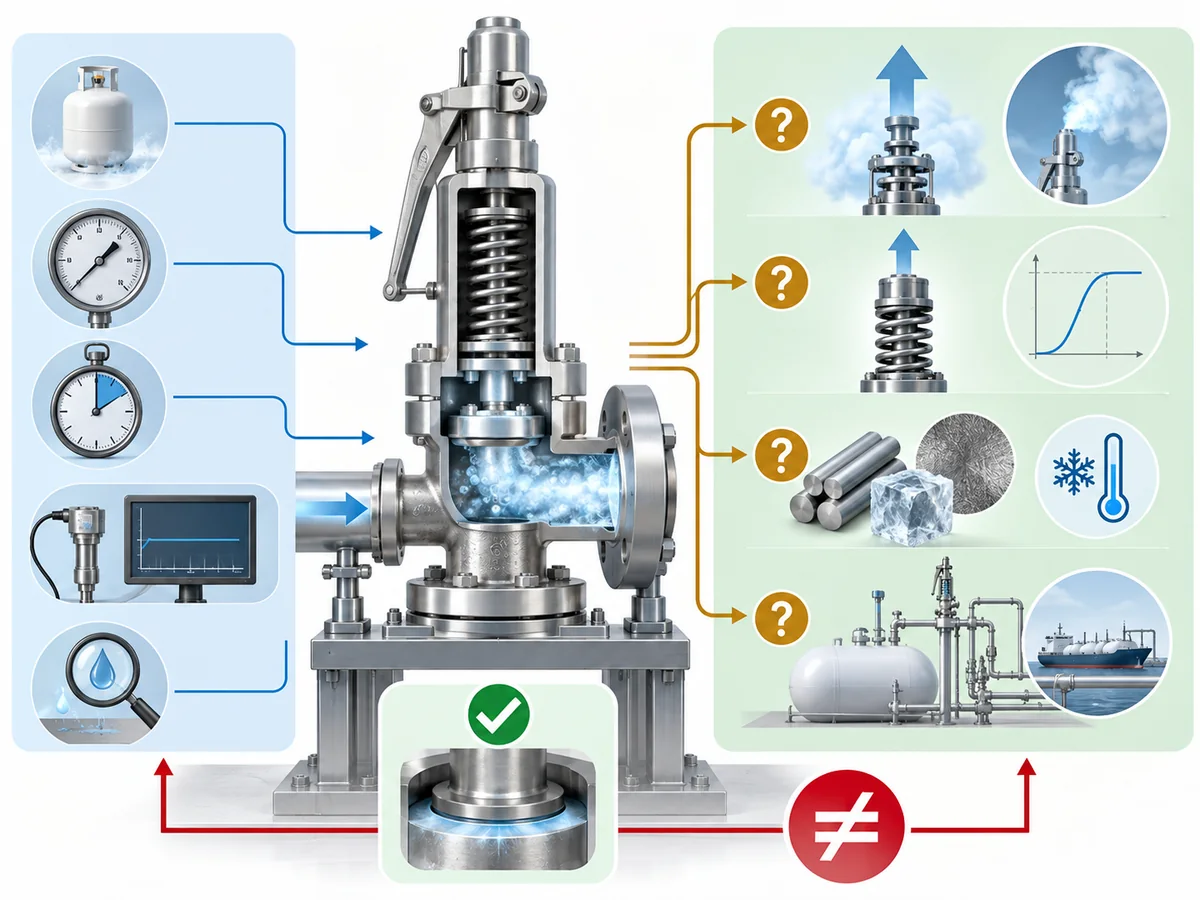
Why “API 527 Passed” Is Incomplete Without the Test Context
A bare API 527 PASS gives less decision value than a result that can be tied to the actual valve, test conditions and acceptance basis. The reviewer needs enough information to answer two questions: Was the right valve tested? 和 Was the result judged against the right criterion?
The following inputs matter because they can change how the seat-tightness evidence should be interpreted.
| Test context | 重要性 | If it is missing |
|---|---|---|
| Valve identity | Establishes that the record belongs to the candidate under review. | The result may not be traceable to the valve. |
| Seat / sealing configuration | Acceptance interpretation can differ with sealing design. | The leakage criterion may be misapplied. |
| Set pressure or applicable pressure basis | Provides the pressure context for the seat test. | The recorded test pressure is difficult to judge. |
| Recorded test pressure | Shows the pressure at which seat tightness was assessed. | The PASS lacks a clear test point. |
| Test medium | The medium is part of the applicable test basis. | The test conditions are incomplete. |
| Observed or measured result | Shows what the test actually found. | A standards reference may be mistaken for evidence. |
| Acceptance basis | Identifies the criterion used to judge the result. | “PASS” cannot be independently interpreted. |
| Purchaser / project requirement | The purchaser may require tighter seat performance than the baseline criterion. | A standard-level PASS may not satisfy the contract. |
This does 不 mean API 527 universally requires every test certificate to contain the same administrative fields. A serial number, customer tag, witness signature, calibration reference or work-order number may be required by a particular quality plan, but those items should not be described as universal API 527 requirements without the applicable project basis.
The practical review question is whether there is enough valve identity, test-condition and acceptance information to show that the result actually supports the candidate under review.
If that information is missing, the appropriate conclusion is generally that the evidence is incomplete for the requested decision—not automatically that the valve failed. A document hold is different from a test failure: one means the evidence package is not yet adequate; the other means the recorded result did not meet the applicable criterion.
Does Passing API 527 Mean an LPG Safety Valve Has Zero Leakage?
No. An API 527 PASS should not be translated into a general claim of “zero leakage in LPG service.”
For applicable metal-seated valves, a defined amount of seat leakage can be acceptable under the test basis. Published manufacturer procedures illustrate the distinction: metal-seat testing can use an allowable leakage rate, while some O-ring or soft-seat configurations use a no-leak criterion under defined bench-test conditions. See, for example, Baker Hughes’ Consolidated 1900 / 1900 DM technical manual.
Allowable seat leakage is therefore not the same as universal zero leakage. A metal-seated valve may satisfy its applicable acceptance criterion without a literal zero leakage reading. Conversely, a no-leak result on a particular soft-seat configuration is still bounded by the documented bench-test pressure, medium, configuration and setup. It does not become a lifetime guarantee that the complete valve assembly will never show leakage after installation.
示例工程场景: an LPG valve with a metal seat meets the applicable API 527 leakage criterion, but the owner expects “no detectable leakage” during normal operation. The problem is not necessarily a failed API 527 test; it may be a mismatch between the baseline test acceptance and the owner’s tighter operating or purchase requirement. The preventive action is to state the tighter seat-tightness requirement in the RFQ or purchase order and verify the supplied test record against that requirement.
The API 527 seat result should also not be used as evidence for every possible leakage path on the assembly. Manufacturer testing frameworks separately distinguish seat tightness from pressure-boundary and outward/back-seat tightness checks; LESER’s published quality documentation is one example of that separation. LESER quality and testing documentation.
For an LPG application, wording such as “No leakage was observed under the applicable seat-tightness test criterion” may be appropriate when the actual record supports it.
By contrast, “zero-leak LPG valve” implies much more than an API 527 seat-tightness result alone establishes.
What API 527 Does Not Prove About an LPG Safety Valve
A satisfactory seat-tightness result answers one technical question. It does not complete the entire LPG safety-valve review. API’s own standards structure keeps seat tightness, sizing/selection, installation and valve specification as separate engineering subjects; that separation is a useful model for procurement review as well.
Capacity and Required Relieving Duty
API 527 does not show that the selected valve can pass the required relieving flow. API 520 第 I 部分 addresses sizing and selection of pressure-relieving devices, while API 527 addresses seat tightness.
Seat tightness asks whether the closed seat meets the applicable leakage criterion. Capacity review asks whether the valve can relieve the required duty when it opens. Required relieving capacity comes from the governing overpressure scenario; the offered valve then needs a suitable orifice/capacity basis and documented relieving capability. Inlet and outlet connection size alone do not establish that capability.
An API 527 PASS therefore cannot substitute for the required sizing and capacity evidence.
示例工程场景: a replacement valve has the same inlet and outlet connection sizes and the correct set pressure, but its documented relieving capacity is insufficient for the approved LPG relief case. The cause is selection by connection size rather than by required duty and capacity evidence. The prevention is to compare the approved required relieving load with the offered valve’s documented capacity basis before purchase release.
For that separate task, see ZOBAI’s API 520 safety-valve sizing guide.
Set Pressure, Blowdown and Operating Performance
Seat tightness is not complete proof of the valve’s pressure-performance behavior. These terms answer different questions: set pressure governs the intended opening point under the applicable basis; overpressure and accumulation describe pressure rise during a relieving event using different reference points; and blowdown describes the gap between opening and reseating behavior. The applicable limits and definitions depend on the governing code and project basis.
Set-pressure verification, reseating or blowdown behavior, and seat leakage are distinct checks. Passing one should not be used to imply that the others have also been demonstrated.
ZOBAI’s set pressure, overpressure and blowdown guide owns the detailed pressure-performance terminology.
Materials and LPG-Service Compatibility
A seat-tightness result does not establish that the body, trim, seat or sealing materials are suitable for the actual LPG duty. API 526 treats materials and pressure-temperature limits as separate purchase-specification items for applicable flanged pressure-relief valves; that is another reason not to infer material suitability from a seat-leakage result. API’s refining standards catalog summarizes the distinct API 526 and API 527 scopes.
Material review should consider the components that actually see the service or control valve function—not only the body grade. Nozzle and disc surfaces affect the seating interface; guides can affect freedom of movement; springs and bellows may have their own environment and temperature limits; gaskets, O-rings and soft seats may determine sealing compatibility. Passing a leakage test does not replace that component-level review.
For deeper material-selection context, see ZOBAI’s safety-valve material selection guide.
Installed-System and Project Acceptance
A factory seat test does not demonstrate that the installed relief system is acceptable. API 520 第 II 部分 treats installation as a separate engineering subject.
Depending on the installation, the review may still need to address inlet pressure loss, outlet-system resistance, superimposed and built-up back pressure, discharge reaction, drainage and the way the valve is connected to a shared header or disposal system. Those factors can affect stable opening, available capacity and reseating behavior even though the valve passed a bench seat-tightness test.
Valve architecture also matters. A conventional spring-loaded valve, a balanced-bellows design and a pilot-operated valve do not respond identically to back pressure and installed piping conditions. API 527 does not select among those architectures; the installed duty does. For a deeper review, use ZOBAI’s back-pressure and bellows engineering guide.
示例工程场景: an LPG safety valve passes its shop seat-tightness test, then the outlet is connected to a modified common discharge header with greater resistance. The later stability or reseating problem is not evidence that API 527 was performed incorrectly; the engineering issue is that the installed back-pressure condition changed. The prevention is to recheck the valve type, back-pressure basis and outlet system whenever the discharge network is modified.
The same applies at project level: an API 527 result may satisfy one required documentation item without establishing that every owner, EPC, jurisdictional or project requirement has been met.
A valid API 527 result that also satisfies the applicable purchaser or project seat-tightness basis can close that seat-tightness question. It does not close every other question attached to the valve.
How to Review a Supplier’s API 527 Test Record
Review the document as evidence for a specific candidate rather than scanning only for the words “API 527.” A useful review starts with traceability, then moves to the test basis, the recorded result and the applicable acceptance criterion.
-
Match the record to the valve.
Confirm that the identification accepted by the project ties the record to the candidate. A test on another valve or configuration is not evidence for this one merely because both reference API 527.
-
Confirm the seat or sealing configuration.
Make sure the configuration represented by the record matches the valve being supplied.
-
Check the pressure basis.
Compare the stated pressure basis with the recorded seat-test pressure so that the result can be placed in the correct test context.
-
Check the test medium.
Confirm that the documented medium is consistent with the applicable test basis. API’s public description of Standard 527 states that the seat-tightness test medium is tied to the medium used for the set-pressure determination, with a separate rule for dual-service valves.
-
Check the result and acceptance basis together.
Do not stop at
PASS. Review the relationship between the observed or measured result, the applicable criterion and the final acceptance decision. -
Check the purchase or project requirement.
A project may require tighter seat performance than the baseline standard criterion, so the contractual acceptance basis still needs to be checked.
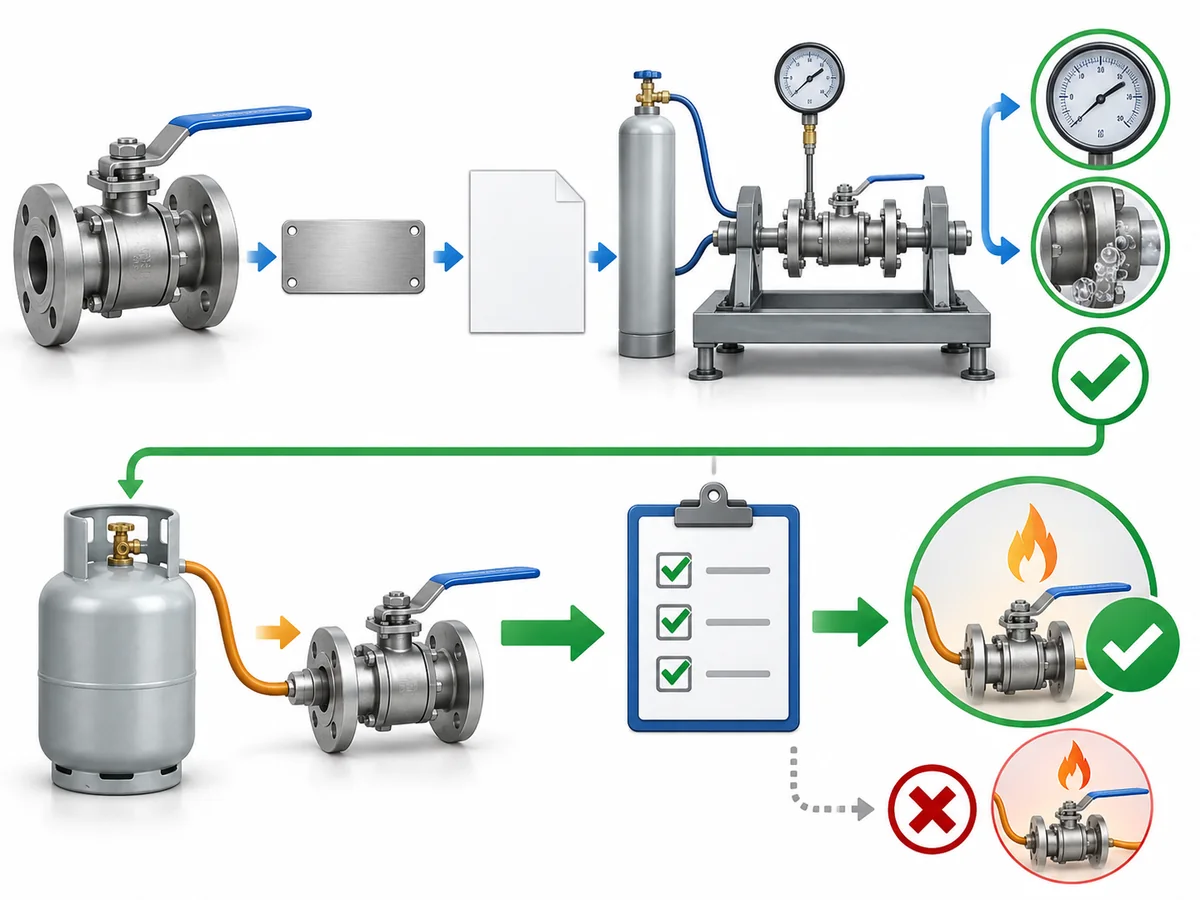
What to Verify Beyond API 527 Before Accepting the Valve for LPG Service
Once the seat-tightness evidence is satisfactory, confirm that the other engineering questions have their own evidence rather than borrowing credibility from API 527.
| Open question | Evidence or input to request | Why it remains separate |
|---|---|---|
| What relieving duty must be handled? | Relief scenario and required capacity basis | Seat tightness does not determine relieving capacity. |
| What pressure performance is required? | Set pressure and other applicable performance requirements | These are separate from seat leakage. |
| What is the actual LPG service? | Medium/state, relevant composition and temperature | Service conditions affect candidate selection. |
| Are the materials and seals suitable? | Body, trim, seat and seal materials plus the compatibility basis | A seat test does not demonstrate compatibility. |
| Which valve configuration is proposed? | Conventional, bellows, pilot-operated or other applicable configuration | Configuration can affect the wider selection review. |
| What does the installed system impose? | Back-pressure and discharge-system inputs where relevant | Installation and system behavior are separate from seat tightness. |
| What project basis applies? | Applicable project specification, code basis and purchaser requirements | Project acceptance covers more than one test. |
| Does the evidence belong to this candidate? | Traceable candidate-specific test documentation | Generic product statements are weaker than candidate evidence. |
| Has the valve been repaired, reset or relapped? | Repair scope, as-left setting/test records and the applicable repair authorization or quality-system evidence | A pre-repair seat result does not prove post-repair condition. |
If the valve has been repaired, reset or relapped
Do not treat an old seat-tightness result as automatically representative after work that can affect the pressure-relief valve’s functional or sealing condition. API RP 576 is specifically an inspection-and-repair practice for self-actuated pressure-relieving devices, including spring-loaded and pilot-operated valves. API’s catalog description of RP 576 identifies inspection and repair as a separate lifecycle activity from new-valve seat testing.
Where the project, jurisdiction or construction code requires recognized valve-repair authorization, verify that route rather than assuming any workshop adjustment is equivalent. The National Board states that its VR Certificate of Authorization and VR Stamp are for the repair of pressure-relief valves under the applicable NBIC program. This is a jurisdiction- and project-dependent requirement, not a universal statement that every LPG valve everywhere must carry a VR repair stamp.
示例工程场景: a valve had an acceptable seat-tightness record when new, then the seat and disc were relapped during overhaul. Reusing the original certificate as the only acceptance evidence would miss the fact that the sealing surfaces and as-left condition changed. The preventive action is to review the repair scope, as-left setting and post-work test documentation required by the applicable repair program before return to service.
The decision path is: verify API 527 seat tightness → identify what remains unproven → request the evidence that answers those remaining questions.
For broader product context, see ZOBAI’s LPG safety-valve page. For a broader purchase package, use the safety-valve RFQ checklist; for in-service planning, see the safety-valve maintenance and inspection guide.
Worked Document Review: Is This API 527 Record Usable?
Assume a supplier submits a one-page certificate stating only that an LPG safety valve “passed API 527.” This is an illustrative document-review scenario, not a claim about a ZOBAI customer or project. The statement alone is not enough to connect the result to the valve being purchased. A usable record should let the reviewer identify the tested item, understand the applicable test conditions and compare the result with the acceptance basis used for that purchase.
| Record field | Usable evidence | Ambiguity that requires clarification |
|---|---|---|
| Valve identity | Tag, serial number, model, size, orifice, set pressure and relevant trim details where required by the project traceability plan | A generic model certificate with no link to the supplied valve. |
| Test basis | Referenced edition/procedure, test medium, pressure, and other method details needed by the governing procedure or project QA plan | “Tested to API” without enough information to identify the actual test basis. |
| Observed result | Measured leakage or clearly recorded observation in the units or form used by the applicable procedure | A pass box with no result that can be reconciled with the acceptance basis. |
| Acceptance comparison | The applicable criterion and a clear comparison with the recorded result | No explanation of which acceptance basis applied. |
| 可追溯性 | Date, controlled test-equipment identification or calibration status, witness/approval and revision control where required by the project quality system | An uncontrolled worksheet that cannot be linked to the accepted test process. |
Even a complete seat-tightness record remains one document in the acceptance package. Confirm capacity, set pressure, materials, LPG service conditions and installed back pressure separately. Use the safety-valve RFQ checklist to keep those decisions traceable.
FAQ About API 527 Seat Tightness for LPG Safety Valves
Does passing API 527 mean an LPG safety valve will have zero leakage in service?
No. API 527 is a seat-tightness test under defined conditions. Applicable metal-seat acceptance can permit measurable leakage, while a no-leak result on a particular soft-seat configuration is still limited to the documented test basis. It should not be turned into a lifetime guarantee that the complete installed valve will never leak.
What should I check on an API 527 test record?
Confirm that the record can be tied to the candidate valve, then review the seat configuration, pressure basis, test pressure, test medium, observed or measured result, acceptance criterion and any tighter purchaser or project requirement. Administrative traceability fields should follow the applicable quality plan rather than being presented as universal API 527 certificate requirements.
Does API 527 prove the valve has enough relieving capacity?
No. Seat tightness and relieving capacity are separate engineering questions. Required relieving capacity comes from the governing relief scenario, and the selected valve needs documented capacity evidence for that duty. Connection size alone is not proof of capacity.
How can back pressure matter if the valve already passed API 527?
API 527 evaluates seat tightness on the test basis; back pressure is an installed-system condition. Depending on valve design and the discharge network, back pressure can affect selection, stable operation, available capacity and reseating behavior. A satisfactory bench seat test therefore does not eliminate the need for an outlet-system review.
Is an old API 527 record enough after a valve has been repaired or relapped?
Not by itself. Work on the seat, disc, setting or other functional parts can change the as-left condition. Review the repair scope and the post-work setting and test documentation required by the applicable owner, project, code or jurisdictional repair program.
Which standards belong in the same review as API 527?
Only those that answer a real project question. API 520 Part I is relevant to sizing and selection, API 520 Part II to installation, API 526 to applicable valve specification items, and API RP 576 to in-service inspection and repair practices. The governing construction code, owner specification and jurisdiction determine which requirements actually apply to a specific LPG installation.