Pruebas e inspección de válvulas de seguridad Una prueba de la palanca de elevación de una válvula de seguridad y una prueba de presión de ajuste verifican cosas diferentes. Una comprobación permitida de la palanca de elevación puede demostrar que la palanca, el vástago y el conjunto móvil pueden desplazarse mecánicamente en las condiciones de la comprobación; no establece la presión a la que la válvula se abrirá automáticamente. Una presión de ajuste …

Pruebas e inspección de válvulas de seguridad
Una prueba de la palanca de elevación de una válvula de seguridad y una prueba de presión de ajuste verifican cosas diferentes. Una comprobación permitida de la palanca de elevación puede demostrar que la palanca, el vástago y el conjunto móvil pueden desplazarse mecánicamente en las condiciones de la comprobación; no establece la presión a la que la válvula se abrirá automáticamente. Una prueba de presión de ajuste utiliza presión controlada para verificar la respuesta de apertura especificada según una base de prueba aprobada. Incluso un resultado satisfactorio de la presión de ajuste no demuestra por sí solo la estanqueidad del asiento, la capacidad de alivio requerida o la idoneidad del sistema de entrada y descarga instalado.
Respuesta rápida: prueba de la palanca de elevación frente a prueba de presión de ajuste
Una comprobación de la palanca de elevación o de prueba asiste mecánicamente a la apertura de una válvula de seguridad equipada con palanca. Puede proporcionar evidencia limitada de que el tren de elevación externo y el conjunto móvil responden, pero no mide la presión de entrada a la que la válvula demostrará su respuesta de apertura automática especificada.
Una prueba de presión de ajuste aplica presión controlada y verifica la respuesta de apertura especificada en condiciones de prueba definidas. Eso es evidencia de ajuste de presión, no un sustituto de una prueba separada de estanqueidad del asiento, una revisión de la carga de alivio y la capacidad, o una evaluación del sistema instalado.
El movimiento de la palanca ≠ verificación de la presión de ajuste
La verificación de la presión de ajuste ≠ verificación de la estanqueidad del asiento
La presión de ajuste ≠ capacidad de alivio
Ninguna prueba por sí sola demuestra la protección del sistema instalado
Alcance de la página: este artículo delimita la frontera de verificación entre las comprobaciones de la palanca de elevación y las pruebas de presión de ajuste. El dimensionamiento detallado, los criterios de aceptación de fugas del asiento, el diseño de contrapresión y los programas de inspección de planta siguen siendo tareas de ingeniería independientes.
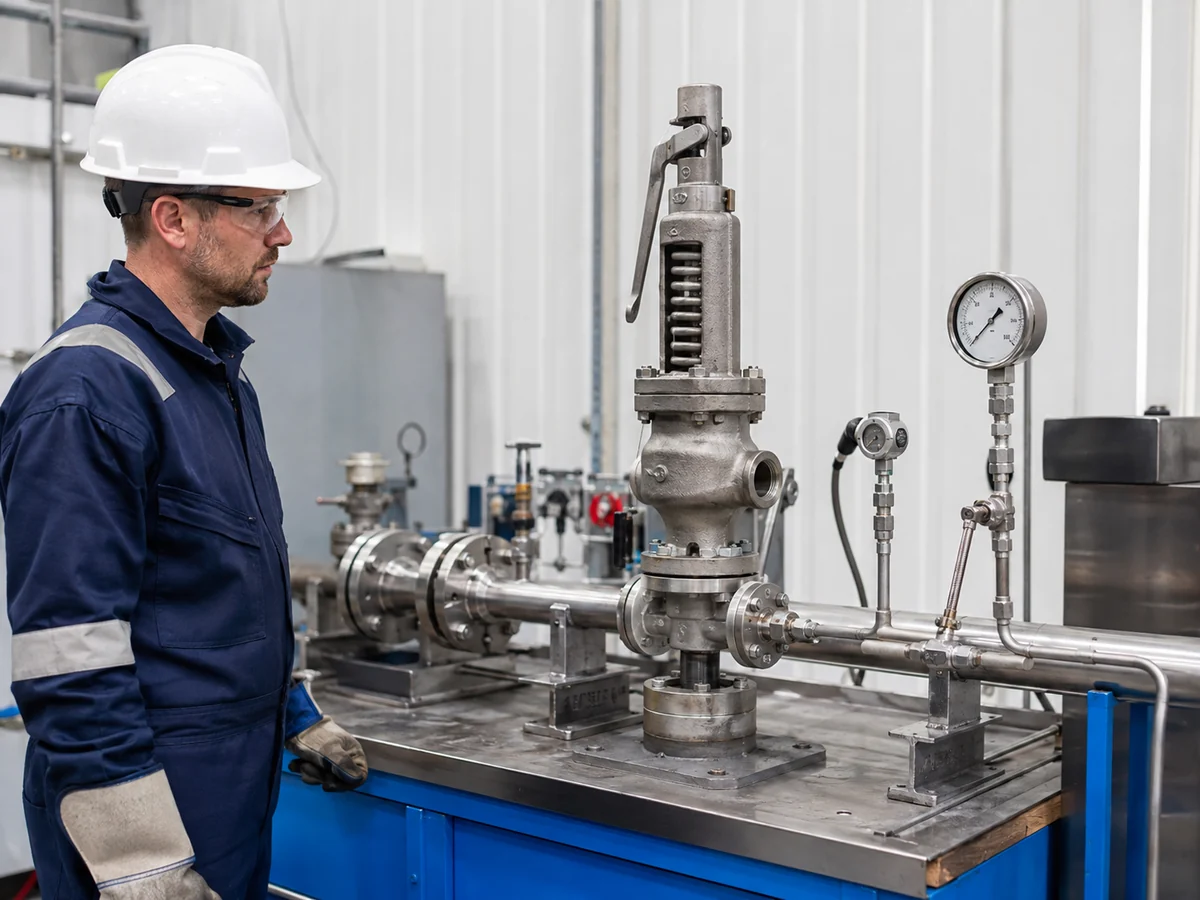
Escena conceptual de pruebas industriales; no es evidencia de un resultado de prueba certificado específico ni de un registro de las instalaciones de ZOBAI.
Qué puede verificar una prueba de la palanca de elevación de una válvula de seguridad
Una palanca de elevación proporciona un medio mecánico para levantar el conjunto móvil en los diseños de válvulas de seguridad equipados específicamente para esa función. Cuando el levantamiento manual está permitido por el procedimiento aplicable, las instrucciones del fabricante y las condiciones de operación, la comprobación puede proporcionar evidencia limitada sobre el movimiento mecánico.
Movimiento mecánico y respuesta del mecanismo de enlace
Una comprobación de la palanca puede ayudar a establecer que:
- la palanca externa y el mecanismo de enlace son capaces de moverse;
- el husillo o el mecanismo de elevación responde a la palanca externa;
- el disco puede desplazarse mecánicamente desde su posición asentada;
- el mecanismo no está claramente agarrotado bajo la condición específica de la comprobación;
- el mecanismo se libera después de que el operador suelte la palanca.
Una resistencia anormal, un movimiento irregular, un retorno incompleto o un movimiento de la palanca sin la respuesta correspondiente del husillo/disco deben provocar una investigación adicional en lugar de reducirse a una simple observación de apto/no apto.
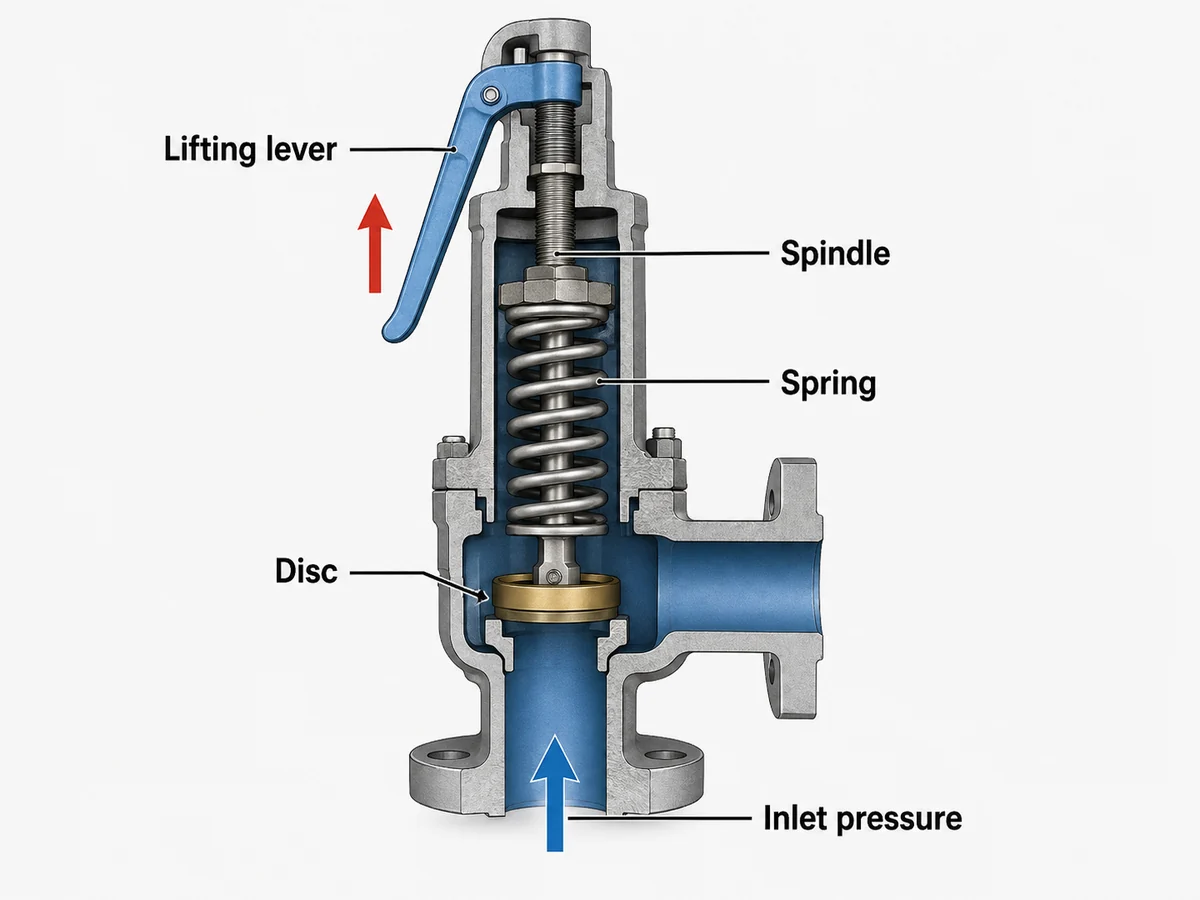
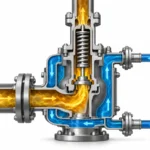
Ilustración de ingeniería simplificada; no es un dibujo de fabricación ni la construcción interna específica del modelo.
Para el contexto de la configuración de la válvula, revise
válvulas de seguridad con palanca.
Lo que una prueba de palanca de elevación no puede verificar
La elevación manual no es una respuesta automática a la presión
Durante la elevación manual, la fuerza mecánica aplicada por el operador ayuda al movimiento del tren de la válvula. Esto difiere de cuando la presión de entrada aumenta hasta que la fuerza de presión supera la fuerza de cierre de la válvula y la válvula demuestra su respuesta de apertura especificada basada en la presión.
Una comprobación exitosa de la palanca no establece:
- la respuesta real a la presión de ajuste;
- la presión diferencial en frío requerida para la prueba, donde se aplica;
- la calibración correcta del resorte;
- la capacidad de alivio requerida o certificada/documentada;
- aceptación formal de estanqueidad del asiento;
- el rendimiento completo de soplado o de reasentamiento;
- pérdida de presión de entrada o contrapresión de salida aceptables;
- código completo o cumplimiento del sistema instalado.
Límite de interpretación: una palanca que mueve la válvula es evidencia de respuesta mecánica bajo esa condición. No es evidencia de que la válvula se abrirá automáticamente a la presión de ajuste especificada durante un evento real de alivio.
El movimiento de la palanca no es evidencia de capacidad
La capacidad de alivio depende del escenario de alivio que rige, el medio y la fase, la tasa de alivio requerida, la presión de alivio, la temperatura de alivio, el área de flujo seleccionada, las características de la válvula y la base de capacidad aceptada del fabricante o de la certificación. Ninguno de estos puede establecerse simplemente levantando el disco.
Revisar
dimensionamiento de válvulas de seguridad y capacidad de alivio certificada
cuando la pregunta de ingeniería es si la válvula puede pasar la carga de alivio requerida.
Lo que una prueba de presión de ajuste puede verificar
Una prueba de presión de ajuste aborda la presión a la cual la válvula demuestra su respuesta de apertura especificada bajo condiciones de prueba controladas. Por lo tanto, proporciona evidencia basada en presión en lugar de evidencia mecánica inducida manualmente.
Información tal como se encontró y tal como se dejó
Para trabajos de mantenimiento y reparación, la distinción entre como se encontró y como se dejó la información es importante.
Tal como se encontró
Registra la respuesta de la válvula antes del ajuste o reparación. Puede revelar deriva, daño o un cambio con respecto a la condición de servicio anterior.
Registra la respuesta de la válvula antes del ajuste o reparación. Puede revelar deriva, daño o un cambio con respecto a la condición de servicio anterior.
Ajuste / reparación
Registra qué se cambió, qué componentes se repararon o reemplazaron y por qué se realizó el trabajo.
Registra qué se cambió, qué componentes se repararon o reemplazaron y por qué se realizó el trabajo.
Como se dejó
Registra la condición de la válvula después del ajuste o reparación autorizados antes de volver al servicio.
Registra la condición de la válvula después del ajuste o reparación autorizados antes de volver al servicio.
Registrar solo el valor final de como se dejó puede ocultar evidencia útil sobre la condición en la que llegó la válvula para la prueba.
El medio de prueba, la temperatura y la CDTP necesitan contexto
La presión de ajuste de servicio no debe tratarse automáticamente como idéntica a cada objetivo de prueba en banco. Dependiendo del diseño de la válvula y del procedimiento adoptado, el medio de prueba, la temperatura, la contrapresión de servicio y la presión diferencial de prueba en frío pueden afectar la condición de prueba requerida.
Cuando se aplique CDTP u otra corrección, el valor debe provenir del procedimiento aplicable, los datos del fabricante de la válvula seleccionada, el código adoptado y los requisitos del proyecto. No se debe inventar una corrección genérica ni transferirla de otra válvula.
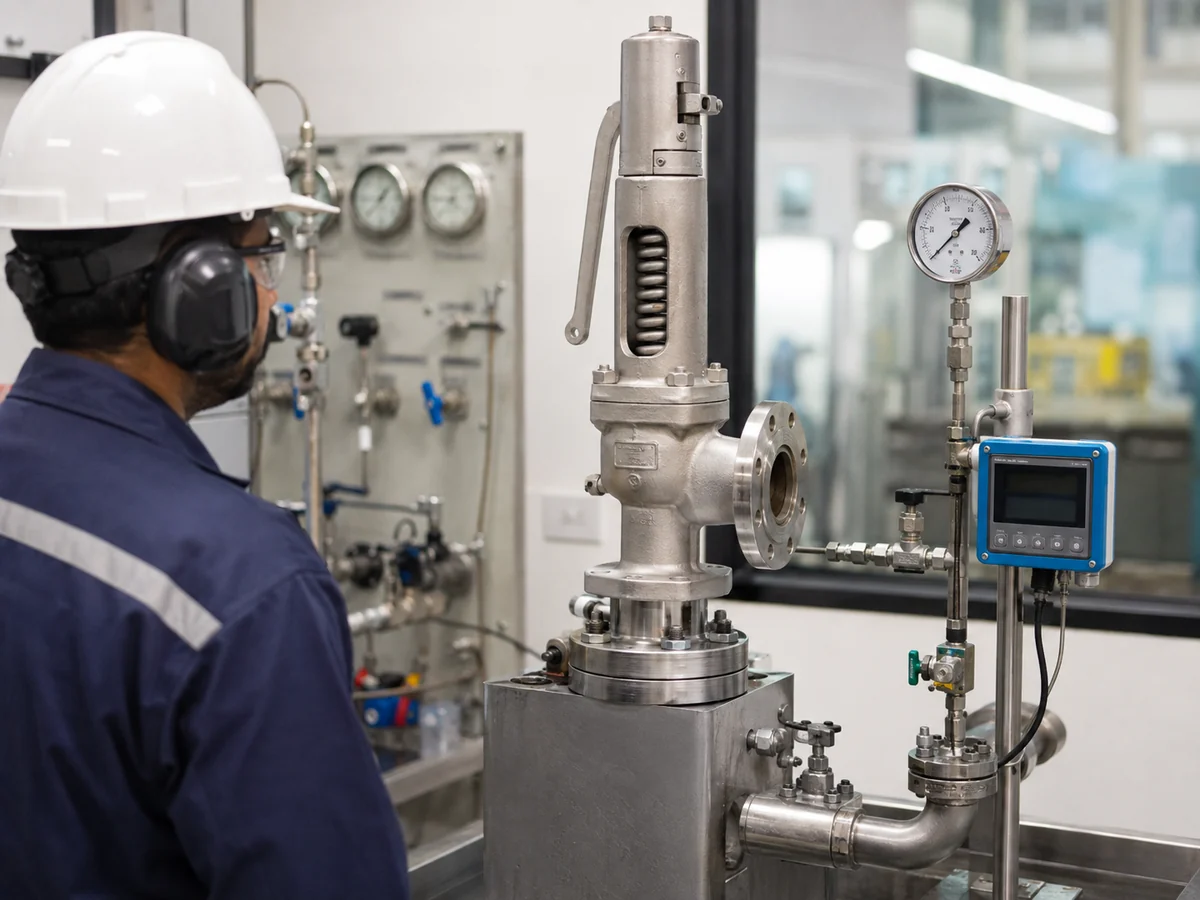
Escena conceptual de pruebas industriales; los instrumentos mostrados no representan un resultado de calibración real de ZOBAI.
Lo que una prueba de presión de ajuste no puede verificar por sí sola
Una presión de ajuste correcta no demuestra una capacidad adecuada
Una válvula puede demostrar el ajuste de apertura requerido y aun así estar subdimensionada para el escenario de alivio gobernante. La presión de ajuste responde cuándo responde la válvula; la capacidad aborda si puede pasar suficiente flujo másico o volumétrico en las condiciones de alivio.
La capacidad de alivio requerida debe establecerse por separado y compararse con la capacidad certificada o documentada aceptada de la válvula seleccionada. Las bases de capacidad para vapor, gas, líquido y dos fases no deben tratarse como intercambiables.
La calibración no sustituye la prueba de estanqueidad del asiento
Una válvula puede cumplir el requisito de presión de apertura y aun así tener fugas a través del asiento cerrado. Por lo tanto, la condición de la superficie del asiento, la contaminación, la alineación, el estado del asiento blando o la calidad de la reparación pueden requerir una investigación y pruebas de fugas por separado.
Cuando se requiera la verificación de la estanqueidad del asiento, revise la
Prueba de estanqueidad de asiento API 527
orientación en lugar de tratar la calibración de la presión de ajuste como aceptación de fugas.
Los resultados de banco no sustituyen la revisión del sistema instalado
Una prueba de banco no reproduce la ruta de alivio completa instalada. La presión de ajuste correcta por sí sola no demuestra que la pérdida de presión de entrada, la resistencia de salida, la contrapresión superpuesta, la contrapresión acumulada, la reacción de descarga, el drenaje, la carga de tuberías o la disposición del venteo del bonete sean aceptables. Para una revisión específica de la configuración, consulte
Contrapresión y fuelle.
Las preguntas de instalación, como la geometría de las tuberías, el soporte, el drenaje y la descarga segura, pertenecen a la
guía de instalación de válvulas de seguridad
y a la revisión de ingeniería real del proyecto.
Prueba de palanca de elevación vs. prueba de presión de ajuste: matriz de evidencia
| Pregunta de verificación | Comprobación de la palanca de elevación | Prueba de Presión de Tarado | ¿Se requiere evidencia adicional? |
|---|---|---|---|
| La palanca/vinculación externa se mueve | Evidencia funcional limitada | No es su propósito principal | Inspeccione si la respuesta es anormal |
| El disco/husillo se puede desplazar mecánicamente | Evidencia limitada | Puede observarse durante la apertura | Es posible que aún se requiera una inspección interna |
| Presión de ajuste especificada / respuesta de apertura | No | Verificado bajo condiciones de prueba definidas | Procedimiento aprobado y registro de prueba |
| Condición de ajuste tal como se encontró / tal como se dejó | No | Sí | Registrar condición de prueba y ajustes |
| Estanqueidad del asiento | Sin prueba formal | No automáticamente | Prueba de fugas separada |
| Capacidad de alivio requerida | No | No | Cálculo de escenario de alivio |
| Capacidad certificada/documentada | No | No | Evidencia del fabricante/certificación |
| Rendimiento de purga / reasentamiento | No | Solo si se incluye específicamente en el procedimiento de prueba | Prueba de rendimiento aplicable |
| Pérdida de presión de entrada | No | No | Revisión de la tubería instalada |
| Contrapresión superpuesta / acumulada | No | No se establece normalmente solo con la prueba de ajuste | Revisión del sistema y la configuración de la válvula |
| Adecuación completa de la protección contra presión instalada | No | No | Revisión completa de ingeniería |
El tamaño de la conexión ≠ capacidad de alivio.
Una válvula de reemplazo puede encajar físicamente en la brida o rosca existente y aun así tener un área de flujo, coeficiente, capacidad certificada o base de servicio aplicable diferente.
Una válvula de reemplazo puede encajar físicamente en la brida o rosca existente y aun así tener un área de flujo, coeficiente, capacidad certificada o base de servicio aplicable diferente.
Cómo interpretar un resultado de prueba sin exagerar
Un registro de mantenimiento útil debe vincular cada resultado a una pregunta de ingeniería específica. Evite reducir varias preguntas de aceptación independientes a un solo “PASS” genérico.
| Resultado observado | Conclusión de ingeniería razonable | Conclusión que aún requiere evidencia |
|---|---|---|
| La palanca y el enlace se movieron | Se observó movimiento mecánico bajo la condición de verificación | Presión de ajuste especificada, capacidad y aceptación de estanqueidad del asiento |
| La válvula volvió después de soltar la palanca | El mecanismo regresó a la posición de asiento | Cumplimiento formal de estanqueidad del asiento |
| Válvula abierta en la condición de prueba en banco requerida | Se verificó la respuesta de apertura basada en presión para esa condición de prueba | Capacidad requerida y adecuación del sistema instalado |
| La presión de ajuste final es aceptable | La válvula ajustada cumplió con la base de aceptación de presión de ajuste adoptada | Por qué cambió la condición inicial y si el servicio causó deriva o daño |
| El tamaño de la conexión de reemplazo coincide | La interfaz física puede ser compatible | Capacidad equivalente, materiales, configuración de la válvula e idoneidad del código |
Por qué una válvula puede pasar una prueba y aún tener otro problema
Escenario de ingeniería compuesto para capacitación
La palanca se mueve, pero la presión de ajuste es incorrecta
Problema observado: la palanca se mueve libremente y la válvula parece regresar, pero la prueba basada en presión está fuera del objetivo de presión de ajuste aprobado.
Causa técnica: el levantamiento manual solo demuestra un movimiento mecánico limitado; la condición del resorte, el ajuste o el historial de servicio aún pueden afectar el ajuste de presión.
Corrección: registre el resultado tal como se encontró, inspeccione el mecanismo correspondiente y ajuste o repare únicamente según el procedimiento aprobado antes de repetir la prueba basada en presión.
Prevención: mantenga registros de condición inicial/final e investigue la deriva recurrente en lugar de usar una verificación exitosa de la palanca como evidencia de calibración.
Escenario de ingeniería compuesto para capacitación
La presión de ajuste pasa, pero la fuga persiste
Problema observado: la válvula cumple con la condición de prueba de presión de ajuste definida pero no cumple con el requisito separado de estanqueidad del asiento.
Causa técnica: la calibración de apertura y el sellado del asiento cerrado son cuestiones de rendimiento diferentes; la contaminación, el daño del asiento, la alineación o la condición del sello pueden afectar la fuga.
Corrección: realice la evaluación de fugas aplicable, inspeccione los componentes del asiento y complete la ruta de reparación autorizada si no se cumple el criterio de aceptación.
Prevención: mantenga los resultados de presión de ajuste y estanqueidad del asiento como líneas de aceptación separadas en la documentación de prueba y reparación.
Escenario de ingeniería compuesto para capacitación
La presión de ajuste es correcta, pero la capacidad sigue siendo incierta
Problema observado: una válvula de reemplazo se ajusta a la tubería y pasa la calibración de presión de ajuste, pero el proceso protegido ha sido modificado.
Causa técnica: la carga de alivio gobernante, las propiedades del fluido o el sistema de descarga pueden haber cambiado aunque el tamaño de la conexión y la presión de ajuste permanezcan sin cambios.
Corrección: revalide el escenario de alivio y la capacidad requerida, luego compare el resultado con la capacidad documentada de la válvula seleccionada para el fluido y las condiciones de alivio aplicables.
Prevención: incluya la revisión de alivio de presión en la gestión del cambio siempre que cambien el caudal del proceso, la composición, la entrada de calor, los casos de salida bloqueada o las condiciones del cabezal común.
La estanqueidad del asiento, la capacidad y el soplado son preguntas de verificación separadas
Estanqueidad de asiento
La estanqueidad del asiento aborda las fugas a través de la válvula cerrada y requiere su propia base de aceptación cuando dicha prueba sea aplicable.
Capacidad de alivio
La capacidad de alivio requerida comienza con el equipo protegido y el escenario de alivio gobernante. La capacidad de la válvula seleccionada debe confirmarse luego contra la base de fluido relevante, las condiciones de alivio y los datos aceptados del fabricante o de certificación.
Purga y cierre
La presión de ajuste y el comportamiento de cierre están relacionados pero no son parámetros intercambiables. El rendimiento de purga o de reasentamiento solo debe declararse como verificado cuando el procedimiento aplicable realmente lo mide y evalúa. Para el límite de terminología entre estas variables, consulte
presión de ajuste, sobrepresión y purga.
Qué debe provocar un resultado de prueba anormal a continuación
| Observación | Posible preocupación de ingeniería | Siguiente comprobación |
|---|---|---|
| La palanca no se mueve con normalidad | Atascamiento, corrosión, daño en el mecanismo de enlace, depósitos o problema de ensamblaje | Deje de tratar la verificación de la palanca como evidencia rutinaria; inspeccione el mecanismo según el procedimiento de mantenimiento aprobado |
| La palanca se mueve pero la respuesta del disco es incierta | Juego, problema de vinculación o movimiento interno no confirmado | Verifique el tren de elevación y la condición interna antes de aceptar el resultado funcional |
| La válvula no regresa con normalidad | Atascamiento mecánico, daño en el asiento, contaminación o desalineación | Inspección adicional y prueba de fugas aplicable |
| La presión de ajuste encontrada difiere del requisito aprobado | Deriva de ajuste, condición del resorte, influencia del servicio o ajuste previo incorrecto | Documente la condición encontrada, investigue la causa y luego ajuste solo bajo el procedimiento aprobado |
| La presión de ajuste pasa pero la fuga permanece | Condición del asiento/sello o contaminación | Evaluación separada de la estanqueidad del asiento y revisión de reparación |
| La válvula pasa la prueba de banco, pero el sistema ha cambiado | El escenario de alivio original, la capacidad o la base de contrapresión pueden dejar de ser válidos | Revisión de ingeniería de gestión del cambio y del sistema de alivio |
No fuerce una válvula dañada o incierta a través de una verificación manual de la palanca simplemente para obtener un APROBADO.
Si la condición de la válvula, la exposición al proceso o la seguridad de la descarga son inciertas, siga el procedimiento aprobado de mantenimiento, aislamiento e inspección para la instalación real.
Si la condición de la válvula, la exposición al proceso o la seguridad de la descarga son inciertas, siga el procedimiento aprobado de mantenimiento, aislamiento e inspección para la instalación real.
Cuándo una verificación con palanca de elevación no debe tratarse como una prueba rutinaria universal
Antes de considerar la elevación manual, confirme:
- la válvula seleccionada está diseñada con un dispositivo de elevación apropiado;
- el código adoptado, la jurisdicción y el procedimiento del propietario-usuario permiten la verificación prevista;
- las instrucciones del fabricante respaldan la prueba bajo la condición operativa real;
- la presión del proceso y el estado del servicio son apropiados para el procedimiento aprobado;
- el medio y la ruta de descarga no crean una exposición inaceptable para el personal o el medio ambiente;
- se ha considerado el servicio tóxico, corrosivo, sucio, polimerizante, condensante o de otro modo peligroso;
- no se sospecha que la válvula tenga daños mecánicos graves.
No copie un porcentaje universal de presión de elevación en cada procedimiento de mantenimiento. La condición real debe confirmarse contra el código de equipo adoptado, el diseño de la válvula, las instrucciones del fabricante, el procedimiento del propietario-usuario y la jurisdicción.
Qué deben registrar los equipos de mantenimiento y control de calidad
“Válvula de seguridad probada — OK” proporciona muy poca información para el próximo ingeniero, inspector o revisor de reparaciones. Un registro útil debe distinguir la prueba realizada, la condición de la prueba y la evidencia realmente obtenida. Para el marco de inspección más amplio, consulte el
guía de mantenimiento e inspección de válvulas de seguridad.
- Fabricante de la válvula e identificación
- Información de la placa de características
- Equipo protegido
- Medio y fase de servicio
- Tipo de prueba realizada
- Medio de prueba
- Procedimiento de prueba aplicable
- Presión de ajuste encontrada
- Objetivo de prueba requerido / CDTP cuando corresponda
- Ajuste realizado
- Presión de ajuste final
- Resultado de estanqueidad del asiento si se probó por separado
- Condición mecánica observada
- Piezas inspeccionadas, reparadas o reemplazadas
- Identificación del resorte o asiento blando cuando corresponda
- Datos de trazabilidad o resellado cuando corresponda
- Identificación del equipo de prueba cuando se requiera
- Requisito aplicable del proyecto / código / propietario-usuario
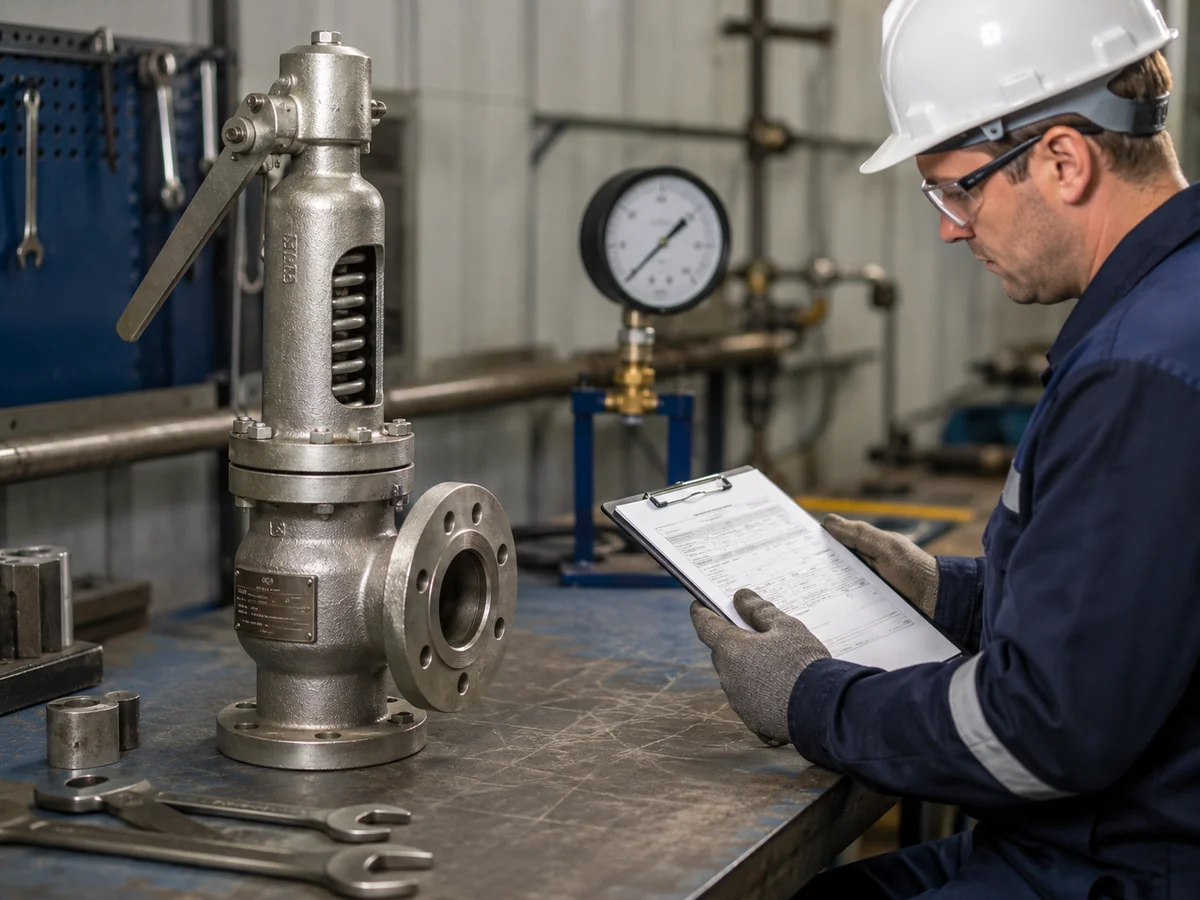
Escena de documentación conceptual; ningún formulario mostrado representa un certificado real o informe de prueba del cliente.
Flujo de trabajo de decisión: ¿Qué evidencia necesita realmente?
¿Necesita evidencia de que la palanca y el tren de elevación mecánico pueden moverse?
Una verificación funcional permitida de la palanca de elevación puede proporcionar evidencia mecánica limitada.
Una verificación funcional permitida de la palanca de elevación puede proporcionar evidencia mecánica limitada.
¿Necesita verificar la respuesta de apertura basada en presión especificada?
Utilice la prueba de presión de ajuste aplicable y registre la condición de prueba real y la base de aceptación.
Utilice la prueba de presión de ajuste aplicable y registre la condición de prueba real y la base de aceptación.
¿Necesita verificar la fuga del asiento cerrado?
Utilice la prueba de estanqueidad del asiento aplicable en lugar de inferir el rendimiento de fugas a partir de la calibración de presión de ajuste.
Utilice la prueba de estanqueidad del asiento aplicable en lugar de inferir el rendimiento de fugas a partir de la calibración de presión de ajuste.
¿Necesita verificar la capacidad de alivio requerida?
Revise el escenario de alivio gobernante, el medio y la fase, la tasa de alivio requerida, la temperatura de alivio, la presión de alivio y la evidencia aceptada de capacidad de la válvula.
Revise el escenario de alivio gobernante, el medio y la fase, la tasa de alivio requerida, la temperatura de alivio, la presión de alivio y la evidencia aceptada de capacidad de la válvula.
¿Necesita verificar la protección instalada completa?
Revise la presión de operación, la MAWP/presión de diseño, la presión de ajuste, la pérdida de entrada, la contrapresión superpuesta, la contrapresión acumulada, la tubería de descarga, la reacción/soporte, el drenaje, la configuración de la válvula, los materiales y los requisitos aplicables del proyecto/código.
Revise la presión de operación, la MAWP/presión de diseño, la presión de ajuste, la pérdida de entrada, la contrapresión superpuesta, la contrapresión acumulada, la tubería de descarga, la reacción/soporte, el drenaje, la configuración de la válvula, los materiales y los requisitos aplicables del proyecto/código.
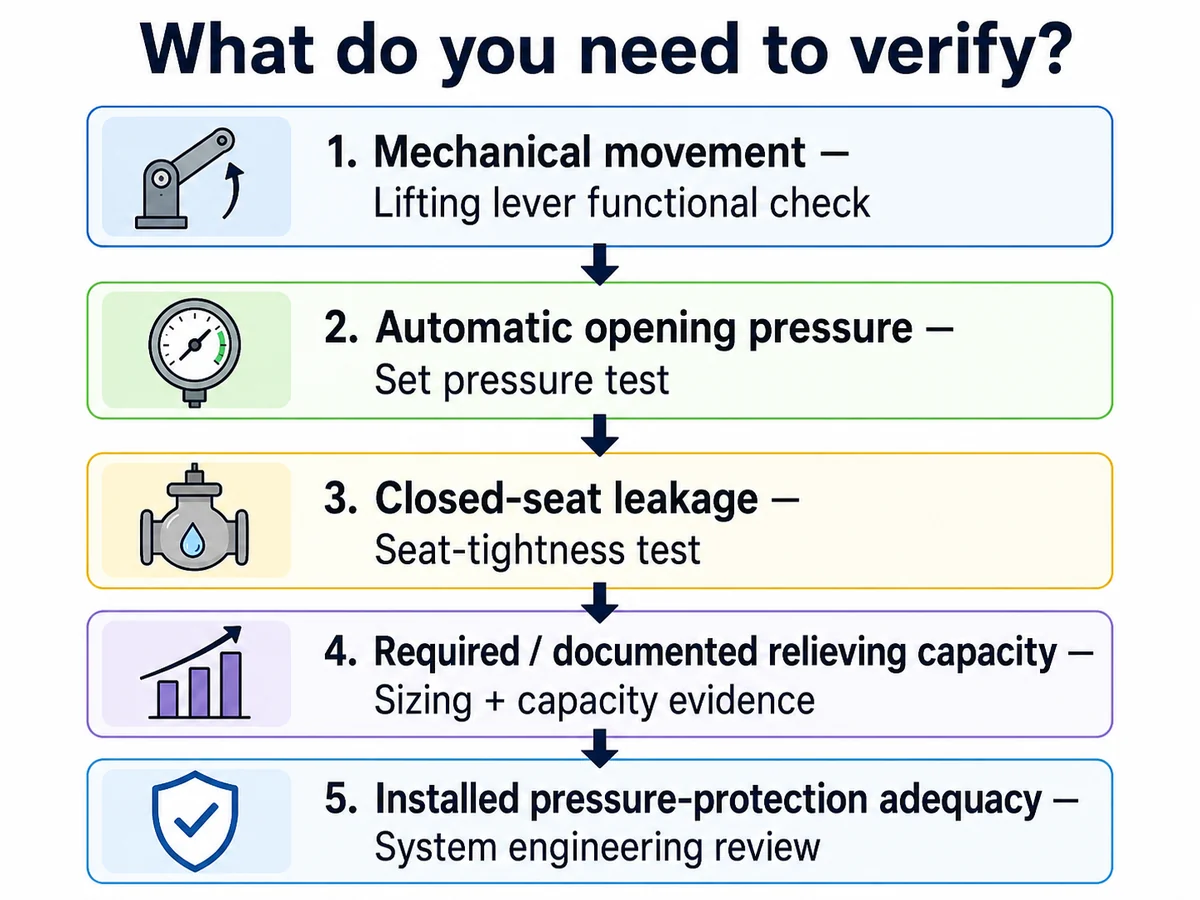
Herramienta simplificada de apoyo a la decisión de ingeniería; la aceptación específica del proyecto aún requiere el procedimiento aplicable y la base de ingeniería.
Para una revisión más amplia del sistema, utilice la
centro de ingeniería de válvulas de seguridad hub.
No Apruebe un Reemplazo Solo con Base en el Resultado de la Prueba
No se debe aceptar una válvula de reemplazo simplemente porque pase una prueba de presión de ajuste o comparta las dimensiones nominales de entrada y salida de la válvula anterior.
Antes de aceptar el reemplazo, confirme:
- que el equipo protegido y el escenario de alivio gobernante no han cambiado o han sido revalidados;
- que la capacidad de alivio requerida sigue siendo vigente;
- que la válvula seleccionada tenga una base de capacidad documentada adecuada;
- que la configuración de la válvula sea adecuada para las condiciones reales de contrapresión;
- que el medio, la fase y la temperatura de alivio sean compatibles con los materiales seleccionados y el sistema de asiento/sello;
- que el resorte, el fuelle y las partes húmedas relevantes sean adecuados para el servicio;
- que las conexiones de entrada/salida y las clasificaciones de presión-temperatura sean correctas;
- que se cumplan los requisitos del proyecto/código y de documentación adoptados.
Información a confirmar antes de la solicitud de cotización, reparación o reemplazo
No envíe únicamente el tamaño nominal de la válvula. Antes de la cotización, reparación o revisión de reemplazo, proporcione los datos reales de protección de presión cuando estén disponibles:
- Equipo protegido
- Escenario de alivio principal
- Medio y fase
- Presión de operación
- Presión máxima de trabajo admisible (MAWP) o presión de diseño
- Presión de tarado
- Capacidad de alivio requerida y base de cálculo
- Temperatura de alivio
- Contrapresión superpuesta
- Contrapresión acumulada
- Detalles de las conexiones de entrada y salida
- Materiales del cuerpo / boquilla / disco / guía cuando corresponda
- Tipo de asiento / sello
- Requisitos de resorte y fuelle cuando corresponda
- Placa de identificación o hoja de datos de la válvula existente
- Registros de pruebas anteriores de as-found / as-left
- Código / especificación de proyecto aplicable
- Paquete de inspección, calibración y documentación requerido
Preguntas Frecuentes
¿Una prueba exitosa de la palanca de elevación demuestra que la presión de ajuste de la válvula de seguridad es correcta?
No. Una comprobación con palanca de elevación aplica fuerza mecánica al conjunto móvil. No mide la presión de entrada a la cual la válvula demostrará su respuesta de apertura automática especificada.
¿Puede una prueba con palanca de elevación reemplazar una prueba de presión establecida?
No cuando se requiere verificación de presión de ajuste. La comprobación de la palanca proporciona evidencia limitada de funcionamiento mecánico, mientras que la prueba de presión de ajuste proporciona evidencia de apertura basada en presión bajo condiciones de prueba definidas.
¿Una prueba de presión de ajuste demuestra que la válvula tiene suficiente capacidad de alivio?
No. La capacidad de alivio requerida debe provenir del escenario de alivio gobernante y compararse con la base de capacidad certificada o documentada aceptada de la válvula seleccionada para el fluido y las condiciones de alivio aplicables.
¿Superar una prueba de presión establecida significa que la válvula no tendrá fugas?
No necesariamente. La presión de ajuste y la estanqueidad del asiento son objetivos de prueba separados. Cuando se requiera aceptación de fugas, debe verificarse utilizando el procedimiento aplicable de estanqueidad del asiento.
¿Por qué se deben registrar tanto la presión de ajuste como la presión de ajuste final?
Los datos de recepción muestran la condición recibida del servicio, mientras que los datos de salida registran la condición después del ajuste o reparación autorizados. Mantener ambos ayuda a identificar desviaciones, problemas de mantenimiento y cambios a lo largo del tiempo.
¿Se puede levantar manualmente cada válvula de seguridad durante la operación?
No debe asumirse ninguna regla universal. Primero deben verificarse el diseño de la válvula, el medio, la condición del proceso, la seguridad de descarga, las instrucciones del fabricante, el código adoptado, la jurisdicción y el procedimiento del propietario-usuario.
¿Se puede seleccionar una válvula de repuesto solo por el tamaño de conexión y la presión de ajuste?
No. La revisión de reemplazo también debe confirmar el escenario de alivio gobernante, la capacidad requerida y documentada, las condiciones de alivio, la contrapresión, los materiales, la configuración de la válvula, la clasificación de la conexión y los requisitos aplicables del proyecto/código.
Referencias Técnicas Oficiales
Estas fuentes respaldan el alcance de ingeniería y la terminología utilizada en este artículo. No prueban la certificación o el cumplimiento de una válvula ZOBAI específica. Para un proyecto real, verifique la edición adoptada por el código del equipo, la especificación del propietario-usuario y la jurisdicción.
-
ASME BPVC Sección XIII — Normas para Protección contra Sobrepresión
— ASME actualmente enumera la edición 2025 e identifica el diseño, material, inspección, ensamblaje, pruebas y marcado entre los temas de dispositivos de alivio de presión de la sección. -
ISO 4126-1:2013 — Válvulas de Seguridad
— ISO establece que esta edición fue revisada y confirmada en 2025 y sigue vigente; es una norma de producto para válvulas de seguridad, no un método completo de diseño de aplicación. -
API RP 576 — Inspección de dispositivos de alivio de presión
— API identifica la RP 576 como su práctica de inspección para dispositivos de alivio de presión; los materiales de certificación actuales API indican la 5.ª edición, septiembre de 2024. Verifique la edición adoptada por el proyecto. -
National Board — Consideraciones de temperatura para la aplicación de válvulas de alivio de presión
— explica por qué el medio de prueba, la temperatura y las condiciones de presión de ajuste en frío son importantes al relacionar un resultado de prueba con el servicio.
Las normas y referencias técnicas son fuentes de evidencia, no sustitutos de los datos del fabricante de la válvula seleccionada, el cálculo del escenario de alivio, la especificación del proyecto o los requisitos jurisdiccionales.
Normas y limitaciones de ingeniería
Los requisitos de prueba y aceptación de válvulas de seguridad varían según el equipo protegido, el diseño de la válvula, el servicio, el medio de prueba, la jurisdicción y la norma o edición del código adoptado.
Los nombres de las normas en este artículo explican solo el alcance de ingeniería. No implican que cada producto ZOBAI cuente automáticamente con todas las aprobaciones, certificaciones o marcados referenciados.
¿Necesita confirmar qué demuestra realmente su prueba actual?
Envíe el equipo protegido, el escenario de alivio, el medio y la fase, la presión de operación, la presión MAWP/de diseño, la presión de ajuste, la capacidad de alivio requerida, la temperatura de alivio, la contrapresión superpuesta y acumulada, los detalles de conexión, la placa de identificación de la válvula y los registros de prueba disponibles tal como se encontraron/tal como se dejaron para revisión de ingeniería.