Leitfaden für Sicherheitsventile für korrosive Medien Was ist ein korrosionsbeständiges Sicherheitsventil? Materialien, Grenzwerte und Auswahlprüfungen Ein korrosionsbeständiges Sicherheitsventil ist eine druckentlastende Vorrichtung, deren Druckgrenze, benetzte Innenteile und exponierte Funktionsteile für ein definiertes korrosives Medium oder eine definierte korrosive Umgebung ausgewählt sind. Es ist nicht einfach nur ein Edelstahlventil. Die Mediumzusammensetzung, Konzentration, Phase, Verunreinigungen, …

Was ist ein korrosionsbeständiges Sicherheitsventil? Materialien, Grenzwerte und Auswahlprüfungen
Ein korrosionsbeständiges Sicherheitsventil ist eine druckentlastende Vorrichtung, deren Druckgrenze, benetzte Innenteile und exponierte Funktionsteile für ein definiertes korrosives Medium oder eine definierte korrosive Umgebung ausgewählt sind. Es ist nicht einfach nur ein Edelstahlventil. Die Mediumzusammensetzung, Konzentration, Phase, Verunreinigungen, normale und Entlastungstemperatur, Druck, Kondensationsrisiko, externe Atmosphäre und das Abgassystem bestimmen, welche Materialien und Konstruktionsdetails überprüft werden müssen. Die Korrosionsbeständigkeit muss die Teile abdecken, die das Öffnen, den Durchfluss, die Führung und das Wiederverschließen steuern – nicht nur den Körper. Das Ventil muss immer noch den richtigen Ansprechdruck, die dokumentierte Entlastungskapazität, die Druck-Temperatur-Einstufung, die Rückdruckreaktion und die Installation aufweisen. Eine Materialkennzeichnung, Flanschgröße oder Beschichtung kann die Eignung für die Anwendung nicht beweisen; die endgültige Auswahl erfordert modellspezifische Herstellerdaten, den übernommenen Projektstandard und ein vollständiges Service-Datenblatt.
Seitenumbruch: Diese Definitionsseite erklärt, was “korrosionsbeständiges Sicherheitsventil” bedeutet und welche technischen Prüfungen diese Beschreibung glaubwürdig machen. Sie bietet keine universelle chemische Kompatibilitätstabelle, führt keine Entlastungsberechnungen durch, verspricht keine Materialgüte oder ersetzt ein modellspezifisches Datenblatt und eine Projektgenehmigung.
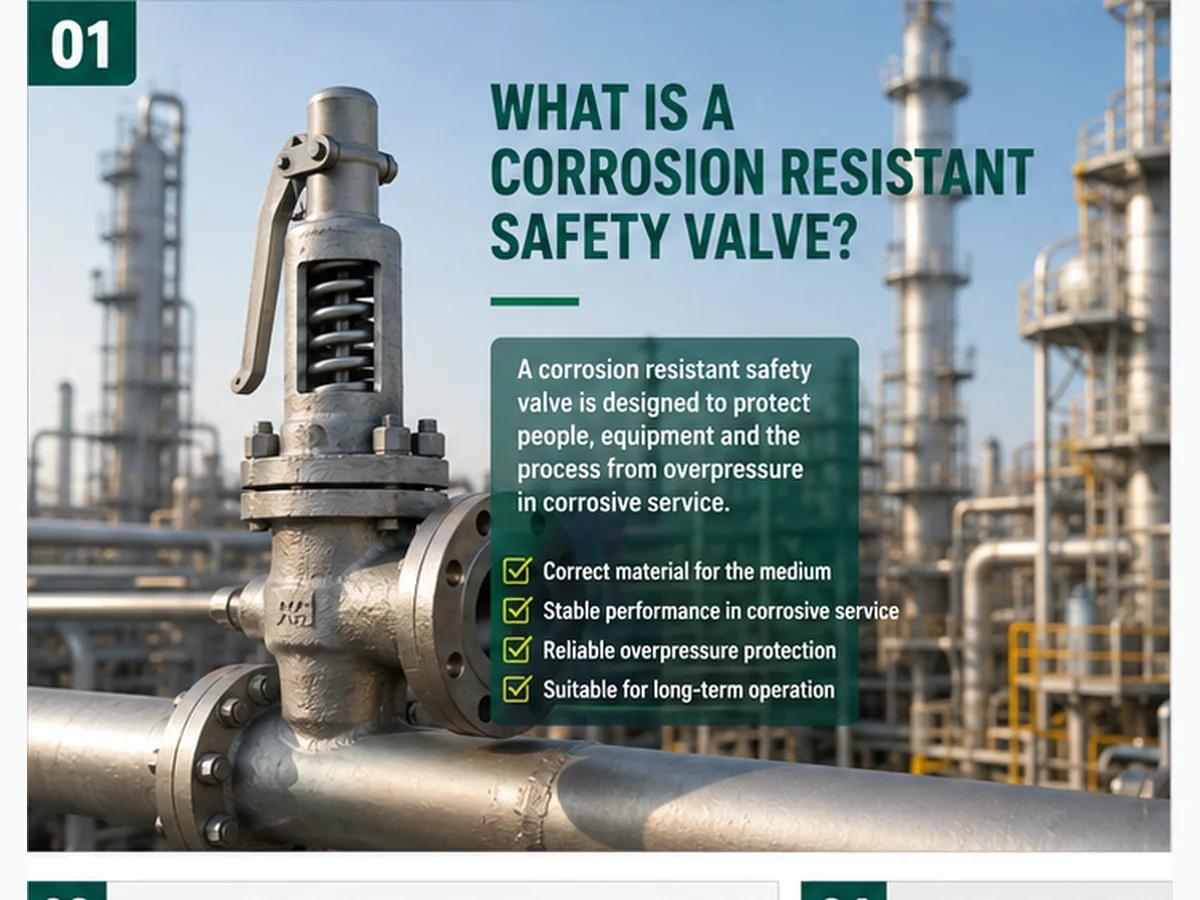
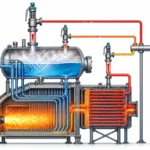
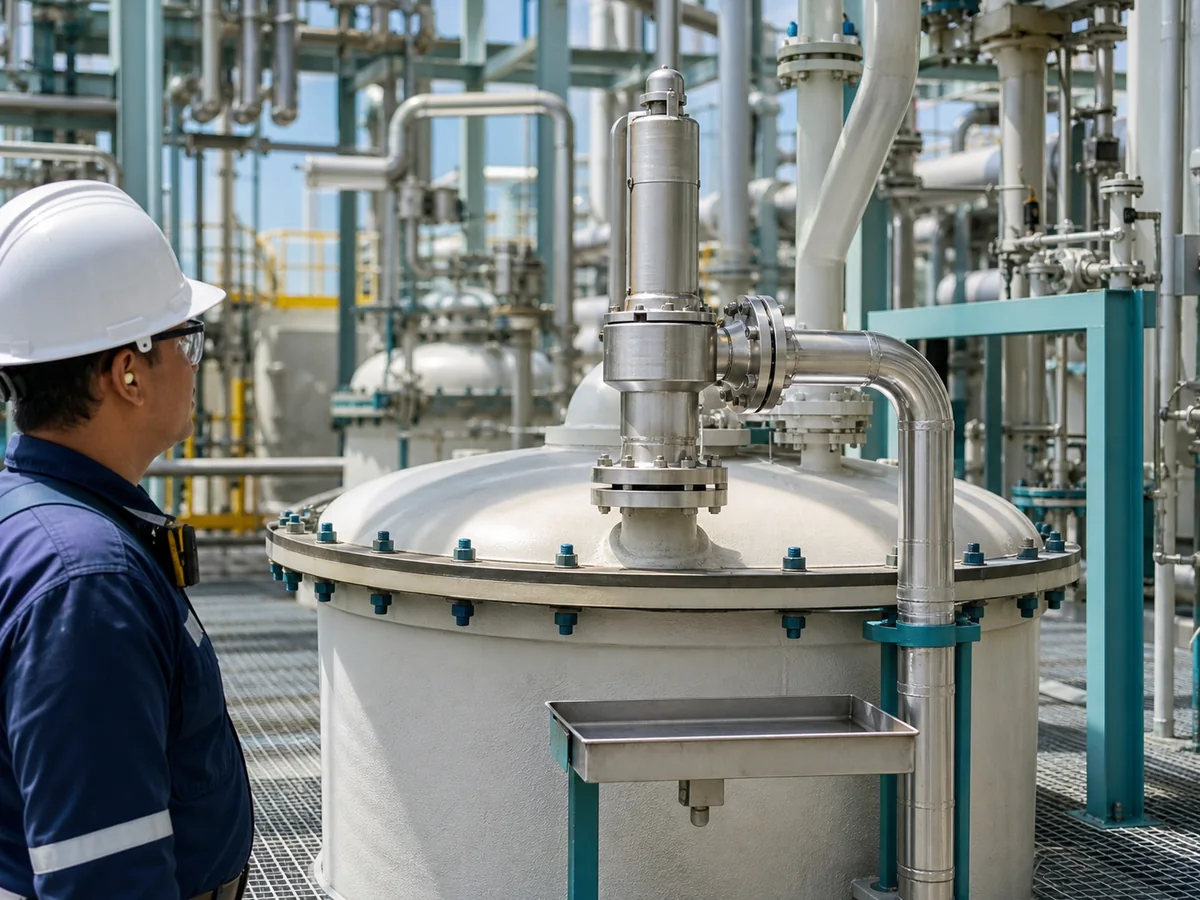
Industrielles Konzeptbild; die endgültige Materialeignung und Produktdetails müssen anhand des ausgewählten Ventildatenblatts und der Projektspezifikation bestätigt werden.
Schnelle Antwort
Ein korrosionsbeständiges Sicherheitsventil wird für ein bestimmtes korrosives Fluid oder eine bestimmte korrosive Umgebung ausgewählt, wobei die Materialkompatibilität über die Druckgrenze, den Trim, die Führungsteile, die Federkammer, den Faltenbalg, die Dichtungen, die Verschraubungen und den Abflussweg geprüft wird. Edelstahl allein ist kein Beweis für Kompatibilität. Das Ventil muss auch den erforderlichen Ansprechdruck, die Entlastungskapazität, die Temperatur, den Gegendruck, die Installation und die Dokumentationsgrundlage erfüllen.
- Definieren Sie das genaue Medium, die Konzentration, die Phase, die Verunreinigungen und die Entlastungstemperatur.
- Überprüfen Sie jede benetzte oder exponierte Funktionsteile, nicht nur den Körper.
- Trennen Sie die Materialeignung von der erforderlichen und zertifizierten/bemessenen Entlastungskapazität.
- Überprüfen Sie den Ausgangsgegendruck, die Entwässerung, die Federkammerbelastung und die Rohrleitungsbelastungen.
- Verwenden Sie das ausgewählte Modelldatenblatt und die übernommene Projektausgabe für die endgültige Genehmigung.
Was ist ein korrosionsbeständiges Sicherheitsventil?
Korrosive Medien
Materialprüfung
Kapazität weiterhin erforderlich
RFQ-Daten benötigt
Technische Definition
Ein korrosionsbeständiges Sicherheitsventil ist ein Sicherheitsventil, dessen Materialien und Konstruktion so ausgewählt sind, dass Korrosion, Spannungsrisskorrosion, Ablagerungen oder chemische Angriffe das Gerät nicht daran hindern, für den spezifizierten Einsatz zu öffnen, zu heben, abzublasen, zu führen, wieder zu schließen und druckdicht zu bleiben. Abhängig von der Exposition kann das Design Edelstahl- oder Nickellegierungs-Druckteile, korrosionsbeständige Trims, kompatible Metall- oder Weichdichtungen, geschützte Federkammerkonstruktionen, einen Faltenbalg, geeignete Dichtungen und externen Korrosionsschutz verwenden.
Es bleibt ein Überdruckschutzeinrichtung. Das ausgewählte Ventil muss gemäß seiner spezifizierten Öffnungseigenschaft öffnen, die erforderliche Abblaseleistung auf Basis des angegebenen Mediums abführen und innerhalb der geltenden Konstruktions- und Projektanforderungen wieder schließen. Produktfamiliennamen ersetzen nicht das Datenblatt des ausgewählten Modells. Für die umfassendere Entscheidungsfindung verwenden Sie die Leitfaden zur Auswahl von Sicherheitsventilen.
Terminologiegrenze: Sicherheitsventil, Druckentlastungsventil, PSV, PRV und SRV
Die Terminologie variiert je nach Normenfamilie und Branche. “Druckentlastungsventil” kann als allgemeine Geräte-Kategorie verwendet werden, während “Sicherheitsventil”, “Entlastungsventil” und “Sicherheits-Entlastungsventil” unterschiedliche Öffnungseigenschaften oder Medienanwendungen beschreiben können. PSV und SRV sind gängige Projektkürzel. PRV ist mehrdeutig, da es auch für Druckreduzierventil stehen kann. Der Name allein kann keine Medienbasis, Pop- oder Proportionalverhalten, zertifizierte Kapazität, Code-Kennzeichnung oder Eignung festlegen; diese Punkte müssen aus dem Datenblatt des Ventils und der geltenden Norm hervorgehen.
Schutzobjekt
Diese Ventile können Reaktoren, Druckbehälter, Wärmetauscher, Abscheider, Nassgas-Systeme, Chemikalienlager- oder -transportausrüstungen, Wäscher, Rohrleitungen und Paket-Systeme schützen. Die Auswahl beginnt mit der geschützten Druckgrenze und dem maßgebenden Abblaseszenario, da diese die erforderliche Kapazität, Phasenlage des Mediums, Abblasetemperatur und Entlastungsbedingung bestimmen.
Was “korrosionsbeständig” nicht automatisch bedeutet
“Korrosionsbeständig” bedeutet nicht geeignet für jede Säure, Lauge, chloridhaltige Flüssigkeit, Lösungsmittel, Sauergas, feuchten Dampf, Meeresatmosphäre oder Mehrphasenprozess. Es bedeutet nicht, dass das Gehäusematerial die Düse, den Kegel, die Führung, die Spindel, die Feder, den Faltenbalg, die Dichtung, den O-Ring, die Verschraubung oder das Auslasssystem schützt. Es beweist auch keine Druckstufe, Dichtheit des Sitzes, Abblasekapazität, Normenzertifizierung oder Prüfumfang.
Auswahlgrenze: Materialverträglichkeit ist eine unabhängige Qualifikation. Kapazität, Ansprechdruck, Betriebsmarge, Druck-Temperatur-Eignung, Gegendruck, Installation und Dokumentation müssen separat verifiziert werden. Ein Ventil kann dem Medium widerstehen und dennoch unterdimensioniert, instabil oder für das Projekt ungeeignet sein.
| Artikel | Praktische Bedeutung |
|---|---|
| Hauptfunktion | Automatische Überdrucksicherung für einen definierten korrosiven oder korrosionsgefährdeten Einsatz. |
| Normalzustand | Während des Normalbetriebs geschlossen und dicht bis zur spezifizierten Akzeptanzbasis. |
| Öffnungsgrundlage | Der spezifizierte Ansprechdruck und die Öffnungseigenschaft unter den geltenden Prüf- und Einsatzbedingungen. |
| Grundlage der Korrosionsprüfung | Tatsächliche Zusammensetzung, Konzentration, Phase, Verunreinigungen, normale und Abblasetemperatur, Druck, Kondensat und äußere Einwirkung. |
| Hauptauswahlrisiko | Behandlung eines generischen Materialnamens als Nachweis für Komponentenverträglichkeit, Kapazität, Stabilität und Dokumentation. |
Warum korrosiver Dienst die Auswahl von Sicherheitsventilen verändert
Korrosion kann die Druckgrenze oder den Betriebsmechanismus außer Funktion setzen
Korrosion kann Gehäuse und Oberteil ausdünnen oder reißen lassen, Düse und Kegel grubig machen, Führungs- oder Spindelreibung erhöhen, die Feder schwächen, einen Faltenbalg durchlöchern, eine Dichtung oder einen O-Ring angreifen, das Typenschild verdecken und die Einlass- oder Auslassrohre beschädigen. Ein Sicherheitsventil ist ein dynamisches Bauteil: Ein lokalisierter Angriff auf eine Führungs- oder Dichtfläche kann wichtiger sein als ein gleichmäßiger Wandverlust an anderer Stelle.
Zusammensetzung, Benetzungsphase, Verunreinigungen und Entlastungstemperatur beeinflussen das Materialverhalten
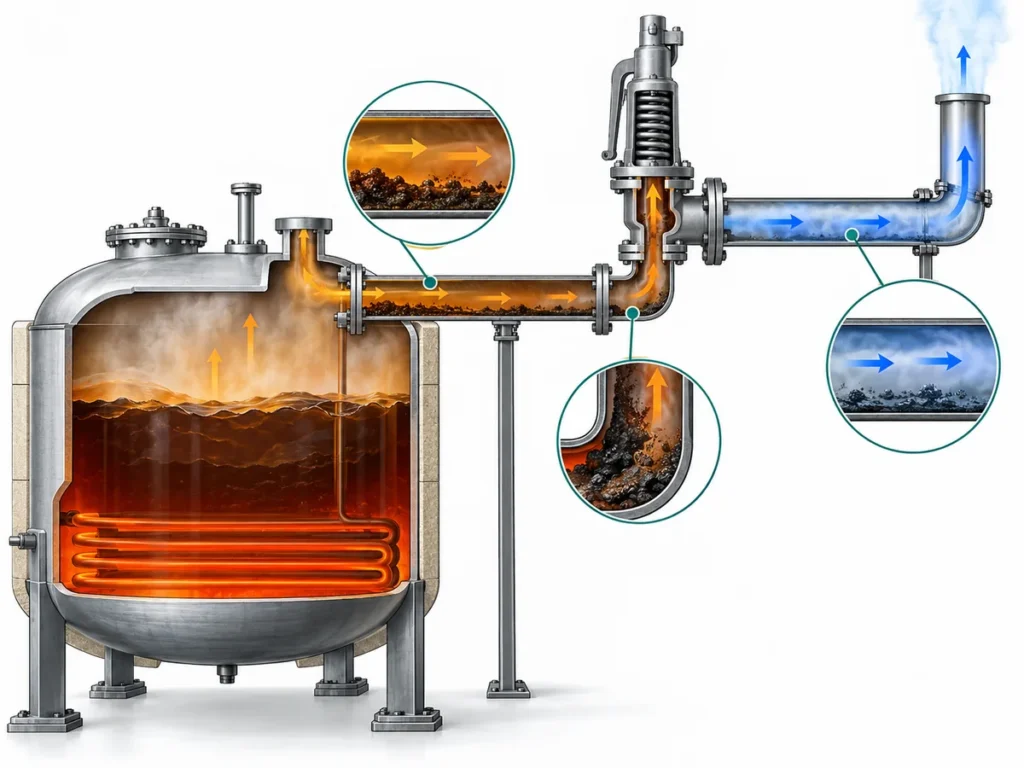
Die Kompatibilität muss unter den Bedingungen bewertet werden, denen die Komponente tatsächlich ausgesetzt ist. Trockenes Gas kann sich beim Abkühlen verflüssigen; Dampf kann sich im Oberteil oder in der Abblaseleitung kondensieren; Chloride können sich in Ablagerungen konzentrieren; Reinigungschemikalien können eine andere Exposition als das Prozessmedium erzeugen. Normale und Entlastungstemperaturen können die Korrosionsrate, die Temperaturgrenzen von Weichdichtungen, das Dichtungsverhalten und die zulässige Druckfestigkeit verändern. Bestätigen Sie das ausgewählte Ventil anhand der anwendbaren Druck-Temperatur-Werte.
Korrosionsprodukte können Leckagen, Festfressen, instabilen Hub und schlechtes Wiederverschließen verursachen
Die Druckgrenze kann scheinbar intakt bleiben, während Ablagerungen, Kristallisation, Polymerisation oder Korrosionsprodukte die Bewegung des Kegels und den Dichtsitz beeinträchtigen. Das daraus resultierende Symptom kann Leckage, verzögerte Öffnung, eingeschränkter Hub, Flattern, Schlagen oder Versagen des Wiederverschließens sein. Das Symptom allein identifiziert nicht die Ursache; Materialbeweise, Betriebshistorie, Rohrleitungsdaten und Inspektionsergebnisse müssen zusammen ausgewertet werden.
Komplexes technisches Szenario: Ein Datenblatt für Trockengas spezifiziert eine Gehäusekonstruktion aus Edelstahl, aber die Betriebslinie kühlt periodisch unter den Taupunkt von Sauergas ab. Kondensat erreicht die Führung und die Auslasskammer, was zu Ablagerungen und lokalisierter Korrosion führt. Das beobachtete Problem ist das Festfressen nach der Abschaltung. Die Korrektur besteht darin, die Benetzungsbedingung zu definieren, alle exponierten Teile und die Entwässerung zu überprüfen und Materialien anhand der tatsächlichen Kondensatchemie auszuwählen. Die vorbeugende Maßnahme ist, die Taupunkt- und Start-/Stoppbedingungen in der Anfrage (RFQ) anzugeben. Dies ist ein Schulungsszenario, kein Kundenbericht.
Für H2Bei der Förderung von schwefelhaltigem Öl und Gas oder bei der Süßung von Erdgas kann ISO 15156 / NACE MR0175 für die Auswahl von rissbeständigen metallischen Werkstoffen relevant sein. Sie ergänzt, ersetzt aber nicht den anwendbaren Konstruktionscode. Sie sollte nicht jeder Anfrage für chemische Anwendungen hinzugefügt oder als allgemeiner Standard für Säure-, Chlorid- oder nachgeschaltete Raffineriekompatibilität behandelt werden.
Verwenden Sie ISO 15156 / NACE MR0175 nur für die Dienste, die in ihren Geltungsbereich fallen
| Betriebsfaktor | Warum er die Auswahl verändert | Was zu bestätigen ist |
|---|---|---|
| Saure oder alkalische Medien | Kann Druckteile, Trimmteile, Dichtsitze und Dichtungen angreifen; das Korrosionsverhalten ändert sich mit Konzentration und Temperatur. | Zusammensetzung, Konzentrationsbereich, Verunreinigungen, Phase, normale und Entlastungstemperatur. |
| Chloride oder Meeresexposition | Kann bei anfälligen Materialien und Bedingungen lokale Korrosion oder Spannungsrisskorrosion fördern. | Chloridquelle, Nass-/Trockenexposition, Temperatur, Ablagerungen, Spalten, Spülung und Außenatmosphäre. |
| Nasses Gas oder korrosives Dampf | Kondensat kann Teile freilegen, die während des normalen Dauerbetriebs nicht benetzt werden. | Taupunkt, Start-/Stoppbedingungen, Kondensatchemie, Entwässerung und Auslassführung. |
| Schmutzige, kristallisierende oder polymerisierende Medien | Ablagerungen können den Strömungspfad blockieren, die Reibung erhöhen oder den Sitz beschädigen. | Feststoffe, Viskosität, Kristallisations-/Polymerisationstendenz, Reinigungsmethode und Wartungshistorie. |
| Hohe oder niedrige Entlastungstemperatur | Kann Korrosionsmechanismen, mechanische Eigenschaften, Federverhalten und Dichtungsgrenzen verändern. | Normale, gestörte und Entlastungstemperatur sowie Druck-Temperatur-Bemessungsgrundlage. |
Ingenieurregel: Keine Legierung ist gegen jede korrosive Umgebung beständig. Wählen Sie Materialien anhand der tatsächlichen Exposition, verfügbarer Test- oder Servicedaten, mechanischer Anforderungen, Wartbarkeit und Kompatibilität mit benachbarten Komponenten – nicht anhand eines generischen Etiketts “korrosionsbeständig”.
Wo werden korrosionsbeständige Sicherheitsventile eingesetzt?
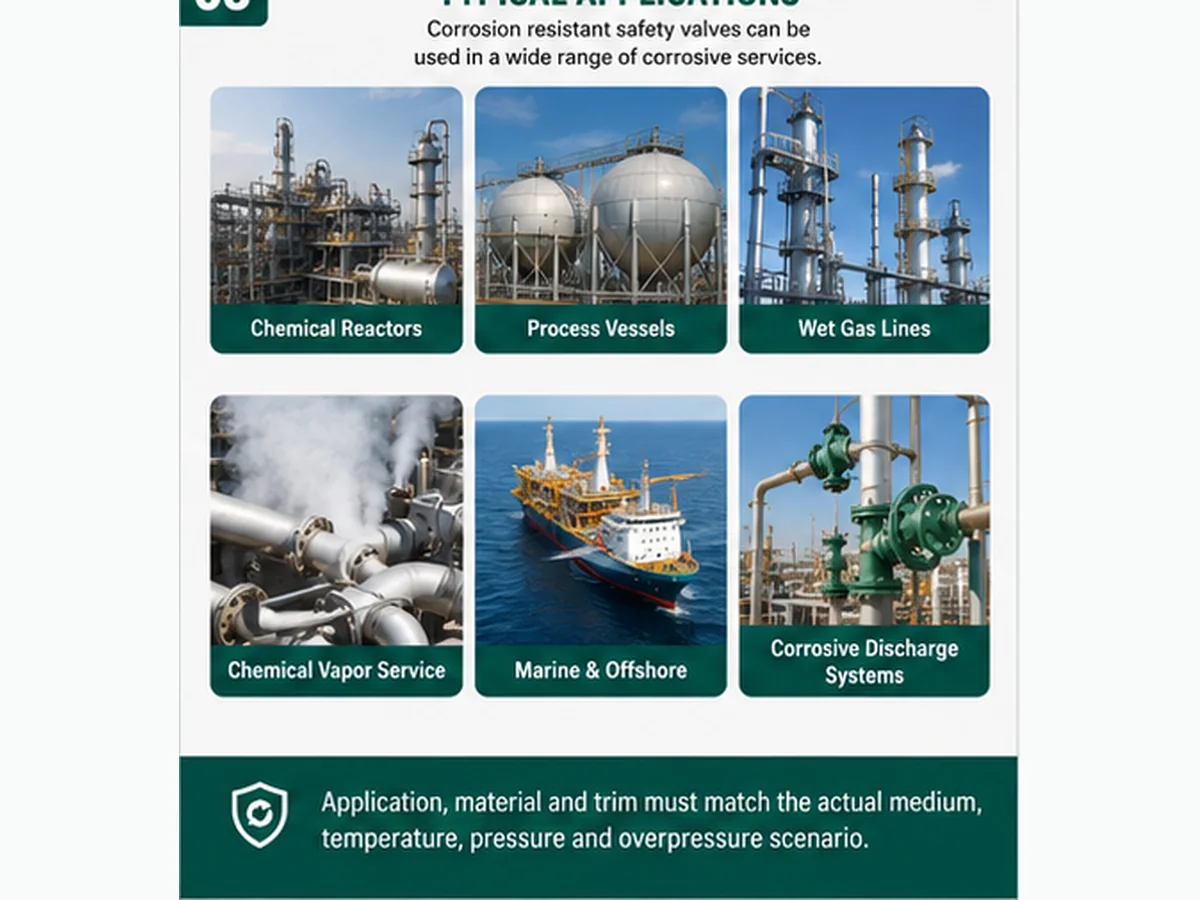
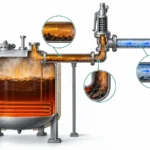
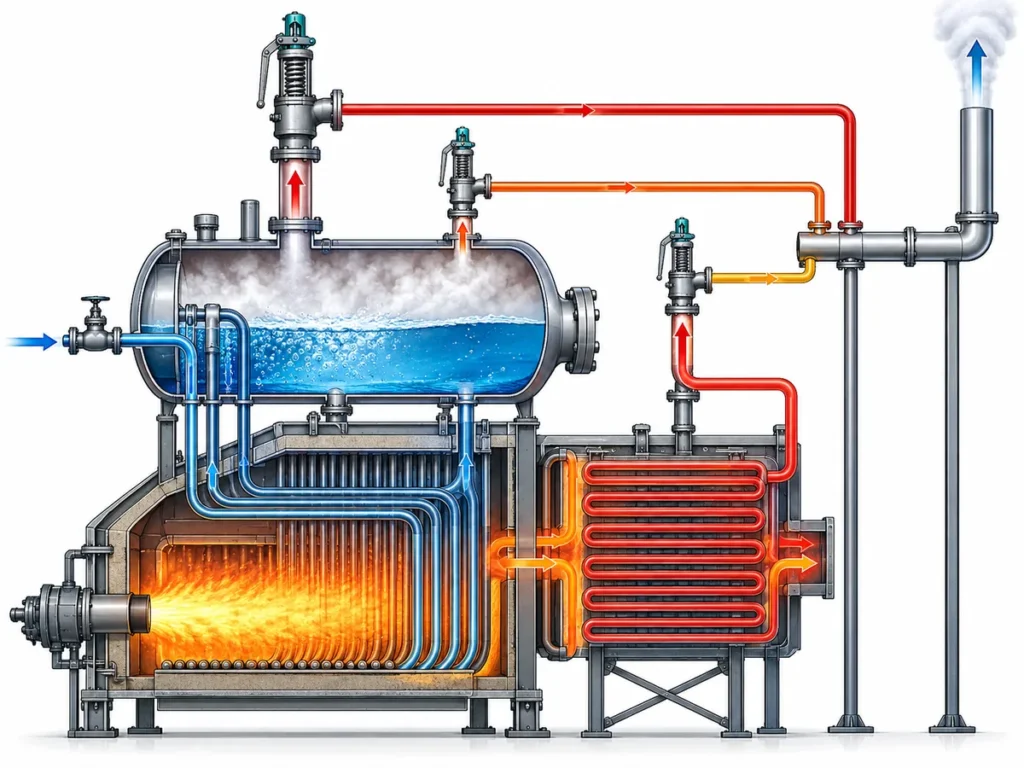
Vereinfachte Anwendungsübersicht für die Angebotsorientierung; die tatsächliche Ventilposition und Materialauswahl hängen von der geschützten Ausrüstung, dem Entlastungsszenario und der Projektprüfung ab.
Chemische und verfahrenstechnische Ausrüstung
Reaktoren, Druckbehälter, Wärmetauscher, Abscheider und Transportsysteme können dem Einlass und den benetzten Innenteilen Säuren, Laugen, Lösungsmitteln, Katalysatoren oder Reaktionsprodukten aussetzen. Das maßgebliche Entlastungsszenario und die Zusammensetzung des abgeleiteten Mediums können vom Normalbetrieb abweichen.
Nassgas-, Dampf- und Kondensationsbetrieb
Nasses Gas und korrosive Dämpfe erfordern eine Überprüfung des Taupunkts, des Kondensats und der Entwässerung, da das Ventil und das Ableitsystem eine flüssige Phase aufweisen können, die in der normalen Prozessbeschreibung fehlt.
Exposition im Freien, an Land und in korrosiver Atmosphäre
Äußere Einwirkungen können das Oberteil, das Federgehäuse, die Verschraubungen, die Kappe, den Hebel, die Entlüftungen, die Abläufe und das Typenschild beeinträchtigen, auch wenn das Prozessmedium nicht korrosiv ist. Beschichtung, Material, Entwässerung und Inspektionszugang sind separate Entscheidungen.
Hygienische Anwendungen stellen ein anderes Auswahlproblem dar.
Bei hygienischen Anwendungen stehen Reinigbarkeit, Entwässerungsfähigkeit, Oberflächengüte und Anforderungen an CIP/SIP oder Produktkontakt im Vordergrund. Ein hygienisches Ventil kann auch Korrosion ausgesetzt sein, aber “hygienisch” und “korrosionsbeständig” sind keine austauschbaren Produktdefinitionen.
Welche Teile erfordern eine Korrosionsprüfung?
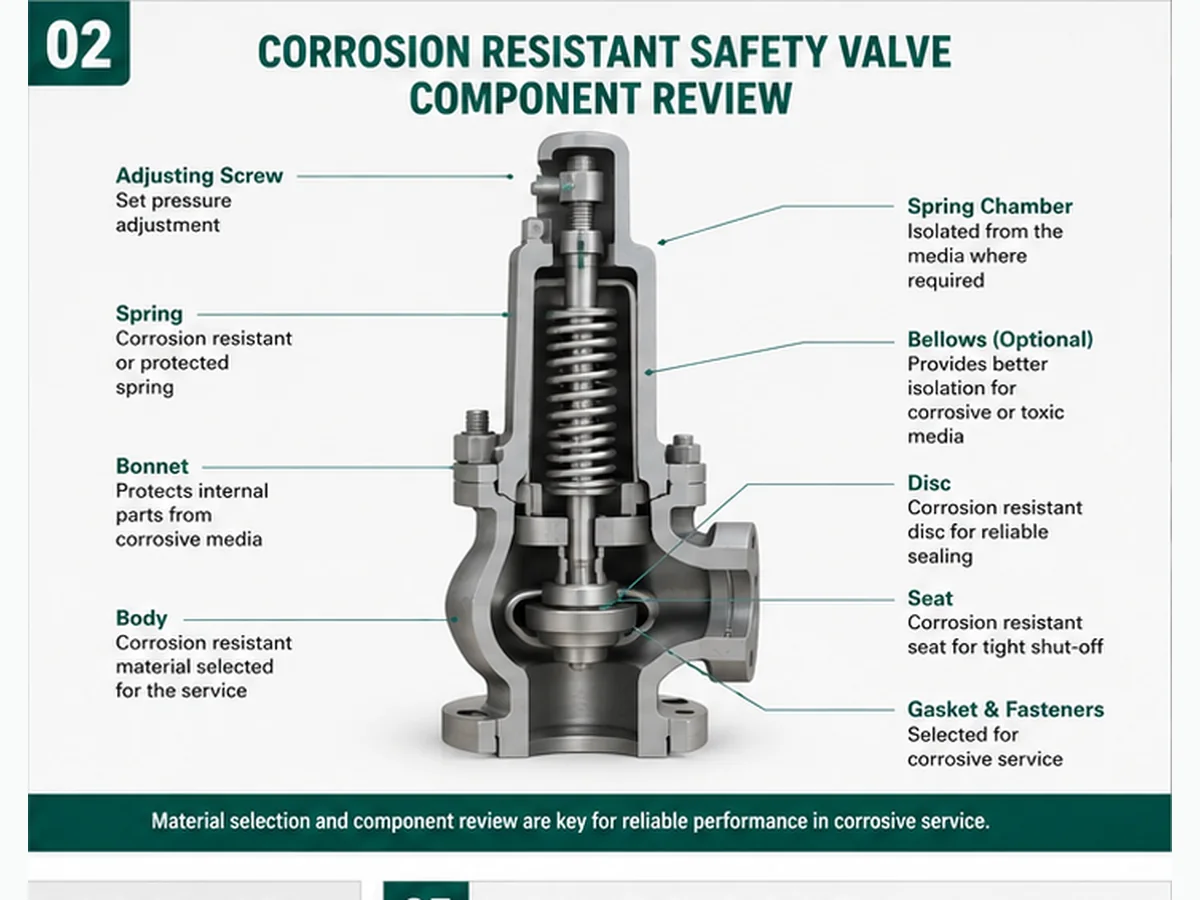
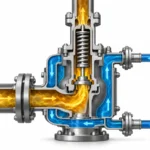
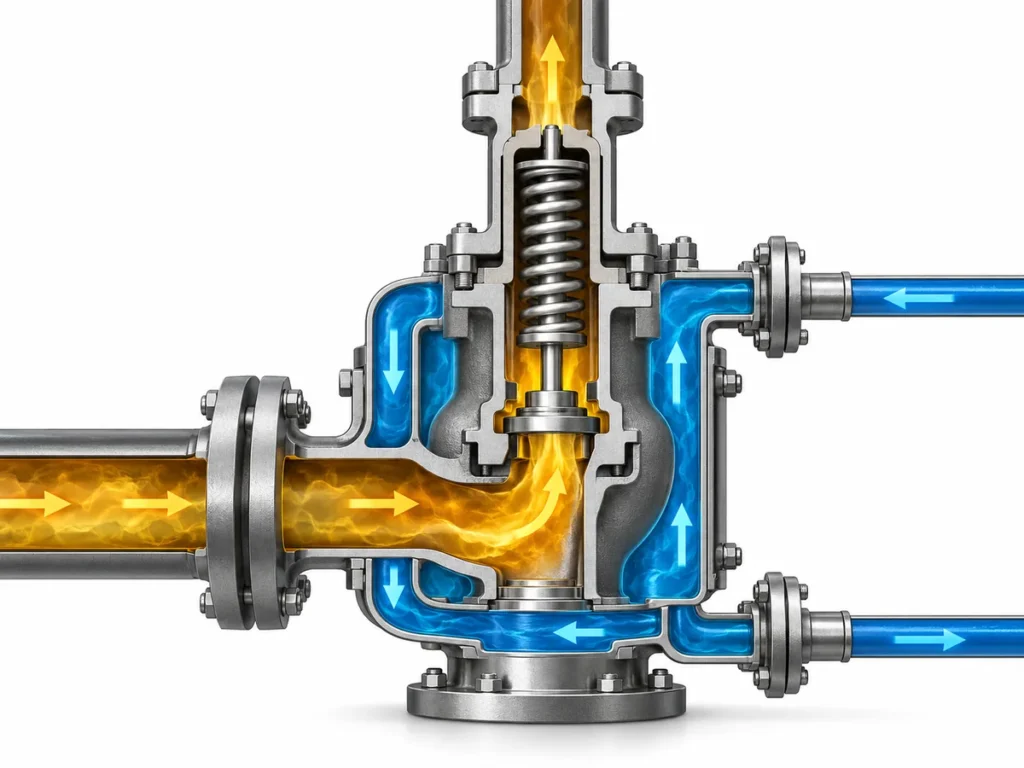
Vereinfachte technische Darstellung; kein modellspezifischer Querschnitt, keine Materialgarantie oder zertifizierte Konstruktionszeichnung.
Die alleinige Angabe des Gehäusematerials ist ein häufiger Beschaffungsfehler. Die Überprüfung sollte die Druckgrenze, den benetzten Strömungspfad, den beweglichen und führenden Mechanismus, die Federkammer, die Dichtungen, die Befestigungselemente und die Exposition auf der Ableitungsseite umfassen. Jede Komponente kann einer anderen Exposition und Ausfallfolge unterliegen.
| Komponente | Korrosionsbedenken | Was vor der Angebotsanfrage zu bestätigen ist |
|---|---|---|
| Gehäuse und Oberteil | Allgemeine oder lokale Korrosion, äußere Einwirkung, Ausdünnung oder Rissbildung der Druckgrenze. | Material, Guss-/Schmiedespezifikation falls erforderlich, Druck-Temperatur-Bewertung, Korrosionszuschlagspolitik, Inspektionsumfang. |
| Düse und Kegel | Lochfraß, Erosionskorrosion, Fressen oder Ablagerungen, die den Dichtsitz und den Hub verändern. | Benetzte Materialien, Härtepaarung, Medienreinheit, Geschwindigkeit/Phasenwechsel und Wartungsmethode. |
| Sitz / Weichsitz / O-Ring | Chemischer Angriff, Quellung, Verhärtung, Permeation, Extrusion oder Temperaturschäden. | Metall- oder Weichsitz-Ausführung, Polymerqualität, Temperaturgrenzen, Leckagezulassung und Dekompressionsverhalten, wo relevant. |
| Führung und Spindel | Lokalisierte Korrosion, Ablagerungen, Fressen oder Fehlausrichtung, die die Reibung erhöhen. | Materialpaarung, Spiel, Kondensat-/Feststoffexposition, Reinigungs- und Inspektionsnachweise. |
| Feder und Federkammer | Korrosion oder Ablagerungen, die Federkraft, Bewegung oder Wiederholgenauigkeit verändern. | Oberteilumgebung, Entlüftungsführung, Bedarf an Faltenbalg/Schutz, Federmaterial und Beschränkungsgrenzen. |
| Faltenbalg | Korrosion, Ermüdung, Perforation oder blockierte Entlüftung; Ausfall kann die Gegendruckantwort verändern. | Faltenbalglegierung, Bewegung, Temperatur, zyklische Belastung, interne/externe Exposition und Entlüftungsroute. |
| Dichtungen, Packungen und Dichtelemente | Chemische Inkompatibilität, Kriechen, Relaxation, Quellen oder Leckage. | Exaktes Material, Temperatur-/Druckgrenzen, Montageverfahren und Rückverfolgbarkeit des Austauschs. |
| Befestigungselemente, Kappe und externe Teile | Atmosphärische Korrosion, festsitzende Einstellteile, Verlust der Kennzeichnung oder schlechter Zugang. | Äußere Umgebung, Schraubenmaterial, Beschichtungssystem, Schutz der Typenschilder und Zugang zur Inspektion. |
Wenn korrosive Medien oder Auslassdrücke die Federkammer erreichen können, Faltenbalg-kompensierte Sicherheitsventile oder eine andere geschützte Konstruktion muss möglicherweise überprüft werden. Ein Faltenbalg ist keine universelle Korrosionsbarriere: Legierung, Temperatur, Ermüdung, Entlüftung, Bewegung und Ausfallmodus bleiben modellspezifisch.
Komplexes technisches Szenario: Ein Ersatz wertet den Körper von Kohlenstoffstahl auf Edelstahl auf, behält aber ein inkompatibles Düsen-, Scheiben- und Führungsplattenmaterial bei. Das Ventil besteht eine Werkseinstellungsprobe, entwickelt dann Sitzleckagen und raue Bewegungen im Betrieb. Die technische Ursache ist eine Materialfehlanpassung auf Komponentenebene, nicht eine falsche Körpergüte. Die Korrektur besteht darin, den vollständigen Zeitplan für benetzte und funktionale Materialien zu überprüfen; die Präventionskontrolle ist ein Datenblatt, das Körper-, Düsen-, Scheiben-, Führungsplatten-, Spindel-, Feder-, Faltenbalg-, Dichtungs- und Sitzmaterialien separat benennt. Dies ist ein illustratives Schulungsbeispiel.
Hauptauslegungsoptionen für Sicherheitsventile für korrosive Medien
Edelstahl- und Legierungskonstruktion
Die Materialauswahl muss den Korrosionsmechanismus und die mechanische Beanspruchung berücksichtigen. “Edelstahl” ist ein Familienname, keine Kompatibilitätsentscheidung, und ein höherer Legierungsgehalt beseitigt nicht die Notwendigkeit, Fertigung, Härte, Fressen und benachbarte Materialien zu überprüfen.
Ausbalancierter Faltenbalg oder geschützte Federkammer
Ein Faltenbalg oder eine geschützte Haube kann ausgewählte Teile vom Auslassdruck oder korrosiven Abfluss isolieren, aber der Faltenbalg selbst wird zu einer druck- und ermüdungsempfindlichen Komponente. Seine Entlüftungsleitung und Fehleranzeige müssen offen und korrekt verlegt bleiben.
Auswahl von Metall-, Weich- und Dichtungssitzen
Metallsitze vermeiden Polymerkompatibilitätsgrenzen, können aber empfindlich auf Lochfraß und Partikel reagieren. Weichdichtungen können Leckagen reduzieren, wenn sie chemisch und thermisch geeignet sind, aber Schwellung, Verhärtung, Dekompression und Rückverfolgbarkeit des Austauschs erfordern eine Überprüfung.
Beschränkungen bei Auskleidungen und Beschichtungen
Eine Beschichtung oder Auskleidung kann nur dann eine externe oder ausgewählte interne Korrosionskontrolle unterstützen, wenn der Hersteller deren Position, Vorbereitung, Dicke, Reparaturmethode und Temperatur-/Druckbelastung genehmigt. Sie darf den Durchfluss, Freiräume, Entlüftungen oder Dichtflächen nicht behindern.
Konventionelle federbelastete und pilotgesteuerte Grenzen
Konventionelle Ventile sind einfach, können aber empfindlich auf Gegendruck und die Belastung des Oberteils reagieren. Pilotgesteuerte Ausführungen können ein anderes Betriebsverhalten und Gegendruckverhalten aufweisen, jedoch können Steuerleitungen, Piloten und Dichtungen anfällig für Verstopfung, Kondensat, Kristallisation oder chemische Angriffe sein.
Inspektions-, Reparatur- und Dokumentationskontrollen
Materialaufzeichnungen, Ergebnisse von Ansprechdruck und Dichtheit, Befund-/Zustandsdaten, Rückverfolgbarkeit von Ersatzteilen, Wiederabdichtung und Änderungsmanagement sollten spezifiziert werden, wo erforderlich. Diese Aufzeichnungen ersetzen nicht die Überprüfung der Kapazität oder des installierten Systems.
| Konstruktionsoption | Wann es überprüft werden kann | Grenze |
|---|---|---|
| Drucktragende Teile aus Edelstahl oder Legierungen | Wenn Korrosionsdaten die Güte für das tatsächliche Fluid, die Temperatur und den Herstellungszustand unterstützen. | Nicht universell; Güte, Produktform, Wärmebehandlung, Härte, Schweißen und Serviceexposition können eine Rolle spielen. |
| Korrosionsbeständige Garnitur | Bei lokalisierter Korrosion, Fressen, Erosion oder Ablagerungen an Düse, Scheibe, Führung oder Spindeloberfläche. | Die Garnitur muss sich weiterhin bewegen, führen, abdichten und die gewählte Strömungsgeometrie beibehalten. |
| Gegendruckkompensierter Faltenbalg / geschützte Kammer | Wenn der Auslassdruck oder korrosive Abströmmedien die Komponenten der Federkammer beeinträchtigen könnten. | Das Faltenbalgmaterial, die zyklische Lebensdauer, die Entlüftung, die Temperatur, die Bewegung und die Gegendruckgrenzwerte erfordern Modelldaten. |
| Weichsitz | Wenn geringere Leckage erforderlich ist und das Elastomer oder Polymer mit der Chemie, dem Druck und der Temperatur kompatibel ist. | Chemische Verträglichkeit, Dekompression, Alterung und Rückverfolgbarkeit von Ersatzteilen müssen bestätigt werden. |
| Auskleidung oder Beschichtung | Wenn für eine definierte Oberfläche und Exposition als Teil des Hersteller-/Projektdesigns zugelassen. | Ersetzt nicht die Druckgrenze, die Garnitur, den Sitz, den Strömungsbereich, die Inspektion oder die Normenprüfung. |
| Pilotgesteuerte Konfiguration | Wenn das Projekt die Betriebsmarge oder die Gegendruckeigenschaften benötigt und das Medium für den Pilot- und Messpfad geeignet ist. | Schmutzige, viskose, kristallisierende, kondensierende oder gefrierende Betriebsbedingungen können Pilotkanäle und Dichtungen beeinträchtigen; verwenden Sie modellspezifische Grenzwerte. |
Komplexes technisches Szenario: Ein pilotgesteuertes Ventil wird ausgewählt, um die Betriebsmarge zu verbessern, aber der Prozessdampf kondensiert in der Messleitung und hinterlässt kristalline Ablagerungen. Die Öffnung verzögert sich und die Wiederholbarkeit verschlechtert sich. Die Korrektur besteht darin, die Reinheit des Fluids, das Phasenverhalten, die Verlegung der Messleitung und eine alternative Ventilarchitektur zu überprüfen. Die Präventionskontrolle besteht darin, Kondensat-, Feststoff- und Reinigungsbedingungen in die Auswahl des Ventiltyps einzubeziehen. Dies ist ein illustratives Szenario, keine Produktgarantie.
Vorläufige Matrix für korrosive Medien
Diese Matrix ist ein Screening-Tool, kein Materialdiagramm oder endgültiger Modellauswähler. Sie identifiziert die Informationen, die zur Definition der Korrosionsbelastung erforderlich sind und die Materialauswahl von der Auslegung des Überdruckschutzes trennt.
| Frage | Warum es die Entscheidung beeinflusst | Was vor der Angebotsanfrage zu senden ist |
|---|---|---|
| Welche Ausrüstung und Druckgrenze werden geschützt? | Der Ausrüstungscode, der MAWP/Konstruktionsdruck und das Entlastungsszenario legen die Grundlage für den Überdruckschutz fest. | Anlagentyp/-kennzeichnung, Konstruktionsdokumente, Betriebsdruck, MAWP/Konstruktionsdruck und Anschlussdaten. |
| Was ist das maßgebliche Entlastungsszenario? | Blockierte Auslässe, Reglerausfall, thermische Ausdehnung, Reaktionsstörungen, Rohrbrüche oder Brandeinwirkung können Durchfluss, Phase und Zusammensetzung ändern. | Beschreibung des Szenarios, erforderliche Kapazität und Berechnungsbasis durch den zuständigen Ingenieur. |
| Was ist das genaue Medium unter Normal- und Entlastungsbedingungen? | Korrosion hängt von Zusammensetzung, Konzentration, Verunreinigungen, Benetzungsphase, Temperatur und Druck ab – nicht allein vom Handelsnamen. | Zusammensetzungsbereich, Verunreinigungen, pH-Wert (wo relevant), Dampf-/Flüssigkeits-/Zweiphasenzustand und Entlastungstemperatur. |
| Kann Kondensation, Feststoffe, Kristallisation oder Polymerisation auftreten? | Ablagerungen und Phasenänderungen können Materialbelastung, Spiel, Dichtungskontakt, Entwässerung und Wartung beeinflussen. | Taupunkt, Feststoffe, Viskosität, Kristallisations-/Polymerisationsgrenzen, Anfahr-/Abfahrplan und Reinigungsplan. |
| Wohin entlüftet das Ventil? | Atmosphärische Ableitung, Abgasleitungen und gemeinsame Header ändern Gegendruck, Korrosionsbelastung, Entwässerung und Reaktionslasten. | Auslasszeichnung, Ziel, Header-Druck, aufgebauter Gegendruck, Abflüsse und Unterstützung. |
| Welche Nachweise und Inspektionsumfang sind erforderlich? | Materialaufzeichnungen, PMI, Prüfprotokolle, Kapazitätsnachweise und Zeugenpunkte beeinflussen Abnahme und Lieferzeit. | Projekt-Spezifikation, QA-Plan, Dokumentenliste, Halte-/Überwachungspunkte und Rückverfolgbarkeitsebene. |
| Welcher Korrosionsmechanismus ist glaubwürdig? | Gleichmäßige Korrosion, Lochfraß, Spaltkorrosion, galvanische Korrosion, Erosionskorrosion und umgebungsbedingte Rissbildung erfordern unterschiedliche Kontrollen. | Vorherige Inspektionsergebnisse, Korrosionsstudie, Labor-/Service-Daten, benachbarte Materialien und Herstellungszustand. |
| Welche Druckbegriffe sind bestätigt? | Betriebsdruck, MAWP, Ansprechdruck, CDTP, Überdruck, Ansammlung und Entlastungsdruck beeinflussen unterschiedliche Prüfungen und sollten nicht zusammengeführt werden. | Projekt-Datenblattwerte mit Einheiten, Fluid-/Testbasis, Gegendruck und übernommene Normenausgabe. |
Angebotsregel: “Korrosionsbeständiges Sicherheitsventil” oder “Edelstahl-Sicherheitsventil” ist keine vollständige Spezifikation. Geben Sie mindestens das tatsächliche Medium und den Konzentrationsbereich, Phase, Verunreinigungen, Betriebs- und Entlastungstemperatur, Druckbegriffe, Entlastungslast, Gegendruck, Material der Komponenten und die erforderlichen Nachweise an.
Korrosionsbeständigkeit beweist keine Abblasekapazität
Korrosionsbeständigkeit und Entlastungsleistung sind unabhängige technische Prüfungen. Ein kompatibles Material begründet nicht die erforderliche Durchflussfläche, den Durchflusskoeffizienten, den Hub, die Stabilität oder die Normkapazität. Umgekehrt kann ein Ventil mit ausreichender Nennkapazität fehlschlagen, weil der Sitz, die Führung, die Federkammer oder das Entlastungssystem chemisch ungeeignet sind.
Die erforderliche Entlastungskapazität ist die Last, die sich aus dem maßgebenden Entlastungsszenario ergibt. Das ausgewählte Ventil muss über eine zertifizierte oder anderweitig projektakzeptierte Nennkapazität für die angegebene Fluidbasis und die Bedingungen verfügen. Die effektive Öffnungsfläche, die tatsächliche Bohrung, der Koeffizient und der Hub sind keine austauschbaren Begriffe, und die Größe des Einlass-/Auslassanschlusses ist nur eine mechanische Schnittstelle. Dampf-, Luft-/Gas-, Flüssigkeits- und Zweiphasenkapazitäten können nicht ohne die entsprechende Berechnung und Datenbasis substituiert werden. Für die vollständige Unterscheidung siehe Sicherheitsventil-Auslegung und zertifizierter Abblaseleistung.
| Artikel | Was es bedeutet | Häufiger Fehler |
|---|---|---|
| Materialeignung | Ob jedes druckführende, benetzte, bewegliche, abdichtende und exponierte Teil für die tatsächliche Chemie und Temperatur geeignet ist. | Annahme, dass eine Materialgüte den Druckschutz oder die Lebensdauer beweist. |
| Ansprechdruck und CDTP | Der Ansprechdruck definiert die angegebene Öffnungsgrundlage; CDTP kann Test-/Serviceunterschiede wie Gegendruck oder Temperatur berücksichtigen, wo zutreffend. | Ein erfolgreicher Ansprechdrucktest als Genehmigung für Kapazität, Material oder installierte Systeme. |
| Erforderliche Abblaseleistung | Die Last, die für das maßgebliche Szenario abgeführt werden muss, mit Angabe der Fluidphase und der Berechnungsgrundlage. | Verwendung von Anschlussgröße, vorherigem Ventilaussehen oder Prozessfluss als Abkürzung. |
| Zertifizierte / Nenn-Abblaseleistung | Modell- und konfigurationsspezifische Leistungsnachweise für das angegebene Fluid, den Druck, die Temperatur und die Standardgrundlage. | Annahme, dass alle Ventile mit demselben DN/NPS oder Körperguss die gleiche Leistung haben. |
| Effektiver Durchflussquerschnitt, tatsächlicher Bohrungsdurchmesser und Koeffizient | Unterschiedliche geometrische und leistungsbezogene Begriffe, die bei der Auslegung oder in Produktdaten verwendet werden; sie müssen anhand der anwendbaren Methode interpretiert werden. | Gleichsetzung eines gemessenen Bohrungsdurchmessers oder einer Katalogbuchstabenbezeichnung mit der endgültig akzeptierten Leistung. |
| Gegendruck und Einlassverlust | Systemdrücke im installierten Zustand, die Öffnung, Kapazität und Stabilität beeinflussen können. | Auswahl des richtigen Materials unter Vernachlässigung der Leistung des Rohrleitungssystems. |
Zur Auslegungskontext, verwenden Sie API 520 Auslegung von Sicherheitsventilen als Übersetzungshilfe. Die endgültige Kapazitätsannahme erfordert die Projektberechnung, die Daten des ausgewählten Herstellers und die übernommene Ausgabe.
Komplexes technisches Szenario: Eine Prozessausweitung erhöht die maßgebliche Dampfentlastungslast, aber das vorhandene korrosionsbeständige Ventil wird beibehalten, da seine Legierung und Anschlussgröße unverändert bleiben. Der Ansprechdrucktest besteht, doch die ursprüngliche Kapazitätsbasis deckt den neuen Fall nicht mehr ab. Die Korrektur besteht darin, die Entlastungslast und die ausgewählte Kapazitätsprüfung zu wiederholen; die Präventionskontrolle ist ein Auslöser für das Änderungsmanagement, wann immer sich Zusammensetzung, Durchsatz, Szenario oder Entlastungssystem ändern. Dies ist ein Schulungsszenario.
Überprüfung von Gegendruck und Federkammer bei korrosivem Einsatz
Der Gegendruck muss in den überlagerten Druck, der vor dem Öffnen vorhanden ist, und den aufgebauten Druck, der durch den Entlastungsstrom erzeugt wird, unterteilt werden. Jeder kann konstant oder variabel sein. Im korrosiven Betrieb steuert das Auslasssystem auch, ob Dampf, Kondensat oder gemischte Entlastung den Faltenbalg, das Oberteil, die Entlüftung, die Federkammer, die Auslassleitung und die nachgeschalteten Geräte erreicht. Ventiltyp, Material und Entlastungsdesign müssen daher gemeinsam überprüft werden.
| Bedingung | Fokus der Überprüfung | Mögliche Maßnahmen vor der Angebotsanfrage (RFQ) |
|---|---|---|
| Atmosphärische Entlastung | Sichere Führung, korrosive Dämpfe oder Flüssigkeit, Reaktionskraft, äußere Einwirkung, Lärm und Entwässerung. | Geben Sie Auslassorientierung, Höhe, nahegelegene Exposition, Mediumphase und Materialanforderung an. |
| Lange oder erhöhte Auslassleitung | Aufgebauter Gegendruck, eingeschlossene Flüssigkeit, thermische Bewegung, Lagerlasten und Korrosionszuschlag. | Geben Sie Leitungsgröße, äquivalente Länge, Fittings, Höhenprofil, Entwässerungen, Lagerung und Material an. |
| Gemeinsamer Abblase-Header | Überlagerter Druck, variabler Header-Druck, gemischte Chemie und Annahmen für gleichzeitige Entlastung. | Geben Sie minimalen/maximalen Header-Druck, angeschlossene Geräte, Entlastungsfälle und Kompatibilität der kombinierten Entlastung an. |
| Mögliche Freilegung der Federkammer oder des Oberteils | Korrosion von Feder, Führung, Spindel oder Oberteil-Interna und Folgen einer Verstopfung der Entlüftung. | Bestätigen Sie die Oberteilkonstruktion, den Bedarf an Faltenbalg, den Entlüftungsweg und die normale/gestörte Beanspruchung. |
| Faltenbalg berücksichtigt | Gegendruckkompensation plus Überprüfung von Faltenbalgkorrosion, Ermüdung und Ausfallmodi. | Verwenden Sie die Grenzwerte des ausgewählten Modells für Material, Bewegung, Temperatur, Gegendruck und Entlüftung. |
Für den Mechanismus und die Konfigurationsgrenze auf Systemebene, überprüfen Sie Gegendruck und Faltenbalg.
Komplexes technisches Szenario: Ein Edelstahlventil entlädt sich über eine neu hinzugefügte horizontale Leitung. Saurer Kondensat sammelt sich an einem nicht entwässerten Tiefpunkt, und der variable Leitungsdruck erreicht den Auslass, bevor er sich öffnet. Dichtungsleckage und externe Korrosion treten nach mehreren Ereignissen auf. Die Korrektur kombiniert Entwässerung, Berechnung des Leitungsdrucks, Materialprüfung und Überprüfung der Ventilkonfiguration. Die Präventionskontrolle besteht darin, Auslassmodifikationen in das Management of Change (MOC) aufzunehmen. Dies ist ein illustrativer Fall.
Welche Informationen definieren ein korrosionsbeständiges Sicherheitsventil?
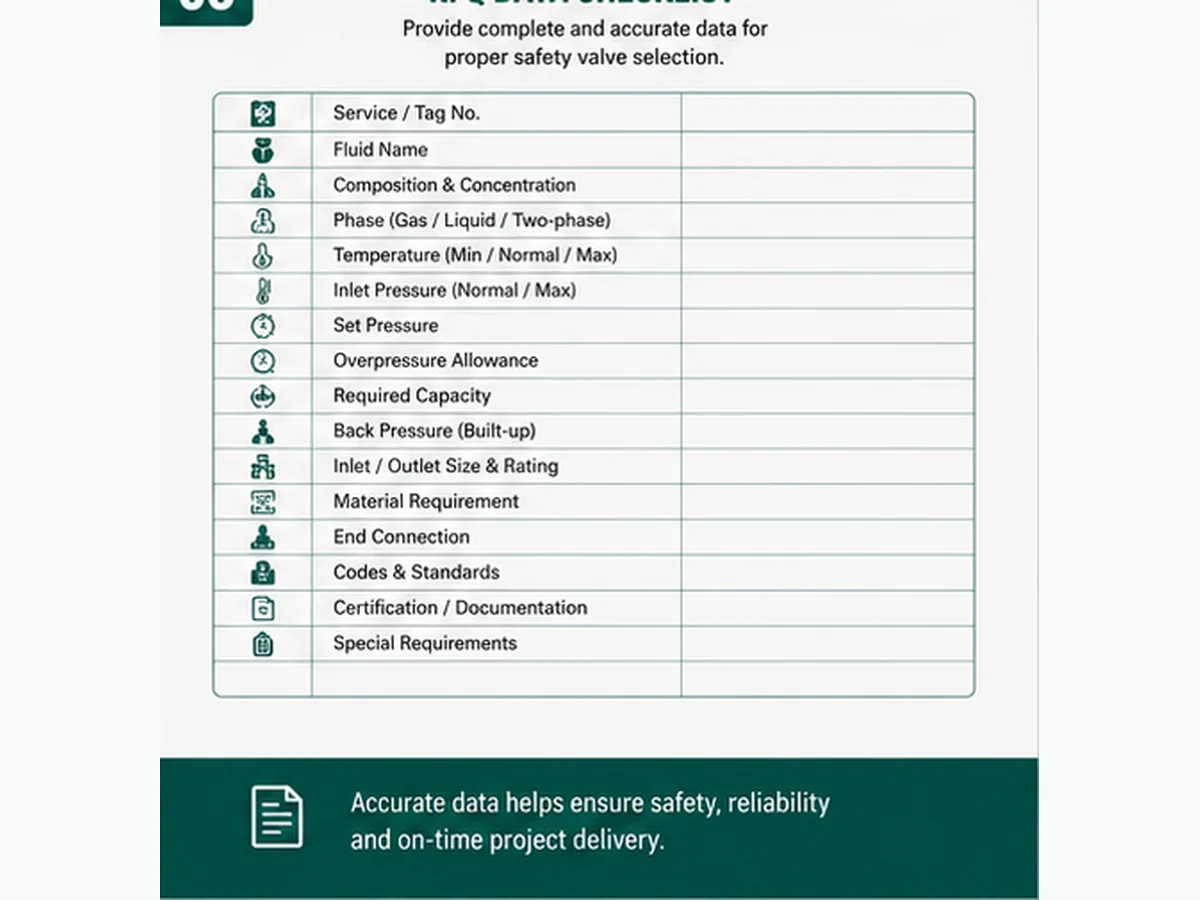
Grafik zur RFQ-Checkliste; die endgültige Ventilauswahl hängt von realen Servicedaten, Herstellerdokumentation und Projekt-/Code-Prüfung ab.
Eine Definition wird zu einer technischen Spezifikation, nur wenn die geschützte Ausrüstung, der Entlastungsfall und die tatsächliche Beanspruchung bekannt sind. Die RFQ sollte normale, gestörte, Stillstands- und Entlastungsbedingungen angeben, wenn sich Phase oder Chemie ändern; andernfalls kann der Lieferant Materialien oder Konfiguration nicht verantwortungsvoll bestätigen.
Geschützte Ausrüstung, maßgebliches Entlastungsszenario und erforderliche Kapazität
Vollständige Medienzusammensetzung, Konzentrationsbereich und Verunreinigungen
Normale und entlastende Phase; Taupunkt, Kondensat, Feststoffe oder Polymerisationsrisiko
Betriebsdruck, MAWP/Konstruktionsdruck, Ansprechdruck, CDTP falls zutreffend und Betriebsmarge
Entlastungsdruck, Überdruck-/Akkumulationsbasis und Fluideigenschaften
Normal-, Anfahr-/Abfahr- und Entlastungstemperatur
Überlagerter und aufgebauter Gegendruck; Abblaseziel
Einlass-/Auslass-Standard, Nennleistung, Flansch-/Gewindeart und Rohrleitungsführung
Anforderungen an Gehäuse, Oberteil, Düse, Kegel, Führung, Spindel, Feder, Faltenbalg, Dichtung und Sitz
Datenblatt, Materialrückverfolgbarkeit, Prüf-, Kapazitäts-, Inspektions- und Reparaturdokumentationsanforderungen
Häufige Fehler bei der Auswahl von korrosionsbeständigen Sicherheitsventilen
| Fehler | Risiko | Besser prüfen |
|---|---|---|
| Annahme, dass Edelstahl immer ausreicht | Lokalisierte Korrosion, Spannungsrisskorrosion, Fressverschleiß, Dichtungsangriff oder vorzeitiges Versagen. | Bestätigen Sie den Korrosionsmechanismus, die genaue chemische Zusammensetzung, die Temperatur, den Herstellungszustand und jede exponierte Komponente. |
| Nur Gehäusematerial spezifizieren | Düse, Kegel, Führung, Spindel, Feder, Faltenbalg, Dichtung oder Verschraubung können anfällig bleiben. | Erstellen Sie einen materialbezogenen Zeitplan auf Komponentenebene und eine Expositionskarte. |
| Kapazität und Fluidbasis ignoriert | Das Ventil kann passen und korrosionsbeständig sein, aber die maßgebliche Abblaseleistung nicht erfüllen. | Vergleichen Sie die erforderliche Kapazität mit der zugelassenen Nennkapazität für das tatsächliche Medium und die Bedingungen. |
| Ignorieren von Gegendruck und Entwässerung | Instabiler Betrieb, korrosive Kondensatrückhaltung, Exposition von Faltenbalg/Feder oder falsche Konfiguration. | Berechnen Sie die Auswirkungen am Ausgang und überprüfen Sie Entlüftungen, Abflüsse, Halterungen und Material. |
| Kopieren des alten Ventils | Wiederholt einen historischen Auslegungs-, Material-, Installations- oder Dokumentationsfehler, nachdem sich die Prozessbedingungen geändert haben. | Überprüfen Sie das aktuelle Abblaseszenario, die Chemie, die Kapazität, das Typenschild, die gefundenen Daten und die Rohrleitungen. |
| Beschichtung oder Auskleidung als universelle Lösung betrachten | Beschädigung, Ablösung oder ungeschützte funktionale Oberflächen können die Strategie vereiteln. | Bestätigen Sie den vom Hersteller genehmigten Standort, die Vorbereitung, Temperatur, Inspektion und Reparaturmethode. |
Austauschwarnung: Ein korrodiertes Ventil sollte nicht allein nach Größe, Druckklasse, Ansprechdruck oder Gehäusematerial kopiert werden. Ermitteln Sie, ob der Ausfall von der Chemie, Phasenänderung, Kapazitätsfehlanpassung, Gegendruck, Ablagerungen, externer Exposition, Wartungspraxis oder mehreren Mechanismen herrührte.
Prüfungen bei Installation und Entlastung in korrosiven Medien
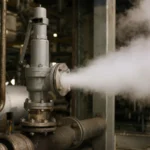
Vereinfachte Installationsdarstellung; die endgültige Installation muss den Anweisungen des ausgewählten Modells, den Projektspezifikationen und den geltenden Vorschriften folgen.
Einbaulage, Einlasssauberkeit und Druckverlust
Installieren Sie das ausgewählte Ventil in der vom Hersteller, dem Konstruktionscode und dem Projekt geforderten Einbaulage. Der Einlassweg muss sauber, ausreichend abgestützt und auf Druckverlust, Korrosion, Ablagerungen und Rohrleitungsspannungen geprüft sein. Korrosionsprodukte oder ein verengter Strömungsweg können die Stabilität und die abgegebene Kapazität beeinträchtigen, selbst wenn die Ventilwerkstoffe geeignet sind.
Auslass-Unterstützung, Entwässerung, Reaktionskraft und korrosive Ableitung
Unterstützen Sie die Auslassleitung unabhängig und leiten Sie die Ableitung an einen zugelassenen Ort. Berücksichtigen Sie überlagerte und aufgebaute Gegendrücke, Reaktionskräfte, thermische Bewegungen, Entwässerungen und Flüssigkeitstaschen. Korrosive Kondensate können den Auslass, den Faltenbalg oder die Federkammer angreifen und die Ableitung einschränken, wenn keine tiefen Punkte vorhanden sind.
Inspektionszugang und risikobasierte Wartungsintervalle
Korrosive Medien können kürzere oder zustandsbasierte Inspektionsintervalle rechtfertigen, aber kein universelles Intervall gilt. Nutzen Sie Prozesshistorie, Korrosionsmechanismen, Befunde, Leckagen, Ablagerungen, Materialverhalten, geltende Vorschriften und das Integritätsprogramm des Standorts. Sorgen Sie für Zugang zu Kappen, Entlüftungen, Abflüssen, Dichtungen und Kennzeichnungen. Für allgemeine Layoutprüfungen überprüfen Sie die Installationsanleitung für Sicherheitsventile.
| Soll | Nicht | Warum es wichtig ist |
|---|---|---|
| In der zugelassenen Ausrichtung mit einem kurzen, sauberen und kompatiblen Einlass installieren. | Keinen langen, reduzierten oder korrodierten Einlass ohne hydraulische und mechanische Prüfung verwenden. | Einlassverluste, Ablagerungen und Rohrleitungsspannungen können die Öffnungsstabilität und die abgegebene Kapazität beeinträchtigen. |
| Unterstützen Sie den Auslass unabhängig und bewerten Sie Reaktionslasten. | Erlauben Sie keiner schweren oder thermisch beweglichen Ableitungsleitung, den Ventilkörper zu belasten. | Mechanische Belastung kann die Ausrichtung verzerren, Anschlüsse beschädigen und Leckagen verschlimmern. |
| Sorgen Sie für Entwässerung, wo sich Kondensat oder Spülflüssigkeit ansammeln kann. | Erzeugen Sie keine unüberprüften Flüssigkeitstaschen im Auslass, in der Oberteilentlüftung oder im Messpfad. | Zurückgehaltene korrosive Flüssigkeiten können Komponenten angreifen, gefrieren, polymerisieren oder die Bewegung einschränken. |
| Korrosive Abgasleitungen und Entlüftungen des Oberteils/Faltenbalgs zu sicheren, zugelassenen Orten führen. | Entlüftungen, Abflüsse oder Abgasleitungen nicht als Umgehung von Leckagen verstopfen. | Blockierte Leitungen können das Ventilverhalten verändern oder Personal und Ausrüstung gefährden. |
| Zugang für Inspektionen bereitstellen und Typenschild, Dichtungen sowie Rückverfolgbarkeit erhalten. | Kein festes Inspektionsintervall ohne Nachweis der Nutzung oder regulatorische Grundlage definieren. | Der Zustand bei der Prüfung und die Historie wiederholter Ausfälle sollten den Wartungsplan bestimmen. |
Prüf-, Dokumentations- und Inspektionsanforderungen
Dokumentationsanforderungen sollten drei separate Punkte aufzeigen: was ausgewählt wurde, welche Materialien und Konstruktionen geliefert wurden und wie das Gerät geprüft oder repariert wurde. Ein Ergebnis des Ansprechdrucks beweist keine Dichtheit des Sitzes oder die Kapazität; ein Materialzertifikat beweist keine chemische Kompatibilität; und eine Reparaturzulassung genehmigt nicht das Design des installierten Überdruckschutzsystems.
| Dokument / Prüfgegenstand | Unterstützte Funktionen | Hinweis für Käufer |
|---|---|---|
| Genehmigtes Ventildatenblatt | Ausgewähltes Modell, Öffnungskennlinie, Druckbegriffe, Fluidbasis, Materialien, Anschlüsse und Grenzwerte. | Als kontrollierte technische Basis verwenden; Überarbeitungen durch Änderungsmanagement aufzeichnen. |
| Materialaufzeichnungen auf Komponentenebene | Spezifizierte Materialien für Druckgrenze, Innenteile, Feder, Faltenbalg, Dichtung und Sitz, wo Rückverfolgbarkeit erforderlich ist. | Teile und Zertifizierungsstufe vor der Angebotserstellung definieren; keine generischen “vollständigen Materialzertifikate” anfordern.” |
| PMI oder andere Materialverifizierung, falls erforderlich | Verifizierung der identifizierten Legierungsteile im Rahmen des Materialverifizierungsprogramms des Projekts. | Teile, Methode, Abnahme- und Zeugenanforderungen angeben; PMI ist keine Korrosionsverträglichkeitsstudie. |
| Ansprechdruckprüfung und CDTP-Basis | Öffnungsanpassung unter spezifizierten Testbedingungen, einschließlich der anwendbaren Korrekturbasis. | Prüfmedium, Toleranz und anwendbare Norm definieren; dies begründet keine Abblaseleistung. |
| Dichtheitsprüfung des Sitzes | Leckageverhalten gemäß der angegebenen Methode und Abnahmekriterien. | Getrennt von Nachweisen für Ansprechdruck und Kapazität halten; siehe API 527 Dichtheitsprüfung. |
| Nachweis der zertifizierten / Nennkapazität | Abblasefähigkeit für den ausgewählten Gerätetyp, die Konfiguration und die Fluidbasis. | Vergleich mit der erforderlichen Abblaslast; Hersteller, Modell und Konfiguration verifizieren. |
| Zustand vor der Wartung / Zustand nach der Wartung und Reparatur-Rückverfolgbarkeit | Zustand vor der Arbeit, ausgetauschte Teile, Einstellungen, Endergebnisse, Wiederabdichtung und Status des Typenschilds. | Wo Code-Reparaturen gelten, bestätigen Sie den autorisierten Reparaturweg und die aktuellen NBIC/Projektanforderungen. |
| Inspektions-/Zeugen- und Freigabebereich | Definiert Haltepunkte, Sicht-/ZfP-Prüfungen, Anwesenheit des Kunden oder Dritter und Freigabeprotokolle. | Anforderungen vor der Angebotserstellung angeben; keine Genehmigung durch Dritte aus einem generischen Prüfbericht implizieren. |
| Management-of-Change-Aufzeichnung | Zeigt an, ob sich Medium, Durchsatz, Entlastungsszenario, Temperatur, Rohrleitung oder Reparaturkonfiguration geändert haben. | Material-, Kapazitäts- und installierte Systemannahmen nach relevanten Änderungen neu validieren. |
Dokumentengrenze: Gehen Sie nicht davon aus, dass jedes korrosionsbeständige Ventil PMI, vollständige Rückverfolgbarkeit, API 527-Ergebnisse, Kapazitätszertifizierung, Zeugeninspektion oder Code-Reparaturaufzeichnungen enthält. Geben Sie die genauen erforderlichen Nachweise an und bestätigen Sie, dass diese für den ausgewählten Hersteller, das Modell, die Konfiguration und den Reparaturumfang gelten.
Häufiges Problem nach der Wartung: Ein Ventil kehrt aus der Reparatur mit einem akzeptablen Ansprechdruckergebnis zurück, aber der Sitz leckt weiterhin, da Lochfraß an der Düse verbleibt und der Ersatz-Weichsitz nicht mit dem Prozesslösungsmittel kompatibel ist. Die Korrektur ist eine Komponenteninspektion plus die richtige Sitzdichtheit und Materialprüfung. Die Präventionskontrolle besteht darin, die Daten 'wie gefunden/wie hinterlassen', die Rückverfolgbarkeit von Ersatzteilen und die Wiederabdichtungsaufzeichnungen beizubehalten. Dies ist ein zusammengesetztes Schulungsbeispiel.
Workflow zur Überprüfung von Ersatzventilen
Wenn ein bestehendes Ventil Korrosion, Undichtigkeiten, Schwergängigkeit, instabilen Hub oder beschädigte Identifikation aufweist, sollte der Austausch mit einer Ursachenanalyse und einer Überprüfung des Änderungsmanagements beginnen. Das Kopieren der alten Größe, des alten Ansprechdrucks oder der alten Legierung kann dasselbe Versagen reproduzieren oder eine veraltete Kapazitätsbasis beibehalten.
Identifizieren Sie die geschützte Ausrüstung und den maßgeblichen Entlastungsfall.
Bestätigen Sie die Ausrüstungscode-Basis, die aktuellen Prozessbedingungen, das Entlastungsszenario und die erforderliche Abblasekapazität.
Erfassen Sie das alte Ventil und die Installationsnachweise.
Fotografieren Sie Typenschild, Dichtungen, Gehäuse, Einlass, Auslass, Entlüftungsöffnungen am Oberteil, Stützen, Abflüsse, Ablagerungen, Korrosions- und Leckagestellen.
Definieren Sie die aktuelle Chemie und alle Expositionszustände.
Prüfen Sie Zusammensetzungsbereich, Verunreinigungen, Phase, Taupunkt, An-/Abfahren, Reinigung, Entlastungstemperatur und äußere Atmosphäre.
Trennen Sie Nachweise für Material, Ansprechdruck und Kapazität.
Überprüfen Sie die erforderliche Kapazität anhand der akzeptierten modellspezifischen Kapazität; leiten Sie diese nicht aus alten DN/NPS oder einem bestandenen Ansprechdrucktest ab.
Ordnen Sie Komponenten- und Rohrleitungsbelastung zu.
Überprüfen Sie Gehäuse, Düse, Kegel, Führung, Spindel, Federkammer, Faltenbalg, Dichtungen, Befestigungselemente, Einlass- und Auslasssysteme.
Kontrollieren Sie Reparatur-/Ersatzdokumente.
Definieren Sie Ist-/Soll-Daten, Teile, Federbereich, Materialrückverfolgbarkeit, Prüfungen, Wiederabdichtung/Typenschild und den zutreffenden autorisierten Reparaturweg.
Komplexes technisches Szenario: Ein Sicherheitsventil für chemische Behälter hat ein Edelstahlgehäuse, einen korrodierte Sitzfläche und eine angegriffene Federkammer. Das Prozessdatenblatt listet nur “Säuredampf” auf, aber die Kühlung erzeugt Kondensat mit einer anderen Konzentration. Die Entscheidung für den Ersatz muss die Entlastungslast, den Ansprechdruck, die Entlastungstemperatur, die Kondensatchemie, die Werkstoffe von Trim und Sitz, die Exposition der Federkammer, den Gegendruck, die Auslassentwässerung und den Dokumentationsumfang bestätigen. Die Korrektur ist nicht nur eine höhere Gehäuselegierung. Dieses allgemeine Trainingsszenario ist kein Kundenfall oder eine Aussage zur Produktleistung.
Fehlerbehebung bei korrosionsbedingten Ventilsymptomen
Diese Symptome sind Anhaltspunkte für eine erste Beurteilung, keine Beweise für einen einzelnen Korrosionsmechanismus. Erfassen Sie, wann das Symptom auftritt, bewahren Sie die Ist-Befunde auf und überprüfen Sie Prozess, Rohrleitungen, Auslegung und Ventilzustand vor Reparatur oder Austausch.
| Symptom | Mögliche korrosionsbedingte Ursachen | Prüfungen vor dem Austausch | Unsichere Abkürzung zur Vermeidung |
|---|---|---|---|
| Sitzleckage | Lochfraß, Partikel, Ablagerungen, inkompatibles Sitz-/Dichtungsmaterial, Fressen oder Kondensatangriff. | Leckage im Ist-Zustand, Zustand von Sitz/Düse, Chemie, Betriebsmarge, Prüfmethode und Reparaturhistorie. | Austausch nur des Gehäuses oder Erhöhung der Federvorspannung. |
| Festklemmen oder verzögertes Öffnen | Korrosion von Führung/Spindel, Fressen, Kristallisation, Polymerisation, Ablagerungen oder blockierte Pilot-/Führungsleitungen. | Bewegung, Ablagerungen, Phasenverhalten, Reinigungsverlauf, Spiel und Werkstoffe der Komponenten. | Annahme, dass allein die Einstellung des Ansprechdrucks die eingeschränkte Bewegung korrigiert. |
| Flattern oder Schwingen | Überdimensionierung, Einlassverlust, aufgebauter/überlagerter Gegendruck, instabiler Prozessfluss, Ablagerungen oder mechanische Belastung. | Erforderliche und Nennleistung, Einlass-/Auslassberechnungen, Druckverlauf, Stützen und interner Zustand. | Änderung der Legierung oder Ventilgröße ohne Systemüberprüfung. |
| Schlechtes Wiederverschließen | Sitzbeschädigung, Korrosionsprodukte, ungeeignetes Blowdown-Verhalten, variabler Gegendruck oder eingeschlossenes Kondensat. | Sitzflächen, Druckverlauf, Blowdown-/Wiederverschließungsverhalten, Auslassentwässerung und Gegendruck. | Läppen oder Polieren ohne Korrektur der Exposition und der Ursache in der Rohrleitung. |
| Externe Korrosion oder beschädigte Kennzeichnung | Marine-/chemische Atmosphäre, Spülung, Isolationsschäden, Beschichtungsversagen oder galvanische Kopplung. | Äußere Umgebung, Beschichtung/Material, Verschraubung, Entlüftungen, Abflüsse, Typenschild und Inspektionshistorie. | Ignorieren externer Teile, da das Prozessmedium nicht korrosiv ist. |
Korrosionsbeständiges Sicherheitsventil vs. Standard-Sicherheitsventil
Die Überdruckschutzfunktion ist dieselbe
Ein korrosionsbeständiges Ventil und ein Ventil aus Standardmaterial müssen beide die definierten Geräte zum richtigen Ansprechdruck und bei erforderlicher Kapazität schützen. Beide erfordern eine geeignete Druckstufe, Stabilität, Rückdruckverhalten, Installation und Dokumentation.
Die Betrachtung der Exposition und des Komponentenmaterials ist breiter
Die zusätzliche Arbeit besteht darin, Korrosionsmechanismen zu identifizieren und normale, gestörte, abgeschaltete, entlastende und externe Expositionen jeder druckführenden Wand, benetzten, führenden, abdichtenden und federkammerseitigen Komponente zuzuordnen.
Korrosionsbeständigkeit erhöht weder die Kapazität noch den Normenstatus
Der Wechsel der Legierung, des Sitzes oder der Beschichtung erhöht allein nicht die effektive Öffnung, die Nennkapazität, den zulässigen Ansprechdruck oder den Zertifizierungsumfang. Diese Eigenschaften bleiben spezifisch für das ausgewählte Design und die Nachweise.
Wann eine technische Überprüfung erforderlich ist
Fordern Sie eine technische und Korrosionsprüfung an, wenn das Medium nicht vollständig definiert ist; wenn Konzentration, Phase oder Temperatur variieren; wenn Kondensation, Feststoffe, Kristallisation, Polymerisation, Chloride oder H₂S auftreten können; oder wenn die äußere Exposition stark ist. Geben Sie die geschützten Geräte, den maßgeblichen Entlastungsfall, die Druckbedingungen, die erforderliche Kapazität, den Zusammensetzungsbereich, das Phasenverhalten, das Temperaturprofil, den Rückdruck sowie die Materialanforderungen auf Rohrleitungs- und Komponentenebene an.
Der Austausch erfordert eine zusätzliche Überprüfung nach Korrosion, Undichtigkeiten, Festfressen, Flattern, wiederholten Reparaturen, fehlender Kennzeichnung, Prozessänderung oder Änderung des Ableitungssystems. Bewahren Sie das alte Datenblatt, Typenschild, die Befunde im Ist-Zustand, Fotos und die Reparaturhistorie auf. Kopieren Sie nicht das alte Ventil nur, weil die Abmessungen übereinstimmen.
FAQ
Was ist ein korrosionsbeständiges Sicherheitsventil?
Es ist ein Sicherheitsventil, dessen Druckgrenze, medienberührte Innenteile und exponierte Funktionsteile für ein definiertes korrosives Medium oder eine definierte korrosive Umgebung ausgewählt sind. Es erfordert dennoch eine separate Überprüfung von Ansprechdruck, Abblaseleistung, Gegendruck, Installation und Dokumentation.
Reicht Edelstahl immer für korrosive Medien aus?
Edelstahl ist eine Familie von Legierungen, und die Eignung hängt von Zusammensetzung, Konzentration, Verunreinigungen, Phase, Temperatur, Herstellungszustand, Korrosionsmechanismus und Bauteilbelastung ab. Allein die Werkstoffgüte des Gehäuses ist kein ausreichender Nachweis.
Welche Daten werden vor der Auswahl eines korrosionsbeständigen Sicherheitsventils benötigt?
Schützen Sie Anlagen, definieren Sie das Entlastungsszenario, die erforderliche Kapazität, die vollständige Medienzusammensetzung und den Bereich, die Phase, Verunreinigungen, Betriebs- und Entlastungstemperaturen, Druckbegriffe, Gegendruck, Rohrleitungen, Werkstoffe der Komponenten und Dokumentationsanforderungen.
Welche Sicherheitsventil-Teile erfordern eine Korrosionsprüfung?
Möglicherweise Gehäuse, Oberteil, Düse, Kegel, Führung, Spindel, Sitz, Feder, Faltenbalg, Dichtung, Packung, O-Ring, Verschraubung, Kappe, Entlüftungen, Einlassleitung und Auslassleitung. Die Überprüfung hängt von der tatsächlichen Exposition ab.
Kann eine Beschichtung oder Auskleidung einen Sicherheitsventil korrosionsbeständig machen?
Nr. Eine Beschichtung oder Auskleidung ist nur für zugelassene Oberflächen und Bedingungen geeignet. Sie kann keine Prüfungen der Druckgrenze, der Einbauten, des Sitzes, des Strömungsbereichs, der Temperatur, der Inspektion, der Reparierbarkeit und des Herstellers ersetzen.
Beweist Korrosionsbeständigkeit die Kapazität eines Sicherheitsventils?
Werkstoffverträglichkeit, erforderliche Abblaseleistung und modellspezifische zertifizierte oder Nennleistung sind separate Prüfungen. Anschlussgröße, Gehäusewerkstoff und Ansprechdruck beweisen keine Leistung.
Wann sollte ein Faltenbalg oder eine geschützte Federkammer in Betracht gezogen werden?
Berücksichtigen Sie diese, wenn der Auslassdruck oder korrosive Abfluss die Federtrommelteile beeinträchtigen kann, abhängig vom Faltenbalgmaterial, der Temperatur, der Ermüdung, der Bewegung, der Entlüftung und den Grenzwerten für den Gegendruck des ausgewählten Modells.
Welche Dokumente sollten für korrosive Medien angefordert werden?
Je nach Projekt: kontrolliertes Datenblatt, Materialaufzeichnungen der Komponenten, PMI-Umfang, Ergebnisse der Ansprechdruck- und Dichtheitsprüfung, Nachweise der Nennleistung, Reparaturberichte (Zustand vor und nach der Reparatur), Rückverfolgbarkeit und Inspektions-/Zeugenprotokolle.
Gilt ISO 15156 / NACE MR0175 für jedes korrosionsbeständige Sicherheitsventil?
Nein. Es ist für H2S-haltige Öl- und Gasproduktions- sowie Erdgasentschwefelungsumgebungen innerhalb seines Geltungsbereichs relevant. Es ist kein universeller Standard für chemische Verträglichkeit und ersetzt nicht den geltenden Konstruktionscode oder die Materialprüfung des Projekts.
Beweist ein bestandener Ansprechdrucktest die Materialeignung oder die Abblaseleistung?
Nr. Ein Ansprechdruck-Test prüft die Öffnungseinstellung unter spezifizierten Testbedingungen. Materialeignung, Dichtheit des Sitzes, Nennkapazität und Leistung im installierten System erfordern separate Nachweise.
Normen und Auswahlgrenzen
Diese Seite erläutert material- und konfigurationsbezogene Grenzen für Sicherheitsventile im Zusammenhang mit Korrosion. Sie gibt keine urheberrechtlich geschützten Normen wieder, berechnet keine Abblaseleistung, garantiert keine chemische Kompatibilität und besagt nicht, dass ein ZOBAI-Modell automatisch den Vorschriften eines Rechtsraums entspricht. ISO 4126-1 ist eine Produktnorm, kein Anwendungscode. API-Dokumente haben definierte Geltungsbereiche für Raffinerie-/Prozessindustrie. ISO 15156 / NACE MR0175 wird nur für anwendbare H2-haltige Öl- und Gasförderdienste verwendet. Für den Themenüberblick von ZOBAI siehe ASME-Sicherheitsventil-Normen.
Offizieller Geltungsbereich und Ausgabereferenzen
Nutzen Sie diese offiziellen Seiten, um den Geltungsbereich und den aktuellen Veröffentlichungsstatus zu bestätigen. Die gekaufte Norm, die übernommene Projektausgabe, das Herstellerdatenblatt und die lokalen behördlichen Anforderungen bleiben maßgebend.
- ASME BPVC Section XIII, 2025 — Regeln für Überdruckschutz
- API 520 Teil I, 10. Ausgabe — Auslegung und Auswahl
- API Standards Plan — aktueller Veröffentlichungsstatus für API 520, 521, 526, 527 und RP 576
- ISO 4126-1:2013 mit Änderung 1:2016 — Produktnorm für Sicherheitsventile
- ISO 15156-1:2020 — Geltungsbereich Materialauswahl für H₂S-haltige Öl- und Gasförderung
- AMPP — Materialauswahl und Auslegung zur Korrosionskontrolle
- National Board NB-18 — Verzeichnis der Zertifizierungen für Druckentlastungseinrichtungen
- National Board VR Certificate of Authorization — Geltungsbereich Reparatur von Druckentlastungsventilen
Benötigen Sie eine Überprüfung des Datenblatts für ein Sicherheitsventil für korrosive Medien?
Senden Sie die geschützte Ausrüstung, das Entlastungsszenario, die erforderliche Kapazität, die vollständige Chemie und den Konzentrationsbereich, das Phasenverhalten, die Druckbedingungen, das Temperaturprofil, den Gegendruck, das Rohrleitungs-Layout, die Materialanforderungen für Komponenten und die erforderlichen Nachweise. Unbekannte Elemente sollten als “zu bestätigen” gekennzeichnet werden, nicht geraten.