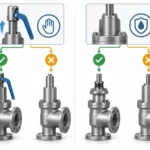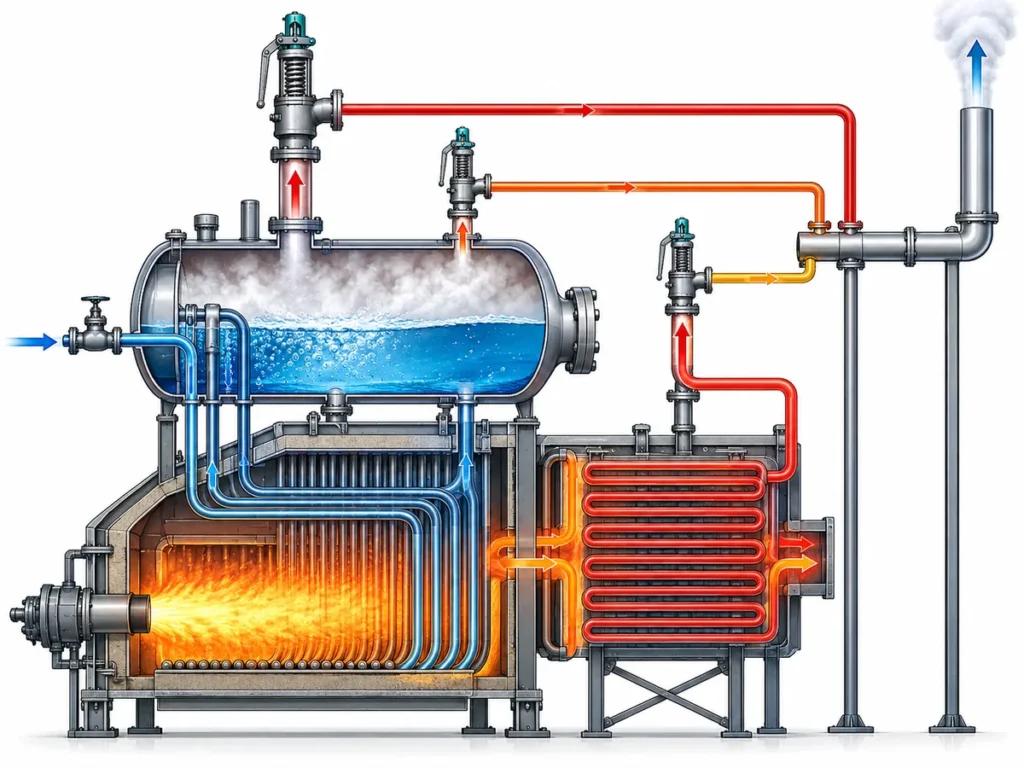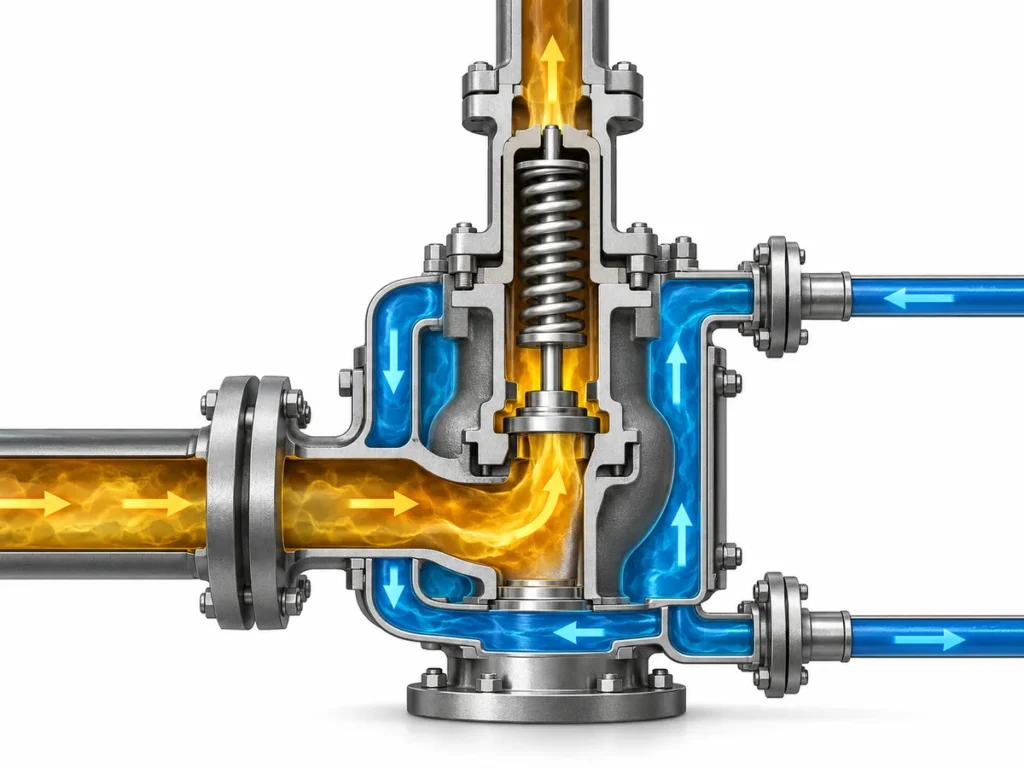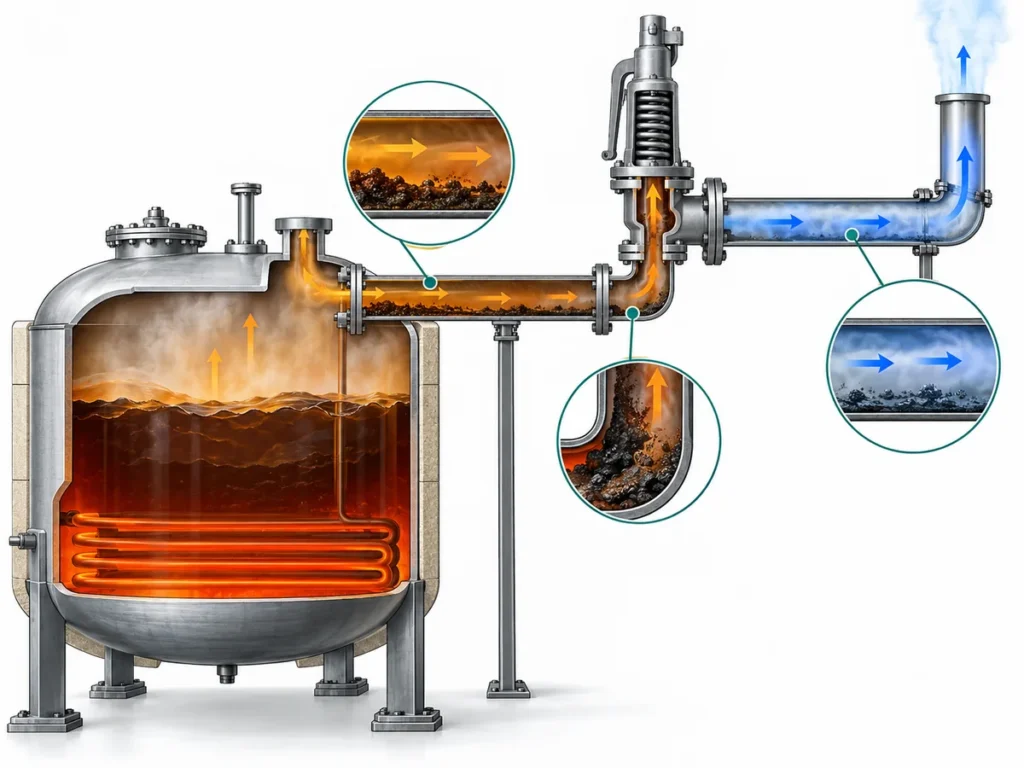
了解为什么带提升杠杆并不一定意味着杠杆载荷式,弹簧机构与杠杆重锤机构有何区别,以及更换前需要核实哪些内容。

在识别或更换现有阀门时,不应假定杠杆式安全阀与杠杆载荷式安全阀含义相同。
弹簧式安全阀可以配有外部提升杠杆,而弹簧仍提供正常的关闭载荷。Emerson 的 Crosby EM 文档就是一个直接的制造商示例:EM 明确为弹簧式,但可提供带提升杠杆的配置。相比之下,在杠杆重锤式设计中,杠杆和重锤是施加正常关闭载荷机构的一部分。
对于更换工作,这一差异会改变任务内容。旧描述、照片、可见杠杆、公称连接尺寸或整定压力值都可以作为证据,但其中任何一项单独都不能证明拟用替换件具有相同的机构或能够执行相同的保护职责。排量、排放系统条件、材料以及适用的项目/规范依据仍必须核查。
实际步骤是:确定杠杆的作用 → 确定加载机构 → 确定泄放职责 → 验证替换候选件。
术语边界: 在本文中, 杠杆加载 是杠杆重锤式或重锤杠杆式加载布置的描述性简称。它并非作为每个规范、制造商或管辖区都使用的通用正式术语提出。
杠杆式安全阀与杠杆载荷式安全阀是同一回事吗?
并不可靠。仅凭“杠杆”一词不足以确定阀门的加载机构。
这种歧义源于该词在工程中的两种不同用法。
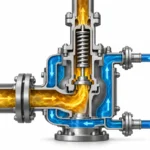
弹簧式安全阀可能带有一个 提升杠杆 或 扳手 用于手动作用于阀杆或阀瓣机构。阀门仍为弹簧式,因为弹簧提供正常的机械关闭载荷。 Emerson 的 Crosby EM 文件, 例如,将产品标识为弹簧式,同时单独提供提升杠杆配置。
A 杠杆与重锤 布置则不同。在那里,杠杆和重锤构成机械系统的一部分,与阀瓣下方的流体作用力相抗衡。外部杠杆不仅仅是手动试验或泄压附件;它参与产生正常的关闭载荷。
在本文中, 杠杆加载 作为描述性简称,用于表示这种杠杆-重锤或重锤-杠杆加载概念。不应将其理解为声称每个标准、制造商或司法管辖区都将“杠杆加载安全阀”作为同一正式术语使用。
因此,仅写有“杠杆安全阀”的旧记录尚不是完整的机构描述。
对于更换工作,需询问:杠杆是手动提升阀门,还是杠杆参与加载阀瓣?
示例工程场景: 维护照片显示一个较长的外部杠杆,而旧采购描述只写“杠杆式安全阀”。如果采购方假定杠杆提供关闭载荷,那么带手动提升杠杆的弹簧式安全阀可能被误归类为重锤杠杆式设计。预防措施是在指定替换件之前,核实原始型号、剖视图、铭牌文件或制造商数据。
在明确这一点之前,将两个名称视为可互换可能会把识别错误带入更换规格中。
杠杆实际在做什么:提升阀门还是加载阀瓣?
消除歧义最清晰的方法是将 两个规格维度.
| 规格问题 | 其识别内容 |
|---|---|
| 什么提供正常关闭载荷? | 加载机构——例如弹簧或杠杆重锤装置。 |
| 是否配备手动提升/泄压装置? | 一种独立的操作机构,可机械作用于阀杆/阀瓣组件以实现其预定功能。 |
因此,弹簧式安全阀可以无矛盾地描述为:
主关闭载荷机构: 弹簧
手动提升装置: 已安装提升杠杆
当前制造商文档确认这种组合存在。外部杠杆的存在并不会仅仅因为杠杆可见就将阀门转变为杠杆重锤式加载设计。Crosby 的 EM 安装手册甚至将提升杠杆硬件视为弹簧式安全阀上的独立阀帽/杠杆组件。 Crosby EM 系列弹簧式安全阀手册.
如果确认现有阀门采用弹簧加载方式,则 ZOBAI 弹簧式安全阀 页面是适合作为该产品系列归属页面,以便进一步进行商务评审。
在杠杆重锤式结构中,杠杆是正常加载装置的一部分。区别在于功能,而非外观。
应按阀门正常关闭载荷的来源进行分类,而不是仅凭是否可见杠杆来判断。
这里的要点是识别和更换,而不是操作或测试提升杠杆的说明。制造商程序、建造规范、业主-用户方案以及具体工况决定任何手动提升试验。在另一个事故调查背景下,美国国家锅炉与压力容器检验师协会(National Board)的指南警告调查人员不要用提升杠杆驱动泄压阀,因为这样做可能改变正在保存的证据。 美国国家锅炉与压力容器检验师协会调查-试验经验教训. 该警告针对调查场景;此处并未将其改写为对制造商授权杠杆试验的普遍禁令。
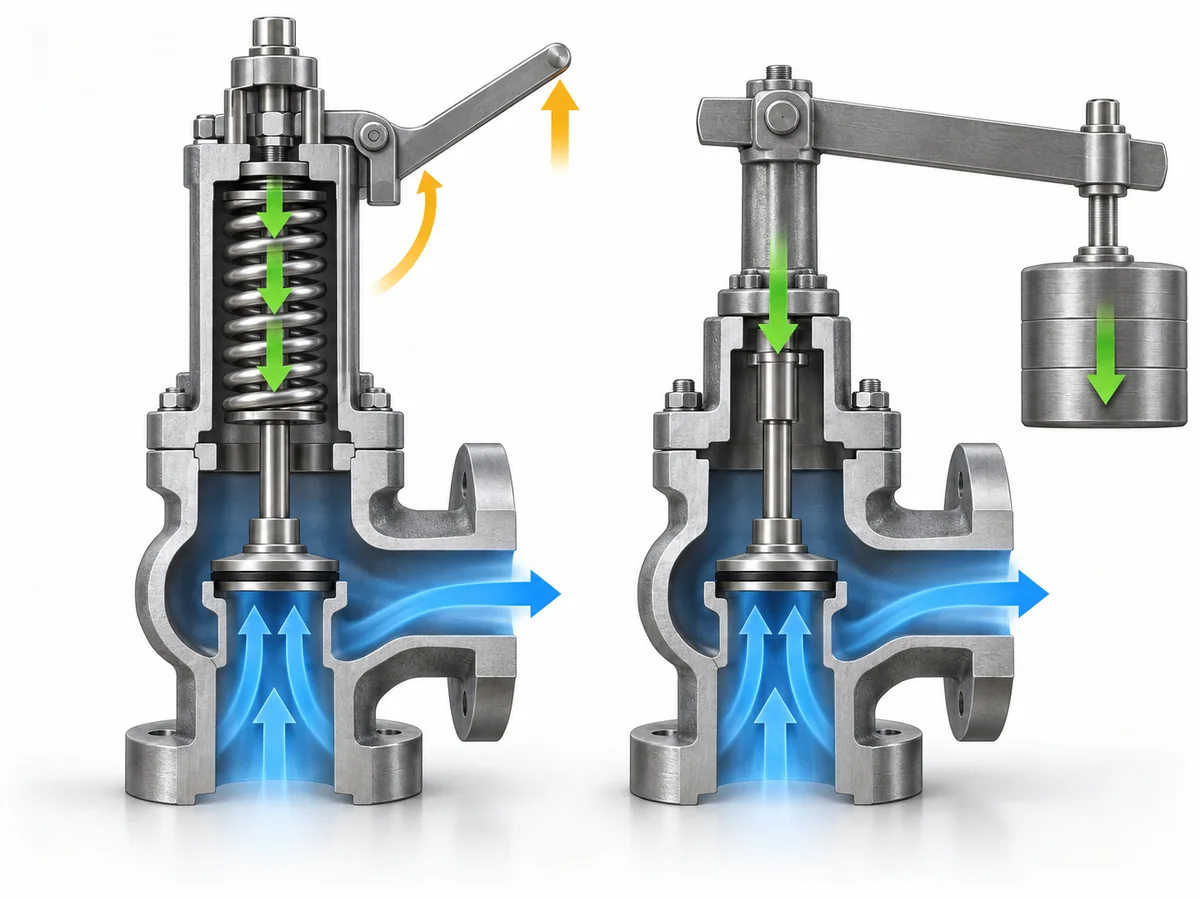
杠杆加载机构与带杠杆的弹簧式阀门有何区别
机械原理上的区别很直接: 关闭载荷由什么提供?
在弹簧式安全阀中,弹簧力提供直接的机械载荷,与试图抬起阀瓣的流体作用力相抗衡。提升杠杆(如配备)是一个独立的手动部件。
In a lever-and-weight arrangement, the lever and weight provide that mechanical loading. Changing the weight or lever geometry therefore changes the load system itself; that is categorically different from a manual lifting lever on a spring-loaded valve.
两者都可归入更广泛的概念,即 直接载荷式安全阀. The current ISO 4126-1:2013 remains the published Part 1 product standard for safety valves; industry technical guidance based on EN ISO 4126 describes direct loading by a spring, weight, or lever-and-weight arrangement. “Direct-loaded” therefore should not be read as if it means “spring-loaded only.”
| 对比项 | Spring-loaded valve with lifting lever | Lever-and-weight / weighted-lever design |
|---|---|---|
| Normal closing-load source | 弹簧 | Lever-and-weight arrangement |
| External lever can be present | 是 | 是 |
| Visible lever alone identifies loading method | 否 | 否 |
| Lever participates in normal closing load | Not merely because a lifting lever is fitted | Yes, where the lever-and-weight arrangement provides the load |
| Can belong to the broader direct-loaded category | 是 | 是 |
For replacement identification, this leads to a better question than “Do the valves look alike?”
What element supplies the closing load in the existing valve, and what element supplies it in the proposed replacement?
Nothing in this comparison means one architecture is universally superior, or that changing from one loading mechanism to another is automatically acceptable. Suitability depends on the code of construction, jurisdiction, service, relieving capacity, installation, materials, discharge conditions, and the documentation required for the protected equipment.
Why Legacy Names, Photos and Similar Appearance Can Misidentify a Replacement
Legacy replacement projects rarely begin with perfect documentation. Sometimes the original datasheet is missing and the available evidence is limited to a nameplate, photograph, old drawing, purchase description, or maintenance note.
Those clues are valuable, but they should not all be given the same weight.
A photograph: A photograph may show an external lever, bonnet style, connection arrangement, or other visible features. It does not by itself prove that the valve is lever-and-weight loaded, because documented spring-loaded valves can also carry lifting levers.
A legacy name: A phrase such as “lever safety valve” tells you how the valve was described. Unless the terminology or construction is otherwise documented, it does not conclusively identify what provides the normal closing load.
The same connection size: The same nominal inlet size does not guarantee the same relieving capacity. Spirax Sarco safety-valve selection guidance distinguishes connection size from actual capacity and other application variables.
The same set pressure: Set pressure is an important input, but it is not a complete replacement specification. Required discharge capacity and relevant application conditions still have to be established. A candidate that has the same set pressure but inadequate rated/certified relieving capacity does not become equivalent merely because the pressure value matches.
A hand lever that moves: Manual movement does not prove set pressure, capacity, seat condition, blowdown behavior, or system suitability. A lifting lever is not a substitute for controlled setting, inspection, repair, or capacity evidence.
For an uncertain legacy valve, a practical evidence order is:
- Original manufacturer and model information, if available.
- Original datasheet or sectional drawing.
- Legible nameplate and documented configuration.
- Rated/capacity or project records needed to establish the protected duty.
- Photographs and installation appearance as supporting evidence.
- Legacy shorthand descriptions as clues rather than final mechanism proof.
This is a practical verification hierarchy for the replacement task, not a formal regulatory hierarchy.
If the available evidence still cannot establish the loading mechanism or protected duty, keep the uncertainty visible. Replacing an unknown with a guessed specification does not remove the risk; it moves the uncertainty into procurement.
示例工程场景: An old valve and a proposed replacement share the same inlet size and set pressure, so they appear interchangeable on a short purchase description. The proposed valve’s relieving-capacity basis, outlet size, materials, or discharge/backpressure limits may still differ. The prevention step is to compare the required relieving duty and candidate documentation rather than treating flange size plus set pressure as an equivalence test.
What Must Be Verified Before Replacing a Lever-Loaded or Uncertain Legacy Valve?
Once the existing valve has been identified as far as reasonably possible, replacement becomes a duty-and-evidence comparison, not a terminology comparison.
Matching the name is not enough. Matching the inlet size is not enough. Matching set pressure alone is not enough. The proposed valve has to protect the same equipment against the defined relief case with adequate documented capacity and an acceptable system interface.
ASME’s current BPVC Section XIII is the dedicated overpressure-protection section for pressure-relief devices and addresses design, material, testing, marking, capacity/flow-resistance certification, installation, and related overpressure-protection rules. That is why replacement evidence extends well beyond a visual mechanism match.
API’s current standards plan lists API RP 576, Inspection of Pressure-Relieving Devices, 5th Edition as the current inspection/repair practice. API describes it as covering self-actuated pressure-relieving devices including direct-acting spring-loaded valves and other PRD types. It is useful inspection/repair context, but it should not be used as a shortcut to infer that any visible lever defines the loading mechanism.
Establish the Existing Valve and Protected Duty
Confirm, where applicable:
- existing manufacturer and model;
- available nameplate, datasheet, and drawing information;
- actual closing-load mechanism;
- whether a manual lifting/easing device is fitted and what type it is;
- 被保护设备;;
- service medium and relevant phase/state;
- 整定压力基准;;
- required relieving duty or capacity.
The distinction between connection size and capacity deserves particular attention. Two valves may physically fit the same nominal connection while providing different relieving capacity. For qualifying ASME/National Board capacity-certified devices, the National Board’s NB-18 Pressure Relief Device Certification database is a stronger evidence source than a legacy nickname.
If required relieving capacity has not yet been established, use the dedicated 安全阀选型与认证泄放能力指南 rather than treating this terminology article as a sizing method.
Check the Installed-System Interface
Compare the candidate with the actual system, including as applicable:
- 进口和出口连接;;
- discharge or disposal arrangement;
- relevant backpressure conditions;
- material compatibility for pressure-containing, trim, spring/guide and sealing parts as applicable to the design;
- seat/seal requirements;
- other operating characteristics that affect the chosen valve.
Backpressure deserves separate attention when the replacement discharges into a closed header or other pressure-containing disposal system. Different valve constructions can respond differently to outlet pressure, so a discharge-system change should not be hidden inside a like-for-like purchase description.
示例工程场景: The existing valve originally discharged to an open system, but the replacement is to be routed into a common header. Even if set pressure, inlet size and required capacity appear unchanged, the outlet-pressure environment is different. The prevention step is to include the revised disposal-system conditions in the replacement review and confirm that the proposed construction is suitable for them.
The exact checklist depends on the protected system. These are engineering-screening variables, not a claim that every installation requires the same data in the same way.
Confirm the Applicable Project and Jurisdiction Basis
A valve that appears mechanically similar may still be unacceptable under the rules governing a particular installation.
For example, current Virginia rules for power and high-pressure, high-temperature water boilers prohibit weighted-lever safety valves within that defined scope and call for replacement by direct spring-loaded pop-type valves conforming to the current ASME Section I basis.
The example is intentionally narrow. It does 不 establish that weighted-lever safety valves are prohibited in every jurisdiction or application.
Likewise, ISO 4126-1 is a product standard; it should not by itself be treated as the application-acceptance rule for a specific installed system.
If the task is repair rather than replacement of an applicable ASME/National Board capacity-certified pressure-relief valve, the National Board’s VR 授权证书 program is the relevant repair framework. Its scope is specific to qualifying pressure-relief-valve repair and should not be generalized to every valve, jurisdiction, or maintenance activity.
Compare the Proposed Candidate
The candidate needs enough documentation to show what is actually being offered and how it compares with the defined duty. Depending on the project, this may include:
- loading mechanism and manual lifting arrangement;
- configuration and connections;
- set pressure and capacity basis;
- applicable materials and seat/seal construction;
- backpressure or discharge-system limitations;
- required approvals, capacity certification, or supporting documentation.
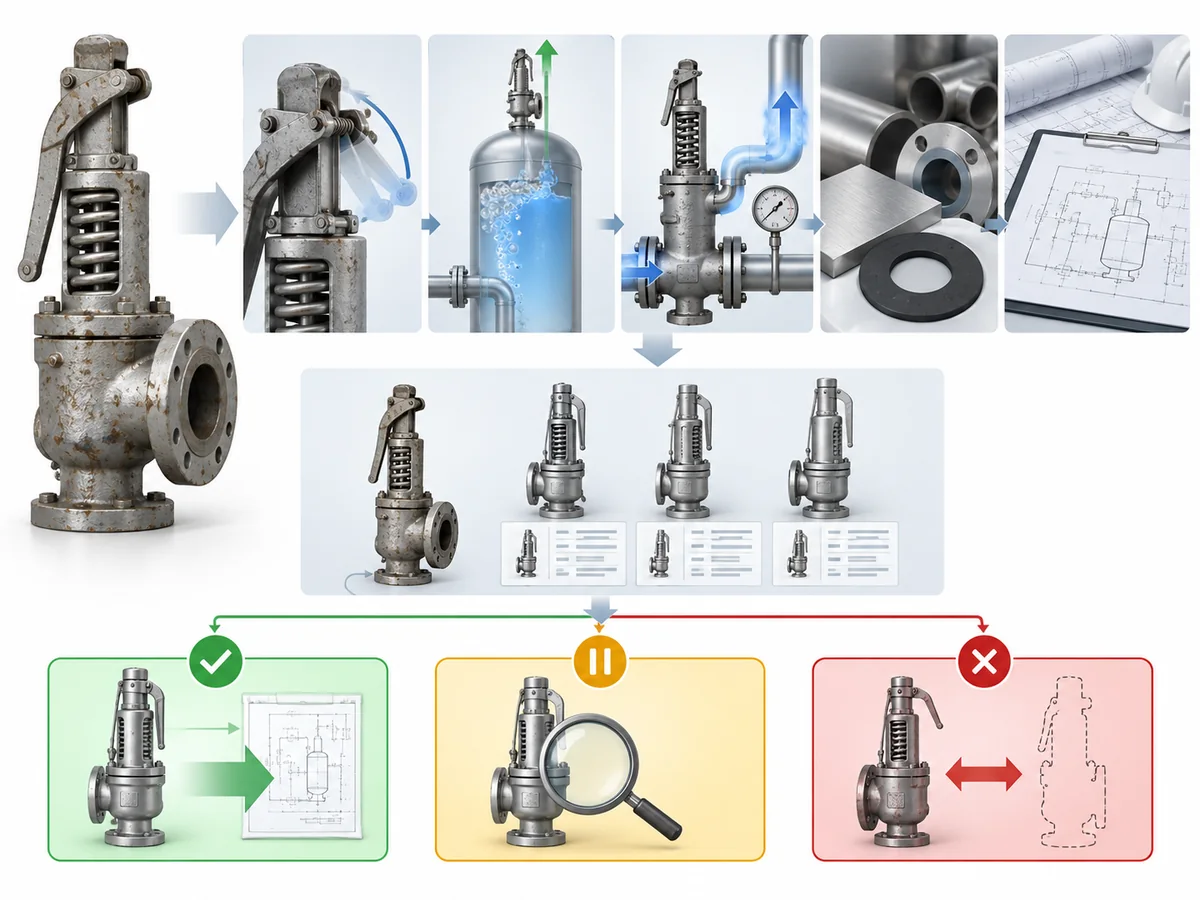
| 筛选状态 | 含义 |
|---|---|
| PROCEED TO ENGINEERING REVIEW | Enough evidence exists to compare the candidate against the defined duty. This is not final approval. |
| 暂缓 | An important variable remains unresolved, such as the loading mechanism, required capacity, applicable project basis, or a relevant system interface. |
| REJECT KNOWN MISMATCH | Available evidence already shows that the candidate conflicts with a known requirement. |
PROCEED / HOLD / REJECT are engineering-screening labels used by this article. They are not classifications from a standard or regulation.
How to Specify the Replacement RFQ Without Repeating the Terminology Error
The final procurement step is to make the ambiguity impossible to miss.
Instead of sending a supplier only:
“Need replacement lever safety valve.”
separate what is known about the loading mechanism from what is known about the lifting arrangement. If a lever-and-weight design is confirmed, say so explicitly. If only a manual lifting lever is confirmed, record that as an accessory/function rather than silently turning it into the loading mechanism.
A replacement RFQ can capture:
- existing manufacturer;
- existing model;
- available nameplate / drawing / datasheet;
- 被保护设备;;
- service medium;
- relevant service phase/state;
- 整定压力基准;;
- required relieving duty or capacity;
- inlet connection;
- outlet connection;
- primary closing-load mechanism;
- manual lifting/easing arrangement;
- discharge/backpressure information where applicable;
- material / seat / seal requirements where relevant;
- applicable project specification, jurisdiction, or code basis;
- required certification or documentation;
- items the supplier must confirm for the proposed candidate.
If the original loading mechanism is not known, write “未知”. Attach the evidence that is available rather than translating an ambiguous legacy term into a guessed mechanism.
For current lifting-lever product configurations, see ZOBAI Lever Safety Valves. That page owns the commercial product intent; this article remains focused on terminology, mechanism identification, and replacement risk.
The supplier response should make equally clear what construction is being proposed, what capacity evidence applies, and which project information the recommendation depends on. If the supplier’s terminology differs from the legacy wording, ask for a sectional drawing or construction description rather than forcing the old name onto the new design.
Need to replace an unidentified or legacy safety valve?
Send the available nameplate, model information, drawings or photos together with the protected service, set-pressure basis, and required relieving duty. The proposed replacement should be reviewed against the actual mechanism, duty, interfaces, and project requirements before it is treated as equivalent.
Frequently Asked Questions About Lever Safety Valves
Does a lifting lever mean the safety valve is lever-loaded?
No. A spring-loaded safety valve can be fitted with a lifting or easing lever while the spring remains the normal closing-load mechanism. The loading mechanism and the manual lifting arrangement should be identified separately.
What is a lever-loaded safety valve in this article?
This article uses “lever-loaded” as descriptive shorthand for a lever-and-weight or weighted-lever design in which the lever-and-weight arrangement participates in providing the normal closing load. The phrase is not assumed to be the formal term used by every code, manufacturer, or jurisdiction.
Can I identify the loading mechanism from a photograph?
Not reliably. A photograph can show an external lever, bonnet, connections and other visible details, but documented spring-loaded valves can also have lifting levers. Use manufacturer/model data, sectional drawings, nameplate information and controlled records where available.
Is matching set pressure and connection size enough for a replacement?
No. Set pressure and connection size are important, but the replacement also needs adequate relieving capacity and compatibility with the protected service, inlet/outlet arrangement, backpressure conditions, materials, required approvals and other project-specific requirements.
When does backpressure matter in a safety-valve replacement?
Backpressure matters when the discharge system can impose pressure at the valve outlet, such as a closed or common header. A change in the disposal system can change the replacement review even if the inlet connection and set pressure remain the same.
Can a weighted-lever safety valve always be replaced with a spring-loaded valve?
Do not assume so. Some defined jurisdictions and boiler scopes require spring-loaded replacement, but that does not create a universal rule for every application. The governing code of construction, jurisdiction, protected duty and documentation requirements must be checked for the actual installation.
What should an RFQ say if the old valve is simply called a “lever safety valve”?
State the legacy wording, but also record the loading mechanism as confirmed, unknown, or under review; identify whether a manual lifting/easing device is fitted; attach the available nameplate, photos, drawings and model information; and provide the protected service, set-pressure basis and required relieving duty.
何时需要 NB VR 维修?
The National Board VR program applies to repair of qualifying ASME/National Board capacity-certified pressure-relief valves within the program’s scope. It should not be generalized to every valve or maintenance activity, and replacement requirements may follow a different project or jurisdictional path.