通过定位堵塞部位、检查伴热效果、区分沉积机理并在检修前收集证据,诊断夹套式安全阀堵塞问题。.

Jacketed safety valve plugging can still occur even when the body has a heating jacket.
A jacketed safety valve can still plug because a heating jacket addresses only part of the plugging problem. It can reduce temperature-related solidification or viscosity risk in the region it effectively heats, but it does not prove that every process-wetted surface, moving component, outlet region, or adjacent pipe remains free of restriction. Process deposits, foreign material, inadequate local heat delivery, or restriction outside the effectively heated zone can produce similar symptoms.
That makes “the valve is plugged” a symptom, not a diagnosis. Before increasing heat, cleaning the valve, changing the installation, or replacing the device, first establish where the restriction exists and what mechanism could reasonably have created it there. The useful troubleshooting sequence is location → plausible mechanism → discriminating evidence → controlled next action.
Jacketed Safety Valve Plugging: Locate the Restriction
The first troubleshooting question is not “What causes plugging?” It is “Where is the restriction?”
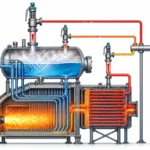
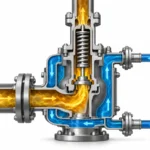
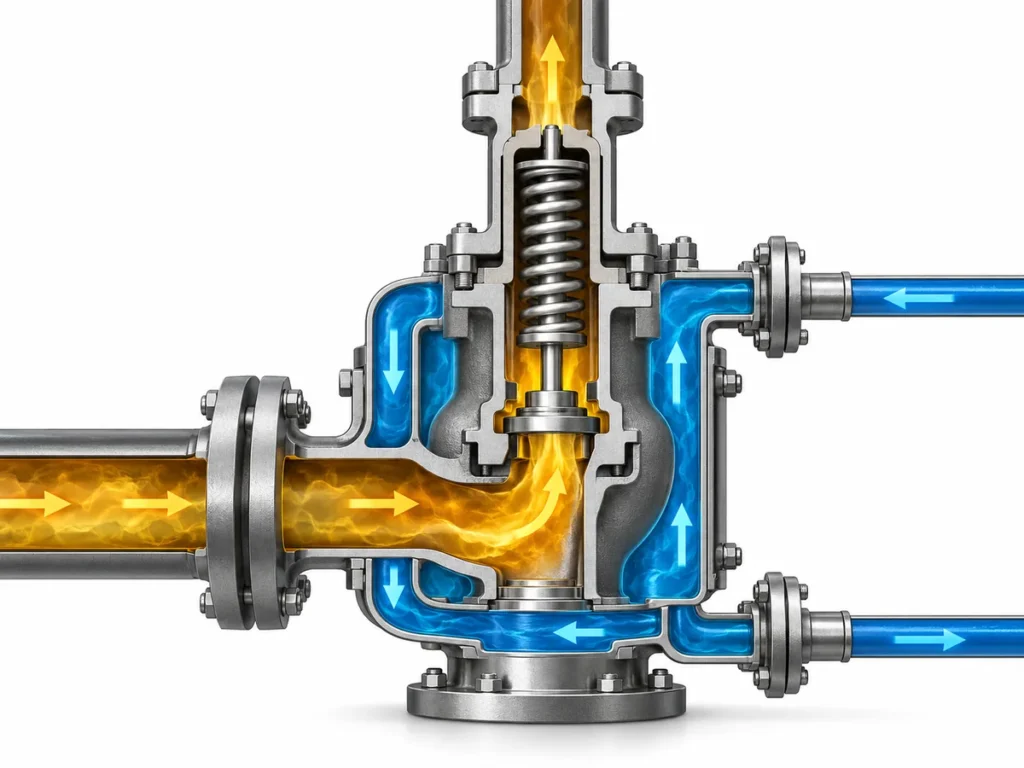
A jacketed safety valve contains two very different functional domains: the process side that must remain available for pressure relief, and the jacket or heating circuit used to influence temperature. A problem in the heating circuit can allow the process medium to cool, but the heating circuit itself is not the relief flow path. Keeping those two domains separate avoids a common diagnostic mistake.
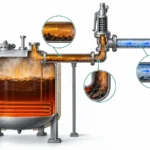
On the process side, restriction may appear around the nozzle or seating region. Manufacturer documentation for jacketed and severe-service relief valves recognizes the possibility of material hardening, solidifying, crystallizing, or depositing in these areas. Depending on valve design, contamination or deposits may also interfere with guided or other moving components and affect expected movement or reseating.
The exact internal geometry is model-specific, so a troubleshooting article should not assume that every jacketed valve heats or exposes the same components. For an installed valve, the drawing, datasheet, or manufacturer documentation is the correct source for determining which regions are actually jacketed and which moving parts may be exposed to the process medium.
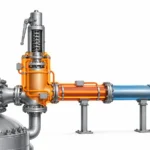
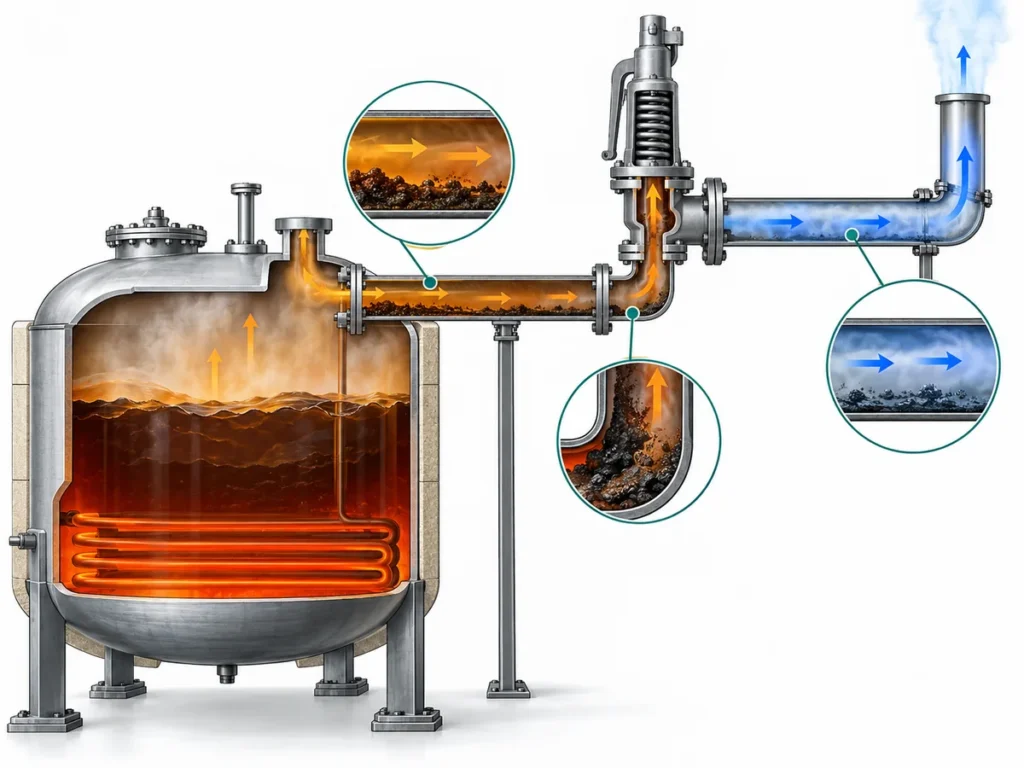
Restriction can also exist outside the valve body. The outlet connection or adjacent piping may operate under a different thermal condition from the jacketed region. If material remains fluid through the heated part of the valve but cools farther downstream, the observed problem may be an installation-level thermal issue rather than evidence that the body jacket itself is defective.
This location-first approach changes the next question. A deposit at the nozzle, material interfering with a guided component, and solidified material farther into the discharge arrangement may all be described casually as “plugging,” but they do not establish the same mechanism or justify the same corrective action.
Thermal Plugging Starts Where Effective Heating Breaks Down
A jacket is a thermal-management feature. Its presence does not, by itself, establish that adequate heat reaches every location that matters.
This distinction is particularly important with media whose flowability changes strongly with temperature. If the process material can harden, crystallize, congeal, or become much more viscous as it cools, the troubleshooting question is not simply whether the valve has a jacket. It is whether the relevant process region stayed within the thermal condition required by that service.
Several variables can change that answer.
The first is coverage. Manufacturer designs differ. Some jacket arrangements concentrate heating around the valve body or outlet region; some designs offer additional heated areas for demanding service. Process-pipe tracing or jacketing therefore cannot automatically be treated as evidence that the valve seat region, internal components, or discharge path is receiving equivalent thermal protection.
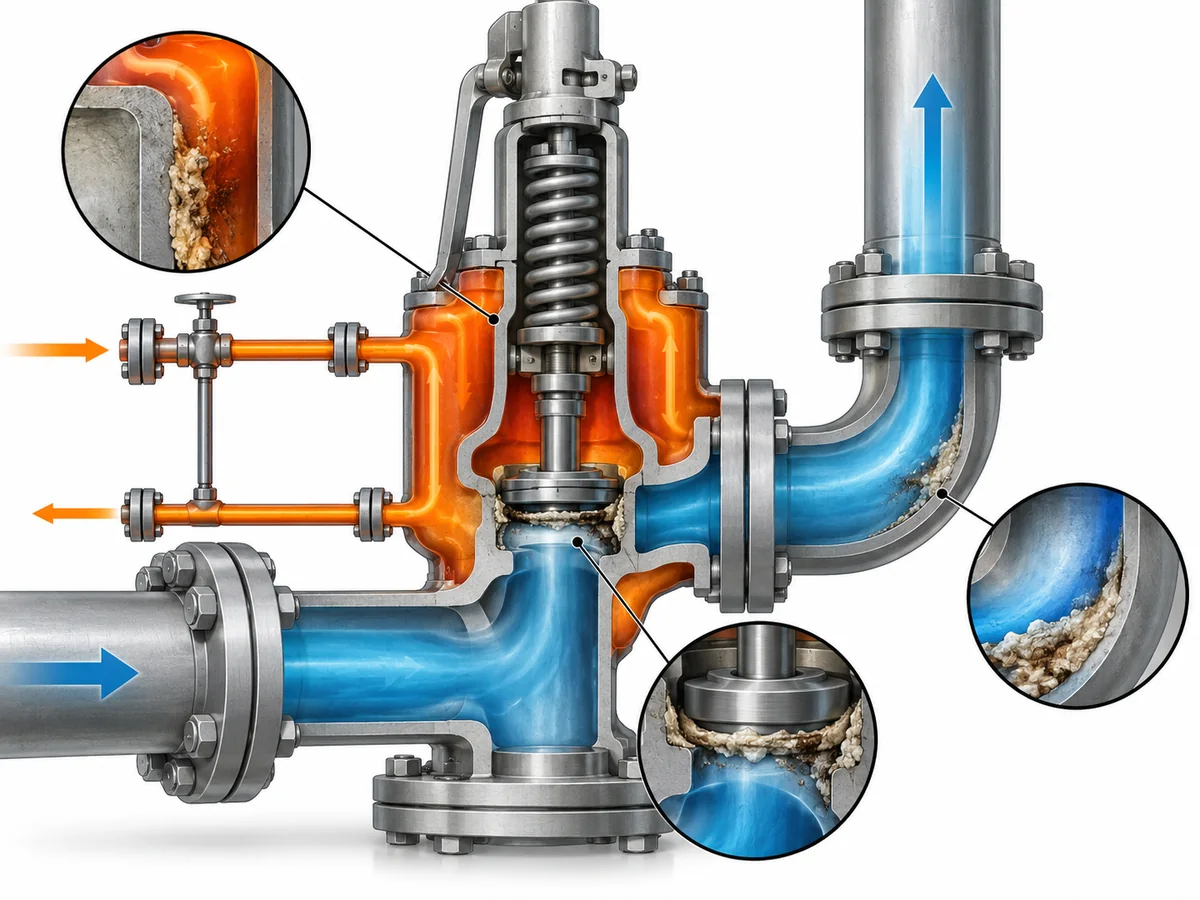
The second variable is actual heat delivery. For a steam-heated installation, heat transfer depends on the condition and operation of the heating system, not merely on the presence of steam connections. General steam-heating practice shows that steam and condensate behavior, drainage, operating condition, and the arrangement of the heating circuit affect heat transfer. The exact significance of these factors must be evaluated against the installed valve and heating system rather than converted into a universal pressure, temperature, or flow rule.
The third variable is time. A process that remains fluid during steady production may behave differently during a prolonged standby or shutdown. A valve may be adequately heated in normal operation yet experience a different temperature history when process flow stops, the heating medium is interrupted, or surrounding equipment cools. A repeated plugging event after a particular shutdown pattern is therefore useful evidence, but it is still a clue rather than proof of one mechanism.
The fourth variable is the thermal boundary around the valve. The jacketed body, inlet pipe, outlet pipe, insulation, and any heat-tracing system should not be mentally collapsed into one heated object. They may have different thermal behavior. If troubleshooting confirms that the valve body remains adequately heated while a nearby process or discharge region cools, the next engineering task belongs to the broader piping and thermal-management arrangement.
A representative example illustrates the distinction. Imagine a valve body that remains heated while an adjacent region of the discharge path cools during standby. Material may remain mobile inside the heated region yet become more viscous or solidify farther downstream. The visible symptom is still “plugging near a jacketed safety valve,” but adding more heat to the valve body would not automatically address the actual restriction location. This is an illustrative engineering scenario, not a recorded project case.
The practical lesson is simple: jacket present 和 effective thermal protection at the restriction location are not equivalent statements.
Plugging Mechanisms Can Overlap
Temperature is important in jacketed service, but not every deposit is evidence of insufficient heating.
For temperature-sensitive media, several supported mechanisms deserve consideration. Material may harden or solidify as it cools. Crystallizing media may form solids in local regions where temperature or concentration conditions permit crystallization. Highly viscous material may become increasingly difficult to move as temperature falls. These mechanisms are directly relevant to why heating jackets are offered for certain relief-valve applications.
Particulate contamination and foreign material form a different branch of the diagnosis. Manufacturer troubleshooting literature documents cases where foreign material or deposits interfere with seating or guided components. A hotter jacket will not necessarily remove a contamination problem whose controlling mechanism is solids carried by the process.
These mechanisms can also interact. Temperature may change viscosity and deposit behavior at the same time that suspended material is present. A deposit found after disassembly may therefore be the result of more than one operating condition. Its appearance alone should not be used to declare that heating failure was the root cause.
More chemistry-dependent mechanisms require tighter boundaries. Polymerization, coking, decomposition, or other reaction-driven deposits can be relevant in some processes, but they should not be presented as generic causes of jacketed safety-valve plugging. Whether one of these mechanisms is credible depends on the actual medium, composition, contaminants, temperature history, residence time, and process conditions.
The same caution applies to exact solidification or crystallization temperatures. A generic article should not assign a transition temperature to an unspecified medium or assume that a familiar commercial material always behaves the same way. The real service composition and operating data control that judgment.
This is why “increase the jacket temperature” is not a universal troubleshooting answer. If the cause is foreign material, a process-derived deposit, a restriction outside the heated region, or a chemistry-dependent mechanism, more heat may fail to address the root problem and could introduce a different process concern.
The useful distinction is not simply thermal versus nonthermal. It is: What material is present, where did it accumulate, what operating history preceded the restriction, and which mechanism is actually consistent with that evidence?
Diagnose the Cause From Evidence, Not From the Word “Plugging”
A useful troubleshooting process should reduce uncertainty rather than convert a symptom into a confident diagnosis.
Start with the physical evidence. If the restriction location is unknown, do not skip directly to the cause. If the valve has been removed and inspected under the applicable maintenance procedure, record where deposits or foreign material were found. If the issue appears to be in adjacent piping rather than the valve itself, preserve that distinction.
Then compare that evidence with the process and temperature history. What medium was in service? What was its phase and known composition? Does its flowability depend strongly on temperature? Were there shutdowns, prolonged standby periods, abnormal temperature excursions, or changes in the heating system before the problem appeared?
For a jacketed installation, also verify what the heating system was actually doing. Useful information includes the heating medium, available pressure and temperature data, the jacket connections and coverage, and how surrounding piping or equipment was being kept hot. The purpose is not to prove a failure from one reading. It is to determine whether the proposed thermal mechanism is consistent with the real installation.
Operating and maintenance history adds another layer. A restriction discovered after a relief event may raise different questions from one that develops repeatedly during long standby periods. A valve that has experienced repeated contamination may require a different investigation from one in a clean service that solidifies predictably when cold.
The following matrix can help organize the evidence without turning observations into automatic diagnoses:
| 观察现象 | Plausible interpretation | What to check next | 该项不能证明的内容 |
|---|---|---|---|
| Hardened or crystalline material around the nozzle or seating region | Cooling, solidification, crystallization, or another deposit mechanism may be involved | Medium/composition, temperature history, actual jacket coverage and heat condition | That the jacket itself failed |
| Valve body is heated but restriction appears farther downstream | Adjacent piping may have a different thermal condition | Outlet arrangement, insulation/tracing scope, operating and standby temperatures | That more body-jacket heating will solve the problem |
| Foreign or particulate material is found around guided or moving parts | Contamination or process solids may be interfering with movement | Source of solids, deposit observations, inspection and service history | That temperature is the controlling cause |
| Problems recur after shutdown or long standby | Thermal history may be contributing | Heating continuity, cooling duration, medium behavior during shutdown | That shutdown temperature alone is the root cause |
| Jacket is installed but its operating condition is not documented | Adequacy of heat delivery is unknown | Heating-medium data, jacket condition and installation records | That the jacket is ineffective |
| Deposits are present but composition is unknown | Several thermal or process mechanisms remain possible | Deposit characterization and actual process composition where appropriate | Polymerization, coking, crystallization, or any other specific mechanism |
The goal is not to rank these causes by probability. There is no defensible universal ranking for an unspecified process, valve design, and heating arrangement. Instead, each observation should eliminate some explanations, strengthen others, and identify the information still missing.
That distinction matters because plugging can affect more than cleanliness. Manufacturer literature documents cases where solidified or foreign material can interfere with expected opening, full movement, closing, or reseating. That is enough to make a suspected restriction an engineering concern.
而是 不 enough to calculate a generic loss of relieving capacity. Connection size is not capacity, and the visible amount of deposit is not a certified flow calculation. Quantifying the effect of a restriction requires the actual geometry, fluid and relieving conditions, valve data, and the applicable capacity basis. A statement such as “20% blockage means 20% less capacity” would not be justified.
For the same reason, an external appearance or nominal connection match is not a sufficient basis for replacement. If the troubleshooting process eventually leads to valve replacement, the replacement review must still address the applicable set pressure, required and documented relieving capacity, service conditions, configuration, materials, installation interfaces, back-pressure conditions where relevant, governing requirements, and documentation.
Confirm the Cause Before Cleaning, Repair, or Replacement
The purpose of troubleshooting is to define the next engineering action, not to prescribe an intervention before the mechanism is known.
Before a maintenance or engineering review, assemble a compact evidence package. The most useful inputs for this problem are usually:
- process medium, phase, and known composition;
- normal operating temperature and relevant shutdown or standby temperature history;
- any known temperature-sensitive behavior of the medium;
- heating medium and available jacket operating data;
- valve manufacturer, model, datasheet, or drawing when available;
- the regions that are actually jacketed;
- inlet and outlet arrangement, insulation, and heat-tracing scope;
- exact location of the observed restriction or deposit;
- inspection photographs or observations where available;
- valve lifting/discharge history;
- shutdown/startup history;
- maintenance and prior cleaning history;
- required relieving capacity or existing sizing basis if repair or replacement is being considered;
- applicable project specification or maintenance requirements.
This information helps separate an identification problem from an engineering-acceptance problem. A photograph may help identify where material accumulated, but it does not establish remaining relieving capacity. A matching connection size may identify a replacement candidate, but it does not establish interchangeability. A jacketed body may confirm that thermal management was intended, but it does not prove that the installed heating arrangement was effective under the event being investigated.
Corrective action should follow the confirmed cause as closely as the available evidence allows. If inadequate local heating is supported, the heating arrangement needs engineering review. If the restriction is outside the jacketed region, the broader piping and thermal-management system becomes the relevant boundary. If process solids or foreign material are involved, the source of those deposits must be investigated rather than automatically increasing heat. If the deposit mechanism cannot yet be identified, the correct next step is additional inspection or process review—not a more confident assumption.
申请工程审查
If the plugging mechanism is still uncertain, send the process medium and operating-temperature history, heating-medium conditions, valve identification or datasheet, inlet/outlet arrangement, jacket and tracing coverage, inspection findings, and maintenance history for review. If replacement is being considered, include the existing sizing/capacity basis and project requirements as well.
The objective is not to select a remedy from the word “plugging.” It is to identify the restriction, establish the most defensible mechanism, and then make the maintenance, thermal-management, or replacement decision from evidence.