Capacidade da Válvula de Segurança e Seleção do Orifício Capacidade da Válvula de Segurança vs. Tamanho da Conexão: O Que Realmente Determina a Vazão? O tamanho da conexão de uma válvula de segurança indica como a válvula se encaixa na tubulação. O orifício e a capacidade de alívio certificada indicam se a válvula selecionada pode descarregar a carga necessária. Esses valores estão relacionados, mas não são intercambiáveis. …

Capacidade da Válvula de Segurança e Seleção do Orifício
Capacidade da Válvula de Segurança vs Tamanho da Conexão: O Que Realmente Determina a Vazão?
O tamanho da conexão de uma válvula de segurança indica como a válvula se encaixa na tubulação. O orifício e a capacidade de alívio certificada indicam se a válvula selecionada pode descarregar a carga necessária. Esses valores estão relacionados, mas não são intercambiáveis.
Regra de decisão de engenharia: aprove primeiro a demanda de alívio, depois o orifício selecionado e a capacidade suportada, e por último a conexão de entrada/saída. Uma válvula que se encaixa no flange ainda pode ser subdimensionada para o cenário de sobrepressão governante.

A seleção final deve usar o meio real, a pressão de alívio, a temperatura de alívio, a sobrepressão admissível, a contrapressão, o modelo selecionado e a base de código aplicável.
Resposta Rápida
O tamanho da conexão não é a capacidade da válvula de segurança. Os tamanhos de entrada e saída descrevem a interface mecânica com o sistema de tubulação. O tamanho do orifício descreve a abertura interna de fluxo ou a área de fluxo designada. A capacidade de alívio certificada ou suportada pelo fabricante é o fluxo que a válvula selecionada pode descarregar sob condições definidas de meio, pressão, temperatura e condições de teste ou cálculo.
Duas válvulas podem ser ambas marcadas como 2 × 3 pol ou DN50 × DN80 e ainda ter diferentes designações de orifício, características de abertura e capacidades suportadas. A comparação correta é, portanto:
Carga de alívio requerida
O fluxo que o equipamento protegido deve descarregar durante o cenário de alívio governante.
Capacidade da válvula selecionada
O fluxo suportado do modelo exato da válvula e orifício sob as condições de alívio aplicáveis.
Tamanho da conexão
A interface de entrada e saída usada para ajuste, classificação de tubulação e revisão de instalação.
Para a metodologia completa de dimensionamento, use o Guia de dimensionamento e capacidade certificada de válvulas de segurança. da ZOBAI. Esta página foca apenas no erro comum de tratar o tamanho do flange como evidência de capacidade.
Tamanho da Conexão, Tamanho do Orifício e Capacidade de Alívio São Valores Diferentes
Registros de compra frequentemente descrevem uma válvula de segurança pelo tamanho de entrada, tamanho de saída e pressão de ajuste. Essa informação é útil para identificação, mas não define o caminho de fluxo interno nem prova que a válvula protegerá o equipamento. Os três valores a seguir devem ser revisados separadamente.
| Valor de Seleção | O que Descreve | O que Não Comprova | Evidência Típica |
|---|---|---|---|
| Tamanho da conexão de entrada e saída | Interface nominal de tubulação, tamanho de flange ou rosca, faceamento e classe de pressão | Área interna de fluxo, capacidade necessária ou capacidade de alívio suportada | Desenho de arranjo geral, especificação de tubulação, placa de identificação e tabela dimensional |
| Tamanho do orifício ou bocal | Abertura interna de fluxo, família de orifícios designada ou limite efetivo de fluxo | Capacidade para cada meio e condição sem o coeficiente aplicável e base de pressão | Ficha técnica do fabricante, designação API 526 quando aplicável, dados de projeto certificados |
| Capacidade de alívio certificada ou documentada | Fluxo suportado para uma configuração de válvula definida e condições de alívio declaradas | Que o cálculo de alívio da planta, tubulação de entrada ou sistema de descarga esteja correto | Tabela de capacidade certificada, cálculo do fabricante, listagem, ficha técnica ou registro de projeto aprovado |
Não estime a capacidade a partir do diâmetro externo da válvula ou apenas do DN/NPS. Se o modelo exato, orifício e base de capacidade não puderem ser verificados, marque a capacidade como não confirmada e retenha a aprovação técnica.
Por que duas válvulas com o mesmo tamanho de conexão podem ter capacidades diferentes
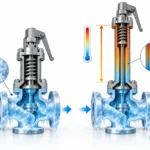
Os fabricantes podem usar o mesmo corpo ou o mesmo envelope de flange para mais de um orifício interno. A entrada e a saída visíveis podem, portanto, permanecer inalteradas enquanto o gargalo do bocal, a geometria do assento, o porta-disco, a guia e a elevação mudam. Diferentes séries de produtos também podem usar diferentes coeficientes, arranjos de blowdown e bases de certificação.
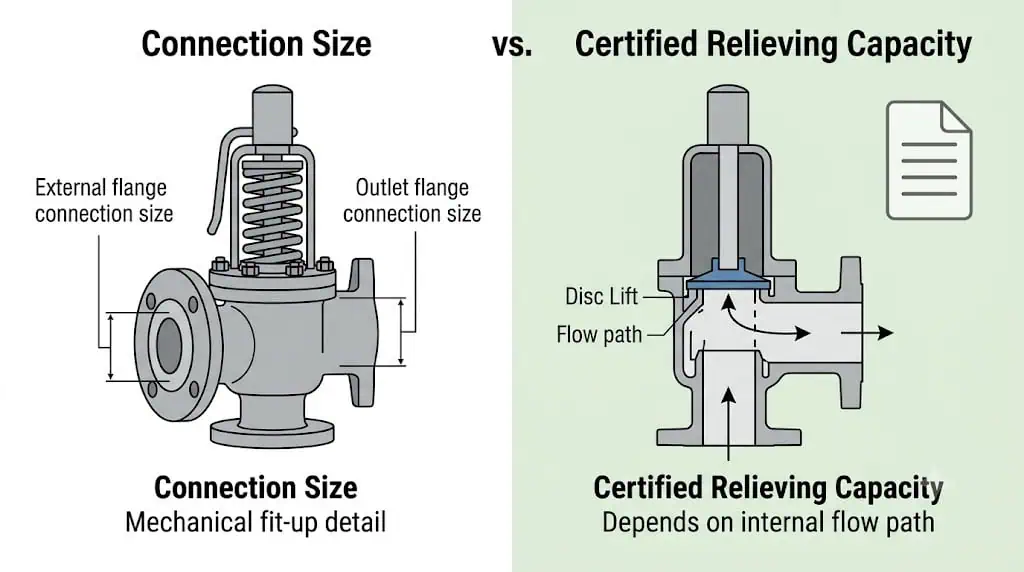
A ilustração explica o princípio de seleção; não é um desenho de fabricação certificado.
| Fator | Como isso muda a decisão de capacidade |
|---|---|
| Área do bocal ou do orifício efetivo | Uma área de fluxo suportada maior pode passar mais fluido quando as demais condições de dimensionamento são comparáveis. |
| Elevação da válvula e geometria do disco | A área de cortina disponível e o caminho de fluxo influenciam o desempenho de descarga do projeto selecionado. |
| Meio e fase | Vapor, gás, vapor e líquido exigem diferentes propriedades de fluido e tratamento de dimensionamento. Serviço bifásico pode exigir um método aprovado pelo projeto. |
| Pressão de ajuste e de alívio | A pressão disponível durante o alívio afeta o fluxo suportado e deve corresponder à base de cálculo. |
| Temperatura de alívio | A temperatura altera a densidade e outras propriedades do fluido e também pode limitar materiais ou componentes de assento macio. |
| Contrapressão | A contrapressão superimposta e a contrapressão acumulada podem afetar a capacidade e a estabilidade, particularmente para projetos convencionais com mola. |
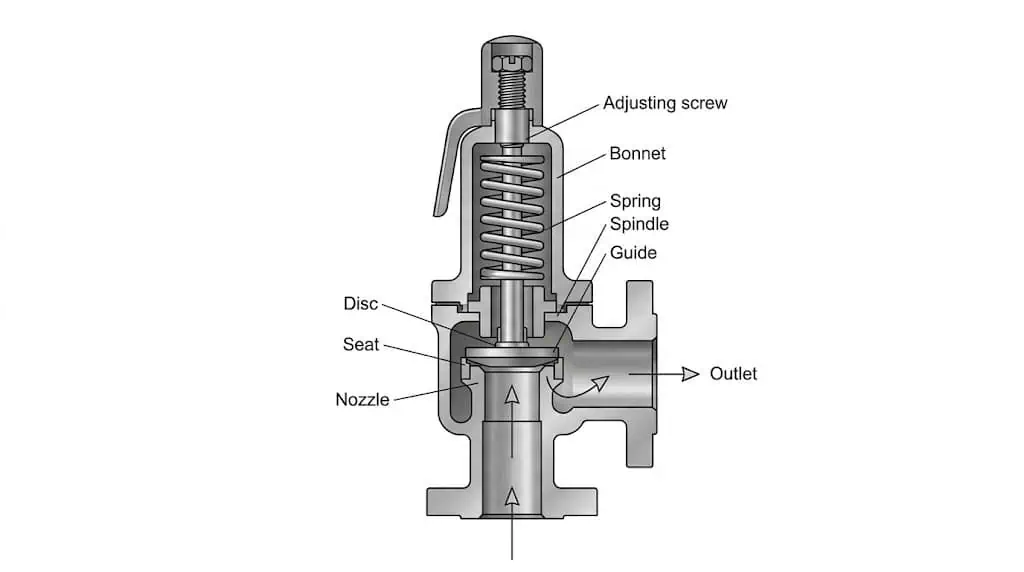
Exemplo de substituição: mesma conexão 2 × 3, orifício interno diferente
Um comprador solicita uma válvula de segurança com mola de 2 × 3 pol na pressão de ajuste existente. Duas cotações se encaixam nas mesmas flanges, mas os orifícios selecionados e as capacidades documentadas são diferentes. Aprovar a válvula de menor preço apenas pelo tamanho da conexão pode criar uma substituição subdimensionada.
Ação correta: identificar o equipamento protegido e o caso de alívio governante, confirmar a carga necessária e comparar essa carga com a capacidade exata do modelo/orifício. Aprovar a conexão de 2 × 3 somente após a verificação de capacidade ser aprovada.
Capacidade de Alívio Necessária vs Capacidade Certificada ou Suportada da Válvula
A seleção de válvulas de segurança é uma comparação entre demanda e capacidade. A capacidade de alívio necessária vem do sistema protegido e do seu cenário de sobrepressão governante. A capacidade suportada da válvula vem do projeto da válvula selecionada sob condições definidas. O tamanho da conexão pertence à revisão da tubulação e não pode substituir nenhum dos lados dessa comparação.
| Questão de Engenharia | Evidência Requerida | Limite de Aprovação |
|---|---|---|
| O que deve ser aliviado? | Equipamento protegido, cenário governante, meio/fase e carga necessária aprovada | Segurar se o cenário de alívio ou o fluxo necessário estiver ausente |
| Em quais condições? | Pressão de ajuste, sobrepressão permitida ou base de acumulação, pressão de alívio e temperatura de alívio | Segurar se os termos de pressão ou unidades estiverem misturados |
| A válvula selecionada pode suportar essa carga? | Modelo exato, orifício, fonte de capacidade, base do fluido e correções aplicáveis | Mantenha a retenção se a capacidade for copiada de outro modelo ou inferida pelo tamanho |
| Funcionará quando instalada? | Revisão da perda de pressão na entrada, contrapressão na saída, roteamento da descarga, drenagem e suporte | Segurar se as condições de instalação diferirem da base de capacidade |
| A válvula caberá na tubulação? | Tamanho da conexão, classe de pressão, face, dimensões e compatibilidade de materiais | A aprovação mecânica não libera um ponto de retenção de capacidade em aberto |
As comparações de capacidade devem usar a mesma base
Antes de comparar a capacidade necessária e a suportada, alinhe as unidades, a base do fluido, a pressão de alívio, a temperatura e as premissas de contrapressão. Não compare kg/h com Nm³/h sem uma conversão documentada. Não aplique um valor de capacidade de ar diretamente a vapor, líquido ou gás de processo. Não introduza uma margem arbitrária apenas para fazer a válvula selecionada parecer aceitável.
Para efeitos de contrapressão, consulte o guia de contrapressão e fole. Para limites de instalação, consulte o guia de instalação de válvulas de segurança.
O que a API 526 comprova—e o que não comprova
A API 526 é comumente usada para padronizar dimensões de válvulas de alívio de pressão flangeadas de aço e famílias de orifícios designados dentro do seu escopo. Essa padronização ajuda engenheiros e compradores a comparar dimensões de envelope, combinações de conexão e designações de orifícios. Isso não significa que toda válvula com o mesmo tamanho de entrada/saída tenha automaticamente a mesma capacidade certificada.
A API 526 pode apoiar
- comunicação padronizada de dimensões e conexões;
- discussões sobre designação de orifícios dentro do escopo da norma;
- coordenação de envelope de substituição e tubulação;
- comparação de RFQ mais consistente.
A API 526 não substitui
- o cálculo de alívio aplicável;
- os dados de capacidade do fabricante para a válvula exata selecionada;
- a verificação de meio, pressão e temperatura;
- a revisão de contrapressão e perda na entrada.;
- requisitos de código do projeto e certificação.
Use o Guia de válvulas de segurança flangeadas API 526 para contexto dimensional e de família de orifícios. Use o guia de dimensionamento mais amplo quando um fluxo de trabalho formal de capacidade for necessário.
Fluxo de trabalho correto para seleção de válvulas de segurança
- Identifique o equipamento protegido. Confirme a identificação da caldeira, vaso, trocador de calor, compressor, tubulação, tanque ou skid.
- Identifique o cenário de alívio governante. Exemplos incluem saída bloqueada, exposição ao fogo, falha do regulador, expansão térmica ou ruptura de tubo.
- Confirme a carga de alívio necessária. Registre o valor, as unidades e a base de cálculo.
- Defina as condições de alívio. Confirme o meio, a fase, a pressão de ajuste, a pressão de alívio, a temperatura e a base de sobrepressão permitida.
- Selecione o projeto da válvula e o orifício. Compare a capacidade suportada exata com a carga necessária aprovada.
- Revise os efeitos da instalação. Verifique a perda de pressão na entrada, a contrapressão na saída, o roteamento de descarga, o suporte e a drenagem.
- Confirme a conexão e a documentação. Verifique tamanho, classe, face, dimensões, materiais, testes, marcações e certificados.
Ponto de espera do pedido de compra: a comparação comercial pode começar antes de todos os itens técnicos serem encerrados, mas o modelo final e o orifício não devem ser congelados enquanto a carga necessária, a base de capacidade ou a condição de instalação permanecerem não verificadas.
Para a configuração da válvula de segurança com mola, revise válvulas de segurança com mola. Quando o sistema de saída cria contrapressão significativa ou variável, compare os projetos convencional, balanceado por fole e pilotado, em vez de assumir que um nome de construção resolve todas as condições.
Verificação de substituição: não substitua apenas pelo tamanho
A placa de identificação da válvula antiga e a medição do flange são entradas de identificação úteis, mas não provam que a válvula antiga foi dimensionada corretamente ou permanece adequada após mudanças no processo. O desgargalamento, o maior aporte de calor, as mudanças na válvula de controle e as modificações no cabeçote de descarga podem invalidar a capacidade original ou a base de instalação.
| Verificação de Substituição | Dados mínimos | Prosseguir ou segurar |
|---|---|---|
| Identificação da válvula instalada | Placa de identificação, modelo, número de série, fotos nítidas, tamanho e classe de entrada/saída | Prosseguir apenas para identificação |
| Equipamento protegido | Etiqueta do equipamento, MAWP/pressão de projeto, serviço e folha de dados existente | Segurar se o serviço protegido for desconhecido |
| Base de alívio | Cenário governante e capacidade necessária com unidades | Segurar se a capacidade estiver ausente ou desatualizada |
| Substituição selecionada | Modelo exato, orifício e capacidade suportada | Segurar se a oferta indicar apenas tamanho da conexão e pressão de ajuste |
| Instalação | Linha de entrada, redutores, coletor de saída, contrapressão, suportes e drenagem | Revisar antes da liberação final |
| Documentação | Folha de dados, desenho, evidência de capacidade, relatórios de teste, registros de materiais e marcação | Definir antes da liberação do pedido de compra |
Gatilho de Gerenciamento de Mudanças: recalcular e revalidar a válvula sempre que a capacidade do processo, a entrada de calor, o equipamento protegido, a base da pressão de ajuste, o cenário de alívio ou o sistema de descarga mudarem.
Checklist de RFQ para Revisão de Capacidade e Conexão
Um RFQ útil deve fornecer ao fornecedor informações suficientes para selecionar um orifício e verificar a capacidade. “DN50 × DN80, 10 bar” não é uma especificação completa de válvula de segurança.
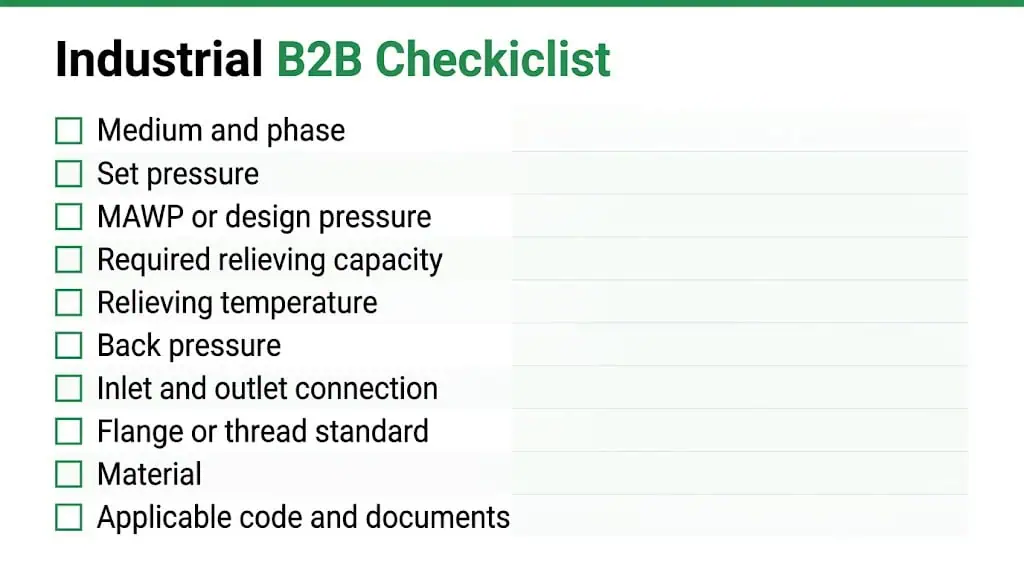
| Parâmetro de Cotação | O que fornecer | Por que Importa |
|---|---|---|
| Equipamento protegido e cenário | Tag do equipamento e caso de sobrepressão governante | Define o dever de proteção |
| Meio e fase | Base de vapor, gás, vapor, líquido ou bifásico aprovada; composição/propriedades quando necessário | Método de dimensionamento e revisão de material |
| Dados de Pressão | Pressão de operação, MAWP/pressão de projeto, pressão de ajuste e base de sobrepressão permitida | Define o limite de pressão e a pressão de alívio disponível |
| Capacidade de alívio requerida | Valor de vazão, unidades, revisão do cálculo e condições de alívio | Fornece a demanda que a válvula deve atender |
| Temperatura de alívio | Temperatura na condição de alívio governante | Afeta as propriedades do fluido e os limites dos componentes |
| Contrapressão | Valores sobrepostos e acumulados, incluindo faixa constante ou variável | Afeta a construção, a capacidade e a estabilidade |
| Conexões | Tamanho de entrada/saída, padrão, classe, faceamento e restrições dimensionais | Suporta a montagem e a revisão da tubulação |
| Materiais e documentos | Requisitos de corpo/guarnição/assento, norma aplicável, testes, certificados e escopo de inspeção | Suporta a aprovação técnica e de garantia da qualidade |
Valores desconhecidos devem ser marcados “a confirmar”. Eles não devem ser estimados silenciosamente a partir de uma fotografia antiga da válvula ou do diâmetro nominal do tubo.
Cinco Erros Comuns de Seleção
1. Tratar DN/NPS como capacidade de vazão
O tamanho nominal é uma designação de tubulação, não um valor de vazão certificado.
2. Usar a pressão de ajuste como resultado do dimensionamento
A pressão de ajuste define a regulagem de abertura; ela não define a carga de alívio governante.
3. Reutilizar a capacidade de outro meio
Os valores de capacidade para ar, vapor, gás e líquido não são intercambiáveis sem o método e as propriedades corretos.
4. Ignorar a contrapressão
A pressão no sistema de saída pode alterar a capacidade e a estabilidade da válvula, mesmo quando o flange e o orifício parecem aceitáveis.
5. Substituir pela aparência
A válvula antiga pode ter sido selecionada incorretamente ou pode não corresponder mais ao serviço atual do processo.
Regra de aprovação
Exija uma cadeia rastreável desde o cálculo de alívio até o modelo/orifício selecionado, evidência de capacidade, desenho, placa de identificação e documentação de teste.
Limite de Referência Técnica
API 520, API 526, ASME BPVC Seção XIII, informações de certificação do National Board e ISO 4126 podem apoiar diferentes partes de uma revisão de alívio de pressão. Nenhum deles torna o tamanho da conexão um substituto para a capacidade necessária ou suportada. Use a edição e a jurisdição adotadas pelo projeto.
Perguntas frequentes
O tamanho da conexão da válvula de segurança é o mesmo que a capacidade?
Nº O tamanho da conexão descreve a interface de tubulação de entrada e saída. A capacidade depende do orifício interno selecionado, do projeto da válvula, do meio, da pressão, da temperatura, da contrapressão e dos dados de desempenho suportados.
Duas válvulas de segurança de 2 × 3 podem ter capacidades diferentes?
Sim. Elas podem usar orifícios internos, características de abertura, coeficientes, conjuntos internos ou projetos certificados diferentes, mesmo que os tamanhos externos de entrada e saída sejam iguais.
O que é mais importante: o tamanho da conexão ou o tamanho do orifício?
Elas têm finalidades diferentes. O tamanho da conexão é essencial para o encaixe na tubulação e a instalação. O orifício e a capacidade suportada são fundamentais para comprovar que a válvula pode aliviar a carga necessária.
O tamanho do orifício da API 526 comprova automaticamente a capacidade?
Nº A API 526 padroniza a comunicação dimensional e de designação de orifício dentro do seu escopo. A capacidade exata da válvula selecionada ainda deve ser verificada para o meio e as condições de alívio aplicáveis.
A pressão de ajuste é suficiente para selecionar uma válvula de segurança?
Não. A pressão de ajuste não define a carga de alívio necessária. A seleção também precisa do cenário governante, da capacidade necessária, do meio, da temperatura de alívio, da sobrepressão admissível, da contrapressão e das condições de instalação.
Posso substituir uma válvula de segurança antiga usando apenas a placa de identificação e o tamanho do flange?
Nº. Use a placa de identificação para identificação, depois confirme o equipamento protegido, o cenário de alívio atual, a capacidade necessária, o orifício exato de substituição, a capacidade suportada e a condição da tubulação instalada.
A capacidade de ar pode ser usada para serviço com vapor, gás ou líquido?
Não diretamente. A capacidade deve ser revisada com base no meio real, fase, propriedades, pressão e temperatura. Meios diferentes exigem o cálculo adequado ou dados suportados.
O que um fornecedor deve fornecer para comprovar a capacidade?
O fornecedor deve identificar o modelo exato e o orifício e fornecer a fonte de capacidade aplicável certificada ou suportada pelo fabricante, unidades, base do meio, condições de pressão e temperatura e quaisquer fatores de correção aprovados.
Confirme o orifício e a capacidade antes de pedir
Envie à ZOBAI o equipamento protegido, cenário de alívio, vazão necessária, pressão de ajuste, meio, temperatura de alívio, contrapressão e requisitos de conexão. A revisão deve identificar o modelo de válvula selecionado, orifício e capacidade suportada—não apenas o tamanho do flange.